I've been a bit ill, so not much of a post today.
My wife raised two points (bold) about yesterday's post, my admittedly idealized and unrealistic prescription for work in the US:
1) It was assembly lines, which is one type of work that may disconnect the worker from the end-product of labor, which made much of today's production and wealth possible.
My response: OK. Why didn't Henry Ford at least show the workers a few cars every week or so? She said that perhaps he did. Perhaps so.
2) Speculation may really be productive work. A speculator may at least be making a living.
Obviously, it depends on what is meant by productive. I don't understand day-trading, futures, and the like. I have a suspicion that most or all of these amount to a form of gambling, and don't really increase the value of anything, but I stand to be corrected.
This is probably oversimple, but one of the problems with Enron was that they weren't really producing anything.
Musings on science, the Bible, and fantastic literature (and sometimes basketball and other stuff).
God speaks to us through the Bible and the findings of science, and we should listen to both types of revelation.
The title is from Psalm 84:11.
The Wikipedia is usually a pretty good reference. I mostly use the World English Bible (WEB), because it is public domain. I am grateful.
License
I have written an e-book, Does the Bible Really Say That?, which is free to anyone. To download that book, in several formats, go here.

The posts in this blog are licensed under a Creative Commons Attribution-NonCommercial-ShareAlike 3.0 Unported License. You can copy and use this material, as long as you aren't making money from it. If you give me credit, thanks. If not, OK.
The posts in this blog are licensed under a Creative Commons Attribution-NonCommercial-ShareAlike 3.0 Unported License. You can copy and use this material, as long as you aren't making money from it. If you give me credit, thanks. If not, OK.
Tuesday, May 31, 2005


Monday, May 30, 2005
Work and Retirement

Modified from Punch, May 16, 1917, as uploaded by Project Gutenberg
(for illustrative purposes only--I don't play golf--so far!)
Our Sunday School lesson for May 29th had this as part of the text:
11
12
13
There's also this: 1 Thessalonians 4:11 and that ye study to be quiet, and to do your own business, and to work with your hands, even as we charged you;
I told my University that I would not be available to work for the next academic year, except, possibly, on a part-time basis. My salary slot has been filled. My wife has already finished her work as a public school teacher. Her slot has, too. We are, in short, retiring.
What, if anything, does the Bible say about retirement? Does retirement violate this, and other, biblical commands to work?
I have found a few web pages on this matter. Here's one that gives some history of retirement as an idea in the U. S., and says that Social Security should be abolished, because it leads to violations of the 4th and 5th commandments. This page points out that Samuel gave a retirement speech, upon the selection of Saul to be king, and he promised to continue the work of prayer for Israel. (1 Samuel 12:23)
Here are a few thoughts:
>Humans are expected to work, and to contribute toward their own support. (There must be exceptions for young children and for infirmity.) This is not only fulfilled by working for pay, but by other work, which may not be paid, but is just as important, such as edifying others, housework, maintenance, and care for those unable to care for themselves.
>For many retired workers, retirement funds are a form of compensation for previous work. However, I don't believe that that entirely relieves retired persons from keeping busy, or from helping others.
>At least some work, of some types, is good for us. Physical effort, in moderation, is good for us.
>Work should be satisfying, at least occasionally. A worker should be able to look back on a good job well done. There is something wrong with a society where some types of work are so disconnected from the final worthwhile product that workers can't get satisfaction out of their work.
>Work should not interfere with being able to worship (not necessarily on Sunday morning).
>The end product of work should be for the good of others. Some lines of work (prostitution, drug dealing, working to cheat others) are morally wrong. There is something terribly wrong with a society where some people can't seem to support themselves without making their bodies into sex objects. There is also something terribly wrong with a society where cutting corners (for example by illegally influencing legislation, violating legitimate regulations, mistreating employees, or cheating customers) is rewarded highly. (I am not sure that some kinds of speculation are really useful work.)
Study and learning are usually useful work.
>There is something fundamentally wrong with a society where the pay of supervisors is two or more orders of magnitude above that of those who are actually producing the product, especially if supervisor pay is not linked to wise management.
>We place too much value on entertainment. Entertainment is legitimate, in moderation, but retirement spent mainly in seeking entertainment is fundamentally wrong, as is a working life aimed at such a retirement. There is something seriously wrong in a society which compensates entertainers so highly, and doesn't compensate many of those who care for relatives at all, and those in caring and protective professions so poorly.
>There is no legitimate retirement from serving God, although the way we serve Him may change with changing circumstances.
I may post some more about this matter in the future. Let me close with an admonishment to younger readers: save for your retirement! It's never too early! I guess that this indicates that I expect, and hope, to find justification for what I have done, namely retired.

This work is licensed under a Creative Commons License. Feel free to use it, but not to restrict others from using it.
Sunday, May 29, 2005
How Firm a Foundation
How Firm a Foundation
Words by John Rippon, 1787, hence public domain; tune most commonly used by Joseph Funk, 1832
How firm a foundation, ye saints of the Lord,
Is laid for your faith in His excellent Word!
What more can He say than to you He hath said,
You, who unto Jesus for refuge have fled?
In every condition, in sickness, in health;
In poverty’s vale, or abounding in wealth;
At home and abroad, on the land, on the sea,
As thy days may demand, shall thy strength ever be.
Fear not, I am with thee, O be not dismayed,
For I am thy God and will still give thee aid;
I’ll strengthen and help thee, and cause thee to stand
Upheld by My righteous, omnipotent hand.
When through the deep waters I call thee to go,
The rivers of woe shall not thee overflow;
For I will be with thee, thy troubles to bless,
And sanctify to thee thy deepest distress.
When through fiery trials thy pathways shall lie,
My grace, all sufficient, shall be thy supply;
The flame shall not hurt thee; I only design
Thy dross to consume, and thy gold to refine.
Even down to old age all My people shall prove
My sovereign, eternal, unchangeable love;
And when hoary hairs shall their temples adorn,
Like lambs they shall still in My bosom be borne.
The soul that on Jesus has leaned for repose,
I will not, I will not desert to its foes;
That soul, though all hell should endeavor to shake,
I’ll never, no never, no never forsake.
Saturday, May 28, 2005
She's done!
My wife's salaried life is over. She put in her last day of teaching yesterday.
We thank God that she was able to work this long. We also thank Him that the state retirement system exists, and He helped us to obtain full retirement compensation from them, even though she did not work when either of the girls were little.
There were some problems. All jobs have them. There were unreasonable regulations, co-workers (none part of her team) whose main goal seemed to be to avoid work, parents who didn't have a clue as to how to guide their children, and children who didn't cooperate. There were emotions because a child wasn't doing well, or had awful circumstances at home. There were discipline problems. There was an incident when a child hurt herself and tried to get my wife in trouble for it. She often wished that she and her team members had been closer.
On the other hand, there were good things, and good times. Many of them. There were kids who loved her, parents who appreciated her, kindnesses done by co-workers, kids who really learned, or who were really turned on, and other great experiences.
It's been, overall, a God-given career. On the whole, she liked it. Let's put it this way--she offered to come back and help her co-workers as a volunteer next year. Thanks, Lord, for allowing her to help others for these many years, and for all the other public school teachers who are your servants, and are coming back to work next year.
We thank God that she was able to work this long. We also thank Him that the state retirement system exists, and He helped us to obtain full retirement compensation from them, even though she did not work when either of the girls were little.
There were some problems. All jobs have them. There were unreasonable regulations, co-workers (none part of her team) whose main goal seemed to be to avoid work, parents who didn't have a clue as to how to guide their children, and children who didn't cooperate. There were emotions because a child wasn't doing well, or had awful circumstances at home. There were discipline problems. There was an incident when a child hurt herself and tried to get my wife in trouble for it. She often wished that she and her team members had been closer.
On the other hand, there were good things, and good times. Many of them. There were kids who loved her, parents who appreciated her, kindnesses done by co-workers, kids who really learned, or who were really turned on, and other great experiences.
It's been, overall, a God-given career. On the whole, she liked it. Let's put it this way--she offered to come back and help her co-workers as a volunteer next year. Thanks, Lord, for allowing her to help others for these many years, and for all the other public school teachers who are your servants, and are coming back to work next year.
Friday, May 27, 2005
Women in the Old Testament: 5 Sisters
Mahlah, Noah, Hoglah, Milcah, and Tirzah--they were the daughters of Zelophehad, and their story is told in Numbers 26:33, 27:1-7, 36:2-12, and Joshua 17:3-6. What was their story? They were the only children of their father. He had no sons. Since he had no sons, his family stood to lose any hope of possessions in his name in the Promised Land. The five sisters did something about this. They thrust themselves forward, appealing to Moses, and asked that they be given rights to land ownership, just as men were. It is possible that they presented their request to one or more underlings of Moses first. If so, the underling decided that this was a hard case, and passed the decision on up. Moses listened to their request, and passed it up, too. He asked God, and God said that they were right, and that they should be given an inheritance, so that Zelophehad's name would not be lost.
Numbers 36:6b is amazing: "Let them be married to whom they think best; only into the family of the tribe of their father shall they be married." (ASV) This gave these five women the privilege of selecting husbands for themselves. I don't believe there is another record of this in the Old Testament, unless it be Rebekah's choice whether or not to go with Abraham's servant, to marry Isaac. True, the privilege of choosing a spouse is tempered by a restriction, and a restriction not placed on men, but the privilege is still there.
God's people were willing to hear a request by women for treatment as full citizens, and God Himself made sure that the request was granted.
I have posted on Women in the Old Testament previously. Here's a post on Tamar. Here's the first in the series. I have also posted on Abishag, a particular woman. For a post on Athaliah, and links to posts on women in the OT, generally, see here.
Thanks for reading!
Numbers 36:6b is amazing: "Let them be married to whom they think best; only into the family of the tribe of their father shall they be married." (ASV) This gave these five women the privilege of selecting husbands for themselves. I don't believe there is another record of this in the Old Testament, unless it be Rebekah's choice whether or not to go with Abraham's servant, to marry Isaac. True, the privilege of choosing a spouse is tempered by a restriction, and a restriction not placed on men, but the privilege is still there.
God's people were willing to hear a request by women for treatment as full citizens, and God Himself made sure that the request was granted.
I have posted on Women in the Old Testament previously. Here's a post on Tamar. Here's the first in the series. I have also posted on Abishag, a particular woman. For a post on Athaliah, and links to posts on women in the OT, generally, see here.
Thanks for reading!
Thursday, May 26, 2005
Sunspots 10
Things I have recently spotted that may be of interest to someone else:
Eye of Science contains a gallery of amazing photos of small things, taken with high-tech equipment.
* * * * *
Here's a (fictional) humorous exchange of messages about an elephant and a circus.
* * * * *
From Project Gutenberg: Old Testament Legends Being Stories out of Some of the Less-Known Apocryphal Books of the Old Testament by M. R. James, including stories about the death of Adam and Eve, the courtship of Joseph and Aseneth [sic], and others, is here.
* * * * *
The Window in the Garden Wall, a daily C. S. Lewis quote blog, posted a quote on May 23rd about dull writing. I wonder what Lewis would have said about most blogs, including this one?
* * * * *
Bonnie, at Off the Top, has completed her postings on Lewis' The Abolition of Man. Many people point to this book as prophetic about much related to technology. If you've never read it, read her eight posts.
* * * * *
The Latest Christian Carnival is at this blog, and was posted on May 25th.
* * * * *
Cameron (full disclosure--he's our nephew) continues describing his family's fascinating adventures with Russian culture, and, in separate posts, continues describing what missions should be like. He's a good writer, and I can say that, as he's from my wife's side of the family.
Things I'm thankful for, 1
The obvious:
You, whoever you are, who is reading any part of this posting--even if it's only to here. Thanks!
God, in all three persons
The Bible
My wife, daughters, sons-in-law, grandson, and other family
My church
The good job I have had
Freedom of worship, assembly, speech, press
The right to petition for redress of grievances
The right to be protected from unreasonable search and seizure
Good neighbors, friends, and students
Now, some Internet entities I am thankful for:
Blogger, Bloglines, Google, MSN, and Earthlink (These all have the obvious URL--www.whatever.com, and, if you got this far, you probably know all this already.)
Flickr--same deal on the URL. My page is here.
Yahoo Yellow Pages (Here's the top-level page for Port Angeles, Washington state.)
The Wikipedia
Project Gutenberg (For instance, May 25th publications include The American Missionary, Volume 49, No. 3, March, 1895, apparently a publication of the Congregational Church, mostly about the work among Indians and African-Americans, and The Book of Mormon, in case anyone is looking for a digital edition.)
The ESV Bible's RSS feed
Arts & Letters Daily
ArtsJournal
Christianity Today Online
Some chemicals:
Oxygen
Water
Chlorophyll
DNA, and all the necessary forms of RNA
Amino Acids
ATP
Carbon, Nitrogen, Sulfur, Potassium, Phosphorus, Hydrogen, Magnesium, Calcium, Iron, Copper, Manganese, Zinc, Molybdenum and any other elements essential to my life
Digestive enzymes
Vitamins
Neurotransmitters
Hemoglobin
NADP and NADPH
People who do things:
Our honest auto mechanic
Grocery cashiers, waitresses, nurses, policemen and firemen
Teachers and librarians
The people who bring the news, and all the web entities listed above, to me
Will probably do this again
* * * *
Thanks, younger daughter (and who makes at least one reader) for telling me that I messed up a URL.
You, whoever you are, who is reading any part of this posting--even if it's only to here. Thanks!
God, in all three persons
The Bible
My wife, daughters, sons-in-law, grandson, and other family
My church
The good job I have had
Freedom of worship, assembly, speech, press
The right to petition for redress of grievances
The right to be protected from unreasonable search and seizure
Good neighbors, friends, and students
Now, some Internet entities I am thankful for:
Blogger, Bloglines, Google, MSN, and Earthlink (These all have the obvious URL--www.whatever.com, and, if you got this far, you probably know all this already.)
Flickr--same deal on the URL. My page is here.
Yahoo Yellow Pages (Here's the top-level page for Port Angeles, Washington state.)
The Wikipedia
Project Gutenberg (For instance, May 25th publications include The American Missionary, Volume 49, No. 3, March, 1895, apparently a publication of the Congregational Church, mostly about the work among Indians and African-Americans, and The Book of Mormon, in case anyone is looking for a digital edition.)
The ESV Bible's RSS feed
Arts & Letters Daily
ArtsJournal
Christianity Today Online
Some chemicals:
Oxygen
Water
Chlorophyll
DNA, and all the necessary forms of RNA
Amino Acids
ATP
Carbon, Nitrogen, Sulfur, Potassium, Phosphorus, Hydrogen, Magnesium, Calcium, Iron, Copper, Manganese, Zinc, Molybdenum and any other elements essential to my life
Digestive enzymes
Vitamins
Neurotransmitters
Hemoglobin
NADP and NADPH
People who do things:
Our honest auto mechanic
Grocery cashiers, waitresses, nurses, policemen and firemen
Teachers and librarians
The people who bring the news, and all the web entities listed above, to me
Will probably do this again
* * * *
Thanks, younger daughter (and who makes at least one reader) for telling me that I messed up a URL.
Tuesday, May 24, 2005
Vetch pod

This is a vetch pod, scanned. I posted about vetch a few days ago. Vetch is a member of the legume, or pea family. This vetch pod looks a lot like most types of bean or pea pods. It is about 2 inches, or about 5 centimeters, in length. If you look carefully, you can see the seeds pushing out the walls of the pod.
Monday, May 23, 2005
Frodo, Ged and Hazel: Flowers and Plants
As mentioned in previous posts, The Ring trilogy by Tolkien, the Earthsea books by Le Guin, and Watership Down by Richard Adams are my favorite works of fantastic literature. I pointed out that all three authors present amazing details in their sub-creations. In this post, I discuss some of what they do with flowering plants.
Tolkien wrote this, probably his most flower-strewn passage (but not the only one):
Adams can be flowery, too. Here's an example:
Tolkien wrote this, probably his most flower-strewn passage (but not the only one):
When his eyes were in turn uncovered, Frodo looked up and caught his breath. They were standing in an open space. To the left stood a great mound, covered with a sward of grass as green as Spring-time in the Elder days. Upon it, as a double crown, grew two circles of trees: the outer had bark of snowy white, and were leafless but beautiful in their shapely nakedness; the inner were mallorn-trees of great height, still arrayed in pale gold. . . . At the feet of the trees, and all about the green hillsides the grass was studded with small golden flowers shaped like stars. Among them, nodding on slender stalks, were other flowers, white and palest green: they glimmered as a mist amid the rich hue of the grass. Over all the sky was blue, and the sun of afternoon glowed upon the hill and cast long green shadows beneath the trees.
'Behold! You are come to Cerin Amroth,' said Haldir, 'For this is the heart of the ancient realm as it was long ago, and here is the mound of Amroth, where in happier days his high house was built. Here ever bloom the winter flowers in the unfading grass: the yellow elanor, and the pale niphredil. - J. R. R. Tolkien, The Fellowship of the Ring: Being the First Part of The Lord of the Rings. Boston: Houghton Mifflin Company, 1963, pp. 364-5. The remaining eight members of the Fellowship have come to the realm of Galadriel, after the fall of Gandalf in Moria, and are being escorted by Haldir, an elf in her service.
Adams can be flowery, too. Here's an example:
June was moving toward July and high summer. Hedgerows and verges were at their rankest and thickest. The rabbits sheltered in dim green sun-flecked caves of grass, flowering marjoram and cow parsley; peered round spotted hairy-stemmed clumps of viper's bugloss, blooming red and bllue above their heads; pushed between towering stalks of yellow mullein. Sometimes they scuttled along open turf, colored like a tapestry meadow with self-heal, centaury and tormentil. . . .
Some time before ni-Frith, in the heat of the day, Silver paused in a little patch of thorn. There was no breeze and the air was full of the sweet, chrysanthemum-like smell of the flowering composite of dry uplands--corn chamomile, yarrow and tansy. -Richard Adams, Watership Down. New York: Avon Books, 1972. p. 273.
Le Guin's prose is less flowery, in the usual sense of that word, but she does, indeed, pay attention to plants:
He came to the path that led to the Immanent Grove, a path that led always straight and direct no matter how time and the world bent awry about it, and following it came soon into the shadow of the trees.
The trunks of some of these were vast. Seeing them one could believe at last that the Grove never moved; they were like immemorial towers grey with years; their roots were like the roots of mountains. Yet these, the most ancient, were some of them thin of leaf, with branches that had died. They were not immortal. Among the giants grew sapling trees, tall and vigorous with bright crowns of foliage, and seedlings, slight leafy wands no taller than a girl.
The ground beneath the trees was soft, rich with the rotten leaves of all the years. Ferns and small woodland plants grew in it, but there was no kind of tree but the one, which had no name in the Hardic tongue of Earthsea. Under the branches the air smelled earthy and fresh, and had a taste in the mouth like live spring water.
In a glade which had been made years before by the falling of an enormous tree, Ged met the Master Patterner, who lived within the Grove and seldom or never came forth from it. Ursula K. Le Guin, The Farthest Shore, New York: Bantam Books, 1972, p. 10.
At the edge of the Grove, where the leaves of the great trees reached out over ordinary ground, he sat with his back against a mighty root, his staff across his knees. He shut his eyes as if resting, and sent a sending of his spirit over the hills and fields of Roke, northward, to the sea-assaulted cape where the Isolate Tower stands.
"Kurremkarmerruk," he said in spirit, and the Master Namer looked up from the thick book of names of roots and herbs and leaves and seeds and petals that he was reading to his pupils and said, "I am here, my lord."
Then he listened, a big thin old man, white-haired under his dark hood; and the students at their writing-tables in the tower room looked up at him and glanced at one another.
"I will come," Kurremkarmerruk said, and bent his head to his book again, saying, "Now the petal of the flower of moly hath a name, which is iebera, and so also the sepal, which is partonath; and the stem and leaf and root hath each his name . . ."
But under his tree the Archmage Ged, who knew all the names of moly, withdrew his sending and, stretching out his legs more comfortably and keeping his eyes shut, presently fell asleep in the leaf-spotted sunlight. Ursula K. Le Guin, The Farthest Shore, New York: Bantam Books, 1972, p. 12.
Tolkien and Le Guin not only mention flowering plants, but each makes a specific area, remarkable for its plants, to be in some sense the center of their fantastic sub-creation. The hill of Cerin Amroth is the heart of elvendom. It was there that Aragorn first saw Arwen. It will be there that Arwen lies down alone when Aragorn has passed away. The Immanent Grove is the center of Roke Island, which is, in turn, the center of meaning of Earthsea.
Previous posts in this series were on April 11th and 18th, 2005, and also on May 2nd.
Sunday, May 22, 2005
Star Wars: Christian or not?
A Christian doesn't have to see only movies, or read only books, that have a Christian world-view. Christians should be careful what they put in their minds. Being careful may mean that we don't intentionally watch, listen to, or read, some material with a Christian world-view which is of poor quality. We should also avoid material with a Christian world-view which is false. (Is that an oxymoron? Lying for Christ . . .) I may have done myself, or the series, a disservice, but I have not read any of the Left Behind books. I understand that the material is of poor quality, and pushes a particular view of eschatology as if it were certain. (I also understand that some people I love and admire have read and enjoyed the series, and I am not qualified to make a first-hand evaluation of them. I'm just trying to illustrate a point.) I try to watch what I watch on TV.
Here's what Paul said about this subject:
Finally, brethren, whatsoever things are true, whatsoever things are honorable, whatsoever things are just, whatsoever things are pure, whatsoever things are lovely, whatsoever things are of good report; if there be any virtue, and if there be any praise, think on these things. (Philippians 4:8, ASV)
He didn't say, but implied, that things which are dishonorable, unjust, impure, unlovely and bad report are to be avoided.
I have not yet seen Revenge of the Sith. We may or may not see it. I did see episodes 1 and 2, and wished that I had spent my time and money in other ways--they were not well done. Episodes 4, 5, and 6 of Star Wars were, in my opinion, worth seeing, and I may see them again.
Clearly, there are some differences of opinion about the world view of the series. (See here and here for articles on the concept of world view--both written from a Christian world view!)
Marla Swoffer has lived near George Lucas, the creator of Star Wars, and has thoughts on him and his company based on that experience. Steven J. Rosen, apparently a Hindu himself, finds themes from Hindu literature in the Star Wars movies. Christianity Today Online just published a four part series which finds Christian themes there. (This is the fourth) Peter Chattaway and Jeffrey Overstreet, Christian film critics, speculate that the current crop of such were inspired by George Lucas. Here's one of (probably many) posts claiming that Lucas just wanted to raise questions about spirituality. Who is right?
I'm guessing that there are also Buddhist and Taoist themes in Star Wars. If there are, it wouldn't have surprised C. S. Lewis:
Here's what Paul said about this subject:
Finally, brethren, whatsoever things are true, whatsoever things are honorable, whatsoever things are just, whatsoever things are pure, whatsoever things are lovely, whatsoever things are of good report; if there be any virtue, and if there be any praise, think on these things. (Philippians 4:8, ASV)
He didn't say, but implied, that things which are dishonorable, unjust, impure, unlovely and bad report are to be avoided.
I have not yet seen Revenge of the Sith. We may or may not see it. I did see episodes 1 and 2, and wished that I had spent my time and money in other ways--they were not well done. Episodes 4, 5, and 6 of Star Wars were, in my opinion, worth seeing, and I may see them again.
Clearly, there are some differences of opinion about the world view of the series. (See here and here for articles on the concept of world view--both written from a Christian world view!)
Marla Swoffer has lived near George Lucas, the creator of Star Wars, and has thoughts on him and his company based on that experience. Steven J. Rosen, apparently a Hindu himself, finds themes from Hindu literature in the Star Wars movies. Christianity Today Online just published a four part series which finds Christian themes there. (This is the fourth) Peter Chattaway and Jeffrey Overstreet, Christian film critics, speculate that the current crop of such were inspired by George Lucas. Here's one of (probably many) posts claiming that Lucas just wanted to raise questions about spirituality. Who is right?
I'm guessing that there are also Buddhist and Taoist themes in Star Wars. If there are, it wouldn't have surprised C. S. Lewis:
If you are a Christian you do not have to believe that all the other religions are simply wrong all through. If you are an atheist you do have to believe that the main point in all the religions of the whole world is simply one huge mistake. If you are a Christian, you are free to think that all these religions, even the queerest ones, contain at least some hint of the truth. When I was an atheist I had to persuade myself that most of the human race have always been wrong about the question that mattered to them most; when I became a Christian I was able to take a more liberal view. But, of course, being a Christian does mean thinking that where Christianity differs from other religions, Christianity is right and they are wrong. As in arithmetic--there is only one right answer to a sum, and all other answers are wrong: but some of the wrong answers are much nearer being right than others. C. S. Lewis, Mere Christianity: What One Must Believe to Be a Christian. New York: Macmillan, 1952. p. 43.
I suppose that the Star Wars movies do contain some part of the truth. There are honorable acts and noble sacrifices portrayed. There is beauty in the scenery. There is good music in the score. Are they "Christian"? I'm not sure.
Thanks for reading.
Saturday, May 21, 2005
Pro Basketball's First Family?
There are, no doubt, several good candidates for this non-existent title. The Van Gundy brothers, Jeff and Stan, are both NBA head coaches. Another candidate is the Miller family. Only two of the five siblings have been connected with professional basketball in important ways, but those two are significant.
Cheryl Miller is a basketball hall of famer. She received that honor in 1995. She had been an outstanding high school, college, and Olympic player and gold medal winner, and a winning college coach, by that time. Since then, she became a Women's NBA coach, and a broadcaster. She was the first woman to call a men's professional basketball game for a television broadcast. I am not sure, but I believe that she was the first woman to call a televised game in any men's professional team sport, and also, that she has been, so far, the only one to do it. She has been called the "greatest female basketball player of all time."
Her brother, Reggie, is retiring from the Indiana Pacers after this season. Miller is 12th in career NBA scoring, 6th in career minutes played, and 7th in career games played. This would be striking enough, but perhaps even more striking is the fact that Miller has played his entire career, beginning with the 1987-88 season, with the same team.
In 2005, that is rare. Most professional athletes change franchises several times. The Pacers, and Miller, were able to adjust to Reggie Miller's reduced scoring role in the last few seasons, with Miller setting an example of genuine professionalism, coming off the bench when asked to, working hard for his team, even though others had become the stars. I am sure that he has an ego--most people do--but he subordinated his own glorification for the good of the team. Many highly paid athletes haven't even tried to do this--it's a foreign concept. For example, there are rumors that Chris Webber doesn't want to play with Allen Iverson, claiming that Iverson doesn't allow him the chance to score enough.
On May 19th, Reggie Miller played his last game. The Pacers lost to the Detroit Pistons, who go on to face Shaquille O'Neal, Dwyane Wade, Stan Van Gundy and the rest of the Miami Heat in the NBA playoffs. Miller was high scorer for his team in his last game. His coach took him out with a few seconds to go. The crowd, including his opponents, gave Miller a standing ovation, which resumed after the game ended, and clearly would have lasted long after Miller walked down the tunnel to the locker room. A referee, his teammates, and most or all of the Pistons personally acknowledged his achievements. The Detroit coach called a time out to allow for extended applause. This was especially remarkable, as these two teams got into a fight that turned into a mini-riot in November. One of the Pacers, Ron Artest, was suspended for the season. There was no sign of any remaining rancor between the teams on the 19th. Pro athletes can be good sports!
Professional athletes, like other entertainers, are role models, whether they want to be or not, and whether they are good ones or not (Some professional entertainers are not good models). Reggie and Cheryl Miller have set examples of excellence in sport, working hard to take long-term advantage of their tremendous talent. I do not know if either of them are believers. I hope so.
Cheryl Miller is a basketball hall of famer. She received that honor in 1995. She had been an outstanding high school, college, and Olympic player and gold medal winner, and a winning college coach, by that time. Since then, she became a Women's NBA coach, and a broadcaster. She was the first woman to call a men's professional basketball game for a television broadcast. I am not sure, but I believe that she was the first woman to call a televised game in any men's professional team sport, and also, that she has been, so far, the only one to do it. She has been called the "greatest female basketball player of all time."
Her brother, Reggie, is retiring from the Indiana Pacers after this season. Miller is 12th in career NBA scoring, 6th in career minutes played, and 7th in career games played. This would be striking enough, but perhaps even more striking is the fact that Miller has played his entire career, beginning with the 1987-88 season, with the same team.
In 2005, that is rare. Most professional athletes change franchises several times. The Pacers, and Miller, were able to adjust to Reggie Miller's reduced scoring role in the last few seasons, with Miller setting an example of genuine professionalism, coming off the bench when asked to, working hard for his team, even though others had become the stars. I am sure that he has an ego--most people do--but he subordinated his own glorification for the good of the team. Many highly paid athletes haven't even tried to do this--it's a foreign concept. For example, there are rumors that Chris Webber doesn't want to play with Allen Iverson, claiming that Iverson doesn't allow him the chance to score enough.
On May 19th, Reggie Miller played his last game. The Pacers lost to the Detroit Pistons, who go on to face Shaquille O'Neal, Dwyane Wade, Stan Van Gundy and the rest of the Miami Heat in the NBA playoffs. Miller was high scorer for his team in his last game. His coach took him out with a few seconds to go. The crowd, including his opponents, gave Miller a standing ovation, which resumed after the game ended, and clearly would have lasted long after Miller walked down the tunnel to the locker room. A referee, his teammates, and most or all of the Pistons personally acknowledged his achievements. The Detroit coach called a time out to allow for extended applause. This was especially remarkable, as these two teams got into a fight that turned into a mini-riot in November. One of the Pacers, Ron Artest, was suspended for the season. There was no sign of any remaining rancor between the teams on the 19th. Pro athletes can be good sports!
Professional athletes, like other entertainers, are role models, whether they want to be or not, and whether they are good ones or not (Some professional entertainers are not good models). Reggie and Cheryl Miller have set examples of excellence in sport, working hard to take long-term advantage of their tremendous talent. I do not know if either of them are believers. I hope so.
Friday, May 20, 2005
Green Plants
We are absolutely dependent on green plants. Without them, we would have almost nothing to eat, because either we eat them directly, or we eat animals that eat them, or we eat the products (milk and eggs) of animals that eat them.
There is a common misconception that we depend on green plants for Oxygen. It is true that they give off Oxygen, and that we breathe it, but there is enough Oxygen in the atmosphere already to supply our needs for centuries. We would starve to death in much less time, if there were no plants.
But it's not just food. They provide us with fabrics and paper, and with chemicals like turpentine, building materials, fuel, medicines, shade, and, of course, beauty. That list is not exhaustive.
Here's what a psalmist had to say about plants:
Psalm 104:14 He causeth the grass to grow for the cattle, And herb for the service of man; That he may bring forth food out of the earth, 15 And wine that maketh glad the heart of man, [And] oil to make his face to shine, And bread that strengtheneth man's heart. 16 The trees of Jehovah are filled [with moisture], The cedars of Lebanon, which he hath planted; 17 Where the birds make their nests: As for the stork, the fir-trees are her house. (ASV)
They do a lot of things.
The same writer also said, of all of God's creations: Psalm 104:24 O Jehovah, how manifold are thy works! In wisdom hast thou made them all: The earth is full of thy riches. (ASV)
We don't often recognize the "riches" that plants make available to us.
In previous posts, which were on flowers currently on display, in their quiet way, in upstate South Carolina, I have highlighted three families of plants. There are many more flowering plants that could have been mentioned--plants that provide us with rubber, with coffee and tea, with melons and peppers, with flour and pasta, with cranberries and carrots, with mustard, ketchup and potatoes. There are many with leaves, roots, stems and flowers that enrich us and delight us. There are "manifold," no doubt, that are just as remarkable, but are unfamiliar to us.
There is a common misconception that we depend on green plants for Oxygen. It is true that they give off Oxygen, and that we breathe it, but there is enough Oxygen in the atmosphere already to supply our needs for centuries. We would starve to death in much less time, if there were no plants.
But it's not just food. They provide us with fabrics and paper, and with chemicals like turpentine, building materials, fuel, medicines, shade, and, of course, beauty. That list is not exhaustive.
Here's what a psalmist had to say about plants:
Psalm 104:14 He causeth the grass to grow for the cattle, And herb for the service of man; That he may bring forth food out of the earth, 15 And wine that maketh glad the heart of man, [And] oil to make his face to shine, And bread that strengtheneth man's heart. 16 The trees of Jehovah are filled [with moisture], The cedars of Lebanon, which he hath planted; 17 Where the birds make their nests: As for the stork, the fir-trees are her house. (ASV)
They do a lot of things.
The same writer also said, of all of God's creations: Psalm 104:24 O Jehovah, how manifold are thy works! In wisdom hast thou made them all: The earth is full of thy riches. (ASV)
We don't often recognize the "riches" that plants make available to us.
In previous posts, which were on flowers currently on display, in their quiet way, in upstate South Carolina, I have highlighted three families of plants. There are many more flowering plants that could have been mentioned--plants that provide us with rubber, with coffee and tea, with melons and peppers, with flour and pasta, with cranberries and carrots, with mustard, ketchup and potatoes. There are many with leaves, roots, stems and flowers that enrich us and delight us. There are "manifold," no doubt, that are just as remarkable, but are unfamiliar to us.
Thursday, May 19, 2005
Small aster/composite

This flower is a member of the Aster, or composite, family, a family of flowering plants with many species. Most of this family are weeds (see also a blog post on spiritual weeds). The reason that these are sometimes called composites is that what seems to be a single flower is a composite of many. The many flowers are often of two types, ray and disc flowers. Ray flowers are larger and showier, and are around the outside of the "flower." You can see a ring of ray flowers in the picture above. If you are familiar with sunflowers, you should be able to visualize what ray flowers look like. The disc flowers are in the center. They make sunflower seeds. (Some composites have only ray flowers, or only disc flowers.)
The particular plant in the photo is currently very common in upstate South Carolina, especially along roadsides, and in yards that haven't been mowed for several days.
I'm too lazy to do a lot of research to identify this plant. The closest I can come to a common name for it is colts-foot, or colts foot or, possibly, catsear. Don't ask me why it (may) have either one of those names. The plant, nor its flower, seem to resemble a colt's foot, or a cat's ear. Perhaps it did to someone.
Scientific names are important, because they identify plants so that there is (usually-sometimes there is controversy between scientists on how to classify something) no ambiguity over the identification. However, common names are important, too.
During my first year of teaching in South Carolina, when I, no doubt, had some arrogance, due to my recent Ph. D., and also some arrogance due to my midwestern origin, I rebuked a student for calling an animal a "toad-frog." I had never heard that term. I have come to realize that, if he knew what he meant by a toad-frog, and his audience did, too, he was communicating as well as if he had called it Rana pipiens, or, as I would have, simply a frog. Common names are fine for communicating within your own culture. They can cause problems when trying to communicate between cultures. That's one reason why we know so little about the exact identification of living things in the Bible.
The particular plant in the photo is currently very common in upstate South Carolina, especially along roadsides, and in yards that haven't been mowed for several days.
I'm too lazy to do a lot of research to identify this plant. The closest I can come to a common name for it is colts-foot, or colts foot or, possibly, catsear. Don't ask me why it (may) have either one of those names. The plant, nor its flower, seem to resemble a colt's foot, or a cat's ear. Perhaps it did to someone.
Scientific names are important, because they identify plants so that there is (usually-sometimes there is controversy between scientists on how to classify something) no ambiguity over the identification. However, common names are important, too.
During my first year of teaching in South Carolina, when I, no doubt, had some arrogance, due to my recent Ph. D., and also some arrogance due to my midwestern origin, I rebuked a student for calling an animal a "toad-frog." I had never heard that term. I have come to realize that, if he knew what he meant by a toad-frog, and his audience did, too, he was communicating as well as if he had called it Rana pipiens, or, as I would have, simply a frog. Common names are fine for communicating within your own culture. They can cause problems when trying to communicate between cultures. That's one reason why we know so little about the exact identification of living things in the Bible.
Wednesday, May 18, 2005
Sunspots 9
Two posts on the Trilemma, posed by C. S. Lewis: either Christ was God's son, or crazy. One post here, another here. They come to somewhat different conclusions about the validity of Lewis' logic.
* * * * *
Five U. S. Senators, from both parties, introduced a bill, on April 21, 2005, that would allow some kinds of somatic cell nuclear transfer, under these, and other conditions: human eggs used in such research must be unfertilized; egg donations must be voluntary, with no financial reward for egg donors, nuclear transfer may not be undertaken in labs doing in vitro fertilization. There is a House bill, introduced in May, that would also attempt to control embryonic stem cell research, thus, in effect, relaxing some of the restrictions on such research.
* * * * *
Article in Wired, discussing guidelines produced by the National Academies of Science to regulate the possible production of human-animal chimeras.
* * * * *
Cameron, at points to ponder, has commented a second time about communication, and also posted about Russian seasons, and his infant son.
* * * * *
If you are sick, be careful--it may not be a good idea to look for information on the web!
* * * * *
Wittenberg Gate has some posts on what the influence of Biblical belief in government should be.
* * * * *
Science & Spirit is an on-line periodical that may be of interest to some of you. I was particularly interested in (and read) the articles "Curtain Call" and "The Next Philosophy."
* * * * *
See today's Christian Carnival. I'm glad I did. I found a former student's blog, two reviews of an author I like, and a discussion of the chronology of part of 1st Samuel that I had seen, but couldn't re-locate.
Tuesday, May 17, 2005
Vetch flowers

Another member of the legume, or pea, family (see previous post) is vetch. Vetch flowers are small, and the plant isn't nearly as large as kudzu (see previous post). But the plants do have root nodules, where there are bacteria that are able to take Nitrogen, a gas which we can't put to use with our own body chemistry, and make it available to vetch, and then, when vetch is eaten, to other living things.
Vetch will climb over other plants, and up man-made objects. On a recent trip to a nearby town, my wife and I recognized it by the little patches of blue in fields, on in bushes. There are many varieties of vetch, and I am not certain which one this is. Some species are not native to North America, and some are.
One definition of a weed is a plant growing where you don't want it to. Vetch can be a weed, by this definition. It can also be useful as cattle forage, or as a way to build up the soil.
Vetch is the name of Ged's best friend, in Ursula K. Le Guin's A Wizard of Earthsea. (See here, here, and here for previous posts on that book.)
After a Google search, and about 20 links, I have concluded that there probably isn't a really good general web page on this plant. There should be.
More on kudzu: a report says that an extract of kudzu can cause people to cut back on alcohol consumption.
Monday, May 16, 2005
Kudzu, stealth invader
Yesterday's post showed a photo of a kudzu leaf, and remarked that the plant is not native to the Southeastern U. S., even though it sometimes seems that it covers that section of the world.
Apparently kudzu was brought here by Japanese exhibitors. As a flourishing plant, with fragrant flowers, it attracted attention, and it wasn't long before it was being grown here.
There's a biological lesson in this. It often happens that organisms brought in to a new area thrive, and change the environment significantly, because there are no animals present in the new area whose role in life is to eat them, or parasitize them. That doesn't always happen, but it happens too often. I am aware of a few examples, including rabbits and other animals in Australia, kudzu, starlings, English sparrows, Russian thistles, giant Salvinia, lampreys, nutria and water hyacinths. No doubt there are many more. Some might say that the introduction of Old World humans into the New World from the East is another example of this!
Like kudzu, often the introductions have been deliberate, and probably never with the intention of radically changing the biological community, but for aesthetic reasons, or even to control other organisms.
The biological lesson is that we should be very careful what we are doing, and probably, in most cases, let things be as they are.
There's a spiritual lesson, too, of course. Some things don't belong in our brains. They may be brought there because they look or sound good, or just without thinking carefully about what we are doing, but end up destroying or displacing that which is good. See Philippians 4:8, which describes the things which we should put in our brains, and, by implication, what we should not. See also James 1:13-15, which tells of the consequences of letting sin into our lives. Like kudzu, it isn't supposed to be there. Like kudzu, it can flourish, and destroy the good that is there.
Apparently kudzu was brought here by Japanese exhibitors. As a flourishing plant, with fragrant flowers, it attracted attention, and it wasn't long before it was being grown here.
There's a biological lesson in this. It often happens that organisms brought in to a new area thrive, and change the environment significantly, because there are no animals present in the new area whose role in life is to eat them, or parasitize them. That doesn't always happen, but it happens too often. I am aware of a few examples, including rabbits and other animals in Australia, kudzu, starlings, English sparrows, Russian thistles, giant Salvinia, lampreys, nutria and water hyacinths. No doubt there are many more. Some might say that the introduction of Old World humans into the New World from the East is another example of this!
Like kudzu, often the introductions have been deliberate, and probably never with the intention of radically changing the biological community, but for aesthetic reasons, or even to control other organisms.
The biological lesson is that we should be very careful what we are doing, and probably, in most cases, let things be as they are.
There's a spiritual lesson, too, of course. Some things don't belong in our brains. They may be brought there because they look or sound good, or just without thinking carefully about what we are doing, but end up destroying or displacing that which is good. See Philippians 4:8, which describes the things which we should put in our brains, and, by implication, what we should not. See also James 1:13-15, which tells of the consequences of letting sin into our lives. Like kudzu, it isn't supposed to be there. Like kudzu, it can flourish, and destroy the good that is there.
Finally, brethren, whatsoever things are true, whatsoever things are honorable, whatsoever things are just, whatsoever things are pure, whatsoever things are lovely, whatsoever things are of good report; if there be any virtue, and if there be any praise, think on these things. Philippians 4:8, ASV.
Sunday, May 15, 2005
Kudzu leaves
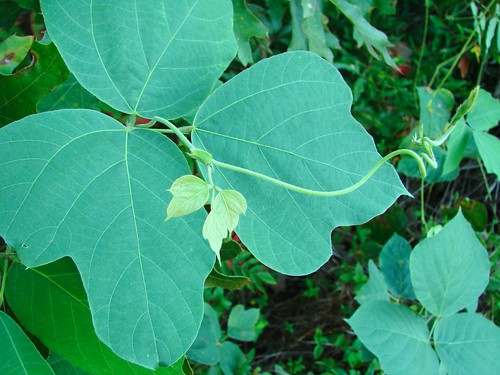
The picture above is of some kudzu leaves. Kudzu is not yet in bloom in upstate South Carolina, but, as you can see from yesterday's post, it is, as usual, thriving. Kudzu is one of the last plants to put forth new growth in the Spring. It is quite sensitive to frost. There will be blooms later. It grows rapidly, and I have never had a student from the Northeast or Midwest who didn't notice the ubiquity of kudzu during the season when it grows, as I did. I am still amazed at it, after four decades of living near it. If unchecked, it covers acres of land, and will cover buildings, trees, and other plants. The name is Japanese, apparently. It grows so well because there are few, or no, natural enemies of kudzu here. It is rare to find insect holes in kudzu leaves.
Woodchucks often live in holes in banks where kudzu is growing.
Kudzu is a member of the legume, or pea family of flowering plants. (Legume is a fancy name for pod.) This family is one of the most important families of plants, because they can fix Nitrogen, thus making it available for use in proteins, nucleic acids, and other essential molecules of living things. Vegetarians generally eat one or more legumes regularly.
Kudzu flowers, leaves and roots are edible (links go to recipes). The kudzu root apparently resembles jicama, or yam bean, root. Jicama (not kudzu) is available in some grocery stores in the area. I have grown to like it over the last year or so. I have yet to eat kudzu. Maybe someday.
* * * * * *
Addendum, January 19, 2006: Over the last few days, our Flickr photo of kudzu, which is the photo above, has experienced some 260 views. If you have been assigned this page for a school assignment, or have assigned it, good (although I'd be pleased to find out, if this is true). If you see any needed improvements, or have suggestions, please comment or contact me otherwise. Thanks.
Woodchucks often live in holes in banks where kudzu is growing.
Kudzu is a member of the legume, or pea family of flowering plants. (Legume is a fancy name for pod.) This family is one of the most important families of plants, because they can fix Nitrogen, thus making it available for use in proteins, nucleic acids, and other essential molecules of living things. Vegetarians generally eat one or more legumes regularly.
Kudzu flowers, leaves and roots are edible (links go to recipes). The kudzu root apparently resembles jicama, or yam bean, root. Jicama (not kudzu) is available in some grocery stores in the area. I have grown to like it over the last year or so. I have yet to eat kudzu. Maybe someday.
* * * * * *
Addendum, January 19, 2006: Over the last few days, our Flickr photo of kudzu, which is the photo above, has experienced some 260 views. If you have been assigned this page for a school assignment, or have assigned it, good (although I'd be pleased to find out, if this is true). If you see any needed improvements, or have suggestions, please comment or contact me otherwise. Thanks.
Saturday, May 14, 2005
Cherokee rose

And why are ye anxious concerning raiment? Consider the lilies of the field, how they grow; they toil not, neither do they spin: yet I say unto you, that even Solomon in all his glory was not arrayed like one of these. Matthew 6:28-29, ASV. (Similar language is used in Luke 12:27)
Yesterday's post featured blackberry flowers. Today's features another flower currently blooming in upstate South Carolina. This, like the blackberry, is a member of the rose family. I don't have a name for this one that I'm confident of, other than rose.
I am aware that roses aren't lilies. I also know that there is little certainty about what particular plants the Bible is referring to, when specific plants are mentioned. Even so, I don't propose that Jesus was talking about roses here. I am assuming that Jesus' statement applied to more than lilies.
I said I wasn't confident of the name, but this may be a Cherokee Rose. May not, too. I'm not sure. I expect to deal with common names in a future post.
This simple rose has a beauty of its own. So, of course, do showier ones, with more color and more petals.
The green thing going from the lower right to behind the flower is, for those not from here, a kudzu stem. I know what that is. I have to admit that even kudzu has beauty, if you can look at it with an unprejudiced eye. More on that later.
My blog description says that it's "Musings on science . . ." I haven't lived up to that part lately, and this series on what's happening around us here is an attempt to make up for that.
Thursday, May 12, 2005
Wild blackberry flowers

It's never a bad idea to stop thinking about whatever is bothering you and think about flowers.
Blackberries are members of the rose family. There are several species of blackberry, and I have no idea which one this is. Roses generally have petals in multiples of five, which are not attached to each other, hence can fall separately. In the picture above, you can see these petals. Several plants that bear fruit that we eat are members of this family, including strawberries, peaches, and apples. Roses are also members of the family, of course. The rose family is one of the largest families of plants.
Blackberries have aggregate fruits, called drupelets. That is, each of the little globes on a blackberry fruit is actually a separate fruit. Drupes have a hard seed in the center, and a fleshy outside, which is good to eat. The seed of blackberries is small enough that it can be ignored, unless it gets stuck in one's teeth. You shouldn't ignore the seed of apricots, peaches, and plums, which are also drupes. Raspberries have drupelets.
Blackberries, in South Carolina and Wisconsin, anyway (places I am most familiar with) often grow in abandoned fields after a year or two since the last cultivation, or along roadsides. They are a part of ecological succession, a fairly early stage thereof. They generally won't grow year after year in the same place, if that place is undisturbed. Since roadsides are disturbed, by mowing, blackberries will grow in the same place year after year.
Blackberries have thorns on their stems, or brambles, which can hurt. The fruit is usually good enough that they are worth picking, in spite of the thorns, although not many people pick. It's usually hot, with pesky insects, always scratchy, and the berries growing near roads are probably polluted. However, I sometimes get a picking or two.
It looks like a good blackberry crop in upstate South Carolina this year. There are blackberry plants in bloom all over the place.
Sunspots 8
THANKS TO GOD! I didn't say that explicitly at the retirement luncheon for me and several others, held at my institution this week, and I surely should have. Not thanks that I am retiring, but thanks for 41 good--no, great--years. Thanks also to a lot of other people, who will never read this, but who made the arrangements, and said various nice things, and to my wife, daughters, and grandson, for showing up, and acting like they enjoyed it. Daughters, that was great. Thanks again.
* * * * *
I began teaching a class the day after the luncheon. . .
* * * * *
The latest Christian Carnival is here. For anyone interested in Women in the Church, there is a link to a post by that title, about 2/3 of the way down the Carnival's listing of posts. I'd link to it directly, but that might deprive someone of seeing a mention of another post that they really should read.
* * * * *
Google Guide gives good tips on using Google, but is not affiliated with that service/site/behemoth/whatever.
* * * * *
Suggestions from Project Gutenberg, which posts public domain books--lots of them:
Christopher Morley's Plum Pudding of divers Ingredients, Discreetly Blended & Seasoned, a book of essays published in 1921, includes two gems on writing as a profession, "The Perfect Reader" and "The Rudeness of Poets." (There are more gems, on other subjects, that I didn't get around to reading, I'm sure.)
Kate Greenway's A Apple Pie is an alphabet book with color illustrations done in 1886. I suggest downloading the zipped version.
* * * * *
For anyone interested in my basketball post, yesterday, here's more on Kwame Brown.
Subscribe to:
Posts (Atom)