License

I have written an e-book, Does the Bible Really Say That?, which is free to anyone. To download that book, in several formats, go here.
Creative Commons License
The posts in this blog are licensed under a Creative Commons Attribution-NonCommercial-ShareAlike 3.0 Unported License. You can copy and use this material, as long as you aren't making money from it. If you give me credit, thanks. If not, OK.

Wednesday, June 29, 2016

Sunspots 580

Things I have recently spotted that may be of interest to someone else: 

The Arts: Wired on how neon signs are made.

Christianity: Relevant tells us why men shouldn't refer to their spouses as "smokin' hot wives," and analyzes the Song of Songs (aka Song of Solomon) in the process.

Relevant muses about prayer being (sometimes) boring.

Ken Schenck closes a fine series on the Ten Commandments with some thoughts on "Thou shalt not covet."

Computing: Gizmo's Freeware has an annotated list of Android apps that serve as reminders and calendars.

Gizmo's also recommends running VirusTotal on any Android devices you have.

Health: Listverse on 10 feats of human endurance, such as staying awake, or going without food and water, for a very long time.

History: Listverse reports on the 10 richest men (no women listed) in history.

Politics: Politifact finds, after thorough research, that the US does not have the highest personal tax rate  in the world, although perhaps it has the highest corporate tax rate in the world.

Wired tells us that people are modifying existing guns to make their own semi-automatic weapons.

Relevant says that racism is alive and well in the US, even in Christians, and, probably, in you and me, and tells us what we can do about it.

Science: Listverse points out 10 things that one or more species of animals can do, that we can't.

Gizmodo reports that the Caribbean basin makes a very low-pitched sound.


Image source (public domain)  

Sunday, June 26, 2016

Excerpts from Impressions, by Martin Wells Knapp, 2

CHAPTER I
IMPRESSIONS -- THEIR ORIGIN


An impression is defined as "an influence on purposes, feelings or actions."

While we are free to choose the right or wrong, yet we are continually acted upon by influences which impress in different ways. Some of them come silently as the sunshine; others come like the lightning's stroke or thunder's peal; others like gentle zephyrs, and some like the devastating tornado. Every impression has a source. Back of all operating second causes there is with each impression a designing mind which is the source of it. God is the author of all good impressions, Satan of all that are evil.

Hence all impressions are naturally divided into two Classes:
1. Those from our Father, which we will call "Impressions from above." These, if followed ripen into convictions.
2. Those from the devil, which we will call "Impressions from below."

From Impressions, by Martin Wells Knapp. Original publication date, 1892. Public domain. My source is here. The previous post in this series is here.

Wednesday, June 22, 2016

Sunspots 579

Things I have recently spotted that may be of interest to someone else:


The Arts: Listverse reports on 10 interesting dollhouses. Some of them have been used for children's play, some haven't.

Christianity: Heart, Mind, Soul and Strength doesn't think we are capable of understanding God fully (or even close to that.) This is in response to an atheist that thinks that, if there is a God, we should be capable of understanding Him.

Relevant on how to escape sexual temptation.

Christianity Today on how suffering produces sanctification.

Ken Schenck tells us that telling the truth is almost always the loving thing to do.

Health: The New York Times reports that, although there are some disturbing trends in health in the US, such as increased suicide rates, and increasing disparity in the life-spans of rich vs. poor, the health of children seems to be improving.

Philosophy: (Or something) Listverse gives us 10 possible explanations for the feeling of déjà vu. I'm not sure that I'm comfortable with any of them, but they're interesting.

Politics: The New York Times on how rare gun deaths are in other countries.

Wired explains the FBI's terrorist watch lists.

Science: Wired wonders if mockingbirds can be trained to sing "songs" that are less annoying.


Image source (public domain)  

Sunday, June 19, 2016

Excerpts from Impressions, by Martin Wells Knapp, 1

IMPRESSIONS By Martin Wells Knapp
PREFACE The author has written this book for the following reasons: 1. Because of the great need of light and the absence of books on this subject. 2. It is believed that Some have gone over the falls of fanaticism, and that others have been greatly perplexed and hindered in their life work on account of lack of such light. 3. Some who read the two sections, which were published, declared themselves to have been greatly helped thereby. 4. God brought the subject-matter to the author's mind, laid it upon his heart, and opened the way for its writing and publication. He feels that equally with his other books, God has directed and will bless in its circulation and perusal. He also believes that with His blessing upon it, it will prove a light-house by life's sea, which will help to warn of threatening danger, and aid its readers in standing "perfect and complete in all the will of God." To whom be glory forever.


From Impressions, by Martin Wells Knapp. Original publication date, 1892. Public domain. My source is here.

Friday, June 17, 2016

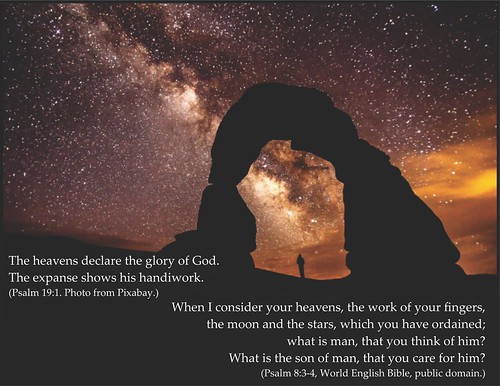
We can't see the Milky Way anymore


God revealed through the Milky Way

National Public Radio, and other news sources, have reported on a study which indicates that most North Americans (and others) cannot see the Milky Way, the galaxy that we are part of, because there is too much artificial light (light pollution) in the sky. That’s too bad, for two reasons, at least.

One reason that it’s too bad is aesthetic. The Milky Way is beautiful. Although it’s not extremely bright, it covers so much of the sky that, when visible, it’s the most obvious feature of the heavens above us. If we can’t see it, we are deprived of one of the most beautiful and majestic aspects of the creation. For comparison, consider your favorite wild flower, or wild bird, or mountain, and suppose that, for some reason, you were never going to see this flower or bird or mountain again. You would be deprived, of some of the beauty that inspires and comforts you, and that’s too bad.

The second reason is that the observation of nature is one of the ways that God is revealed to us. (It’s not the only one, or the most important, but it’s one way.) Because the Bible says so.

Psalm 8 tells us that we should praise God, and also indicates that considering the heavens informs us about our place in the creation:

1 Yahweh, our Lord, how majestic is your name in all the earth!
You have set your glory above the heavens!
3 When I consider your heavens, the work of your fingers,
the moon and the stars, which you have ordained;
4 what is man, that you think of him?
What is the son of man, that you care for him?
5 For you have made him a little lower than the angels,
and crowned him with glory and honor.
6 You make him ruler over the works of your hands.
You have put all things under his feet:

Psalm 97 repeats the first theme:
The heavens declare his righteousness.
All the peoples have seen his glory.

Psalm 19 explicitly says that nature reveals God to us:
1 The heavens declare the glory of God.
The expanse shows his handiwork.
2 Day after day they pour out speech,
and night after night they display knowledge.
3 There is no speech nor language,
where their voice is not heard.
4a Their voice has gone out through all the earth,
their words to the end of the world. 

Such statements are not confined to the Old Testament. Here’s a part of Romans 1:
20 For the invisible things of him since the creation of the world are clearly seen, being perceived through the things that are made, even his everlasting power and divinity, that they may be without excuse.

So, if we can’t see the Milky Way, we are a little less able to worship God, to understand His redemptive work, and to know our place in creation.

Am I advocating turning off all streetlights, or prohibiting driving after dark? No. That’s not my call, and I often use lights at night, sometimes in what I hope is God’s work. But I should realize that, by indiscriminate use of light, I am cutting myself, and others, off from part of my understanding of God. The Passenger Pigeon, once the most common bird in North America, became extinct a little over 100 years ago, due to human activity. We can no longer see huge, majestic flocks of these creatures, and so are also, by that lack, deprived of some once available knowledge of God’s power and majesty. The American Bison, and some rhino species, are not yet extinct, but we are never going to see them in the magnificent numbers that people once did, and the rhinos, at least, may really become extinct. Too bad.

We live in a fallen world, and, environmentally speaking, it seems to become less like God gave it to us by the day. As Paul said, in Romans 8:
19 For the creation waits with eager expectation for the children of God to be revealed. 20 For the creation was subjected to vanity, not of its own will, but because of him who subjected it, in hope 21 that the creation itself also will be delivered from the bondage of decay into the liberty of the glory of the children of God. 22 For we know that the whole creation groans and travails in pain together until now.

Thanks for reading. Look for the Milky Way!

The photo is from Pixabay, which allows such use.

Wednesday, June 15, 2016

Sunspots 578

Things I have recently spotted that may be of interest to someone else:


Christianity: An articulate former atheist describes her process of coming to belief, in Christianity Today.

Ken Schenck on what the Bible says about bearing false witness.

The Environment: National Public Radio reports on a study of light pollution. 80% of North Americans can't see the Milky Way, because of so much light at night. We can't see it from our home. Can you?

Finance: Relevant and other sources report that HBO's John Oliver purchased (he says it's easy to do it) $15,000,000 "worth" of medical debt for about $60,000, and forgave all the debtors.

Health: The New York Times reports that the US is about 25th in the world in infant care.

Politics: Sojourners reports that Russell Moore, an important Southern Baptist, believes that Donald Trump is a lost soul, who should repent.

A woman writes, in Christianity Today, about being refused the use of women's restrooms, and other facilities.

Science: National Public Radio reports on our relationship with dogs. We may have domesticated dogs twice, or perhaps they domesticated us twice.

Listverse describes 10 groups of organisms that have been extinct for a long time. Like Trilobites, and lesser known creatures.

Science News reports that it may be possible to produce fully pluripotent stem cells from adult cells, thus making the use of embryonic cells unnecessary.

Sports: USA Today says that the first 14 LPGA golf tournaments of 2016 were won by young women -- under 23, until a week or so ago. The most recent one, a major tournament, which finished on June 13, was won by the youngest player ever to win a that major, in a playoff with another player who would also have been the youngest. Both are still teenagers.


Image source (public domain)  

Sunday, June 12, 2016

Excerpts from Orthodoxy by G. K. Chesterton, 74

The mass of men have been forced to be gay about the little things, but sad about the big ones. Nevertheless (I offer my last dogma defiantly) it is not native to man to be so. Man is more himself, man is more manlike, when joy is the fundamental thing in him, and grief the superficial.

Melancholy should be an innocent interlude, a tender and fugitive frame of mind; praise should be the permanent pulsation of the soul. Pessimism is at best an emotional half-holiday; joy is the uproarious labour by which all things live. Yet, according to the apparent estate of man as seen by the pagan or the agnostic, this primary need of human nature can never be fulfilled. Joy ought to be expansive; but for the agnostic it must be contracted, it must cling to one corner of the world. Grief ought to be a concentration; but for the agnostic its desolation is spread through an unthinkable eternity. This is what I call being born upside down. The sceptic may truly be said to be topsy-turvy; for his feet are dancing upwards in idle ecstacies, while his brain is in the abyss. To the modern man the heavens are actually below the earth. The explanation is simple; he is standing on his head; which is a very weak pedestal to stand on. But when he has found his feet again he knows it. Christianity satisfies suddenly and perfectly man’s ancestral instinct for being the right way up; satisfies it supremely in this; that by its creed joy becomes something gigantic and sadness something special and small. The vault above us is not deaf because the universe is an idiot; the silence is not the heartless silence of an endless and aimless world. Rather the silence around us is a small and pitiful stillness like the prompt stillness in a sick-room. We are perhaps permitted tragedy as a sort of merciful comedy: because the frantic energy of divine things would knock us down like a drunken farce. We can take our own tears more lightly than we could take the tremendous levities of the angels. So we sit perhaps in a starry chamber of silence, while the laughter of the heavens is too loud for us to hear. Joy, which was the small publicity of the pagan, is the gigantic secret of the Christian. And as I close this chaotic volume I open again the strange small book from which all Christianity came; and I am again haunted by a kind of confirmation. The tremendous figure which fills the Gospels towers in this respect, as in every other, above all the thinkers who ever thought themselves tall. His pathos was natural, almost casual. The Stoics, ancient and modern, were proud of concealing their tears. He never concealed His tears; He showed them plainly on His open face at any daily sight, such as the far sight of His native city. Yet He concealed something. Solemn supermen and imperial diplomatists are proud of restraining their anger. He never restrained His anger. He flung furniture down the front steps of the Temple, and asked men how they expected to escape the damnation of Hell. Yet He restrained something. I say it with reverence; there was in that shattering personality a thread that must be called shyness. There was something that He hid from all men when He went up a mountain to pray. There was something that He covered constantly by abrupt silence or impetuous isolation. There was some one thing that was too great for God to show us when He walked upon our earth; and I have sometimes fancied that it was His mirth.


Orthodoxy, by G. K. Chesterton, is in the public domain, and available from Project Gutenberg. This is my last post in the series of excerpts, as I have run out of Orthodoxy.  It has been a pleasure to read, and publish, a little of that book for nearly a year and a half, and I thank God for the privilege. The previous post in this series is here. Thanks for reading! Read Chesterton.

Wednesday, June 08, 2016

Sunspots 577

Things I have recently spotted that may be of interest to someone else:

Christianity: A Christianity Today columnist who is not a Trump supporter cautions against looking down on evangelicals who do support him.

Benjamin L. Corey on the question of whether Jesus was a pacifist, or not.

Relevant has an essay on "How to Pray When You Don't Feel Like it."

E. Stephen Burnett argues that Christians need fantastic literature that appeals specially to them. Maybe so. I confess that I'm not a huge fan of most such literature. (I am a fan of good fantastic literature, whoever writes it.)

Weekend Fisher argues that rational thought is a natural process -- it isn't miraculous. (Which, of course, does not deny that God made it possible.)

Computing: Wired on Facebook's new privacy settings.

Education: Listverse tells us 10 facts about the English language that you may not have known.


History: (and economics, and Christianity) Ken Schenck on what the Bible says about economic structures in society.

Politics: (or economics) Wired reports on a book about the economics of Star Trek, which has what is apparently a fictional money-free society.

Science: Listverse has a post on 10 strange anatomical facts about animals. Among other things, the post discusses the tongues of frogs and the location of a tick's eyes.


Image source (public domain)  

Sunday, June 05, 2016

Excerpts from Orthodoxy, by G. K. Chesterton, 73

But this larger and more adventurous Christian universe has one final mark difficult to express; yet as a conclusion of the whole matter I will attempt to express it. All the real argument about religion turns on the question of whether a man who was born upside down can tell when he comes right way up. The primary paradox of Christianity is that the ordinary condition of man is not his sane or sensible condition; that the normal itself is an abnormality. That is the inmost philosophy of the Fall. And when rationalists say that the ancient world was more enlightened than the Christian, from their point of view they are right. For when they say “enlightened” they mean darkened with incurable despair. It is profoundly true that the ancient world was more modern than the Christian. The common bond is in the fact that ancients and moderns have both been miserable about existence, about everything, while medievals were happy about that at least. I freely grant that the pagans, like the moderns, were only miserable about everything—they were quite jolly about everything else. I concede that the Christians of the Middle Ages were only at peace about everything—they were at war about everything else. But if the question turn on the primary pivot of the cosmos, then there was more cosmic contentment in the narrow and bloody streets of Florence than in the theatre of Athens or the open garden of Epicurus. Giotto lived in a gloomier town than Euripides, but he lived in a gayer universe.

Orthodoxy, by G. K. Chesterton, is in the public domain, and available from Project Gutenberg. The previous post in this series is here. Thanks for reading! Read Chesterton.

Wednesday, June 01, 2016

Sunspots 576

Things I have recently spotted that may be of interest to someone else:

Christianity: Heart, Mind, Soul and Strength asks what we really want to see.

Ken Schenck on four different ways God may interact with us when it seems we should fight something or somebody.

A contributor to BioLogos discusses what the Bible says about whether God intended death to be part of creation.

A commentator in Baptist News Global writes about some things he has learned about transgender people.

Computing: The US Government's information technology is, in at least some areas, woefully out of date. National Public Radio reports that our nuclear weapons personnel use systems with floppy disks. Some of you don't even know what those are, or were.

The Environment: (sort of) Listverse reports (with photos) on 10 places that look like they aren't real, but come from fantasy novels. But they are real.

History: Listverse reports, with interesting facts about the Romani, aka Gypsies.

The Asahi Shinbun (Japanese newspaper, in English) reports on the significance of origami cranes, including four that were apparently made by President Obama, probably with some help from others.

The New York Times has a pictorial report on walls built to keep people out (or in). They haven't stopped lots of people.

Science: NPR reports on the discovery of a really large sponge, which is, presumably, very old.

Wired reports on Tide's stain-erasing pens -- what chemicals are in them.


Image source (public domain)

Sunday, May 29, 2016

Excerpts from Orthodoxy, by G. K. Chesterton, 72

The unpopular parts of Christianity turn out when examined to be the very props of the people. The outer ring of Christianity is a rigid guard of ethical abnegations and professional priests; but inside that inhuman guard you will find the old human life dancing like children, and drinking wine like men; for Christianity is the only frame for pagan freedom. But in the modern philosophy the case is opposite; it is its outer ring that is obviously artistic and emancipated; its despair is within. And its despair is this, that it does not really believe that there is any meaning in the universe; therefore it cannot hope to find any romance; its romances will have no plots. A man cannot expect any adventures in the land of anarchy. But a man can expect any number of adventures if he goes traveling in the land of authority. One can find no meanings in a jungle of skepticism; but the man will find more and more meanings who walks through a forest of doctrine and design. Here everything has a story tied to its tail, like the tools or pictures in my father’s house; for it is my father’s house. I end where I began—at the right end. I have entered at least the gate of all good philosophy. I have come into my second childhood.

Orthodoxy, by G. K. Chesterton, is in the public domain, and available from Project Gutenberg. The previous post in this series is here. Thanks for reading! Read Chesterton.

Wednesday, May 25, 2016

Sunspots 575

Things I have recently spotted that may be of interest to someone else:


Christianity: Bible scholar Ken Schenck on what the Bible says about wealth.

E. Stephen Burnett has written two "duh!" posts, about truths Christians need to be reminded of: our non-Christian neighbors don't get God's law, and they don't even understand God's grace in a rudimentary way.

Christianity Today on Pascal's wager. (The wager was about whether it makes sense to be a Christian believer, even if, say, Christian teaching about heaven is false.)

Computing: Gizmo's Freeware points to a site that will tell you how hard it would be to crack a password.

The Environment: (or something) Listverse discusses the 10 loneliest things in the world.

Food: Listverse reports on 10 strange soda (aka soft drink) flavors.

Health: National Public Radio reports on whether or not women need to have menstrual periods.

Politics: (and health)  National Public Radio reports that a ten billion dollar program which was supposed to speed up getting treatment visits for veterans has actually made things worse. Oh, dear.

Science: Wired on why insect stings really hurt.

Listverse reports on 10 bizarre-sounding proposals by scientists, most of which were suggested as ways to alleviate Global Climate Change.

NPR reports on research designed to find out why we gossip.

Sports: FiveThirtyEight reports that women get concussions from participating in sports at higher rates than men do.

Image source (public domain)  

Sunday, May 22, 2016

Excerpts from Orthodoxy, by G. K. Chesterton, 71

All other philosophies say the things that plainly seem to be true; only this philosophy has again and again said the thing that does not seem to be true, but is true. Alone of all creeds it is convincing where it is not attractive; . . . Theosophists for instance will preach an obviously attractive idea like reincarnation; but if we wait for its logical results, they are spiritual superciliousness and the cruelty of caste. For if a man is a beggar by his own pre-natal sins, people will tend to despise the beggar. But Christianity preaches an obviously unattractive idea, such as original sin; but when we wait for its results, they are pathos and brotherhood, and a thunder of laughter and pity; for only with original sin we can at once pity the beggar and distrust the king. . . . Orthodoxy makes us jump by the sudden brink of hell; it is only afterwards that we realize that jumping was an athletic exercise highly beneficial to our health.

Orthodoxy, by G. K. Chesterton, is in the public domain, and available from Project Gutenberg. The previous post in this series is here. Thanks for reading! Read Chesterton.

Wednesday, May 18, 2016

Sunspots 574

Things I have recently spotted that may be of interest to someone else:

The Arts: Listverse reports on 10 amazing objects made from ice -- some small, some quite large.

Christianity: Philosopher Alvin Plantinga on why science does not rule out miracles.

Sojourners reports that Southern Baptists, Jews, Sikhs, and Hari Krishna worshipers have come out against a zoning ruling that a mosque couldn't be built.

Computing: Gizmo's Freeware points to a free web-based video studio.

Wired says that ransomware -- making a computer or network unusable, then demanding money to reverse this -- is becoming the most common type of Internet attack. The article discusses ways to avoid this.

Politics: Some reactions from important Christians to Mr. Trump: Sojourners reports on a "called to resist bigotry" statement, signed by sixty important religious leaders. The report includes a long excerpt from an article by Russell Moore, an important official of the Southern Baptist Convention, who signed the statement. Here's the Moore article.

Science: Listverse tells us about 10 organisms (not all are animals!) that may be as or more intelligent than we are.

Sports: Congratulations to Tim Duncan. His team, the San Antonio Spurs of the National Basketball Association, did not win the championship this year. (They have in the past.) But Duncan has won more games with the same team than any player in the history of the NBA.

Image source (public domain)  

Sunday, May 15, 2016

Excerpts from Orthodoxy, by G. K. Chesterton, 70

Now, when society is in a rather futile fuss about the subjection of women, will no one say how much every man owes to the tyranny and privilege of women, to the fact that they alone rule education until education becomes futile: for a boy is only sent to be taught at school when it is too late to teach him anything. The real thing has been done already, and thank God it is nearly always done by women. Every man is womanized, merely by being born. They talk of the masculine woman; but every man is a feminised man.

For I remember with certainty this fixed psychological fact; that the very time when I was most under a woman’s authority, I was most full of flame and adventure. Exactly because when my mother said that ants bit they did bite, and because snow did come in winter (as she said); therefore the whole world was to me a fairyland of wonderful fulfillments, and it was like living in some Hebraic age, when prophecy after prophecy came true. I went out as a child into the garden, and it was a terrible place to me, precisely because I had a clue to it: if I had held no clue it would not have been terrible, but tame. A mere unmeaning wilderness is not even impressive. But the garden of childhood was fascinating, exactly because everything had a fixed meaning which could be found out in its turn.


Orthodoxy, by G. K. Chesterton, is in the public domain, and available from Project Gutenberg. The previous post in this series is here. Thanks for reading! Read Chesterton.

Wednesday, May 11, 2016

Sunspots 573

Things I have recently spotted that may be of interest to someone else:


Christianity: A resource on the history of the Biblical canon.

Computing:
Wired on how to make passwords more secure.

Health: Wired reports on the dangers of driving over the speed limit, or of setting the speed limit higher.
 
Politics: National Public Radio has a commentary on how the news media failed to cover Donald Trump properly.

FiveThirtyEight weighs in on how and why Trump won the Republican nomination.

FiveThirtyEight also reports that Trump supporters have higher incomes than the public at large, which is contrary to what has often been said, or implied.

Science: Listverse reports on animals that decorate themselves, or their surroundings.

Listverse also reports on 10 small isolated villages where health conditions rare elsewhere are common.

Wired reports that the simple little hydra may be potentially immortal, and explains why.
 
Image source (public domain)  

Sunday, May 08, 2016

Excerpts from Orthodoxy, by G. K. Chesterton, 69

Note: This post doesn't have anything to do with Mother's Day, at least not on purpose. Sorry.

If a shade arose from the under world, and stared at Piccadilly, that shade would not quite understand the idea of an ordinary closed carriage. He would suppose that the coachman on the box was a triumphant conqueror, dragging behind him a kicking and imprisoned captive. So, if we see spiritual facts for the first time, we may mistake who is uppermost.

I have now said enough to show (to any one to whom such an explanation is essential) that I have in the ordinary arena of apologetics, a ground of belief. In pure records of experiment (if these be taken democratically without contempt or favour) there is evidence first, that miracles happen, and second that the nobler miracles belong to our tradition. But I will not pretend that this curt discussion is my real reason for accepting Christianity instead of taking the moral good of Christianity as I should take it out of Confucianism. I have another far more solid and central ground for submitting to it as a faith, instead of merely picking up hints from it as a scheme. And that is this: that the Christian Church in its practical relation to my soul is a living teacher, not a dead one. It not only certainly taught me yesterday, but will almost certainly teach me tomorrow. Once I saw suddenly the meaning of the shape of the mitre. One fine morning I saw why windows were pointed; some fine morning I may see why priests were shaven. Plato has told you a truth; but Plato is dead. Shakespeare has startled you with an image; but Shakespeare will not startle you with any more. But imagine what it would be to live with such men still living, to know that Plato might break out with an original lecture tomorrow, or that at any moment Shakespeare might shatter everything with a single song. The man who lives in contact with what he believes to be a living Church is a man always expecting to meet Plato and Shakespeare tomorrow at breakfast. He is always expecting to see some truth that he has never seen before. There is one only other parallel to this position; and that is the parallel of the life in which we all began. When your father told you, walking about the garden, that bees stung or that roses smelt sweet, you did not talk of taking the best of out of his philosophy. When the bees stung you, you did not call it an entertaining coincidence. When the rose smelt sweet you did not say “My father is a rude, barbaric symbol, enshrining (perhaps unconsciously) the deep delicate truths that flowers smell.” No: you believed your father, because you had found him to be a living fountain of facts, a thing that really knew more than you; a thing that would tell you truth tomorrow, as well as today.


Orthodoxy, by G. K. Chesterton, is in the public domain, and available from Project Gutenberg. The previous post in this series is here. Thanks for reading! Read Chesterton.

Friday, May 06, 2016

Why the Bible is God's word.

The Bible is God’s word

Why do I say that? Here are some reasons:

The Bible is accurate. No one has ever shown that a location, an event, or a person mentioned in the Bible, that God intended to be taken as factual, is portrayed falsely. People have tried to disprove its accuracy, but have failed.

The Bible includes predictions that came true, about the coming of Christ, and his death, and other events. If these had been faked (written after the facts) they would almost certainly have been clearer.

The Bible doesn’t gloss over some stuff that we might not like, or that don’t seem appropriate (Like Judges 11, or parts of Psalm 35 or 54).

The Bible speaks to different cultures. Parts of the Old Testament spoke to people living about 3,000 years ago. The New Testament speaks to people living nearly 2,000 years after it was written.

People have had their lives transformed through reading the Bible. The Gideons tell us stories of that every time they come to our church. I knew a man who became a believer through reading a Gideon Bible. He recently passed away, after having been a good pastor for many years.

The Bible can stir emotions. Reading about Christ’s suffering, or the majesty of God’s creation, or the unnamed heroes of faith in the last part of Hebrews 11, brings about feelings in me. Other passages speak to other people.

The Bible points out man’s biggest problem, sin. (See the story of the Fall, Cain and Abel, and much more.) The Bible also points out the solution: Romans 3:23 for all have sinned, and fall short of the glory of God; 24 being justified freely by his grace through the redemption that is in Christ Jesus; 25 whom God sent to be an atoning sacrifice, [text note – or propitiation] through faith in his blood ...

The Bible presents a sensible worldview: There’s a supernatural beginning to the universe, humanity messing up our world, the futility of trying to pay the penalty of sin by human action, successful payment of the price of sin by an unimaginable sacrifice, a valid promise of purpose and joy in life, accompanied by God the Holy Spirit, and a to-be-filled promise of eternal life to come.

The Bible gives us two great commandments, a sturdy foundation for any ethical or legal system.

All this is evidence that the Bible is supernatural – God’s word. To further emphasize that, the Bible depends on itself. Heres the result of a search for the phrase “it is written” in the Bible. It occurs 80 times.

For related reading, from an articulate Bible scholar, see this article.
For my own thoughts on the claim that the King James Bible is the only valid translation, see here.
For my thoughts on whether it is possible to just read the Bible, without interpreting it, see here.
In the paragraph about predictions, I indicated that at least some prophecy was not very clear -- it was difficult or impossible to know what was meant, until after the event prophesied. See here for biblical examples.

Wednesday, May 04, 2016

Sunspots 572

Things I have recently spotted that may be of interest to someone else:


Christianity:
Christianity Today reports that only about one-third of Protestant pastors in the US believe in a literal rapture before a literal tribulation.

Cal Thomas, conservative, Christian, and syndicated columnist, on why Christians should not depend on politics to fix our problems.

Computing: Gizmo's Freeware reports, briefly, on a free substitute for Office.

The Environment: From Wired: “Trying to solve congestion by making roadways wider is like trying to solve obesity by buying bigger pants.” But, in a special case, widening highways seems to have helped traffic flow.

Food: Relevant reports that someone has invented a pizza box made out of pizza.

Health: National Public Radio and other sources report that you can get the same surgery for considerably different prices in different places in the US.

History: A viking longship, powered by sail and oars, has set sail from Norway to North America, according to the History Blog.

An airconditioning system has been found in a tower in Kuwait, dating to about the 7th century, according to the History Blog.

Listverse discusses 10 cases where Muslims, Jews, and Christians protected each other.

Science:
Listverse describes 10 bizarre insect predators. The post includes videos of some of these creatures.

 
Image source (public domain)

Tuesday, May 03, 2016

Equipment and character for following Christ


Our Tools and Power - we have been given enough equipment to follow Christ
Ephesians 1:19b the exceeding greatness of his power toward us who believe, according to that working of the strength of his might 20a which he worked in Christ, when he raised him from the dead

Luke 12:11a “… don’t be anxious how or what you will answer, or what you will say; 12 for the Holy Spirit will teach you in that same hour what you must say.”

Colossians 1:9 For this cause, we also, since the day we heard this, don’t cease praying and making requests for you, that you may be filled with the knowledge of his will in all spiritual wisdom and understanding, 10 that you may walk worthily of the Lord, to please him in all respects, bearing fruit in every good work and increasing in the knowledge of God,

Galatians 5:22 But the fruit of the Spirit is love, joy, peace, patience, kindness, goodness, faith, 23a gentleness, and self-control. (These fruits are tools for following Christ -- see below.)

1 Peter 4:10 As each has received a gift, employ it in serving one another, as good managers of the grace of God in its various forms. 11b … that in all things God may be glorified through Jesus Christ, to whom belong the glory and the dominion forever and ever. Amen.

Ephesians 6:10 Finally, be strong in the Lord, and in the strength of his might. 11 Put on the whole armor of God, that you may be able to stand against the wiles of the devil. 12 For our wrestling is not against flesh and blood, but against the principalities, against the powers, against the world’s rulers of the darkness of this age, and against the spiritual forces of wickedness in the heavenly places. 13 Therefore put on the whole armor of God, that you may be able to withstand in the evil day, and having done all, to stand. 14 Stand therefore, having the utility belt of truth buckled around your waist, and having put on the breastplate of righteousness, 15 and having fitted your feet with the preparation of the Good News of peace, 16 above all, taking up the shield of faith, with which you will be able to quench all the fiery darts of the evil one. 17 And take the helmet of salvation, and the sword of the Spirit, which is the word of God;

Our Character: When I ask, “Tell me the first word that comes to your mind when I say Christian,” not one time has someone suggested the word love. – Philip Yancey, Vanishing Grace: What Ever Happened to the Good News?
But: 1 John 4:8 He who doesn’t love doesn’t know God, for God is love.

Thanks for reading. Be equipped!