I have remarked that the materialist, like the madman, is in prison; in
the prison of one thought. These people seemed to think it singularly inspiring to keep on saying that the prison was very large. The size of
this scientific universe gave one no novelty, no relief. The cosmos went on for ever, but not in its wildest constellation could there be anything
really interesting; anything, for instance, such as forgiveness or free will. The grandeur or infinity of the secret of its cosmos added nothing
to it. It was like telling a prisoner in Reading gaol that he would be glad to hear that the gaol now covered half the county. The warder would
have nothing to show the man except more and more long corridors of stone lit by ghastly lights and empty of all that is human. So these expanders
of the universe had nothing to show us except more and more infinite corridors of space lit by ghastly suns and empty of all that is divine. In
fairyland there had been a real law; a law that could be broken, for the definition of a law is something that can be broken. But the machinery of
this cosmic prison was something that could not be broken; for we ourselves were only a part of its machinery. We were either unable to do
things or we were destined to do them.
Orthodoxy, first published in 1908, by G. K. Chesterton, is in the public domain, and available from Project Gutenberg. The previous post in this series is here.
Thanks for reading! Read Chesterton.
Musings on science, the Bible, and fantastic literature (and sometimes basketball and other stuff).
God speaks to us through the Bible and the findings of science, and we should listen to both types of revelation.
The title is from Psalm 84:11.
The Wikipedia is usually a pretty good reference. I mostly use the World English Bible (WEB), because it is public domain. I am grateful.
License
I have written an e-book, Does the Bible Really Say That?, which is free to anyone. To download that book, in several formats, go here.

The posts in this blog are licensed under a Creative Commons Attribution-NonCommercial-ShareAlike 3.0 Unported License. You can copy and use this material, as long as you aren't making money from it. If you give me credit, thanks. If not, OK.
The posts in this blog are licensed under a Creative Commons Attribution-NonCommercial-ShareAlike 3.0 Unported License. You can copy and use this material, as long as you aren't making money from it. If you give me credit, thanks. If not, OK.
Showing posts with label Cosmos. Show all posts
Showing posts with label Cosmos. Show all posts
Sunday, April 12, 2015


Monday, March 10, 2014
Cosmos, with Neil deGrasse Tyson
I watched part of the first part of Cosmos, a series about (what else)
the cosmos, on Fox TV and also on the National Graphic
Channel, on Sunday evenings, with Neil deGrasse Tyson as narrator. This
is an upgrade of a previous series, with the same name, with Carl Sagan
as narrator, which may have been the most widely watched TV series of
all time. It looks like the new one is going to be a great series, with
great graphics, and magnificent subject matter, but Tyson
unfortunately started it off by quoting Sagan, who said that "The
cosmos is all that is or ever was or ever will be." (Cosmos, p. 4. New
York, Random House, 1980.) That's an interesting statement. It may even
be true, although I personally don't believe it, because the Bible
contradicts it -- the Bible says that there is a God who is superior to
the cosmos. And it's not a scientific statement at all. It's a
philosophical statement, one that can't be proved or disproved by
science. Sagan didn't do any experiments that showed it to be true. Neither did Tyson, or anyone else.
Here's the Wikipedia page on the new series. The Sagan series also has a Wikipedia article -- see the "previous series" link above.
Thanks for reading.
Here's the Wikipedia page on the new series. The Sagan series also has a Wikipedia article -- see the "previous series" link above.
Thanks for reading.
Monday, March 30, 2009
Faith masquerading as science
The Cosmos series, starring Carl Sagan, originally a 1980 PBS series, is now available on Hulu. (I believe that a free Hulu membership is required.) In the first episode, Sagan began by saying that "The Cosmos is all that is or ever was or ever will be." That episode is here.
Please note that that was not a scientific statement. It was a faith statement! How could Sagan have known that? (Or falsified it?) I'm not accusing the late Sagan, a great communicator who did a lot for science education, of deliberately trying to foist an atheistic faith upon millions of impressionable minds. (Cosmos remains the most watched PBS series ever. It was shown to classrooms across the US.) Perhaps he (and his co-writers) was just trying to be poetic. But the fact remains -- that is and was and always will be a scientifically unprovable statement. It is and was a statement of belief.
Genesis begins with a different presupposition: 1:1 In the beginning, God created the heavens and the earth. (ESV)
God, a being outside the heavens and the earth, and existing before they came to be, created. Genesis 1:1 doesn't say when, how, or why, but it does claim that there is a Who outside the cosmos. The cosmos isn't all that is, or ever was, or ever will be. Amen. Can I prove that, or could Sagan, were he still alive, disprove it? I don't think so. Why? Because God is outside the realm of science. Also, because the Bible says:
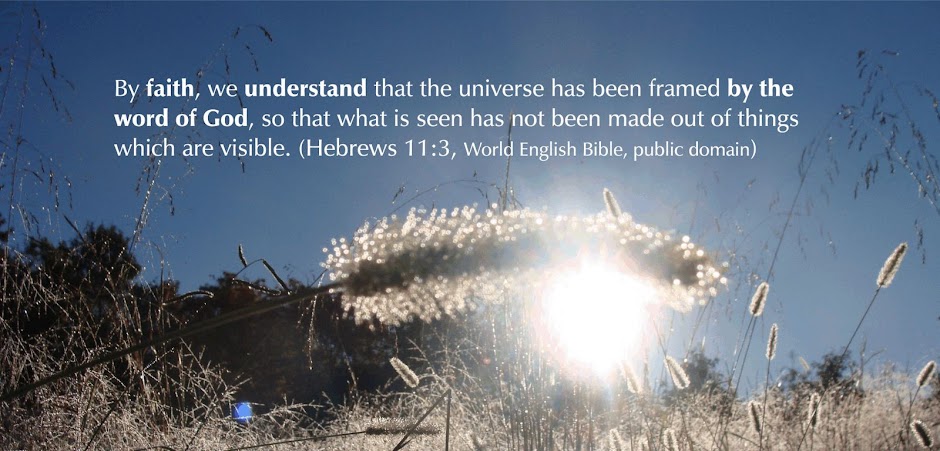
By faith we understand that the universe was created by the word of God, so that what is seen was not made out of things that are visible. (Hebrews 11:3, ESV, emphasis added.) By faith, not by laboratory experiment.
Cosmos was, and is, an interesting program, very well done, showing a lot of good science in an interesting way. But part of it is a particular faith masquerading as science. Thanks for reading.
Please note that that was not a scientific statement. It was a faith statement! How could Sagan have known that? (Or falsified it?) I'm not accusing the late Sagan, a great communicator who did a lot for science education, of deliberately trying to foist an atheistic faith upon millions of impressionable minds. (Cosmos remains the most watched PBS series ever. It was shown to classrooms across the US.) Perhaps he (and his co-writers) was just trying to be poetic. But the fact remains -- that is and was and always will be a scientifically unprovable statement. It is and was a statement of belief.
Genesis begins with a different presupposition: 1:1 In the beginning, God created the heavens and the earth. (ESV)
God, a being outside the heavens and the earth, and existing before they came to be, created. Genesis 1:1 doesn't say when, how, or why, but it does claim that there is a Who outside the cosmos. The cosmos isn't all that is, or ever was, or ever will be. Amen. Can I prove that, or could Sagan, were he still alive, disprove it? I don't think so. Why? Because God is outside the realm of science. Also, because the Bible says:
By faith we understand that the universe was created by the word of God, so that what is seen was not made out of things that are visible. (Hebrews 11:3, ESV, emphasis added.) By faith, not by laboratory experiment.
Cosmos was, and is, an interesting program, very well done, showing a lot of good science in an interesting way. But part of it is a particular faith masquerading as science. Thanks for reading.
Subscribe to:
Posts (Atom)