License

I have written an e-book, Does the Bible Really Say That?, which is free to anyone. To download that book, in several formats, go here.
Creative Commons License
The posts in this blog are licensed under a Creative Commons Attribution-NonCommercial-ShareAlike 3.0 Unported License. You can copy and use this material, as long as you aren't making money from it. If you give me credit, thanks. If not, OK.
Showing posts with label definitions. Show all posts

Thursday, September 15, 2005

I believe in evolution. So do you! part 2

Some people call the meanings of evolution given in the first part -- namely change, natural selection, and speciation -- microevolution. Many Christians believe that all of these occurred by natural processes, although they usually believe that humans are not here solely because of natural processes. They also believe that these processes, like gravity, were designed -- built into the universe by an intelligent Creator, who had foreknowledge of the consequences. Other Christians would disagree, believing that most or all speciation was not the result of natural processes, but of miracles. However, I think all Christians who have honestly thought about it would agree that at least a little change and natural selection have occurred, and probably that at least some species might have arisen by natural selection. There doesn't seem to be any doubt that varieties have so arisen. Therefore, in at least one of these senses, all people believe in evolution.

Now, what about macroevolution? There are at least three types of this.

Another meaning of evolution is phylogeny, the origin of large groups of living things. If, for example, both birds and mammals are descended from reptiles, that would be phylogeny.

Most biologists believe that phylogeny occurred, by natural processes. If pressed, such people would probably agree that it is more difficult to imagine, say, how feathers arose from reptilian scales, than to imagine a scenario for dogs to have arisen from wolves. It is more difficult to believe that natural selection was solely responsible for phylogeny than for speciation. The amount of change needed is considerably greater, and perhaps ordinary mutations could not have produced the variety necessary. It is difficult to produce a scenario that would explain how an organism that had a skin structure intermediate between a scale and a feather would gain any advantage from having such over a relative with scales. In fact, half-feathers might well have been a disadvantage.

There is some fossil evidence for phylogeny by natural means.

Many Christians have difficulty believing that phylogeny took place by natural processes.

Some Christians who do think so say that the days of Genesis 1 were really long periods of time. Maybe so, but, if that's true, it's more complicated than that. Why? Land animals appeared during the sixth day. Birds and water animals appeared on the fifth. Most biologists believe that birds evolved from reptiles, which were land animals. Genesis 1:21 says ". . . God created the great creatures of the sea . . ." on the fifth day. This sounds like it includes whales. However, most biologists believe that whales are descendants of land-living mammals. In both cases, we have something appearing after its descendant. So, although it is possible that the days of Genesis 1 are meant to represent long periods of time, either there are problems with the scientific evidence, or the long periods of time aren't given in consecutive order, and may even have overlapped.

Yet another meaning of evolution, unfortunately, is the origin of life.

Most biologists believe that life emerged from non-living things. This could not have happened by natural selection, at least not until the first living things reproduced. Darwinian natural selection relies on differential reproduction of selected types, and you can't have that without reproduction. Therefore, if life originated without God's miraculous intervention, it wasn't by evolution in the usual sense. What those who doubt God's work in life's origin really believe in is a naturalistic, as opposed to supernaturalistic, origin of life.

Also notice that, contrary to an apparently impossible to eradicate creationist belief, the theory (in the technical sense) of evolution is most definitely NOT a theory of how life originated. The latter is a matter for biophysics and biochemistry, not evolutionary biology. Evolution (in the neo-Darwinian sense) started after the origin of life on earth, and cannot therefore possibly be invoked to explain such origin. Nor do scientists ever use the theory for that purpose! - Massimo Pigliucci, entry, "Creation, Evolution, and the Nature of Science," of Jan 16, 2005, in his (mostly) Rationally Speaking blog, emphasis in original.

Pigliucci is a harsh critic of Intelligent Design, which, to him, is a form of creationism, and of supernaturalism in general. His statement is correct, but I must observe that "creationists" aren't the only ones who believe that the theory of evolution is a theory of how life originated. Many naturalists seem to think so, too, and, unfortunately, most biology textbooks promote this idea, perhaps unintentionally. I agree with Pigliucci that the theory of evolution is not a theory of how life originated.

Even if life really did originate naturalistically, it would be hard to be able to prove this, or to determine exactly how this came about, because of the immense span of time between now and then, and the difficulty of knowing exactly what the conditions were at that time.

Most Christians have difficulty believing that life arose by natural means. I suppose that any who do would say that God created atoms with emergent properties. That is, He planned how life would arise by chance processes, because of the way He designed atoms, and the way He designed the early earth.

A final meaning of evolution, even more unfortunately, is the origin of everything. I don't see how this could have happened by natural selection, and I've never read anyone else who did.

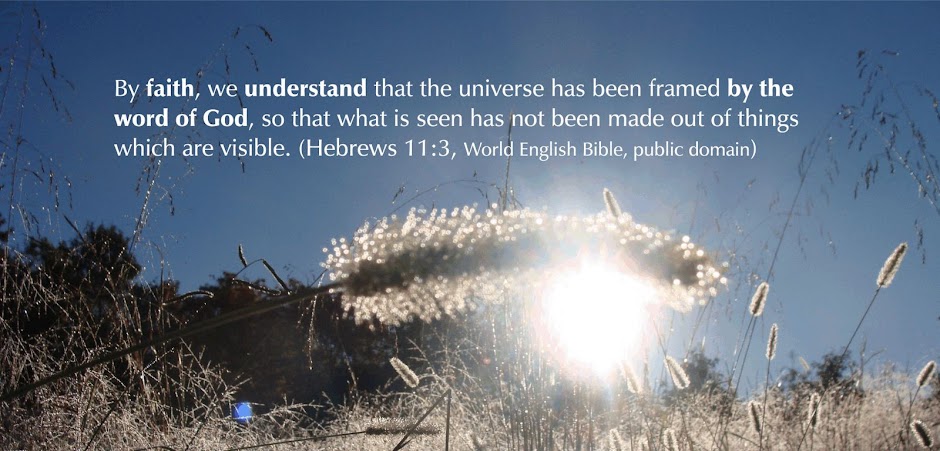
If Genesis 1 means anything, it means that God began the universe. Genesis 1:1 doesn't say when this was, or how or why it happened. It does say Who did it. That fact must be more important than when, how, or why. However the universe arose, we would not expect there to be much, if any, scientific evidence for the means by which it appeared. It is possible to believe that everything somehow began to be something. However, it takes an act of faith, just as believing in a supernatural Creator does. (Hebrews 11:3) Most people don't seem to recognize this. Some do. As Michael Shermer, frequent critic of supernatural beliefs, put it: "In conclusion, I believe, but cannot prove...that reality exists and science is the best method for understanding it, there is no God, the universe is determined but we are free, morality evolved as an adaptive trait of humans and human communities, and that ultimately all of existence is explicable through science." This is one of many responses to Edge's World Question for 2005, which was: "What do you Believe is True Even Though You Cannot Prove it?"

Schermer, a prominent self-confessed atheist, is to be commended for his honesty. He can't prove his world-view. He just believes it. As I understand Hebrews 11:3, I'm in the same position, and so are you, although our world-views may not be the same as Schermer's. So why does Schermer believe as he does? I think Ian Barbour put it very well, and honest naturalists (he uses materialists, instead) would agree with him (I have read statements by naturalists which show this.):

…both scientific materialists and biblical literalists have failed to recognize significant distinctions between scientific and religious assertions. The scientific materialists have promoted a particular philosophical commitment as if it were a scientific conclusion, and the biblical literalists have promoted a prescientific cosmology as if it were an essential part of religious faith. Ian G. Barbour, When Science Meets Religion: Enemies, Strangers, or Partners? San Francisco: Harper San Francisco, 2002, p. 36.

The philosophical commitment of the naturalist is that there is no God, no design, no plan, no pattern. They can believe it, but they can't prove it. I believe that there is a God, a design, a plan, and a pattern. I can't prove it, either. Hebrews 11:3 says that I can believe it, and I do.

One reason for making evolution a big deal is that it's easier to get people to pay attention to you, even support you financially, if you polarize a topic. (Just look at our political process.) Concerning evolution, it's easier to get an audience if you say something extreme, such as that all the science professors at a nearby university are atheists, or that all the conservative preachers in the county are ignorant, anti-scientific yahoos. Both things are said, sometimes because the speaker genuinely believes them, but, I am afraid, sometimes because the speaker wants to attract a following, knowing full well that there are believing scientists at many universities, and intelligent, open-minded (about scientific matters) preachers in conservative churches.

Such extremism does not help anyone, except maybe the extremists. Saying "I don't believe in evolution" is seldom, if ever, completely true. It isn't a clear statement, and may indicate ignorance or muddy thinking, or even deliberate obfuscation. It would be better to say "I believe that humans were specially created," or "I don't believe in macroevolution," or "I'm a young-earth creationist," or exactly whatever the speaker or writer does believe, or not believe. Not everyone is a naturalist -- I'm not -- but everyone believes in at least some evolution.

Tuesday, September 13, 2005

I believe in evolution. So do you!, part 1

I believe in evolution. So do you!
I hope that got your attention. Please read on.
A statement like the first sentence in the title should force the reader to ask a question: "What do you mean by evolution?" (The same question should have been asked, if that first sentence had said: "I don't believe in evolution.") All too often, the question isn't asked, and confusion results. This topic has generated a lot of discussion, and will generate more after I am long gone. Some of the discussion is because of genuine disagreements. But, unfortunately, some of it is because people aren't careful to define their terms.

One meaning of the word, evolution, is change. If that's the meaning, everybody believes in it. Transportation, for example, has evolved from walking and being pulled, or carried, by beasts of burden to bicycles, scooters, trains, automobiles and airplanes. No doubt there will be further evolution, in this sense.
The Bible indicates that all humans descended from a single couple, Adam and Eve, or from a single family, that of Noah and his sons and their wives. Humans are not nearly as homogeneous as they were in the time of Adam and Eve, or of Noah and his wife. That means that humans have evolved into various racial groups.

Another meaning is natural selection. Charles Darwin proposed the notion of natural selection. He noted that there was considerable variety in the offspring of a single pair, and that there weremore offspring born (or hatched, or sprouted) than survived. He also noted that offspring resemble their parents. Those facts led him to propose that there is a struggle for existence, that the most fit survive, and that they leave more offspring in the next generation than those who aren't so fit. I have never read anyone who understood it who doubted Darwin's facts, or his conclusion. Natural selection is a fact. It is probably at least partly responsible for the variety of humankind. It is almost certainly responsible for the frequencies of the sickle-cell anemia gene in various populations. It is responsible for antibiotic-resistant bacteria, and insecticide-resistant insects.
Artificial selection is when humans decide what individual domestic animal or plant is going to reproduce, because they want to get a certain type of offspring. Selection by humans works, and works well. An enormous variety of selective experiments have been done, sometimes by scientists, sometimes by farmers, or people raising animals or growing plants. You can select just about any species for just about anything. The mechanism of artificial selection isthe same as that proposed by Darwin for natural selection.
Darwin himself didn't seem to realize it, but the most important result of natural selection isn't change, it's stability. Organisms don't change very much over time, not because their offspring are all alike, but because departures from the norm are selected against.
So if everybody believes in selection, what's the big deal? Well, one reason is that there are other things people sometimes mean when they use the word,evolution.

Yet another meaning is speciation. The short title of Darwin's book was The Origin of Species. Speciation is those processes which lead to the appearance of new species. Here's where we hit a couple of the big deals. One big deal is the use, in the King James Bible, of the phrase, "after his kind." Some people think that that rules out speciation, the creation of new species. The fact is that, whatever "kind" meant, it is a concept of God, and we aren't sure what it meant. Species, and other categories of taxonomy, are human constructs, and don't necessarily correspond with "kind." (For all we know, cat kind included lions, leopards, and domestic cat-like animals.) Since these are human constructs, they are changeable. Darwin believed, and most biologists also do, that the mechanisms of natural selection, as described above, are responsible for the development of new species.
Can a Christian believe that new species arise by natural selection? Clearly, some do, and some don't. If the world is only about 6,000 years old, there hasn't been enough time for much speciation. If God created the variety of living things by miracles, then they didn't get here by natural selection operating on previous forms. There are Christians who believe that the world is about 6,000 years old, and some who believe that it is much older. Even if it is very old, of course, that doesn't prove that the species we have arose by natural selection, but it would make that possible. There are Christians who believe that God created basically all the species we have now, during a short period of time. There are Christians who don't. All flavors of belief about these matters can be found, although most people don't realize this.
My own view is that at least some speciation has occurred since the beginning. Even the most literal interpretations of Genesis don't rule all speciation out, in my opinion. However, they rule out the possibility that most species arose in this way. Therefore, many Christians do not believe in evolution, if by evolution is meant speciation.
The second big deal relates to humans. Did we arise from some previous species by natural selection? The Bible seems to indicate that humans were created by a miraculous process. The Bible indicates that humans are different, and the God treats them differently, from other organisms. God gave us dominion over the rest of them (Genesis 1:26, 28) and God came as a human,Jesus Christ.
(Lest there be any doubt, no reputable scientist believes that humans evolved from chimpanzees. Many scientists believe that humans and chimpanzees share a common ancestor.)
Some Christians believe that the first part of Genesis is not meant to be taken literally. They can accept that God may have used some process to produce humans out of non-humans, and that our bodies, at least, evolved from some pre-human stock. Many Christians do not accept this, and, therefore, do not believe in evolution, if by evolution is meant the origin of humans from non-humans by partly or entirely natural processes.
The scientific evidence for speciation, including that of humans, is, in a word, similarity. All animals have cells, and are alike in other ways. All mammals, including humans, are similar in several ways. Chimpanzees and humans look enough alike that chimps are sometimes dressed in human clothing. The two species share 96% or more of their DNA. I believe that the Bible teaches that evidence from nature, including the findings of science, must be taken into account. (Psalm 19, Romans 1:20, Acts 14:17) If we knew how to correctly interpret the Bible, and how to correctly interpret scientific findings, there would be no conflicts. We don't know how to correctly do either, and sometimes there are conflicts.
To be continued, God willing. (See here for the second part, here for the third.) If you really have too much time on your hands, click on the origins label at the end of this post!
Thanks for reading.