License

I have written an e-book, Does the Bible Really Say That?, which is free to anyone. To download that book, in several formats, go here.
Creative Commons License
The posts in this blog are licensed under a Creative Commons Attribution-NonCommercial-ShareAlike 3.0 Unported License. You can copy and use this material, as long as you aren't making money from it. If you give me credit, thanks. If not, OK.
Showing posts with label kudzu. Show all posts

Saturday, September 26, 2009

Kudzu

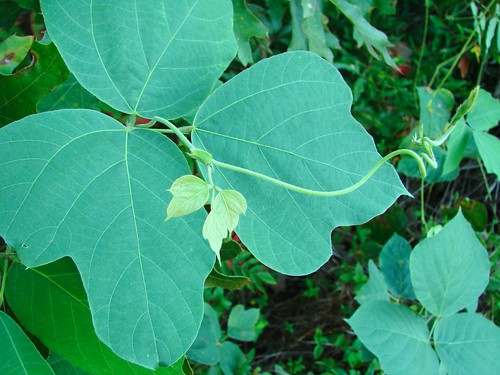
kudzu leaves

Kudzu has been discovered growing in Canada, according to the Toronto Globe and Mail. As you can see from the photo above, kudzu is a vining plant. It happens to be a member of the pea, or Fabaceae family of flowering plants. That means that it has structures in the roots, nodules, which Nitrogen-fixing bacteria can live in. These bacteria take Nitrogen out of the air in the soil, and begin the process of making it available to the kudzu plant, and, thence, to anything that will eat that plant. Nitrogen is found in proteins, and in DNA and RNA, and elsewhere. Living things absolutely must have it in order to exist.

Which brings up a question. How many signs of insect damage (or damage from plant-eating vertebrates, for that matter) do you see in the photo? The answer is none. In spite of kudzu's remarkably rapid growth -- the vines can grow up to a foot a day in good weather -- and that it is a source of protein, it is not eaten readily by many animals. Goats will eat it. I once tried to feed some captive mice some kudzu leaves. Apparently they would gladly have starved to death rather than eating the stuff, so I relented, and put them back on a more normal diet.

Why won't the animals of the Southeastern part of North America, where kudzu grows, eat the plant? Most likely, the answer is that kudzu is not native to that area. It is native to Japan, and parts of China. Presumably, in these areas there are various kinds of insects, and other animals, that eat it. But not in the Southeastern US. When kudzu was brought here, to stop erosion, the animals that eat it were left behind. As a result, kudzu grows almost unchecked. But it is checked. How? by frost. The first common green plant to perish when the weather gets cooler seems to be kudzu. The last plant to start growing in the summer is kudzu. It covers many a hill or field during the time between the first autumn freeze, and the last freeze of the next Spring.

This photo:
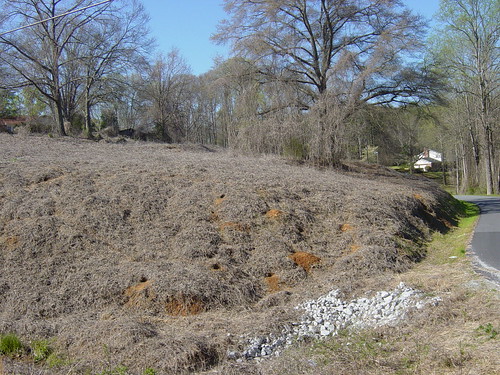
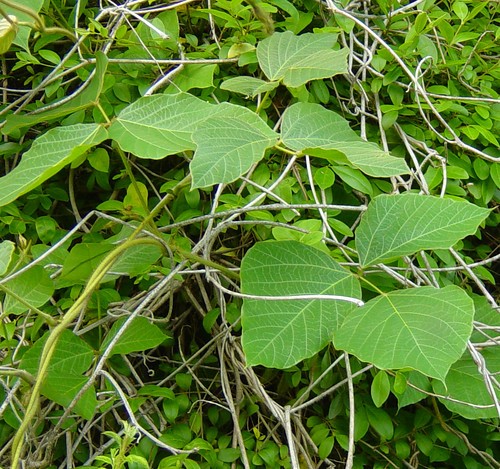
Kudzu, gray,  with woodchuck holes

Shows how kudzu is anything but green in the winter.

It is not good stewardship to bring non-native living things into an area. They often tend to mess up ths organisms that are already there.

Monday, May 16, 2005

Kudzu, stealth invader

Yesterday's post showed a photo of a kudzu leaf, and remarked that the plant is not native to the Southeastern U. S., even though it sometimes seems that it covers that section of the world.

Apparently kudzu was brought here by Japanese exhibitors. As a flourishing plant, with fragrant flowers, it attracted attention, and it wasn't long before it was being grown here.

There's a biological lesson in this. It often happens that organisms brought in to a new area thrive, and change the environment significantly, because there are no animals present in the new area whose role in life is to eat them, or parasitize them. That doesn't always happen, but it happens too often. I am aware of a few examples, including rabbits and other animals in Australia, kudzu, starlings, English sparrows, Russian thistles, giant Salvinia, lampreys, nutria and water hyacinths. No doubt there are many more. Some might say that the introduction of Old World humans into the New World from the East is another example of this!

Like kudzu, often the introductions have been deliberate, and probably never with the intention of radically changing the biological community, but for aesthetic reasons, or even to control other organisms.

The biological lesson is that we should be very careful what we are doing, and probably, in most cases, let things be as they are.

There's a spiritual lesson, too, of course. Some things don't belong in our brains. They may be brought there because they look or sound good, or just without thinking carefully about what we are doing, but end up destroying or displacing that which is good. See Philippians 4:8, which describes the things which we should put in our brains, and, by implication, what we should not. See also James 1:13-15, which tells of the consequences of letting sin into our lives. Like kudzu, it isn't supposed to be there. Like kudzu, it can flourish, and destroy the good that is there.

Finally, brethren, whatsoever things are true, whatsoever things are honorable, whatsoever things are just, whatsoever things are pure, whatsoever things are lovely, whatsoever things are of good report; if there be any virtue, and if there be any praise, think on these things. Philippians 4:8, ASV.

Sunday, May 15, 2005

Kudzu leaves

kudzu tendril
The picture above is of some kudzu leaves. Kudzu is not yet in bloom in upstate South Carolina, but, as you can see from yesterday's post, it is, as usual, thriving. Kudzu is one of the last plants to put forth new growth in the Spring. It is quite sensitive to frost. There will be blooms later. It grows rapidly, and I have never had a student from the Northeast or Midwest who didn't notice the ubiquity of kudzu during the season when it grows, as I did. I am still amazed at it, after four decades of living near it. If unchecked, it covers acres of land, and will cover buildings, trees, and other plants. The name is Japanese, apparently. It grows so well because there are few, or no, natural enemies of kudzu here. It is rare to find insect holes in kudzu leaves.
Woodchucks often live in holes in banks where kudzu is growing.
Kudzu is a member of the legume, or pea family of flowering plants. (Legume is a fancy name for pod.) This family is one of the most important families of plants, because they can fix Nitrogen, thus making it available for use in proteins, nucleic acids, and other essential molecules of living things. Vegetarians generally eat one or more legumes regularly.
Kudzu flowers, leaves and roots are edible (links go to recipes). The kudzu root apparently resembles jicama, or yam bean, root. Jicama (not kudzu) is available in some grocery stores in the area. I have grown to like it over the last year or so. I have yet to eat kudzu. Maybe someday.
* * * * * *
Addendum, January 19, 2006: Over the last few days, our Flickr photo of kudzu, which is the photo above, has experienced some 260 views. If you have been assigned this page for a school assignment, or have assigned it, good (although I'd be pleased to find out, if this is true). If you see any needed improvements, or have suggestions, please comment or contact me otherwise. Thanks.

Saturday, May 14, 2005

Cherokee rose

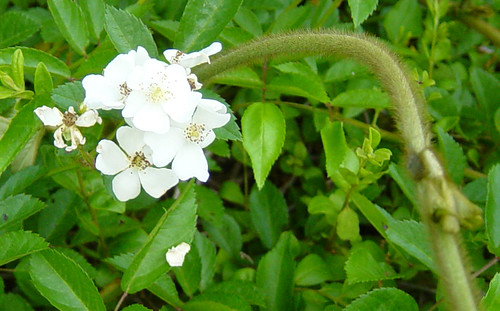
Cherokee rose with kudzu

And why are ye anxious concerning raiment? Consider the lilies of the field, how they grow; they toil not, neither do they spin: yet I say unto you, that even Solomon in all his glory was not arrayed like one of these. Matthew 6:28-29, ASV. (Similar language is used in Luke 12:27)

Yesterday's post featured blackberry flowers. Today's features another flower currently blooming in upstate South Carolina. This, like the blackberry, is a member of the rose family. I don't have a name for this one that I'm confident of, other than rose.

I am aware that roses aren't lilies. I also know that there is little certainty about what particular plants the Bible is referring to, when specific plants are mentioned. Even so, I don't propose that Jesus was talking about roses here. I am assuming that Jesus' statement applied to more than lilies.

I said I wasn't confident of the name, but this may be a Cherokee Rose. May not, too. I'm not sure. I expect to deal with common names in a future post.

This simple rose has a beauty of its own. So, of course, do showier ones, with more color and more petals.

The green thing going from the lower right to behind the flower is, for those not from here, a kudzu stem. I know what that is. I have to admit that even kudzu has beauty, if you can look at it with an unprejudiced eye. More on that later.

My blog description says that it's "Musings on science . . ." I haven't lived up to that part lately, and this series on what's happening around us here is an attempt to make up for that.