License

I have written an e-book, Does the Bible Really Say That?, which is free to anyone. To download that book, in several formats, go here.
Creative Commons License
The posts in this blog are licensed under a Creative Commons Attribution-NonCommercial-ShareAlike 3.0 Unported License. You can copy and use this material, as long as you aren't making money from it. If you give me credit, thanks. If not, OK.
Showing posts with label praise. Show all posts

Saturday, June 06, 2026

What we should/should not be thinking of

Philippians 4:8 Finally, brothers, whatever things are true, whatever things are honorable, whatever things are just, whatever things are pure, whatever things are lovely, whatever things are of good report: if there is any virtue and if there is anything worthy of praise, think about these things. (World English Bible)

That passage indicates that we should think about, and consider, the good in God's world, and the good that other people do. And it also indicates that we should avoid thinking of thangs that aren't good, in the society we live in.

That's hard. I'm something of a news junkie. CBS has been featuring Steve Hartman, reporting on the good in people, every week, for years. The network also reports on the good, nearly every evening. NBC has done the same thing, weekly, even explicitly reminding us that they are telling us about the good that people do.  I don't watch ABC or Fox evening news. Perhaps they, too, are highlighting good things. I hope so. Local TV news seems to be a morass of shootings, politicians lying, and people being horribly mistreated. There's an old saying, I think about newspapers (whatever they were!) "If it bleeds, it leads." There is plenty of bleeding in the world, but we emphasize it way too much.

Thanks for reading. I hope this post has done you some good. 


Thursday, July 11, 2024

Anti-pornography (and slander, and more) in the Bible

A Psalm by David.
101:1 I will sing of loving kindness and justice.
To you, Yahweh, I will sing praises.
101:2 I will be careful to live a blameless life.
When will you come to me?
I will walk within my house with a blameless heart.
101:3 I will set no vile thing before my eyes.
I hate the deeds of faithless men.
They will not cling to me.
101:4 A perverse heart will be far from me.
I will have nothing to do with evil.
101:5 I will silence whoever secretly slanders his neighbor.
I won’t tolerate one who is haughty and conceited.
101:6 My eyes will be on the faithful of the land,
that they may dwell with me.
He who walks in a perfect way,
he will serve me.
101:7 He who practices deceit won’t dwell within my house.
He who speaks falsehood won’t be established before my eyes.
101:8 Morning by morning, I will destroy all the wicked of the land;
to cut off all the workers of iniquity from Yahweh’s city. (World English Bible, public domain)

Verse 3a has an admonition against willingly experiencing pornography. And there are some more admonitions. Verse 5a is against slander. Verse 4b covers it all, I guess: "I will have nothing to do with evil." If that doesn't cover it all, there's 2a, "I will be careful to lead a blameless life." But, in spite of the importance of the warnings, Perhaps the first verse of the Psalm, "I will sing of loving kindness and justice. To you, Yahweh, I will sing praises" is the most important command. If I spend time praising God, verbally or in other media, I won't have time to slander anyone, or to indulge in pornography, or commit other sins. 

Thanks for reading. Praise God!

**** 

Added July 12, 2024:
Pornography is a form of adultery, and slander is a form of false witness. Both of these are forbidden by the Ten Commandments.

Wednesday, January 29, 2020

Sunspots 765


Things I have recently spotted that may be of interest to someone else:


Christianity: (and Sports) A "prophet" has apparently claimed that, if the Kansas City Chiefs win the Super Bowl, it will be an important sign of Christ's return, or something, according to Relevant.

Relevant also has an article on the difference between praise and worship.


(or something) Relevant also reports that President Trump's spiritual advisor prayed that "satanic pregnancies" would miscarry. What?!


Computing: NPR tells us how to avoid having a smartphone hacked.

Gizmo's Freeware tells how to add a webpage address to a smartphone's home screen.


Environment: The Trump administration has taken steps to drastically change water protection regulations, making it easier for some polluters to pollute, according to Gizmodo.
Politics: The New York Times has an article discussing the different challenges facing the two main parties. Basic conclusion: Democrats have to stay close to the center if they want to win. I thank one of my sons-in-law for a link to the article.

Science: Listverse tells us 10 things our body has or does, that you probably didn't know about. Sample: we give off light.


Sports: Maya Moore, one of the best WNBA players ever, has put her career on hold to work for the release of a man she believes was imprisoned unjustly.

FiveThirtyEight says that there will probably never be another Kobe Bryant -- he took shot s that aren't taken now.

The graphic used in these posts is from NASA, hence, it is free to use like this.

Thanks for looking!

Monday, March 20, 2017

Sins we can commit with our tongues

In spite of the title of this post, we aren't really capable of sinning with our tongues. Our heart, our brain, our character, commits sins, some of which are expressed by the tongue. (And also, in the 21st Century, by texting, e-mail, blogs, in print, and through social media.) As Jesus put it: Matt 15:18 But the things which proceed out of the mouth come out of the heart, and they defile the man.19 For out of the heart come evil thoughts, murders, adulteries, sexual sins, thefts, false testimony, and blasphemies. (All Bible quotations from the World English Bible, which is public domain.)
Note that the latter two are sins expressed by the tongue. The others, not so much. But all of them "come out of the heart."

There are some "tongue sins" mentioned in Scripture. Two of them are from the Ten Commandments:

Exodus 20:7 You shall not misuse the name of Yahweh your God, for Yahweh will not hold him guiltless who misuses his name. (There is a text note in the WEB, as follows: or, You shall not take the name of Yahweh your God in vain.)

and

16 You shall not give false testimony against your neighbor. 

The first of these two would seem to indicate that careless use (is there any other kind?) of "OMG," or what that abbreviation stands for, is sinful. Perhaps a more serious violation of that commandment would be to claim that God wants someone to do (or not do) something, when that action, or inaction, is not really of God. Perhaps most of the Crusades were examples of such misuse of God's name, for example.

As to false testimony, probably most lying is also sinful. (But see "Lying, deceit and dishonesty in the Bible," which points out a few examples where God seemed to have condoned verbal deceit. In no case did God condone such deceit where it was to the unfair advantage of the deceiver over others, or where it was to escape a deserved penalty.) When in doubt, I should tell the truth, especially under oath.
 

Mat 5:22 says that we aren't to call anyone a fool. That would seem to include co-workers, family members, politicians that we disagree with, as well as others.

Paul warns against foolish talk in Ephesians 4:29 and 5:4. James 3:10 says that we shouldn't curse. Jesus said that we should not swear, but just speak the truth - Mat 5:37. See also James 5:12.

Gossip is idle talk or rumor, especially about the personal or private affairs of others … (Wikipedia) See Romans 1:29, 2 Corinthians 12:20, 1 Timothy 5:13.

Slander is a false or malicious claim that may harm someone's reputation. (Wikipedia) See Matthew 15:19, Ephesians 4:31, Colossians 3:8, Psalm 101:5


There are other ways that we can sin with the tongue. One is to express pride in ourselves, or those in our family or group, to the low-rating of others. Another is that our talk may be overly self-centered, because we are overly self-centered. I can't document this, but someone said that there was a study done on phone conversations, and the word "I" occurred more often that any other. If I'm self-centered, I don't listen much, or at all. Using our tongue too much, when we should be attentively using our ears, can be sinful.


Enough of what we shouldn't do. What should we use our tongue for? 
David said:
Psalm 15:1 Yahweh, who shall dwell in your sanctuary?
Who shall live on your holy hill?
He who walks blamelessly and does what is right,
and speaks truth in his heart;
he who doesn’t slander with his tongue,
nor does evil to his friend,
nor casts slurs against his fellow man;
in whose eyes a vile man is despised,
but who honors those who fear Yahweh;
he who keeps an oath even when it hurts, and doesn’t change . . .
Isaiah 50:The Lord Yahweh has given me the tongue of those who are taught,
that I may know how to sustain with words him who is weary
  
It seems that the Bible teaches that the worst sin of the tongue is not any of those mentioned above. Rather, the worst sin of the tongue is failing to praise God the Father, Son and Holy Spirit for who He is and what He has done. 

There are at least two hundred passages in the Bible about praising God. A few of them are below.

Revelation is a book that is difficult to interpret. But one thing seems clear. God, Father, Son and Holy Spirit is to be praised:

Revelation 15:3 They sang the song of Moses, the servant of God, and the song of the Lamb, saying,

“Great and marvelous are your works, Lord God, the Almighty!
Righteous and true are your ways, you King of the nations.
Who wouldn’t fear you, Lord,
and glorify your name?
For you only are holy.
For all the nations will come and worship before you.
For your righteous acts have been revealed.”
Luke 19:36 As he went, they spread their cloaks on the road. 37 As he was now getting near, at the descent of the Mount of Olives, the whole multitude of the disciples began to rejoice and praise God with a loud voice for all the mighty works which they had seen, 38 saying, “Blessed is the King who comes in the name of the Lord! Peace in heaven, and glory in the highest!”
39 Some of the Pharisees from the multitude said to him, “Teacher, rebuke your disciples!”
40 He answered them, “I tell you that if these were silent, the stones would cry out.”
Hebrews 13:15 Through him, then, let’s offer up a sacrifice of praise to God continually, that is, the fruit of lips which proclaim allegiance to his name.
Acts 2:46 Day by day, continuing steadfastly with one accord in the temple, and breaking bread at home, they took their food with gladness and singleness of heart, 47 praising God, and having favor with all the people. The Lord added to the assembly day by day those who were being saved.
Luke 23:46 Jesus, crying with a loud voice, said, “Father, into your hands I commit my spirit!” Having said this, he breathed his last. 47 When the centurion saw what was done, he glorified God, saying, “Certainly this was a righteous man.”
There's plenty of praise in the Psalms, such as:
Psalm 100:4 Enter into his gates with thanksgiving,
and into his courts with praise.
Give thanks to him, and bless his name.
For Yahweh is good.
His loving kindness endures forever,
his faithfulness to all generations.
Here's the last of the Psalms, in its entirety:
Psalm 150:1 Praise Yah!
Praise God in his sanctuary!
Praise him in his heavens for his acts of power!
Praise him for his mighty acts!
Praise him according to his excellent greatness!
Praise him with the sounding of the trumpet!
Praise him with harp and lyre!
Praise him with tambourine and dancing!
Praise him with stringed instruments and flute!
Praise him with loud cymbals!
Praise him with resounding cymbals!
Let everything that has breath praise Yah!
Praise Yah!
 
May my tongue be an expression of my integrity, uplift others, and praise God. Thanks for reading!

Thursday, November 26, 2015

All things come from You

All things come from God

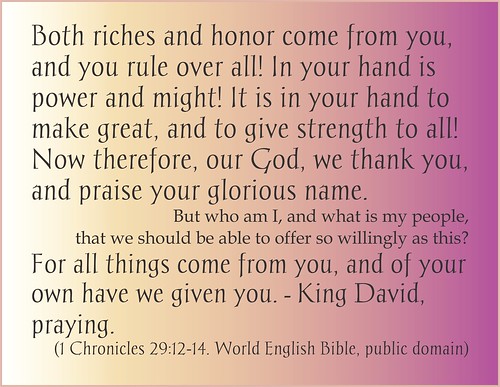
A Thanksgiving poster: All things come from You!

King David's prayer, on the occasion of receiving offerings from the people, for the future construction of the temple. Solomon, David's son, oversaw that construction, but David made sure that things were ready. ". . . all things come from you, and of your own have we given you!"

Thursday, May 14, 2015

Poster on giving God glory, based on The Imitation of Christ

Imitation of Christ, on glory 

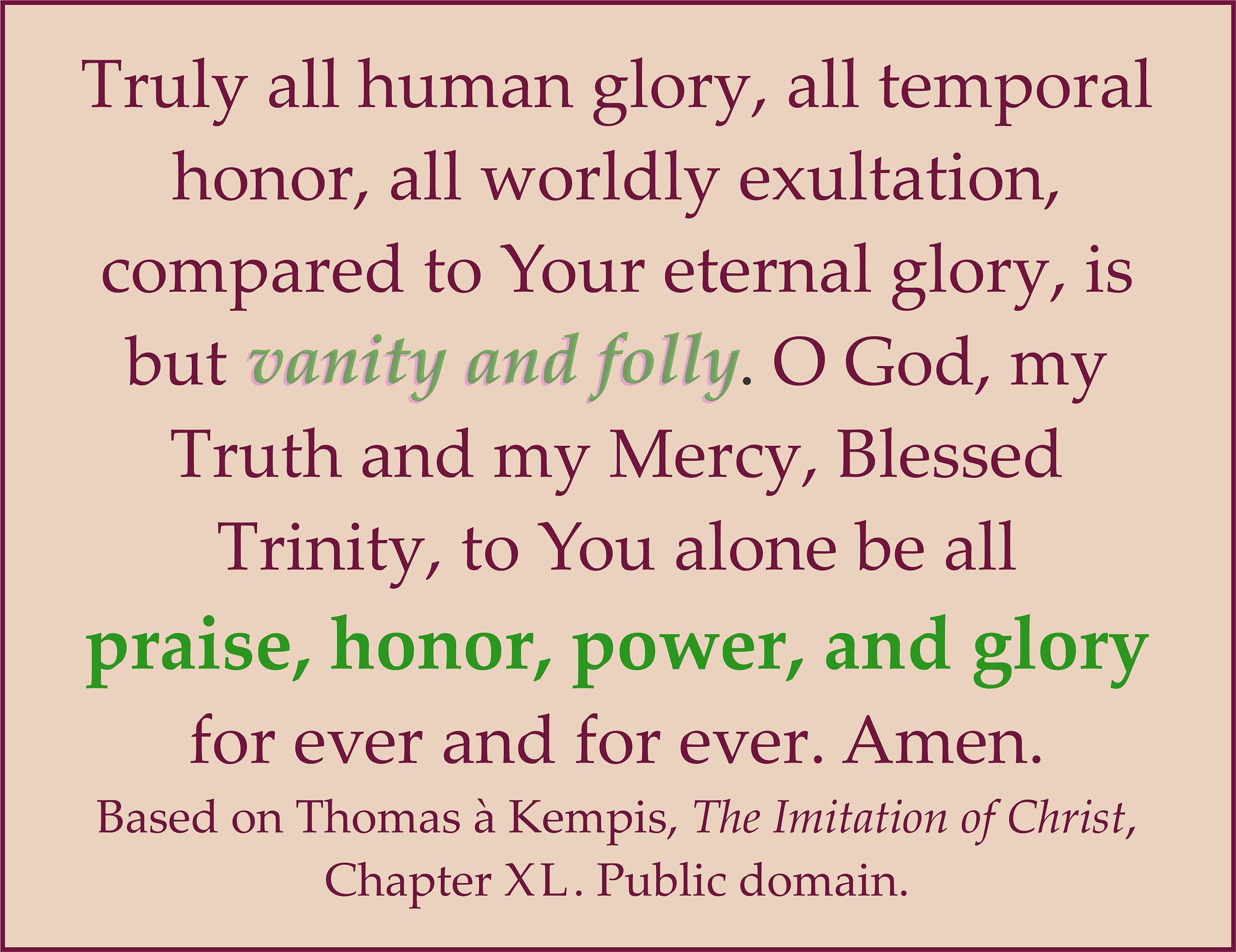
Based on The Imitation of Christ, a work by Thomas à Kempis, 15th century, hence public domain.

"Truly all human glory, all temporal honor, all worldly exultation, compared to Your eternal glory, is but vanity and folly. O God, my Truth and my Mercy, Blessed Trinity, to You alone be all praise, honor, power, and glory for ever and for ever. Amen." Indeed.

Thanks for looking. I used Coolors to generate the color scheme used in this poster.

Saturday, June 30, 2012

Prayer, praise and song, 2, by E. M. Bounds

When God is in the heart, heaven is present and melody is there, and the lips overflow out of the abundance of the heart. This is as true in the private life of the believer as it is so in the congregations of the saints. The decay of singing, the dying down and out of the spirit of praise in song, means the decline of grace in the heart and the absence of God’s presence from the people.

The main design of all singing is for God’s ear and to attract His attention and to please Him. It is “to the Lord,” for His glory, and to His honour. Certainly it is not for the glorification of the paid choir, to exalt the wonderful musical powers of the singers, nor is it to draw the people to the church, but it is for the glory of God and the good of the souls of the congregation. Alas! How far has the singing of choirs of churches of modern times departed from this idea! It is no surprise that there is no life, no power, no unction, no spirit, in much of the Church singing heard in this day. It is sacrilege for any but sanctified hearts and holy lips to direct the singing part of the service of God’s house of prayer. Much of the singing in churches would do credit to the opera house, and might satisfy as mere entertainments, pleasing the ear, but as a part of real worship, having in it the spirit of praise and prayer, it is a fraud, an imposition on spiritually minded people, and entirely unacceptable to God. The cry should go out afresh, “Let all the people praise the Lord,” for “it is good to sing praises unto our God; for it is pleasant; and praise is comely.”
The music of praise, for there is real music of soul in praise, is too hopeful and happy to be denied. All these are in the “giving of thanks.” In Philippians, prayer is called “requests.” “Let your requests be made known unto God,” which describes prayer as an asking for a gift, giving prominence to the thing asked for, making it emphatic, something to be given by God and received by us, and not something to be done by us. And all this is closely connected with gratitude to God, “with thanksgiving, let your requests be made known unto
God.” - From The Essentials of Prayer, by E. M. Bounds.

Although E. M. Bounds died in 1913, this book was first published in 1925, by an admirer of the author's life. Bounds was known for praying from four until seven each morning.

This post is one of a series, taken from The Essentials of Prayer, by Bounds. Found through the Christian Classics Ethereal Library, here. The Essentials of Prayer is in the public domain. The previous post in the entire series on the book is here. Thanks for reading. Read this book, and, more importantly, practice, prayer.

Sunday, June 17, 2012

Prayer and requests by E. M. Bounds

In Philippians, prayer is called “requests.” “Let your requests be made known unto God,” which describes prayer as an asking for a gift, giving prominence to the thing asked for, making it emphatic, something to be given by God and received by us, and not something to be done by us. And all this is closely connected
with gratitude to God, “with thanksgiving, let your requests be made known unto God.”
 
God does much for us in answer to prayer, but we need from Him many gifts, and for them we are to make special prayer. According to our special needs, so must our praying be. We are to be special and particular and bring to the knowledge of God by prayer, supplication and thanksgiving, our particular requests, the things we need, the things we greatly desire. And with it all, accompanying all these requests, there must be thanksgiving.
 
It is indeed a pleasing thought that what we are called upon to do on earth, to praise and give thanks, the angels in heaven and the redeemed disembodied spirits of the saints are doing also. It is still further pleasing to contemplate the glorious hope that what God wants us to do on earth, we will be engaged in doing throughout an unending eternity. Praise and thanksgiving will be our blessed employment while we remain in heaven. Nor will we ever grow weary of this pleasing task. - From The Essentials of Prayer, by E. M. Bounds.

Although E. M. Bounds died in 1913, this book was first published in 1925, by an admirer of the author's life. Bounds was known for praying from four until seven each morning.

This post is one of a series, taken from The Essentials of Prayer, by Bounds. Found through the Christian Classics Ethereal Library, here. The Essentials of Prayer is in the public domain. The previous post in the entire series on the book is here. Thanks for reading. Read this book, and, more importantly, practice, prayer.

Sunday, June 10, 2012

Prayer, praise and song, by E. M. Bounds

Praise is so distinctly and definitely wedded to prayer, so inseparably joined, that they cannot be divorced. Praise is dependent on prayer for its full volume and its sweetest melody. . . .

Giving thanks is the very life of prayer. It is its fragrance and music, its poetry and its crown. Prayer bringing the desired answer breaks out into praise and thanksgiving. So that whatever interferes with and injures the spirit of prayer necessarily hurts and dissipates the spirit of praise.

The heart must have in it the grace of prayer to sing the praise of God. Spiritual singing is not to be done by musical taste or talent, but by the grace of God in the heart. Nothing helps praise so mightily as a gracious revival of true religion in the Church. The conscious presence of God inspires song. The angels and the glorified ones in heaven do not need artistic precentors to lead them, nor do they care for paid choirs to chime in with their heavenly doxologies of praise and worship. They are not dependent on singing schools to teach them the notes and scale of singing. Their singing involuntarily breaks forth from the heart.

God is immediately present in the heavenly assemblies of the angels and the spirits of just men made perfect. His glorious presence creates the song, teaches the singing, and impregnates their notes of praise. It is so on earth. God’s presence begets singing and thanksgiving, while the absence of God from our congregations is the death of song, or, which amounts to the same, makes the singing lifeless, cold and formal. His conscious presence in our churches would bring back the days of praise and would restore the full chorus of song.

Where grace abounds, song abounds. - From The Essentials of Prayer, by E. M. Bounds.

Although E. M. Bounds died in 1913, this book was first published in 1925, by an admirer of the author's life. Bounds was known for praying from four until seven each morning.

This post is one of a series, taken from The Essentials of Prayer, by Bounds. Found through the Christian Classics Ethereal Library, here. The Essentials of Prayer is in the public domain. The previous post in the entire series on the book is here. Thanks for reading. Read this book, and, more importantly, practice, prayer.

Sunday, June 03, 2012

Prayer, Praise and Thanksgiving, by E. M. Bounds, part four

Wherever there is true prayer, there thanksgiving and gratitude stand hard by, ready to respond to the answer when it comes. For as prayer brings the answer, so the answer brings forth gratitude and praise. As prayer sets God to work, so answered prayer sets thanksgiving to work. Thanksgiving follows answered prayer just as day succeeds night.
True prayer and gratitude lead to full consecration, and consecration leads to more praying and better praying. A consecrated life is both a prayer-life and a thanksgiving life.
The spirit of praise was once the boast of the primitive Church. This spirit abode on the tabernacles of these early Christians, as a cloud of glory out of which God shined and spoke. It filled their temples with the perfume of costly, flaming incense. That this spirit of praise is sadly deficient in our present-day congregations must be evident to every careful observer. That it is a mighty force in projecting the Gospel, and its body of vital forces, must be equally evident. To restore the spirit of praise to our congregations should be one of the main points with every true pastor. The normal state of the Church is set forth in the declaration made to God in Psalm 65: “Praise waiteth for thee, O Lord, and unto thee shall the vow be performed.” - From The Essentials of Prayer, by E. M. Bounds.

Although E. M. Bounds died in 1913, this book was first published in 1925, by an admirer of the author's life. Bounds was known for praying from four until seven each morning.

This post is one of a series, taken from The Essentials of Prayer, by Bounds. Found through the Christian Classics Ethereal Library, here. The Essentials of Prayer is in the public domain. The previous post in the entire series on the book is here. Thanks for reading. Read this book, and, more importantly, practice, prayer.

Sunday, May 27, 2012

Prayer, Praise and Thanksgiving, by E. M. Bounds, part three

Gratitude and thanksgiving always looks back at the past though it may also take in the present. But prayer always looks to the future. Thanksgiving deals with things already received. Prayer deals with things desired, asked for and expected. Prayer turns to gratitude and praise when the things asked for have been granted by God.
As prayer brings things to us which beget gratitude and thanksgiving, so praise and gratitude promote prayer, and induce more praying and better praying.
Gratitude and thanksgiving forever stand opposed to all murmurings at God’s dealings with us, and all complainings at our lot. Gratitude and murmuring never abide in the same heart at the same time. An unappreciative spirit has no standing beside gratitude and praise. And true prayer corrects complaining and promotes gratitude and thanksgiving. Dissatisfaction at one’s lot, and a disposition to be discontented with things which come to us in the providence of God, are foes to gratitude and enemies to thanksgiving.
The murmurers are ungrateful people. Appreciative men and women have neither the time nor disposition to stop and complain. The bane of the wilderness-journey of the Israelites on their way to Canaan was their proneness to murmur and complain against God and Moses. For this, God was several times greatly grieved, and it took the strong praying of Moses to avert God’s wrath because of these murmurings. The absence of gratitude left no room nor disposition for praise and thanksgiving, just as it is so always. But when these same Israelites were brought through the Red Sea dry shod, while their enemies were destroyed, there was a song of praise led by Miriam, the sister of Moses. One of the leading sins of these Israelites was forgetfulness of God and His mercies, and ingratitude of soul. This brought forth murmurings and lack of praise, as it always does. - From The Essentials of Prayer, by E. M. Bounds.

Although E. M. Bounds died in 1913, this book was first published in 1925, by an admirer of the author's life. Bounds was known for praying from four until seven each morning.

This post is one of a series, taken from The Essentials of Prayer, by Bounds. Found through the Christian Classics Ethereal Library, here. The Essentials of Prayer is in the public domain. The previous post in the entire series on the book is here. Thanks for reading. Read this book, and, more importantly, practice, prayer.

Sunday, May 13, 2012

Prayer, Praise and Thanksgiving, by E. M. Bounds, Part two

Gratitude is born of meditation on God’s grace and mercy. “The Lord hath done great things for us, whereof we are glad.” [Psalm 126:3] Herein we see the value of serious meditation. “My meditation of him shall be sweet.” [Psalm 104:34] Praise is begotten by gratitude and a conscious obligation to God for mercies given. As we think of mercies past, the heart is inwardly moved to gratitude.

Love is the child of gratitude. Love grows as gratitude is felt, and then breaks out into praise and thanksgiving to God: “I love the Lord because he hath heard my voice and my supplication.” [Psalm  116:1] Answered prayers cause gratitude, and gratitude brings forth a love that declares it will not cease praying: “Because he hath inclined his ear unto me, therefore will I call upon him as long as I live.” [Psalm 116:2] Gratitude and love move to larger and increased praying.
Paul appeals to the Romans to dedicate themselves wholly to God, a living sacrifice, and the constraining motive is the mercies of God:
“I beseech you, therefore, brethren, by the mercies of God, that ye present your bodies a living sacrifice, holy, acceptable unto God, which is your reasonable service.” [Romans 12:1]
Consideration of God’s mercies not only begets gratitude, but induces a large consecration to God of all we have and are. So that prayer, thanksgiving and consecration are all linked together inseparably. - From The Essentials of Prayer, by E. M. Bounds.

Although E. M. Bounds died in 1913, this book was first published in 1925, by an admirer of the author's life. Bounds was known for praying from four until seven each morning.

This post is one of a series, taken from The Essentials of Prayer, by Bounds. Found through the Christian Classics Ethereal Library, here. The Essentials of Prayer is in the public domain. The previous post in the entire series on the book is here. Thanks for reading. Read this book, and, more importantly, practice, prayer.

Sunday, May 06, 2012

Prayer, Praise and Thanksgiving, by E. M. Bounds, Part one

Prayer, praise and thanksgiving all go in company. A close relationship exists between them. Praise and thanksgiving are so near alike that it is not easy to distinguish between them or define them separately. The Scriptures join these three things together. Many are the causes for thanksgiving and praise. The Psalms are filled with many songs of praise and hymns of thanksgiving, all pointing back to the results of prayer. Thanksgiving includes gratitude. In fact thanksgiving is but the expression of an inward conscious gratitude to God for mercies received. Gratitude is an inward emotion of the soul, involuntarily arising therein, while thanksgiving is the voluntary expression of gratitude.
 
Thanksgiving is oral, positive, active. It is the giving out of something to God. Thanksgiving comes out into the open. Gratitude is secret, silent, negative, passive, not showing its being till expressed in praise and thanksgiving. Gratitude is felt in the heart. Thanksgiving is the expression of that inward feeling.
 
Thanksgiving is just what the word itself signifies—the giving of thanks to God. It is giving something to God in words which we feel at heart for blessings received. Gratitude arises from a contemplation of the goodness of God. It is bred by serious meditation on what God has done for us. Both gratitude and thanksgiving point to, and have to do with God and His mercies. The heart is consciously grateful to God. The soul gives expression to that heartfelt gratitude to God in words or acts. - From The Essentials of Prayer, by E. M. Bounds.

Although E. M. Bounds died in 1913, this book was first published in 1925, by an admirer of the author's life. Bounds was known for praying from four until seven each morning.

This post is one of a series, taken from The Essentials of Prayer, by Bounds. Found through the Christian Classics Ethereal Library, here. The Essentials of Prayer is in the public domain. The previous post in the entire series on the book is here. Thanks for reading. Read this book, and, more importantly, practice, prayer.

Sunday, November 20, 2011

Prayers in the Bible: Paul concludes 2 Timothy

2 Timothy 4:18 And the Lord will deliver me from every evil work, and will preserve me for his heavenly Kingdom; to whom be the glory forever and ever. Amen.
19 Greet Prisca and Aquila, and the house of Onesiphorus. 20 Erastus remained at Corinth, but I left Trophimus at Miletus sick. 21 Be diligent to come before winter. Eubulus salutes you, as do Pudens, Linus, Claudia, and all the brothers. 22 The Lord Jesus Christ be with your spirit. Grace be with you. Amen. (World English Bible, public domain)

These are last verses of Paul's second letter to his friend, co-worker, and apprentice, Timothy. They include a personal request, greetings, and news about Trophimus. But they are also flavored with three types of prayer. "to whom be the glory forever and ever," in verse 18 is Adoration, pure and simple. The first part of the same verse is Thanksgiving. In this case, it is praise in advance, for something God hasn't done yet, but is going to do. Amazing!

The last verse is the most common type of prayer in the New Testament. It is a prayer of supplication, or intercession, for a fellow believer, in this case, Timothy.

Thanks for reading. This post is one of a series on prayer. The previous post in the series is here.

Sunday, August 14, 2011

Prayers in the Bible: Jehoshaphat sends the choir in front of the army

2 Chronicles 20:1 It happened after this, that the children of Moab, and the children of Ammon, and with them some of the Ammonites, came against Jehoshaphat to battle. 2 Then some came who told Jehoshaphat, saying, “A great multitude is coming against you from beyond the sea from Syria. Behold, they are in Hazazon Tamar” (that is, En Gedi). 3 Jehoshaphat was alarmed, and set himself to seek to Yahweh. He proclaimed a fast throughout all Judah. 4 Judah gathered themselves together, to seek help from Yahweh. They came out of all the cities of Judah to seek Yahweh. 5 Jehoshaphat stood in the assembly of Judah and Jerusalem, in the house of Yahweh, before the new court; 6 and he said, “Yahweh, the God of our fathers, aren’t you God in heaven? Aren’t you ruler over all the kingdoms of the nations? Power and might are in your hand, so that no one is able to withstand you. 7 Didn’t you, our God, drive out the inhabitants of this land before your people Israel, and give it to the seed of Abraham your friend forever? 8 They lived in it, and have built you a sanctuary in it for your name, saying, 9 ‘If evil comes on us—the sword, judgment, pestilence, or famine—we will stand before this house, and before you, (for your name is in this house), and cry to you in our affliction, and you will hear and save.’ 10 Now, behold, the children of Ammon and Moab and Mount Seir, whom you would not let Israel invade, when they came out of the land of Egypt, but they turned aside from them, and didn’t destroy them; 11 behold, how they reward us, to come to cast us out of your possession, which you have given us to inherit. 12 Our God, will you not judge them? For we have no might against this great company that comes against us; neither know we what to do, but our eyes are on you.”
13 All Judah stood before Yahweh, with their little ones, their wives, and their children. 14 Then the Spirit of Yahweh came on Jahaziel the son of Zechariah, the son of Benaiah, the son of Jeiel, the son of Mattaniah, the Levite, of the sons of Asaph, in the midst of the assembly; 15 and he said, “Listen, all Judah, and you inhabitants of Jerusalem, and you king Jehoshaphat. Thus says Yahweh to you, ‘Don’t be afraid, neither be dismayed by reason of this great multitude; for the battle is not yours, but God’s. 16 Tomorrow go down against them. Behold, they are coming up by the ascent of Ziz. You shall find them at the end of the valley, before the wilderness of Jeruel. 17 You will not need to fight this battle. Set yourselves, stand still, and see the salvation of Yahweh with you, O Judah and Jerusalem. Don’t be afraid, nor be dismayed. Go out against them tomorrow, for Yahweh is with you.’”
18 Jehoshaphat bowed his head with his face to the ground; and all Judah and the inhabitants of Jerusalem fell down before Yahweh, worshiping Yahweh. 19 The Levites, of the children of the Kohathites and of the children of the Korahites, stood up to praise Yahweh, the God of Israel, with an exceeding loud voice. 20 They rose early in the morning, and went forth into the wilderness of Tekoa: and as they went forth, Jehoshaphat stood and said, “Listen to me, Judah, and you inhabitants of Jerusalem! Believe in Yahweh your God, so you shall be established! Believe his prophets, so you shall prosper.”
21 When he had taken counsel with the people, he appointed those who should sing to Yahweh, and give praise in holy array, as they went out before the army, and say, Give thanks to Yahweh; for his loving kindness endures forever. 22 When they began to sing and to praise, Yahweh set ambushers against the children of Ammon, Moab, and Mount Seir, who had come against Judah; and they were struck. 23 For the children of Ammon and Moab stood up against the inhabitants of Mount Seir, utterly to kill and destroy them: and when they had made an end of the inhabitants of Seir, everyone helped to destroy another. 24 When Judah came to the place overlooking the wilderness, they looked at the multitude; and behold, they were dead bodies fallen to the earth, and there were none who escaped. 25 When Jehoshaphat and his people came to take their plunder, they found among them in abundance both riches and dead bodies, and precious jewels, which they stripped off for themselves, more than they could carry away: and they were three days in taking the plunder, it was so much. 26 On the fourth day they assembled themselves in the valley of Beracah; for there they blessed Yahweh: therefore the name of that place was called The valley of Beracah to this day. 27 Then they returned, every man of Judah and Jerusalem, and Jehoshaphat in their forefront, to go again to Jerusalem with joy; for Yahweh had made them to rejoice over their enemies. 28 They came to Jerusalem with stringed instruments and harps and trumpets to the house of Yahweh. 29 The fear of God was on all the kingdoms of the countries, when they heard that Yahweh fought against the enemies of Israel. (World English Bible, public domain)

I don't need to say much about this remarkable story, other than to reiterate part of the title of this post -- Jehoshaphat sent the choir out in front of the army, to point out that King Jehoshaphat was guided by God, speaking through a specific Levite, and that he also took counsel with the people, a wise move, and finally, that the congregation wisely praised God for the result of this battle.

This is one of a series on prayers in the Bible. The previous post is here. Thanks for reading.

Sunday, July 24, 2011

Prayers in the Bible: David doesn't get what he wants

1 Chronicles 17:1  It happened, when David lived in his house, that David said to Nathan the prophet, “Behold, I dwell in a house of cedar, but the ark of the covenant of Yahweh is under curtains.”
2  Nathan said to David, “Do all that is in your heart; for God is with you.”
3  It happened the same night, that the word of God came to Nathan, saying, 4  “Go and tell David my servant, ‘Thus says Yahweh, “You shall not build me a house to dwell in; 5  for I have not lived in a house since the day that I brought up Israel, to this day, but have gone from tent to tent, and from one tent to another. 6  In all places in which I have walked with all Israel, did I speak a word with any of the judges of Israel, whom I commanded to be shepherd of my people, saying, ‘Why have you not built me a house of cedar?’”’
7  “Now therefore, you shall tell my servant David, ‘Thus says Yahweh of Armies, “I took you from the sheep pen, from following the sheep, that you should be prince over my people Israel. 8  I have been with you wherever you have gone, and have cut off all your enemies from before you. I will make you a name, like the name of the great ones who are in the earth. 9  I will appoint a place for my people Israel, and will plant them, that they may dwell in their own place, and be moved no more; neither shall the children of wickedness waste them any more, as at the first, 10  and from the day that I commanded judges to be over my people Israel; and I will subdue all your enemies. Moreover I tell you that Yahweh will build you a house. 11  It shall happen, when your days are fulfilled that you must go to be with your fathers, that I will set up your seed after you, who shall be of your sons; and I will establish his kingdom. 12  He shall build me a house, and I will establish his throne forever. 13  I will be his father, and he shall be my son. I will not take my loving kindness away from him, as I took it from him that was before you; 14  but I will settle him in my house and in my kingdom forever. His throne shall be established forever.”’” 15  According to all these words, and according to all this vision, so Nathan spoke to David.
16  Then David the king went in, and sat before Yahweh; and he said, “Who am I, Yahweh God, and what is my house, that you have brought me thus far? 17  This was a small thing in your eyes, God; but you have spoken of your servant’s house for a great while to come, and have respected me according to the estate of a man of high degree, Yahweh God. 18  What can David say yet more to you concerning the honor which is done to your servant? For you know your servant. 19  Yahweh, for your servant’s sake, and according to your own heart, you have worked all this greatness, to make known all these great things. 20  Yahweh, there is none like you, neither is there any God besides you, according to all that we have heard with our ears. 21  What one nation in the earth is like your people Israel, whom God went to redeem to himself for a people, to make you a name by great and awesome things, in driving out nations from before your people, whom you redeem out of Egypt? 22  For your people Israel you made your own people forever; and you, Yahweh, became their God. 23  Now, Yahweh, let the word that you have spoken concerning your servant, and concerning his house, be established forever, and do as you have spoken. 24  Let your name be established and magnified forever, saying, ‘Yahweh of Armies is the God of Israel, even a God to Israel. The house of David your servant is established before you.’ 25  For you, my God, have revealed to your servant that you will build him a house. Therefore your servant has found courage to pray before you. 26  Now, Yahweh, you are God, and have promised this good thing to your servant. 27  Now it has pleased you to bless the house of your servant, that it may continue forever before you; for you, Yahweh, have blessed, and it is blessed forever.” (World English Bible, public domain)

David wanted to do something to honor God. But God had other plans. Better plans. May this be the story of my life, and yours -- we want to honor God, but God has other, and even better, plans.

Thanks for reading. This is one of a series on prayers in the Bible. The previous post in the series is here.

Saturday, January 29, 2011

Happy 3rd birthday, grandson #2!

Happy 3rd birthday! Grandson #2, getting a haircut

Our younger grandson began his independent life in a neonatal intensive care unit. If you wish, you can see a brief video of the occasion, here. (To my amazement, that video has been viewed well over 10,000 times.)

We thank God that he is a healthy youngster, now three years of age. He didn't stay in the NICU very long.

We love him! (Of course, we love his parents, and his older brother, too.)

Thank God for grandchildren!

Sunday, December 27, 2009

My Heart is Full of Christ, by John Wesley

My heart is full of Christ, and longs
Its glorious matter to declare!
Of Him I make my loftier song,
I cannot from His praise forbear;
My ready tongue makes haste to sing
The glories of my heavenly King.

Fairer than all the earth-born race,
Perfect in comeliness Thou art;
Replenished are Thy lips with grace,
And full of love Thy tender heart:
God ever blest! we bow the knee,
And own all fullness dwells in Thee.

Gird on Thy thigh the Spirit’s sword,
And take to Thee Thy power divine;
Stir up Thy strength, almighty Lord,
All power and majesty are Thine:
Assert Thy worship and renown;
O all redeeming God, come down!

Come, and maintain Thy righteous cause,
And let Thy glorious toil succeed;
Dispread the victory of Thy cross,
Ride on, and prosper in Thy deed;
Through earth triumphantly ride on,
And reign in every heart alone.

Praise to Christ is certainly important at this, and all times. This hymn by Charles Wesley, which I have never heard sung, is one of over 250 on his page at NetHymnal.org. This is the page for this hymn.

Thanks for reading. A blessed season to you!

Sunday, December 13, 2009

Father, God, We Glorify by Charles Wesley

Father, God, we glorify
Thy love to Adam’s seed;
Love that gave Thy Son to die,
And raised Him from the dead:
Him, for our offenses slain,
That we all might pardon find,
Thou hast brought to life again,
The Savior of mankind.

By Thy own right hand of power
Thou hast exalted Him,
Sent the mighty Conqueror
Thy people to redeem:
King of Saints, and Prince of Peace,
Him Thou hast for sinners giv’n,
Sinners from their sins to bless,
And lift them up to Heav’n.

Father, God, to us impart
The gift unspeakable;
Now in every waiting heart
Thy glorious Son reveal:
Quickened with our living Lord,
Let us in Thy Spirit rise,
Rise to all Thy life restored,
And bless Thee in the skies.

In its way, this is a Christmas hymn, in that it talks about sending Christ to us. This is one of over 250 hymns on the Charles Wesley page of nethymnal.org. I have never heard it sung, but you can hear music that has been used to accompany the text on the hymn's own page, here.

Sunday, December 06, 2009

A Hymn to the Trinity, by Charles Wesley

Hail, co-essential Three,
In mystic Unity!
Father, Son, and Spirit, hail!
God by Heaven and earth adored,
God incomprehensible;
One supreme, almighty Lord,
One supreme, almighty Lord.

Thou sittest on the throne,
Plurality in One;
Saints behold Thine open face,
Bright, insufferably bright;
Angels tremble as they gaze,
Sink into a sea of light,
Sink into a sea of light.

Ah! when shall we increase
Their heavenly ecstasies?
Chant, like them, the Lord Most High,
Fall like them who dare not move;
“Holy, holy, holy,” cry,
Breathe the praise of silent love?

Come, Father, in the Son
And in the Spirit down;
Glorious Triune Majesty,
God through endless ages blest,
Make us meet Thy face to see,
Then receive us to Thy breast;
Then receive us to Thy breast.

This hymn, which I have never heard sung, is one of over 250 on the Charles Wesley page of NetHymnal.org. The hymn has its own page, here.

Thanks for reading. Praise to Father, Son, and Holy Ghost!