

I believe that you can get a larger version of the graphic below, by right-clicking on it. You may feel free to use the graphic, as long as you do not use it for any commercial purpose -- it must remain free for all to use.
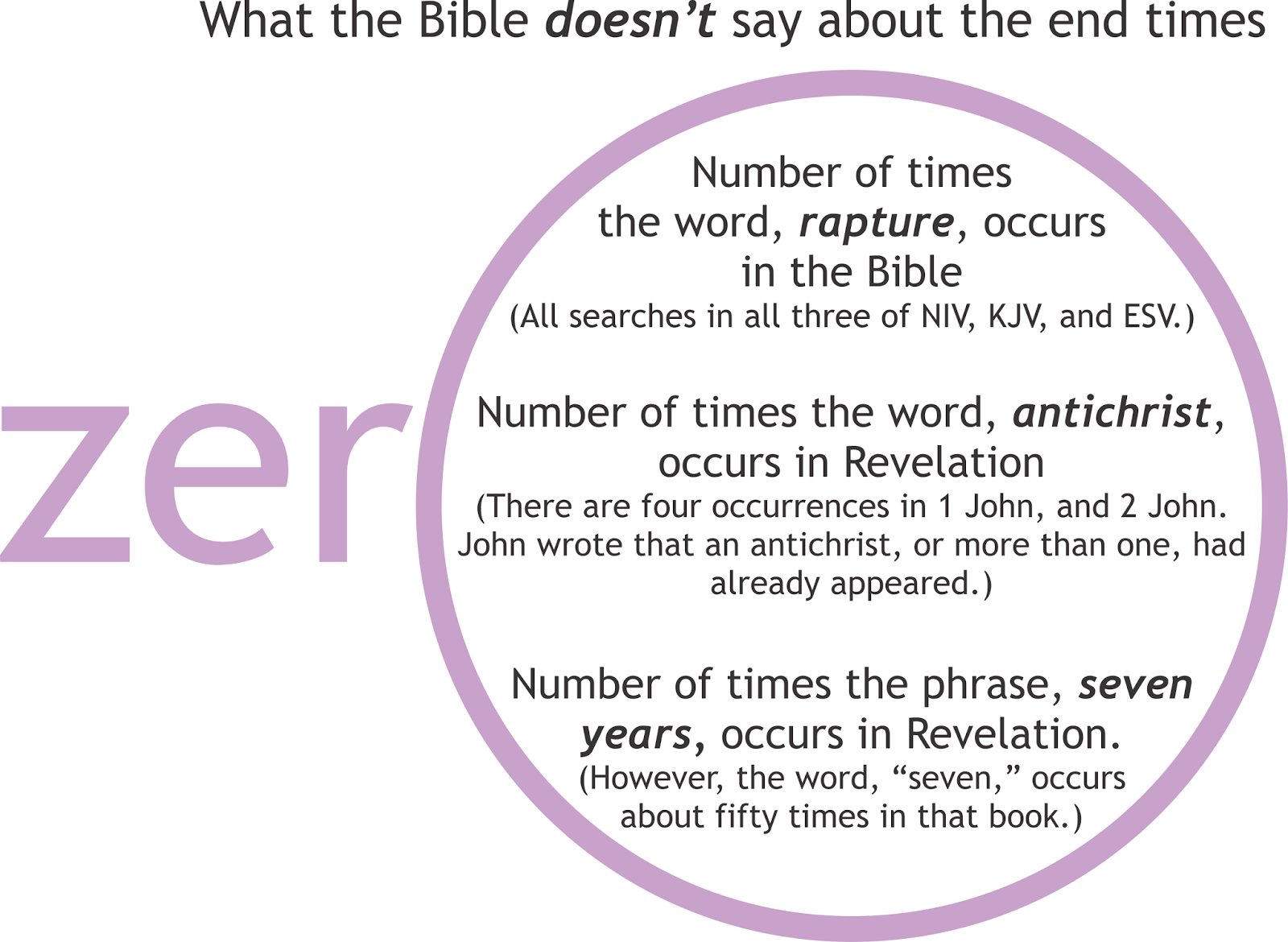
I don't have a lot of answers on end times. Some people seem to have answers, and they may be right. The above graphic illustrates reasons for caution. The Bible is not as clear about the end times as some people seem to believe that it is.
"Rapture" is not a word used in the Bible. The presentation of the idea of a rapture, a sudden removal of Christians from the world, that is most familiar to me is based on 1 Thessalonians 4:17. However, as you may learn from the comments on this post, below, that familiar presentation is probably mistaken, and a misinterpretation of scripture. (This paragraph was amended on September 28, 2009)
There are other reasons for caution. The Bible says this:
Matthew 24:36 “But concerning that day and hour no one knows, not even the angels of heaven, nor the Son, but the Father only. (All scripture from the ESV. See here for information on the ESV policy on on-line usage.)
and
Matthew 24:44 Therefore you also must be ready, for the Son of Man is coming at an hour you do not expect.
A serious warning, widely ignored, occurs in Revelation: 22:18 I warn everyone who hears the words of the prophecy of this book: if anyone adds to them, God will add to him the plagues described in this book, 19 and if anyone takes away from the words of the book of this prophecy, God will take away his share in the tree of life and in the holy city, which are described in this book.
Connie Willis, an author of fantastic literature, put it this way, probably a little too cynically, and, perhaps, even violating the warning above -- but she has a point -- in a short story:
The radio evangelists made it sound like the story of the Second Coming was a single narrative, but it was actually a hodgepodge of isolated scriptures -- Matthew 24 and sections of Isaiah and Daniel, verses out of Second Thessalonians and Joel, stray ravings from Revelation and Jeremiah, all thrown together by the evangelists as if the authors were writing at the same time. If they were even writing about the same thing. Connie Willis, "Epiphany," pp. 653-700, in The Winds of Marble Arch and Other Stories -- Burton, MI: Subterranean Press, 2007 -- p. 671. For similar thoughts, from an expert in Biblical interpretation, see here. (The expert doesn't call Revelation "ravings.") The expert, Kenneth Schenck, of Indiana Wesleyan University, is referring to the Dispensationalist view of end times, in particular the idea that there will be a seven year tribulation, and he points out that that view has, at best, very weak support in the Bible.
Thanks for reading. The Bible is clear on one idea about the end times: He is returning! We don't know when.
* * * * *
Added August 3, 2011: Here is a post, by me, on the first four prophecies mentioned by Matthew as being fulfilled by the coming, and early life, of Christ, and how difficult it must have been for those who first heard these prophecies, or even spoke and wrote them, to understand them as being about what actually happened.
Since these prophecies were difficult to interpret -- in some cases, impossible to interpret correctly until after the prediction came about -- why should we expect easy interpretations of prophecies about end times?
Added March 13, 2010:
David Heddle, of the He Lives blog, has recently posted on a particular word that occurs sometimes in prophecy, namely soon, and also this generation. He points out that some who claim to be interpreting the Bible very literally ignore, for example, part of the very first verse of Revelation, which says that Jesus told John that He was going to show him what would happen soon. Heddle doesn't seem to have a solution to how to deal with soon. I don't either. But, as I said in the title, it's best to be cautious, very cautious, about interpreting end times. Some people aren't very careful.
Added September 18, 2010:
Heddle has also posted on Armageddon, making a case for the idea that the Battle of Armageddon has already occurred.

