License

I have written an e-book, Does the Bible Really Say That?, which is free to anyone. To download that book, in several formats, go here.
Creative Commons License
The posts in this blog are licensed under a Creative Commons Attribution-NonCommercial-ShareAlike 3.0 Unported License. You can copy and use this material, as long as you aren't making money from it. If you give me credit, thanks. If not, OK.
Showing posts with label Dietrich Bonhoeffer. Show all posts

Tuesday, June 10, 2014

Justification versus Sanctification: from Dietrich Bonhoeffer

Bonhoeffer on justification and sanctification 

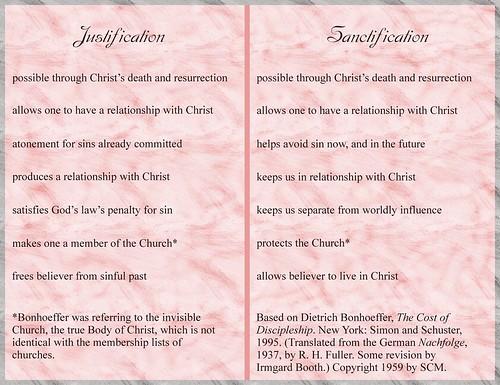
The graphic above is an attempt to portray what Dietrich Bonhoeffer says, in his The Cost of Discipleship, about the difference between justification and sanctification. Bonhoeffer was a pastor, theologian, and became a martyr, during World War II. See here for more of my thoughts on Bonhoeffer.

Thanks for reading, and looking. The graphic is a link to the chart, on my Flickr photostream, where it should be larger than it can be presented here.

Thursday, August 01, 2013

Thoughts on Bonhoeffer

I recently read Bonhoeffer: pastor, martyr, prophet, spy, by Eric Metaxas. It was given to me, and I am grateful. It was a great book, but not for the faint-hearted, as it ran well over 500 pages. The book was well referenced. (Metaxas also wrote Amazing Grace: William Wilberforce and the Heroic Campaign to End Slavery. There was a movie based on that book. Bonhoeffer won the Christian Book Award for 2011.) Here's the Wikipedia article on Bonhoeffer.


Here's some of my reaction to the book, and to the life of Bonhoeffer, himself, but first, a brief biography and history lesson. Dietrich Bonhoeffer was one of eight children, born to an upper-class German family, in 1906. In the early part of the 20th Century, Germany lost the World War I, and was forced to agree to humiliating peace terms. They were a weak nation, politically and economically, ripe for taking over by a dictator. Bonhoeffer grew up knowing that he wanted to pursue theology, and did so, but also felt called to be a pastor. He served as pastor to expatriate Germans in Spain and the UK. When Hitler began to come to power, He claimed to be Christian, and many churches, and church leaders, were taken in. But he was using the church as one way to gain control over Germany. Hitler's Nazi party declared that Jews were an enemy, and that the Old Testament was not really part of the Bible, because it was Jewish. They also forced converted Jews out of the pastorate, and required pastors to swear allegiance to Hitler.

Bonhoeffer, and others, decided that they could not do this, and that much of the church, and its leaders, had sold out. They formed an association known as the Confessing Church, which emphasized the gospel, and refused to be governed by denominational leaders. Bonhoeffer became director of a illegal seminary for young Lutheran pastors-to-be, and exercised considerable influence on these young men.

Eventually, as Hitler and his Nazis did more outlandish, and evil things, Bonhoeffer, some other leaders of the confessing church, some disillusioned generals, and others, came to believe that Hitler must be assassinated, and Naziism overthrown. There were attempts to do this, but Bonhoeffer wasn't directly involved. Hitler survived a bomb explosion, from a bomb carried into the bunker where he was living. He had as many of the German underground as could be identified executed, including Bonhoeffer. Hitler committed suicide a few days later, before the Allies liberated Germany.

I learned several things that I had never heard from the book. One of them was that Martin Luther not only founded the Protestant church, but also, especially by giving Germans the Bible, a book to read in their own language, founded German national consciousness. He wrote some unfortunate contributions to anti-semitism, perhaps after suffering from dementia. 

I had already read Bonhoeffer's The Cost of Discipleship,  in which Bonhoeffer laid out what he believed to be the consequences of the Sermon on the Mount. (See here for a poster based on an important statement in the book, and here for a blog post about the book.) He was opposed to the idea of "cheap grace," because he thought that there was no such thing. Grace only comes with a serious commitment to following Christ as Lord. This biography forcefully showed that Bonhoeffer not only said this, but believed it, and acted upon it.

A few other thoughts:
1) Bonhoeffer never married. He was engaged to a young woman at the time of his death. Their letters to each other have been published, but I haven't read them.
2) Bonhoeffer was, indeed, a prophet, in that he saw what was coming, for Germany, and the church, when others did not. Prophets who predicted disaster were seldom honored in the Old Testament, and Bonhoeffer did not increase his popularity by prophesying the fall of Germany, or the deadly weakening of the church that would follow from not standing up to Hitler. However, according to the book, he didn't hate those who didn't see as he saw.
3) He was willing to work with the ecumenical movement, and, to some extent, that movement, in Europe at large, applied pressure to the Nazis. The ecumenical movement was not very popular with many evangelical Christians in the US, because it was seen as diluting the gospel of sin and redemption. Bonhoeffer didn't dilute these truths, but worked with ecumenical leaders.
4) Is the US in danger of falling to our own Hitler? Maybe, although I don't see it at present. It is unfortunately true that, when the church becomes too closely allied to some political idea, the church suffers, and its message is diluted, sometimes beyond recognition. What do you get when you mix politics with religion? Politics.
One the one hand, the Republican party in the US is often seen as the Christian party. That doesn't help Christianity, although it may help the Republicans. On the other, there are those on the other political side that want the church to uphold practices that the Bible calls sinful, such as homosexual activity. That doesn't help Christianity, either.
5) Political expedience can work in strange ways. The German underground, partly through Bonhoeffer, who had ties to church leaders in England, wanted the British to recognize them, and help them. But, according to the book, Churchill, the British war leader, felt that it was necessary to portray all Germans as Nazis, and hateful, in order to sustain enthusiasm for the war against Germany.
6) Bonhoeffer came to a couple of conclusions that I personally am not comfortable with, but perhaps he was right. First, he concluded that Hitler was so given to evil that he should be killed. Second, Bonhoeffer (and others) would have committed suicide to avoid betraying their families and others who were part of the German underground.
7) I guess the author had it right. Pastor came before martyr, prophet, and spy. Bonhoeffer served as unofficial pastor to his jailers and fellow prisoners during his last several months. He could not be a spy, or much of a teacher, while in prison. (Although he did write while imprisoned.)

Thanks for reading. We need more Bonhoeffers, and more books like this.

Note added June 10, 2014: See here for a chart, based on Bonhoeffer's The Cost of Discipleship. 

Added October 23, 2015: I added "Eric Metaxas" as a tag, and this link to a post, by me, about recent writing, by Mr. Metaxas, on a much different subject, in which he is not an expert. Thanks for reading!

Monday, April 11, 2011

The Cost of Discipleship, by Dietrich Bonhoeffer

I recently read The Cost of Discipleship, by Dietrich Bonhoeffer. It is the most challenging book I have ever read. Why so? Well, first, I know something of the story of the author. Bonhoeffer was a young theologian, with a superior intellect. He stood up for traditional Christianity against the influence of Nazism in Germany, and, in fact, was one of the leaders of the Confessing Church there. He was well received in Britain and the U. S., and could have stayed in either place, until the end of World War II, but he chose to return to Germany, saying that he would have no right to be a spiritual leader among the Germans, after the war, if he had not experienced what they were experiencing. He was imprisoned and eventually executed in a concentration camp.

Bonhoeffer's life was a challenge, but the contents of the book are, if anything, more so. What are the contents?

The book begins with a biography of Bonhoeffer. Then, there's what is probably Bonhoeffer's best-known chapter, a chapter on costly grace. He also writes about cheap grace:

Cheap grace is the preaching of forgiveness without requiring repentance, baptism without church discipline, Communion without confession, absolution without personal confession. Cheap grace is grace without discipleship, grace without the cross, grace without Jesus Christ, living and incarnate. (44-45)

. . . Costly grace is the gospel which must be sought again and again, the gift which must be asked for, the door at which a man must knock.
Such grace is costly because it calls us to follow, and it is grace because it calls us to follow Jesus Christ. It is costly because it costs a man his life, and it is grace becaus it gives a man the only true life. It is costly because it condemns sin, and grace because it justifies the sinner. Above all, it is costly because it cost God the life of his Son: "ye were bought at a price," and what has cost God much cannot be cheap for us. Above all, it is grace because God did not reckon his Son too dear a price to pay for our life, but delivered him up for us. Costly grace is the Incarnation of God. (Dietrich Bonhoeffer, The Cost of Discipleship. New York: Simon and Schuster, 1995. (Translated from the German Nachfolge, 1937, by R. H. Fuller. Some revision by Irmgard Booth.) Copyright 1959 by SCM Press Ltd.45)

There are five chapters on Discipleship.

Then, Bonhoeffer expounds on the Sermon on the Mount, in 15 chapters, each one about a short section of Matthew 5-7. He writes about such matters as love, hiding your gifts, and the role of Christians in politics. These chapters would make great short devotionals, and did so for me.

I had my only disagreement with the late Bonhoeffer in this section. It wasn't over a critical doctrine. On p. 147, Bonhoeffer claims that the Old Testament "tells us more than once that we must love [our enemies]" He says that Ex. 23:4-5, Prov 25:21-22, Gen 45, 1 Sam 24:7, II Kings 6:22 teach this. I checked, and I don't think so. They do teach to be fair and generous to enemies, but I don't think these passages require and teach love of enemies. The New Testament certainly does, whether Bonhoeffer is correct or not.

Bonhoeffer closes with two sections, six chapters each, on "The Messengers," and one on the church.

The entire book, covering so many topics, but yet only one, namely the Christian life, is well written, challenging -- do I measure up? -- and doctrinally sound. It's a great read for the Christian. I commend it to you.

Thanks for reading. A couple of days ago, this blog used a quote from Bonhoeffer as the basis of a poster.

Added August 2, 2013: I have now posted on a biography of Bonhoeffer, here. 

Added June 10, 2014: See here for a chart, based on Bonhoeffer's The Cost of Discipleship. 

Saturday, April 09, 2011

Dietrich Bonhoeffer: The Cost of Discipleship, quotation

Bonhoeffer grace alone


This is a quotation from The Cost of Discipleship, by Dietrich Bonhoeffer. (New York: Simon and Schuster, 1995. See here for Wikipedia article on Bonhoeffer.) Bonhoeffer wasn't just being theoretical about the cost of following Christ, and the single-mindedness with which we should follow. He was an intellectual leader of the Confessing Church, which stood up to Hitler and Naziism. He left Germany, then felt that, if he was going to be part of the church in Germany after World War II, he needed to experience what Germany went through, because of Hitler and what came to his country, with the other Germans. So he went back. Bonhoeffer was eventually arrested, and executed by the Nazis, shortly before the end of Hitler's regime, at the age of 39.

Since searches won't pick up the text in the quotation from the graphic, I quote it here: "The only man who has the right to say that he is justified by grace alone is the man who has left all to follow Christ." The graphic also serves as a link to a larger size, on Flickr. No password is needed to access Flickr.

I wish I were a better example of this.

The background comes from the Flickr photo, of immature blueberries, in the comment below, which photo was posted earlier.

Thanks for looking!

On November 17, 2012, a relative told me that I had used the wrong first name for Bonhoeffer in the description of this picture. Sorry, and I am grateful to the relative. That name has now been corrected.

Added August 2, 2013: I have now posted on a biography of Bonhoeffer, here. 

Friday, November 19, 2010

Christian Responses to Hitler: Obeying Civil Authority

I am not an expert on history. But I am a Sunday School teacher. This week's Sunday School lesson, in our church, includes Paul's statements, to the Romans, about what sort of attitude they should have towards government. I quote Romans 13:1-7, from the WEB, which is public domain:
13:1 Let every soul be in subjection to the higher authorities, for there is no authority except from God, and those who exist are ordained by God. 2 Therefore he who resists the authority, withstands the ordinance of God; and those who withstand will receive to themselves judgment. 3 For rulers are not a terror to the good work, but to the evil. Do you desire to have no fear of the authority? Do that which is good, and you will have praise from the same, 4 for he is a servant of God to you for good. But if you do that which is evil, be afraid, for he doesn’t bear the sword in vain; for he is a servant of God, an avenger for wrath to him who does evil. 5 Therefore you need to be in subjection, not only because of the wrath, but also for conscience’ sake. 6 For this reason you also pay taxes, for they are servants of God’s service, attending continually on this very thing. 7 Give therefore to everyone what you owe: taxes to whom taxes are due; customs to whom customs; respect to whom respect; honor to whom honor.

My wife, who is in my class, asked me how this related to Hitler. That's a good question. This is my attempt to answer that. The quotation above seems to be saying that Hitler, for one, was ordained by God, and shouldn't have been resisted, at least not by Christians in Germany. In the first place, this principle, namely to submit to authority, was not absolute, even for Paul. In Acts 16, Paul refused to leave prison until the rulers had come personally to apologize to him. (They had arrested him in violation of his rights as a Roman citizen.) With this act, he resisted the order to have him released quietly. Why did Paul say this? We don't know. It is possible that he was acting in his own behalf, and wanted to get back at the authorities because they had violated his rights. It is also possible that he wanted to show, for the sake of the new Christians (the jailer and his household had been converted and baptized) that Christianity was respectable, or that Christ was above earthly authority. We don't know.

In Acts 23, Paul reprimanded the high priest:
23:1 Paul, looking steadfastly at the council, said, “Brothers, I have lived before God in all good conscience until this day.” 2 The high priest, Ananias, commanded those who stood by him to strike him on the mouth. 3 Then Paul said to him, “God will strike you, you whitewashed wall! Do you sit to judge me according to the law, and command me to be struck contrary to the law?” 4 Those who stood by said, “Do you malign God’s high priest?” 5 Paul said, “I didn’t know, brothers, that he was high priest. For it is written, ‘You shall not speak evil of a ruler of your people.’” [The Old Testament reference is to Exodus 22:28]
The NIV Study Bible has a text note on verse 5, suggesting that it is possible that Paul's eyesight was poor, and he couldn't tell that it was the high priest, or that someone else was presiding, sitting in the place of the high priest, or that Paul was being sarcastic, or that he refused to recognized the high priest's authority. It seems to me that there is another possibility, and one that also could have occurred in Acts 16. That is that Paul might have sinned -- he wasn't supposed to react to the authorities as he did. In that case, he would have had to confess and repent of his actions. The Bible doesn't indicate the reasons for Paul's actions in either case.

So what was going on here? Does the New Testament contradict itself? I don't think so.

First, I believe that there is a Biblical principle, which is that we should respect and obey those in authority. But that principle is not as important as other moral principles in the Bible, for example the Ten Commandments. Nor is it above the two great commandments from the Old Testament, which Jesus re-affirmed in the New Testament, in Mark 12:28-34, and Matthew 22:34-40. Nor is it above the Golden Rule, "Do unto others as you would have them do unto you." (Matthew 7:12)

Second, God's authority is over any human authority. If a human authority commands me to do something I shouldn't, for example to commit murder, or to deny Christ as Lord, I should refuse. As Peter said, "We must obey God rather than men." (Acts 5:29)

These two points are different aspects of the same thing.

However, we usually aren't asked, by human authorities, to do something that violates a higher Biblical principle, or that puts human authority above God's. We should prayerfully consider, before refusing to obey a human authority. We should be careful that we aren't wanting to disobey because it would be to our own selfish advantage to do so (for example by cheating on our taxes). We should also be careful that we don't assume, for no good reason, that a political position we don't like is opposed to God's desires.

Third, violent resistance seems to be always, or nearly always, contrary to God's plan for Christians.

So what about Hitler? The rule of Hitler, and the Nazis, seems to have produced situations where Christians had legitimate reasons for refusing to obey civil authority.

Although there is disagreement about Hitler's religious views, mostly because Hitler made statements that seem to be contradictory, it seems likely that Hitler, and the Nazis, wanted to destroy Christianity entirely. Holocaust deniers to the contrary, Hitler and the Nazis did try, and nearly succeeded, in eliminating all the Jews from Germany, and other countries that they conquered. There were Christians, and others, who resisted this. Corrie ten Boom, with other members of her family, deceived the Germans who occupied the Netherlands, in various ways, such as by obtaining ration cards by fraudulent means. They did not carry out violent protest. In this way, they, and other citizens of the Netherlands, were able to get many Jews out of the country. Anne Frank and her family were also kept hidden, and helped, by non-Jewish citizens of the Netherlands, which was against the edicts of the occupying Nazis. Oskar Schindler, and many other people, also helped the Jews, in defiance of Nazi demands. As far as I know, Schindler was not a Christian.

Not all Christians, or those who claimed to be Christians, were opposed to the Nazis. There was a group, known as German Christians, who supported Hitler. This source claims that one reason for this support was that these Christians were opposed to homosexual practices, and to communism, and the Nazis, were, too. Homosexuals and communists (and other groups) were persecuted, and executed, by the Nazis.

There was also a Confessing Church, which was primarily opposed to the theological claims of Nazism, rather than to the Holocaust. The theological claims should have been opposed. Here is one such outrageous claim: "Dr. Zoellner ... has tried to tell me that Christianity consists in faith in Christ as the Son of God. That makes me laugh ... Christianity is not dependent upon the Apostle's Creed .... [but] is represented by the Party .... the German people are now called ... by the Führer to a real Christianity .... The Führer is the herald of a new revelation." (See here. Zoellner was a leader of the Confessing Church.) Karl Barth was also one of its leaders. (Here is an article on Barth's thought, during the early days of the Nazi regime.)

Another leader of the Confessing Church was Dietrich Bonhoeffer. Bonhoeffer is the author of several works, translated into English, including The Cost of Discipleship and Ethics, both of them probably among the dozen or so most influential works on Christianity written during the previous century. Bonhoeffer came to believe that active resistance against Hitler was called for. He joined a group that planned to assassinate Hitler. This group did not succeed, and Bonhoeffer was executed, before he reached his 40th birthday. Bonhoeffer realized that he was acting in a way that seemed contrary to his faith, but said that he felt he had to act as he did, and trust God's grace for forgiveness. (See the Wikipedia article on Bonhoeffer for more.)

The Nazi treatment of the Confessing Church, and the error of the German Christians, are instructive. One lesson is that the Church should always keep the State at arms length. In the U.S., there is a danger that conservative churches will become arms of the Republicans, or the Tea Party, and that liberal churches may become arms of the Democrats. Both of these tendencies must and should be opposed. The state, or a political movement, may seem to have goals compatible with a church, but becoming too close together seems to always mean that the church, not the state, compromises its core principles and beliefs. No political party, and few, if any, political movements, have been fully compatible with Christianity.

More on Politics. Ken Schenck, Religion professor at Indiana Wesleyan University, has posted a compilation of Bible verses about social justice.

I have previously mused on the source of political authority in the U. S.

I have posted on what the New Testament says about what Christian attitudes toward government should be.

Summary: We should honor the state, and civil authority, except in extreme circumstances. But we must always put God's moral demands first. For example, we should obey traffic laws, except in emergencies. Poor planning, such as not starting out early enough, does not constitute an emergency.

Thanks for reading.