License

I have written an e-book, Does the Bible Really Say That?, which is free to anyone. To download that book, in several formats, go here.
Creative Commons License
The posts in this blog are licensed under a Creative Commons Attribution-NonCommercial-ShareAlike 3.0 Unported License. You can copy and use this material, as long as you aren't making money from it. If you give me credit, thanks. If not, OK.
Showing posts with label Genesis 1-2. Show all posts

Friday, September 22, 2023

Is Genesis straightforward historical narrative, part 2

In recent post on this blog, I argued that Genesis is not straightforward historical narrative. Many Christ-loving Bible scholars had already said this, for many reasons. My principal reason was that Genesis 1 and Genesis 2 cannot be straightforward historical narrative, because there are discrepancies between these two chapters. See graphic:


There is another important reason for doubting that Genesis 1 and 2 are straightforward historical narrative. That reason is that the firmament, or expanse, mentioned in Genesis 1, does not exist. The Hebrews of Bible times believed that there was a solid, transparent dome above the earth, which held up the heavenly bodies, as well as water, in its various forms. They thought wrong. Genesis 1 and 2 reflects the beliefs of the writers/readers/listeners. That doesn't mean that the Bible is in error. Genesis does not say that you have to believe in a firmament to please God. There is no reference to an expanse or firmament in the commonly  used creeds of the church. The churches of today do not expect belief in a firmament/expanse as a requirement of members.

Genesis 1 and 2 were written, not to teach astronomy, but to emphasize the existence of an all-powerful Creator, who is deeply concerned about the fate of humans.

Thanks for reading.

Monday, July 18, 2022

How many kinds of dragonflies are there?

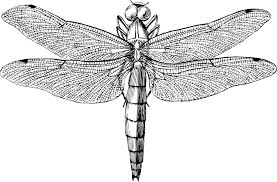
 Antique Dragonfly - Openclipart

Graphic: Antique dragonfly, from openclipart 

My wife and I were out walking, when I saw a dragonfly. She remarked that this one was black and white, and innocently asked me what kind it was. (I hadn't a clue.) I innocently remarked that dragonflies are of many colors, and that there are hundreds of kinds of them, although most of these kinds don't live around where we do. Then she asked me, innocently, if God made each kind of dragonfly, or if they descended and diverged from other kinds. She also asked, innocently, if there wouldn't be a web page, or something, which told us which of these types of events happened.

Well, yes and no. There are some web pages, and/or books, which claim that each kind of organism was made by a separate miracle. For example, see this page, which doesn't specifically say that each creature was created by a distinct miracle, but says that the six days of Genesis 1 were literal 24-hour days, so it would have been impossible for some kind of evolutionary process to produce all the species of dragonflies. (Genesis 1 does not specifically mention flying insects, let alone dragonflies.)

There are also many books and web pages which claim that animals developed into many species, over long periods of time, by completely natural processes -- there is no God, and never was. Here is the Wikipedia web page on an introduction to evolution.

Though you probably don't hear much from them, there are other sources that believe in a Creator. Some of these believe that the days of Genesis 1 were very long periods of time, thus allowing for evolution of dragonflies from a common ancestor. Others who believe in a creator believe that Genesis 1 was never meant to teach science, and that it is a mistake to do so. Genesis 1-2, they say, were meant to teach important truths, such as that there is only one God, not many, like the peoples living around the Israelites believed. And God is sovereign. Further, humans are more like God than any other animal, and have some responsibility to care for God's creation. Genesis 1 and 2 were not, in their view, to be taken literally. This last group holds that God's marvelous original creation included built-in laws, processes and properties of atoms and molecules, and rocks and clouds, that led, over a very long time, to the world we have today.   

To answer my wife's question, there are about 3000 species of dragonflies living on earth today. There were fossil dragonflies, too. Some dragonfly-like insects had wingspans as long as your arm, or even longer. Just don't ask me to identify them.

Appendix See these posts: "Should Genesis 1-2 be taken literally?"

"Young-earth creationism and the kinds of animals"

"Is Genesis 1-11 history, or myth? Comparing the sequence of events in Genesis 1 and Genesis 2"



Saturday, November 27, 2021

Is Genesis 1-11 history, or myth? Comparing the sequence of events in Genesis 1 and Genesis 2

First, what is a myth? The Project Gutenberg eText of Webster's 1913 dictionary says this:
1. A story of great but unknown age which originally embodied a belief regarding some fact or phenomenon of experience, and in which often the forces of nature and of the soul are personified; an ancient legend of a god, a hero, the origin of a race, etc.; a wonder story of prehistoric origin; a popular fable which is, or has been, received as historical.

2. A person or thing existing only in imagination, or whose actual existence is not verifiable.

And what is history? The Project Gutenberg eText of Webster's 1913 dictionary says this:

1. A learning or knowing by inquiry; the knowledge of facts and events, so obtained; hence, a formal statement of such information; a narrative; a description; a written record; as, the history of a patient's case; the history of a legislative bill.

2. A systematic, written account of events, particularly of those affecting a nation, institution, science, or art, and usually connected with a philosophical explanation of their causes; a true story, as distinguished from a romance; -- distinguished also from annals, which relate simply the facts and events of each year, in strict chronological order; from biography, which is the record of an individual's life; and from memoir, which is history composed from personal experience, observation, and memory.

Some Bible scholars claim that Genesis 1-11 is history. If I understand them, they mean that this text relates real events which happened in sequence as they are read in that text. Other Bible scholars claim that the same passage is myth. If I understand them, these scholars mean that this text is true, in the sense that we are to learn from it, and that it tells us about God, but that it does not necessarily portray real events, nor events in the sequence in which they actually happened.

One author who thinks Genesis 1-11 is myth is Joel Edmund Anderson. Here's an excerpt from one of his blog posts:
Saying Genesis 1-11 is myth doesn’t denigrate it. “Myth” doesn’t mean “untruth.” It is a specific genre of ancient writing that was used to describe a culture’s worldview regarding what that culture believed about (a) the gods/God, (b) the nature of human beings, and (c) the nature of the created order. It wasn’t trying to convey historical facts. It was trying to articulate that “worldview lens” through which that culture could interpret their world.

Anderson has written many other blog posts on these topics. So have others. (Here's another of Anderson's posts, pertinent to the topic of the post you are reading.)

What should we learn from Genesis 1-2? I am not God, so cannot be certain of what He wanted us to grasp, but the things that we were meant to learn probably included, first and foremost, that there is only one real God, powerful and wise enough to make the world as it is. Very possibly, mentioning the sun and the moon as appearing on the fourth day, rather than the first day, and without specifically naming them, shows us, and the ancient Hebrews, that we shouldn't worship the sun and the moon. We are also probably meant to learn that God is responsible for beauty, diversity and order in the world, and that humans have special responsibilities -- we are, in some senses, god-like.

Let's now look at Genesis 1 and Genesis 2:


(This graphic gets tangled up with other parts of the blog, on some platforms. The graphic is still there, as a separate file. Feel free to use the graphic, with no attribution needed.)

There are significant differences in the sequence of events in Genesis 1 vs. Genesis 2. Claims that these two chapters both set forth, in sequence, the events of the creation, are not supported by a plain reading of Genesis 1 and 2. There are various ways of explaining the differences between the Genesis 1 sequence, and the Genesis 2 sequence, and perhaps some of them are valid, but the idea that there is a plain reading of these two chapters, setting forth events in sequence, is not supported.
 
This post shows that Answer in Genesis, the most prominent Young-Earth Creationist organization, doesn't believe that there is, or was, a firmament. I guess that that means that the verse about the creation and existence of that firmament can't be history, as history is defined above. (Paragraph added June 17, 2022.)

Thanks for reading!