License

I have written an e-book, Does the Bible Really Say That?, which is free to anyone. To download that book, in several formats, go here.
Creative Commons License
The posts in this blog are licensed under a Creative Commons Attribution-NonCommercial-ShareAlike 3.0 Unported License. You can copy and use this material, as long as you aren't making money from it. If you give me credit, thanks. If not, OK.
Showing posts with label Philippians 2. Show all posts

Tuesday, August 14, 2018

Meditation in Scripture


I am ashamed to admit that, until this year, I have not thought seriously about the Spiritual Disciplines. (Also called spiritual exercises or spiritual practices.) As I understand these, they are things that believers ought to do regularly, so as to follow Christ, and to be more like him. I began reading a couple of books (see here and here) on the subject a few months ago. Our pastor just finished a short series based on Spiritual Disciplines. The Bible does not have a list of Spiritual Disciplines, and different authors suggest somewhat different lists.

1 Timothy 4:7b ("Exercise yourself toward godliness.") and Philippians 2:12b ("Work out your own salvation with fear and trembling.") are two places where the Spiritual Disciplines are alluded to. Reading the Gospels shows us that Jesus practiced at least some of them, especially prayer, submission, service and solitude. Reading Acts shows us that the early church practiced at least prayer, fasting, and service.

Most or all lists of Spiritual Disciplines include Meditation. There is a type of meditation that, although it may have some benefits, is not Christian. Scriptural meditation, however, is not the same thing. It is not “new age.” New age meditation is about you. Scriptural meditation is about God. Meditation, as defined in Webster’s dictionary of 1913, is “To contemplate; to keep the mind fixed upon; to study.” Here are most of the references to meditation in the Bible, using the World English Bible, which is public domain, except as indicated:

Genesis 24:63a Isaac went out to meditate in the field at the evening.

Joshua 1:8a This book of the law shall not depart from your mouth, but you shall meditate on it day and night, that you may observe to do according to all that is written in it.

Psalm 1:1 Blessed is the man who doesn’t walk in the counsel of the wicked, … 2 but his delight is in Yahweh’s law. On his law he meditates day and night.

63:5b My mouth shall praise you with joyful lips, 6 when I remember you on my bed, and think about you in the night watches.

77:11 I will remember [the Lord’s] deeds; … I will remember your wonders of old. 12 I will also meditate on all your work, and consider your doings.

119:15 (Also Psalm 119:78) I will meditate on your precepts, and consider your ways,

23 Though princes … slander me, your servant will meditate on your statutes. 

119:27 Let me understand the teaching of your precepts! Then I will meditate on your wondrous works.

119:48 I reach out my hands for your commandments, which I love. I will meditate on your statutes.

119:97 How I love your law! It is my meditation all day.

119:99b your testimonies are my meditation.

119:148 My eyes stay open through the night watches, that I might meditate on your word.

143:5 I remember the days of old. I meditate on all your doings. I contemplate the work of your hands.

145:5 Of the glorious majesty of your honor, of your wondrous works, I will meditate.

1 Timothy 4:15a Meditate upon these things; give thyself wholly to them; (KJV. Here is chapter 4 of 1 Timothy, which indicates what Paul meant by "these things.")

Most of the occurrences of meditation in the Bible refer to the Law, or to various synonyms for it in Psalm 119. Presumably, the authors were referring to the Torah, the first five books of the Bible, because, in many cases, the rest of the Bible hadn't been written.

There are three places, indicated in green above, where the meditation was to be on what God has done.

We don't know what Isaac was meditating about. The first five books of the Bible weren't written, or weren't mostly written in his time.

One of the occurrences above is marked in red. That one seems to say that, if we run into opposition for our faith, the best strategy is to remember God's power, rather than worry about responding.

I should meditate daily. On what? It's a good idea to meditate -- "contemplate; to keep the mind fixed upon; to study" -- on the Bible. One aspect of the Bible that I should meditate on is to meditate on the life, mission, and character of Jesus Christ. (Passages that should help in that are John 15, Philippians 2, Colossians 1, Hebrews 2, and many others.) 1 Timothy 4 seems to indicate that we should meditate on end times*. It's a good idea to remind myself of what God has done for me, and those I care for, daily. It's a good idea to meditate on the wonders, both spectacular and "ordinary," of God's creation.

Thanks for reading. Meditate on Christ, and the Bible. May I do so, too!

*It's probably not wise to let our meditation on end times dwell too much on whether or not there will be a rapture, and, if there is, when it will be, or about the existence and timing of the tribulation. See here. Rather, we should comfort ourselves by remembering that Christ is returning, at some point, that we will have eternal fellowship with Him, that things that are out of sorts will be put right, and that Christ will be recognized as Lord of all. We should probably also meditate on people who are not ready for Christ's return, and what we might do so that they will become so.

Sunday, October 01, 2017

Impressions, by Martin Wells Knapp, 68

In a previous excerpt, Knapp stated that there are four features of "impressions" from God. These are Scriptural; Right (consistent with good morals); Providential (in harmony with God's will); and Reasonable. His discussion of the result of living by "Convictions from Above," according to Christ's example, continues:
It is only those who suffer with Him who shall reign with Him.

Jesus was Possessed of a Deep Abiding joy. Though sorrowful He was always rejoicing. This joy He bequeaths to all His followers.  He says: "That my joy may be in you that your joy may be full."

As near as we can learn the joy of Jesus consisted, as Adam Clark says, in "The fulfilling the will of the Father in tasting death for every man." This, with the anticipation of the rapture it would bring to countless multitudes, was His joy, or at least a fruitful source of it, and a kindred self sacrifice and anticipation of its results in blessing to others will possess all in whom the Spirit dwells. Its manifestation in the life of Jesus was hid beneath the agonizing efforts of pain and loss with which His life was filled in rescuing the race; but the consciousness of His Father's continual approbation and the success of His soul saving work, was a well-spring of joy even in His hours of deepest agony. "For the joy set before Him He endured the cross, despising the shame, and is now set down at the right hand of the throne of God."

Great Success was Preceded by Great Agony. His early ministry was preceded by His humble birth, misunderstood parentage, and the terrible temptation in the wilderness. His public efforts were opposed at every step by persistent and wily foes. Many of the ministry and church members of His day looked upon Him with suspicion and hatred. Even His "Own brethren did not believe on Him."


The resurrection and Pentecost were preceded by Gethsemane and the crucifixion. He endured untold agony upon the bloody battlefield before He should wear the victor's crown. Beloved, "Let this mind be in you that was also in Christ Jesus; who being in the form of God thought it not robbery to be equal with God, but made Himself of no reputation, and took upon Himself the form of a servant, and was made in the likeness of men, and being formed in fashion as a man, He humbled Himself and became obedient unto death, even the death of the cross. Wherefore, also, God hath highly exalted Him and given Him a name which is above every name; that at the name of Jesus every knee should bow . . . and that every tongue should confess that Jesus Christ is Lord to the glory of God the Father." -- Phil. 2:6-11.


Excerpted from Impressions, by Martin Wells Knapp. Original publication date, 1892. Public domain. My source is here. The previous post in the series is here.

Tuesday, May 27, 2014

Should a Christian iron his clothes?

The title was almost "What would Jesus iron?" but that seems to come perilously close to a violation of the third Commandment, and there's too much of that already.

This is musing on the topic. Don't expect any firm, easy answers. Sorry. Similar musing could be applied to lots of other activities, such as, but not limited to: mowing the grass, washing the car, cleaning the windows, assorted grooming, vacuuming, weeding, painting, straightening the cupboards, getting the toys organized, sending Christmas cards, and even to doing an especially good job on homework. All of these are legitimate activities, but where should they fit in our priorities?

Test 1: Is there something more important to do?
In Luke 10, Jesus had some words for Martha: 10:38 It happened as they went on their way, he entered into a certain village, and a certain woman named Martha received him into her house. 39 She had a sister called Mary, who also sat at Jesus’ feet, and heard his word. 40 But Martha was distracted with much serving, and she came up to him, and said, “Lord, don’t you care that my sister left me to serve alone? Ask her therefore to help me.”
41 Jesus answered her, “Martha, Martha, you are anxious and troubled about many things, 42 but one thing is needed. Mary has chosen the good part, which will not be taken away from her.” (All scripture quotations are from the public domain World English Bible.)


We can't be sure of all that is going on here, because we weren't there, and couldn't have read anyone's minds, if we had been. But it seems that Martha had her priorities wrong. Jesus didn't say that it was wrong to fix a meal, but that there was something more important going on at the time. Perhaps He would have pitched in in the kitchen Himself, after He had talked to Mary, Martha, and Lazarus. Perhaps he would have performed a miracle, and fed them, and whoever else was around (probably a dozen or more disciples). Perhaps they would just have eaten later than they were accustomed to, or fasted through one mealtime.

It's always important to pray, witness, worship with others, and read the Bible. But if that's all we do, we won't keep a job, and our dwelling places, autos, and other possessions will suffer from neglect, and, perhaps, finally become unusable. At some point, Mary should have gone to the kitchen and helped. (Probably Lazarus should have, too.)

Test 2: Do we need to fit in?
In 1st Corinthians 9, Paul said this: 19 For though I was free from all, I brought myself under bondage to all, that I might gain the more. 20 To the Jews I became as a Jew, that I might gain Jews; to those who are under the law, as under the law, that I might gain those who are under the law; 21 to those who are without law, as without law (not being without law toward God, but under law toward Christ), that I might win those who are without law. 22 To the weak I became as weak, that I might gain the weak. I have become all things to all men, that I may by all means save some. 

If everyone in our apartment complex keeps the front door and the back porch looking attractive, and is careful to park in her own parking spot, perhaps we need to, also, or our neighbors will think poorly of us, and may say, "Well, if that's the way a Christian acts, I don't want any of it." To a large extent, we should try to fit in, if we want to reach those around us with the Gospel.

Clearly, there are limits. We shouldn't steal from the grocery store, or go on alcoholic binges, so as to fit in with our unbelieving relatives, neighbors, fellow students, or co-workers who do such things.

Test 3: Is it beneath our position?
The apostles believed that they shouldn't be taking care of food distribution for the widows:
Acts 6:1 Now in those days, when the number of the disciples was multiplying, a complaint arose from the Hellenists against the Hebrews, because their widows were neglected in the daily service. 2 The twelve summoned the multitude of the disciples and said, “It is not appropriate for us to forsake the word of God and serve tables. 3 Therefore select from among you, brothers, seven men of good report, full of the Holy Spirit and of wisdom, whom we may appoint over this business. 6:4 But we will continue steadfastly in prayer and in the ministry of the word.”

But see John 13:12 So when he had washed their feet, put his outer garment back on, and sat down again, he said to them, “Do you know what I have done to you? 13 You call me, ‘Teacher’ and ‘Lord.’ You say so correctly, for so I am. 14 If I then, the Lord and the Teacher, have washed your feet, you also ought to wash one another’s feet. 15 For I have given you an example, that you also should do as I have done to you. 16 Most certainly I tell you, a servant is not greater than his lord, neither one who is sent greater than he who sent him. (World English Bible, public domain)

My guess is that the twelve weren't declining to "serve tables" because it was beneath them, but because they knew they had more important things to do, and others could serve in this way.

See also Philippians: 2:5 Have this in your mind, which was also in Christ Jesus, 6 who, existing in the form of God, didn’t consider equality with God a thing to be grasped, 7 but emptied himself, taking the form of a servant, being made in the likeness of men. 8 And being found in human form, he humbled himself, becoming obedient to death, yes, the death of the cross. 9 Therefore God also highly exalted him, and gave to him the name which is above every name; 10 that at the name of Jesus every knee should bow, of those in heaven, those on earth, and those under the earth, 11 and that every tongue should confess that Jesus Christ is Lord, to the glory of God the Father.

By example, and by His explicit teaching, such as in Luke, Christ taught us that mowing the grass, washing the dishes, or changing the oil, for the sake of others, is not beneath us: Mark 9:33 He came to Capernaum, and when he was in the house he asked them, “What were you arguing among yourselves on the way?”34 But they were silent, for they had disputed one with another on the way about who was the greatest. 35 He sat down, and called the twelve; and he said to them, “If any man wants to be first, he shall be last of all, and servant of all.”

However, even with a Christ-like servant attitude, it may still be possible, as in Acts 7, that it is more important to be doing something other than serving.

Test 4: Is it a requirement for our job?
If what routine maintenance, or care in our appearance, we are doing is really required for our jobs, then we ought to do this maintenance, or be sure that we appear presentable. We should probably do standard grooming before going to work, in most cases. And most of us who are able should have a job. John the Baptist, who preached a strong message of repentance, didn't tell Roman soldiers to leave the army in Luke 3:14, but to use their position fairly, and to be content with their wages. Jesus didn't upbraid the apostles who had gone fishing after the resurrection, and tell them to stop immediately. As far as we know, they didn't remain fishermen for long, though. They truly became the "fishers of men" that Jesus had originally envisioned for them. (Matthew 4:19) That new job was one of higher priority than the old ones.

But note the next test:

Test 5: Are we doing this so we'll look good?
I may get fired if I don't wear clean shirts, or I may turn off people who need to see Christ in my life. But I don't have to wear $250 shirts, or send them to an expensive cleaners, to do either. I probably won't even need to iron them. I should probably paint the kitchen every few years, but I shouldn't need to paint it every six months. I should mow the grass, but I shouldn't be trying to out-do the neighbor across the street. Why am I trying to look good, or be thought well of? If it's for my own sake, that's wrong. If it's to please other people who aren't worth pleasing, that's wrong.

James had something to say about fancy dress:
2:1 My brothers, don’t hold the faith of our Lord Jesus Christ of glory with partiality. 2 For if a man with a gold ring, in fine clothing, comes into your synagogue, and a poor man in filthy clothing also comes in; 3 and you pay special attention to him who wears the fine clothing, and say, “Sit here in a good place”; and you tell the poor man, “Stand there,” or “Sit by my footstool”; 4 haven’t you shown partiality among yourselves, and become judges with evil thoughts? 5 Listen, my beloved brothers. Didn’t God choose those who are poor in this world to be rich in faith, and heirs of the Kingdom which he promised to those who love him? 6 But you have dishonored the poor man. Don’t the rich oppress you, and personally drag you before the courts? 7 Don’t they blaspheme the honorable name by which you are called? 8 However, if you fulfill the royal law, according to the Scripture, “You shall love your neighbor as yourself,” you do well. 9 But if you show partiality, you commit sin, being convicted by the law as transgressors.

Although Jesus didn't say anything explicit about ironing shirts, He had something to say about trying to look good:
Matthew 6:1 “Be careful that you don’t do your charitable giving before men, to be seen by them, or else you have no reward from your Father who is in heaven. 2 Therefore when you do merciful deeds, don’t sound a trumpet before yourself, as the hypocrites do in the synagogues and in the streets, that they may get glory from men. Most certainly I tell you, they have received their reward. 3 But when you do merciful deeds, don’t let your left hand know what your right hand does, 4 so that your merciful deeds may be in secret, then your Father who sees in secret will reward you openly.
5 “When you pray, you shall not be as the hypocrites, for they love to stand and pray in the synagogues and in the corners of the streets, that they may be seen by men. Most certainly, I tell you, they have received their reward. 6 But you, when you pray, enter into your inner room, and having shut your door, pray to your Father who is in secret, and your Father who sees in secret will reward you openly.

And more:
Matthew 6:25 Therefore I tell you, don’t be anxious for your life: what you will eat, or what you will drink; nor yet for your body, what you will wear. Isn’t life more than food, and the body more than clothing? 26 See the birds of the sky, that they don’t sow, neither do they reap, nor gather into barns. Your heavenly Father feeds them. Aren’t you of much more value than they?
27 “Which of you, by being anxious, can add one moment to his lifespan? 28 Why are you anxious about clothing? Consider the lilies of the field, how they grow. They don’t toil, neither do they spin, 29 yet I tell you that even Solomon in all his glory was not dressed like one of these. 6:30 But if God so clothes the grass of the field, which today exists, and tomorrow is thrown into the oven, won’t he much more clothe you, you of little faith?

6. Is it hard on the environment?
It's impossible to completely keep from affecting the air we breathe, the water we drink, and the soil and living things around us. But we can be careful, and do as little damage as possible. Are we consuming more energy than we need? Ironing, and hair drying consume quite a bit. Are we using products that give off harmful chemicals? Are we destroying the habitat of other living things, directly or indirectly? See here for more on environmental stewardship.

7. Is it good use of the resources God has given me?
Should I be saving for my offspring, or contributing my time and resources to ministries to the poor, or to people in third-world cultures, rather than keeping my car washed and polished, or my lawn edged, or my wardrobe updated?

After answering all of the questions above, the Holy Spirit can help us know what Jesus would do. A couple of cautions are in order, though. First, it's much easier, in terms of effort, to spend a half hour meditating on the above questions, and at least pretending to pray, than it is to really get at that algebra homework, or the dirt on the windows. If we don't establish guidelines, and good habits, we'll be spending too much time musing about what to do. Second, we mustn't expect fellow believers to agree with us on all points. Their circumstances may be different, or the Holy Spirit may be leading them to act and think differently from us. God may want some of them to iron their shirts, when He doesn't seem to require that we do so.

Thanks for reading. Think about the appearance of your shirts!

Tuesday, June 19, 2012

Some important equations

Equals sign, or one equals one: equations.
In the graphic above, there are ten important equations, some apparently simple, some not so simple.


Equal: Agreeing in quantity, size, quality, degree, value, etc.; having the same magnitude, the same value, the same degree, etc. - from Webster's Unabridged Dictionary, Project Gutenberg, public domain

The equals sign, which we now take for granted, was first used in 1557, by a Welsh mathematician named Robert Recorde. (See the Wikipedia article on the equals sign.)

Equations used are these: three equations from “simple” arithmetic; Ohm’s law; Einstein’s energy/mass equivalence equation; Euler’s equation; the law of Sines; An equation for compound interest; Slope-intercept formula for a straight line; Newton’s law of universal gravitation.

The largest equation in the graphic, from "simple arithmetic" illustrates one of the main ideas of arithmetic, namely that a thing is equal to itself. Another one uses a zero, which symbol and concept we now take for granted. Zero was invented in India in the 9th century AD. Euler's equation, also known as Euler’s identity, relates perhaps the most important constants of mathematics, e, pi and i, the square root of minus one. There are other ways of representing compound interest, depending on the situation, but the equation used will cover many of them. The law of Sines has been used in astronomy, to measure distances of bodies within the solar system from the earth.

Two of the most important statements in English that use the word equal are:

Philippians 2:6 Who, being in the form of God, thought it not robbery to be equal with God: 7 But made himself of no reputation, and took upon him the form of a servant, and was made in the likeness of men: (King James version)

and

We hold these truths to be self-evident, that all men are created equal, that they are endowed by their Creator with certain unalienable Rights, that among these are Life, Liberty and the pursuit of Happiness. - U. S. Declaration of Independence (I know. At the time, all men weren’t considered equal, and women weren’t included. But it was, and is, a great idea.)

Thanks for looking, and, perhaps, thinking. The graphic is a link to a Flickr page, where larger sizes of it should be available.

Friday, February 03, 2012

Coping with sudden death

This post is in reaction to the accidental death of a seven-year-old girl that I didn't know. She died yesterday. I did know a little about her father, and had spoken briefly with him several times at his place of business. I know a number of his employees, and former employees, pretty well. I know an adult daughter of the person who was driving the vehicle that was involved in the accident. My Facebook page has had a lot of posts by others on this event in the last few hours. Some of them have been wonderful. Many of them have been perplexed. If this helps anyone else, fine. I hope it does. But I'm just musing about it. I'm not an expert.

How should sudden death be coped with?

Be ready! Death comes to everyone, and death is permanent. After death, there are no further chances for communication. Death ends all chances to fix things, to do things, to say things. I should be ready to go at any time. I should be sure that I tell the people that I love that I love them, often. I should be sure that my relationship with Christ is up-to-date. (I hope that I love Him. I know that He loves me.) I should realize that this is true of others, not just me, and, if I truly believe that heaven is for real, and that there is a hell to shun, try to lovingly persuade those others to be ready for their deaths, in as many ways as possible. In Luke 12:20, Jesus told a story of a man who wasn't ready for death, and called him a fool.

My will should be made, and up-to-date, and I should have made plans for others to access my important documents, written a tentative obituary, and planned my funeral.

Comfort! In John 14, and elsewhere, Jesus tried to comfort His disciples, in advance of His death. He sent the Holy Spirit, who is also called The Comforter, to them. The Holy Spirit didn't come right away, but several weeks later. Survivors need comfort, after death, for a long time. Comfort can be given in many ways. Showing up, taking food, helping clean, hugging, saying "I love you," or "I'm sorry," calling, and in other ways.

Forgive! This includes self-forgiveness. I don't know all the circumstances of the accident, but the driver surely has had reason to question a lot of things -- why didn't I do this, and why did I do that, and what if. The parents must have such questions, too. And not just about the accident. Did they show her enough love? Were they perfect parents? No one is a perfect parent, and no one is a perfect driver. Try to realize, and accept this, and move on. It won't be easy.

Of course, it may be necessary to forgive someone else. Is that always easy? Of course not. But what good does it do to not forgive? Unforgiveness eats away at a person. It hurts the unforgiving individual more than it can possibly hurt anyone else.

It may be necessary to ask for forgiveness, too. If so, do it carefully, prayerfully, lovingly and humbly.

It's not about me! It's about the person who has passed, and everyone else. The devil wants me to use any excuse to become the axis that the world revolves around. I'm not, and I must try to avoid trying to be, or thinking that I am or should be. Is this easy? Of course not. Christ provided the example, and Paul tells us about that in Philippians 2:5-11 and 1 Corinthians 13.

Pray! For yourself, for others affected, and, that, in the entire situation, Christ will be glorified, perhaps in ways that you never see.

May God help this family, and those associated with this tragic event, and all the other tragic deaths.

Thanks for reading. I'm no expert on this subject. Both my parents are dead, but both of them were in declining health, and had been for some time. A brother-in-law was murdered, two years ago today. But I haven't coped with the death of a spouse, or a child, a grandchild, a close friend, or, as a child, a young parent. I probably will have to do some of this at some point.

Friday, April 02, 2010

Good Friday gap

The sermon I heard on Sunday used the Palm Sunday story from Luke, and also Philippians 2:5-11, as its basis. You would, of course, expect a Palm Sunday sermon on Palm Sunday.

But the speaker went past Palm Sunday. He pointed out that there is a gap between verses 8 and 9:
8 And being found in human form, he humbled himself by becoming obedient to the point of death, even death on a cross. 9 Therefore God has highly exalted him and bestowed on him the name that is above every name, (ESV. See here for more information on use.)

That gap is because verse 8 ends at Christ's death, on Good Friday, but verse 9 begins with His resurrection, on Easter morning. I hadn't looked at it like that before, but should have.

Thanks for reading.

Friday, November 10, 2006

". . . being dead, yet speaketh." Bible

My wife saw a quote from a previous post of mine, which said this:

"I am constantly struck by the strangeness of reading works that seem addressed, personally and intimately, to me, and yet were written by people who crumbled to dust long ago." (source)

She told me that she wanted to know some of the statements that seem addressed to me. In other words, who speaks to me, though dead? (Hebrews 11:4, KJV, says "By faith Abel offered unto God a more excellent sacrifice than Cain, by which he obtained witness that he was righteous, God testifying of his gifts: and by it he being dead yet speaketh.")

So, here's the first installment, my top ten, as it were, quotations from the Bible. All quotations are from the ESV. (I am grateful that this version of the Bible is available on the web, and that they allow use in blogs, provided the version is cited as I have done -- with a link like the previous sentence, and links to specific passages.)

I have already posted about the significance of some of my choices. To read about why I think the first three choices speak to me, and are important, as relating to a view of science, see here.

Genesis 1:1 In the beginning, God created the heavens and the earth. (See also this post, about why a doctrine of origins is important.)

Psalm 19:1 The heavens declare the glory of God,
and the sky above [text note: "expanse"] proclaims his handiwork.
2 Day to day pours out speech,
and night to night reveals knowledge. (See also this post, about not seeing God revealed in nature.)

Colossians 1:15 He is the image of the invisible God, the firstborn of all creation. 16 For by him [Text note: by means of; or in. Text notes give possible alternate readings.] all things were created, in heaven and on earth, visible and invisible, whether thrones or dominions or rulers or authorities—all things were created through him and for him. 17 And he is before all things, and in him all things hold together.


Psalm 84:11 For the Lord God is a sun and shield;
the Lord bestows favor and honor.
No good thing does he withhold
from those who walk uprightly. (See also this post, about the title of this blog.)


Matthew 22:35 And one of them, a lawyer, asked him a question to test him. 36 “Teacher, which is the great commandment in the Law?” 37 And he said to him, “You shall love the Lord your God with all your heart and with all your soul and with all your mind. 38 This is the great and first commandment. 39 And a second is like it: You shall love your neighbor as yourself. 40 On these two commandments depend all the Law and the Prophets.”

Philippians 2:3 Do nothing from rivalry or conceit, but in humility count others more significant than yourselves. 4 Let each of you look not only to his own interests, but also to the interests of others. 5 Have this mind among yourselves, which is yours in Christ Jesus [Text note: "which was also in Christ Jesus"] 6 who, though he was in the form of God, did not count equality with God a thing to be grasped, 7 but made himself nothing, taking the form of a servant, [Text note: "bondservant"] being born in the likeness of men. 8 And being found in human form, he humbled himself by becoming obedient to the point of death, even death on a cross. 9 Therefore God has highly exalted him and bestowed on him the name that is above every name, 10 so that at the name of Jesus every knee should bow, in heaven and on earth and under the earth, 11 and every tongue confess that Jesus Christ is Lord, to the glory of God the Father.

Philippians 4:8 Finally, brothers, whatever is true, whatever is honorable, whatever is just, whatever is pure, whatever is lovely, whatever is commendable, if there is any excellence, if there is anything worthy of praise, think about these things.

Hebrews 7:25 Consequently, he is able to save to the uttermost [Text note: Or at all times (that is, completely)] those who draw near to God through him, since he always lives to make intercession for them.
26 For it was indeed fitting that we should have such a high priest, holy, innocent, unstained, separated from sinners, and exalted above the heavens. 27 He has no need, like those high priests, to offer sacrifices daily, first for his own sins and then for those of the people, since he did this once for all when he offered up himself. 28 For the law appoints men in their weakness as high priests, but the word of the oath, which came later than the law, appoints a Son who has been made perfect forever.

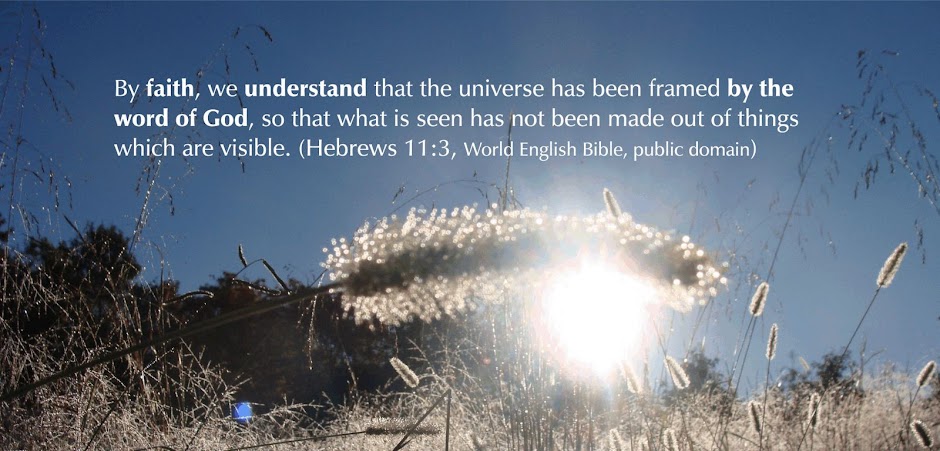
Hebrews 11:3 By faith we understand that the universe was created by the word of God, so that what is seen was not made out of things that are visible. (See also this post, on the significance of this verse. This verse is featured at the top of this blog.)

1 John 1:1 That which was from the beginning, which we have heard, which we have seen with our eyes, which we looked upon and have touched with our hands, concerning the word of life— 2 the life was made manifest, and we have seen it, and testify to it and proclaim to you the eternal life, which was with the Father and was made manifest to us— 3 that which we have seen and heard we proclaim also to you, so that you too may have fellowship with us; and indeed our fellowship is with the Father and with his Son Jesus Christ. 4 And we are writing these things so that our [text note: "your"] joy may be complete. 5 This is the message we have heard from him and proclaim to you, that God is light, and in him is no darkness at all. 6 If we say we have fellowship with him while we walk in darkness, we lie and do not practice the truth. 7 But if we walk in the light, as he is in the light, we have fellowship with one another, and the blood of Jesus his Son cleanses us from all sin. 8 If we say we have no sin, we deceive ourselves, and the truth is not in us. 9 If we confess our sins, he is faithful and just to forgive us our sins and to cleanse us from all unrighteousness. 10 If we say we have not sinned, we make him a liar, and his word is not in us.

This was a fair amount of work, but, I believe, it was more than worth it. I thank my wife for the suggestion. This one is goes into my list of "Important (I think) posts," (See near top right of this page).

I recognize that there are serious dangers in such an exercise, the main one, I suppose, being that one who does it might ignore other Bible passages.

Thanks for reading.

If any of you would like to produce a similar compilation, I would appreciate hearing about it in a comment, but that, of course, is up to you. Thanks in advance.

In the second installment of a series of three, I posted some important quotations from three of my favorite dead authors of fantastic (and other) literature, C. S. Lewis, George MacDonald, and J. R. R. Tolkien. In the third, and, I believe, last, I posted some important quotations from scientists, including Darwin, Newton, Einstein, Copernicus, and Watson and Crick.

* * * * *

Added July 3, 2007, an eleventh passage:

Psalm 136:4 to him who alone does great wonders,
for his steadfast love endures forever;
5 to him who by understanding made the heavens,
for his steadfast love endures forever;
6 to him who spread out the earth above the waters,
for his steadfast love endures forever;
7 to him who made the great lights,
for his steadfast love endures forever;
8 the sun to rule over the day,
for his steadfast love endures forever;
9 the moon and stars to rule over the night,
for his steadfast love endures forever;

Thanks for reading!