This blog is normally reserved for the Sunspots column on Wednesdays, and one such was published earlier today. But the death of Stephen Hawking is important enough that I'm also publishing a link to a post, from a few years ago, which analyzes Hawking's thought.
Thanks for reading.
Musings on science, the Bible, and fantastic literature (and sometimes basketball and other stuff).
God speaks to us through the Bible and the findings of science, and we should listen to both types of revelation.
The title is from Psalm 84:11.
The Wikipedia is usually a pretty good reference. I mostly use the World English Bible (WEB), because it is public domain. I am grateful.
License
I have written an e-book, Does the Bible Really Say That?, which is free to anyone. To download that book, in several formats, go here.

The posts in this blog are licensed under a Creative Commons Attribution-NonCommercial-ShareAlike 3.0 Unported License. You can copy and use this material, as long as you aren't making money from it. If you give me credit, thanks. If not, OK.
The posts in this blog are licensed under a Creative Commons Attribution-NonCommercial-ShareAlike 3.0 Unported License. You can copy and use this material, as long as you aren't making money from it. If you give me credit, thanks. If not, OK.
Showing posts with label Stephen Hawking. Show all posts
Showing posts with label Stephen Hawking. Show all posts
Wednesday, March 14, 2018


Thursday, May 01, 2014
Hawking's Grand Design and God's Not Dead
Stephen Hawking is one of the best-known scientists of our time. When he retired, he was occupying the same professorial chair that Isaac Newton once did. He is also an outspoken atheist.
In 2010, Hawking, in collaboration with Leonard Mlodinow, wrote The Grand Design, which became a best-seller, in spite of its non-fiction status and scientific content. The book argues that it is not necessary to suppose that God created the universe. It also says that "philosophy is dead," and suggests that the search for a unified field theory is futile, so it isn't exactly shy about attacking significant ideas. What they seem to mean by "philosophy is dead" is that some philosophers are not willing to agree with them on all points.
The Grand Design was referred to in the recent movie, God's Not Dead. (See here for my review of that film. That review includes the pivotal quotation from The Grand Design, which was used in the movie. That quotation is the second and third sentences from the second quotation from the book, below.) God's Not Dead did not claim that the existence of God can be proved, but that His existence cannot be disproved. The Grand Design doesn't disprove God's existence, although the authors seem to think that it does, or that it almost does.
As indicated above, Hawking and Mlodinow weren't bashful. They claim, on page 32, that "recent experiments" have shown that our brains operate according to physical laws. There are no notes in the book, so I don't know what experiments they were referring to, but never mind. What other laws would our brains operate by? They claim that, because our brains operate by physical laws, "[f]ree will is an illusion," (p. 32) but are willing for us to act as if we really did have free will. That's a good thing, because if we don't have free will, Hawking and Mlodinow didn't, either, and they therefore believe the things that they do, not because they are true, but because of the physical laws operating in their brains. (And, by the way, if that discussion isn't a matter for philosophy, I don't know what is.)
The fundamental argument of The Grand Design is that there are really many, very many universes, according to M-theory, and that we exist in one of those that is compatible with life. All those universes came into being somehow, and here we are, in this one, the result of a cosmic accident. There are some serious problems with this notion. One of them is that even Hawking and Mlodinow aren't sure what M-theory is:
No one seems to know what the "M" stands for, but it may be "master," "miracle," or "mystery." It seems to be all three. People are still trying to decipher the nature of M-theory, but that may not be possible. It could be that the physicist's traditional expectation of a single theory of nature is untenable, and there exists no single formulation. It might be that to describe the universe, we have to employ different theories in different situations. Each theory may have its own version of reality, but according to model-dependent realism, that is acceptable so long as the theories agree in their predictions whenever they overlap, that is, whenever they can both be applied. (p. 117)
The above is a quotation from the book. That quotation indicates that, whatever M-theory might be, if it is true here, it isn't true elsewhere. That, and their fuzzy description, don't inspire confidence in science based on M-theory.
Another serious problem is that there is no experimental proof for M-theory and its relatives. Granted, a few decades ago, there was no experimental proof for quarks, which were proposed as a way of making sense out of the many types of sub-atomic particles then thought to exist, and, hence, there was skepticism about their existence. But that skepticism has largely disappeared, and there is experimental evidence for the existence of quarks. However, quarks, so far as we know, are the same everywhere in the universe. Quark theory didn't propose that there were different kinds of quarks, or no quarks at all, in other universes. It's not clear that, even if other universes exist, we can access them in any way, which would be necessary, I think, to vindicate M-theory.
Then there's the matter of gravity.
Because there is a law like gravity, the universe can and will create itself from nothing in the manner described in Chapter 6. [Chapter Title - "Choosing Our Universe."] Spontaneous creation is the reason there is something rather than nothing, why the universe exists, why we exist. It is not necessary to invoke God to light the blue touch paper and set the universe going. (p. 180.)
But why is there gravity? If they explain that, I missed it, or didn't understand it. And even if gravity had the power to make the universe create itself from nothing, wouldn't the powers of gravity be different in all the other different universes, according to their own thesis? So why should other universes exist?
Another serious problem is that scientists, and others, are not universally in agreement with Hawking and Mlodinow's central idea, mostly because of the first two serious problems indicated above.
Peter Woit, of Columbia University, has written a severely critical review of The Grand Design. Woit wrote:
I’m in favor of naturalism and leaving God out of physics as much as the next person, but if you’re the sort who wants to go to battle in the science/religion wars, why you would choose to take up such a dubious weapon as M-theory mystifies me. . . . [T]hinking about it, [I] have to admit that the kind of pseudo-science going on here and being promoted in this book isn’t obviously any better than the faith-based explanations of how the world works favored by conventional religions.
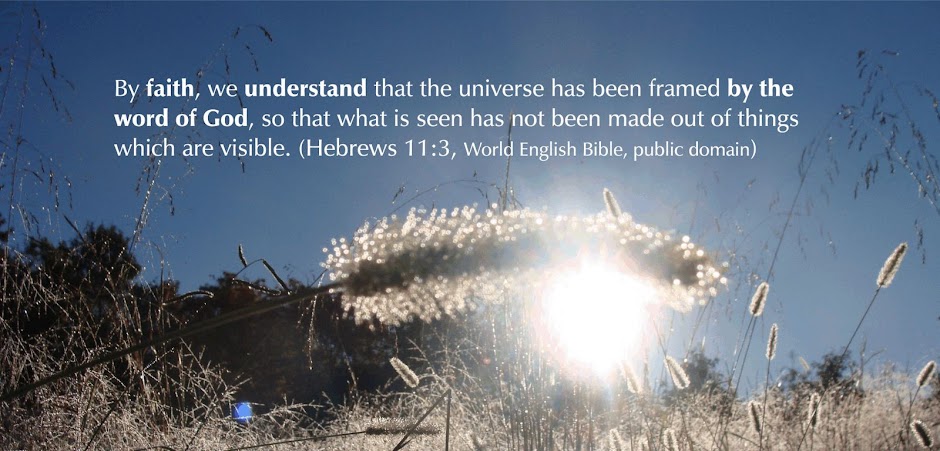
Well put, except that there shouldn't be "science/religion wars." If we really understood God's revelation in Christ, in the Bible, through the church, and in nature (which science unfolds for us) we would see that our existence is best explained by accepting, by faith, that God planned for our universe, and us, to exist. See Hebrews 11:3, which is quoted in the graphic at the top of this post.
I know of no evidence that Woit is a Christian. For other criticisms of the book, see its Wikipedia article.
See also the recent opinion piece in Time, "Why Science Does Not Disprove God."
Thanks for reading!
In 2010, Hawking, in collaboration with Leonard Mlodinow, wrote The Grand Design, which became a best-seller, in spite of its non-fiction status and scientific content. The book argues that it is not necessary to suppose that God created the universe. It also says that "philosophy is dead," and suggests that the search for a unified field theory is futile, so it isn't exactly shy about attacking significant ideas. What they seem to mean by "philosophy is dead" is that some philosophers are not willing to agree with them on all points.
The Grand Design was referred to in the recent movie, God's Not Dead. (See here for my review of that film. That review includes the pivotal quotation from The Grand Design, which was used in the movie. That quotation is the second and third sentences from the second quotation from the book, below.) God's Not Dead did not claim that the existence of God can be proved, but that His existence cannot be disproved. The Grand Design doesn't disprove God's existence, although the authors seem to think that it does, or that it almost does.
As indicated above, Hawking and Mlodinow weren't bashful. They claim, on page 32, that "recent experiments" have shown that our brains operate according to physical laws. There are no notes in the book, so I don't know what experiments they were referring to, but never mind. What other laws would our brains operate by? They claim that, because our brains operate by physical laws, "[f]ree will is an illusion," (p. 32) but are willing for us to act as if we really did have free will. That's a good thing, because if we don't have free will, Hawking and Mlodinow didn't, either, and they therefore believe the things that they do, not because they are true, but because of the physical laws operating in their brains. (And, by the way, if that discussion isn't a matter for philosophy, I don't know what is.)
The fundamental argument of The Grand Design is that there are really many, very many universes, according to M-theory, and that we exist in one of those that is compatible with life. All those universes came into being somehow, and here we are, in this one, the result of a cosmic accident. There are some serious problems with this notion. One of them is that even Hawking and Mlodinow aren't sure what M-theory is:
No one seems to know what the "M" stands for, but it may be "master," "miracle," or "mystery." It seems to be all three. People are still trying to decipher the nature of M-theory, but that may not be possible. It could be that the physicist's traditional expectation of a single theory of nature is untenable, and there exists no single formulation. It might be that to describe the universe, we have to employ different theories in different situations. Each theory may have its own version of reality, but according to model-dependent realism, that is acceptable so long as the theories agree in their predictions whenever they overlap, that is, whenever they can both be applied. (p. 117)
The above is a quotation from the book. That quotation indicates that, whatever M-theory might be, if it is true here, it isn't true elsewhere. That, and their fuzzy description, don't inspire confidence in science based on M-theory.
Another serious problem is that there is no experimental proof for M-theory and its relatives. Granted, a few decades ago, there was no experimental proof for quarks, which were proposed as a way of making sense out of the many types of sub-atomic particles then thought to exist, and, hence, there was skepticism about their existence. But that skepticism has largely disappeared, and there is experimental evidence for the existence of quarks. However, quarks, so far as we know, are the same everywhere in the universe. Quark theory didn't propose that there were different kinds of quarks, or no quarks at all, in other universes. It's not clear that, even if other universes exist, we can access them in any way, which would be necessary, I think, to vindicate M-theory.
Then there's the matter of gravity.
Because there is a law like gravity, the universe can and will create itself from nothing in the manner described in Chapter 6. [Chapter Title - "Choosing Our Universe."] Spontaneous creation is the reason there is something rather than nothing, why the universe exists, why we exist. It is not necessary to invoke God to light the blue touch paper and set the universe going. (p. 180.)
But why is there gravity? If they explain that, I missed it, or didn't understand it. And even if gravity had the power to make the universe create itself from nothing, wouldn't the powers of gravity be different in all the other different universes, according to their own thesis? So why should other universes exist?
Another serious problem is that scientists, and others, are not universally in agreement with Hawking and Mlodinow's central idea, mostly because of the first two serious problems indicated above.
Peter Woit, of Columbia University, has written a severely critical review of The Grand Design. Woit wrote:
I’m in favor of naturalism and leaving God out of physics as much as the next person, but if you’re the sort who wants to go to battle in the science/religion wars, why you would choose to take up such a dubious weapon as M-theory mystifies me. . . . [T]hinking about it, [I] have to admit that the kind of pseudo-science going on here and being promoted in this book isn’t obviously any better than the faith-based explanations of how the world works favored by conventional religions.
Well put, except that there shouldn't be "science/religion wars." If we really understood God's revelation in Christ, in the Bible, through the church, and in nature (which science unfolds for us) we would see that our existence is best explained by accepting, by faith, that God planned for our universe, and us, to exist. See Hebrews 11:3, which is quoted in the graphic at the top of this post.
I know of no evidence that Woit is a Christian. For other criticisms of the book, see its Wikipedia article.
See also the recent opinion piece in Time, "Why Science Does Not Disprove God."
Thanks for reading!
Friday, March 28, 2014
God's Not Dead -- report on the movie
I saw the movie, God's Not Dead, today. It stars Kevin Sorbo, as Professor Radisson, and Shane Harper as a university freshman, Josh Wheaton. Radisson begins his philosophy class by having the students all write "God is dead" on a sheet of paper, with their names, and hand it in. Wheaton says that he can't do that, and Radisson says that, as an alternative, Wheaton must prove, in three 20 minute presentations at the end of the next meetings of the class, that God is not dead.
This movie was obviously made by Christians, and the intended audience is also Christians. Sorbo, and, probably, all the other actors, are also Christians. The Newsboys and Willie and Korie Robinson, of Duck Dynasty, appear as themselves, and are portrayed as outspoken Christians.
Some (not all, I'm sure) Christians may be disturbed by some aspects of the film. A Christian character prepares a meal, and purchases and serves wine. Wheaton's defense of God's existence includes the following, which some will not appreciate: 1) It's not possible to disprove God's existence, but it's not possible to prove it, either. 2) God worked through the Big Bang in the origination of the universe (for more on that, see here) and this is consistent with "Let there be light!" in Genesis 1. 3) Evolution occurred, as God's method of establishing the diversity of living things. This last point got only a couple of sentences, and neither Radisson or Wheaton mentioned the origin of humans.
I will try not to give away much of the plot, and there is a plot. In fact, there are several plots, more or less woven together, involving several characters. I will say that three different couples broke up during the film, and one of the less believable aspects of it is how they stayed together long enough to be presented as couples in the first place, considering that each one had at least one seriously self-centered egotist as one partner. (One of these was supposedly a Christian.) I thought there was too much going on in the movie, actually.
The film is a dramatized version of Christian apologetics. In my view, it does this well, presenting most or all of the important reasons that atheists claim argue against God's existence, and some rebuttals of these reasons. One apologetic defense is to ask "Why is there something rather than nothing?" or to ask "Who started the Big Bang?"
Stephen Hawking is a prominent atheist, and was named, by Radisson, as the greatest scientific mind in the history of the world. (That claim could certainly be disputed, with, say, Newton, as another candidate!) In his book, The Grand Design, co-authored by Leonard Mlodinow, the following statement occurs, and Radisson quoted all or part of it: Because there is a law such as gravity, the universe can and will create itself from nothing. Spontaneous creation is the reason there is something rather than nothing, why the universe exists, why we exist. It is not necessary to invoke God to light the blue touch paper and set the universe going.
There are some problems with using this passage to disprove God's existence. First, as you will see if you go to the Wikipedia article on the book, you will read that by no means all scientists are in agreement with Hawking and Mlodinow, and apparently some who don't agree with them are also unbelievers. Second, why is there gravity at all? (I am sorry that I have yet to read this book -- possibly the authors answer that, but I really doubt it.) Third, as Wheaton pointed out to Radisson, ". . . philosophy is dead." (p. 5)
There was an apologetics advisor for the film. I glimpsed that in the opening credits, but do not recall the name given, and I haven't found it in the movie's web site. Whoever this was, I thought he did a good job. (It was a he. That much I can recall.) At the end of the film, as part of the credits, there was a rather long list of universities that had been sued by Christians (and possibly by some others) for denying Christians their constitutional rights. I'm not sure that any of these were directly related to the subject of the movie. I found one such case on the web site of the Alliance Defense Fund. A student was required to argue in favor of adoption by same-sex couples, and asked for a different assignment, but, instead, was subjected to an examination ". . . for hours about her Christian faith," by a faculty committee. Eventually, apparently after action by the Alliance Defense Fund, she was exonerated, the professor was fired, and she was offered compensation by the university. The credits also said that, at the University I graduated from, the Inter-Varsity Christian Fellowship was banned as a student organization, and that ruling was overturned, after intervention by the ADF. I checked, and found that that claim seems also to be true.
Is being told that there is no God, by a professor, persecution? I don't think so. Being required to act as if you agreed with it, when you don't, would seem to be, however. I don't think being asked to defend one's beliefs is persecution either, in and of itself. It is often part of a higher education, on all sorts of issues.
At least one university philosophy professor has written in defense of Radisson. One claim he makes is that it is Christian universities who deny freedom of thought, by expecting students and faculty to agree to statements of belief, and then expelling them, or firing them, if they don't live up to such an agreement. To some extent, this is true. However, I was on the faculty of a Christian university for over four decades, and never heard of a student being asked to leave for unbelief. (Some were asked to leave for various kinds of bad behavior.) Some students did not believe, of course. At least a couple of faculty were let go precipitously, also for behavior inconsistent with the university's statement of belief. The professor cited claims that state universities are tolerant of all beliefs, and allow freedom of thought. Cases like the ones mentioned above indicate that freedom of thought isn't always tolerated on secular campuses, in spite of what the professor believes. He makes other claims. Some of them seem to be at least partly valid.
I'm glad that I went to see God's Not Dead. It wasn't the greatest movie ever made, but it was thought-provoking.
Thanks for reading!
* * * * *
Note added, May 21, 2014. I have now read, and discussed, the book by Hawking that was so central to the conflict in the movie. My discussion is here.
June 17, 2014. The Speculative Faith blog has published a review of the film, which points out some of the same flaws as the post above.
This movie was obviously made by Christians, and the intended audience is also Christians. Sorbo, and, probably, all the other actors, are also Christians. The Newsboys and Willie and Korie Robinson, of Duck Dynasty, appear as themselves, and are portrayed as outspoken Christians.
Some (not all, I'm sure) Christians may be disturbed by some aspects of the film. A Christian character prepares a meal, and purchases and serves wine. Wheaton's defense of God's existence includes the following, which some will not appreciate: 1) It's not possible to disprove God's existence, but it's not possible to prove it, either. 2) God worked through the Big Bang in the origination of the universe (for more on that, see here) and this is consistent with "Let there be light!" in Genesis 1. 3) Evolution occurred, as God's method of establishing the diversity of living things. This last point got only a couple of sentences, and neither Radisson or Wheaton mentioned the origin of humans.
I will try not to give away much of the plot, and there is a plot. In fact, there are several plots, more or less woven together, involving several characters. I will say that three different couples broke up during the film, and one of the less believable aspects of it is how they stayed together long enough to be presented as couples in the first place, considering that each one had at least one seriously self-centered egotist as one partner. (One of these was supposedly a Christian.) I thought there was too much going on in the movie, actually.
The film is a dramatized version of Christian apologetics. In my view, it does this well, presenting most or all of the important reasons that atheists claim argue against God's existence, and some rebuttals of these reasons. One apologetic defense is to ask "Why is there something rather than nothing?" or to ask "Who started the Big Bang?"
Stephen Hawking is a prominent atheist, and was named, by Radisson, as the greatest scientific mind in the history of the world. (That claim could certainly be disputed, with, say, Newton, as another candidate!) In his book, The Grand Design, co-authored by Leonard Mlodinow, the following statement occurs, and Radisson quoted all or part of it: Because there is a law such as gravity, the universe can and will create itself from nothing. Spontaneous creation is the reason there is something rather than nothing, why the universe exists, why we exist. It is not necessary to invoke God to light the blue touch paper and set the universe going.
There are some problems with using this passage to disprove God's existence. First, as you will see if you go to the Wikipedia article on the book, you will read that by no means all scientists are in agreement with Hawking and Mlodinow, and apparently some who don't agree with them are also unbelievers. Second, why is there gravity at all? (I am sorry that I have yet to read this book -- possibly the authors answer that, but I really doubt it.) Third, as Wheaton pointed out to Radisson, ". . . philosophy is dead." (p. 5)
There was an apologetics advisor for the film. I glimpsed that in the opening credits, but do not recall the name given, and I haven't found it in the movie's web site. Whoever this was, I thought he did a good job. (It was a he. That much I can recall.) At the end of the film, as part of the credits, there was a rather long list of universities that had been sued by Christians (and possibly by some others) for denying Christians their constitutional rights. I'm not sure that any of these were directly related to the subject of the movie. I found one such case on the web site of the Alliance Defense Fund. A student was required to argue in favor of adoption by same-sex couples, and asked for a different assignment, but, instead, was subjected to an examination ". . . for hours about her Christian faith," by a faculty committee. Eventually, apparently after action by the Alliance Defense Fund, she was exonerated, the professor was fired, and she was offered compensation by the university. The credits also said that, at the University I graduated from, the Inter-Varsity Christian Fellowship was banned as a student organization, and that ruling was overturned, after intervention by the ADF. I checked, and found that that claim seems also to be true.
Is being told that there is no God, by a professor, persecution? I don't think so. Being required to act as if you agreed with it, when you don't, would seem to be, however. I don't think being asked to defend one's beliefs is persecution either, in and of itself. It is often part of a higher education, on all sorts of issues.
At least one university philosophy professor has written in defense of Radisson. One claim he makes is that it is Christian universities who deny freedom of thought, by expecting students and faculty to agree to statements of belief, and then expelling them, or firing them, if they don't live up to such an agreement. To some extent, this is true. However, I was on the faculty of a Christian university for over four decades, and never heard of a student being asked to leave for unbelief. (Some were asked to leave for various kinds of bad behavior.) Some students did not believe, of course. At least a couple of faculty were let go precipitously, also for behavior inconsistent with the university's statement of belief. The professor cited claims that state universities are tolerant of all beliefs, and allow freedom of thought. Cases like the ones mentioned above indicate that freedom of thought isn't always tolerated on secular campuses, in spite of what the professor believes. He makes other claims. Some of them seem to be at least partly valid.
I'm glad that I went to see God's Not Dead. It wasn't the greatest movie ever made, but it was thought-provoking.
Thanks for reading!
* * * * *
Note added, May 21, 2014. I have now read, and discussed, the book by Hawking that was so central to the conflict in the movie. My discussion is here.
June 17, 2014. The Speculative Faith blog has published a review of the film, which points out some of the same flaws as the post above.
Wednesday, August 28, 2013
Sunspots 433

The Arts: Wired reports on how an artist has created art based on the movements of the London Underground (that's the subway, if you didn't know this.)
Christianity: E. Stephen Burnett heads an insightful discussion on whether the Harry Potter books teach occultism. (He doesn't believe so.) There are a lot of comments, almost all done in a respectful manner. Burnett says, among other things, that "trusting [occult practices] instead of God as a means to manipulate one’s world and control one’s life. (This is the goal behind any real occult/witchery attempts, including the infamous 'prosperity gospel' heresy.)"
Christianity Today reports that too many non-Christians don't even know a Christian.
Computing: A National Public Radio reporter allowed an MIT professor to examine the metadata from the reporter's Gmail account, in a way similar to how the NSA can use our metadata. The professor learned a lot, without reading any of the e-mail.
Education: None of the more than 24,000 students taking entrance exams for the University of Liberia obtained a score high enough for entrance.
Science: (And Philosophy, and Christianity) Books and Culture, sister publication to Christianity Today, has re-published an essay, by Karl Giberson, a physicist, about the theoretical work of Stephen Hawking.
Image source (public domain)
Tuesday, May 17, 2011
Stephen Hawking and God, again
Stephen Hawking, famous scientist, and best-selling author, has said, in an interview, that 'There is no heaven; it's a fairy story.' He believes, as many do, that human existence ends with death.
Perhaps Hawking is right. I can't prove that he is not.
But statements such as this are not scientific. Hawking has not proved, by experiment, that there is no heaven. He presents no firm scientific evidence for this assertion.
It is interesting that the reason for interviewing Hawking was a lecture he recently gave on M-theory. M-theory is one version of a so-called Theory of Everything, an attempt to explain the physical laws that undergird our universe in one unified scheme. As the Wikipedia article on the theory says, so far, M-theory lacks experimental proof, and ". . . the tangible success of M-theory can be questioned, given its current incompleteness and limited predictive power, even after so many years of intense research."
That doesn't prove that M-theory isn't right. It may be. But perhaps its predictive power is roughly equivalent to assertions about the existence (or not) of a heavenly afterlife. (I would guess that the establishment of M-theory, should that take place, would neither prove or disprove the existence of God.)
For more on Hawking's religious beliefs, see this paragraph in the Wikipedia, or go here.
Thanks for reading.
Perhaps Hawking is right. I can't prove that he is not.
But statements such as this are not scientific. Hawking has not proved, by experiment, that there is no heaven. He presents no firm scientific evidence for this assertion.
It is interesting that the reason for interviewing Hawking was a lecture he recently gave on M-theory. M-theory is one version of a so-called Theory of Everything, an attempt to explain the physical laws that undergird our universe in one unified scheme. As the Wikipedia article on the theory says, so far, M-theory lacks experimental proof, and ". . . the tangible success of M-theory can be questioned, given its current incompleteness and limited predictive power, even after so many years of intense research."
That doesn't prove that M-theory isn't right. It may be. But perhaps its predictive power is roughly equivalent to assertions about the existence (or not) of a heavenly afterlife. (I would guess that the establishment of M-theory, should that take place, would neither prove or disprove the existence of God.)
For more on Hawking's religious beliefs, see this paragraph in the Wikipedia, or go here.
Thanks for reading.
Saturday, July 31, 2010
Stephen Hawking and God
Stephen Hawking may be the most well-known living scientist. Confined to a wheelchair, and unable to speak, Hawking still communicates effectively. He has had an interesting life, it seems. Among other things, he has experienced free fall training with US astronauts, and had a bit role in a Star Trek: The Next Generation episode, playing himself. He also wrote a best-selling book. Hawking shares a birthday with Galileo, and, until his retirement, he held the professorial chair that was once held by Isaac Newton.
Here are two quotations from Hawking, on the subject of the existence of God:
In an interview with Reuters last year, Hawking said he was "not religious in the normal sense."
"I believe the universe is governed by the laws of science," he said. "The laws may have been decreed by God, but God does not intervene to break the laws." "Pope sees physicist Hawking at evolution gathering," Reuters, October 31, 2008.
Diane Sawyer asked Hawking what question he would ask the universe, if given the opportunity. He responded "I want to know why the universe exists, why there is something rather than nothing."
He also said, "There is a fundamental difference between religion, which is based on authority, and science, which is based on observation and reason. Science will win, because it works."
Sawyer said, in commenting on the interview, that Hawking once said that "God not only plays dice with the world, but sometimes throws the dice where they can't be seen."
- ABC World News with Diane Sawyer: "Conversation with Stephen Hawking," June 7, 2010. (My original source for this has been removed by YouTube. Here is a source for the first quotation in the above paragraph.)
Hawking's thinking can be described as bold. This is obvious in his book, A Brief History of Time: From the Big Bang to Black Holes . (Bantam Books, 1988, pp. 173-4)
Brief History is a discussion of the implications of quantum gravity. See the Wikipedia article on the subject, which indicates that there are several competing theories of quantum gravity. It also says (version of July 28, 2010) that all these theories ". . . face the common problem that, as yet, there is no way to put quantum gravity predictions to experimental tests. . ." Hawking's view belongs to the Sum Over Histories group of theories, according to the book, and also according to a history (as of 2000, published in 2001, but the on-line verson has a 2008 date) of theories in quantum gravity, by Rovelli. (See here.) So, although Hawking may be right, he may also be wrong, and currently there isn't any way to prove that he is right. He is understandably enthusiastic about his own approach, but does not dogmatically state that he is right.
The book is only 175 pages long, with only one equation, and minimal scholarly apparatus. It sold very well. Hawking's point is to let it be known that his theory of quantum gravity may indicate that the universe, rather than having had a definite beginning, is eternal. (I'm don't know if the other theories also do this) Hawking makes clear that he thinks such a truth would profoundly change our view of God's activity, in fact meaning that there is no God. Kitty Ferguson, author of The Fire in the Equations: Science, Religion & the Search for God. says, I believe correctly, that Hawking writes as if the possibility that his theory ". . . erases our need for a God is far more reason for celebrating than the fact that the theory makes a new part of this mysterious universe accessible to human beings." (Grand Rapids, MI: Eerdmans, 1995. See here for my most recent post on the book. p. 76. Ferguson's title is a quotation from Brief History, and she indicates that Hawking read at least part of her manuscript before her book was published. See below.)
There have been past occasions where scientific understanding has led to a re-thinking of our role in the universe. Two of the most important are the astronomical findings that show that the earth is a small planet, orbiting a rather mediocre star, in an ordinary galaxy, and that living things on earth seem to have arisen from one, or at most a few, common ancestors, over a very long period of time. These both caused, and, to some degree are still causing, theological upheavals. But I don't think that they necessarily destroy, or even diminish, belief in an omnipotent divine Creator, and I'm not alone in such belief. In fact, these scientific revolutions make many believers more confident of God's power.
Suppose Hawking is correct about quantum gravity and the universe -- bearing in mind that we don't know that. What are the possibilities?
First, it is possible that there is no God, and there doesn't need to be one, because the universe is eternal, and did not have a beginning.
Second, God, much as Christians believe in Him, is part of the universe, co-existent, and, perhaps, playing an important creative part in its development.
Third, God created the universe at some point in time, and created it with an appearance of age, so that there is evidence that supports Hawking's ideas, but that evidence is misleading.
All of these would, of course, have profound implications for theology, and Hawking says just that, on his pages 173 and 174.
But, as indicated above, Hawking at least entertains the idea that God started things:
On page 125, Hawking tells us that "The laws of science, as we know them at present, contain many fundamental numbers, like the size of the electric charge of the electron and the ratio of the masses of the proton and the electron." He goes on to say that the values of these various physical constants "seem to have been very finely adjusted to make possible the development of life," and indicates that values that were much different would have made life, as we know it, impossible, and, in fact, the stars, as we know them, impossible, also. He also says that, so far, there is no theory which would have predicted these particular values for these constants. This may be taken as evidence for a Creator, or as evidence for the Strong Anthropic Principle.
On pages 126-7, he writes about the initial conditions of the universe, which, he says, must have been in a narrow range of temperatures, so as to allow the cosmic background radiation to be so uniform. There must have also been a constricted rate of expansion, because if it were much different, the universe would have collapsed. "It would be very difficult to explain why the universe should have begun in this way, except as the act of a God who intended to create beings like us." (p. 127)
On pages 136-7, Hawking says this: "I'd like to emphasize that this idea that time and space should be finite without boundary is just a proposal: it cannot be deduced from some other principle. Like any other scientific theory, it may initially be put forward for aesthetic or metaphysical reasons, but the real test is whether it makes predictions that agree with observation." (emphasis in original) He goes on to say that it will be difficult to even make predictions, let alone test them.
On page 160, the author sets forth three possibilities:
1) There really is a unified theory, which will tie all the forces of nature, the elementary particles into an explanation that ties them together, and also explains the constants referred to previously in the book.
2) No such theory exists, but we may be able to explain the phenomena indicated with better and better theories, as time passes.
3) There is no such theory, and there is an underlying randomness and unpredictability to the universe.
He goes on to say that some would argue for the 3rd possibility, because it allows God freedom to act. But, says Hawking, God is said to exist outside of time, so there is no reason that He couldn't intervene by making laws in a certain way initially, and, also act sub-atomically, operating through the events which the Heisenberg Uncertainty Principle doesn't let us predict, or even measure. Hawking says that current experience seems to indicate that the second possibility is the one we are experiencing.
Even if there is only one possible unified theory, it is just a set of rules and equations. What is it that breathes fire into the equations and makes a universe for them to describe? The usual approach of science of constructing a model cannot answer the questions of why there should be a universe for the model to describe. Why does the universe go to all the bother of existing? Is the unified theory so compelling that it brings about its own existence? Or does it need a creator, and, if so, does he have any other effect on the universe? And who created him? (page 174)
Thanks for reading.
* * * *
As indicated above, I added a source to replace one that is no longer available. I did this on April 13, 2012.
* * * *
As of July 22, 2012, I am disabling comments on this post, because I have gotten dozens of spam comments on it. Feel free to comment on a different post, and refer to something in this one, not to politics, etc., if you are a real person. Thanks.
* * * *
On September 23, I made three minor editorial changes.
Here are two quotations from Hawking, on the subject of the existence of God:
In an interview with Reuters last year, Hawking said he was "not religious in the normal sense."
"I believe the universe is governed by the laws of science," he said. "The laws may have been decreed by God, but God does not intervene to break the laws." "Pope sees physicist Hawking at evolution gathering," Reuters, October 31, 2008.
Diane Sawyer asked Hawking what question he would ask the universe, if given the opportunity. He responded "I want to know why the universe exists, why there is something rather than nothing."
He also said, "There is a fundamental difference between religion, which is based on authority, and science, which is based on observation and reason. Science will win, because it works."
Sawyer said, in commenting on the interview, that Hawking once said that "God not only plays dice with the world, but sometimes throws the dice where they can't be seen."
- ABC World News with Diane Sawyer: "Conversation with Stephen Hawking," June 7, 2010. (My original source for this has been removed by YouTube. Here is a source for the first quotation in the above paragraph.)
Hawking's thinking can be described as bold. This is obvious in his book, A Brief History of Time: From the Big Bang to Black Holes . (Bantam Books, 1988, pp. 173-4)
Brief History is a discussion of the implications of quantum gravity. See the Wikipedia article on the subject, which indicates that there are several competing theories of quantum gravity. It also says (version of July 28, 2010) that all these theories ". . . face the common problem that, as yet, there is no way to put quantum gravity predictions to experimental tests. . ." Hawking's view belongs to the Sum Over Histories group of theories, according to the book, and also according to a history (as of 2000, published in 2001, but the on-line verson has a 2008 date) of theories in quantum gravity, by Rovelli. (See here.) So, although Hawking may be right, he may also be wrong, and currently there isn't any way to prove that he is right. He is understandably enthusiastic about his own approach, but does not dogmatically state that he is right.
The book is only 175 pages long, with only one equation, and minimal scholarly apparatus. It sold very well. Hawking's point is to let it be known that his theory of quantum gravity may indicate that the universe, rather than having had a definite beginning, is eternal. (I'm don't know if the other theories also do this) Hawking makes clear that he thinks such a truth would profoundly change our view of God's activity, in fact meaning that there is no God. Kitty Ferguson, author of The Fire in the Equations: Science, Religion & the Search for God. says, I believe correctly, that Hawking writes as if the possibility that his theory ". . . erases our need for a God is far more reason for celebrating than the fact that the theory makes a new part of this mysterious universe accessible to human beings." (Grand Rapids, MI: Eerdmans, 1995. See here for my most recent post on the book. p. 76. Ferguson's title is a quotation from Brief History, and she indicates that Hawking read at least part of her manuscript before her book was published. See below.)
There have been past occasions where scientific understanding has led to a re-thinking of our role in the universe. Two of the most important are the astronomical findings that show that the earth is a small planet, orbiting a rather mediocre star, in an ordinary galaxy, and that living things on earth seem to have arisen from one, or at most a few, common ancestors, over a very long period of time. These both caused, and, to some degree are still causing, theological upheavals. But I don't think that they necessarily destroy, or even diminish, belief in an omnipotent divine Creator, and I'm not alone in such belief. In fact, these scientific revolutions make many believers more confident of God's power.
Suppose Hawking is correct about quantum gravity and the universe -- bearing in mind that we don't know that. What are the possibilities?
First, it is possible that there is no God, and there doesn't need to be one, because the universe is eternal, and did not have a beginning.
Second, God, much as Christians believe in Him, is part of the universe, co-existent, and, perhaps, playing an important creative part in its development.
Third, God created the universe at some point in time, and created it with an appearance of age, so that there is evidence that supports Hawking's ideas, but that evidence is misleading.
All of these would, of course, have profound implications for theology, and Hawking says just that, on his pages 173 and 174.
But, as indicated above, Hawking at least entertains the idea that God started things:
Science seems to have uncovered a set of laws that, within the limits set by the uncertainty principle, tell us how the universe will develop with time, if we know its state at any one time. These laws may have originally been decreed by God, but it appears that he has since left the universe to evolve according to them and does not now intervene in them. But how did he choose the initial state or configuration of the universe? What were the "boundary conditions" at the beginning of time?
One possible answer is to say that God chose the initial configuration of the universe for reasons that we cannot hope to understand. This would certainly have been within the power of an omnipotent being, but if he had started it off in such an incomprehensible way, why did he choose to let it evolve according to laws that we could understand? The whole history of science has been the gradual realization that events do not happen in an arbitrary manner, but that they reflect a certain underlying order, which may or may not be divinely inspired. (page 122. The color used indicates a block quotation.)On page 125, Hawking tells us that "The laws of science, as we know them at present, contain many fundamental numbers, like the size of the electric charge of the electron and the ratio of the masses of the proton and the electron." He goes on to say that the values of these various physical constants "seem to have been very finely adjusted to make possible the development of life," and indicates that values that were much different would have made life, as we know it, impossible, and, in fact, the stars, as we know them, impossible, also. He also says that, so far, there is no theory which would have predicted these particular values for these constants. This may be taken as evidence for a Creator, or as evidence for the Strong Anthropic Principle.
On pages 126-7, he writes about the initial conditions of the universe, which, he says, must have been in a narrow range of temperatures, so as to allow the cosmic background radiation to be so uniform. There must have also been a constricted rate of expansion, because if it were much different, the universe would have collapsed. "It would be very difficult to explain why the universe should have begun in this way, except as the act of a God who intended to create beings like us." (p. 127)
On pages 136-7, Hawking says this: "I'd like to emphasize that this idea that time and space should be finite without boundary is just a proposal: it cannot be deduced from some other principle. Like any other scientific theory, it may initially be put forward for aesthetic or metaphysical reasons, but the real test is whether it makes predictions that agree with observation." (emphasis in original) He goes on to say that it will be difficult to even make predictions, let alone test them.
On page 160, the author sets forth three possibilities:
1) There really is a unified theory, which will tie all the forces of nature, the elementary particles into an explanation that ties them together, and also explains the constants referred to previously in the book.
2) No such theory exists, but we may be able to explain the phenomena indicated with better and better theories, as time passes.
3) There is no such theory, and there is an underlying randomness and unpredictability to the universe.
He goes on to say that some would argue for the 3rd possibility, because it allows God freedom to act. But, says Hawking, God is said to exist outside of time, so there is no reason that He couldn't intervene by making laws in a certain way initially, and, also act sub-atomically, operating through the events which the Heisenberg Uncertainty Principle doesn't let us predict, or even measure. Hawking says that current experience seems to indicate that the second possibility is the one we are experiencing.
Even if there is only one possible unified theory, it is just a set of rules and equations. What is it that breathes fire into the equations and makes a universe for them to describe? The usual approach of science of constructing a model cannot answer the questions of why there should be a universe for the model to describe. Why does the universe go to all the bother of existing? Is the unified theory so compelling that it brings about its own existence? Or does it need a creator, and, if so, does he have any other effect on the universe? And who created him? (page 174)
Thanks for reading.
* * * *
As indicated above, I added a source to replace one that is no longer available. I did this on April 13, 2012.
* * * *
As of July 22, 2012, I am disabling comments on this post, because I have gotten dozens of spam comments on it. Feel free to comment on a different post, and refer to something in this one, not to politics, etc., if you are a real person. Thanks.
* * * *
On September 23, I made three minor editorial changes.
Tuesday, October 16, 2007
Stephen Hawking's singularity at the beginning
When people start using terms like singularity, my brain generally goes into neutral.
Stephen Hawking, one of the most famous scientists of our time (he holds the same professorial chair that Isaac Newton did, and appeared, as a holographic simulation of himself, on an episode of Star Trek: Voyager) wrote A Brief History of Time, a best-selling book (there are those who claim that not many who own the book have actually read and understood it!). In that book, he claimed, as I understood him, that the universe sort of started up by itself -- without a singularity, a special event, at the beginning.
I have recently read a chapter, "In Defense of Rational Theism," by William Lane Craig, in Does God Exist: The Debate between Theists & Atheists (Amherst, NY: Prometheus Books. J. P. Moreland and Kai Nielsen are given as senior authors. The chapter is pp. 139-161). As part of this chapter, Craig, a philosopher, criticizes Hawking's idea that there was no** singularity at the beginning of time. He states that Hawking was on questionable ground on two points, which, he says, are among Hawking's assumptions, not his facts:
1) He assumes that there must have been (be?) multiple universes*, in fact, all possible universes, but we only know about the one we are in now. Craig says that the reason for this particular part of Hawking's metaphysics is that quantum physics would suppose that there was indeterminacy in the universe to begin with, but it collapsed to one particular state, and this collapse -- which is related to the Big Bang, would have required some sort of observer, which, says Craig, quoting Hawking, "smacks of divine intervention," (p. 147 of Craig) which Hawking wanted to deny.
*Philip Pullman used this idea in his His Dark Materials series.
**On October 17th, I changed "of a" to "that there was no," after suddenly realizing that I had written the opposite of what I had wanted to say. Sigh. Thanks, Steve, for your comment. Without it, I wouldn't have noticed this.
2) Craig says that Hawking misused mathematics in his model, specifically that he uses imaginary numbers inappropriately.
I am not equipped to evaluate Craig's claims, but, at least in part, they make sense. Hawking starts out, apparently, by not believing that there is a supernatural God who began the universe. So it is no wonder that he comes out "proving" this! Hebrews 11:3 says that we understand God's work in creation by faith. Hawking seems to have a different sort of faith. (See also this post.)
Thanks for reading.
Stephen Hawking, one of the most famous scientists of our time (he holds the same professorial chair that Isaac Newton did, and appeared, as a holographic simulation of himself, on an episode of Star Trek: Voyager) wrote A Brief History of Time, a best-selling book (there are those who claim that not many who own the book have actually read and understood it!). In that book, he claimed, as I understood him, that the universe sort of started up by itself -- without a singularity, a special event, at the beginning.
I have recently read a chapter, "In Defense of Rational Theism," by William Lane Craig, in Does God Exist: The Debate between Theists & Atheists (Amherst, NY: Prometheus Books. J. P. Moreland and Kai Nielsen are given as senior authors. The chapter is pp. 139-161). As part of this chapter, Craig, a philosopher, criticizes Hawking's idea that there was no** singularity at the beginning of time. He states that Hawking was on questionable ground on two points, which, he says, are among Hawking's assumptions, not his facts:
1) He assumes that there must have been (be?) multiple universes*, in fact, all possible universes, but we only know about the one we are in now. Craig says that the reason for this particular part of Hawking's metaphysics is that quantum physics would suppose that there was indeterminacy in the universe to begin with, but it collapsed to one particular state, and this collapse -- which is related to the Big Bang, would have required some sort of observer, which, says Craig, quoting Hawking, "smacks of divine intervention," (p. 147 of Craig) which Hawking wanted to deny.
*Philip Pullman used this idea in his His Dark Materials series.
**On October 17th, I changed "of a" to "that there was no," after suddenly realizing that I had written the opposite of what I had wanted to say. Sigh. Thanks, Steve, for your comment. Without it, I wouldn't have noticed this.
2) Craig says that Hawking misused mathematics in his model, specifically that he uses imaginary numbers inappropriately.
I am not equipped to evaluate Craig's claims, but, at least in part, they make sense. Hawking starts out, apparently, by not believing that there is a supernatural God who began the universe. So it is no wonder that he comes out "proving" this! Hebrews 11:3 says that we understand God's work in creation by faith. Hawking seems to have a different sort of faith. (See also this post.)
Thanks for reading.
Subscribe to:
Posts (Atom)