License

I have written an e-book, Does the Bible Really Say That?, which is free to anyone. To download that book, in several formats, go here.
Creative Commons License
The posts in this blog are licensed under a Creative Commons Attribution-NonCommercial-ShareAlike 3.0 Unported License. You can copy and use this material, as long as you aren't making money from it. If you give me credit, thanks. If not, OK.
Showing posts with label enzymes. Show all posts

Wednesday, September 30, 2020

Saturday, November 22, 2014

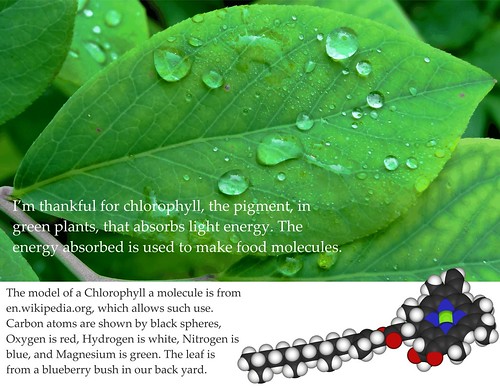
I'm thankful for Chlorophyll

Thankful for chlorophyll

The picture above is of a blueberry leaf, and of one version of a  model of a Chlorophyll molecule.

A recent post attempted to explain why we should be thankful for Carbon atoms, which are able to form complex structures. A Chlorophyll molecule isn't nearly as complex as DNA, or as a protein, but it's pretty complex. The Wikipedia article on Chlorophyll says that Chlorophyll a has this chemical structure: C55H72O5N4Mg. That's 137 atoms, of 5 different elements. Without the capacity of Carbon to form such structures, life would be impossible. (Chlorophyll a is the most common Chlorophyll molecule. Chlorophyll b, which is very similar, is also found in green plants. Other similar molecules are found in other types of organisms.)

Life requires energy sources. For most living things, certainly including us, Chlorophyll is essential in making such energy available. How does it do this? It is a pigment. Like all pigments, it absorbs certain types of light. Light is a form of energy. Before we get to the energy, let's consider the color of Chlorophyll. It's green. So what? That means that it is not absorbing green light. Green light is being reflected from the leaves that contain Chlorophyll, or it is passing through them. It's other colors of light that Chlorophyll absorbs. (That's true of all pigments -- a red pigment, for example, does not absorb red light. It reflects it.) Chlorophyll absorbs the energy of blue and red, or far red, light.

What does Chlorophyll do with this energy? It makes it available to photosynthesis, the process, as the name suggests, whereby light energy is used to make things. What is made is simple sugars, which are used for food, and also as raw materials for making other types of molecules needed by living things.

Photosynthesis requires two raw materials, water (H2O) and Carbon dioxide (CO2). The energy absorbed by Chlorophyll is used to break water molecules, so that Hydrogen is available. In the process, Oxygen is given off. See here for the summary chemical equation for photosynthesis. It is only a summary. The process is complex. That Hydrogen becomes attached to Carbon, from the Carbon Dioxide, and the result is glucose (C6H12O6).

The food we eat, where food is an energy source usable by our body's metabolism, all comes from green plants, directly or indirectly. It comes from plants like beans and spinach, or from animals that eat green plants, like cows, or, rarely, from animals that eat animals that eat green plants, such as some fish.

The three-dimensional structure of Chlorophyll makes it possible for it to trap light energy, and divert it into chemical energy -- food. I believe, but cannot prove, that God designed Carbon atoms, and also Hydrogen, Oxygen, Nitrogen and Magnesium atoms, so that they could be assembled into Chlorophyll molecules, thus making it possible for green plants to get food, and for us to get food from them. I also believe that He planned and designed the complex enzymes that construct Chlorophyll, and that assist in transferring captured light energy to chemical bonds. As I say, I can't prove any of this, but no one can disprove it, either.

Thanks for reading. Be grateful for photosynthesis.

Saturday, May 17, 2014

Did living things come from a common ancestor, or were they created separately?

The title asks an important question. It's also a broad question. Let me re-phrase it, more narrowly:

Do some living things resemble each other because of descent from a common ancestor, or because they were created to be similar?

Some people do not believe that the earth is old enough for there to have been distant common ancestors. They might believe that, say, cows and bison came from a common ancestor, or at least that all the breeds of cows did, but that cows and deer could not have, because there wasn't enough time. Some people, often the same ones, believe that the language of Genesis 1 indicates that God created the varieties of organisms by separate creative acts. Some people, usually the same ones as mentioned above, do not believe that humans and non-human primates share any common ancestry, because they believe that the language of Genesis 1 indicates that humans were created specially from non-living material. On the other hand, there are Bible-believing, God-fearing Christians, who are not so sure of all of this, and believe that the earth is very old. Such people may also believe that God especially endowed some pre-existing primate with the image of God (whatever that is) and that, therefore, non-human primates were distant biological ancestors of humans. Billy Graham has said that that may have been what happened.

If humans and chimpanzees were created separately, then how do people who believe this explain the similarities between the two? In particular, how do they explain the genetic similarity? The usual response is that, in order to function properly, genes have to fall within a narrow range of structural constraints. Therefore, human genes, and chimpanzee genes, were created to be much alike. Although we aren't really sure that there is only one way to make, say, an Oxygen-carrying molecule like hemoglobin, this argument of those who believe in special creation has some plausibility. But not enough.

A recent article, by a scientist who is a Christian, and well-qualified to discuss the matter, examines a situation where genes don't function. And, in this case, vitamin C production, it turns out that non-functioning genes of humans and non-human primates are very similar. The only reasonable explanation seems to be that humans and non-humans inherited their genes for vitamin C production from an ancestor which had lost the capacity to produce enzymes that could synthesize vitamin C. Thus neither humans nor orangutans can produce vitamin C, but both have the apparent remains of the genes that produced it in the presumed common ancestor, and these remains are almost identical.

Thanks for reading.