License

I have written an e-book, Does the Bible Really Say That?, which is free to anyone. To download that book, in several formats, go here.
Creative Commons License
The posts in this blog are licensed under a Creative Commons Attribution-NonCommercial-ShareAlike 3.0 Unported License. You can copy and use this material, as long as you aren't making money from it. If you give me credit, thanks. If not, OK.
Showing posts with label goodness. Show all posts

Saturday, October 03, 2015

Augustine on God's goodness


Going on hiatus - Augustine on the goodness of God 
The graphic above is my attempt to illustrate a simple, but profound truth from Augustine, in his Confessions, Book VII. His statement is "For never soul was, nor shall be, able to conceive any thing which may be better than You, who are the sovereign and the best good."

I used a triangle to represent the Trinity, and the apex is colored gold for God's royalty and sovereignty. The apex is also the point furthest from the dark area at the bottom. Don't take the graphic, with its symbolism as anything but a feeble attempt to represent something -- the symbols are imperfect, and imperfectly arranged.

Mark has a related passage: 10:17 As he was going out into the way, one ran to him, knelt before him, and asked him, “Good Teacher, what shall I do that I may inherit eternal life?”
18 Jesus said to him, “Why do you call me good? No one is good except one—God. ..." I'm not sure why Jesus seemed to leave Himself, God in flesh, out of the goodness group.


Thanks for looking!

Thursday, March 26, 2015

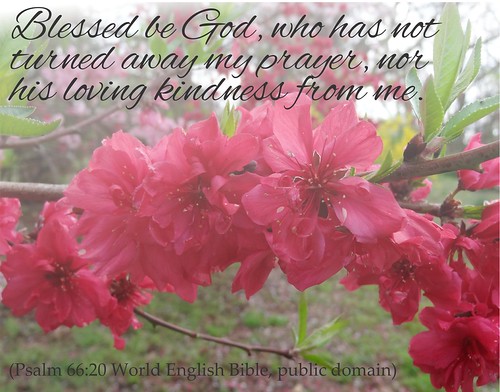
Psalm 66:20 poster

Psalm 66:20 script
The above poster is an attempt to do justice to Psalm 66:20, which says "Blessed be God, who has not turned away my prayer, nor his loving kindness from me." (World English Bible, public domain.)

The photo is some member of the rose family, perhaps a crabapple. I'm not good at distinguishing between peaches, pears, apples, cherries, and the like.

Thanks for looking! Blessed be God.

Friday, April 26, 2013

C. S. Lewis on the goodness of creation

C. S. Lewis, in his Reflections on the Psalms, notes that the goodness of God's creation should not be understood solely for what it does for the good of humans. He writes, about Psalm 104, one of the finest nature poems ever written:

[This Jewish poem, and the Jews that used it in worship,] embraces things that are no use to man. In the great Psalm especially devoted to Nature, from which I have just quoted . . . we have not only the useful cattle, the cheering vine, and the nourishing corn. We have springs where the wild asses quench their thirst (11), fir trees for the storks (17), hill country for the wild goats and “conies” (perhaps marmots, 18), finally even the lions (21); and even with a glance far out to sea, where no Jew willingly went, the great whales playing, enjoying themselves (26). (The parentheses are references to the verses in Psalm 104.) 

The Kindle citation is: Lewis, C. S. (1964-10-07). Reflections on the Psalms (Harvest Book) (pp. 83-84). Houghton Mifflin Harcourt. Kindle Edition.

Lewis said it well. Psalm 104 describes not only living things that were of great importance to the ancient Jews, but it also praises the diversity of God's creation, specifically mentioning aspects of that creation that advanced the interests of non-human animals, including some that the Jews would rarely or never be associated with.


Lewis didn't refer to it, but I'll quote part of that Psalm: 
24 Yahweh, how many are your works!
In wisdom have you made them all.
The earth is full of your riches.
25 There is the sea, great and wide,
in which are innumerable living things,
both small and large animals. (World English Bible, public domain)

Lewis, nor the Psalmist, knew about some of the remarkable discoveries in astronomy, over the last couple of decades. Surely galaxies, stars, and planets that humans have yet to discover, even from long range, also show forth the goodness and glory of God's creation! But they aren't useful to us now, and won't be for the forseeable future. Did Eris, a dwarf planet in our own solar system, which was not even discovered until 2005, ever do anything good for you? How about the Horologium Supercluster, which is about 700 million light years away? But they, too, are part of the good creation that God brought into being.

Thanks for reading!

Monday, January 26, 2009

George MacDonald on the only way to eradicate evil

Nothing will ever close that wound," he answered, with a sigh. "It must eat into her heart! Annihilation itself is no death to evil. Only good where evil was, is evil dead. An evil thing must live with its evil until it chooses to be good. That alone is the slaying of evil." George MacDonald, Lilith (public domain, 1895) Chapter XXX (Adam, or Mr. Raven, to Vane, the main character.

Thursday, January 01, 2009

Badness comes because we don't try to be good, from George MacDonald

Remember, then, that whoever does not mean good is always in danger of harm.
. . .

'What wrong were you doing all day, Curdie? It is better to come to the point, you know,' said the old lady, and her voice was gentler even than before.

'I was doing the wrong of never wanting or trying to be better. And now I see that I have been letting things go as they would for a long time. Whatever came into my head I did, and whatever didn't come into my head I didn't do. I never sent anything away, and never looked out for anything to come. I haven't been attending to my mother - or my father either. And now I think of it, I know I have often seen them looking troubled, and I have never asked them what was the matter. And now I see, too, that I did not ask because I suspected it had something to do with me and my behaviour, and didn't want to hear the truth. And I know I have been grumbling at my work, and doing a hundred other things that are wrong.'

'You have got it, Curdie,' said the old lady, in a voice that sounded almost as if she had been crying. 'When people don't care to be better they must be doing everything wrong.

George MacDonald, The Princess and Curdie, 1883, Public Domain, Chapter 3. (Available from Project Gutenberg)

The Princess and Curdie is a pretty good story, as story, but MacDonald's writing is also full of gems like the above, which stand alone.

Thanks for reading. Read MacDonald.