Why is the sun important to us?
For starters, the gravitational attraction of the sun holds the earth in a stable orbit, which is necessary for our very existence as living beings on this planet.
The sun is a giant source of energy. Einstein pointed out the relationship between energy and mass, in his famous e = m c-squared equation. Every second, thousands of tons of mass are turned into energy, by the sun. The process involves four Hydrogen nuclei fusing into a Helium nucleus, which has a little less mass than the Hydrogen nuclei. This fusion wouldn’t be possible without the extreme temperature in the core of the sun – millions of degrees. Temperature is a measurement of the velocity of molecules. At absolute zero, all motion ceases. In the core of the sun, the velocity of particles is so high that they can overcome natural forces of mutual repulsion, hence slamming together and fusing nuclei.
In case you didn’t know, the c in Einstein’s equation is the velocity of light, a large number, and it’s squared. That means that a little bit of mass can be converted to a lot of energy.
What happens to the sun’s radiated energy? Most of it goes off into space, perhaps eventually hitting something. The sun is about 93,000,000 miles away from us. Think of a giant sphere, with a diameter that large. The sun’s radiated energy goes off evenly in all directions. The earth occupies only a very small fraction of the surface of that imaginary sphere. But that very small fraction gets hit by a tiny bit of the sun’s emitted energy, and that is very important to us.
Energy from the sun keeps the earth at a temperature compatible with human, and other, life. It is possible that there is life elsewhere in the solar system, but not likely. Either conditions would be too hot for life, or too cold, in most planets and planetary moons, such as the moons of Saturn.
Energy from the sun, in the form of light, makes it possible for us to perceive the world around us, using vision. Most insects, most vertebrates, and some other animals use vision, which would be impossible without light from the sun. (Some animals can see types of light that we can’t, but that statement still applies.) We can perceive the world around us in other ways, to be sure, but vision is arguably more important than the other senses we have.
Energy from the sun makes the seasons possible, and also makes various critically important earthly phenomena, such as the water cycle, possible. Energy from the sun makes erosion and weathering of rocks possible.
Energy from the sun, in the form of light, makes photosynthesis possible. Essentially all of the food energy we take in came directly or indirectly from photosynthesis. In photosynthesis, light is captured by green plants, who use it to produce sugars and various other organic substances, that we need to build ourselves, and to release energy to keep us going.
Is the sun important to us? Absolutely. Yes, that’s the right word – absolutely.
Perhaps St. Paul was speaking of the critical importance of light, when, under the inspiration of the Holy Spirit, he wrote “1 Timothy 6:15b who is the blessed and only Ruler, the King of kings, and Lord of lords; 16 who alone has immortality, dwelling in unapproachable light; whom no man has seen, nor can see: to whom be honor and eternal power. Amen. (World English Bible, public domain.)

Musings on science, the Bible, and fantastic literature (and sometimes basketball and other stuff).
God speaks to us through the Bible and the findings of science, and we should listen to both types of revelation.
The title is from Psalm 84:11.
The Wikipedia is usually a pretty good reference. I mostly use the World English Bible (WEB), because it is public domain. I am grateful.
License
I have written an e-book, Does the Bible Really Say That?, which is free to anyone. To download that book, in several formats, go here.

The posts in this blog are licensed under a Creative Commons Attribution-NonCommercial-ShareAlike 3.0 Unported License. You can copy and use this material, as long as you aren't making money from it. If you give me credit, thanks. If not, OK.
The posts in this blog are licensed under a Creative Commons Attribution-NonCommercial-ShareAlike 3.0 Unported License. You can copy and use this material, as long as you aren't making money from it. If you give me credit, thanks. If not, OK.
Showing posts with label life. Show all posts
Showing posts with label life. Show all posts
Tuesday, May 07, 2019


Monday, October 08, 2018
"I am" in the Gospel of John -- important occurrences.
There are about 70 occurrences of the word pair "I am" in John, most rather trivial. Those below are not trivial.
This “I am”
is not in John, but is the source of one that is in that Gospel:
Exodus 3:14 God said to Moses, “I AM WHO I AM,” and he said, “You shall tell the children of Israel this: ‘I AM has sent me to you.’”
Exodus 3:14 God said to Moses, “I AM WHO I AM,” and he said, “You shall tell the children of Israel this: ‘I AM has sent me to you.’”
John 8:58
Jesus said to them, “Most certainly, I tell you, before Abraham came into
existence, I AM.” Jesus was referring to the experience of Moses indicated
above, and his critical hearers understood that He was doing so.
In John 4,
Jesus, in effect, told the Samaritan woman that I am living water. 10 Jesus answered her, “If you knew the gift of
God, and who it is who says to you, ‘Give me a drink,’ you would have asked
him, and he would have given you living water.” 13 Jesus answered her,
“Everyone who drinks of this water will thirst again, 14 but whoever drinks of
the water that I will give him will never thirst again; but the water that I
will give him will become in him a well of water springing up to eternal life.”
6:35 Jesus
said to them, “I am the bread of life.
He who comes to me will not be hungry, and he who believes in me will never be
thirsty. 47 Most certainly, I tell you, he who believes in me has eternal life.
48 I am the bread of life.
8:12 Again,
therefore, Jesus spoke to them, saying, “I
am the light of the world. He who follows me will not walk in the darkness,
but will have the light of life.”
10:11 I am the good shepherd. The good
shepherd lays down his life for the sheep.
11:25 Jesus
said to her, “I am the resurrection and
the life. He who believes in me will still live, even if he dies. 26
Whoever lives and believes in me will never die. Do you believe this?” [To
Martha]
14:6 Jesus
said to him, “I am the way, the truth,
and the life. No one comes to the Father, except through me. [To Peter. Perhaps other disciples were present.]
15:1 “I am the true vine, and my Father is
the farmer. 2 Every branch in me that doesn’t bear fruit, he takes away. Every
branch that bears fruit, he prunes, that it may bear more fruit.
18:37 Pilate
therefore said to him, “Are you a king then?” Jesus answered, “You say that I am a king. For this reason I have
been born, and for this reason I have come into the world, that I should
testify to the truth. Everyone who is of the truth listens to my voice.”
Thanks for reading. He is!
Saturday, August 27, 2016
Salvation acrostic
Sin: separates us from God, and hurts us and others. It is something
we have all done, but can’t pay the penalty for. Romans 3:23, 6:23.
Atonement: Christ’s death paid the price for my sin. Romans5:6-15.
Love: God loved us so much that He sacrificed Himself for our
sin. Luke 19:10.
Victory: With the help of God the Holy Spirit, it is possible
to live a holy life, victorious over temptation, including the temptation to
take credit for our own salvation. Psalm 13:5-6; John 17:6-26, Romans 6:1-2, 1Thessalonians 5:5-11.
Attractiveness: A victorious life should be attractive to
other people. John 7:37-39, Acts 16:25-34.
Teaching: Jesus told his disciples to teach all nations, and
to make disciples of converts. Converts should learn from the Bible on their own,
and be part of a teaching church. Matthew 28:18-20, Mark 16:15-16, Luke24:45-49, 2 Peter 3:17-18.
Immortality: Believers, whose sins have been paid for, are
promised immortality with Christ. Ephesians 1:11-14, Romans 6:23
Overcoming: The church, and individual Christians, seem to be
weak, at times. But Christ has promised that the true church – composed of
actual believers, not necessarily church members – will endure. Matthew 16:18, Revelation 2:8-11.
New life, with purpose, and with fruit: Those who have
experienced salvation should manifest the Fruit of the Spirit. (Galatians5:22-23) They will also participate, often with others, in attracting new
believers, especially by serving, giving, testifying and praying. John 15:8, Acts
6:7, 11:27-29, Romans 12:4-8, Matthew 25:31-46. They will have intimacy with
God. Matthew 10:16-20, John 14:16-16:15.
I have probably left out important concepts, and important scripture passages. Let me know if you think of such, in a comment, if you can. Thanks for reading.
* * * * *
On September 5, 2016, the links to scripture -- ESV -- were added.
* * * * *
On September 5, 2016, the links to scripture -- ESV -- were added.
Saturday, November 21, 2015
What the Bible says about the created world - an overview
Restoring
and preserving creation
Genesis 1:31: Everything created was good.
Genesis 1:26, 28: Humans are stewards over the natural
world, for God.
Genesis 3:17-19: The relationship between humans and
nature changed because of the Fall.
2 Chronicles 36:21: Israel was punished for not taking
care of the land, as commanded in Exodus 23:10-11, Leviticus 25:1-5. (Habakkuk
predicted that punishment in 2:8)
Job 40-42: God is in charge of the natural world, and
He knows it intimately.
Psalm 19:1-4 (Also, Romans 1:20): The natural world is
one of the ways God is revealed to us. We try to make the Bible, another way
God speaks, available in the language of the heart, because it speaks more
clearly. We should also protect nature, so it will speak more clearly. It’s
harder to see God in a polluted world.
Psalm 24:1: The earth is the Lord’s, not ours. We are
merely stewards of God’s creation.
Psalm 104:10-17: God sustains the natural world.
Psalm 104:24-25: God created an abundant diversity of
living things.
Romans 8:19-22: The creation is eager to be restored.
2 Corinthians 5:17-21: We are to help Christ with His
ministry of reconciliation.
Colossians 1:15-20: Christ sustains the natural world.
He also has a ministry of reconciling the natural world to Himself. We should
help Him sustain the natural world.
Hebrews 11:3: We probably can’t prove that God created
the universe, but we should believe it.
Revelation 21:1-5: God will make all things new.
A quick summary. For more on what the Bible says about environmental stewardship, see here.
Thursday, July 30, 2015
Death, Life, and 1 Corinthians 15
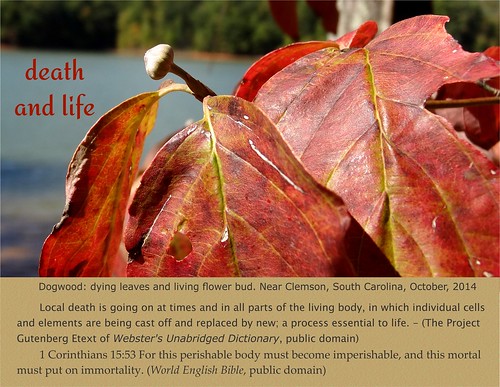
In preparing the graphic, I came across a most relevant statement in a public domain dictionary: "Local death is going on at all times, and in all parts of the living body, in which individual cells and elements are being cast off and replaced by new; a process essential to life." Indeed! Even biologists often don't attach enough significance to the work of decomposer organisms, such as fungi.
Paul (and other Biblical sources) teach that there will be a physical resurrection -- believers will have some sort of physical body, superior to the ones we now have. Christ already has such a body. I don't have a clue as to what that will be like, and you don't, either, although your ideas may be better than mine.
The plant was a dogwood tree, growing near Clemson, South Carolina. That's Lake Hartwell in the background.
Thanks for looking, and reading.
Tuesday, April 07, 2015
On the importance of water (again)
Tuesday, December 16, 2014
Conditions for redemption

If the earth is six thousand years old, people can be redeemed from sin.
If the earth is six billion years old, people can be redeemed from sin.
If the rapture will occur in the middle of a seven year tribulation, people can be redeemed from sin.
If the Bible doesn't really teach that there is a rapture, but, instead, that there is a triumphant procession welcoming Christ back to earth, people can be redeemed from sin.
If women can be divinely called to be ministers, people can be redeemed from sin.
If women can't be divinely called to be ministers, people can be redeemed from sin.
If . . .
If . . .
Should I go on? Some things are peripheral.
But if Christ didn't come to earth as a human embryo, live a sinless life as the God-man, die a sacrificial death on the cross, and rise again, people can't be redeemed from sin.
Some things are essential. (See 1 Corinthians 15:13-21)
(This post was modified, by adding the reference to 1 Corinthians, and the graphic, on December 24, 2014.)
Tuesday, November 18, 2014
I'm thankful for Carbon atoms

The picture above is of an Alanine molecule. Alanine is one of 20 or so amino acids found in living things, and that make living things possible. There is only one amino acid that's simpler than Alanine. The others are more complex. The graphic is modified, with permission, from one found on en.wikipedia.org. The spheres represent atoms. The rods, some very thick, represent bonds between the atoms.
Life on earth is often called Carbon-based, and there's good reason for that. The reason is that Carbon is the basis of the complex molecules that make up living things, including DNA, proteins, antibodies, sugars, fats, steroids, vitamins, hormones, proteins, caffeine, the alkaloids found in chocolate, and many more.
Suppose you were in a group of people, and that group decided that each person would hold hands with two other people. If you did, the most complex arrangement you could make is a line, perhaps not a straight line, but a line. The line might be a loop, but it would still be a line. Now suppose that you and the others could hold on with hands, and also with feet. The possibilities for arrangements are much greater with four connections per person. Well, Carbon is like that, too. It readily forms four connections, called covalent bonds, with other atoms. Usually these are Hydrogen, Nitrogen, Oxygen, Sulfur or Phosphorus, or another Carbon atom. These six elements make up almost all of the molecules necessary for life.
The Alanine molecule shown above illustrates the ability of Carbon to connect to four different things. Alanine has a central Carbon. That Carbon is attached to 4 different entities. One of them is a Hydrogen molecule. The other three are more complex. Two of them, the COOH and the NH2, are found in all other amino acids. But the CH3 group, a methyl, is not. The other amino acids have some other entity in its place. Each of the amino acids found in us has a different item connected to the central Carbon. All 20 of these amino acids are necessary to make hemoglobin, the molecule that carries Oxygen around your body in the bloodstream. Hemoglobin is much more complex than Alanine -- it has 147 amino acids, of 20 different types, including 11 Alanines. Those 147 amino acids have to be of the right kind, at the right place, in order for Hemoglobin to work properly.
The ability to connect to four other things is critical to the complex structure of the molecules of living things. Can any other type of atom do that? Well, Silicon can. It's a member of the same family of elements as Carbon. But Carbon works for us in a way that Silicon can't. Carbon is a smaller atom -- a Carbon atom has less than half the mass of Silicon. Silicon is too heavy to float into the air. But Carbon, with other atoms, forms gases, which can get into the air. One of these is Carbon Dioxide. Carbon Dioxide can go anywhere on earth, as a gas, through the air. Photosynthesis, the process that makes our food, takes in Carbon Dioxide and water, and turns it into food. The green plants that carry out photosynthesis can grow in a wide variety of situations, because they can make their own food in them. And the animals that live on green plant food can also exist in a wide variety of locations, all throughout the biosphere. If our molecules were based on Silicon, that wouldn't be possible.
I believe that God planned the universe, including the properties of Carbon atoms. I can't prove this, but no one can disprove it, either, even those who say that those properties are an accident.
I'm thankful for Carbon atoms, and the amazing things that they are able to do, connected to other atoms. I hope you are, too. Thanks for reading.
A later post indicates the reasons why I'm thankful for water.
Monday, January 18, 2010
Christopher Robin and time travel
"But wherever they go, and whatever happens to them on the way, in that enchanted place on the top of the Forest, a little boy and his bear will always be playing." A. A. Milne, Chapter Ten, "In Which Christopher Robin and Pooh Come to an Enchanted Place, and We Leave Them There," from The House at Pooh Corner.
Thanks for reading! Read Milne. Today would have been his 118th birthday.
Thanks for reading! Read Milne. Today would have been his 118th birthday.
Subscribe to:
Posts (Atom)