
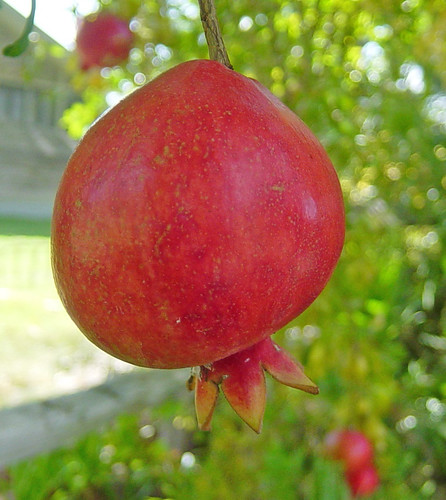
A few years ago, I did a post on places in the Bible where figs were mentioned. A commenter suggested that I also do one on apples. I did so recently. One of the passages included also mentioned pomegranates, so I am also doing a post on pomegranates, as mentioned in the Bible. I used a search in the King James Version, and also one in the English Standard Version. The searches gave the same results.
Pomegranates are native to what is now Iran, and have been cultivated since the Bronze Age, according to the Wikipedia.
Here are the references that I found, given in the World English Bible, which is public domain:
Exodus 28:31 “You shall make the robe of the ephod all of blue. 32 It shall have a hole for the head in the middle of it. It shall have a binding of woven work around its hole, as it were the hole of a coat of mail, that it not be torn. 33 On its hem you shall make pomegranates of blue, and of purple, and of scarlet, around its hem; and bells of gold between and around them: 34 a golden bell and a pomegranate, a golden bell and a pomegranate, around the hem of the robe. (Exodus 28 has a similar passage.)
1 Samuel 14:2 Saul stayed in the uttermost part of Gibeah under the pomegranate tree which is in Migron: and the people who were with him were about six hundred men;
Song of Solomon 4:3 Your lips are like scarlet thread.
Your mouth is lovely.
Your temples are like a piece of a pomegranate behind your veil. (Song of Solomon 6:7 is similar.)
Song of Solomon 8:2 I would lead you, bringing you into my mother’s house,
who would instruct me.
I would have you drink spiced wine,
of the juice of my pomegranate.
Joel 1:12 The vine has dried up, and the fig tree withered;
the pomegranate tree, the palm tree also, and the apple tree,
even all of the trees of the field are withered;
for joy has withered away from the sons of men.
Haggai “‘... 2:19 Is the seed yet in the barn? Yes, the vine, the fig tree, the pomegranate, and the olive tree haven’t produced. From today I will bless you.’”
Thanks for reading.
Musings on science, the Bible, and fantastic literature (and sometimes basketball and other stuff).
God speaks to us through the Bible and the findings of science, and we should listen to both types of revelation.
The title is from Psalm 84:11.
The Wikipedia is usually a pretty good reference. I mostly use the World English Bible (WEB), because it is public domain. I am grateful.
License
I have written an e-book, Does the Bible Really Say That?, which is free to anyone. To download that book, in several formats, go here.

The posts in this blog are licensed under a Creative Commons Attribution-NonCommercial-ShareAlike 3.0 Unported License. You can copy and use this material, as long as you aren't making money from it. If you give me credit, thanks. If not, OK.
Showing posts with label pomegranate. Show all posts
Tuesday, October 07, 2014
Friday, July 20, 2007
Pomegranates in the Bible
The photo above is of a pomegranate flower bud, about to open, taken in Southern California. The color is natural. The largest bud in the photo was about 2 inches/7 cm long. The photo is a live link to our Flickr photos.
Based on the Bible, pomegranates must have been important in the culture of the Middle East.
Exodus 28 and 39 say that the garment worn by the priest was to be decorated with blue, purple and scarlet pomegranates, made of yarn.
When the spies came back from Israel to Moses and the people, they brought samples of the fruit of the land, including pomegranates.
To the ancient Israelites, and to God, one of the signs that a land was good was that it was able to grow pomegranates. (Deuteronomy 8) In the desert, they complained to Moses that they would rather have stayed in Egypt, because there were no pomegranates in the desert. (Numbers 20)
Solomon's temple had bronze pillars, decorated with pomegranates. (I Kings 7)
The Song of Solomon, that great poem to erotic love, describes a beautiful woman's cheeks as being like the halves of a pomegranate.
Here's a photo of a more mature pomegranate fruit. Here's the Wikipedia article on pomegranates.
Thanks for reading!
Labels:
500 or more views,
bible study,
botany,
fruit,
photography,
pomegranate
Subscribe to:
Posts (Atom)
