I started this blog in late 2004. I want to offer thanks to a number of entities, and persons. Forgive me if you are not mentioned, or not mentioned enough.
Thanks, first of all, to God, who has given me the ability to do this. Thanks to my wife, who suggested that we purchase the laptop I'm using as we type this, and who has encouraged me in doing this.
Thanks to my readers, whether regular, occasional, or one-time, whether they comment, link to this blog, mention it in theirs, or just look. I want to thank family, especially my daughters and a nephew, a couple of dozen or more persons associated with Southern Wesleyan University, some other bloggers, an individual from our church, and, I think, some people who don't fit in any of those categories. (If some of you commented or e-mailed, I'd know more about who you are!) I'm sorry that I flit from category to category so much, but it's my blog. That makes me even more grateful to you.
Thanks to other bloggers. As some readers know from personal experience, finding time, motivation, resources, and something to write/show on a regular basis isn't a casual occupation. Finding an audience isn't easy. I want to especially thank Bonnie, Catez, Julana, Kathryn, Joe, Jeremy, Ken, Kevin, Marla, Michele, Perry, and Rebecca, who have provided material worth reading or looking at on a consistent basis. Most of you have commented or e-mailed me, in some cases a lot, and I treasure our friendship. We don't always agree (if we did, one of us would be redundant).
Thanks to the over two dozen bloggers currently, or recently, associated with Southern Wesleyan University. Whether you are telling about your visits to your grandmother, how your sister plays music you can't stand, surviving the ice storm, recovering from athletic injuries, new ways to use a computer, how your job is going, how your classes are going, showing photos, or describing how your pregnancy is progressing, I thank you. Seeing some of what you are up to has made retirement so much easier. There are some of you who ought to consider long-time blogging for the wider world, not just your friends, on a consistent basis. Not because I suggest it, though!
Thanks to Microsoft, Corel, ZoneAlarm, etc., and to Blogger, Bloglines, Google, Flickr. Thanks to the Christian Carnival. Thanks to Slate, MSN, Arts and Letters Daily, the Librarian's Internet Index, Nature, Carl Zimmer, The Panda's Thumb, Sports Illustrated, Harper's and SciTech Daily. Thanks to some relatives, and to motels, and other institutions that have provided web access.
God bless you all!
Thanks for reading.
Musings on science, the Bible, and fantastic literature (and sometimes basketball and other stuff).
God speaks to us through the Bible and the findings of science, and we should listen to both types of revelation.
The title is from Psalm 84:11.
The Wikipedia is usually a pretty good reference. I mostly use the World English Bible (WEB), because it is public domain. I am grateful.
License
I have written an e-book, Does the Bible Really Say That?, which is free to anyone. To download that book, in several formats, go here.

The posts in this blog are licensed under a Creative Commons Attribution-NonCommercial-ShareAlike 3.0 Unported License. You can copy and use this material, as long as you aren't making money from it. If you give me credit, thanks. If not, OK.
The posts in this blog are licensed under a Creative Commons Attribution-NonCommercial-ShareAlike 3.0 Unported License. You can copy and use this material, as long as you aren't making money from it. If you give me credit, thanks. If not, OK.
Saturday, December 31, 2005


Friday, December 30, 2005
Biblical warning about aimless web-surfing
Turn my eyes from looking at worthless things; and give me life in your ways. Psalm 119:37 (ESV)
Thursday, December 29, 2005
Thoughts on Yosemite and John Muir

The photo above is of El Capitan, taken in Yosemite National Park, California
Yosemite National Park is amazing and unique. It is no wonder that John Muir was so enchanted with the area. The park contains redwoods, waterfalls, rivers, and spectacular cliffs. The most popular area is in a valley, surrounded by cliffs on both sides.
Shortly after the park was established, Congress allowed its Hetch Hetchy valley to be dammed, for water for San Francisco. This was a blow to Muir, and deprived us, according to him, of more spectacular scenery.
John Muir was a scientist who did much of his scientific work in nature. He wasn't a college professor, nor did he work as a researcher for the government, or for some company, on a regular basis. He observed, and he wrote. He didn't just describe, he taught (he was said to be especially good at teaching children about nature in ways they could understand) and he advocated. One of the things he advocated most strongly was the establishment of Yosemite. Muir was a Christian, and probably one of those who really do communicate with God in natural surroundings on a regular basis.
This is the next-to-last sentence of Muir's The Yosemite:
These temple destroyers, devotees of ravaging commercialism, seem tohave a perfect contempt for Nature, and, instead of lifting their eyesto the God of the mountains, lift them to the Almighty Dollar.
Here's a paragraph from his The Mountains of California:
In the morning everything is joyous and bright, the delicious purple ofthe dawn changes softly to daffodil yellow and white; while the sunbeamspouring through the passes between the peaks give a margin of gold toeach of them. Then the spires of the firs in the hollows of the middleregion catch the glow, and your camp grove is filled with light. Thebirds begin to stir, seeking sunny branches on the edge of the meadowfor sun-baths after the cold night, and looking for their breakfasts,every one of them as fresh as a lily and as charmingly arrayed.Innumerable insects begin to dance, the deer withdraw from the openglades and ridge-tops to their leafy hiding-places in the chaparral, theflowers open and straighten their petals as the dew vanishes, every pulse beats high, every life-cell rejoices, the very rocks seem totingle with life, and God is felt brooding over everything great and small.
We recently visited part of the park. The area is, indeed, beautiful. There are redwood trees, the spectacular valley, equally spectacular mountains, and some beautiful water features. Yosemite is not far, an hour's drive or so, from Fresno, CA, a city of roughly half million. Fresno is in the San Joaquin Valley, which is both one of most intensely farmed areas in the U. S., and also one of the most heavily polluted and transformed from its natural state. Why didn't Muir try to preserve more of this valley? Perhaps because it was flat, therefore less attractive than the mountains. Perhaps Muir knew that trying to preserve this area would have been a losing battle, more difficult than preserving Yosemite.
Muir's activity wasn't confined to the West. He was born in Scotland, but emigrated to Wisconsin as a boy, with his family, and lived and worked in the Eastern part of the U. S. Several of his works are available from Project Gutenberg. His Thousand-Mile Walk to the Gulf is available from the Sierra Club. He walked from Louisville, KY, to Florida.
Wednesday, December 28, 2005
Sunspots 37

Things I have recently spotted that may be of interest to someone else:
Thorough and updated report in blog.bioethics.net, on how the reported success in transplanting adult human nuclei to unfertilized eggs, carried out in South Korea, was mostly faked.
The full text of Judge Jones's opinion in Kitzmiller, the Dover, Pennsylvania Intelligent Design trial, is here. (warning: it's over 139 pages long, and a .PDF file, over 300 kb in size)
Article in The New Atlantis on Tom Wolfe's I am Charlotte Simmons, which was reviewed, when it was published a year or so ago, as being basically about sex in a fictional university. (I haven't read it, and don't plan to) The authors of the article don't deny that, but say it's really about the terrible human condition we are in, with no moral compass: "If Wolfe’s description . . . accurately portrays the character of our elite universities, then the dissolution of the American way of life is nearly complete. Our ancient faith is no longer a vibrant and effective part of the education of future leaders. Our ability to perpetuate our culture and our constitutional soul will wither alongside our belief in the soul itself."
I am pleased to note that this blog now has 12 Bloglines subscribers, the most it's ever had. (I'm one of them.) Thank you, readers, or, at least, subscribers.
This week's Christian Carnival is here. (For information on locating these Carnivals, see here)
Image source (public domain)
Tuesday, December 27, 2005
Torture and Christianity
I previously posted on the subject of torture, expressing surprise that evangelical bloggers had said so little about it, when we have expressed a lot of moral outrage over other issues. (I don't read every such blog, of course!).
Joe Carter and Justin Taylor have gone a long way toward remedying this, hosting an on-line symposium on torture. I recommend that anyone seriously interested in the subject read these articles. I found that Augustine had considered this issue, and that Kenneth Magnuson, a Southern Baptist, no less, was the writer who brought it up in his contribution to the symposium. Albert Mohler (also a Southern Baptist, if it matters) wrote a good essay, paying careful attention to moral distinctions and reality. Robert Vischer takes the White House's John Yoo to task. Here, he says, is part of what Yoo wrote, followed immediately by Vischer's response:
Clearly, any harm that might occur during an interrogation would pale to insignificance compared to the harm avoided by preventing such an attack, which could take hundreds or thousands of lives.
And in that single statement, we have the essence of why Christians cannot condone torture, no matter the justifications offered. An ethic grounded in human dignity can never hold that the purposeful infliction of pain on a person is insignificant, nor that its significance can be minimized as though concerns over human life and dignity are mere variables in a cost-benefit analysis.
Richard John Neuhaus had this to say:
Establishing a principle is not “merely for show.” Recognizing, clearly but sotto voce, that there will sometimes be exceptions to the principle is not hypocrisy.
There were a couple of other articles, just as deserving of your time. This is a serious issue, indeed, and I am grateful to the symposium's hosts.
* * * *
Cleaned up a little, without changing anything substantial, on Dec 29, 2005. All but one change (his to Vischer's) was in the formatting.
Joe Carter and Justin Taylor have gone a long way toward remedying this, hosting an on-line symposium on torture. I recommend that anyone seriously interested in the subject read these articles. I found that Augustine had considered this issue, and that Kenneth Magnuson, a Southern Baptist, no less, was the writer who brought it up in his contribution to the symposium. Albert Mohler (also a Southern Baptist, if it matters) wrote a good essay, paying careful attention to moral distinctions and reality. Robert Vischer takes the White House's John Yoo to task. Here, he says, is part of what Yoo wrote, followed immediately by Vischer's response:
Clearly, any harm that might occur during an interrogation would pale to insignificance compared to the harm avoided by preventing such an attack, which could take hundreds or thousands of lives.
And in that single statement, we have the essence of why Christians cannot condone torture, no matter the justifications offered. An ethic grounded in human dignity can never hold that the purposeful infliction of pain on a person is insignificant, nor that its significance can be minimized as though concerns over human life and dignity are mere variables in a cost-benefit analysis.
Richard John Neuhaus had this to say:
Establishing a principle is not “merely for show.” Recognizing, clearly but sotto voce, that there will sometimes be exceptions to the principle is not hypocrisy.
There were a couple of other articles, just as deserving of your time. This is a serious issue, indeed, and I am grateful to the symposium's hosts.
* * * *
Cleaned up a little, without changing anything substantial, on Dec 29, 2005. All but one change (his to Vischer's) was in the formatting.
Monday, December 26, 2005
The Christian's Secret of a Happy Life, pt. 15
I continue a series of excerpts from The Christian's Secret of a Happy Life by Hannah Whitall Smith. The book, which is public domain, is available on-line in its entirety here. This version is somewhat different from the paperback I have in my physical possession. (New York: Ballentine Books, 1986) For an article on Smith, in Christian History, go here. This Chapter is entitled "The Joy of Obedience." The material below is quoted exactly, from the text at the first link in this post.
There are many relations in life which require from the different parties only very moderate degrees of devotion. We may have really pleasant friendships with one another, and yet spend a large part of our lives in separate interests, and widely differing pursuits. When together, we may greatly enjoy one another's society, and find many congenial points; but separation is not any especial distress to us, and other and more intimate friendships do not interfere. There is not enough love between us, to give us either the right or the desire to enter into and share one another's most private affairs. A certain degree of reserve and distance is the suitable thing, we feel. But there are other relations in life where all this is changed. The friendship becomes love. The two hearts give themselves to one another, to be no longer two but one. A union of souls takes place, which makes all that belongs to one the property of the other. Separate interests and separate paths in life are no longer possible. Things which were lawful before become unlawful now, because of the nearness of the tie that binds. The reserve and distance suitable to mere friendship becomes fatal in love. Love gives all, and must have all in return. The wishes of one become binding obligations to the other, and the deepest desire of each heart is, that it may know every secret wish or longing of the other, in order that it may fly on the wings of the wind to gratify it.
Sunday, December 25, 2005
Christ didn't come as a baby . . .
We don't seem to know what day, or even what year, Christ was born, but he was born.
Christ didn't come as a baby. He came as an embryo. Did He retain any of His divine omniscience and omnipotence during that period? I don't know, but I suspect that He didn't retain all of it. The Bible teaches that He was tempted like we are. I don't know if fetuses are tempted. However, to really be like us, He must have had an experience much like ours, and I suspect that that meant, after He was born, not being able to speak for a year or so, and, before He was born, giving up some of his powers and awareness. Was this easy for the Creator of the Universe? I wouldn't think so--the cross wasn't.
If He gave anything up, He did it for me.
(This is a repost from December 24, 2004.)
Christ didn't come as a baby. He came as an embryo. Did He retain any of His divine omniscience and omnipotence during that period? I don't know, but I suspect that He didn't retain all of it. The Bible teaches that He was tempted like we are. I don't know if fetuses are tempted. However, to really be like us, He must have had an experience much like ours, and I suspect that that meant, after He was born, not being able to speak for a year or so, and, before He was born, giving up some of his powers and awareness. Was this easy for the Creator of the Universe? I wouldn't think so--the cross wasn't.
If He gave anything up, He did it for me.
(This is a repost from December 24, 2004.)
Saturday, December 24, 2005
Plants and Christmas

This photo is of a poinsettia plant, in Southern California. The red things aren't petals, they are modified leaves, or bracts. The actual flowers are the smaller yellow structures. This particular branch is part of a plant that is at least 10 feet tall. It is not twining around the utility pole, it just happens to be growing in front of it. (Note the branch behind the bracts on the lower right.) To see more of our photos, or a larger size of this one, click on the photo. You will be taken to our Flickr photos. No password is needed, and you won't be besieged by pop-up ads.
A number of plants are associated with Christmas. One web page that deals with that subject is here.
God's best at Christmas time.
Thanks for reading, and looking.
A number of plants are associated with Christmas. One web page that deals with that subject is here.
God's best at Christmas time.
Thanks for reading, and looking.
Friday, December 23, 2005
Reaction to the Intelligent Design Court Decision, 2
I didn't anticipate posting about Intelligent Design again today, but (for me) I received a landslide of comments (4) to my yesterday's post. So I'm posting again. Some of this is written because of those comments, which I appreciate so much.
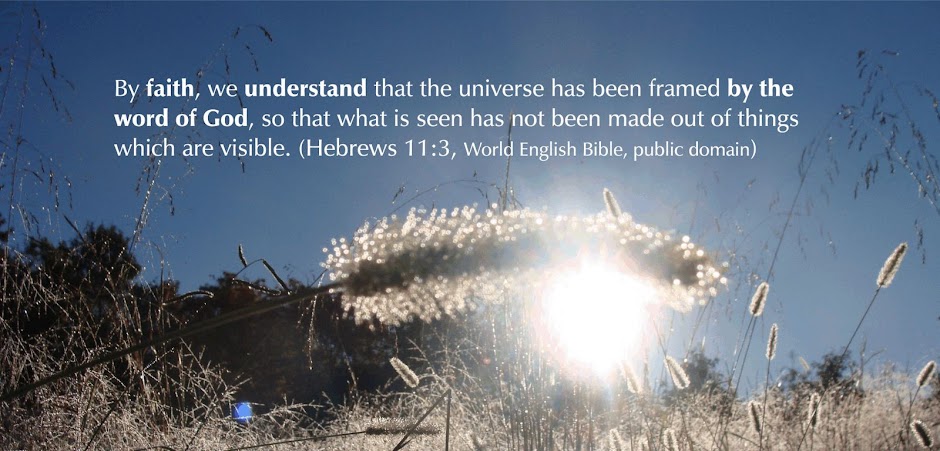
1) The central message of Christianity is Christ's redemption. Since that has to be accepted on faith, it isn't surprising that believing in God's creative action also requires faith, not scientific proof (Hebrews 11:3). (The New Testament emphasizes the creative activity of God the Son, not God the Father or God the Holy Spirit. See the first chapters of John and Colossians.)
2) I have read Darwin's Black Box, even used it as a text once. Michael Behe's thesis is interesting, and he may even be correct, but his book is not proof, in my opinion. It attempts to show that some aspects of living things are too complex to have arisen by natural selection, but saying that, and proving it, are two different things. At least some of his examples of specified complexity have been explained, since he wrote the book, without invoking a Designer. (Which can be one problem with Intelligent Design. If you say that anything that you can't explain the origin of was done by God, then if you find an explanation, it seems to make God smaller. God is responsible for the things we think we can explain, as well as those we can't. He is responsible for 2 + 2, as well as infinity.)
3) Behe is right about this:
Many people, including many important and well-respected scientists, just don't want there to be anything beyond nature. they don't want a supernatural being to affect nature, no matter how brief or constructive the interaction may have been. In other words, like young-earth creationists, they bring an a priori philosophical commitment to their science that restricts what kinds of explanations they will accept about the physical world. Michael J. Behe, Darwin's Black Box: The Biochemical Challenge to Evolution. New York: The Free Press, 1996, p. 243. Emphasis in original.
Those who "don't want there to be anything beyond nature" have done some unscientific things. I don't doubt that there are universities and public schools where science teachers (and perhaps others) say, in so many words, or imply, that science has proved that there is no God. It hasn't, and it can't. Statements like that should be just as unconstitutional as requiring prayer in public schools.
4) Prayer can be practiced, even on public school campuses in the U. S., by voluntary groups, but not as part of a State-mandated educational program. Intelligent Design could be studied and discussed in the same way. Unlike many, I am opposed to letting prayer and other religious practices be required by the public schools. So is the Supreme Court. I have two reasons for this opposition. First, if, say, prayer were required, this would mean that some teachers who are not believers could be leading it. Second, this would open the door for other faiths to have the same privilege, out of fairness, or if their religion became the majority in a school district.
5) One problem with stating whether or not one believes in "evolution" is that the word has so many different meanings. If it means "Change in a population, over time, in response to the environment," which is usually called "natural selection" and is what Darwin's theory was written about, he was right. Natural selection has occurred, for example in humans--if all humans came from one stock, there have been changes and divergence, just as would be expected from natural selection at work. Natural selection also explains insect resistance to insecticides and bacterial resistance to antibiotics very well. As far as I know, all scientists, including those who are young-earth creationists accept the validity of natural selection. These latter would say, however, that there hasn't been enough time for natural selection to have produced all the varieties of living things, but that much of this variety was specially created, or designed, by God in the beginning.
However, if by "evolution," is meant that there is no purpose in the universe, that's a different matter. There is no scientific evidence proving that, and Christians must reject it. "Naturalism" is a term often used to mean that there is no purpose in the universe, or at least excluding God from explanations. It contrasts with "supernaturalism."
There are various other meanings to "evolution."
Thanks for taking the time to read.
Merry Christmas.
Thursday, December 22, 2005
Reaction to the Intelligent Design Court Decision
This week, a U. S. District Judge ruled that the teaching of Intelligent Design in a school district in Pennsylvania was unconstitutional. This statement summarizes the ruling: "our conclusion today is that it is unconstitutional to teach ID as an alternative to evolution in a public school science classroom."
The Judge, apparently a church-going Republican, also said:
To be sure, Darwin's theory of evolution is imperfect. However, the fact that a scientific theory cannot yet render an explanation on every point should not be used as a pretext to thrust an untestable alternative hypothesis grounded in religion into the science classroom or to misrepresent well-established scientific propositions.
My judgment is that the Judge was correct. The school board (most of whom have not been re-elected) wanted ID taught for religious reasons, and requiring that something that promotes a particular creed in the public schools should not be done. (I wouldn't want, say, Wiccan teaching in my grandson's school.)
However, that being said, if science (or other classes) teach that there is no purpose to the universe, and that living things are here solely by chance, that would also be religious doctrine, and should also be disallowed in the classroom. Proving (or disproving) such statements is outside the purview of science, although some scientists make statements like that. At least some, probably a lot, of the motivation to fight the teaching of ID has been based on such naturalistic beliefs.
I believe that we would all be better off if what is meant by "evolution" were clearly spelled out when it is discussed. Are we talking about the origin of the universe (which is outside the field of biology, and has nothing directly to do with Darwin) or about the origin of humans, or about changes like those in bacteria, selected by exposure to antibiotics?
Lest there be any doubt, I personally believe that God did, at some level or levels, design things so that the universe, and living things, including humans, are as they are. I am not sure when God did this, nor how. I am not sure how many times God may have done this.
Although I believe this, I don't believe that it is scientifically possible to prove that God did any of this. Hebrews 11:3 tells us that we understand how things began by faith. (Others, Michael Behe for one, believe that it is possible.)
I also believe that natural selection works, much as Darwin described it, and that organisms have changed over time. That does not necessarily mean that everything taught as fact in biology textbooks is true.
The most important thing about Genesis 1 is not when, or how. It is Who.
The Judge, apparently a church-going Republican, also said:
To be sure, Darwin's theory of evolution is imperfect. However, the fact that a scientific theory cannot yet render an explanation on every point should not be used as a pretext to thrust an untestable alternative hypothesis grounded in religion into the science classroom or to misrepresent well-established scientific propositions.
My judgment is that the Judge was correct. The school board (most of whom have not been re-elected) wanted ID taught for religious reasons, and requiring that something that promotes a particular creed in the public schools should not be done. (I wouldn't want, say, Wiccan teaching in my grandson's school.)
However, that being said, if science (or other classes) teach that there is no purpose to the universe, and that living things are here solely by chance, that would also be religious doctrine, and should also be disallowed in the classroom. Proving (or disproving) such statements is outside the purview of science, although some scientists make statements like that. At least some, probably a lot, of the motivation to fight the teaching of ID has been based on such naturalistic beliefs.
I believe that we would all be better off if what is meant by "evolution" were clearly spelled out when it is discussed. Are we talking about the origin of the universe (which is outside the field of biology, and has nothing directly to do with Darwin) or about the origin of humans, or about changes like those in bacteria, selected by exposure to antibiotics?
Lest there be any doubt, I personally believe that God did, at some level or levels, design things so that the universe, and living things, including humans, are as they are. I am not sure when God did this, nor how. I am not sure how many times God may have done this.
Although I believe this, I don't believe that it is scientifically possible to prove that God did any of this. Hebrews 11:3 tells us that we understand how things began by faith. (Others, Michael Behe for one, believe that it is possible.)
I also believe that natural selection works, much as Darwin described it, and that organisms have changed over time. That does not necessarily mean that everything taught as fact in biology textbooks is true.
The most important thing about Genesis 1 is not when, or how. It is Who.
Wednesday, December 21, 2005
Sunspots 36

Things I have recently spotted that may be of interest to someone else:
Blog post that claims that the conventional wisdom, that the date of Christmas was selected to counter a pagan holiday, is wrong. (A commenter says that the conventional wisdom is correct.)
A post on nudity and Christianity. The poster says there there are "Christian nudists." (He's not one of them.)
A new object, some 500-1000 kilometers in diameter, has been found beyond Pluto. Its orbit is at an angle to most of the rest of the objects in our solar system.
There's a new sound in the official international phonetic alphabet. The sound is found in several african languages, and a faith-based organization proposed that it be adopted as a recognized sound and symbol.
Something I didn't spot was the 235th birthday of Beethoven, on December 16th. Sorry.
Harper's has published excerpts from a math book, published by Bob Jones University, which combined Christian doctrine with mathematics. The most interesting quote in the excerpts: "Ambiguous means open to multiple interpretations. Some people say that you can interpret the Bible in any way that you want. However, there is no ambiguity in the Bible."
Someone named Ashley Hepp commented on one of my posts, but I can't figure out which one. If she (or he) sees this, and wants further contact, please comment again, with a note on the date or subject of the post, or some indication as to how I might reach you. Thanks.
There was an ice storm in the Carolinas. A couple of the bloggers I subscribe to, both associated with Southern Wesleyan University, were able to blog without electricity in their homes. See here for scvff and here for Joy.
Sherilyn rants about the popular perception of heaven. (hint: it isn't about us)
Bonnie has begun a series on Christians and mental illness.
April, a friend and former student, who first blogged (very effectively, I must say) about her mission trip to Southeast Asia, is back in Southeast US, and posted, for the first time in several months.
This week's Christian Carnival is here. (For information on locating these Carnivals, see here)
Image source (public domain)
Tuesday, December 20, 2005
Guest Comments on the Harry Potter movie
A regular reader, who doesn't blog, e-mailed me these comments on the current Harry Potter movie. I consider them worthy of posting. Thanks!
Character Problems: 1) Every scene in which we see Professor Snape is either played for comedy at the time or played for comedy later on in the movie. I was hopeful that there might be one scene that was not played for comedy, that is, when Snape says he knows Harry has been going through his private stores, but this too was used for comedy later on when Dumbledore turns to Snape after discovering Barty Crouch Jr. and says, "Now I guess we know who's been going through your stores, Severus," or whatever it is he says. Again comedy. Snape can be funny. I enjoyed the humor that he provided earlier in the movie, but I have to wonder what in the world they are going to do when they get to movie number 6.
2) They had several shots during which it is hard not to imagine a romantic tension between Harry and Hermione and they totally loused up the romantic tension between Hermione and Ron after the Yule Ball. She's not supposed to be as angry at him for getting in the way of her date with Krum as she is angry at him for not asking her to the ball himself and then sulking about it. And Harry agrees with her. Now, I know in the book, Harry just thought that Hermione was right and didn't say anything, but they could have really played that off better somehow in the movie. If Harry and Hermione ever kiss in these movies, I will not spend another penny on going to see them.
3) The actor who plays Dumbledore has not read the books. I would be willing to bet a good sum of money on this if I had any. The scene where Dumbledore comes after Harry after his name comes out of the goblet was way overacted. Dumbledore actually grabbed him and shook him while screaming. This will not get in the way of the later plot as much as the previous two issues, but I think it was a bad decision. Dumbledore would never endanger a student or be physically threatening to them in any way. The core motivation of his character is care for the students he teaches.
Theme Difficulties: The movie left out any part of the book that had to do with the strong persecuting the weak. It left out the fact that the death eaters did not in fact burn down the entire Quidditch camp. They did something which defines who they are much more clearly in the book. They tortured a muggle family. Also, there were no house elves in this movie. In the book, they play a major role, and along with the house elves, they left out everything about S.P.E.W. (Hermione's quest to create the Society for the Preservation of Elvish Welfare).
They did a similar butchering of the themes of book three by leaving out the fact that Harry's father is the same as Harry's patronus. They also took out a lot of the themes having to do with family in the third movie.
Plot Difficulties: My main problem with the plot is that they never even touched priori incantatem until the very end and at that point they only said the name. Anyone watching the movie who hadn't read the books would have no idea that, although this casting of it is spectacular, it is a normal spell that anyone can use to determine the last spells cast by any individual's wand.
Monday, December 19, 2005
The Iraqi election, in California

Many things have been said about the manner of entry of the US into a war in Iraq, about the conduct of that war, and the like. I've said a few myself. But at least one good thing seems to have come from this war, and not a small one -- an evil dictator is in prison, and Iraqis have a voice in their own future.
This restaurant, in El Cajon, California, was one of the sites where Iraqis living in the U. S. could vote in the recent election. We drove by, a couple of days after the election, and took this picture. God bless them. May Iraq not only have elections, but may Iraqis be able to decide upon the claims of Christ, too.
You should be able to see a larger version of this photo, if you wish, by clicking on it. You can also get to all of our Flickr photos that way.
Thanks for reading!
Saturday, December 17, 2005
The Christian's Secret of a Happy Life, pt. 14
I continue a series of excerpts from The Christian's Secret of a Happy Life by Hannah Whitall Smith. The book, which is public domain, is available on-line in its entirety here. This version is somewhat different from the paperback I have in my physical possession. (New York: Ballentine Books, 1986) For an article on Smith, in Christian History, go here. This Chapter is entitled "Practical Results in Daily Life." The material below is quoted exactly, from the text at the first link in this post. However, where there are blank lines between paragraphs, I have omitted material.
The standard of practical holy living has been so low among Christians that any good degree of real devotedness of life and walk is looked upon with surprise, and even often with disapprobation, by a large portion of the Church.
But we, who have heard the call of our God to a life of entire consecration and perfect trust, must do differently from all this. We must come out from the world and be separate, and must not be conformed to it in our characters nor in our purposes. We must no longer share in its spirit or its ways. Our conversation must be in Heaven, and we must seek those things that are above, where Christ sitteth on the right hand of God. We must walk through the world as Christ walked. We must have the mind that was in Him. As pilgrims and strangers we must abstain from fleshly lusts that war against the soul. As good soldiers of Jesus Christ, we must disentangle ourselves from the affairs of this life as far as possible, that we may please Him who hath chosen us to be soldiers. We must abstain from all appearance of evil. We must be kind one to another, tenderhearted, forgiving one another, even as God, for Christ's sake, hath forgiven us. We must not resent injuries or unkindness, but must return good for evil, and turn the other cheek to the hand that smites us. We must take always the lowest place among our fellowmen; and seek not our own honor, but the honor of others. We must be gentle, and meek, and yielding; not standing up for our own rights, but for the rights of others. All that we do must be done for the glory of God. And, to sum it all up, since He which hath called us is holy, so we must be holy in a manner of conversation; because it is written, "Be ye holy, for I am holy."
Meekness and quietness of spirit become in time the characteristics of the daily life; a submissive acceptance of the will of God, as it comes in the hourly events of each day; pliability in the hands of God to do or to suffer all the good pleasure of His will; sweetness under provocation; calmness in the midst of turmoil and bustle; yieldingness to the wishes of others, and an insensibility to slights and affronts, absence of worry or anxiety; deliverance from care and fear: all these, and many other similar graces are invariably found to be the natural outward development of that inward life which is hid with Christ in God. Then as to the habits of life: we always see such Christians sooner or later giving themselves up to some work for God and their fellowmen, willing to spend and be spent in the Master's service. They become indifferent to outward show in the furniture of their houses and the style of their living, and make all personal adornment secondary to the things of God. The voice is dedicated to God, to talk and sing for Him. The purse is placed at His disposal. The pen is dedicated to write for Him, the lips to speak for Him, the hands and the feet to do His bidding. Year after year such Christians are seen to grow more unworldly, more heavenly-minded, more transformed, more like Christ, until even their very faces express so much of the beautiful inward Divine life, that all who look at them cannot but take knowledge of them that they live with God, and are abiding in Him.
Where's the moral outrage?
Evangelical bloggers (and other kinds) occasionally express their moral outrage. There was a lot of this over the Schiavo case, and there has been a lot over embryonic stem cell research, plus some over whether or not churches should meet on Christmas Day. But, unless I missed it, not much on some other things . . .
As regular readers (thank you--you know who you are) know, I generally post "Sunspots" once a week, with links to various things that have interested me, and might interest you. I almost entitled this post "Things I haven't spotted," using a negative image of the sun graphic, but I didn't. But here are three things I didn't spot much, or any of:
1) Comments on the execution of "Tookie" Williams. I saw only one blogger who wrote about the matter. No doubt I heard more about it than some, as I am currently residing in California, where he was executed. It is true that Williams was a convicted felon. But, on the other hand, he was black, and there have been injustices against blacks, involving the death penalty. He claimed that he was innocent of the crimes he had been charged with. He had tried to influence young people to stay out of gangs. Maybe the death penalty itself is wrong. Perhaps he shouldn't have been executed. Didn't this doubt cross anyone else's mind?
2) Moral outrage at the Bush administration for its opposition to Senator McCain's no-torture amendment to the Defense appropriation bill. President Bush went so far as to threaten to use his first-ever veto on the bill, if language forbidding the use of torture was not removed. Vice-President Cheney lobbied for its removal. They finally backed down, but because of political reality, not, apparently, because they suddenly realized that there is something terribly wrong with a country that uses torture for any purpose, especially when it claims the moral high ground. (To say nothing of the fact that use of torture by the U. S. makes it easier for other countries to justify torturing our own citizens in the future!)
You didn't read anything in this blog about these matters, either, until now. Sorry. I have, mostly, stayed out of political matters, and I intend to be very careful before posting on such in the future. I did contact my congresspersons about the second matter, and the one below.
3) Moral outrage at Senator Ted Stevens for another amendment to the defense appropriations bill, namely one that would allow drilling for fuel in the Arctic National Wildlife Refuge. (Senator Stevens is the same one who put about a quarter of a billion dollars of U. S. taxpayer's money into the highway appropriations bill, for the purpose of building a bridge in Alaska, so that less than 100 workers wouldn't have to use the ferry. As another senator pointed out, the same money could have bought each of these workers a small plane.) If we have a God-given mandate to be good stewards of the environment, doesn't that include preserving some parts of it? Doesn't that include becoming less dependent on fossil fuel? I think so.
You are, of course, welcome to disagree, even to the point of moral outrage!
Friday, December 16, 2005
Narnia movie: The Georgie Henley show
My wife and I went to see the new Narnia movie yesterday, and enjoyed it a lot. We agreed that Georgie Henley, who is currently 10 years old, was a great Lucy. And, since Lucy has the largest part in the movie, that was good for the movie. I'd say that she was Lucy.
If you are looking for a lot of stuff on the web about this young lady, you aren't going to find it. But that's OK. Even movie stars aren't defined by what you can locate with Google. Will she go on to become a great actress? Will this be her only role? (See Mary Badham, who basically had just one role, as a 10-year-old, in a great movie, but presumably has gone on to lead a decent and productive life as a non-star.) Who knows? I hope she isn't spoiled by any success that comes from this.
What about the movie? If you are looking for reviews, lots of them, see here, also here for one that didn't make the extensive Christianity Today list.
Did the film follow the book, The Lion, The Witch, And The Wardrobe? Not exactly. There were a number of tweaks. One was adding a little material at the beginning about World War II. (I had forgotten, but Arevanye reminded me, that C. S. Lewis, himself, had children from London stay with him during the bombing.) You can read about changes from the book in many of the movie reviews from the previous paragraph. Some changes, at least, are to be expected when you change from a relatively short book to a movie. No doubt there will be many arguments on the pros and cons of these changes. I won't contribute to such arguments here.
Did the film portray Isaiah 53:5? ("But he was wounded for our transgressions, he was bruised for our iniquities: the chastisement of our peace [was] upon him; and with his stripes we are healed." Handel used this KJV text as part of his great Messiah.) In my opinion, yes. That was the central Christian message in the book, and it remains so in the film.
Did the film have a sense of wonder, of joy, characteristics of the book, and of the writing of Lewis, generally? Yes. No doubt much of the credit goes to the producer, director, and their many assistants, but a lot of it goes to Georgie Henley.
Thanks for reading. Enjoy the film, if you haven't already.
If you are looking for a lot of stuff on the web about this young lady, you aren't going to find it. But that's OK. Even movie stars aren't defined by what you can locate with Google. Will she go on to become a great actress? Will this be her only role? (See Mary Badham, who basically had just one role, as a 10-year-old, in a great movie, but presumably has gone on to lead a decent and productive life as a non-star.) Who knows? I hope she isn't spoiled by any success that comes from this.
What about the movie? If you are looking for reviews, lots of them, see here, also here for one that didn't make the extensive Christianity Today list.
Did the film follow the book, The Lion, The Witch, And The Wardrobe? Not exactly. There were a number of tweaks. One was adding a little material at the beginning about World War II. (I had forgotten, but Arevanye reminded me, that C. S. Lewis, himself, had children from London stay with him during the bombing.) You can read about changes from the book in many of the movie reviews from the previous paragraph. Some changes, at least, are to be expected when you change from a relatively short book to a movie. No doubt there will be many arguments on the pros and cons of these changes. I won't contribute to such arguments here.
Did the film portray Isaiah 53:5? ("But he was wounded for our transgressions, he was bruised for our iniquities: the chastisement of our peace [was] upon him; and with his stripes we are healed." Handel used this KJV text as part of his great Messiah.) In my opinion, yes. That was the central Christian message in the book, and it remains so in the film.
Did the film have a sense of wonder, of joy, characteristics of the book, and of the writing of Lewis, generally? Yes. No doubt much of the credit goes to the producer, director, and their many assistants, but a lot of it goes to Georgie Henley.
Thanks for reading. Enjoy the film, if you haven't already.
Thursday, December 15, 2005
Review of Narnia film by Locus
Locus Online is published by a periodical concerned with fantastic literature. They have published a serious review of "The Lion, The Witch, and The Wardrobe," written by a self-confessed "liberal feminist atheist." The review is surprisingly sympathetic.
The reviewer considers the Christianity in the film, and in Lewis's writing in general, and calls Lewis "less-than-enlightened" for it. However, she forgives, and writes that she was particularly impressed with how C. S. Lewis treated females:
. . . in the Narnia books, this supposedly backwards man created female heroes (not all white) and female villains who are more active, more numerous, more believable, and more in control of their own destinies than the so-called heroines and villainesses of all too many recent fantasy/SF movies and books. And, to its credit, the movie adaptation of The Lion, the Witch and the Wardrobe leaves its strong female characters strong.
I'm trying to think of non-white heroines in the writing of Lewis, without access to my Lewis library. I'm guessing that the woman who was Eve, more or less, in Perelandra was green, and that Aravis, the Calormene princess in The Horse and His Boy wasn't white. Help me out. Are there others?
The reviewer considers the Christianity in the film, and in Lewis's writing in general, and calls Lewis "less-than-enlightened" for it. However, she forgives, and writes that she was particularly impressed with how C. S. Lewis treated females:
. . . in the Narnia books, this supposedly backwards man created female heroes (not all white) and female villains who are more active, more numerous, more believable, and more in control of their own destinies than the so-called heroines and villainesses of all too many recent fantasy/SF movies and books. And, to its credit, the movie adaptation of The Lion, the Witch and the Wardrobe leaves its strong female characters strong.
I'm trying to think of non-white heroines in the writing of Lewis, without access to my Lewis library. I'm guessing that the woman who was Eve, more or less, in Perelandra was green, and that Aravis, the Calormene princess in The Horse and His Boy wasn't white. Help me out. Are there others?
Wednesday, December 14, 2005
Sunspots 35

Things I have recently spotted that may be of interest to someone else:
What does the word, tmesis, mean? The spelling, believe it or not, is correct! I didn't know. See below.
An article in Physics Today on Albert Einstein as a philosopher of science.
Article in The Guardian that says that biodiesel would be worse for the environment than fossil fuels, and details the author's support for that claim.
Interview with Richard Dawkins, by Beliefnet. Lest there be any doubt, he doesn't believe in God.
Web page from the University of California on William Paley, who is associated with the Argument from Design for the existence of God. (Thanks to the Librarians' Internet Index)
From the Griffith Observatory, a page on the Star of Bethlehem, with several links. (Thanks to the Librarians' Internet Index)
A new mammal has been discovered in Borneo. There's even a photo or two.
A scarf that automatically matches the clothing item under it has been developed.
Wired article on Firefox extensions you must have. You are using the free Firefox browser, aren't you? (Should be using version 1.5 now)
This week's Christian Carnival is here. (For information on locating these Carnivals, see here)
Image source (public domain)
tmesis means "in grammar and rhetoric, the separation of the parts of a compound word," according to the Word of the Day for December 12th, provided by my personal Google home page.
Tuesday, December 13, 2005
Good for Stan Van Gundy!
Stan Van Gundy, who has been coach of the Miami Heat of the National Basketball Association, resigned, for family reasons. Good for him!
Van Gundy has four children, the oldest a 14-year-old daughter. According to news reports, he had calculated that he would see them for less than 50 days out of a 170-day season, and that, said Van Gundy, just wasn't enough.
I'm afraid this kind of thing doesn't happen often enough, and it's not just professional coaching where it doesn't. The most important thing I ever did was to help my wife raise our kids.
Van Gundy has four children, the oldest a 14-year-old daughter. According to news reports, he had calculated that he would see them for less than 50 days out of a 170-day season, and that, said Van Gundy, just wasn't enough.
I'm afraid this kind of thing doesn't happen often enough, and it's not just professional coaching where it doesn't. The most important thing I ever did was to help my wife raise our kids.
Monday, December 12, 2005
The Christian's Secret of a Happy Life, pt. 13
I continue a series of excerpts from The Christian's Secret of a Happy Life by Hannah Whitall Smith. The book, which is public domain, is available on-line in its entirety here. This version is somewhat different from the paperback I have in my physical possession. (New York: Ballentine Books, 1986) For an article on Smith, in Christian History, go here. This Chapter is entitled "Service." The material below is quoted exactly, from the text at the first link in this post. However, where there are blank lines between paragraphs, I have omitted material.
There is, perhaps, no part of Christian experience where a greater change is known upon entering into the life hid with Christ in God, than in the matter of service. In all the lower forms of Christian life, service is apt to have more or less of bondage in it; that is, it is one purely as a matter of duty, and often as a trial and a cross. Certain things, which at the first may have been a joy and delight, become weary tasks, performed faithfully, perhaps, but with much secret disinclination, and many confessed or unconfessed wishes that they need not be done at all, or at least that they need not be done so often. The soul finds itself saying, instead of the "May I" of love, the "Must I" of duty. The yoke, which was at first easy, begins to gall, and the burden feels heavy instead of light.
It is altogether the way we look at things, whether we think they are crosses or not. And I am ashamed to think that any Christian should ever put on a long face and shed tears over doing a thing for Christ, which a worldly man would be only too glad to do for money.
What we need in the Christian life is to get believers to want to do God's will, as much as other people want to do their own will. And this is the idea of the Gospel. It is what God intended for us; and it is what He has promised. In describing the new covenant in Heb. 8:6-13, He says it shall no more be the old covenant made on Sinai, that is, a law given from the outside, controlling a man by force, but it shall be a law written within constraining a man by love. "I will put my laws," He says, "in their mind, and write them in their hearts." This can mean nothing but that we shall love His law, for anything written on our hearts we must love. And putting it into our minds is surely the same as God working in us to "will and to do of His good pleasure," and means that we shall will what God wills, and shall obey His sweet commands, not because it is our duty to do so, but because we ourselves want to do what He wants us to do.
Then, too, if the work is His, the responsibility is His, and we have no room left for worrying about it. Everything in reference to it is known to Him, and He can manage it all. Why not leave it all with Him then, and consent to be treated like a child and guided where to go. It is a fact that the most effectual workers I know are those who do not feel the least care or anxiety about their work, but who commit it all to their dear Master, and, asking Him to guide them moment by moment in reference to it, trust Him implicitly for each moment's needed supplies of wisdom and of strength. To see such, you would almost think perhaps that they were too free from care, where such mighty interests are at stake. But when you have learned God's secret of trusting, and see the beauty and the power of that life which is yielded up to His working, you will cease to condemn, and will begin to wonder how any of God's workers can dare to carry burdens, or assume responsibilities which He alone is able to bear.
Subscribe to:
Posts (Atom)