License

I have written an e-book, Does the Bible Really Say That?, which is free to anyone. To download that book, in several formats, go here.
Creative Commons License
The posts in this blog are licensed under a Creative Commons Attribution-NonCommercial-ShareAlike 3.0 Unported License. You can copy and use this material, as long as you aren't making money from it. If you give me credit, thanks. If not, OK.
Showing posts with label stewardship. Show all posts

Friday, December 27, 2019

Environmental Stewardship in the Bible, re-post

Two Days late for Earth Day - Environmental stewardship

We have God-given responsibilities to non-human organisms
Genesis 1:26-28 seems to indicate clearly that humans were placed in charge of the non-human world. Psalm 8:6 reiterates that idea. Psalm 24:1 indicates that even though we are, in some sense, in charge, the world, and the things in it, are God’s. So does Psalm 50:10,11.* The story of Noah seems to indicate that, at one point, humans were directly responsible for the lives of many kinds of animals. Genesis 7:2-5, 14-16, Proverbs 12:10 and Proverbs 27:23 all have to do with caring for animals.

God seems to care not just for animals in general, but for kinds of animals. Psalms 104:24-25 praises God for the diversity of His creation, and His creatures. Since this explicitly includes the wide variety of ocean animals, it doesn’t seem possible that this praise is meant to be only because of their usefulness to humans. Genesis 7:3, 14-16 indicate God’s concern that the different kinds of animals would be preserved. Genesis 8:1 says that God had not forgotten Noah or the animals. Noah and his family were God’s agents in this care, of course, but they were God-directed agents. It would seem reasonable to argue that in our day, we also have responsibilities to the kinds of animals that exist in our time.

Does God care for individual non-human organisms? Perhaps. The question seems to be addressed in Matthew 10:29, which says that even individual sparrows do not fall without God’s knowledge. (Two verses later, Christ stated that the twelve were of more value than many sparrows. However, He didn’t say that sparrows were valueless.)

Does God’s care, and the care that humans are supposed to have, mean that we must refrain from killing animals deliberately? Apparently not. Jesus certainly condoned fishing (John 21:6, Matthew 17:27, Luke 5:4). He ate (Luke 24:36-43), and probably fished (John 21:9) even after His resurrection. Peter's vision, after the resurrection, and after Pentecost, used eating meat as a sign that God does not show favoritism (Acts 11:1-18). Paul referred disparagingly to people who forbid eating meat (I Timothy 4:1-3). There are no explicit commands forbidding the consumption of all meat in the Bible. This is not to say that the Bible condones killing of animals wantonly. That would be contradictory to benign dominion. Nor does the Bible condone consumption of animal flesh (or any other kind of food) selfishly, or to excess. But we are allowed to kill non-human organisms for cause, at least. Such causes include killing an animal because it threatens a human (Exodus 21:29), killing for meat (Genesis 9:2-3, Leviticus 11:1-22) and killing an animal for its skin (Genesis 3:21). Exodus 12:21-23 and 12:46, and Mark 14:12, indicate clearly that the Passover, one of the most important ceremonies of the Jews, and the last ceremony Jesus performed with His disciples, involved eating meat. The Bible is very clear that humans and animals are not equals. Christ came in human form, principally to redeem humans, although the effects of redemption will be felt through all of creation. We have dominion over animals, not the reverse. That dominion implies responsible use, including research and killing for good cause. (Nothing in this paragraph rules out the practice of vegetarianism. Some Christians may decide, or God may reveal to them, that they shouldn't eat meat. But they cannot prove that Scripture demands that Christians don't eat meat.)

Does God’s care extend to plants? To non-living entities? (The Bible, like present-day people, is more concerned with some kinds of animals than others. There is little, if any, mention of mollusks in scripture, for instance.) The Bible mentions God’s care of plants (Psalm 104:16, Matthew 6:30). It also states that everything He created was initially good (Genesis 1:31) and that creation as a whole, not just humans, groans, waiting for restoration (Romans 8:22). It is true that the Bible does not dwell on plants nearly as much as on animals. The creation of plants gets only one phrase in the Genesis account, whereas the creation of animals gets several. There is no mention of God’s concern for plants during the flood, nor are certain kinds of plants declared unclean in the Mosaic dietary laws. All this means that the Hebrews, like ourselves, were more interested in animals than in plants. Perhaps it means that God is also more interested.
From the above, we conclude that God’s care extends beyond humans, certainly to animals. Scripture is less explicit about God’s care for plants, and even less so about His care for rocks, streams, and clouds. However, there seems no reason to expect God to condone wanton destruction of any kind. If God cares for non-human creations, and we are responsible for His creation, then it behooves us to care for non-human creations as well. Proverbs 12:10 says that good people care for their domestic animals, and bad people are cruel to theirs. Caring for animals is usually consistent with caring for plants, or for rocks, streams and clouds. II Chronicles 36:21 tells us that the 70 years that the Israelites were to spend in captivity was not an arbitrary figure. God chose that because his people did not care for the land as he instructed them to. Jeremiah 2:7 and Habakkuk 2:17 condemn the Israelites because they hadn’t taken care of their land.

New Testament teaching on care of the environment
Most of the usual teaching on what the Bible says about care of the environment is from the Old Testament. However, there are two passages from the New Testament that also argue that we should be caring carefully for the environment. They are indirect, but their urgency is important. 
Romans 1:20 tells us that observing and learning about nature are part of God’s revelation to humans. (So does Psalm 19:1-4). If that is so, isn’t that another reason to try to preserve nature as well as we can? The Bible is one of the ways that God reveals Himself to us. For a long time, Christians have believed that the Bible should be translated into the language people are most familiar with, so that that revelation may be as clear as possible. Similarly, it would seem that God's revelation through nature should be as clear as possible. A person is more likely to see God in a pristine stream than in a polluted river. Probably seeing bison herds roam freely in Western North America gave people a glimpse of one aspect of God’s power and majesty that they can’t really get now. Therefore, helping to preserve nature in as good a condition as we can is one way to bring people to a saving knowledge of Christ. Not the most direct way, and probably not the most effective, for many people, but it is still a way to do this.
 
Colossians 1:15-20 says, of Christ, that “in Him all things hold together.” (ESV -- other versions have similar language.) That passage also says that He is working to reconcile all things to Himself, and working to make peace through the blood of the cross. As Christians, we believe that it is our duty to be His instruments in reconciling sinners to Christ, and to help Him in the ministry of making peace. In fact, 2 Corinthians 5:18-19, tell us that:  18 But all things are of God, who reconciled us to himself through Jesus Christ, and gave to us the ministry of reconciliation; 19 namely, that God was in Christ reconciling the world to himself, not reckoning to them their trespasses, and having committed to us the word of reconciliation. 
Doesn’t it follow that we should also participate in Christ’s work of sustaining “all things,” including endangered species and ecosystems or biological communities? (I realize that there are other places in the New Testament where reconciliation and peacemaking are mentioned, or implied, and this is probably the only one that mentions Christ's sustaining work. But that doesn't mean that His sustaining work can be dismissed, or that we have no responsibility to be His instruments in doing it.)

What must we do when our responsibilities seem to conflict?
One response is to ask, do they ever really conflict? We believe that our responsibilities do, in fact, appear to conflict, in these matters, and in others. As fallen, finite beings, we do not always interpret God’s directions correctly. We certainly do not know enough to always judge correctly. If we did possess the ability to decide correctly in all cases, perhaps God’s demands on us would never even seem to conflict. However, we can’t, and they do seem to conflict. Perhaps, this being a fallen world, they actually conflict.
The Bible does not present a formal hierarchy of principles to guide our behavior, in matters of environmental ethics, or in other matters. It does not tell us how to choose when, for instance, a decision we make will lead to either 5 minutes of misery for each of 2000 people, or 3 days of misery for a single individual. It does not tell us what to do when bringing a field under cultivation will help to feed hungry people, but also will kill native plants, deprive animals of homes, and use petroleum resources. As fallen beings in a fallen world, it is probably too much to expect that all our decisions will be correct.

Here are some attempts at principles which may be of help in making decisions about environmental matters:
This world is temporary. Temporal concerns of any kind should be carefully weighed against eternal values. The fossil record indicates that more species have become extinct than are now alive, and usually not because humans caused the extinction. This doesn’t excuse us from trying to save the organisms that live in our time, of course.

We should recognize that environmental concerns are sometimes overstated, not prioritized, or controversial. Some would have us believe that humans are choking to death and swimming in carcinogens. This is overstatement. The atmosphere may not be as clear as it ought to be, and we may indeed be exposed to cancer-causing substances, but people in North America are living longer than ever before. It seems certain that we can’t cure every ill, environmental or otherwise. Is it more important to try to stop global warming, to save the California condor, or to cut down on our consumption of fossil fuels? Is the cost, or risk, from pollution to landfills from disposable diapers more or less than the pollution to water from washing non-disposable ones? No one seems to know the answers. Solutions are not prioritized. We must be careful not to act precipitously just because someone has a concern.

Selfishness is wrong. Most North Americans seem to subconsciously believe that we are somehow entitled to more possessions than people in other parts of the world. Such a life style contributes to environmental degradation. It may also deprive people in other parts of the world, or future generations, of resources. It may mean that our church, and other charitable causes, do not have funds that we could well afford to give. We may not personally be able to change the way the world works very much. We can change it a little, and we should. We can avoid conspicuous consumption, we can avoid wanting things simply because they are newer than the things we already have. We can participate in recycling, even if it requires some effort on our part. We can think carefully about every purchase we make.
Isaiah 5:8-10 is a warning to the Hebrews. It tells them that God doesn’t condone selfishness in material things, including use of land. It predicts that the land will stop yielding enough, as God’s punishment for selfishness.

Knowledge is necessary. We are in God’s image. Part of the reflection of the omniscient God in us is the desire for knowledge. The Bible speaks approvingly of Solomon’s knowledge of the natural world (I Kings 4:32-33). We should learn to appreciate the world as God made it, and this requires knowledge of it. Knowledge is also necessary for wise alleviation of our own mistakes.

Unselfish love is a scriptural requirement. This unselfish love ought to color our relationships with others in every area, certainly including our environmental activities. It is not clear that we can, or ought, to have a relationship of unselfish love with non-human organisms, but it would seem consistent with God’s expectation of us that we act unselfishly toward non-human organisms.
We need guidance from God. All our important decisions need His help. Even with this guidance, we don’t always agree. God may well want some of us to be deeply involved in helping crisis pregnancies, but others to try to help clean up the environment. This doesn’t mean that both groups can’t assist in both efforts, but God may give our lives different emphases.

Having stated these principles, we realize anew that it is difficult to apply them to cases. In many cases, all we can say is “God help us.”

The Bible does not rule out the use of current technology, and the development of new technology
Since the development and use of technology has often been related to use of valuable resources, or contributed to greater “efficiency” in despoiling the landscape, we certainly need to be careful in developing and using technology, for our own sake, as well as that of the landscape. Is technology anti-God? The answer to that question seems to be “it depends.”
There are three biblical passages that indicate reasons why particular technological development may be wrong.
First, worshiping the results of our technology is clearly wrong, as well as just plain stupid (Isaiah 44:9-20).

Second, pride in our accomplishments is wrong (Daniel 4:30-32).

Third, supposing that there are no limits to human ability is wrong (Genesis 11:5-9).

On the other hand, there are biblical reasons for supposing that technological development is not always wrong, and, in fact, can sometimes glorify God. Noah’s ark, the tabernacle, and the temple, were technological constructs, and God gave instructions for the building of each of them. In fact, in the building of the temple, and other projects completed during the reign of Solomon, there was apparently extensive use of resources. Solomon sent 10,000 workers to Lebanon to cut down cedar trees each month (I Kings 5:14), in addition to the servants of King Hiram who helped them. They may have worked there for as long as seven (I Kings 6:38) or even twenty years (II Chronicles 8:1). All this was at least allowed by God, and some of it was directed by Him. Jeremiah 22:6 contains an amazing statement. This verse says that God finds the royal palace at Jerusalem as beautiful as the mountains of Lebanon. It would seem that technological development, by and of itself, is not wrong, although it may be done for wrong reasons, or with the wrong attitude.
Part of the image of God in humans is the desire to create things. The fact that we can create and use technology has certainly lead to some unfortunate consequences, such as deaths and injuries in highway accidents. However, it may also lead to some fortunate consequences, such as our being able to alleviate some of the consequences of our own mistakes of the past, or even some of the consequences of the fall.


+  +  +  +  +

April 23, 2011:

On an earlier date, links to all the scripture referenced in this post, using the English Standard Version, were added. (See here for the ESV policy on copyright.) The section on New Testament teaching on care of the environment was inserted on this date. It had been part of a previous post. That post is still on-line. I have not removed any of the comments from the previous version of this post.

Thanks for reading!

*Added October 15, 2014: More scripture on God's ownership, and our stewardship: Jeremiah 27:5 ‘I have made the earth, the men, and the animals that are on the surface of the earth by my great power and by my outstretched arm. I give it to whom it seems right to me. 6 Now I have given all these lands into the hand of Nebuchadnezzar the king of Babylon, my servant. I have also given the animals of the field to him to serve him. (World English Bible, public domain) 

Added April 20, 2017: E. Stephen Burnett has written a fine blog post on how care of the current earth relates to the New Earth.

Added December 27, 2019: Nancy Sleeth, in Relevant, demolishes some objections some Christians raise (such as "It's all going to be destroyed in the end, so why care for earth?")

This post originally appeared on April 22, 2006. I have re-posted it, after reading Sleeth's article. To see comments prior to December 2019, use the link in the previous sentence. Thanks for reading.

Sunday, February 03, 2019

The Art of Divine Contentment: An Exposition of Philippians 4:11 by Thomas Watson. Excerpt 64

Watson continues to urge his readers to be contented with what they have, and to warn of some dangers of being prosperous:

3. A prosperous condition hath in it a greater reckoning; every man must be responsible for his talents. Thou that hast great possessions in the world, dost thou trade thy estate for God’s glory? art thou rich in good works? Grace makes a private person a common good. Dost thou disburse thy money for public uses? It is lawful, in this sense, to put out our money to use. O let us all remember an estate is a depositum; we are but stewards; and our Lord and Master will ere long say, “give an account of your stewardship:” the greater our estate, the greater our charge, the more our revenues, the more our reckonings. You that have a lesser mill going in the world, be content: God will expect less from you, where He hath sowed more sparingly.

Thomas Watson lived from 1620-1686, in England. He wrote several books which survive. This blog, God willing, will post excerpts from his The Art of Divine Contentment: An Exposition of Philippians 4:11, over a number of weeks, on Sundays.

My source for the text is here, and I thank the Christian Classics Ethereal Library for making this text (and many others) available. The previous excerpt is here.
  
Philippians 4:11 Not that I speak because of lack, for I have learned in whatever state I am, to be content in it. (World English Bible, public domain.)

Thursday, April 24, 2014

The Bible and protecting the environment

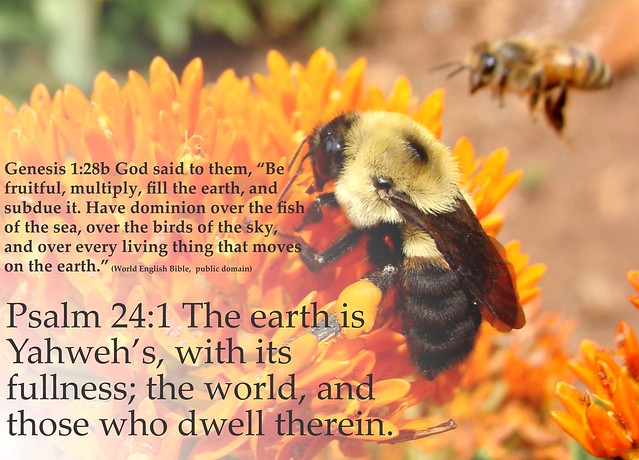
Two Days late for Earth Day - Environmental stewardship This blog didn't have any Earth Day post this year. Sorry. The above graphic is an attempt to make up for that failure. But, just as Christ is risen every day of the year, the earth should be cared for every day of the year.

For an essay on what the Bible says about caring for the environment, and it says a lot, see here.

Thanks for looking!

Friday, July 16, 2010

Elizabeth Moon, naturalist

Elizabeth Moon is an honored writer of fantastic literature. She won the Nebula Award for her The Speed of Dark. She is the author of good books in more than one genre of fantastic literature. (See here for one of my posts on a fantasy series by Moon.)

Moon is a blogger. In fact, she has two blogs. One of those mostly details the hard work necessary to write for a living. The other, however, is about the Texas land that she and her family have tried to bring back to its natural condition. I recommend a essay by Moon, illustrated by some of her photos, about small predators on this land, or, rather, in and around a body of water on this land.

Thanks for reading. Read Elizabeth Moon.

Monday, July 12, 2010

Yes, study the oil spill, and protect Texas

According to the Miami Herald, a group of scientists are proposing that, before the Gulf Oil Spill well is capped, we learn as much about it as we can. How much oil and natural gas are really escaping, where are they going, and what are their effects.

This seems reasonable to me, but it's probably expecting too quick a reaction from BP and federal bureaucracies to expect it to happen.

The Houston Chronicle has an opinion piece which says, again, I believe, correctly, that, with the current and impending destruction of estuaries in the path of the escaped oil, similar locations along the Texas coast are suddenly much more important, and steps should be taken to protect them more carefully than they are now. BP should pay for some of this, too.

Thanks for reading.

Tuesday, June 29, 2010

Gulf Oil Spill: Southern Baptist reaction

I was pleased to discover that the Southern Baptist Convention, which met this month in Orlando, had passed a resolution condemning the Gulf Oil Spill.

This is a quotation from the resolution, from the Associated Baptist Press report: "Our God-given dominion over the creation is not unlimited, as though we were gods and not creatures, so therefore, all persons and all industries are then accountable to higher standards than to profit alone."

National Public Radio also reported on the matter. I quote from that report:
. . . the Convention called on the government "to act determinatively and with undeterred resolve to end this crisis ... to ensure full corporate accountability for damages, clean-up and restoration ... and to ensure that government and private industry are not again caught without planning for such possibilities."

NPR interviewed the Dean of Southern Baptist Theological Seminary, who told the reporter that there was no reason why a true conservative should not call for government to regulate responsibly, and also told the reporter that a believe in sin included a belief in corporate sin. (The Dean was not speaking for the Convention, but for himself, but, no doubt, his views are shared by many Southern Baptists.)

Good for the SBC, which is the largest Christian body in the US, as I understand it, and generally associated with conservative political views.

Thanks for reading.

Monday, June 14, 2010

Shameless Self-promotion

I received my copies of Care of Creation: Christian Voices on God, Humanity, and the Environment, a book published by the Wesleyan Publishing House, today. I was one of several authors, all having some connection to The Wesleyan Church or closely related bodies. I co-authored a chapter on "Endangered Species and Habitats."

The book is available from the publisher for $14.99, and from Amazon and Barnes and Noble for less.

To see some of my thinking on these matters, go here. That post, which I consider one of my most important, sets forth what the Bible says about these matters. Very little of that post, although it's a good summary, has not been said by others. During the writing of the book, I also wrote this post, on two new (to me, anyway) reasons for preserving nature around us. As far as I know, no one else has ever discussed these two reasons.

Thanks for reading.

Wednesday, May 26, 2010

Sunspots 262

Things I have recently spotted that may be of interest to someone else:


Science:National Public Radio reports on the recent attempt to produce an artificial "cell" with DNA prepared and provided by the experiments. It's not really artificial life, says the report, but it makes some long-standing ethical questions more immediately important.

Computing:
Wired reports that a Chicago judge, who was sent hundreds of e-mails by supporters of a public figure, in an attempt to influence the judge, could not hold that public figure in contempt of court. Don't start e-mailing judges, though . . .

Christianity:
The Evangelical Environmental Network has a comprehensive statement on what the Bible says about creation care. The statement is almost entirely quotations from the Bible, a lot of them.


Image source (public domain)

Monday, May 10, 2010

Probable effects of the Gulf oil spill

Wired has a good article on the likely effects of the gulf oil spill. There will be some, and long-lasting ones, too, on wildlife, and probably on humans. Too bad.

Tuesday, December 15, 2009

Sunspots 239

Things I have recently spotted that may be of interest to someone else:


Note: I almost always post "Sunspots" on Wednesdays, but have other plans for tomorrow's post, this time.

Humor:

(or something) Someone alerted the Strange Maps blogger (that's what his blog is about) to a field in Nebraska that's exactly the shape of, well, Nebraska.

Music:
(or something) Wired reports that an inventor is connecting earth tremors to musical instruments, to create earth-born (!) music.

Computing: 
Wired reports that a (so far) anonymous Wikipedia editor is being sued for claiming that an actor is homosexual, when the actor denies this. This case raises the issue of web anonymity, of course, and also the issue of whether calling someone homosexual when they aren't is a prosecutable offense. (Would the reverse claim also be?)

Literature:
(Art, actually) Wired reports on an artist that creates art objects out of old hard drives.

Christianity:
The Beautiful Feet blogger believes he may have found a Christmas prediction in the book of Job, of all places.

More on Jan, who, as I reported previously, finally got around to paying her tithe.


Image source (public domain)

Saturday, September 26, 2009

Kudzu

kudzu leaves

Kudzu has been discovered growing in Canada, according to the Toronto Globe and Mail. As you can see from the photo above, kudzu is a vining plant. It happens to be a member of the pea, or Fabaceae family of flowering plants. That means that it has structures in the roots, nodules, which Nitrogen-fixing bacteria can live in. These bacteria take Nitrogen out of the air in the soil, and begin the process of making it available to the kudzu plant, and, thence, to anything that will eat that plant. Nitrogen is found in proteins, and in DNA and RNA, and elsewhere. Living things absolutely must have it in order to exist.

Which brings up a question. How many signs of insect damage (or damage from plant-eating vertebrates, for that matter) do you see in the photo? The answer is none. In spite of kudzu's remarkably rapid growth -- the vines can grow up to a foot a day in good weather -- and that it is a source of protein, it is not eaten readily by many animals. Goats will eat it. I once tried to feed some captive mice some kudzu leaves. Apparently they would gladly have starved to death rather than eating the stuff, so I relented, and put them back on a more normal diet.

Why won't the animals of the Southeastern part of North America, where kudzu grows, eat the plant? Most likely, the answer is that kudzu is not native to that area. It is native to Japan, and parts of China. Presumably, in these areas there are various kinds of insects, and other animals, that eat it. But not in the Southeastern US. When kudzu was brought here, to stop erosion, the animals that eat it were left behind. As a result, kudzu grows almost unchecked. But it is checked. How? by frost. The first common green plant to perish when the weather gets cooler seems to be kudzu. The last plant to start growing in the summer is kudzu. It covers many a hill or field during the time between the first autumn freeze, and the last freeze of the next Spring.

This photo:

Kudzu, gray,  with woodchuck holes

Shows how kudzu is anything but green in the winter.

It is not good stewardship to bring non-native living things into an area. They often tend to mess up ths organisms that are already there.

Sunday, August 23, 2009

How we, too often, do Biblical study and interpretation

From an article in First Things on the Green Bible:

The Green Bible presents us with a curious kind of natural theology: We start with things we know to be true from trusted sources—Al Gore, perhaps?—and then we turn to Scripture to measure it against those preexisting and reliable authorities. And what a relief to discover that God is green. Because we already know that it's good to be green—what we didn't know is whether God measures up to that standard. Alan Jacobs, "Blessed are the Green of Heart," First Things, May, 2009.

I haven't seen the Green Bible. I don't know whether Jacobs' criticism is fair or not. (He indicates, in the article, that he is doing his part to take care of the environment himself, and there is a comment to the article that he was not being fair.) I do know myself, and how I sometimes act. How often do I do that sort of Biblical study and interpretation? Doing it in reverse, that is -- starting out with a preconceived view and searching the Bible until I find justification for it?

God help me.

Sunday, August 16, 2009

Stewardship in Ezra

Ezra 8:24 Then I set apart twelve of the leading priests: Sherebiah, Hashabiah, and ten of their kinsmen with them. 25 And I weighed out to them the silver and the gold and the vessels, the offering for the house of our God that the king and his counselors and his lords and all Israel there present had offered. 26 I weighed out into their hand 650 talents of silver, and silver vessels worth 200 talents, and 100 talents of gold, 27 20 bowls of gold worth 1,000 darics and two vessels of fine bright bronze as precious as gold. 28 And I said to them, “You are holy to the Lord, and the vessels are holy, and the silver and the gold are a freewill offering to the Lord, the God of your fathers. 29 Guard them and keep them until you weigh them before the chief priests and the Levites and the heads of fathers' houses in Israel at Jerusalem, within the chambers of the house of the Lord.” 30 So the priests and the Levites took over the weight of the silver and the gold and the vessels, to bring them to Jerusalem, to the house of our God. (ESV, emphasis added.)

Ezra doesn't exactly say so, but it seems that the implication is clear -- these priests had been given something to care for, and at the end of their journey, when the treasure they had been entrusted with would be turned over to others, there would be a reckoning. Had they taken any of the metal for themselves? Any talents, or, perhaps, any shavings off of the gold bowls?

God wants me to be responsible for what I've been entrusted with, too.

Thanks for reading.

Sunday, August 02, 2009

The diversity of God's creation

I have been struck by the number of times that the Bible is inclusive about God's creation, in reference to how good it is, and, I believe, to our responsibility to care for all of it. (See here and here for posts on what the Bible says about environmental stewardship.)

Genesis 1 concludes by saying that everything God had made was very good.

In Genesis 6:19-20, God's instructions to Noah were to have representatives of all of the animals on the ark. (I have questions about Noah's flood, a lot of questions. One of them is as to whether the flood was world-wide or not. I'm not sure. But I am sure that Noah thought it was, and, therefore, he must have believed that he needed to preserve all the animals from the area around him, if not from the entire earth.)

In Psalm 24:1, the Psalmist tells us that the entire earth, and the things that live on it, belong to God.

Psalm 104:24-25 attempts, in two verses, to describe the amazing diversity that God created. It also says that God made them all in His wisdom.

Colossians 1:15-20
speaks of Christ, and says that He created all things, and that He holds all things together.

All things were made good, in God's wisdom. Therefore, we have a responsibility to preserve them.

Thanks for reading.

Thursday, July 16, 2009

Additional Biblical reasons for environmental stewardship

I have previously posted on "Environmental Stewardship in the Bible," and, in fact, this is one of what I consider to be one of my most significant posts (out of about 1,200!). I freely confess that the Biblical reasons for trying to keep the environment around us in as good a condition as we can were mostly, maybe totally, not original.

In this post, I wish to put forward two new arguments from the Bible, in favor of trying to preserve endangered species, and endangered ecosystems or communities. As far as I know, they are original. Perhaps that is so because they aren't very good reasons. I don't know.

Psalm 19:1-4 and Romans 1:20 tell us that observing and learning about nature are part of God’s revelation to humans. If that is so, isn’t that another reason to try to preserve nature as well as we can? The Bible is one of the ways that God reveals Himself to us. For a long time, Christians have believed that the Bible should be translated into the language people are most familiar with, so that that revelation may be as clear as possible. Similarly, it would seem that God's revelation through nature should be as clear as possible. A person is more likely to see God in a pristine stream than in a polluted river. Probably seeing bison herds roam freely in Western North America gave people a glimpse of one aspect of God’s power and majesty that they can’t really get now. Therefore, helping to preserve nature in as good a condition as we can is one way to bring people to a saving knowledge of Christ. Not the most direct way, and probably not the most effective, for many people, but it is still a way to do this.

2) Colossians 1:15-20 says, of Christ, that “in Him all things hold together.” (ESV -- other versions have similar language. See here for the ESV policy on electronic use of this version of the Bible.) That passage also says that He is working to reconcile all things to Himself, and that He is working to make peace through the blood of the cross. As Christians, we believe that it is our duty to be His instruments in reconciling sinners to Christ, and to help Him in the ministry of making peace. In fact, 2 Corinthians 5:18-19, tell us that:  18 But all things are of God, who reconciled us to himself through Jesus Christ, and gave to us the ministry of reconciliation; 19 namely, that God was in Christ reconciling the world to himself, not reckoning to them their trespasses, and having committed to us the word of reconciliation.

Doesn’t it follow that we should also participate in Christ’s work of sustaining “all things,” including endangered species and ecosystems or biological communities? (I realize that there are other places in the New Testament where reconciliation and peacemaking are mentioned, or implied, and this is probably the only one that mentions Christ's sustaining work. But that doesn't mean that His sustaining work can be dismissed, or that we have no responsibility to be His instruments in doing it.)

What do you think?

Thanks for reading. (This post was edited on October 16, 2009. I attempted to enhance the arguments, without changing them. On September 26, 2013, I added the quotation from 2 Corinthians, and the introduction to it.)

Wednesday, April 22, 2009

Holmes Rolston, III

Holmes Rolston, III, (See also his web pages at Colorado State University, which are extensive, and include course syllabi, many of his publications, and some video of lectures that he has given.) is arguably the most important figure in the development of environmental ethics, the study of what we should and should not do with the organisms, landscape, communities, bodies of water, geological features, and atmosphere around us. I recently had the privilege of reviewing Saving Creation: Nature and Faith in the Life of Holmes Rolston, III, by Christopher J. Preston. (San Antonio, TX: Trinity University Press, 2009) The book told Rolston's story quite well, covering his professional life, and his personal life, where it fit. (Rolston is still alive.)

I knew of Rolston as an environmental ethicist. He wrote the first paper in the first issue of the journal, Environmental Ethics, which said, in part:
We need wild nature in much the same way that we need the other things in life which we appreciate for their intrinsic rather than their instrumental worth, somewhat like we need music or art, philosophy or religion, literature or drama. But these are human activities, and our encounter with nature has the additional feature of being our sole contact with worth and beauty independent of human activity. We need friends not merely as our instruments, but for what they are in themselves, and, moving one order beyond this, we need wild nature precisely because it is a realm of values which are independent of us. Wild nature has a kind of integrity, and we are the poorer if we do not recognize it and enjoy it. Holmes Rolston III, "Can and Ought We to Follow Nature," Environmental Ethics 1:7-30, Spring, 1979. Quote is from pages 22-23. This paper was the first one in the initial issue of this journal. (Also found here)

I went to a conference on environmental ethics with a philosophy professor from my university, at the University of Georgia, in 1981. Rolston was there. We spoke with him. My friend, more perceptive than I, guessed that Rolston had been a Presbyterian pastor. He was exactly right. Rolston's first professional post was as a pastor in a Presbyterian church in Virginia. He had an undergraduate degree in physics from Davidson College (and once saw Albert Einstein close up, although he didn't speak to him), and a seminary degree from Union Theological Seminary, followed by a doctorate from New College, Edinburgh, Scotland.

Preston's book reminded me of something that I had forgotten. I had read Rolston's Science and Religion: A Critical Survey (Philadelphia: Temple University Press, 1987) about twenty years ago. I had forgotten that it is a powerful plea for a cooperative relationship between science and Christianity. Like Ian G. Barbour's When Science Meets Religion: Enemies, Strangers, or Partners (HarperSanFrancisco, 2000), Rolston believes that science and Christianity should be compatible. Rolston argued for a view of God as being involved in the suffering that goes along with the struggles of life, including for non-human creatures. Clearly a believer, he wrote:
When one is caught in the anguish of the struggle, as in a fight against disease, insanity, infertility, or moral evil, one may still cry out for strength and meaning to the strong son of God, beyond all recourse to biochemistry, beyond all description of the evolutionary struggle. (p. 145)

Preston's biography describes how Rolston found that he wasn't connecting as well with his parishioners as he might have wished. He perhaps, showed too much of his intellect and education to them. At any rate, he pursued an academic career, eventually ending up at Colorado State University in the Department of Philosophy, where he has been based since 1968.

Preston's subtitle indicates what the author believes, namely that Rolston has integrated his study of nature (he is an accomplished naturalist, as well as a philosopher) with his faith. He says that Rolston early saw, however, that he would need to put forth ideas that would be acceptable in a secular world, and he did that, achieving such prominence that he was asked to author that first article in Environmental Ethics.

Rolston had influence outside of academic circles. He participated, with his writing, in acting to preserve the environment in certain conflicts in Virginia, and also in the West.

The answers in environmental ethics are not always obvious, or are controversial. How important is it to preserve a species from extinction? Can feeding human beings from the land used by that species override our stewardship responsibilities? How important is it to preserve wilderness in close to its pristine state? Can we do so? Why should we? Rolston has made important contributions to our thinking about environmental stewardship, and other areas.

One of Rolston's most lyrical works is his essay, "The Pasqueflower," in Natural History, April 1979, pages 6-16. (Also available here.) Rolston has often seen pasqueflowers blooming through the snow in the mountain west. Natural History is a secular publication, not a religious one. But Rolston included this statement:
Perhaps it may not be so fanciful but rather entirely realistic that this pasqueflower should in its limited and natural way come to serve as a symbol for what Jesus in his unlimited, supernatural way represents to the Christian mind, a hint of the release of life from the powers that would suppress it. The pasqueflower is of a piece with the rose of Sharon, which blooms in the desert, and the shoot budding out of the stump of Jesse, for here we have an earthen gesture of the powers of resurgent life. (p. 14)

He deserves the honors that he has received.

Thanks for reading. Read Rolston.

This being Earth Day, you may wish to read my own post, from 2006, on "Environmental Stewardship in the Bible."

Thursday, March 19, 2009

Why worry about origins?

With the anniversary of Darwin's publication of Origin of Species . . . the topic of evolution is again being pushed to the forefront of public thought. It deserves to be asked why this topic should be of concern to evangelical readers. After all, people have been finding salvation in Christ for two millenia without needing to have a perfect understanding of the process of origins. Why should readers put time and effort into trying to disentangle this issue? Bethany Sollereder, "God and Evolution: A Review of Four Contemporary Books," Perspectives on Science and Christian Faith, 61:40-48, March, 2009. Quote is from p. 40.

Why, indeed? Sollreder might equally have said that we don't need a perfect understanding of quantum mechanics, or eschatology, the Trinity, or a lot of other things, to make it to heaven, and it's a good thing that we don't. In fact, we finite humans probably don't have a "perfect understanding" of anything.

But we are created in God's image. Things that that seems to include are the ability to think, and some curiosity. (As well as some other properties, probably more important than these two. We can form relationships, communicate verbally, and make moral choices, among other likely attributes of being in God's image.) So reasoning, curious creatures are probably going to try to figure out how things got started. A long time ago, some scientists used to say, when they were learning how things worked, that they were "thinking God's thoughts after Him." Maybe they were. Maybe scientists of our day sometimes are, too.

Not only do we try to find out things because we are in God's image, but we are supposed to be stewards of God's creation. To be a good steward is to be an informed steward. Study of how things came to be as they are should help us to understand better how to take care of the living things that are still in existence.

As you can see from the reference above, Sollereder's review goes on for nine pages. Clearly, the editor of Perspectives, and, presumably, Sollereder, thought there was some importance in describing four books on reconciling scientific data about origins, God's revelation in nature, with God's revelation through the Bible. I agree. Suffice it to say that Sollereder believes that Kenneth R. Miller's Only A Theory: Evolution and the Battle for America's Soul, and Denis Lamoureaux's Evolutionary Creation: A Christian Approach to Evolution, are valuable books, for persons who read them carefully.

Can I prove that reading one of these books is as important as, say, reading a book about how to raise a Christian family? No. But, for some Christians, Christian stewardship of God's creation, and learning as much as possible about God's activity in the natural world, seems to be part of their calling. If that is true, they need to follow that call, which may include learning, and receiving training, in areas such as origins.

Thanks for reading.

Sunday, December 14, 2008

John, on supporting missionaries

3 John 1:5 Beloved, it is a faithful thing you do in all your efforts for these brothers, strangers as they are, 6 who testified to your love before the church. You will do well to send them on their journey in a manner worthy of God. 7 For they have gone out for the sake of the name, accepting nothing from the Gentiles. 8 Therefore we ought to support people like these, that we may be fellow workers for the truth. (ESV, emphasis added.)

Thanks for reading. Support a missionary!

Wednesday, November 19, 2008

Sunspots 186


Things I have recently spotted that may be of interest to someone else:


I'm not sure quite where to put this. Jan has a good short post on crying.

Science:
It's possible that a man has been cured of AIDS by a bone transplant, Wired reports.

National Public Radio reports that we have photographed large planets from other solar systems.

Politics:
(or something) Wired on why we have five time zones in North America. (China has only one, I believe.)

A Slate writer discusses a politically conservative environmentalist agenda. (And says that that is not an oxymoron!)

Computing:
CBS News points out that, for teenagers, the dangers of driving drunk are much greater than those of on-line predators.

Christianity:
Ken Schenck on the Tribulation: "But Paul knows nothing of a seven year tribulation."

Schenck also reviewed a book on women's roles, by a Christian author. He says that the author argues that the so-called traditional family, with the woman at home, is a post-industrial revolution development. ". . . before the industrial revolution everyone was at home and everyone worked at home."


Image source (public domain)

Tuesday, November 11, 2008

Photos from Antarctica

The Boston Globe has posted 32 spectacular photos from Antarctica, which are well worth seeing.

As of today, at least, no password or special software is needed to see these.

Thanks for reading.