The following propositions have
been urged: First, that some faith in our life is required even to improve it; second, that some dissatisfaction with things as they are is necessary
even in order to be satisfied; third, that to have this necessary content and necessary discontent it is not sufficient to have the obvious
equilibrium of the Stoic. For mere resignation has neither the gigantic levity of pleasure nor the superb intolerance of pain. There is a vital
objection to the advice merely to grin and bear it. The objection is that if you merely bear it, you do not grin. Greek heroes do not grin: but
gargoyles do—because they are Christian. And when a Christian is pleased, he is (in the most exact sense) frightfully pleased; his pleasure is
frightful. Christ prophesied the whole of Gothic architecture in that hour when nervous and respectable people (such people as now object to barrel
organs) objected to the shouting of the gutter-snipes of Jerusalem. He said, “If these were silent, the very stones would cry out.” Under the
impulse of His spirit arose like a clamorous chorus the façades of the medieval cathedrals,
thronged with shouting faces and open mouths. The prophecy has fulfilled itself: the very stones cry out.
If these things be conceded, though only for argument, we may take up where we left it the thread of the thought of the natural man, called by
the Scotch (with regrettable familiarity), “The Old Man.” We can ask the next question so obviously in front of us. Some satisfaction is needed
even to make things better. But what do we mean by making things better? Most modern talk on this matter is a mere argument in a circle—that circle
which we have already made the symbol of madness and of mere rationalism. Evolution is only good if it produces good; good is only good if it helps
evolution. The elephant stands on the tortoise, and the tortoise on the elephant.
Obviously, it will not do to take our ideal from the principle in nature; for the simple reason that (except for some human or divine theory), there
is no principle in nature. For instance, the cheap anti-democrat of today will tell you solemnly that there is no equality in nature. He is right,
but he does not see the logical addendum. There is no equality in nature; also there is no inequality in nature. Inequality, as much as equality,
implies a standard of value. To read aristocracy into the anarchy of animals is just as sentimental as to read democracy into it. Both
aristocracy and democracy are human ideals: the one saying that all men are valuable, the other that some men are more valuable. But nature does
not say that cats are more valuable than mice; nature makes no remark on the subject. She does not even say that the cat is enviable or the mouse
pitiable. We think the cat superior because we have (or most of us have) a particular philosophy to the
effect that life is better than death. But if the mouse were a German pessimist mouse, he might not think that the cat had beaten him at all. He
might think he had beaten the cat by getting to the grave first. Or he might feel that he had actually inflicted frightful punishment on the cat
by keeping him alive. Just as a microbe might feel proud of spreading a pestilence, so the pessimistic mouse might exult to think that he was
renewing in the cat the torture of conscious existence. It all depends on the philosophy of the mouse. You cannot even say that there is victory or
superiority in nature unless you have some doctrine about what things are superior. You cannot even say that the cat scores unless there is a system
of scoring. You cannot even say that the cat gets the best of it unless there is some best to be got. We cannot, then, get the idea itself from
nature, and as we follow here the first and natural speculation, we will leave out (for the present) the idea of getting it from God. We must have
our own vision. But the attempts of most moderns to express it are highly vague.
Orthodoxy, first published in 1908, by G. K. Chesterton, is in the public domain, and available from Project Gutenberg. The previous post in this series is here. Thanks for reading! Read Chesterton.

Musings on science, the Bible, and fantastic literature (and sometimes basketball and other stuff).
God speaks to us through the Bible and the findings of science, and we should listen to both types of revelation.
The title is from Psalm 84:11.
The Wikipedia is usually a pretty good reference. I mostly use the World English Bible (WEB), because it is public domain. I am grateful.
License
I have written an e-book, Does the Bible Really Say That?, which is free to anyone. To download that book, in several formats, go here.

The posts in this blog are licensed under a Creative Commons Attribution-NonCommercial-ShareAlike 3.0 Unported License. You can copy and use this material, as long as you aren't making money from it. If you give me credit, thanks. If not, OK.
The posts in this blog are licensed under a Creative Commons Attribution-NonCommercial-ShareAlike 3.0 Unported License. You can copy and use this material, as long as you aren't making money from it. If you give me credit, thanks. If not, OK.
Sunday, August 30, 2015


Wednesday, August 26, 2015
Sunspots 535

Christianity: Relevant tells us that private communion shouldn't be a chore, and makes some suggestions to make it more interesting. They suggest communion through food, among other things.
Stephen L. Corey points out that God created, or at least allowed, people who are not exactly male or female.
Computing: Gizmo's Freeware on privacy (or not -- some leaks can be fixed) in Windows 10.
Education: National Public Radio reports on how public schools in the US are neglecting the smartest kids.
Science: National Public Radio reports on research linking our leanness, or lack thereof, to our gut bacteria.
NPR also reports on very low-frequency communication sounds made by elephants.
Wired reports that Pluto's atmosphere seems to be being renewed. Its gravity is too weak to hold it as well as the earth holds ours.
Wired also explains why water gets stale when left out overnight.
Wired also reports on an on-line database of mathematical sequences, and the man who has maintained this database for 50 years. (Examples: 1, 1, 2, 3, 5, 8, 13, 21, 34 . . ., the Fibonacci sequence, or 1, 2, 3, 5, 7, 11, 13, 17, 19, 23, 29 . . ., the prime numbers.) There are many, many more of these sequences in the database.
Image source (public domain)
Sunday, August 23, 2015
Excerpts from Orthodoxy, by Gilbert K. Chesterson, 35
This is the thrilling romance of Orthodoxy. People have fallen into a foolish habit of speaking of orthodoxy as something heavy, humdrum, and
safe. There never was anything so perilous or so exciting as orthodoxy. It was sanity: and to be sane is more dramatic than to be mad. It was the
equilibrium of a man behind madly rushing horses, seeming to stoop this way and to sway that, yet in every attitude having the grace of statuary
and the accuracy of arithmetic. The Church in its early days went fierce and fast with any war-horse; yet it is utterly unhistoric to say that she
merely went mad along one idea, like a vulgar fanaticism. She swerved to left and right, so exactly as to avoid enormous obstacles. She left on one
hand the huge bulk of Arianism, buttressed by all the worldly powers to make Christianity too worldly. The next instant she was swerving to avoid
an orientalism, which would have made it too unworldly. The orthodox
Church never took the tame course or accepted the conventions; the orthodox Church was never respectable. It would have been easier to have
accepted the earthly power of the Arians. It would have been easy, in the Calvinistic seventeenth century, to fall into the bottomless pit of
predestination. It is easy to be a madman: it is easy to be a heretic. It is always easy to let the age have its head; the difficult thing is to
keep one’s own. It is always easy to be a modernist; as it is easy to be a snob. To have fallen into any of those open traps of error and
exaggeration which fashion after fashion and sect after sect set along the historic path of Christendom—that would indeed have been simple. It is
always simple to fall; there are an infinity of angles at which one falls, only one at which one stands. To have fallen into any one of the fads from
Gnosticism to Christian Science would indeed have been obvious and tame. But to have avoided them all has been one whirling adventure; and in my
vision the heavenly chariot flies thundering through the ages, the dull heresies sprawling and prostrate, the wild truth reeling but erect.
Orthodoxy, first published in 1908, by G. K. Chesterton, is in the public domain, and available from Project Gutenberg. The previous post in this series is here. Thanks for reading! Read Chesterton.
Orthodoxy, first published in 1908, by G. K. Chesterton, is in the public domain, and available from Project Gutenberg. The previous post in this series is here. Thanks for reading! Read Chesterton.
Wednesday, August 19, 2015
On the implementation of penicillin - Howard Florey, Edward Abraham, Ernst Chain, Norman Heatley and others
I recently read The Mold in Dr. Florey's Coat: The story of the Penicillin Miracle, by Eric Lax.
The book was a thorough study of the history of the discovery and implementation of penicillin, with World War II as a significant part of the historical background. The title comes from the idea of some of the scientists involved, that, if Britain were about to be conquered by the Germans, they could rub spores from the mold in their coats, and go to the U. S. to continue their work. It never came to that.
Penicillin is, or was, an important antibiotic. It was the first one used on a systematic basis, to treat infections. Although not used so much now, because bacteria have become resistant to it, and some people have developed allergies to it, derivatives of penicillin are still in use. One of my family members is currently taking amoxicillin.
There are several features of the book, and the story it tells, that are more broadly applicable.
1) Lax points out that many of the most important scientific developments of the 20th century were done on very small budgets, often as a sort of hobby by the person doing the work. That was true of the isolation and production of penicillin. Leeuwenhoek, the builder of the first microscope, was, of course, not a professional microscopist -- there were no such people.
2) The account of scientific discoveries (or other notable events) that is transmitted is often seriously distorted. That is, according to Lax, true of the original discovery of the mold that produced the first usable penicillin, by Alexander Fleming. I have often heard that Fleming discovered the bacteria-killing properties of the mold by accident. Lax indicates that that isn't exactly true. He was investigating. Fleming stopped working on penicillin, and Howard Florey, and others, took it up, but Fleming got much of the credit for the development of the drug. Florey and his group, with little or no help from Fleming, did that.
Eventually, Fleming, Florey, and Ernst Chain were awarded the Nobel Prize for their work on penicillin. Edward Abraham and Norman Heatley also made significant contributions, but they were not so honored. Eventually, they were honored in other ways. There were no female heads of laboratories, and they didn't make any ground-breaking contributions, but there were many women workers, some of whom worked at considerable risk, breathing in dangerous materials, and working long hours.
3) Scientific discoveries are often not made freely available to others. There's a lot in the book about patents, and it is clear that the British scientists involved, and, eventually, others, believed that penicillin should be treated as a military secret, and they would have been horrified if it had been made available to the Germans.
Thanks for reading. I hope you don't need to take an antibiotic.
The book was a thorough study of the history of the discovery and implementation of penicillin, with World War II as a significant part of the historical background. The title comes from the idea of some of the scientists involved, that, if Britain were about to be conquered by the Germans, they could rub spores from the mold in their coats, and go to the U. S. to continue their work. It never came to that.
Penicillin is, or was, an important antibiotic. It was the first one used on a systematic basis, to treat infections. Although not used so much now, because bacteria have become resistant to it, and some people have developed allergies to it, derivatives of penicillin are still in use. One of my family members is currently taking amoxicillin.
There are several features of the book, and the story it tells, that are more broadly applicable.
1) Lax points out that many of the most important scientific developments of the 20th century were done on very small budgets, often as a sort of hobby by the person doing the work. That was true of the isolation and production of penicillin. Leeuwenhoek, the builder of the first microscope, was, of course, not a professional microscopist -- there were no such people.
2) The account of scientific discoveries (or other notable events) that is transmitted is often seriously distorted. That is, according to Lax, true of the original discovery of the mold that produced the first usable penicillin, by Alexander Fleming. I have often heard that Fleming discovered the bacteria-killing properties of the mold by accident. Lax indicates that that isn't exactly true. He was investigating. Fleming stopped working on penicillin, and Howard Florey, and others, took it up, but Fleming got much of the credit for the development of the drug. Florey and his group, with little or no help from Fleming, did that.
Eventually, Fleming, Florey, and Ernst Chain were awarded the Nobel Prize for their work on penicillin. Edward Abraham and Norman Heatley also made significant contributions, but they were not so honored. Eventually, they were honored in other ways. There were no female heads of laboratories, and they didn't make any ground-breaking contributions, but there were many women workers, some of whom worked at considerable risk, breathing in dangerous materials, and working long hours.
3) Scientific discoveries are often not made freely available to others. There's a lot in the book about patents, and it is clear that the British scientists involved, and, eventually, others, believed that penicillin should be treated as a military secret, and they would have been horrified if it had been made available to the Germans.
Thanks for reading. I hope you don't need to take an antibiotic.
Sunspots 534

The Arts: Relevant has some questions for us to ask ourselves before we watch an R-rated show.
Computing: Gizmo's Freeware has an annotated list of the best free Windows apps, in several categories.
Gizmo's also tells you how to hide the live tiles in Windows 10. The article also tells about a program that restores the Windows 7 interface to Windows 10.
Gizmo's has begun to rate for-pay items. They have rated the best Virtual Private Network (VPN) services. In case you haven't heard of VPNs, you should have. They shield you from, say, someone hacking into your motel's network (or the one at your home or business).
From Windows Secrets: How to make the lithium-ion batteries in most modern information appliances last for years (and how not to!)
Humor: (Sort of) FiveThirtyEight examines people's behavior when they split a check for a meal. Interesting.
Science: Wired reports on a giant starfish that can catch fish.
In a photo, Wired also demonstrates that crystallized DNA is beautiful.
National Public Radio reports on why different animals have different pupil shapes.
Image source (public domain)
Monday, August 17, 2015
Biologos visits Answers in Genesis's Creation Museum
I've never been to the Creation Museum, and I probably won't ever go. But the idea is interesting, and the museum is, too.
In case you didn't know it, Ken Ham is the guiding light behind the museum, and behind Answers in Genesis. Ham debated Bill Nye, "the Science Guy" at the museum, a few months ago.
A pair of scientists, from the BioLogos Forum, visited the Creation museum recently. I found their remarks enlightening. Perhaps you will, too.
Thanks for reading. Read the article.
In case you didn't know it, Ken Ham is the guiding light behind the museum, and behind Answers in Genesis. Ham debated Bill Nye, "the Science Guy" at the museum, a few months ago.
A pair of scientists, from the BioLogos Forum, visited the Creation museum recently. I found their remarks enlightening. Perhaps you will, too.
Thanks for reading. Read the article.
Wednesday, August 05, 2015
Sunspots 533

Christianity: Ken Schenck tells us that the primary duty of the church is to worship God.
Computing: (or Fashion) Wired reports on a woman who printed her own clothes with a 3-D printer.
Wired reviews Windows 10 -- quite positively, but don't install it quite yet, yourself -- let Microsoft get out whatever bugs there may be.
Some artificial intelligence scientists are saying that we need a world-wide ban on the production of robots which are designed to kill people, using their own artificial intelligence. Some of them already exist.
Politics: (or business) National Public Radio tells us that human trafficking is widespread in agriculture and fisheries, around the world, with some in the US.
OpenSecrets is a non-partisan web site that keeps track of money and politics.
Science: Wired reports on "Kick 'em Jenny," which is the name of a dormant volcano, (I am not making this up!) which may be about to erupt.
NPR reports on transporting, as done in Star Trek. One atom at a time. Sort of.
Sports: Congratulations to Nancy Lieberman, who has been hired as an assistant coach in the National Basketball Association. (She's not the first woman hired -- Becky Hammon had that honor.) And Christianity Today (!) reports that a National Football League team has, for the first time, hired a female coach.
Image source (public domain)
Monday, August 03, 2015
Parasite Rex
Carl Zimmer is an important communicator of science, perhaps the most important such communicating in English, at the present time. I have read a few dozen of his articles and blogs, but had never read one of his books. Now I have. That book is Parasite Rex: Inside the Bizarre World of Nature's Most Dangerous Creatures. Here is the book's Amazon page, Kindle version.
Quick summary: Most animals, at least the vertebrates, arthropods, and molluscs, are parasitized by several other animals. (The book also considers plants a little. It says very little about fungal parasites. Zimmer couldn't cover everything.) Most biologists don't consider the effect of this massive amount of debilitating interaction nearly enough. Parasites are hard to study. They usually are hidden, and often pass through more than one host animal during their lifetime. Humans, until recently, were as prone to parasites as other animals. Some humans, in primitive conditions, still are. Even though parasites harm their hosts, they seldom kill them, at least not until they have had offspring with a good chance of reaching another host. If they did kill immediately, they would be destroying their own chances of survival.
Some interesting ideas:
There are probably more parasitic species than free-living ones.
Parasites have seldom been found as fossils, mostly because they are almost all soft-bodied.
The discovery of parasites caused some theological concerns:
Parasites seemed to arise by spontaneous generation. If God created everything in the first six days, then all organisms living now should be descendants of those first organisms, not just appearing suddenly, as it were, from nowhere. Eventually, it was shown that parasites came from previous organisms, often from their eggs.
It seemed that parasites were a dead end -- they just got into a host and died there. But a scientist named Friedrich Küchenmeister doubted that that was the full story, and found that those parasites, in at least some cases, were not dead ends. If the host was eaten, they went into a new stage of development.
"[Darwin] found that parasitic wasps are a particularly good antidote to sentimental ideas about God. The way that the larvae devoured their host from the inside was so awful that Darwin once wrote of them, 'I cannot persuade myself that a beneficient and omnipotent God would have designedly created the Ichneumonidae [one group of parasitic wasps] with the express intention of their feeding within the living bodies of Caterpillars.'"
I have posted on questions related to whether germs, and by extension, parasites, were present before the Fall.
Some parasites can control the gene activity of their hosts, or control the behavior of their hosts, in bizarre ways, generally to the benefit of the parasite, usually somehow helping the parasite to reach another host animal. To put it another way, they create zombies.
Parasites may be responsible for the development of sex and mating. (It is, of course, possible for many animals to reproduce without sex, although most vertebrates require some sort of fertilization to reproduce.) Often, animals display to attract females. Parasite-ridden animals usually aren't as colorful, or as active, and observing these males allows females to select the more healthy and less parasite-ridden, mates, who, usually, have better genes, perhaps genes that give resistance to parasites, or genes which cause behavior which is less likely to lead to being parasitized.
IgE, an immunoglobulin that our own bodies produce, and that causes allergies and other problems, isn't just a nuisance. For most of human history, and in many places on earth, IgE helped to repel parasites. Some experiments indicate that ulcerative colitis and Crohn's disease (an intestinal problem) can be cured by introducing parasites into the people that have these problems.
There are other fascinating ideas, and many descriptions of how parasites live, and of the scientists who have made discoveries about them, and how these discoveries came about. A fine book!
Thanks for reading!
Quick summary: Most animals, at least the vertebrates, arthropods, and molluscs, are parasitized by several other animals. (The book also considers plants a little. It says very little about fungal parasites. Zimmer couldn't cover everything.) Most biologists don't consider the effect of this massive amount of debilitating interaction nearly enough. Parasites are hard to study. They usually are hidden, and often pass through more than one host animal during their lifetime. Humans, until recently, were as prone to parasites as other animals. Some humans, in primitive conditions, still are. Even though parasites harm their hosts, they seldom kill them, at least not until they have had offspring with a good chance of reaching another host. If they did kill immediately, they would be destroying their own chances of survival.
Some interesting ideas:
There are probably more parasitic species than free-living ones.
Parasites have seldom been found as fossils, mostly because they are almost all soft-bodied.
The discovery of parasites caused some theological concerns:
Parasites seemed to arise by spontaneous generation. If God created everything in the first six days, then all organisms living now should be descendants of those first organisms, not just appearing suddenly, as it were, from nowhere. Eventually, it was shown that parasites came from previous organisms, often from their eggs.
It seemed that parasites were a dead end -- they just got into a host and died there. But a scientist named Friedrich Küchenmeister doubted that that was the full story, and found that those parasites, in at least some cases, were not dead ends. If the host was eaten, they went into a new stage of development.
"[Darwin] found that parasitic wasps are a particularly good antidote to sentimental ideas about God. The way that the larvae devoured their host from the inside was so awful that Darwin once wrote of them, 'I cannot persuade myself that a beneficient and omnipotent God would have designedly created the Ichneumonidae [one group of parasitic wasps] with the express intention of their feeding within the living bodies of Caterpillars.'"
I have posted on questions related to whether germs, and by extension, parasites, were present before the Fall.
Some parasites can control the gene activity of their hosts, or control the behavior of their hosts, in bizarre ways, generally to the benefit of the parasite, usually somehow helping the parasite to reach another host animal. To put it another way, they create zombies.
Parasites may be responsible for the development of sex and mating. (It is, of course, possible for many animals to reproduce without sex, although most vertebrates require some sort of fertilization to reproduce.) Often, animals display to attract females. Parasite-ridden animals usually aren't as colorful, or as active, and observing these males allows females to select the more healthy and less parasite-ridden, mates, who, usually, have better genes, perhaps genes that give resistance to parasites, or genes which cause behavior which is less likely to lead to being parasitized.
IgE, an immunoglobulin that our own bodies produce, and that causes allergies and other problems, isn't just a nuisance. For most of human history, and in many places on earth, IgE helped to repel parasites. Some experiments indicate that ulcerative colitis and Crohn's disease (an intestinal problem) can be cured by introducing parasites into the people that have these problems.
There are other fascinating ideas, and many descriptions of how parasites live, and of the scientists who have made discoveries about them, and how these discoveries came about. A fine book!
Thanks for reading!
Sunday, August 02, 2015
Excerpts from Orthodoxy, by Gilbert K. Chesterton, 34
This is what I have called guessing the hidden eccentricities of life.
This is knowing that a man’s heart is to the left and not in the middle. This is knowing not only that the earth is round, but knowing exactly
where it is flat. Christian doctrine detected the oddities of life. It not only discovered the law, but it foresaw the exceptions. Those underrate
Christianity who say that it discovered mercy; any one might discover mercy. In fact every one did. But to discover a plan for being merciful
and also severe—that was to anticipate a strange need of human nature. For no one wants to be forgiven for a big sin as if it were a little one. Any
one might say that we should be neither quite miserable nor quite happy. But to find out how far one may be quite miserable without making it
impossible to be quite happy—that was a discovery in psychology.
Last and most important, it is exactly this which explains what is so inexplicable to all the modern critics of the history of Christianity. I mean the monstrous wars about small points of theology, the earthquakes of emotion about a gesture or a word. It was only a matter of an inch; but an inch is everything when you are balancing. The Church could not afford to swerve a hair’s breadth on some things if she was to continue her great and daring experiment of the irregular equilibrium. Once let one idea become less powerful and some other idea would become too powerful. It was no flock of sheep the Christian shepherd was leading, but a herd of bulls and tigers, of terrible ideals and devouring doctrines, each one of them strong enough to turn to a false religion and lay waste the world. Remember that the Church went in specifically for dangerous ideas; she was a lion tamer. The idea of birth through a Holy Spirit, of the death of a divine being, of the forgiveness of sins, or the fulfillment of prophecies, are ideas which, any one can see, need but a touch to turn them into something blasphemous or ferocious.
Orthodoxy, first published in 1908, by G. K. Chesterton, is in the public domain, and available from Project Gutenberg. The previous post in this series is here. Thanks for reading! Read Chesterton.
Last and most important, it is exactly this which explains what is so inexplicable to all the modern critics of the history of Christianity. I mean the monstrous wars about small points of theology, the earthquakes of emotion about a gesture or a word. It was only a matter of an inch; but an inch is everything when you are balancing. The Church could not afford to swerve a hair’s breadth on some things if she was to continue her great and daring experiment of the irregular equilibrium. Once let one idea become less powerful and some other idea would become too powerful. It was no flock of sheep the Christian shepherd was leading, but a herd of bulls and tigers, of terrible ideals and devouring doctrines, each one of them strong enough to turn to a false religion and lay waste the world. Remember that the Church went in specifically for dangerous ideas; she was a lion tamer. The idea of birth through a Holy Spirit, of the death of a divine being, of the forgiveness of sins, or the fulfillment of prophecies, are ideas which, any one can see, need but a touch to turn them into something blasphemous or ferocious.
Orthodoxy, first published in 1908, by G. K. Chesterton, is in the public domain, and available from Project Gutenberg. The previous post in this series is here. Thanks for reading! Read Chesterton.
Saturday, August 01, 2015
Relevant on why Christianity and science should be friends.
Here's a brief essay from Relevant, entitled "5 Reasons the Church should Embrace Science."
There are other reasons, such as that scientific findings can help us to be better stewards of God's creation, but the five given are good.
Thanks for reading.
There are other reasons, such as that scientific findings can help us to be better stewards of God's creation, but the five given are good.
Thanks for reading.
Friday, July 31, 2015
It is impossible to overemphasize the importance of the resurrection!
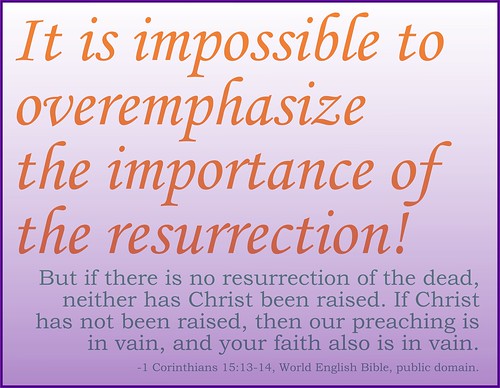
It is impossible to overemphasize the importance of the resurrection!
The poster above is a graphic portrayal of the slogan used in the title of this post -- "It is impossible to overemphasize the importance of the resurrection!" I have also used 1 Corinthians 15:13-14, part of Paul's great essay on the importance of the resurrection -- that's not the only place in the New Testament where it is emphasized.
Thanks for looking, and reading.
Thursday, July 30, 2015
Death, Life, and 1 Corinthians 15

In preparing the graphic, I came across a most relevant statement in a public domain dictionary: "Local death is going on at all times, and in all parts of the living body, in which individual cells and elements are being cast off and replaced by new; a process essential to life." Indeed! Even biologists often don't attach enough significance to the work of decomposer organisms, such as fungi.
Paul (and other Biblical sources) teach that there will be a physical resurrection -- believers will have some sort of physical body, superior to the ones we now have. Christ already has such a body. I don't have a clue as to what that will be like, and you don't, either, although your ideas may be better than mine.
The plant was a dogwood tree, growing near Clemson, South Carolina. That's Lake Hartwell in the background.
Thanks for looking, and reading.
Wednesday, July 29, 2015
Sunspots 532
Things I have recently spotted that may
be of interest to someone else:

Christianity: An essay in Relevant on "What We Get Wrong about Humility." A lot, it seems.
Computing: Gizmo's Freeware tells us about a free Windows program to recover deleted files.
Gizmo's also advises on upgrading (or not) to Windows 10.
And Gizmo's points to a treasure trove on YouTube: Over half a million old news clips, of the kind you used to see with movies, if you can remember that far back.
Education: FiveThirtyEight, the statistical site, says that having students evaluate teachers is actually working pretty well.
The New York Times tells us that there aren't really many differences between colleges.
The Environment: FiveThirtyEight (and other outlets) tells us that the first six months of 2015 were the hottest such ever recorded. The report gives details for a number of US cities, some of which experienced some cold weather, too.
Politics: (Or violence) More US residents have been killed, in terror attacks, by white supremacists, than were killed in terror attacks by jihadists, since September 11, 2001. See here and here, for details.
And Relevant gives us some shocking statistics about gun violence in the US.
Benjamin L. Corey asks if my (or your) version of Christianity has become Americanized.
Image source (public domain)
Christianity: An essay in Relevant on "What We Get Wrong about Humility." A lot, it seems.
Computing: Gizmo's Freeware tells us about a free Windows program to recover deleted files.
Gizmo's also advises on upgrading (or not) to Windows 10.
And Gizmo's points to a treasure trove on YouTube: Over half a million old news clips, of the kind you used to see with movies, if you can remember that far back.
Education: FiveThirtyEight, the statistical site, says that having students evaluate teachers is actually working pretty well.
The New York Times tells us that there aren't really many differences between colleges.
The Environment: FiveThirtyEight (and other outlets) tells us that the first six months of 2015 were the hottest such ever recorded. The report gives details for a number of US cities, some of which experienced some cold weather, too.
Politics: (Or violence) More US residents have been killed, in terror attacks, by white supremacists, than were killed in terror attacks by jihadists, since September 11, 2001. See here and here, for details.
And Relevant gives us some shocking statistics about gun violence in the US.
Benjamin L. Corey asks if my (or your) version of Christianity has become Americanized.
Image source (public domain)
Sunday, July 26, 2015
Excerpts from Orthodoxy, by Gilbert K. Chesterton, 33
Charity is a paradox, like modesty and courage. Stated baldly, charity
certainly means one of two things—pardoning unpardonable acts, or loving unlovable people. But if we ask ourselves (as we did in the case of pride)
what a sensible pagan would feel about such a subject, we shall probably be beginning at the bottom of it. A sensible pagan would say that there
were some people one could forgive, and some one couldn’t: a slave who stole wine
could be laughed at; a slave who betrayed his benefactor could be killed, and cursed even after he was killed. In so far as the act was pardonable,
the man was pardonable. That again is rational, and even refreshing; but it is a dilution. It leaves no place for a pure horror of injustice, such
as that which is a great beauty in the innocent. And it leaves no place for a mere tenderness for men as men, such as is the whole fascination of
the charitable. Christianity came in here as before. It came in startlingly with a sword, and clove one thing from another. It divided the
crime from the criminal. The criminal we must forgive unto seventy times seven. The crime we must not forgive at all. It was not enough that slaves
who stole wine inspired partly anger and partly kindness. We must be much more angry with theft than before, and yet much kinder to thieves than
before. There was room for wrath and love to run wild. And the more I considered Christianity, the more I found that while it had established a
rule and order, the chief aim of that order was to give room for good things to run wild.
Orthodoxy, first published in 1908, by G. K. Chesterton, is in the public domain, and available from Project Gutenberg. The previous post in this series is here. Thanks for reading! Read Chesterton.
Orthodoxy, first published in 1908, by G. K. Chesterton, is in the public domain, and available from Project Gutenberg. The previous post in this series is here. Thanks for reading! Read Chesterton.
Friday, July 24, 2015
Revolutions in genetics - again, part two
A previous post considered new techniques in genetic engineering, and pointed to some discussions of these techniques. This one considers another type of revolution in genetics.
A recent report in Wired indicates that some scientists have figured out how to add additional Nitrogen bases to the standard Adenine, Cytosine, Guanine and Thymine found in the organisms around us, including ourselves. It seems too early to predict what, if any, impact this will have on our lives, but it is possible that this revolution, still in its infancy, will have consequences that are far-reaching.
Adding new bases has the potential of making DNA more efficient at its job, which is carrying hereditary information -- more information in less space. This would be something like adding a few new letters to ordinary English. One question, as with adding letters, is: would someone (or a cell, or an organism) confronted with such understand the message?
Interesting. We'll see where this goes, if anywhere.
Thanks for reading.
A recent report in Wired indicates that some scientists have figured out how to add additional Nitrogen bases to the standard Adenine, Cytosine, Guanine and Thymine found in the organisms around us, including ourselves. It seems too early to predict what, if any, impact this will have on our lives, but it is possible that this revolution, still in its infancy, will have consequences that are far-reaching.
Adding new bases has the potential of making DNA more efficient at its job, which is carrying hereditary information -- more information in less space. This would be something like adding a few new letters to ordinary English. One question, as with adding letters, is: would someone (or a cell, or an organism) confronted with such understand the message?
Interesting. We'll see where this goes, if anywhere.
Thanks for reading.
Thursday, July 23, 2015
Revolutions in genetics - again, part one
In 1975, an important conference, called by a scientist, and attended by scientists in a particular research field, and some key non-scientists who were invited, was held at the Asilomar conference center, near the Pacific ocean, in California. The purpose was to consider the safety of work with microorganisms -- could some dangerous genetically engineered superbug escape, and put humanity at risk? The conference resulted in guidelines for research on genetically modified organisms. It was suggested, for example, that laboratories doing certain kinds of work, such as with human cancer-related genes, would take stringent precautions against the accidental release of microorganisms carrying such genes. The most widely used experimental bacterium was, and is, Escherichia coli, which grows naturally in the human intestines. Presumably, an E. coli strain carrying dangerous genes, developed for experimental purposes, and grown in glassware, could become established in humans, if it came in contact with them.
The Asilomar Conference was a landmark in science. It established guidelines, developed by scientists, that, although not having the force of governmental edicts, were generally adhered to. (The guidelines were adhered to by non-US scientists.) It was one of the few times that scientists, as a group, and in conjunction with non-scientists, looked ahead, and tried to envision what might go wrong because of technological break-throughs. Apparently, for example, no one thought much about the tremendous changes in society that would come about as a result of the development of automobiles -- such as auto accidents, the dedication of large portions of real estate to roads and parking, the use of autos as a rendezvous for sexual activity, and the politics of oil distribution. I'm not aware that anyone seriously thought about the effect of cell phones, either.
At about the turn of the century, there were suggestions that something like the Asilomar conference should be held again, in an attempt to prohibit the use of genetic engineering techniques for warfare. Self-replicating weapons are potentially as, or more, dangerous than fission or fusion bombs.
Some have suggested that, within the last three or four years, there has been a sudden leap forward in our ability to move genes from one organism to another. The technique involves what are called CRISPRs. Quoting the Wikipedia article on these:
Since 2013, the CRISPR/Cas system has been used for gene editing (adding, disrupting or changing the sequence of specific genes) and gene regulation in species throughout the tree of life. ... By delivering the Cas9 protein and appropriate guide RNAs into a cell, the organism's genome can be cut at any desired location...
It may be possible to use CRISPR to build RNA-guided gene drives capable of altering the genomes of entire populations.
The scientists most involved in developing these techniques have indicated that they don't think it should be used on humans yet, but a group of Chinese scientists tried them on "non-viable embryos."
There are considerable ethical questions about the possible application of these new techniques, not least the possibility of using human embryos, however derived, as experimental organisms.
The Wikipedia article, referenced above, on the techniques, is a good place to start reading about CRISPRs, although it's not for the faint of heart. There is a recent article in Wired, which introduces the possibilities, and also discusses questions about patenting these techniques (which brings up other ethical questions) and profiles the most important scientists in the field, most of whom are female.
The use of CRISPRs seems to be a truly revolutionary change in how we manipulate DNA, other organisms, and in how we may manipulate ourselves.
Thanks for reading. I have written previous essays on what the Bible says relating to technology, and on what the Bible says about environmental stewardship.
The Asilomar Conference was a landmark in science. It established guidelines, developed by scientists, that, although not having the force of governmental edicts, were generally adhered to. (The guidelines were adhered to by non-US scientists.) It was one of the few times that scientists, as a group, and in conjunction with non-scientists, looked ahead, and tried to envision what might go wrong because of technological break-throughs. Apparently, for example, no one thought much about the tremendous changes in society that would come about as a result of the development of automobiles -- such as auto accidents, the dedication of large portions of real estate to roads and parking, the use of autos as a rendezvous for sexual activity, and the politics of oil distribution. I'm not aware that anyone seriously thought about the effect of cell phones, either.
At about the turn of the century, there were suggestions that something like the Asilomar conference should be held again, in an attempt to prohibit the use of genetic engineering techniques for warfare. Self-replicating weapons are potentially as, or more, dangerous than fission or fusion bombs.
Some have suggested that, within the last three or four years, there has been a sudden leap forward in our ability to move genes from one organism to another. The technique involves what are called CRISPRs. Quoting the Wikipedia article on these:
Since 2013, the CRISPR/Cas system has been used for gene editing (adding, disrupting or changing the sequence of specific genes) and gene regulation in species throughout the tree of life. ... By delivering the Cas9 protein and appropriate guide RNAs into a cell, the organism's genome can be cut at any desired location...
It may be possible to use CRISPR to build RNA-guided gene drives capable of altering the genomes of entire populations.
The scientists most involved in developing these techniques have indicated that they don't think it should be used on humans yet, but a group of Chinese scientists tried them on "non-viable embryos."
There are considerable ethical questions about the possible application of these new techniques, not least the possibility of using human embryos, however derived, as experimental organisms.
The Wikipedia article, referenced above, on the techniques, is a good place to start reading about CRISPRs, although it's not for the faint of heart. There is a recent article in Wired, which introduces the possibilities, and also discusses questions about patenting these techniques (which brings up other ethical questions) and profiles the most important scientists in the field, most of whom are female.
The use of CRISPRs seems to be a truly revolutionary change in how we manipulate DNA, other organisms, and in how we may manipulate ourselves.
Thanks for reading. I have written previous essays on what the Bible says relating to technology, and on what the Bible says about environmental stewardship.
Wednesday, July 22, 2015
Sunspots 531

Christianity: Relevant warns us against claiming God's favor. Among other things, the article points out that some football kickers point to the sky when they hit a field goal, but not when they miss . . .
Relevant also gives us some warning signs that we might be legalistic.
A meditation on how we should love others, as God loved us.
Computing: Christianity Today (surprise!) has an article on ways to spot fake "news." There's so much of it out there, I'm sorry to say.
A robot visited the White House, and the President. Really.
Health: (or something) clothing that makes it easier for autistic children, or demented adults, to dress themselves.
Science: (and Food) Wired reports on the microbiology of cheesemaking.
National Public Radio reports, here, here and here, on the importance of yogurt, and the history of yogurt use.
Image source (public domain)
Monday, July 20, 2015
The purpose of learning

No doubt you can think of some other words that God might want those of us who know a little something to use to sustain the weary, but these 12 were what came to my mind: belonging, comfort, forgiveness, freedom, grace, guidance, hope, joy, love, mercy, peace and purpose.
Two other passages about the importance of a "word" came to mind:
John 1:1 In the beginning was the Word, and the Word was with God, and the Word was God. 2 The same was in the beginning with God.
1 Corinthians 12:4 Now there are various kinds of gifts, but the same Spirit. 8a For to one is given through the Spirit the word of wisdom, and to another the word of knowledge, according to the same Spirit;
The first passage refers to Christ, Himself, as the Word. The second indicates that being able to speak a word of wisdom, or a word of knowledge, are spiritual gifts.
A word (sorry!) of warning: 1 Corinthians 8:1 Now concerning things sacrificed to idols: We know that we all have knowledge. Knowledge puffs up, but love builds up.
Jesus indicated that He, Himself, was the answer for those who are burdened: Matthew 11:28 “Come to me, all you who labor and are heavily burdened, and I will give you rest. 29 Take my yoke upon you, and learn from me, for I am gentle and humble in heart; and you will find rest for your souls. 30 For my yoke is easy, and my burden is light.”
Thanks for reading! Sustain the weary. There are plenty of them. What they really need is examples of Christ-like love.
Sunday, July 19, 2015
Excerpts from Orthodoxy, by Gilbert K. Chesterton, 32
When one came to think of one’s self, there was vista and void enough for
any amount of bleak abnegation and bitter truth. There the realistic gentleman could let himself go—as long as he let himself go at himself.
There was an open playground for the happy pessimist. Let him say anything against himself short of blaspheming the original aim of his being; let
him call himself a food and even a damned fool (though that is Calvinistic); but he must not say that fools are not worth saving. He must
not say that a man, quâ man, can be valueless. Here, again in short, Christianity got over the difficulty of combining furious opposites, by
keeping them both, and keeping them both furious. The Church was positive on both points. One can hardly think too little of one’s self. One can
hardly think too much of one’s soul.
Orthodoxy, first published in 1908, by G. K. Chesterton, is in the public domain, and available from Project Gutenberg. The previous post in this series is here. Thanks for reading! Read Chesterton.
Orthodoxy, first published in 1908, by G. K. Chesterton, is in the public domain, and available from Project Gutenberg. The previous post in this series is here. Thanks for reading! Read Chesterton.
Friday, July 17, 2015
Genetically Modified foods are safe to eat
Slate has published a thorough study of the opposition to genetically modified organisms (GMOs) in food, and found that such foods are safe to eat, and, in some cases, safer than crops that haven't been so modified.
There has been at least one unfortunate case where anti-GMO activists have prevented poor people in poor countries from receiving health benefits easily and cheaply.
There are legitimate concerns about who sells GMOs, or herbicides designed to work with them, and about the development of resistant weeds, but neither of these have to do with the safety of GMOs in your morning cereal, etc.
Thanks for reading. Read Slate.
There has been at least one unfortunate case where anti-GMO activists have prevented poor people in poor countries from receiving health benefits easily and cheaply.
There are legitimate concerns about who sells GMOs, or herbicides designed to work with them, and about the development of resistant weeds, but neither of these have to do with the safety of GMOs in your morning cereal, etc.
Thanks for reading. Read Slate.
Subscribe to:
Posts (Atom)