And now we come to the crucial question which truly concludes the whole
matter. A reasonable agnostic, if he has happened to agree with me so far, may justly turn round and say, “You have found a practical philosophy in
the doctrine of the Fall; very well. You have found a side of democracy now dangerously neglected wisely asserted in Original Sin; all right. You
have found a truth in the doctrine of hell; I congratulate you. You are convinced that worshippers of a personal God look outwards and are
progressive; I congratulate them. But even supposing that those doctrines do include those truths, why cannot you take the truths and leave the
doctrines? Granted that all modern society is trusting the rich too much because it does not allow for human weakness; granted that orthodox ages
have had a great advantage because (believing in the Fall) they did allow for human weakness, why cannot you simply allow for human weakness without
believing in the Fall? If you have discovered that the idea of damnation represents a healthy idea of danger, why can you not simply take the idea
of danger and leave the idea of damnation? If you see clearly the kernel of common sense in the nut of Christian orthodoxy, why cannot you simply
take the kernel and leave the nut? Why
cannot you (to use that cant phrase of the newspapers which I, as a highly scholarly agnostic, am a little ashamed of using), why cannot you simply
take what is good in Christianity, what you can define as valuable, what you can comprehend, and leave all the rest, all the absolute dogmas that
are in their nature incomprehensible?” This is the real question; this is the last question; and it is a pleasure to try to answer it.
The first answer is simply to say that I am a rationalist. I like to have some intellectual justification for my intuitions. If I am treating man as
a fallen being it is an intellectual convenience to me to believe that he fell; and I find, for some odd psychological reason, that I can deal
better with a man’s exercise of free will if I believe that he has got it. But I am in this matter yet more definitely a rationalist. I do not
propose to turn this book into one of ordinary Christian apologetics; I should be glad to meet at any other time the enemies of Christianity in
that more obvious arena. Here I am only giving an account of my own growth in spiritual certainty. But I may pause to remark that the more I saw of
the merely abstract arguments against the Christian cosmology the less I thought of them. I mean that having found the moral atmosphere of the
Incarnation to be common sense, I then looked at the established intellectual arguments against the Incarnation and found them to be common
nonsense. In case the argument should be thought to suffer from the absence of the ordinary apologetic I will here very briefly summarise my
own arguments and conclusions on the purely objective or scientific truth of the matter.
Orthodoxy, first published in 1908, by G. K. Chesterton, is in the public domain, and available from Project Gutenberg. The previous post in this series is here. Thanks for reading! Read Chesterton.
Musings on science, the Bible, and fantastic literature (and sometimes basketball and other stuff).
God speaks to us through the Bible and the findings of science, and we should listen to both types of revelation.
The title is from Psalm 84:11.
The Wikipedia is usually a pretty good reference. I mostly use the World English Bible (WEB), because it is public domain. I am grateful.
License
I have written an e-book, Does the Bible Really Say That?, which is free to anyone. To download that book, in several formats, go here.

The posts in this blog are licensed under a Creative Commons Attribution-NonCommercial-ShareAlike 3.0 Unported License. You can copy and use this material, as long as you aren't making money from it. If you give me credit, thanks. If not, OK.
The posts in this blog are licensed under a Creative Commons Attribution-NonCommercial-ShareAlike 3.0 Unported License. You can copy and use this material, as long as you aren't making money from it. If you give me credit, thanks. If not, OK.
Sunday, February 28, 2016


Wednesday, February 24, 2016
Sunspots 562

The Arts: The History Blog tells us that the score of a cantata, co-written by Mozart and Salieri, has been discovered.
Christianity: Ken Schenck examines what the Bible says about divorce.
He also tells us about spiritual disciplines.
Sojourners warns Christians that history will judge them on the answers to four questions.
Benjamin L. Corey discusses the paradox that "God never changes," but that, really, God is always changing. (He is. Read the article.)
The Environment: (or something) A 6.5 minute drone's-eye video of Table Rock State Park, arguably the most scenic spot in South Carolina. In some ways, as spectacular as Yosemite, and that's saying something.
Health: FiveThirtyEight points out that the Zika virus has not yet been proved to cause birth defects, and that it will be difficult to prove this, if in fact it is true.
Humor: (or something) Gizmo's Freeware reports on Mega Tic Tac Toe, a 1 or 2 or online game, based on tic tac toe, which is available for Android, Windows, and iOS computers.
Politics: A very non-partisan statement on "Who Would Jesus Vote For?" from NewSpring Church.
Science: Listverse reports on 10 "atrocities of natural selection," among which is a cancer which is actually an organism, and more really creepy behaviors.
Listverse also reports on 10 surprising bird mating rituals, with a video of each.
Image source (public domain)
Tuesday, February 23, 2016
Augustine on Miracles, from The City of God
For we cannot listen to those who maintain that the invisible God works no visible miracles; for even they believe that He made the world, which surely they will not deny to be visible. Whatever marvel happens in this world, it is certainly less marvellous than this whole world itself,—I mean the sky and earth, and all that is in them,—and these God certainly made. But, as the Creator Himself is hidden and incomprehensible to man, so also is the manner of creation. Although, therefore, the standing miracle of this visible world is little thought of, because always before us, yet, when we arouse ourselves to contemplate it, it is a greater miracle than the rarest and most unheard-of marvels. For man himself is a greater miracle than any miracle done through his instrumentality. Therefore God, who made the visible heaven and earth, does not disdain to work visible miracles in heaven or earth, that He may thereby awaken the soul which is immersed in things visible to worship Himself, the Invisible. But the place and time of these miracles are dependent on His unchangeable will, in which things future are ordered as if already they were accomplished. For He moves things temporal without Himself moving in time. - Augustine, The City of God, Tenth Book, 12, public domain. Available from Project Gutenberg, and other sources.
Monday, February 22, 2016
The Bible and our reaction to authority

Every President, Governor, Sheriff, etc., was either put in place by God, or God allowed that person to be in that office.
Respect authority:
Romans 13:1 Let every soul be in subjection to the higher authorities, for there is no authority except from God, and those who exist are ordained by God. 2 Therefore he who resists the authority, withstands the ordinance of God; and those who withstand will receive to themselves judgment. 3 For rulers are not a terror to the good work, but to the evil. Do you desire to have no fear of the authority? Do that which is good, and you will have praise from the same, 4 for he is a servant of God to you for good. But if you do that which is evil, be afraid, for he doesn’t bear the sword in vain; for he is a servant of God, an avenger for wrath to him who does evil. 5 Therefore you need to be in subjection, not only because of the wrath, but also for conscience’ sake. 6 For this reason you also pay taxes, for they are servants of God’s service, continually doing this very thing. 7 Therefore give everyone what you owe: if you owe taxes, pay taxes; if customs, then customs; if respect, then respect; if honor, then honor. (All Bible quotations from the World English Bible, public domain.)
Ecclesiastes 10:20 Don’t curse the king, no, not in your thoughts; and don’t curse the rich in your bedroom: for a bird of the sky may carry your voice, and that which has wings may tell the matter.
Exodus 22:28 You shall not blaspheme God, nor curse a ruler of your people.
Titus 3:1 Remind them to be in subjection to rulers and to authorities.
1 Peter 2:13 Therefore subject yourselves to every ordinance of man for the Lord’s sake: whether to the king, as supreme; 14 or to governors, as sent by him for vengeance on evildoers and for praise to those who do well. . . . 17 Honor all men. Love the brotherhood. Fear God. Honor the king.
In our culture, we have trouble honoring anyone at all. Our humor often doesn’t affirm anyone or anything, but mocks politicians, and all sorts of people. (“Trailer trash,” for example.) The 2nd President Bush was mocked for his sometimes confused sentences, his walk, and his pronunciation. I did some of that, and I shouldn’t have. Cartoons of President Obama (and Presidents before him), often have been designed to do the opposite of honor. He is sometimes called Obummer, or worse things. Some Christians have delightedly passed on these, and other, examples of disrespect through telling jokes, through e-mail, or through social media. But we are supposed to belong to a different culture!
The principle of honoring those in authority goes beyond the President, and extends to other elected officials and public servants, such as TSA, police, teachers, and the DMV.
Must we support all the policies and actions of such people? No. But we should disagree, if we must, in a respectful manner. There are cases of Paul disagreeing, by asserting his rights, in Acts 16:35-39, and also in Acts 22:24-25. Nathan, and other prophets, reprimanded the Old Testament kings, when appropriate.
Praying for those in authority
1 Timothy 2:1 I exhort therefore, first of all, that petitions, prayers, intercessions, and givings of thanks, be made for all men: 2 for kings and all who are in high places; that we may lead a tranquil and quiet life in all godliness and reverence. 3 For this is good and acceptable in the sight of God our Savior; 4 who desires all people to be saved and come to full knowledge of the truth
The Roman Emperor, at the time Paul wrote this, was probably Nero, who persecuted Christians.
It is true that much of the reason for praying for rulers, in this passage, seems to be so that Christians can live in peace, but it’s also true that we should pray that rulers will believe in Christ as savior, and intercede for them in other matters. Prayer for wisdom for those in authority is also important, and should be part of our prayer life, although the Bible doesn’t explicitly say that.
Thanks for reading! Respect those in office, even if you don't agree with some of their actions.
Sunday, February 21, 2016
Excerpts from Orthodoxy, by G. K. Chesterton, 61
If we wish to pull
down the prosperous oppressor we cannot do it with the new doctrine of human perfectibility; we can do it with the old doctrine of Original Sin.
If we want to uproot inherent cruelties or lift up lost populations we cannot do it with the scientific theory that matter precedes mind; we can
do it with the supernatural theory that mind precedes matter. If we wish specially to awaken people to social vigilance and tireless pursuit of
practise, we cannot help it much by insisting on the Immanent God and the Inner Light: for these are at best reasons for contentment; we can help it
much by insisting on the transcendent God and the flying and escaping gleam; for that means divine discontent. If we wish particularly to assert
the idea of a generous balance against that of a dreadful autocracy we shall instinctively be Trinitarian rather than Unitarian. If we desire
European civilization to be a raid and a rescue,
we shall insist rather that souls are in real peril than that their peril is ultimately unreal. And if we wish to exalt the outcast and the
crucified, we shall rather wish to think that a veritable God was crucified, rather than a mere sage or hero. Above all, if we wish to
protect the poor we shall be in favour of fixed rules and clear dogmas. The rules of a club are occasionally in favour of the poor member. The
drift of a club is always in favour of the rich one.
Orthodoxy, first published in 1908, by G. K. Chesterton, is in the public domain, and available from Project Gutenberg. The previous post in this series is here. Thanks for reading! Read Chesterton.
Orthodoxy, first published in 1908, by G. K. Chesterton, is in the public domain, and available from Project Gutenberg. The previous post in this series is here. Thanks for reading! Read Chesterton.
Wednesday, February 17, 2016
Sunspots 561

The Arts: Gizmo's Freeware lets us know that the Saint Paul Chamber Orchestra offers about 250 orchestral works for free streaming.
Christianity: Relevant tells us what the Bible says about dating. (Nothing direct, but there are some important principles.)
Computing: Gizmo's Freeware discusses an easy, and free, method of sharing information across computers. You can create, and/or share, code, sketches, lists, and other types of information.
Gizmo's also reviews free Windows firewall programs.
A Wired post argues that you should never delete a Facebook account upon the death of the owner of the account.
Humor: (or something) Listverse tells us the strange stories of the names of some candies, and also gives information on the "candy desk" in the U. S. Senate. Who knew?
Listverse also lists 10 common words, and gives their history -- they used to mean something quite different. The list includes "artificial," "nice," and "silly."
Politics: Sojourners discusses evidence that our political, and other, strongly held beliefs influence our perceptions of the facts. Surprise.
National Public Radio reports that the head of the government's interrogation program says that waterboarding, and similar strategies, do not work.
Listverse reports on 10 controversial statistics often used by advocates of one side or another in the culture wars -- on rape, suicide, and gun violence.
Science: Wired discusses some electric fish, some new to science. They can communicate electrically with each other.
NPR, and many other news outlets, report on the discovery of gravitational waves, predicted by Einstein, and giving more evidence that black holes really exist. Nature also has a report on this.
Image source (public domain)
Sunday, February 14, 2016
Excerpts from Orthodoxy, by G. K. Chesterton, 60
These can be called the essentials of the old orthodoxy, of which the
chief merit is that it is the natural fountain of revolution and reform; and of which the chief defect is that it is obviously only an abstract
assertion. Its main advantage is that it is the most adventurous and manly of all theologies. Its chief disadvantage is simply that it is a theology.
It can always be urged against it that it is in its nature arbitrary and in the air. But it is not so high in the air but that great archers spend
their whole lives in shooting arrows at it—yes, and their last arrows; there are men who will ruin themselves and ruin their civilization if they
may ruin also this old fantastic tale. This is the last and most astounding fact about this faith; that its enemies will use any weapon
against it, the swords that cut their own fingers, and the firebrands that burn their own homes. Men who begin to fight the Church for the sake of
freedom and humanity end by flinging away freedom and humanity if only they may fight the Church.
This is no exaggeration; I could fill a book with the instances of it. Mr. Blatchford set out, as an ordinary Bible-smasher, to prove that Adam was guiltless of sin against God; in manœuvring so as to maintain this he admitted, as a mere side issue, that all the tyrants, from Nero to King Leopold, were guiltless of any sin against humanity. I know a man who has such a passion for proving that he will have no personal existence after death that he falls back on the position that he has no personal existence now. He invokes Buddhism and says that all souls fade into each other; in order to prove that he cannot go to heaven he proves that he cannot go to Hartlepool. I have known people who protested against religious education with arguments against any education, saying that the child’s mind must grow freely or that the old must not teach the young. I have known people who showed that there could be no divine judgment by showing that there can be no human judgment, even for practical purposes. They burned their own corn to set fire to the church; they smashed their own tools to smash it; any stick was good enough to beat it with, though it were the last stick of their own dismembered furniture. We do not admire, we hardly excuse, the fanatic who wrecks this world for love of the other. But what are we to say of the fanatic who wrecks this world out of hatred of the other? He sacrifices the very existence of humanity to the non-existence of God. He offers his victims not to the altar, but merely to assert the idleness of the altar and the emptiness of the throne. He is ready to ruin even that primary ethic by which all things live, for his strange and eternal vengeance upon some one who never lived at all.
And yet the thing hangs in the heavens unhurt. Its opponents only succeed in destroying all that they themselves justly hold dear. They do not destroy orthodoxy; they only destroy political and common courage sense. They do not prove that Adam was not responsible to God; how could they prove it? They only prove (from their premises) that the Czar is not responsible to Russia. They do not prove that Adam should not have been punished by God; they only prove that the nearest sweater should not be punished by men. With their oriental doubts about personality they do not make certain that we shall have no personal life hereafter; they only make certain that we shall not have a very jolly or complete one here. With their paralyzing hints of all conclusions coming out wrong they do not tear the book of the Recording Angel; they only make it a little harder to keep the books of Marshall & Snelgrove. Not only is the faith the mother of all worldly energies, but its foes are the fathers of all worldly energies, but its foes are the fathers of all worldly confusion. The secularists have not wrecked divine things; but the secularists have wrecked secular things, if that is any comfort to them. The Titans did not scale heaven; but they laid waste the world.
Orthodoxy, first published in 1908, by G. K. Chesterton, is in the public domain, and available from Project Gutenberg. The previous post in this series is here. Thanks for reading! Read Chesterton.
This is no exaggeration; I could fill a book with the instances of it. Mr. Blatchford set out, as an ordinary Bible-smasher, to prove that Adam was guiltless of sin against God; in manœuvring so as to maintain this he admitted, as a mere side issue, that all the tyrants, from Nero to King Leopold, were guiltless of any sin against humanity. I know a man who has such a passion for proving that he will have no personal existence after death that he falls back on the position that he has no personal existence now. He invokes Buddhism and says that all souls fade into each other; in order to prove that he cannot go to heaven he proves that he cannot go to Hartlepool. I have known people who protested against religious education with arguments against any education, saying that the child’s mind must grow freely or that the old must not teach the young. I have known people who showed that there could be no divine judgment by showing that there can be no human judgment, even for practical purposes. They burned their own corn to set fire to the church; they smashed their own tools to smash it; any stick was good enough to beat it with, though it were the last stick of their own dismembered furniture. We do not admire, we hardly excuse, the fanatic who wrecks this world for love of the other. But what are we to say of the fanatic who wrecks this world out of hatred of the other? He sacrifices the very existence of humanity to the non-existence of God. He offers his victims not to the altar, but merely to assert the idleness of the altar and the emptiness of the throne. He is ready to ruin even that primary ethic by which all things live, for his strange and eternal vengeance upon some one who never lived at all.
And yet the thing hangs in the heavens unhurt. Its opponents only succeed in destroying all that they themselves justly hold dear. They do not destroy orthodoxy; they only destroy political and common courage sense. They do not prove that Adam was not responsible to God; how could they prove it? They only prove (from their premises) that the Czar is not responsible to Russia. They do not prove that Adam should not have been punished by God; they only prove that the nearest sweater should not be punished by men. With their oriental doubts about personality they do not make certain that we shall have no personal life hereafter; they only make certain that we shall not have a very jolly or complete one here. With their paralyzing hints of all conclusions coming out wrong they do not tear the book of the Recording Angel; they only make it a little harder to keep the books of Marshall & Snelgrove. Not only is the faith the mother of all worldly energies, but its foes are the fathers of all worldly energies, but its foes are the fathers of all worldly confusion. The secularists have not wrecked divine things; but the secularists have wrecked secular things, if that is any comfort to them. The Titans did not scale heaven; but they laid waste the world.
Orthodoxy, first published in 1908, by G. K. Chesterton, is in the public domain, and available from Project Gutenberg. The previous post in this series is here. Thanks for reading! Read Chesterton.
Thursday, February 11, 2016
Ken Ham's view of the origin of species is impossible
A little over two years ago, Bill Nye and Ken Ham had a debate on their views of origins, with Ham arguing that the earth is but a few thousand years old, and Nye that it is much older than that.
In a recent post, Natural Historian, (Joel Duff) takes a close look at Ham's views, and finds that they are not compatible with the Bible, or with the way things are now.
Natural Historian uses a slide from the debate, which slide shows Ham's view on the origin of the species of animals now living on earth. That view is that there were a few kinds of animals (dog-like, cat-like, etc.) on the ark, in pairs, but that since the Flood, about 4500 years ago, these kinds gave rise to all the dog-like and cat-like species we have today, plus any that are now extinct, but known from their fossils. See here for a discussion of this, from a young-earth creationist viewpoint.
Natural Historian says that this is impossible, because there are so many species of animals today, that, if they all arose from a much smaller number of ancestral types, the new species would have had to evolve at a very rapid rate, so rapid that we would find it easy to observe new species arising during recent time. We haven't seen any such thing. Also, Natural Historian says that there is no indication, in the Bible, but that dogs were dogs, camels were camels, etc., way back in Biblical times, even in Job, which was supposedly written soon after the Flood. The Bible, says Natural Historian, describes about 100 species of animals, with no indication that any of them were different, in Bible times, from those in existence today. Illustrations of animals, by ancient peoples, show no differences between those animals and those now alive.
There are, for example, about 80 known species of cats, currently living and extinct, and well over 100 species of living and extinct species of dogs.
Interesting, to be sure. Thanks for reading. For further reading on my own views of origins, see here. See also my post on "What's wrong with young-earth creationism."
In a recent post, Natural Historian, (Joel Duff) takes a close look at Ham's views, and finds that they are not compatible with the Bible, or with the way things are now.
Natural Historian uses a slide from the debate, which slide shows Ham's view on the origin of the species of animals now living on earth. That view is that there were a few kinds of animals (dog-like, cat-like, etc.) on the ark, in pairs, but that since the Flood, about 4500 years ago, these kinds gave rise to all the dog-like and cat-like species we have today, plus any that are now extinct, but known from their fossils. See here for a discussion of this, from a young-earth creationist viewpoint.
Natural Historian says that this is impossible, because there are so many species of animals today, that, if they all arose from a much smaller number of ancestral types, the new species would have had to evolve at a very rapid rate, so rapid that we would find it easy to observe new species arising during recent time. We haven't seen any such thing. Also, Natural Historian says that there is no indication, in the Bible, but that dogs were dogs, camels were camels, etc., way back in Biblical times, even in Job, which was supposedly written soon after the Flood. The Bible, says Natural Historian, describes about 100 species of animals, with no indication that any of them were different, in Bible times, from those in existence today. Illustrations of animals, by ancient peoples, show no differences between those animals and those now alive.
There are, for example, about 80 known species of cats, currently living and extinct, and well over 100 species of living and extinct species of dogs.
Interesting, to be sure. Thanks for reading. For further reading on my own views of origins, see here. See also my post on "What's wrong with young-earth creationism."
Wednesday, February 10, 2016
Sunspots 560

The Arts: A list of 50 books a child should read before age 12.
ListVerse gives us an annotated list of the origins of 10 common words, including poison, influenza and OK.
Christianity: Relevant asks why more churches don't put women in various leadership roles.
Relevant also points out five scripture passages that Christians tend to ignore.
And Relevant asks if Muslim refugees are really a threat to Christianity in the U.S.
And Relevant has posted 10 "profound quotes" from D. L. Moody.
Finance: (and politics) FiveThirtyEight reports on a study that shows that the children of richer parents, or parents who are married to each other, are better off than other children. This is especially true for boys.
Health: Wired reports that we aren't certain that the Zika virus causes microcephaly.
The History Blog reports that a Canadian First Nations group has been using a certain clay deposit for medicinal purposes, and that this same clay may be effective against some of the most dangerous microbes.
Politics: A post in Relevant reminds us of 7 things Christians need to remember about politics.
Science has posted about what the Presidential candidates (some no longer viable) say they believe about various scientific issues, such as funding for research, global climate change, and vaccination. There is nothing about origins in the article.
ListVerse has posted about 10 previous episodes where the US had to decide what to do with refugees. Our reactions were a mixed bag, for sure.
Science: The BBC says that the gut bacteria of bears help them to prepare for winter, by storing more fat shortly before they hibernate.
Wired tells us, with photos, that there have been several different volcanic eruptions over the last few days.
Image source (public domain)
Sunday, February 07, 2016
Excerpts from Orthodoxy, by G. K. Chesterton, 59
"Christianity is the only religion on earth that has felt that omnipotence made God incomplete."
Here again we reach the same substantial conclusion. In so far as we desire the definite reconstructions and the dangerous revolutions which have distinguished European civilization, we shall not discourage the thought of possible ruin; we shall rather encourage it. If we want, like the Eastern saints, merely to contemplate how right things are, of course we shall only say that they must go right. But if we particularly want to make them go right, we must insist that they may go wrong.
Lastly, this truth is yet again true in the case of the common modern attempts to diminish or to explain away the divinity of Christ. The thing may be true or not; that I shall deal with before I end. But if the divinity is true it is certainly terribly revolutionary. That a good man may have his back to the wall is no more than we knew already; but that God could have his back to the wall is a boast for all insurgents for ever. Christianity is the only religion on earth that has felt that omnipotence made God incomplete. Christianity alone has felt that God, to be wholly God, must have been a rebel as well as a king. Alone of all creeds, Christianity has added courage to the virtues of the Creator. For the only courage worth calling courage must necessarily mean that the soul passes a breaking point—and does not break. In this indeed I approach a matter more dark and awful than it is easy to discuss; and I apologise in advance if any of my phrases fall wrong or seem irreverent touching a matter which the greatest saints and thinkers have justly feared to approach. But in that terrific tale of the Passion there is a distinct emotional suggestion that the author of all things (in some unthinkable way) went not only through agony, but through doubt. It is written, “Thou shalt not tempt the Lord thy God.” No; but the Lord thy God may tempt Himself; and it seems as if this was what happened in Gethsemane. In a garden Satan tempted man: and in a garden God tempted God. He passed in some superhuman manner through our human horror of pessimism. When the world shook and the sun was wiped out of heaven, it was not at the crucifixion, but at the cry from the cross: the cry which confessed that God was forsaken of God. And now let the revolutionists choose a creed from all the creeds and a god from all the gods of the world, carefully weighing all the gods of inevitable recurrence and of unalterable power. They will not find another god who has himself been in revolt. Nay (the matter grows too difficult for human speech), but let the atheists themselves choose a god. They will find only one divinity who ever uttered their isolation; only one religion in which God seemed for an instant to be an atheist.
Orthodoxy, first published in 1908, by G. K. Chesterton, is in the public domain, and available from Project Gutenberg. The previous post in this series is here. Thanks for reading! Read Chesterton.
Here again we reach the same substantial conclusion. In so far as we desire the definite reconstructions and the dangerous revolutions which have distinguished European civilization, we shall not discourage the thought of possible ruin; we shall rather encourage it. If we want, like the Eastern saints, merely to contemplate how right things are, of course we shall only say that they must go right. But if we particularly want to make them go right, we must insist that they may go wrong.
Lastly, this truth is yet again true in the case of the common modern attempts to diminish or to explain away the divinity of Christ. The thing may be true or not; that I shall deal with before I end. But if the divinity is true it is certainly terribly revolutionary. That a good man may have his back to the wall is no more than we knew already; but that God could have his back to the wall is a boast for all insurgents for ever. Christianity is the only religion on earth that has felt that omnipotence made God incomplete. Christianity alone has felt that God, to be wholly God, must have been a rebel as well as a king. Alone of all creeds, Christianity has added courage to the virtues of the Creator. For the only courage worth calling courage must necessarily mean that the soul passes a breaking point—and does not break. In this indeed I approach a matter more dark and awful than it is easy to discuss; and I apologise in advance if any of my phrases fall wrong or seem irreverent touching a matter which the greatest saints and thinkers have justly feared to approach. But in that terrific tale of the Passion there is a distinct emotional suggestion that the author of all things (in some unthinkable way) went not only through agony, but through doubt. It is written, “Thou shalt not tempt the Lord thy God.” No; but the Lord thy God may tempt Himself; and it seems as if this was what happened in Gethsemane. In a garden Satan tempted man: and in a garden God tempted God. He passed in some superhuman manner through our human horror of pessimism. When the world shook and the sun was wiped out of heaven, it was not at the crucifixion, but at the cry from the cross: the cry which confessed that God was forsaken of God. And now let the revolutionists choose a creed from all the creeds and a god from all the gods of the world, carefully weighing all the gods of inevitable recurrence and of unalterable power. They will not find another god who has himself been in revolt. Nay (the matter grows too difficult for human speech), but let the atheists themselves choose a god. They will find only one divinity who ever uttered their isolation; only one religion in which God seemed for an instant to be an atheist.
Orthodoxy, first published in 1908, by G. K. Chesterton, is in the public domain, and available from Project Gutenberg. The previous post in this series is here. Thanks for reading! Read Chesterton.
Wednesday, February 03, 2016
Sunspots 559

The Arts: The Piano Guys have fun, lots of it, with Pachelbel's Canon, here, and here (these are wildly different).
.
Christianity: BioLogos has a post on "Do Dinosaurs Go to Heaven?"
Christianity Today reports on the Morocco Declaration, the result of a meeting of many Muslim leaders, and some Christians, which Declaration ends thus: "it is unconscionable to employ religion for the purpose of aggressing upon the rights of religious minorities in Muslim countries."
Relevant asks why so many Christians are afraid of non-violence.
Ken Schenck has posted on what the Bible says about adultery.
Finance: ListVerse tells us how to launder money, or at least how criminals do it.
Health: (or Neurobiology) ListVerse told me 10 things that the brains of babies can do - I didn't know about them, and you probably don't, either.
Wired reports on the difficulty of replacing the lead-containing water pipes in Flint, Michigan.
History: Listverse discusses 10 important battles, where the winners were actually worse off after winning.
Politics: In Sojourners: Why Liberals win the Culture Wars (Most of them, anyway).
Science: ListVerse has listed the 10 most important medical breakthroughs of 2015. I surely learned some interesting things from that list.
Wired reports on an insect that eats toads, gruesomely.
Image source (public domain)
Tuesday, February 02, 2016
Does serving God guarantee prosperity? Not so much.
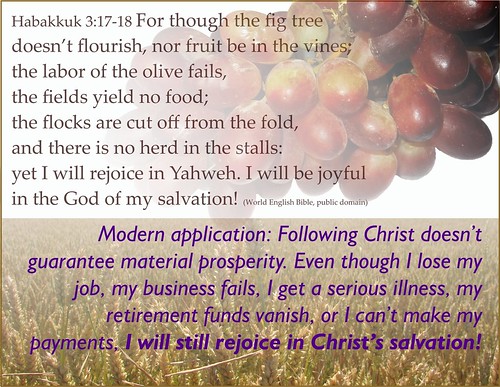
Does serving God guarantee prosperity? Habakkuk didn't think so.
There are other Biblical cases that show that there us no guarantee that things will go "our way."
See Job, who lost all that he had, including his children. True, he got replacements for all of these, including the children, but he wasn't prosperous for a period in his life, and, by God's own testimony, Job was following God at the time. Other passages include Christ's warnings about earthly treasure, His own poverty, Paul's recitation of adversities in his life, and the amazing record of the anonymous heroes of faith who suffered for the sake of God's Kingdom.
Matthew 6:19 “Don’t lay up treasures for yourselves on the earth, where moth and rust consume, and where thieves break through and steal; 20 but lay up for yourselves treasures in heaven, where neither moth nor rust consume, and where thieves don’t break through and steal; 21 for where your treasure is, there your heart will be also. (Jesus speaking.)
Matthew 8:9 A scribe came, and said to him, “Teacher, I will follow you wherever you go.”
20 Jesus said to him, “The foxes have holes, and the birds of the sky have nests, but the Son of Man has nowhere to lay his head.”
Mark 10:24 The disciples were amazed at his words. But Jesus answered again, “Children, how hard it is for those who trust in riches to enter into God’s Kingdom! 25 It is easier for a camel to go through a needle’s eye than for a rich man to enter into God’s Kingdom.”
2 Corinthians 11:23b I am more so: in labors more abundantly, in prisons more abundantly, in stripes above measure, and in deaths often. 24 Five times I received forty stripes minus one from the Jews. 25 Three times I was beaten with rods. Once I was stoned. Three times I suffered shipwreck. I have been a night and a day in the deep. 26 I have been in travels often, perils of rivers, perils of robbers, perils from my countrymen, perils from the Gentiles, perils in the city, perils in the wilderness, perils in the sea, perils among false brothers; 27 in labor and travail, in watchings often, in hunger and thirst, in fastings often, and in cold and nakedness.
Hebrews 11:35b Others were tortured, not accepting their deliverance, that they might obtain a better resurrection. 36 Others were tried by mocking and scourging, yes, moreover by bonds and imprisonment. 37 They were stoned. They were sawn apart. They were tempted. They were slain with the sword. They went around in sheep skins and in goat skins; being destitute, afflicted, ill-treated— 38 of whom the world was not worthy—wandering in deserts, mountains, caves, and the holes of the earth. 39 These all, having had testimony given to them through their faith, didn’t receive the promise, 40 God having provided some better thing concerning us, so that apart from us they should not be made perfect.
All quotations are from the World English Bible, public domain. Thanks for reading.
Monday, February 01, 2016
Job's grandchildren?
Job 1:1 There was a man in the land of Uz, whose name was Job. That man was blameless and upright, and one who feared God, and turned away from evil. 2 There were born to him seven sons and three daughters.
4 His sons went and held a feast in the house of each one on his birthday; and they sent and called for their three sisters to eat and to drink with them.
18 While he was still speaking, there came also another, and said, “Your sons and your daughters were eating and drinking wine in their oldest brother’s house, 19 and behold, there came a great wind from the wilderness, and struck the four corners of the house, and it fell on the young men, and they are dead. I alone have escaped to tell you. (World English Bible, public domain)
The Bible doesn't mention Job as having grandchildren through his first ten children. But it does indicate that each of his seven sons had a house of their own, so, most likely, at least some of them also had wives, and children, and perhaps the daughters had husbands, and children. Thus, Job's suffering may have included not only the loss of his good health and material possessions, and the loss of his children, but the loss of his grandchildren.
At the end of the book, Job had more children, the same number as before, and the Bible tells us that he did have grandchildren, and more:
Job 42:13 He had also seven sons and three daughters. 14 He called the name of the first, Jemimah; and the name of the second, Keziah; and the name of the third, Keren Happuch. 15 In all the land were no women found so beautiful as the daughters of Job. Their father gave them an inheritance among their brothers. 16 After this Job lived one hundred forty years, and saw his sons, and his sons’ sons, to four generations.
I would have hated to lose my children, and/or my grandchildren, as Job did.
Thanks for reading.
4 His sons went and held a feast in the house of each one on his birthday; and they sent and called for their three sisters to eat and to drink with them.
18 While he was still speaking, there came also another, and said, “Your sons and your daughters were eating and drinking wine in their oldest brother’s house, 19 and behold, there came a great wind from the wilderness, and struck the four corners of the house, and it fell on the young men, and they are dead. I alone have escaped to tell you. (World English Bible, public domain)
The Bible doesn't mention Job as having grandchildren through his first ten children. But it does indicate that each of his seven sons had a house of their own, so, most likely, at least some of them also had wives, and children, and perhaps the daughters had husbands, and children. Thus, Job's suffering may have included not only the loss of his good health and material possessions, and the loss of his children, but the loss of his grandchildren.
At the end of the book, Job had more children, the same number as before, and the Bible tells us that he did have grandchildren, and more:
Job 42:13 He had also seven sons and three daughters. 14 He called the name of the first, Jemimah; and the name of the second, Keziah; and the name of the third, Keren Happuch. 15 In all the land were no women found so beautiful as the daughters of Job. Their father gave them an inheritance among their brothers. 16 After this Job lived one hundred forty years, and saw his sons, and his sons’ sons, to four generations.
I would have hated to lose my children, and/or my grandchildren, as Job did.
Thanks for reading.
Sunday, January 31, 2016
Excerpts from Orthodoxy, by G. K. Chesterton, 58
All Christianity concentrates on the man at the crossroads. The vast and
shallow philosophies, the huge syntheses of humbug, all talk about ages and evolution and ultimate developments. The true philosophy is concerned
with the instant. Will a man take this road or that?—that is the only thing to think about, if you enjoy thinking. The eons are easy enough to
think about, any one can think about them. The instant is really awful: and it is because our religion has intensely felt the instant, that it has
in literature dealt much with battle and in theology dealt much with hell. It is full of danger, like a boy’s book: it is at an immortal crisis.
There is a great deal of real similarity between popular fiction and the religion of the western people. If you say that popular fiction is vulgar
and tawdry, you only say what the dreary and well-informed say also about the images in the Catholic churches. Life (according to the faith) is very
like a serial story in a magazine: life ends with the promise (or menace) “to be continued in our next.” Also, with a noble vulgarity, life imitates
the serial and leaves off at the exciting moment. For death is distinctly an exciting moment.
But the point is that a story is exciting because it has in it so strong an element of will, of what theology calls free will. You cannot finish a sum how you like. But you can finish a story how you like. When somebody discovered the Differential Calculus there was only one Differential Calculus he could discover. But when Shakespeare killed Romeo he might have married him to Juliet’s old nurse if he had felt inclined. And Christendom has excelled in the narrative romance exactly because it has insisted on the theological free will. It is a large matter and too much to one side of the road to be discussed adequately here; but this is the real objection to that torrent of modern talk about treating crime as disease, about making a prison merely a hygienic environment like a hospital, of healing sin by slow scientific methods. The fallacy of the whole thing is that evil is a matter of active choice whereas disease is not. If you say that you are going to cure a profligate as you cure an asthmatic, my cheap and obvious answer is, “Produce the people who want to be asthmatics as many people want to be profligates.” A man may lie still and be cured of a malady. But he must not lie still if he wants to be cured of a sin; on the contrary, he must get up and jump about violently. The whole point indeed is perfectly expressed in the very word which we use for a man in hospital; “patient” is in the passive mood; “sinner” is in the active. If a man is to be saved from influenza, he may be a patient. But if he is to be saved from forging, he must be not a patient but an impatient. He must be personally impatient with forgery. All moral reform must start in the active not the passive will.
Orthodoxy, first published in 1908, by G. K. Chesterton, is in the public domain, and available from Project Gutenberg. The previous post in this series is here. Thanks for reading! Read Chesterton.
But the point is that a story is exciting because it has in it so strong an element of will, of what theology calls free will. You cannot finish a sum how you like. But you can finish a story how you like. When somebody discovered the Differential Calculus there was only one Differential Calculus he could discover. But when Shakespeare killed Romeo he might have married him to Juliet’s old nurse if he had felt inclined. And Christendom has excelled in the narrative romance exactly because it has insisted on the theological free will. It is a large matter and too much to one side of the road to be discussed adequately here; but this is the real objection to that torrent of modern talk about treating crime as disease, about making a prison merely a hygienic environment like a hospital, of healing sin by slow scientific methods. The fallacy of the whole thing is that evil is a matter of active choice whereas disease is not. If you say that you are going to cure a profligate as you cure an asthmatic, my cheap and obvious answer is, “Produce the people who want to be asthmatics as many people want to be profligates.” A man may lie still and be cured of a malady. But he must not lie still if he wants to be cured of a sin; on the contrary, he must get up and jump about violently. The whole point indeed is perfectly expressed in the very word which we use for a man in hospital; “patient” is in the passive mood; “sinner” is in the active. If a man is to be saved from influenza, he may be a patient. But if he is to be saved from forging, he must be not a patient but an impatient. He must be personally impatient with forgery. All moral reform must start in the active not the passive will.
Orthodoxy, first published in 1908, by G. K. Chesterton, is in the public domain, and available from Project Gutenberg. The previous post in this series is here. Thanks for reading! Read Chesterton.
Wednesday, January 27, 2016
Sunspots 558

Christianity: An article in Relevant examines Christianity and debt, and asserts that going into debt is not always a sin. (It can be!)
Crosswalk asks us to think about foul language, especially as we may let it in through entertainment outlets.
An essay in First Things, entitled Nikabrik's Candidate, about Christians and politics. (You need to read Prince Caspian, if you haven't.)
Ken Schenck has posted on what the Bible says that relates to abortion.
Finance: (and Health) US News has published rankings of the Best Countries, for such categories as for raising children, retiring, investing.
Politics: "10 Myths about Guns and Gun Control" is an article that points out some myths on both sides of this controversy.
Benjamin L. Corey argues that being for the mass deportation of illegal immigrants is the opposite of being pro-life.
Sports: ESPN and other sources report that, for the first time, an NFL team has hired a female full-time assistant coach.
Image source (public domain)
Monday, January 25, 2016
What the New Testament says about paying taxes
Matthew 22:17 Tell us therefore, what do you think? Is it lawful to pay taxes to Caesar, or not?”
18 But Jesus perceived their wickedness, and said, “Why do you test me, you hypocrites? 19 Show me the tax money.”
They brought to him a denarius.
20 He asked them, “Whose is this image and inscription?”
21 They said to him, “Caesar’s.”
Then he said to them, “Give therefore to Caesar the things that are Caesar’s, and to God the things that are God’s.”
This episode is repeated, almost word for word, in Mark 12:13-17 and Luke 20:21-25
Jesus was not speaking of paying taxes to an elected government, but to a foreign occupying government.
Romans 13:3 For rulers are not a terror to the good work, but to the evil. Do you desire to have no fear of the authority? Do that which is good, and you will have praise from the authority, 4 for he is a servant of God to you for good. But if you do that which is evil, be afraid, for he doesn’t bear the sword in vain; for he is a servant of God, an avenger for wrath to him who does evil. 5 Therefore you need to be in subjection, not only because of the wrath, but also for conscience’ sake. 6 For this reason you also pay taxes, for they are servants of God’s service, continually doing this very thing. 7 Therefore give everyone what you owe: if you owe taxes, pay taxes; if customs, then customs; if respect, then respect; if honor, then honor.
All quotations from the World English Bible, public domain. A more comprehensive post, on what the Bible says about politics, is here. Thanks for reading.
18 But Jesus perceived their wickedness, and said, “Why do you test me, you hypocrites? 19 Show me the tax money.”
They brought to him a denarius.
20 He asked them, “Whose is this image and inscription?”
21 They said to him, “Caesar’s.”
Then he said to them, “Give therefore to Caesar the things that are Caesar’s, and to God the things that are God’s.”
This episode is repeated, almost word for word, in Mark 12:13-17 and Luke 20:21-25
Jesus was not speaking of paying taxes to an elected government, but to a foreign occupying government.
Romans 13:3 For rulers are not a terror to the good work, but to the evil. Do you desire to have no fear of the authority? Do that which is good, and you will have praise from the authority, 4 for he is a servant of God to you for good. But if you do that which is evil, be afraid, for he doesn’t bear the sword in vain; for he is a servant of God, an avenger for wrath to him who does evil. 5 Therefore you need to be in subjection, not only because of the wrath, but also for conscience’ sake. 6 For this reason you also pay taxes, for they are servants of God’s service, continually doing this very thing. 7 Therefore give everyone what you owe: if you owe taxes, pay taxes; if customs, then customs; if respect, then respect; if honor, then honor.
All quotations from the World English Bible, public domain. A more comprehensive post, on what the Bible says about politics, is here. Thanks for reading.
Sunday, January 24, 2016
Excerpts from Orthodoxy by G. K. Chesterton, 57
Again, the same is true of that difficult matter of the danger of the
soul, which has unsettled so many just minds. To hope for all souls is imperative; and it is quite tenable that their salvation is inevitable. It
is tenable, but it is not specially favourable to activity or progress. Our fighting and creative society ought rather to insist on the danger of
everybody, on the fact that every man is hanging by a thread or clinging to a precipice. To say that all will be well anyhow is a comprehensible
remark: but it cannot be called the blast of a trumpet. Europe ought rather to emphasize possible perdition; and Europe always has emphasized
it. Here its highest religion is at one with all its cheapest romances. To the Buddhist or the eastern fatalist existence is a science or a plan,
which must end up in a certain way. But to a Christian existence is a story, which may end up in any way. In a thrilling novel (that purely
Christian product) the hero is not eaten by cannibals; but it is essential to the existence of the thrill that he might be eaten by cannibals. The
hero must (so to speak) be an eatable hero. So in Christian morals, in short, it is wicked to call a man “damned”: but it is strictly religious
and philosophic to call him damnable.
Orthodoxy, first published in 1908, by G. K. Chesterton, is in the public domain, and available from Project Gutenberg. The previous post in this series is here. Thanks for reading! Read Chesterton.
Orthodoxy, first published in 1908, by G. K. Chesterton, is in the public domain, and available from Project Gutenberg. The previous post in this series is here. Thanks for reading! Read Chesterton.
Friday, January 22, 2016
Vengeance - some of what the Bible says about it

The Webster’s Unabridged Dictionary,
1913 public domain edition, defines vengeance in this way: “Punishment
inflicted in return for an injury or an offense; retribution; -- often, in a
bad sense, passionate or unrestrained revenge.”
The Bible says quite a bit about
vengeance. In summary, believers are not to take vengeance into their own
hands, but to leave this to God. The Bible promises that God will punish
unforgiven sin. Christ’s example, and Stephen’s, show us how we should take injury or offense to ourselves. (We might legitimately react differently if a helpless person, rather than we, ourselves, is injured or offended.)
Some Bible passages on vengeance: (From the World English Bible, public domain)
Leviticus 19:18 “‘You shall not take
vengeance, nor bear any grudge against the children of your people; but you
shall love your neighbor as yourself. I am Yahweh.
Isaiah 53:7a He was oppressed, yet
when he was afflicted he didn’t open his mouth. . . . 11b My righteous servant
will justify many by the knowledge of himself; and he will bear their
iniquities. 12 Therefore I will give him a portion with the great, and he will
divide the plunder with the strong; because he poured out his soul to death, and
was counted with the transgressors; yet he bore the sins of many, and made
intercession for the transgressors.
There are many Biblical prophecies of
God’s coming vengeance for evil. Amos begins by listing several nations, their
transgressions, and promising vengeance., Jonah, Nahum is almost entirely a
prophecy of the punishment of Nineveh. Obadiah promises God’s vengeance up
Edom. there are many more prophecies, such as Ezekiel 25:15-17, where God says
He will take vengeance on the Philistines. In Revelation 20:7-18, the final
judgment of God is described.
Matthew 5:38 “You have heard that it
was said, ‘An eye for an eye, and a tooth for a tooth.’ 39 But I tell you, don’t resist him who is evil; but whoever
strikes you on your right cheek, turn to him the other also. (Quoting Exodus
21:24; Leviticus 24:20; Deuteronomy 19:21)
Matthew 7:12 Therefore whatever you
desire for men to do to you, you shall also do to them; for this is the law and
the prophets. (The Golden Rule.)
Luke 6:35 But love your enemies, and
do good, and lend, expecting nothing back; and your reward will be great, and
you will be children of the Most High; for he is kind toward the unthankful and
evil. 36 “Therefore be merciful, even as your Father is also merciful.
Jesus
on the cross, about those who crucified Him: Luke 23:34 Jesus said, “Father,
forgive them, for they don’t know what they are doing.”
Acts 7:59 They stoned Stephen as he
called out, saying, “Lord Jesus, receive my spirit!” 60a He kneeled down, and
cried with a loud voice, “Lord, don’t hold this sin against them!”
Romans 12:19 Don’t seek revenge yourselves,
beloved, but give place to God’s wrath. For it is written, “Vengeance belongs
to me; I will repay, says the Lord.” 20 Therefore “If your enemy is hungry,
feed him. If he is thirsty, give him a drink; for in doing so, you will heap
coals of fire on his head.” (Quoting Deuteronomy 32:35 and Proverbs 25:21-2.
Hebrews 10:30 also quotes Deuteronomy 32:35.)
Romans 13:3a For rulers are not a
terror to the good work, but to the . 4 for he is a servant of God to you for
good. 4b But if you do that which is evil, be afraid, for he doesn’t bear the
sword in vain; for he is a servant of God, an avenger for wrath to him who does
evil.
1 Thessalonians 5:15 See that no one
returns evil for evil to anyone, but always follow after that which is good for
one another and for all.
Two stories of God taking vengeance: Jezebel:
See 1 Kings 21, which tells part of the evil that Jezebel did. Her husband,
Ahab, repented, somewhat, anyway. Jezebel never did. 2 Kings 9 tells the story
of the death of Jezebel, which was prophesied at God’s direction, and was really
arranged by God – the dogs ate her in the parking lot in front of the palace,
but Jehu didn’t plan that.
And one from the New Testament: King
Herod (one of them) was struck down by an angel of God, as told in Acts
12:2-23.
Thanks for reading!
Thanks for reading!
Subscribe to:
Posts (Atom)