Owen Gingerich has written The Book Nobody Read: Chasing the Revolutions of Nicolas Copernicus. New York: Walker & Company, 2004. The title comes from Arthur Koestler's book, The Sleepwalkers, which was a popular book about early astronomy. According to Gingerich, Koestler claimed that nobody, or at least no important astronomers, read Copernicus' work, De revolutionibus (On the Revolutions of the Heavenly Spheres, 1543). Gingerich found most, or all, of the existing copies, and shows, from evidence such as annotations in the books by important astronomers, such as Kepler, that Koestler's claim was false. Gingerich is a professor of astronomy and the history of astronomy.
He writes: Today we admire Copernicus for having the audacity to introduce the heliocentric cosmology into Western culture, essentially triggering the Scientific Revolution. The Copernican cosmology did not just provide the modern blueprint for the solar system. It was a compelling unification of the disparate elements of the heavenly spheres. The greatest of scientists have been unifiers, men who found connections that had never before been perceived. Isaac Newton destroyed the dichotomy between celestial and terrestrial motions, forging a common set of laws that applied to the Earth and sky alike. James Clerk Maxwell connected electricity and magnetism, and showed that light was electromagnetic radiation. Charles Darwin envisioned how all living organisms were related through common descent. Albert Einstein tore asunder the separation between matter and energy, linking them through his famous E = mc2 equation.
Copernicus, too, was nothing if not a unifier. In the Ptolemaic astronomy each planet was a separate entity. True, they could be stacked one after another, producing a system of sorts, but their motions were each independent. The result, Copernicus wrote, was like a monster composed of spare parts, a head from here, the feet from there, the arms from yet another creature. Each planet in Ptolemy's system had a main circle and a subsidiary circle, the so-called epicycle. Mars with its epicycle was a prototype for each of the other planets, but because the frequency and size of the retrograde was different for each planet, an epicycle with an individual size and period was required for each planet. Copernicus discovered that he could eliminate one circle from each set by combining them all into a unified system. Owen Gingerich, The Book Nobody Read: Chasing the Revolutions of Nicolas Copernicus. New York: Walker & Company, 2004. pp. 53-4.
He presents evidence that ". . . neither Copernicus nor his predecessors were interested in adding extra circles just to make the predictions work a little better. Nevertheless, the legend of epicycles on epicycles has become so pervasive that barely a year passes without some author in the Physical Review or the Astronomical Journal remarking, apologetically, 'Maybe my theory has too many epicycles.'" Clearly, I haven't stamped out the myth. pp. 59-60.
And writes about Kepler:
In the Ptolemaic system, the Sun moved around its circle at a constant speed -- it just looked as if it moved at different speeds because it wasn't at the center of the Earth's circle.
And this, Kepler believed, had to be wrong. If Mercury, the planet closest to the Sun, moved fastest, and Saturn, the most distant planet, moved slowest, then this was because Mercury, being closer, soaked up more of the Sun's motive power and thus naturally moved faster. But in winter the Earth wasn't closer to the Sun than in summer, and Kepler reasoned that it should actually be going faster in its orbit in winter. That was physics, and Kepler, as the world's first astro-physicist, worked out the consequences. p. 168.
Thanks for reading.
Musings on science, the Bible, and fantastic literature (and sometimes basketball and other stuff).
God speaks to us through the Bible and the findings of science, and we should listen to both types of revelation.
The title is from Psalm 84:11.
The Wikipedia is usually a pretty good reference. I mostly use the World English Bible (WEB), because it is public domain. I am grateful.
License
I have written an e-book, Does the Bible Really Say That?, which is free to anyone. To download that book, in several formats, go here.

The posts in this blog are licensed under a Creative Commons Attribution-NonCommercial-ShareAlike 3.0 Unported License. You can copy and use this material, as long as you aren't making money from it. If you give me credit, thanks. If not, OK.
The posts in this blog are licensed under a Creative Commons Attribution-NonCommercial-ShareAlike 3.0 Unported License. You can copy and use this material, as long as you aren't making money from it. If you give me credit, thanks. If not, OK.
Monday, March 26, 2007


Sunday, March 25, 2007
John Bunyan on why we should seek to get to Heaven
{124} PRUD. And what is it that makes you so desirous to go to Mount Zion?
CHR. Why, there I hope to see him alive that did hang dead on the cross; and there I hope to be rid of all those things that to this day are in me an annoyance to me; there, they say, there is no death; and there I shall dwell with such company as I like best. [Isa. 25:8; Rev. 21:4] For, to tell you truth, I love him, because I was by him eased of my burden; and I am weary of my inward sickness. I would fain be where I shall die no more, and with the company that shall continually cry, "Holy, Holy, Holy!"
PRUDENCE is one of the spiritual guides at the house of the Interpreter (see my post of March 11). The scripture references are part of the original.This is an extract from Pilgrim's Progress by John Bunyan (1678, public domain. One version gives paragraph numbers.) Bunyan included the scriptural references in the book. Pilgrim's Progress, though little read now, was important enough to have been considered, for a century or two, the most important writing in English, except for the Bible.
Thanks for reading.
Friday, March 23, 2007
The Language of God, Chapter 2, by Francis Collins
A previous post gives the contents of Chapter 1, and the bibliographic and author information for The Language of God: A Scientist Presents Evidence for Belief.
Chapter Two considers four common arguments against faith in God (and against the validity of religion in general) with rebuttals.
The first argument is that religion is just wish fulfillment. Collins, following C. S. Lewis on this topic, says that, if religion were really wish fulfillment, the god we imagine would be much more indulgent than the God of the Bible. He also says that just because we may wish for a god, that does not prove that there isn't one.
The second argument is that there is a lot of harm done in the name of religion. Collins does not deny that, but points out that there is also a lot of good done in the name of religion, for example the story told in the film "Amazing Grace." He also points out that great evil was done by a supposedly atheist society, the Soviet Union. Finally, he says that it is not reasonable to judge the truth of religion solely by its human adherents. He asks "would you judge Mozart's The Magic Flute on the basis of a poorly rehearsed performance by fifth-graders?" (p. 42)
The third argument is the evil that exists. How could God allow it? Collins has a personal story of great evil done to an innocent person. I'll let readers of the book discover that story for themselves. He follows Lewis (and many others) in pointing out that much evil is the result of God's allowing humans free moral choice, and our choices being bad. He also says: . . . if the most important relationship we are to develop on this earth is a relationship with God, and if our existence as spiritual creatures is not limited to what we can know and observe during our earthly lifetime, then human sufferings take on a wholly new context. We may never fully understand the reasons for these painful experiences, but we can begin to accept the idea that there may be such reasons. (p. 46)
The fourth argument is about miracles. How can a rational person, a scientist, believe in them? Let's put it this way. Collins is a scientist's scientist, and he believes in them. He does say that we use "miracle" much too often, and that we should not assume that everything we can't explain is due to divine intervention, but he sees no reason that a scientist cannot believe in miracles. Nothing in science can disprove them, as they are outside the purview of science.
Collins won't convince a reader who refuses to be convinced, but he makes a good case.
Thanks for reading.
Chapter Two considers four common arguments against faith in God (and against the validity of religion in general) with rebuttals.
The first argument is that religion is just wish fulfillment. Collins, following C. S. Lewis on this topic, says that, if religion were really wish fulfillment, the god we imagine would be much more indulgent than the God of the Bible. He also says that just because we may wish for a god, that does not prove that there isn't one.
The second argument is that there is a lot of harm done in the name of religion. Collins does not deny that, but points out that there is also a lot of good done in the name of religion, for example the story told in the film "Amazing Grace." He also points out that great evil was done by a supposedly atheist society, the Soviet Union. Finally, he says that it is not reasonable to judge the truth of religion solely by its human adherents. He asks "would you judge Mozart's The Magic Flute on the basis of a poorly rehearsed performance by fifth-graders?" (p. 42)
The third argument is the evil that exists. How could God allow it? Collins has a personal story of great evil done to an innocent person. I'll let readers of the book discover that story for themselves. He follows Lewis (and many others) in pointing out that much evil is the result of God's allowing humans free moral choice, and our choices being bad. He also says: . . . if the most important relationship we are to develop on this earth is a relationship with God, and if our existence as spiritual creatures is not limited to what we can know and observe during our earthly lifetime, then human sufferings take on a wholly new context. We may never fully understand the reasons for these painful experiences, but we can begin to accept the idea that there may be such reasons. (p. 46)
The fourth argument is about miracles. How can a rational person, a scientist, believe in them? Let's put it this way. Collins is a scientist's scientist, and he believes in them. He does say that we use "miracle" much too often, and that we should not assume that everything we can't explain is due to divine intervention, but he sees no reason that a scientist cannot believe in miracles. Nothing in science can disprove them, as they are outside the purview of science.
Collins won't convince a reader who refuses to be convinced, but he makes a good case.
Thanks for reading.
Thursday, March 22, 2007
Is your church ready to have a child molester attend?
A church in San Diego County, California, has gotten a lot of media attention (if this link doesn't work any more, and you want to know more about this particular situation, try a search for "Mark Pliska," the man in question, or for "Pilgrim United Church of Christ, Carlsbad, California," or for "Madison Shockley," the pastor) recently, because a convicted (and released) sex offender has attended Pilgrim Church of Christ, and apparently wished to do so with the congregation being aware of his past.
I heard an interview with the pastor, and another pastor who has worked with several congregations on such matters. You can listen to that interview, and read some explanatory material here. Currently, the church is working on policies to cover the situation.
There are two major questions for churches:
1) How willing is the church to accept repentant criminals and other "outsiders?" It might be well for a church congregation, board, pastoral staff, or all of these, to consider this. What would happen if someone with AIDS, or, in churches with ethnic or language homogeneity, if someone from another ethnic group wanted to attend? What would Jesus do? What should we do? If we/I are reluctant to accept such people, why, and what should we do about it? This would probably be a healthy discussion best held before such an event occurred.
2) Does the church have policies or understandings in place to protect children? Most child molestation is done by family members, but too much of it happens from teachers, pastors, children and youth workers, and the like. Are there rules such that adults are never alone with children? This protects children, and also would protect the adult from false accusations.
I don't like to even think about such things, but I think I should.
Thanks for reading.
(Some editorial changes were made on March 26, 2007)
* * * * * *
On May 6, 2007, this church adopted a policy on safety, which would allow a sex offender who met certain requirements to attend, and should also go far to protect children against offenses committed by church workers and others, while they are attending a church function.
I heard an interview with the pastor, and another pastor who has worked with several congregations on such matters. You can listen to that interview, and read some explanatory material here. Currently, the church is working on policies to cover the situation.
There are two major questions for churches:
1) How willing is the church to accept repentant criminals and other "outsiders?" It might be well for a church congregation, board, pastoral staff, or all of these, to consider this. What would happen if someone with AIDS, or, in churches with ethnic or language homogeneity, if someone from another ethnic group wanted to attend? What would Jesus do? What should we do? If we/I are reluctant to accept such people, why, and what should we do about it? This would probably be a healthy discussion best held before such an event occurred.
2) Does the church have policies or understandings in place to protect children? Most child molestation is done by family members, but too much of it happens from teachers, pastors, children and youth workers, and the like. Are there rules such that adults are never alone with children? This protects children, and also would protect the adult from false accusations.
I don't like to even think about such things, but I think I should.
Thanks for reading.
(Some editorial changes were made on March 26, 2007)
* * * * * *
On May 6, 2007, this church adopted a policy on safety, which would allow a sex offender who met certain requirements to attend, and should also go far to protect children against offenses committed by church workers and others, while they are attending a church function.
Wednesday, March 21, 2007
Sunspots 100

Things I have recently spotted that may be of interest to someone else:
Science: (also Literature, and Christianity) my own post on Green, from March 17, 2005, part of a series on the colors of the rainbow. (St. Patrick's Day occurred since the last Sunspots.)
The Conservapedia's article on Baramin (the equivalent, the article says, of "kind," which is used in the King James Version of the Bible.)
Politics: (sort of) American Women Through Time
Christianity Today says that the National Association of Evangelicals has endorsed a statement condemning torture.
Article claiming that, even if there were no moral reason not to torture, torture is counterproductive, anyway -- first, because information obtained that way is suspect, and second, because it encourages torture of our own troops.
Music: Today is the birthday of Johann Sebastian Bach, arguably the greatest composer of all time. According to The Writer's Almanac, he said (in German, no doubt): "There's nothing remarkable about [making music]. All one has to do is hit the right keys at the right time and the instrument plays itself." (Thanks to one of our daughters for the links.)
Computing: Zotero is a Firefox extension (free, of course) for capturing bibliographic information.
This week's Christian Carnival is here. (For information on locating these Carnivals, see here.)
When I don't tell where I found an item above, I either found it directly, or was probably pointed to it by the Librarian's Internet Index, SciTech Daily, or Arts and Letters Daily. All of these sources are great.
Thanks for reading! Keep clicking away.
Image source (public domain)
Monday, March 19, 2007
John C. Polkinghorne on physics and free will
I reject a compatibilist account of human agency since I do not believe that the mere impression of choice can be the foundation of moral being. John Polkinghorne, "Physical Process, Quantum Events, and Divine Agency," pp. 181-190, in Quantum Mechanics: Scientific Perspectives on Divine Action, Volume 5, edited by Robert John Russell, Philip Clayton, Kirk Wegter-McNelly, and John Polkinghorne. Vatican City State: Vatican Observatory Foundation, 2001. Quote is from p. 188.
Those who have appealed to (an assumed indeterministic) quantum theory . . . have to recognize how ill-defined and problematic is the concept of "indeterminate quantum events." The only events that we might feel reasonably free to invoke with some degree of confidence (assuming we have espoused the appropriate interpretative proposal) are measurement events. Their strictly episodic nature does not obviously fit them to describe agency which must surely be assumed to have a more free-flowing character. John Polkinghorne, "Physical Process, Quantum Events, and Divine Agency," pp. 181-190, in Quantum Mechanics: Scientific Perspectives on Divine Action, Volume 5, edited by Robert John Russell, Philip Clayton, Kirk Wegter-McNelly, and John Polkinghorne. Vatican City State: Vatican Observatory Foundation, 2001. Quote is from p. 188-9.
Those who have appealed to chaos theory, ontologically reinterpreted as reflecting openness and not mere ignorance, and potentially affording a desirably continuous account of active process . . . do so partly because the exploration of a strange attractor seems to have a much wider and more flowing character than is afforded by a discrete series of measurement events. John Polkinghorne, "Physical Process, Quantum Events, and Divine Agency," pp. 181-190, in Quantum Mechanics: Scientific Perspectives on Divine Action, Volume 5, edited by Robert John Russell, Philip Clayton, Kirk Wegter-McNelly, and John Polkinghorne. Vatican City State: Vatican Observatory Foundation, 2001. Quote is from p. 189
Those who appeal to quantum theory are supposing that its widely held (but poorly understood) indeterminism is the appropriate place at which to begin. Those of us who appeal to chaos theory are supposing that its direct connection with macroscopic phenomena, where human and divine agency are both expected to manifest themselves, makes it the more promising zero-order approximation. Both groups surely know that there is much more work to be done.
This might seem to be a disappointingly modest conclusion to the discussion, but problems of the exercise of agency are of immense difficulty and are unlikely to yield, after centuries of effort, to a contemporary quick fix. We can nevertheless be affirmed in the value of continuing the enterprise by our belief in our direct experience of human agency, and by our religious intuition of divine providence, both of which assure us that these fundamental experiences must be capable of being accommodated within an adequate worldview. John Polkinghorne, "Physical Process, Quantum Events, and Divine Agency," pp. 181-190, in Quantum Mechanics: Scientific Perspectives on Divine Action, Volume 5, edited by Robert John Russell, Philip Clayton, Kirk Wegter-McNelly, and John Polkinghorne. Vatican City State: Vatican Observatory Foundation, 2001. Quote is from p. 190.
Those who have appealed to (an assumed indeterministic) quantum theory . . . have to recognize how ill-defined and problematic is the concept of "indeterminate quantum events." The only events that we might feel reasonably free to invoke with some degree of confidence (assuming we have espoused the appropriate interpretative proposal) are measurement events. Their strictly episodic nature does not obviously fit them to describe agency which must surely be assumed to have a more free-flowing character. John Polkinghorne, "Physical Process, Quantum Events, and Divine Agency," pp. 181-190, in Quantum Mechanics: Scientific Perspectives on Divine Action, Volume 5, edited by Robert John Russell, Philip Clayton, Kirk Wegter-McNelly, and John Polkinghorne. Vatican City State: Vatican Observatory Foundation, 2001. Quote is from p. 188-9.
Those who have appealed to chaos theory, ontologically reinterpreted as reflecting openness and not mere ignorance, and potentially affording a desirably continuous account of active process . . . do so partly because the exploration of a strange attractor seems to have a much wider and more flowing character than is afforded by a discrete series of measurement events. John Polkinghorne, "Physical Process, Quantum Events, and Divine Agency," pp. 181-190, in Quantum Mechanics: Scientific Perspectives on Divine Action, Volume 5, edited by Robert John Russell, Philip Clayton, Kirk Wegter-McNelly, and John Polkinghorne. Vatican City State: Vatican Observatory Foundation, 2001. Quote is from p. 189
Those who appeal to quantum theory are supposing that its widely held (but poorly understood) indeterminism is the appropriate place at which to begin. Those of us who appeal to chaos theory are supposing that its direct connection with macroscopic phenomena, where human and divine agency are both expected to manifest themselves, makes it the more promising zero-order approximation. Both groups surely know that there is much more work to be done.
This might seem to be a disappointingly modest conclusion to the discussion, but problems of the exercise of agency are of immense difficulty and are unlikely to yield, after centuries of effort, to a contemporary quick fix. We can nevertheless be affirmed in the value of continuing the enterprise by our belief in our direct experience of human agency, and by our religious intuition of divine providence, both of which assure us that these fundamental experiences must be capable of being accommodated within an adequate worldview. John Polkinghorne, "Physical Process, Quantum Events, and Divine Agency," pp. 181-190, in Quantum Mechanics: Scientific Perspectives on Divine Action, Volume 5, edited by Robert John Russell, Philip Clayton, Kirk Wegter-McNelly, and John Polkinghorne. Vatican City State: Vatican Observatory Foundation, 2001. Quote is from p. 190.
Sunday, March 18, 2007
{84} Now, said Christian, let me go hence. Nay, stay, said the Interpreter, till I have shewed thee a little more, and after that thou shalt go on thy way. So he took him by the hand again, and led him into a very dark room, where there sat a man in an iron cage.
Now the man, to look on, seemed very sad; he sat with his eyes looking down to the ground, his hands folded together, and he sighed as if he would break his heart. Then said Christian, What means this? At which the Interpreter bid him talk with the man.
Then said Christian to the man, What art thou? The man answered, I am what I was not once.
{85} CHR. What wast thou once?
MAN. The man said, I was once a fair and flourishing professor, both in mine own eyes, and also in the eyes of others; I once was, as I thought, fair for the Celestial City, and had then even joy at the thoughts that I should get thither. [Luke 8:13]
CHR. Well, but what art thou now?
MAN. I am now a man of despair, and am shut up in it, as in this iron cage. I cannot get out. Oh, now I cannot!
CHR. But how camest thou in this condition?
MAN. I left off to watch and be sober. I laid the reins, upon the neck of my lusts; I sinned against the light of the Word and the goodness of God; I have grieved the Spirit, and he is gone; I tempted the devil, and he is come to me; I have provoked God to anger, and he has left me: I have so hardened my heart, that I cannot repent.
{86} Then said Christian to the Interpreter, But is there no hope for such a man as this? Ask him, said the Interpreter. Nay, said Christian, pray, Sir, do you.
INTER. Then said the Interpreter, Is there no hope, but you must be kept in the iron cage of despair?
MAN. No, none at all.
INTER. Why, the Son of the Blessed is very pitiful.
MAN. I have crucified him to myself afresh [Heb. 6:6]; I have despised his person [Luke 19:14]; I have despised his righteousness; I have "counted his blood an unholy thing"; I have "done despite to the Spirit of grace". [Heb. 10:28-29] Therefore I have shut myself out of all the promises, and there now remains to me nothing but threatenings, dreadful threatenings, fearful threatenings, of certain judgement and fiery indignation, which shall devour me as an adversary.
{87} INTER. For what did you bring yourself into this condition?
MAN. For the lusts, pleasures, and profits of this world; in the enjoyment of which I did then promise myself much delight; but now every one of those things also bite me, and gnaw me like a burning worm.
INTER. But canst thou not now repent and turn?
{88} MAN. God hath denied me repentance. His Word gives me no encouragement to believe; yea, himself hath shut me up in this iron cage; nor can all the men in the world let me out. O eternity, eternity! how shall I grapple with the misery that I must meet with in eternity!
INTER. Then said the Interpreter to Christian, Let this man's misery be remembered by thee, and be an everlasting caution to thee.
CHR. Well, said Christian, this is fearful! God help me to watch and be sober, and to pray that I may shun the cause of this man's misery! Sir, is it not time for me to go on my way now?
This is an extract from Pilgrim's Progress by John Bunyan (1678, public domain. One version gives paragraph numbers.) Bunyan included the scriptural references in the book. Pilgrim's Progress, though little read now, was important enough to have been considered, for a century or two, the most important writing in English, except for the Bible.
Saturday, March 17, 2007
What I believe about origins
Some time ago, someone asked me what I believed about origins. What the individual wanted was to see which of several categories of belief I fell into. I didn't exactly answer him on that, and I'm sure I told him more than he wanted to hear, but here's part of my answer.
Then, yesterday, a commenter was surprised that I didn't think purposeless chance was the main creative agent.
So I'm posting this on St. Patrick's Day, even though it's not particularly green.
What do I believe?
1) I believe that God was involved in the planning and execution of the origin of matter, the universe, and life.
2) I believe that the Son had the most important role in this (John 1, and other scriptures, teach this), but the Father and the Holy Spirit must have also been involved.
3) I believe that the Son not only created, but that He somehow is maintaining things. (Colossians 1:14-17)
4) I believe that things changed, due to a deliberate sin by human beings, such that God's original plan is not now completely expressed. How much the Fall has changed things, I'm not sure. Probably a lot. Christ came to redeem us, and the rest of creation, from the effects of that sin.
5) I believe that God's design allowed for emergent properties, that is, for example, Carbon was created so that life, as we know it, could be based on it, when life appeared.
6) I believe that God's design for life was comprehensive enough that He allowed what appear to us to be chance processes to work in carrying it out. However, He may also be actually selecting and directing which sperms succeed, which spores germinate, etc.
7) I believe that God somehow created humans specially. We are especially in His image, we have dominion over other living things, and Christ appeared on earth in human form.
* * * * *
Added July 23, 2007: See here for more on the topic of item 7.
8) I'm not sure exactly what the "image of God" means. I believe that all of God's creation, such as a stone, has some of the image of the creator in it. We have more of it than stones, of course. Presumably the image includes things like the capacity to love, to reason, to communicate, and to create (on a much smaller scale). Perhaps the soul (whatever that is) is God's image in us.
9) I don't know if there are living things on other planets or not. The Bible is silent on the subject, and proving that there are such living things wouldn't bother me. (It is impossible to scientifically prove that there aren't living things on some other planet.) The same holds true for alternate universes. God is big enough to be the God of all the universes, however many there are. We only know of one for sure, though, and of one place in it where there is life.
10) I believe that God used the Big Bang to begin the universe as we know it, and that the Bible does not rule this out. Furthermore, I believe that science has no good explanation for what caused the Big Bang, or came before it, while Christianity and Judaism do have such an explanation -- God planned and created the Big Bang.
11) I believe that I don't have all the answers on this subject, and don't think anyone else does, either.
12) I believe that the most commonly held theories, or at least the ones that are heard about most, namely young-earth creationism (YEC) and intelligent design (ID), are not the same. There are serious differences between them.
13) I believe that God has revealed Himself to us in several ways, including through the Bible, the church, and the work of the Holy Spirit, and that of our own consciouses, in our lives, and also through nature. (Psalm 19, Acts 14:17, Romans 1:20) I believe that we, fallen beings that we are, can and do make mistakes in our interpretation of all of these revelations, but that, nonetheless, they are all legitimate.
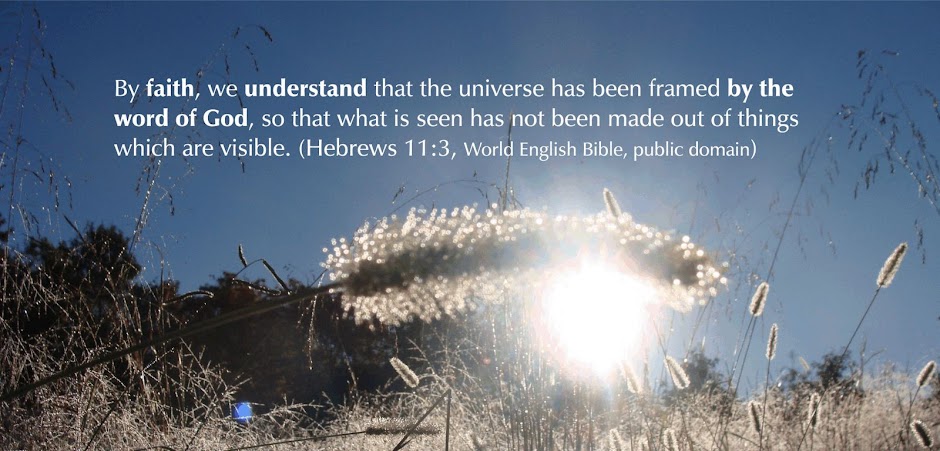
14) I believe that God did deliberately design the natural world. (He included the capacity for chance processes, such as natural selection, as part of the design, so that they influence the way living things appear.) However, I don't believe that it is possible to prove (or disprove) God's creative activity in the past (or in the present, for that matter) scientifically. Hebrews 11:3 seems to indicate this.
15) I believe that demanding that the public schools teach that science has proved that YEC, or ID, are true, is a serious mistake, not least because there is no such proof.
16) I believe that science has not, and can not, rule out God's creative activity, in at least the following: the origin of the universe, the origin of living things, the origin of human beings. Scientists (and others) may sincerely doubt that God did any or all of these things, but they have no right to claim that science has ruled them out. It hasn't. No public school or university class, or textbook, should make such claims, and, if such claims are made, they should be strongly fought.
17) I believe that some people, perhaps well-meaning, perhaps not, have screamed loud and long about some view of origins, (usually YEC, but, lately, also ID) and gotten many Christians, or the world at large, to believe that all Christians believe as they do. This is most unfortunate. I believe that some intelligent people have been lost to the kingdom because of militant YEC views.
18) I believe that Christians can legitimately hold any of several views on origins, including YEC or ID, but also others, and should respect the right of other Christians to hold differing views, and welcome them into fellowship. There are a number of views, all held by Christians, and all of them have strengths, and all of them have weaknesses. The only view that all Christians must reject is the naturalistic view, namely that we are here solely because of purposeless chance. If the Bible means anything, this view is false.
19) I believe that many students who are home-schooled, or who attend private Christian schools, are being seriously short-changed, because they are taught that YEC, or ID, is what the Bible teaches, or even what science has proved. They should also be presented with a fair view of other interpretations. Not only are they being short-changed, but future generations of Christian leaders are being misled, and, in turn, misleading others.
Addendum, July 19, 2007: As this post indicates, the Bible tells us that God created because of His love.
Addendum, January 27, 2012: I added some labels/tags, and one bible verse.
Addendum, December 20, 2012: Here's a link to a post from BioLogos on the impossibility of disproving the existence of God. (We can't prove it scientifically, either.)
Addendum, January 29, 2013: I added point 10, above, and modified point 15.
Addendum, April 8, 2015: I made three minor editorial changes.
Addendum, May 26, 2016: I have discovered a consensus statement on origins, produced by some prominent Christian scientists with different views on the matter, but which they all agree on. I agree with them. (The consensus statement is followed by a listing of points that they don't agree on.)
Thanks for reading.
Then, yesterday, a commenter was surprised that I didn't think purposeless chance was the main creative agent.
So I'm posting this on St. Patrick's Day, even though it's not particularly green.
What do I believe?
1) I believe that God was involved in the planning and execution of the origin of matter, the universe, and life.
2) I believe that the Son had the most important role in this (John 1, and other scriptures, teach this), but the Father and the Holy Spirit must have also been involved.
3) I believe that the Son not only created, but that He somehow is maintaining things. (Colossians 1:14-17)
4) I believe that things changed, due to a deliberate sin by human beings, such that God's original plan is not now completely expressed. How much the Fall has changed things, I'm not sure. Probably a lot. Christ came to redeem us, and the rest of creation, from the effects of that sin.
5) I believe that God's design allowed for emergent properties, that is, for example, Carbon was created so that life, as we know it, could be based on it, when life appeared.
6) I believe that God's design for life was comprehensive enough that He allowed what appear to us to be chance processes to work in carrying it out. However, He may also be actually selecting and directing which sperms succeed, which spores germinate, etc.
7) I believe that God somehow created humans specially. We are especially in His image, we have dominion over other living things, and Christ appeared on earth in human form.
* * * * *
Added July 23, 2007: See here for more on the topic of item 7.
8) I'm not sure exactly what the "image of God" means. I believe that all of God's creation, such as a stone, has some of the image of the creator in it. We have more of it than stones, of course. Presumably the image includes things like the capacity to love, to reason, to communicate, and to create (on a much smaller scale). Perhaps the soul (whatever that is) is God's image in us.
9) I don't know if there are living things on other planets or not. The Bible is silent on the subject, and proving that there are such living things wouldn't bother me. (It is impossible to scientifically prove that there aren't living things on some other planet.) The same holds true for alternate universes. God is big enough to be the God of all the universes, however many there are. We only know of one for sure, though, and of one place in it where there is life.
10) I believe that God used the Big Bang to begin the universe as we know it, and that the Bible does not rule this out. Furthermore, I believe that science has no good explanation for what caused the Big Bang, or came before it, while Christianity and Judaism do have such an explanation -- God planned and created the Big Bang.
11) I believe that I don't have all the answers on this subject, and don't think anyone else does, either.
12) I believe that the most commonly held theories, or at least the ones that are heard about most, namely young-earth creationism (YEC) and intelligent design (ID), are not the same. There are serious differences between them.
13) I believe that God has revealed Himself to us in several ways, including through the Bible, the church, and the work of the Holy Spirit, and that of our own consciouses, in our lives, and also through nature. (Psalm 19, Acts 14:17, Romans 1:20) I believe that we, fallen beings that we are, can and do make mistakes in our interpretation of all of these revelations, but that, nonetheless, they are all legitimate.
14) I believe that God did deliberately design the natural world. (He included the capacity for chance processes, such as natural selection, as part of the design, so that they influence the way living things appear.) However, I don't believe that it is possible to prove (or disprove) God's creative activity in the past (or in the present, for that matter) scientifically. Hebrews 11:3 seems to indicate this.
15) I believe that demanding that the public schools teach that science has proved that YEC, or ID, are true, is a serious mistake, not least because there is no such proof.
16) I believe that science has not, and can not, rule out God's creative activity, in at least the following: the origin of the universe, the origin of living things, the origin of human beings. Scientists (and others) may sincerely doubt that God did any or all of these things, but they have no right to claim that science has ruled them out. It hasn't. No public school or university class, or textbook, should make such claims, and, if such claims are made, they should be strongly fought.
17) I believe that some people, perhaps well-meaning, perhaps not, have screamed loud and long about some view of origins, (usually YEC, but, lately, also ID) and gotten many Christians, or the world at large, to believe that all Christians believe as they do. This is most unfortunate. I believe that some intelligent people have been lost to the kingdom because of militant YEC views.
18) I believe that Christians can legitimately hold any of several views on origins, including YEC or ID, but also others, and should respect the right of other Christians to hold differing views, and welcome them into fellowship. There are a number of views, all held by Christians, and all of them have strengths, and all of them have weaknesses. The only view that all Christians must reject is the naturalistic view, namely that we are here solely because of purposeless chance. If the Bible means anything, this view is false.
19) I believe that many students who are home-schooled, or who attend private Christian schools, are being seriously short-changed, because they are taught that YEC, or ID, is what the Bible teaches, or even what science has proved. They should also be presented with a fair view of other interpretations. Not only are they being short-changed, but future generations of Christian leaders are being misled, and, in turn, misleading others.
Addendum, July 19, 2007: As this post indicates, the Bible tells us that God created because of His love.
Addendum, January 27, 2012: I added some labels/tags, and one bible verse.
Addendum, December 20, 2012: Here's a link to a post from BioLogos on the impossibility of disproving the existence of God. (We can't prove it scientifically, either.)
Addendum, January 29, 2013: I added point 10, above, and modified point 15.
Addendum, April 8, 2015: I made three minor editorial changes.
Addendum, May 26, 2016: I have discovered a consensus statement on origins, produced by some prominent Christian scientists with different views on the matter, but which they all agree on. I agree with them. (The consensus statement is followed by a listing of points that they don't agree on.)
Thanks for reading.
Friday, March 16, 2007
Remarkable statement from The Panda's Thumb
"The Panda's Thumb" is a vociferously anti-Intelligent Design blog, and, it usually seems, anti-theistic. However, sometimes, at least some of the authors (there are several) back off a little bit. Here's part of a post from two days ago:
Random heritable variation and natural selection may very well be responsible for all of biological complexity, but I doubt any scientist - even an atheist - would attest to that particular phrasing. (You don’t know what you don’t know and it is entirely possible that something else
amenable to scientific investigation is responsible.) Further, there exist people who fully support evolution and yet also think that some non-natural agent is involved somehow, whether through a mechanism scrutable to science or not. Arguing in favor of the idea that all biological complexity arose only due to random heritable variation and natural selection would needlessly alienate those theists who also support evolution and would make statements that would be potentially rebutted by whatever is discovered to create complexity that isn’t evolution. (The data don’t demand it, it would be needlessly divisive: who else but a creationist would suggest that such language be used?) "Hey Dr. Egnor: At Least Galen Dissected Animals, Not Straw Men" March 14, 2007. A "bhumburg" is given as the author.
The post is in response to a statement by a Dr. Egnor (the reference is given in the original post, if you are interested) who, probably, did set up a straw man in a pro-ID argument (I didn't read his post). There are a couple of remarks that I'd like to make about the quotation above.
First, Amen and Hallelujah! Such a statement doesn't mock or negate the possibility of God's creative activity, and it was a pleasure to read it.
Second, regardless of this statement, I would expect most readers who read "The Panda's Thumb" on a regular basis to come away with the impression that the authors do, indeed, believe that "Random heritable variation and natural selection" are the only agents involved in the existence of "all biological complexity," and even in the existence of life itself. I wonder what other authors of "The Panda's Thumb" think of this part of this post. Such a belief, as bhumburg says, is not a scientific belief, but a faith statement, but anti-theists don't always understand that.
Thanks for reading.
Random heritable variation and natural selection may very well be responsible for all of biological complexity, but I doubt any scientist - even an atheist - would attest to that particular phrasing. (You don’t know what you don’t know and it is entirely possible that something else
amenable to scientific investigation is responsible.) Further, there exist people who fully support evolution and yet also think that some non-natural agent is involved somehow, whether through a mechanism scrutable to science or not. Arguing in favor of the idea that all biological complexity arose only due to random heritable variation and natural selection would needlessly alienate those theists who also support evolution and would make statements that would be potentially rebutted by whatever is discovered to create complexity that isn’t evolution. (The data don’t demand it, it would be needlessly divisive: who else but a creationist would suggest that such language be used?) "Hey Dr. Egnor: At Least Galen Dissected Animals, Not Straw Men" March 14, 2007. A "bhumburg" is given as the author.
The post is in response to a statement by a Dr. Egnor (the reference is given in the original post, if you are interested) who, probably, did set up a straw man in a pro-ID argument (I didn't read his post). There are a couple of remarks that I'd like to make about the quotation above.
First, Amen and Hallelujah! Such a statement doesn't mock or negate the possibility of God's creative activity, and it was a pleasure to read it.
Second, regardless of this statement, I would expect most readers who read "The Panda's Thumb" on a regular basis to come away with the impression that the authors do, indeed, believe that "Random heritable variation and natural selection" are the only agents involved in the existence of "all biological complexity," and even in the existence of life itself. I wonder what other authors of "The Panda's Thumb" think of this part of this post. Such a belief, as bhumburg says, is not a scientific belief, but a faith statement, but anti-theists don't always understand that.
Thanks for reading.
Thursday, March 15, 2007
The Language of God, by Francis Collins
Francis Collins is the long-time head of the U. S. Human Genome Project. (Here's the Wikipedia article on him, and here is his page at the National Human Genome Research Institute. Here is a statement by Collins to CNN, with some responses from readers.) I knew that Collins was a Christian, and an important scientist, but, based on the first two chapters, and a later one, I discovered that he is also an important author for the general public. His The Language of God: A Scientist Presents Evidence for Belief (Free Press, 2006) is currently among the 300 best-sellers, according to Amazon. It was in the top 10, I believe, when it first appeared. I've read a lot of books related to science and Christianity, and this one has to be in the top five of all of those, perhaps the best. Why? Because Collins is writing for a reasonably intelligent reader, on a simple, but very important topic, namely, "is science compatible with Christianity?" His answer may be summarized in a single word, and it begins with y, and ends with s. (He defends his answer at some length!) The book is also excellent because Collins is aware of contrary arguments, and deals with them, and writes well.
The first chapter of this splendid book describes some of Collins' journey to faith. He was an atheist, but, like many intelligent readers of his generation, found Mere Christianity by C. S. Lewis. This book, he says, demolished all his arguments as to why there was not a God. I will not rehearse all these arguments here, or re-hash some probably valid criticism of Lewis. Suffice it to say that reading Lewis was a major contributor to the conversion of a great scientist, and he is doing his part toward defending the faith (and science) in this book.
I hope to post more on this splendid volume in the future.
The first chapter of this splendid book describes some of Collins' journey to faith. He was an atheist, but, like many intelligent readers of his generation, found Mere Christianity by C. S. Lewis. This book, he says, demolished all his arguments as to why there was not a God. I will not rehearse all these arguments here, or re-hash some probably valid criticism of Lewis. Suffice it to say that reading Lewis was a major contributor to the conversion of a great scientist, and he is doing his part toward defending the faith (and science) in this book.
I hope to post more on this splendid volume in the future.
Wednesday, March 14, 2007
Sunspots 99

Things I have recently spotted that may be of interest to someone else:
Science:
Fairy rings are made by mushrooms. The Botany Photo of the Day has posted a satellite photo of fairy rings in London.
A complaint about the "Jesus Tomb" video from Scientific American, no less.
Also from Scientific American: a beaver has taken up residence in the Bronx.
Astronomy Online is a good general source.
Music:
The Chicago Symphony has changed its summer schedule to avoid an anticipated outbreak of 17-year Cicadas. Really.
Sports:
My team, the Southern Wesleyan University Lady Warriors, won the National Christian College Championship. This is also, mostly, the team that went to Europe on a mission trip. I was privileged to be present for the chapel where they reported, and to see a few games, before we went West.
Computing:
A Slate article on Zoho, a web-based, but nearly free, alternative to Office.
Christianity:
Henry Neufeld on why everybody needs help from experts in studying the Bible (even after taking Greek and Hebrew classes).
Henry Neufeld, in a different blog, on the ESV Bible. (He finds both good and bad in it.)
A position paper from Stanton F. Jones, of Wheaton College, on homosexuality. (Warning -- this is a .PDF file)
This week's Christian Carnival is here. (For information on locating these Carnivals, see here.)
When I don't tell where I found an item above, I either found it directly, or was probably pointed to it by the Librarian's Internet Index, SciTech Daily, or Arts and Letters Daily. All of these sources are great.
Thanks for reading! Keep clicking away.
Image source (public domain)
Life of Pi: Ecumenism on a grand scale
Today is 3/14, which inspires some people to celebrate pi day on this date. Pi, the ratio between the circumference and the diameter of a circle, begins with 3.14. It goes on from there forever, because it is an irrational number, meaning that it can't be expressed as a ratio between two numbers. The Wikipedia article on Pi, or π, is the only such article I remember that has an animated graphic.
Life of Pi, Booker Prize-winning novel by Yann Martel, is only slightly about mathematics. I'll spoil the plot, because the book's cover gives it away, anyway. A 16-year-old Indian boy, Pi Patel, survives a shipwreck. So does a large tiger. The two of them coexist on a lifeboat for several months.
Patel claims to be a Christian, a Hindu, and a Muslim, all at the same time, which, besides giving most readers some pause, is upsetting to his three spiritual guides. I can't speak for the Hindu or Muslim beliefs and practices presented, but Patel and Martel seem to comprehend Christianity, and faith in general:
I'll be honest about it. It's not atheists who get stuck in my craw, but agnostics. Doubt is useful for a while.We must all pass through the Garden of Gethsemane. If Christ played with doubt, so must we. If Christ spent an anguished night in prayer, if He burst out from the Cross, "My God, my God, why have you forsaken me?" then surely we are also permitted doubt. But we must move on. To choose doubt as a philosophy of life is akin to choosing immobility as a means of transportation. p. 28.
And about the beginning of Pi's conversion to Christianity:
He . . . told me a story. Or rather, since Christians are so fond of capital letters, a Story.
And what a story. The first thing that drew me in was disbelief. What? Humanity sins but it's God's Son who pays the price? p. 53.
Martel also has some definite statements to make about animal behavior. Interesting statements. For example:
Whatever the reason for wanting to escape, sane or insane, zoo detractors should realize that animals don't escape to somewhere but from something. Something within their territory has frightened them -- the intrusion of an enemy, the assault of a dominant animal, a startling noise -- and set off a flight reaction. The animal flees, or tries to. p. 41.
I won't give away any more of the plot than I did in the first paragraph, other than to say that I think the period on the lifeboat lasted too long for my taste.
A good read. I'm not sorry I read the book.
Thanks for reading.
Life of Pi, Booker Prize-winning novel by Yann Martel, is only slightly about mathematics. I'll spoil the plot, because the book's cover gives it away, anyway. A 16-year-old Indian boy, Pi Patel, survives a shipwreck. So does a large tiger. The two of them coexist on a lifeboat for several months.
Patel claims to be a Christian, a Hindu, and a Muslim, all at the same time, which, besides giving most readers some pause, is upsetting to his three spiritual guides. I can't speak for the Hindu or Muslim beliefs and practices presented, but Patel and Martel seem to comprehend Christianity, and faith in general:
I'll be honest about it. It's not atheists who get stuck in my craw, but agnostics. Doubt is useful for a while.We must all pass through the Garden of Gethsemane. If Christ played with doubt, so must we. If Christ spent an anguished night in prayer, if He burst out from the Cross, "My God, my God, why have you forsaken me?" then surely we are also permitted doubt. But we must move on. To choose doubt as a philosophy of life is akin to choosing immobility as a means of transportation. p. 28.
And about the beginning of Pi's conversion to Christianity:
He . . . told me a story. Or rather, since Christians are so fond of capital letters, a Story.
And what a story. The first thing that drew me in was disbelief. What? Humanity sins but it's God's Son who pays the price? p. 53.
Martel also has some definite statements to make about animal behavior. Interesting statements. For example:
Whatever the reason for wanting to escape, sane or insane, zoo detractors should realize that animals don't escape to somewhere but from something. Something within their territory has frightened them -- the intrusion of an enemy, the assault of a dominant animal, a startling noise -- and set off a flight reaction. The animal flees, or tries to. p. 41.
I won't give away any more of the plot than I did in the first paragraph, other than to say that I think the period on the lifeboat lasted too long for my taste.
A good read. I'm not sorry I read the book.
Thanks for reading.
Tuesday, March 13, 2007
Coyotes in the San Diego area
Monday morning, I was sitting at the computer desk, in our daughter and son-in-law's home, quietly typing away, when the sensor floodlight came on, illuminating the driveway. It comes on a lot, especially when it's windy, so I didn't think much about it. Then I glanced out, and there was a coyote in the driveway. It wandered over near the trashcans (which were almost empty) as if it owned the place.
We are staying in one of San Diego's many suburbs. It is a thickly populated suburban area. We can throw a rock and easily hit at least a half dozen houses from our daughter and son-in-law's property, and we can see hundreds of buildings from a front window. Here's a typical view.Our son-in-law had already gone to work, and had let out Jamba, the gray male cat, as he usually does. I saw the cat with his fur extended, and his tail up, so I went to the door. By that time, the coyote had apparently gone elsewhere, and Jamba expressed no interest in coming back in, so I let him stay out. (Our daughter and son-in-law previously had a house in San Diego, itself, and believe that one of their cats, which disappeared, was eaten by a coyote.)
I guess the coyote didn't get the message about Daylight Saving Time, which had changed the day before.
I thought it best to approach any neighbors I saw about the matter. One across the street, and one next door, expressed surprise. However, two other neighbors, on the next street over, were not surprised. Both of them had seen coyotes in the area, and one told us that he had heard them howling.
Thanks for reading.Sunday, March 11, 2007
John Bunyan on the necessity of sanctification
{75} CHR. Then said Christian, What means this?
INTER. The Interpreter answered, This parlour is the heart of a man that was never sanctified by the sweet grace of the gospel; the dust is his original sin and inward corruptions, that have defiled the whole man. He that began to sweep at first, is the Law; but she that brought water, and did sprinkle it, is the Gospel. Now, whereas thou sawest, that so soon as the first began to sweep, the dust did so fly about that the room by him could not be cleansed, but that thou wast almost choked therewith; this is to shew thee, that the law, instead of cleansing the heart (by its working) from sin, doth revive, put strength into, and increase it in the soul, even as it doth discover and forbid it, for it doth not give power to subdue. [Rom. 7:6; 1 Cor. 15:56; Rom. 5:20]
{76} Again, as thou sawest the damsel sprinkle the room with water, upon which it was cleansed with pleasure; this is to show thee, that when the gospel comes in the sweet and precious influences thereof to the heart, then, I say, even as thou sawest the damsel lay the dust by sprinkling the floor with water, so is sin vanquished and subdued, and the soul made clean through the faith of it, and consequently fit for the King of glory to inhabit. [John 15:3; Eph. 5:26; Acts 15:9; Rom. 16:25,26; John 15:13]
This is an extract from Pilgrim's Progress by John Bunyan (1678, public domain. One version gives paragraph numbers.) Bunyan included the scriptural references in the book. Pilgrim's Progress, though little read now, was important enough to have been considered, for a century or two, the most important writing in English, except for the Bible.Thanks for reading.
Friday, March 09, 2007
Another Anti-Dembski blog post
David Heddle, over at the He Lives blog, has written yet another cogent criticism of William Dembski and the Intelligent Design (ID) political movement. He points out, as others have, the ID has both political, religious, and scientific aspects. It is all too easy to confuse these. I have no problem with ID as a religious stance, and I don't think Heddle does, either. But Dembski and others have gone way beyond that, attempting to have ID taught as part of the science curriculum in the public schools, and enlisting Young-Earth Creationists (YEC) as foot soldiers in this cause.
There are real tragedies in all this including:
A) Thousands, maybe millions of conscientious Christians are being taught:
1) that YEC and ID are the same thing, when they are not
2) that ID is good science, and therefore deserves a place in the public school curricula
3) that no Bible-believing and Bible-understanding Christian disagrees with points 1 and 2
B) Honest, genuinely seeking non-Christians may evaluate Christianity based on the stances I listed above, and believe, based on scientific or political ID nonsense (and/or YEC nonsense), that Christianity, the Bible, and Christ's redemptive work are also nonsense, and be eternally lost.
Thanks for reading.
* * * *
The remarks above are slightly modified from a comment I made on the post on the He Lives blog. Less than two days later, there are 26 comments on this post, some of which are challenges to my comment, by apparent atheists.
There are real tragedies in all this including:
A) Thousands, maybe millions of conscientious Christians are being taught:
1) that YEC and ID are the same thing, when they are not
2) that ID is good science, and therefore deserves a place in the public school curricula
3) that no Bible-believing and Bible-understanding Christian disagrees with points 1 and 2
B) Honest, genuinely seeking non-Christians may evaluate Christianity based on the stances I listed above, and believe, based on scientific or political ID nonsense (and/or YEC nonsense), that Christianity, the Bible, and Christ's redemptive work are also nonsense, and be eternally lost.
Thanks for reading.
* * * *
The remarks above are slightly modified from a comment I made on the post on the He Lives blog. Less than two days later, there are 26 comments on this post, some of which are challenges to my comment, by apparent atheists.
Thursday, March 08, 2007
Five Ways to Look at Death
Eric Cohen, writing in The New Atlantis, describes five ways of looking at death. He relates the five following persons to them: Jacob from the Bible, Socrates, Christ, Benjamin Franklin, and the Sisyphus of Albert Camus.
Jacob, he says, died knowing that he was going to, but accepting it. He didn't ask anyone for an organ transplant, or to clone him and harvest the clone for needed parts. Of course, he couldn't have, those procedures not having been dreamed of yet. Cohen knows this, of course. But he says that Jacob's death looks to the future -- he commanded that he be buried in his homeland, and prophesied about the doings of his sons. He writes: "Our medical machinery makes Jacob’s version of the good human death ever more unlikely." That is, of course, because of the frequency of prolonged poor health, or other incapacitation, at the end, even though we are living longer than we used to.
Cohen describes the suicide/punishment of Socrates, and they says this about the death of Christ: Unlike Socrates and Jacob, Jesus confronts us with the horror of death endured in all its horribleness: not sought as an exit, yet not escaped at the cost of betraying one’s given purpose. In Jesus, we learn what it means to forgo all control and retain all control simultaneously—what it means, passively and actively, to die as an act of surrender.
Franklin, says Cohen, guessed that there might come a future time when death would be postponed by technological means, and wished that he might have lived in such a time.
Cohen is describing the state of medical ethics, both as a profession, and in society's application of it. He says, correctly, that the largest debates over these matters recently have been over death at both ends of life -- the Schiavo case, and the possibility of destroying human embryos as a means of prolonging the lives of others.
A readable and well written essay, on an important subject. I recommend that you read it in the original.
Thanks for reading.
Jacob, he says, died knowing that he was going to, but accepting it. He didn't ask anyone for an organ transplant, or to clone him and harvest the clone for needed parts. Of course, he couldn't have, those procedures not having been dreamed of yet. Cohen knows this, of course. But he says that Jacob's death looks to the future -- he commanded that he be buried in his homeland, and prophesied about the doings of his sons. He writes: "Our medical machinery makes Jacob’s version of the good human death ever more unlikely." That is, of course, because of the frequency of prolonged poor health, or other incapacitation, at the end, even though we are living longer than we used to.
Cohen describes the suicide/punishment of Socrates, and they says this about the death of Christ: Unlike Socrates and Jacob, Jesus confronts us with the horror of death endured in all its horribleness: not sought as an exit, yet not escaped at the cost of betraying one’s given purpose. In Jesus, we learn what it means to forgo all control and retain all control simultaneously—what it means, passively and actively, to die as an act of surrender.
Franklin, says Cohen, guessed that there might come a future time when death would be postponed by technological means, and wished that he might have lived in such a time.
Cohen is describing the state of medical ethics, both as a profession, and in society's application of it. He says, correctly, that the largest debates over these matters recently have been over death at both ends of life -- the Schiavo case, and the possibility of destroying human embryos as a means of prolonging the lives of others.
A readable and well written essay, on an important subject. I recommend that you read it in the original.
Thanks for reading.
Wednesday, March 07, 2007
Sunspots 98

Things I have recently spotted that may be of interest to someone else:
Science:
The US Department of Agriculture has given approval for the inclusion of human genes that may boost human immunity in rice plants. So we may be eating human gene products in rice.
Computing:
This blog (so far) is available in China. Not every web site is.
Literature:
E. Stephen Burnett on Harry Potter.
Philosophy:
The Philosopher's Magazine Online has listed eight of the best philosophy blogs.
Christianity:
Mark, on Britney Spears, Anna Nicole, and Noah.
Ben Witherington, on the so-called tomb of Jesus (Where, supposedly, Jesus' bones have been found). (He's an expert, and doesn't believe there is such a thing.)
Carl Zimmer, science writer -- I'm almost certain he is Jewish, and he may be an atheist -- also has some choice criticisms of this supposed discovery.
Bonnie has posted the third part of a series on language, sexual fidelity, and the like.
This week's Christian Carnival is here. (For information on locating these Carnivals, see here.)
When I don't tell where I found an item above, I either found it directly, or was probably pointed to it by the Librarian's Internet Index, SciTech Daily, or Arts and Letters Daily. All of these sources are great.
Thanks for reading! Keep clicking away.
Image source (public domain)
Tuesday, March 06, 2007
Mystic and Rider by Sharon Shinn
Sharon Shinn has not often been proclaimed as one of the greatest writers of fantastic literature in English. Nonetheless, I enjoy reading her novels. They almost always involve romance. (In the sense of a man and a woman gradually finding that they love each other.)
I first found Shinn's work in a bookstore, by accident, if there are such. (In The Silver Chair, C. S. Lewis said that there weren't any.) The title was Archangel (1997), which intrigued me. I suppose that Shinn is best known for the series of novels with the same setting -- a future world of humans, who have fled from Earth, and live on another planet, which vaguely resembles the Middle East in several features. Shinn's work often involves religion, in some form. She was asked about that in an interview with the St. Louis Post-Dispatch, April 2, 2006. Her response was that she is not an adherent of any faith, but is "still looking." She also said that "For me, to a certain extent, religion is part of the world building, because so many societies are defined by their religion." She's certainly right about that, and some fantastic fiction is poorer because that fact has been ignored by its authors.
I think I'm going to like the world of Mystic and Rider (New York: Ace, 2005) better than the world of Archangel. It seems more believable than the world of Archangel, which included a giant spaceship, circling and protecting the world, without the inhabitants understanding its nature -- that didn't ring quite true, although it was an interesting device. I know I'm going to like the characters. Much of the book is about the adventures of the heroine, a mystic (with some magical powers) and those traveling with her, who include humans, some mystic and some not, and a large dangerous animal. The development of understanding between the characters took some good work on Shinn's part. Their interactions, trust and mistrust, settling into roles, are believable. I like that in a book.
Religion comes up in this book, too:
There are converts up in the northern parts, too, but they only get a handful of applicants. My father has supported one for years, because he says that all people need some form of faith in their lives, even if it's something they choose not to follow. Just to know it's there. Just to know there's a power somewhere stronger than you and willing to knock you down if you don't behave. Sharon Shinn, Mystic and Rider. (p. 47)
I'm looking forward to at least one sequel, with the further adventures of at least some of the same characters.
Thanks for reading.
* * * * *
Added April 10, 2007. Shinn has a short story, "When Winter Comes," in The Queen in Winter (New York: Berkeley, 2006) that is based on this book. She has developed one incident in Mystic and Rider into a fine story, and I suspect that at least one of the characters, Kinnon, a baby with mystical powers (but otherwise, a baby) will show up in another book in this series, a little older. She has, as usual, some nice sentences, such as these, which begin the story:
People always say they're willing to die for the ones they love, as if nothing else they could do would be so hard. But it is harder to keep living for someone else, doing everything in your power to keep that person safe and breathing. I know. (p. 85)
I first found Shinn's work in a bookstore, by accident, if there are such. (In The Silver Chair, C. S. Lewis said that there weren't any.) The title was Archangel (1997), which intrigued me. I suppose that Shinn is best known for the series of novels with the same setting -- a future world of humans, who have fled from Earth, and live on another planet, which vaguely resembles the Middle East in several features. Shinn's work often involves religion, in some form. She was asked about that in an interview with the St. Louis Post-Dispatch, April 2, 2006. Her response was that she is not an adherent of any faith, but is "still looking." She also said that "For me, to a certain extent, religion is part of the world building, because so many societies are defined by their religion." She's certainly right about that, and some fantastic fiction is poorer because that fact has been ignored by its authors.
I think I'm going to like the world of Mystic and Rider (New York: Ace, 2005) better than the world of Archangel. It seems more believable than the world of Archangel, which included a giant spaceship, circling and protecting the world, without the inhabitants understanding its nature -- that didn't ring quite true, although it was an interesting device. I know I'm going to like the characters. Much of the book is about the adventures of the heroine, a mystic (with some magical powers) and those traveling with her, who include humans, some mystic and some not, and a large dangerous animal. The development of understanding between the characters took some good work on Shinn's part. Their interactions, trust and mistrust, settling into roles, are believable. I like that in a book.
Religion comes up in this book, too:
There are converts up in the northern parts, too, but they only get a handful of applicants. My father has supported one for years, because he says that all people need some form of faith in their lives, even if it's something they choose not to follow. Just to know it's there. Just to know there's a power somewhere stronger than you and willing to knock you down if you don't behave. Sharon Shinn, Mystic and Rider. (p. 47)
I'm looking forward to at least one sequel, with the further adventures of at least some of the same characters.
Thanks for reading.
* * * * *
Added April 10, 2007. Shinn has a short story, "When Winter Comes," in The Queen in Winter (New York: Berkeley, 2006) that is based on this book. She has developed one incident in Mystic and Rider into a fine story, and I suspect that at least one of the characters, Kinnon, a baby with mystical powers (but otherwise, a baby) will show up in another book in this series, a little older. She has, as usual, some nice sentences, such as these, which begin the story:
People always say they're willing to die for the ones they love, as if nothing else they could do would be so hard. But it is harder to keep living for someone else, doing everything in your power to keep that person safe and breathing. I know. (p. 85)
Sunday, March 04, 2007
From Pilgrim's Progress: Using fiction to impart truth
{5} 'Well, yet I am not fully satisfied, That this your book will stand, when soundly tried.' Why, what's the matter? 'It is dark.' What though? 'But it is feigned.' What of that? I trow? Some men, by feigned words, as dark as mine, Make truth to spangle and its rays to shine.
'But they want solidness.' Speak, man, thy mind. 'They drown the weak; metaphors make us blind.'
Solidity, indeed, becomes the pen Of him that writeth things divine to men; But must I needs want solidness, because By metaphors I speak? Were not God's laws, His gospel laws, in olden times held forth By types, shadows, and metaphors? Yet loth Will any sober man be to find fault With them, lest he be found for to assault The highest wisdom. No, he rather stoops, And seeks to find out what by pins and loops, By calves and sheep, by heifers and by rams, By birds and herbs, and by the blood of lambs, God speaketh to him; and happy is he That finds the light and grace that in them be. John Bunyan, Pilgrim's Progress (1678, public domain. One version gives paragraph numbers.) Here Bunyan is answering possible objections to the way he has written, in "The Author's Apology for His Book." As the Wikipedia article on Bunyan says, the book is "arguably the most famous published Christian allegory."
Thanks for reading.Friday, March 02, 2007
"Amazing Grace"
May I add my small voice to those praising the film, "Amazing Grace," now showing in theaters?
The film is a biography of William Wilberforce, servant of God and politician, who led the fight to overthrow the slave trade in the British empire. He was, in the film, and in reality, inspired partly by John Newton, who wrote "Amazing Grace." Newton had been a slave trader himself, but had a spiritual awakening. All of us are wretches, without the grace of God, but Newton apparently felt himself more so because of his past.
In the film, Wilberforce must decide whether to serve God by withdrawing from society, or by trying to change society as a Member of Parliament. Wise Christians urge him to stay in the public arena.
The film has excellent acting, and is well done, and, above all, inspiring. I'd call it a must-see.
Thanks for reading.
Update, March 3, 2006: I just saw the author of Amazing Grace: William Wilberforce and the Heroic Campaign to End Slavery, Eric Metaxas, interviewed on C-SPAN2. This is the book that the movie was based on. The most remarkable thing that Metaxas said was that Wilberforce loved his enemies -- and he had some who wanted, not just to defeat him, but to kill him.
Update, October 23, 2015: I added the link, in the paragraph above, to the Wikipedia article on Mr. Metaxas. I also added his name as a tag, and enlarged the font size for the entire post. Here is a link to a recent post, by me, on some writing, by Mr. Metaxas, on another subject. He is not an expert in that subject.
Thanks for reading!
The film is a biography of William Wilberforce, servant of God and politician, who led the fight to overthrow the slave trade in the British empire. He was, in the film, and in reality, inspired partly by John Newton, who wrote "Amazing Grace." Newton had been a slave trader himself, but had a spiritual awakening. All of us are wretches, without the grace of God, but Newton apparently felt himself more so because of his past.
In the film, Wilberforce must decide whether to serve God by withdrawing from society, or by trying to change society as a Member of Parliament. Wise Christians urge him to stay in the public arena.
The film has excellent acting, and is well done, and, above all, inspiring. I'd call it a must-see.
Thanks for reading.
Update, March 3, 2006: I just saw the author of Amazing Grace: William Wilberforce and the Heroic Campaign to End Slavery, Eric Metaxas, interviewed on C-SPAN2. This is the book that the movie was based on. The most remarkable thing that Metaxas said was that Wilberforce loved his enemies -- and he had some who wanted, not just to defeat him, but to kill him.
Update, October 23, 2015: I added the link, in the paragraph above, to the Wikipedia article on Mr. Metaxas. I also added his name as a tag, and enlarged the font size for the entire post. Here is a link to a recent post, by me, on some writing, by Mr. Metaxas, on another subject. He is not an expert in that subject.
Thanks for reading!
Thursday, March 01, 2007
Hydrogen is NOT a practical source of energy
Hydrogen is not, repeat, not, a practical source of energy. The reason is plainly laid out in a recent article in The New Atlantis.
As the author says, almost all of the Hydrogen on earth is combined with some other element, and the only way Hydrogen can serve as a source of energy is if it is not so combined. In order to free it, it is necessary to apply energy, and, because of the second law of thermodynamics, it takes more energy to separate the Hydrogen from, say, Oxygen, than we would get back by re-combining the two in, say, an automobile.
The chemistry in what follows is simplified greatly.
Hydrogen + Oxygen gives off energy. Lots of it. But you have to have the reactants to carry out this equation.
Just in case anyone hasn't thought of it, it also takes energy to obtain energy from petroleum -- it must be found, tapped, shipped, refined, and stored. But we get more energy from petroleum than it takes us to do all of this. The reason is because the Hydrogen in hydrocarbons does not need to be free in order to serve as a fuel. It's the same Hydrogen, but combining Oxygen with the Hydrogen in hydrocarbons gives off energy. Not as much as if free Hydrogen were combined with Oxygen, but, with hydrocarbons, we don't have to free it. The fuel + Oxygen reaction gives off energy. Hydrogen in hydrocarbons is in a form that can combine with Oxygen without being freed first. Photosynthesis, done freely for us by plants, using the energy of the sun's light, combines Hydrogen with Carbon to make organic matter, which was the source of hydrocarbons and other fossil fuels.
Hydrogen, like gasoline, can be a carrier of energy -- stored until needed. But the article claims that it isn't even very good at that. (See also the Wikipedia article on the Hydrogen Economy.)
There are probably some uses of Hydrogen fuel cells that would be practical. But they won't solve our energy problems.
Hydrogen, used another way, might solve our fuel problems. That would be in a fusion reactor, a tamed Hydrogen bomb. We don't seem to be very close to making that practical yet, and, so far, we aren't using ordinary Hydrogen, but a heavy isotope thereof, in such reactors (and also in Hydrogen bombs.)
Thanks for reading.
As the author says, almost all of the Hydrogen on earth is combined with some other element, and the only way Hydrogen can serve as a source of energy is if it is not so combined. In order to free it, it is necessary to apply energy, and, because of the second law of thermodynamics, it takes more energy to separate the Hydrogen from, say, Oxygen, than we would get back by re-combining the two in, say, an automobile.
The chemistry in what follows is simplified greatly.
Hydrogen + Oxygen gives off energy. Lots of it. But you have to have the reactants to carry out this equation.
Just in case anyone hasn't thought of it, it also takes energy to obtain energy from petroleum -- it must be found, tapped, shipped, refined, and stored. But we get more energy from petroleum than it takes us to do all of this. The reason is because the Hydrogen in hydrocarbons does not need to be free in order to serve as a fuel. It's the same Hydrogen, but combining Oxygen with the Hydrogen in hydrocarbons gives off energy. Not as much as if free Hydrogen were combined with Oxygen, but, with hydrocarbons, we don't have to free it. The fuel + Oxygen reaction gives off energy. Hydrogen in hydrocarbons is in a form that can combine with Oxygen without being freed first. Photosynthesis, done freely for us by plants, using the energy of the sun's light, combines Hydrogen with Carbon to make organic matter, which was the source of hydrocarbons and other fossil fuels.
Hydrogen, like gasoline, can be a carrier of energy -- stored until needed. But the article claims that it isn't even very good at that. (See also the Wikipedia article on the Hydrogen Economy.)
There are probably some uses of Hydrogen fuel cells that would be practical. But they won't solve our energy problems.
Hydrogen, used another way, might solve our fuel problems. That would be in a fusion reactor, a tamed Hydrogen bomb. We don't seem to be very close to making that practical yet, and, so far, we aren't using ordinary Hydrogen, but a heavy isotope thereof, in such reactors (and also in Hydrogen bombs.)
Thanks for reading.
Wednesday, February 28, 2007
Sunspots 97

Things I have recently spotted that may be of interest to someone else:
Science:
A memorial for Dolly, the cloned sheep, who appeared on Feb 22, 1997.
A beautiful close-up of an unidentified moss, with description. Some mosses have some water transport mechanisms, it seems. Amazing!
A web page (I am not making this up!) on ladybugs/ladybeetles/ladybirds of Ireland.
Female chimpanzees make and use spears in hunting prey. (They don't seem to be very good at killing with them.)
Literature:
I am happy to note that Arevanye is back to posting daily quotes from, or relevant to, C. S. Lewis.
A web page speculating about the last Harry Potter book, and also attempting to serve as a Harry Potter FAQ.
Christianity:
Bonnie, who has a long-standing interest in these things, and writes about them occasionally, has a two (so far, at least) part post on sex before marriage. First part ; second.
This week's Christian Carnival is here. (For information on locating these Carnivals, see here.)
When I don't tell where I found an item above, I either found it directly, or was probably pointed to it by the Librarian's Internet Index, SciTech Daily, or Arts and Letters Daily. All of these sources are great.
Thanks for reading! Keep clicking away.
Image source (public domain)
Tuesday, February 27, 2007
Genesis 4-6: What we DO know
There's a lot we don't know about what Genesis says. Apparently God didn't think we need to know some things. After we discussed it, my wife wanted me to post about something that we do know from this passage.
Here's a link to Genesis 4 through 6 in the English Standard Version (ESV).
Where did Cain and Seth get their wives? The Bible doesn't say. Probably from their sisters, but who knows for sure? Genesis 4:17 says that Cain founded a city, named after his son, Enoch. What sort of city? How large? Was this in a cave, in homes made from brick or mud huts, or wood, or tents? We don't know. Genesis 4:20 says that Jabal, apparently Cain's great-grandson was the "father of those who dwell in tents and have livestock." Does that mean that no one else had used tents before him? It doesn't seem possible that it means that no one had livestock before Jabal, because Abel brought a sacrifice from his flocks. (4:4 says "firstborn of his flock.") Abel was apparently killed many years before Jabal came along. What does this mean? How to explain this apparent inconsistency? I don't know.
Many more questions could be raised. But one thing stands out. Genesis 6 says that Noah stood out. In 6:8, the Bible says that he "found favor in the eyes of the Lord." In 6:9, he is described as "a righteous man, blameless in his generation. Noah walked with God." The same chapter makes clear that the rest of mankind around Noah was quite different -- evil, godless, sinful. So, one thing that Genesis 4-6 does say is that it is possible to live for God, even though surrounded by evil people. I'm not in such circumstances, but I hope I live for God. I hope you do, too.
Thanks for reading. Happy birthday to my wife.
Here's a link to Genesis 4 through 6 in the English Standard Version (ESV).
Where did Cain and Seth get their wives? The Bible doesn't say. Probably from their sisters, but who knows for sure? Genesis 4:17 says that Cain founded a city, named after his son, Enoch. What sort of city? How large? Was this in a cave, in homes made from brick or mud huts, or wood, or tents? We don't know. Genesis 4:20 says that Jabal, apparently Cain's great-grandson was the "father of those who dwell in tents and have livestock." Does that mean that no one else had used tents before him? It doesn't seem possible that it means that no one had livestock before Jabal, because Abel brought a sacrifice from his flocks. (4:4 says "firstborn of his flock.") Abel was apparently killed many years before Jabal came along. What does this mean? How to explain this apparent inconsistency? I don't know.
Many more questions could be raised. But one thing stands out. Genesis 6 says that Noah stood out. In 6:8, the Bible says that he "found favor in the eyes of the Lord." In 6:9, he is described as "a righteous man, blameless in his generation. Noah walked with God." The same chapter makes clear that the rest of mankind around Noah was quite different -- evil, godless, sinful. So, one thing that Genesis 4-6 does say is that it is possible to live for God, even though surrounded by evil people. I'm not in such circumstances, but I hope I live for God. I hope you do, too.
Thanks for reading. Happy birthday to my wife.
Monday, February 26, 2007
The Best book on Tolkien
I have recently been privileged to read the best book about J. R. R. Tolkien and his writing. That book is The Power of the Ring: The Spiritual Vision Behind the Lord of the Rings (New York: Crossroad Publishing Company, 2005) by Stratford Caldecott.
Why do I say this? Caldecott knows Tolkien's writing. He presents some intriguing insights into Tolkien. He considers Tolkien's Catholicism. The book is short (about 200 pages) and very readable, without sacrificing the scholarly apparatus that some readers might want.
So what does Caldecott make of Tolkien? Quite a bit. Here's some of it:
Tolkien saw natural things freighted with the depth of meaning that all things possess, being rooted in the mind of God. God does not create things simply to fill up space. He creates for a reason, and the ultimate reason for his creation is love. Each thing, and especially each living thing, is a word, a symbol, a revelation. Each is a note, or a theme, in some great music. At any rate, it is more than itself: that is, more than the thing most people see when they look at it. (p. 24)
Tolkien's relationship with his father, or lack thereof, was very important to him, and one reason why father-son relationships are important in his work. (His father died when Tolkien was four years old.)
Caldecott considers Mary-figures in Tolkien's work. These include Galadriel, and, he says, Tolkien's changing views on Galadriel over the years were to make her more like Mary -- purer than in his original conception.
Beren and Lúthien, says he, were important archetypes for Tolkien, standing for male and female qualities, in humans and elves, respectively. This explains the lack of important roles for females in his writing, according to Caldecott. The story of these two, he writes, is re-told, not only in the story of Aragorn and Arwen, but in the story of Sam Gamgee and Rosie Cotton.
On a similar note, Caldecott says that ". . . the center of The Lord of the Rings is not in Gondor, it is in the Shire, firmly rooted in the domestic. It is there that we must look for the final integration of Elvishness into human nature, within the romance as a whole. (p. 96) As he points out, the last sentence of the trilogy is domestic, and in the Shire.
I liked this book a lot. I'm not sure that I agree with all of Caldecott's conclusions, but they are worth a hearing, at least.
Thanks for reading.
Why do I say this? Caldecott knows Tolkien's writing. He presents some intriguing insights into Tolkien. He considers Tolkien's Catholicism. The book is short (about 200 pages) and very readable, without sacrificing the scholarly apparatus that some readers might want.
So what does Caldecott make of Tolkien? Quite a bit. Here's some of it:
Tolkien saw natural things freighted with the depth of meaning that all things possess, being rooted in the mind of God. God does not create things simply to fill up space. He creates for a reason, and the ultimate reason for his creation is love. Each thing, and especially each living thing, is a word, a symbol, a revelation. Each is a note, or a theme, in some great music. At any rate, it is more than itself: that is, more than the thing most people see when they look at it. (p. 24)
Tolkien's relationship with his father, or lack thereof, was very important to him, and one reason why father-son relationships are important in his work. (His father died when Tolkien was four years old.)
Caldecott considers Mary-figures in Tolkien's work. These include Galadriel, and, he says, Tolkien's changing views on Galadriel over the years were to make her more like Mary -- purer than in his original conception.
Beren and Lúthien, says he, were important archetypes for Tolkien, standing for male and female qualities, in humans and elves, respectively. This explains the lack of important roles for females in his writing, according to Caldecott. The story of these two, he writes, is re-told, not only in the story of Aragorn and Arwen, but in the story of Sam Gamgee and Rosie Cotton.
On a similar note, Caldecott says that ". . . the center of The Lord of the Rings is not in Gondor, it is in the Shire, firmly rooted in the domestic. It is there that we must look for the final integration of Elvishness into human nature, within the romance as a whole. (p. 96) As he points out, the last sentence of the trilogy is domestic, and in the Shire.
I liked this book a lot. I'm not sure that I agree with all of Caldecott's conclusions, but they are worth a hearing, at least.
Thanks for reading.
Sunday, February 25, 2007
Diary of an Old Soul, Feb 25 - Mar 4
25. There is a misty twilight of the soul,
A sickly eclipse, low brooding o'er a man,
When the poor brain is as an empty bowl,
And the thought-spirit, weariful and wan,
Turning from that which yet it loves the best,
Sinks moveless, with life-poverty opprest:--
Watch then, O Lord, thy feebly glimmering coal.
26. I cannot think; in me is but a void;
I have felt much, and want to feel no more;
My soul is hungry for some poorer fare--
Some earthly nectar, gold not unalloyed:--
The little child that's happy to the core,
Will leave his mother's lap, run down the stair,
Play with the servants--is his mother annoyed?
27. I would not have it so. Weary and worn,
Why not to thee run straight, and be at rest?
Motherward, with toy new, or garment torn,
The child that late forsook her changeless breast,
Runs to home's heart, the heaven that's heavenliest:
In joy or sorrow, feebleness or might,
Peace or commotion, be thou, Father, my delight.
28. The thing I would say, still comes forth with doubt
And difference:--is it that thou shap'st my ends?
Or is it only the necessity
Of stubborn words, that shift sluggish about,
Warping my thought as it the sentence bends?--
Have thou a part in it, O Lord, and I
Shall say a truth, if not the thing I try.
29. Gather my broken fragments to a whole,
As these four quarters make a shining day.
Into thy basket, for my golden bowl,
Take up the things that I have cast away
In vice or indolence or unwise play.
Let mine be a merry, all-receiving heart,
But make it a whole, with light in every part.
MARCH. 1. The song birds that come to me night and morn,
Fly oft away and vanish if I sleep,
Nor to my fowling-net will one return:
Is the thing ever ours we cannot keep?--
But their souls go not out into the deep.
What matter if with changed song they come back?
Old strength nor yet fresh beauty shall they lack.
2. Gloriously wasteful, O my Lord, art thou!
Sunset faints after sunset into the night,
Splendorously dying from thy window-sill--
For ever. Sad our poverty doth bow
Before the riches of thy making might:
Sweep from thy space thy systems at thy will--
In thee the sun sets every sunset still.
3. And in the perfect time, O perfect God,
When we are in our home, our natal home,
When joy shall carry every sacred load,
And from its life and peace no heart shall roam,
What if thou make us able to make like thee--
To light with moons, to clothe with greenery,
To hang gold sunsets o'er a rose and purple sea!
4. Then to his neighbour one may call out, "Come!
Brother, come hither--I would show you a thing;"
And lo, a vision of his imagining,
Informed of thought which else had rested dumb,
Before the neighbour's truth-delighted eyes,
In the great æther of existence* rise,
And two hearts each to each the closer cling!
*19th-century physicists supposed that light was carried from the sun by an invisible medium called the ether, or aether, which filled the empty parts of the universe.
The above is excerpted from George MacDonald's A Book of Strife in the Form of The Diary of an Old Soul (Public Domain, 1880). For further information see this post. These are the entries for/from February 25th through March 4th.
With this post, I have completed the entire cycle of a year from this book, posted in this form. It has been a blessing to me. Thank you, God, for George MacDonald!
Thanks for reading.
A sickly eclipse, low brooding o'er a man,
When the poor brain is as an empty bowl,
And the thought-spirit, weariful and wan,
Turning from that which yet it loves the best,
Sinks moveless, with life-poverty opprest:--
Watch then, O Lord, thy feebly glimmering coal.
26. I cannot think; in me is but a void;
I have felt much, and want to feel no more;
My soul is hungry for some poorer fare--
Some earthly nectar, gold not unalloyed:--
The little child that's happy to the core,
Will leave his mother's lap, run down the stair,
Play with the servants--is his mother annoyed?
27. I would not have it so. Weary and worn,
Why not to thee run straight, and be at rest?
Motherward, with toy new, or garment torn,
The child that late forsook her changeless breast,
Runs to home's heart, the heaven that's heavenliest:
In joy or sorrow, feebleness or might,
Peace or commotion, be thou, Father, my delight.
28. The thing I would say, still comes forth with doubt
And difference:--is it that thou shap'st my ends?
Or is it only the necessity
Of stubborn words, that shift sluggish about,
Warping my thought as it the sentence bends?--
Have thou a part in it, O Lord, and I
Shall say a truth, if not the thing I try.
29. Gather my broken fragments to a whole,
As these four quarters make a shining day.
Into thy basket, for my golden bowl,
Take up the things that I have cast away
In vice or indolence or unwise play.
Let mine be a merry, all-receiving heart,
But make it a whole, with light in every part.
MARCH. 1. The song birds that come to me night and morn,
Fly oft away and vanish if I sleep,
Nor to my fowling-net will one return:
Is the thing ever ours we cannot keep?--
But their souls go not out into the deep.
What matter if with changed song they come back?
Old strength nor yet fresh beauty shall they lack.
2. Gloriously wasteful, O my Lord, art thou!
Sunset faints after sunset into the night,
Splendorously dying from thy window-sill--
For ever. Sad our poverty doth bow
Before the riches of thy making might:
Sweep from thy space thy systems at thy will--
In thee the sun sets every sunset still.
3. And in the perfect time, O perfect God,
When we are in our home, our natal home,
When joy shall carry every sacred load,
And from its life and peace no heart shall roam,
What if thou make us able to make like thee--
To light with moons, to clothe with greenery,
To hang gold sunsets o'er a rose and purple sea!
4. Then to his neighbour one may call out, "Come!
Brother, come hither--I would show you a thing;"
And lo, a vision of his imagining,
Informed of thought which else had rested dumb,
Before the neighbour's truth-delighted eyes,
In the great æther of existence* rise,
And two hearts each to each the closer cling!
*19th-century physicists supposed that light was carried from the sun by an invisible medium called the ether, or aether, which filled the empty parts of the universe.
The above is excerpted from George MacDonald's A Book of Strife in the Form of The Diary of an Old Soul (Public Domain, 1880). For further information see this post. These are the entries for/from February 25th through March 4th.
With this post, I have completed the entire cycle of a year from this book, posted in this form. It has been a blessing to me. Thank you, God, for George MacDonald!
Thanks for reading.
Saturday, February 24, 2007
Adoration, Confession, Thanksgiving, Supplication
Someone invented the ACTS mnemonic to represent the four types of prayer. I freely confess (and this is not a prayer, just a confession) that most of my praying is of the latter type. I have posted previously about the New Testament pattern of supplication, which is so different from what most public praying I hear is about, which is praying for people who are sick, or for families that have suffered loss. These things are surely important, but praying for strength for other people in their Christian life is much more important.
Adoration is telling God how wonderful He is. Confession is telling Him that we aren't so wonderful. Thanksgiving is thanking Him for specific things He has done. Supplication is asking Him to do things.
My friend Bob Black once pointed out that The Lord's Prayer (Matthew 6:9-13) does not include thanksgiving. It does include adoration, confession, and supplication.
These four aspects, or types, of prayer aren't the whole story. They are one side of the story. Prayer must be listening to God, as well as telling Him stuff.
Rebecca had a post on how a local church should pray. Several readers added to it. See here.
* * * * *

On January 2, 2011, I added this graphic to the post. You can see a larger version by using the graphic as a link.
Adoration is telling God how wonderful He is. Confession is telling Him that we aren't so wonderful. Thanksgiving is thanking Him for specific things He has done. Supplication is asking Him to do things.
My friend Bob Black once pointed out that The Lord's Prayer (Matthew 6:9-13) does not include thanksgiving. It does include adoration, confession, and supplication.
These four aspects, or types, of prayer aren't the whole story. They are one side of the story. Prayer must be listening to God, as well as telling Him stuff.
Rebecca had a post on how a local church should pray. Several readers added to it. See here.
* * * * *
On January 2, 2011, I added this graphic to the post. You can see a larger version by using the graphic as a link.
Friday, February 23, 2007
Happy Birthday, Handel!
George Frederic Handel was born on this date, in 1685. He is probably best known for his "Messiah," which used the text of the King James Bible, and that extensive composition is probably best known for the "Hallelujah Chorus," although there is a lot of other great music in "Messiah." (The link at the beginning of the paragraph has links to some of Handel's music.)
On a more current, but less important note, we have arrived in Southern California, for an extended stay. Our oldest daughter is located several hours from her home, on military deployment. Our son-in-law's work assignments take him away from home overnight, sometimes for several days, so we will have sole human responsibility for our grandson some of the time.
My mother, who is 96, was hospitalized a few days ago, and is recovering, but our sister-in-law felt that it was necessary to place her in a nursing home when she leaves the hospital, as she is not able to take care of herself, at least not yet. Apparently she has accepted this. She went to nursing homes as a volunteer for a few decades, playing the piano and otherwise encouraging the residents, and, of course, lately was older than most of them. She may recover enough to go back home. We'll see.
Thanks for reading. I plan to post occasionally.
On a more current, but less important note, we have arrived in Southern California, for an extended stay. Our oldest daughter is located several hours from her home, on military deployment. Our son-in-law's work assignments take him away from home overnight, sometimes for several days, so we will have sole human responsibility for our grandson some of the time.
My mother, who is 96, was hospitalized a few days ago, and is recovering, but our sister-in-law felt that it was necessary to place her in a nursing home when she leaves the hospital, as she is not able to take care of herself, at least not yet. Apparently she has accepted this. She went to nursing homes as a volunteer for a few decades, playing the piano and otherwise encouraging the residents, and, of course, lately was older than most of them. She may recover enough to go back home. We'll see.
Thanks for reading. I plan to post occasionally.
Wednesday, February 21, 2007
Sunspots 96

Things I have recently spotted that may be of interest to someone else:
Humor:
Science:
The Panda's Thumb presents evidence against Michael Behe (Darwin's Black Box) claims of irreducible complexity.
The same blog (which is indispensable on the subject of Intelligent Design -- they don't like it) refers to an article by Robert John Russell, who believes in God's creative activity, but says that ID is not scientifically supportable.
The ID movement sometimes claims (at least to non-Christians) that it does not know who the Designer is/was. As Russell says, if living things were designed, it was either by God or by a natural agent, which, if the latter, must have not been designed, but appeared due to chance processes.
Politics:
or maybe Religion: Article in USA Today about the religion of President George Washington. According to the article, he at least believed in Divine Providence.
Sports:
Computing:
Literature:
A good blog post on "The Sacramental Theology of Gene Wolfe."
A blogger has re-written the end of Tolkien's The Return of the King, as if, she says, Ursula K. Le Guin had written it.
Philosophy:
Christianity:
This week's Christian Carnival is here. (For information on locating these Carnivals, see here.)
When I don't tell where I found an item above, I either found it directly, or was probably pointed to it by the Librarian's Internet Index, SciTech Daily, or Arts and Letters Daily. All of these sources are great.
Thanks for reading! Keep clicking away.
Image source (public domain)
Sunday, February 18, 2007
Diary of an Old Soul, Feb 18 - 24
18. Keep me from wrath, let it seem ever so right:
My wrath will never work thy righteousness.
Up, up the hill, to the whiter than snow-shine,
Help me to climb, and dwell in pardon's light.
I must be pure as thou, or ever less
Than thy design of me--therefore incline
My heart to take men's wrongs as thou tak'st mine.
19. Lord, in thy spirit's hurricane, I pray,
Strip my soul naked--dress it then thy way.
Change for me all my rags to cloth of gold.
Who would not poverty for riches yield?
A hovel sell to buy a treasure-field?
Who would a mess of porridge careful hold
Against the universe's birthright old?
20. Help me to yield my will, in labour even,
Nor toil on toil, greedy of doing, heap--
Fretting I cannot more than me is given;
That with the finest clay my wheel runs slow,
Nor lets the lovely thing the shapely grow;
That memory what thought gives it cannot keep,
And nightly rimes ere morn like cistus-petals go.
21. 'Tis--shall thy will be done for me?--or mine,
And I be made a thing not after thine--
My own, and dear in paltriest details?
Shall I be born of God, or of mere man?
Be made like Christ, or on some other plan?--
I let all run:--set thou and trim my sails;
Home then my course, let blow whatever gales.
22. With thee on board, each sailor is a king
Nor I mere captain of my vessel then,
But heir of earth and heaven, eternal child;
Daring all truth, nor fearing anything;
Mighty in love, the servant of all men;
Resenting nothing, taking rage and blare
Into the Godlike silence of a loving care.
23. I cannot see, my God, a reason why
From morn to night I go not gladsome free;
For, if thou art what my soul thinketh thee,
There is no burden but should lightly lie,
No duty but a joy at heart must be:
Love's perfect will can be nor sore nor small,
For God is light--in him no darkness is at all.
24. 'Tis something thus to think, and half to trust--
But, ah! my very heart, God-born, should lie
Spread to the light, clean, clear of mire and rust,
And like a sponge drink the divine sunbeams.
What resolution then, strong, swift, and high!
What pure devotion, or to live or die!
And in my sleep, what true, what perfect dreams!
The above is excerpted from George MacDonald's A Book of Strife in the Form of The Diary of an Old Soul (Public Domain, 1880). For further information see this post. These are the entries for/from February 18th through 24th.
My wrath will never work thy righteousness.
Up, up the hill, to the whiter than snow-shine,
Help me to climb, and dwell in pardon's light.
I must be pure as thou, or ever less
Than thy design of me--therefore incline
My heart to take men's wrongs as thou tak'st mine.
19. Lord, in thy spirit's hurricane, I pray,
Strip my soul naked--dress it then thy way.
Change for me all my rags to cloth of gold.
Who would not poverty for riches yield?
A hovel sell to buy a treasure-field?
Who would a mess of porridge careful hold
Against the universe's birthright old?
20. Help me to yield my will, in labour even,
Nor toil on toil, greedy of doing, heap--
Fretting I cannot more than me is given;
That with the finest clay my wheel runs slow,
Nor lets the lovely thing the shapely grow;
That memory what thought gives it cannot keep,
And nightly rimes ere morn like cistus-petals go.
21. 'Tis--shall thy will be done for me?--or mine,
And I be made a thing not after thine--
My own, and dear in paltriest details?
Shall I be born of God, or of mere man?
Be made like Christ, or on some other plan?--
I let all run:--set thou and trim my sails;
Home then my course, let blow whatever gales.
22. With thee on board, each sailor is a king
Nor I mere captain of my vessel then,
But heir of earth and heaven, eternal child;
Daring all truth, nor fearing anything;
Mighty in love, the servant of all men;
Resenting nothing, taking rage and blare
Into the Godlike silence of a loving care.
23. I cannot see, my God, a reason why
From morn to night I go not gladsome free;
For, if thou art what my soul thinketh thee,
There is no burden but should lightly lie,
No duty but a joy at heart must be:
Love's perfect will can be nor sore nor small,
For God is light--in him no darkness is at all.
24. 'Tis something thus to think, and half to trust--
But, ah! my very heart, God-born, should lie
Spread to the light, clean, clear of mire and rust,
And like a sponge drink the divine sunbeams.
What resolution then, strong, swift, and high!
What pure devotion, or to live or die!
And in my sleep, what true, what perfect dreams!
The above is excerpted from George MacDonald's A Book of Strife in the Form of The Diary of an Old Soul (Public Domain, 1880). For further information see this post. These are the entries for/from February 18th through 24th.
Thursday, February 15, 2007
Sunspots 95

Things I have recently spotted that may be of interest to someone else:
Science:
There is an interdisciplinary Center for Spirituality and the Mind at the University of Pennsylvania. A recent news report said that they had studied brain changes in Pentecostals during episodes of "speaking in tongues."
Wired reports on the status of organ (as in live person's kidney) sales in India.
David Heddle (who doesn't often agree with the Intelligent Design movement, although he believes in a designer) comes down on the side of William Dembski, for once.
Enceladus, one of the many moons of Saturn, is producing particles that land on other moons of the same planet.
A report on research into producing workable connections between the nervous system and a computer. (Why would anyone do this? For example, so that a quadriplegic could manipulate devices by thinking about doing so.) Some progress has been made. However, it might not be necessary, says the report.
Politics:
Slate says that stem-cell research won't make states that have invested in it rich.
Sports:
At half-time of the February 10th North Carolina men's basketball game, the 1981-2 and 1956-7 teams were honored. Both of them won national championships, 25 and 50 years ago.
Literature:
Eliot writes about prominent writers of speculative fiction, recognized widely, who were also Christian. It's an impressive list.
Christianity:
Jan muses on Lisa Nowak, the now-notorious astronaut.
David Heddle uses scripture to refute arguments that baptism must involve total immersion.
In First Things: "Evangelicals and the Mother of God," an appeal to find a Biblical perspective on Mary.
This week's Christian Carnival is here. (For information on locating these Carnivals, see here.)
When I don't tell where I found an item above, I either found it directly, or was probably pointed to it by the Librarian's Internet Index, SciTech Daily, or Arts and Letters Daily. All of these sources are great.
Thanks for reading! Keep clicking away.
Image source (public domain)
Sunday, February 11, 2007
Diary of an Old Soul, Feb 11 - 17
11. I will not shift my ground like Moab's king*,
But from this spot whereon I stand, I pray--
From this same barren rock to thee I say,
"Lord, in my commonness, in this very thing
That haunts my soul with folly--through the clay
Of this my pitcher, see the lamp's dim flake;
And hear the blow that would the pitcher break.**"
12. Be thou the well by which I lie and rest;
Be thou my tree of life, my garden ground;
Be thou my home, my fire, my chamber blest,
My book of wisdom, loved of all the best;
Oh, be my friend, each day still newer found,
As the eternal days and nights go round!
Nay, nay--thou art my God, in whom all loves are bound!
13. Two things at once, thou know'st I cannot think.
When busy with the work thou givest me,
I cannot consciously think then of thee.
Then why, when next thou lookest o'er the brink
Of my horizon, should my spirit shrink,
Reproached and fearful, nor to greet thee run?
Can I be two when I am only one.
14. My soul must unawares have sunk awry.
Some care, poor eagerness, ambition of work,
Some old offence that unforgiving did lurk,
Or some self-gratulation, soft and sly--
Something not thy sweet will, not the good part,
While the home-guard looked out, stirred up the old murk,
And so I gloomed away from thee, my Heart.
15. Therefore I make provision, ere I begin
To do the thing thou givest me to do,
Praying,--Lord, wake me oftener, lest I sin.
Amidst my work, open thine eyes on me,
That I may wake and laugh, and know and see
Then with healed heart afresh catch up the clue,
And singing drop into my work anew.
16. If I should slow diverge, and listless stray
Into some thought, feeling, or dream unright,
O Watcher, my backsliding soul affray;
Let me not perish of the ghastly blight.
Be thou, O Life eternal, in me light;
Then merest approach of selfish or impure
Shall start me up alive, awake, secure.
17. Lord, I have fallen again--a human clod!
Selfish I was, and heedless to offend;
Stood on my rights. Thy own child would not send
Away his shreds of nothing for the whole God!
Wretched, to thee who savest, low I bend:
Give me the power to let my rag-rights go
In the great wind that from thy gulf doth blow.
*Balak (Numbers 22-23) looked at the Israelites from more than one location.
**MacDonald is apparently referring to Gideon here. (see Judges 7)
The above is excerpted from George MacDonald's A Book of Strife in the Form of The Diary of an Old Soul (Public Domain, 1880). For further information see this post. These are the entries for/from February 11th through 17th.
But from this spot whereon I stand, I pray--
From this same barren rock to thee I say,
"Lord, in my commonness, in this very thing
That haunts my soul with folly--through the clay
Of this my pitcher, see the lamp's dim flake;
And hear the blow that would the pitcher break.**"
12. Be thou the well by which I lie and rest;
Be thou my tree of life, my garden ground;
Be thou my home, my fire, my chamber blest,
My book of wisdom, loved of all the best;
Oh, be my friend, each day still newer found,
As the eternal days and nights go round!
Nay, nay--thou art my God, in whom all loves are bound!
13. Two things at once, thou know'st I cannot think.
When busy with the work thou givest me,
I cannot consciously think then of thee.
Then why, when next thou lookest o'er the brink
Of my horizon, should my spirit shrink,
Reproached and fearful, nor to greet thee run?
Can I be two when I am only one.
14. My soul must unawares have sunk awry.
Some care, poor eagerness, ambition of work,
Some old offence that unforgiving did lurk,
Or some self-gratulation, soft and sly--
Something not thy sweet will, not the good part,
While the home-guard looked out, stirred up the old murk,
And so I gloomed away from thee, my Heart.
15. Therefore I make provision, ere I begin
To do the thing thou givest me to do,
Praying,--Lord, wake me oftener, lest I sin.
Amidst my work, open thine eyes on me,
That I may wake and laugh, and know and see
Then with healed heart afresh catch up the clue,
And singing drop into my work anew.
16. If I should slow diverge, and listless stray
Into some thought, feeling, or dream unright,
O Watcher, my backsliding soul affray;
Let me not perish of the ghastly blight.
Be thou, O Life eternal, in me light;
Then merest approach of selfish or impure
Shall start me up alive, awake, secure.
17. Lord, I have fallen again--a human clod!
Selfish I was, and heedless to offend;
Stood on my rights. Thy own child would not send
Away his shreds of nothing for the whole God!
Wretched, to thee who savest, low I bend:
Give me the power to let my rag-rights go
In the great wind that from thy gulf doth blow.
*Balak (Numbers 22-23) looked at the Israelites from more than one location.
**MacDonald is apparently referring to Gideon here. (see Judges 7)
The above is excerpted from George MacDonald's A Book of Strife in the Form of The Diary of an Old Soul (Public Domain, 1880). For further information see this post. These are the entries for/from February 11th through 17th.
Thursday, February 08, 2007
Hiatus
We are planning an extended trip, and I don't expect to post very much for a couple of weeks or so. I will also not be able to read, or comment, on other blogs much, if any.
I will probably continue my excerpts from the writing of George MacDonald, on Sundays, and may post a Sunspots or two.
Thanks for reading. We would ask for your prayers.
I will probably continue my excerpts from the writing of George MacDonald, on Sundays, and may post a Sunspots or two.
Thanks for reading. We would ask for your prayers.
Numbering the stars, 2
In a recent post, I mused about how many stars there are (we don't know, but a lot) and pointed out that the Bible teaches that God knows how many there are, and is in control of all of them.
A commenter to the post said this: "It would be pretty impressive if the number of descendants was actually the number of stars! I suppose we would have to hope that life could be sustained on other planets... even if they were of the dwarf variety."
That would, indeed, be a lot of descendants. The comment triggered three more quick thoughts.
1) The previous post was more about the stars than about the number of descendants. The Bible says that Abraham had other children, besides Isaac, the ancestor of the Jews, including Ishmael (who was also promised a large posterity) and some other sons. It also says that gentile (non-Jew) Christians are the offspring of Abraham, by faith. (See here and here -- all the links in this paragraph are to portions of the ESV version of the Bible.)
2) One way that a very large number of descendants of Abraham would be possible would be if the earth, and humans, last for a very long time. Most Bible scholars seem to think that that won't happen. However, they have believed that for nearly two thousand years, and the second coming still hasn't come about.
3) C. S. Lewis, for one, didn't believe that it would be a good idea for humans to populate other planets. He felt that we had messed this one up enough, I guess. There are environmental ethics issues with the possibility of transferring life to other planets, especially if there is any Carbon-based life on them. Even a few bacteria, transferred to another planet, might greatly alter such a planet.
4) On the contrary, I suppose that it could be argued that exploring other heavenly bodies, like, say, exploring Antarctica, is part of the legitimate "dominion" of humans, and that learning about them is part of our stewardship responsibility. It's a complex subject.
Thanks for reading.
A commenter to the post said this: "It would be pretty impressive if the number of descendants was actually the number of stars! I suppose we would have to hope that life could be sustained on other planets... even if they were of the dwarf variety."
That would, indeed, be a lot of descendants. The comment triggered three more quick thoughts.
1) The previous post was more about the stars than about the number of descendants. The Bible says that Abraham had other children, besides Isaac, the ancestor of the Jews, including Ishmael (who was also promised a large posterity) and some other sons. It also says that gentile (non-Jew) Christians are the offspring of Abraham, by faith. (See here and here -- all the links in this paragraph are to portions of the ESV version of the Bible.)
2) One way that a very large number of descendants of Abraham would be possible would be if the earth, and humans, last for a very long time. Most Bible scholars seem to think that that won't happen. However, they have believed that for nearly two thousand years, and the second coming still hasn't come about.
3) C. S. Lewis, for one, didn't believe that it would be a good idea for humans to populate other planets. He felt that we had messed this one up enough, I guess. There are environmental ethics issues with the possibility of transferring life to other planets, especially if there is any Carbon-based life on them. Even a few bacteria, transferred to another planet, might greatly alter such a planet.
4) On the contrary, I suppose that it could be argued that exploring other heavenly bodies, like, say, exploring Antarctica, is part of the legitimate "dominion" of humans, and that learning about them is part of our stewardship responsibility. It's a complex subject.
Thanks for reading.
Wednesday, February 07, 2007
Sunspots 94

Things I have recently spotted that may be of interest to someone else:
Humor:
Two very short movies, less than 30 seconds total. First, a baby suddenly erupts, here. Second, how to word process (You won't get the full implications of this if you have never used an actual typewriter. There are a few of us left who remember using one).
Politics:
Leonard Pitts, jr., a syndicated columnist, has a web page, "What works," about, he says, some ideas that are making a positive difference in the lives of African-American children in poverty.
Sports:
Christianity Today says that the two Super Bowl coaches are both Christians.
Computing:
Microsoft has produced a Windows Vista Advisor tool, which will check your system for compatibility issues, and check your hardware for readiness for an upgrade. One of our computers is ready, but our laptop doesn't have enough RAM. I'm not surprised.
Literature:
E Stephen Burnett has posted two installments (first and second) of a series on the Harry Potter books. Burnett writes from a Christian perspective, and is an author of fantastic literature. Let's put it this way. He doesn't think the books should be burned, but he's not sure that children should be reading them, until they can tell the difference between right and wrong at a fairly sophisticated level.
C. S. Lewis did write The Dark Tower . (There have been allegations that he didn't)
Philosophy:
Ken Schenck has some good thoughts on the question of absolute truth. Schenck is usually one for simple answers, and he doesn't have any here, but he understands the issues, and explains them well.
Christianity:
Ken Schenck (Bible teacher at a Christian university) again, has some thoughts on homosexuality and Romans 1.
Henry, on the argument that the KJV is the best version of the Bible is best because 17th-century Greek scholars were better than those of today. (He argues against it.)
This week's Christian Carnival is here. (For information on locating these Carnivals, see here.)
When I don't tell where I found an item above, I either found it directly, or was probably pointed to it by the Librarian's Internet Index, SciTech Daily, or Arts and Letters Daily. All of these sources are great.
Thanks for reading! Keep clicking away.
Image source (public domain)
Subscribe to:
Posts (Atom)