I understand that there are conservative Christians who reject the
idea of a Big Bang. I suppose that most of these, at least the ones who
can give a good reason for such rejection, do so either because they
believe that the earth is only a few thousand years old, or because, in
their minds, the Big Bang is associated with evolution, which they
reject.
As to the first, it is possible, indeed, that the earth is only a few thousand years old. (But see this post, and others, on a book by a believing Christian, scientist, and Bible scholar, David Snoke, entitled A Biblical Case for an Old Earth.)
Even if the earth were only a few thousand years old, the Bible does
not explicitly say that the universe is the same age as the earth. I
don't see anything in the Bible that would rule out an ancient universe.
I also take two Biblical statements seriously. These are Psalm 19:1-4 and Romans 1:20,
both of which tell us that one of God's ways of revealing himself to us
is through what nature tells us. Much of what nature tells us,
especially about things which are very small, very large, or very far
away, or were very long ago, can come to us only though scientific
findings. These findings may be mistaken at times, but they should
certainly not be rejected out of hand. There is good scientific evidence
that there was a Big Bang, and that it took place a very long time ago.
The Big Bang was not
proposed as some sort of anti-God crusade. On the contrary, the first
good evidence for a Big Bang was discovered by accident, by scientists
who weren't looking for such evidence. The Big Bang, as an
explanation for the origin of the universe as we know it, is taken by some scientists, even unbelieving scientists, as
evidence for the existence of a divine Creator.
For example, here's what the late Robert Jastrow wrote, about the discovery of evidence for the Big Bang, in his book, God and the Astronomers:
For
the scientist who has lived by his faith in the power of reason, the
story ends like a bad dream. He has scaled the mountains of ignorance;
he is about to conquer the highest peak; as he pulls himself over the
final rock, he is greeted by a band of theologians who have been sitting
there for centuries. (New York: Warner Books, 1978, pp. 105-106.) Jastrow, according to the Wikipedia article
on him, was not a Christian, but an agnostic. However, he believed that
science had no explanation for what came before, or caused, the Big
Bang, and acknowledged that the Judeo-Christian religions do have an
explanation, namely that an eternal God began the universe with a
supernatural act, or acts, such as the Big Bang. When the Big Bang theory was first proposed,
as Jastrow indicated, there were scientists who were pretty upset about
the idea, because there was no good explanation for what caused it, or
what, if anything, came before it. There still isn't an explanation that
has been proved experimentally, although there have been attempts at
such explanations, most notably by Stephen Hawking.
Acceptance
of the idea of a Big Bang was slow. The evidence for a Big Bang is
good, considering how long ago it would have happened, and the idea is
accepted by most scientists. The evidence for it, to me, is an important
part of God's revelation to us.
As to the connection
to evolution, there is no direct connection. In the first place,
evolution, like any controversial subject, should be defined
before it is discussed at all. This, unfortunately, happens only
rarely. In the second place, evolution is a biological process. The Big
Bang was a physical process.
What Christians should be concerned about, even if they have the wrong name for it, is not evolution, but naturalism.
That's what most conservative Christians really mean when they say that they don't believe in evolution. (There is good evidence, generally accepted, for at least some types of evolution. The most ardent Young-Earth Creationist scientists believe that humans evolved into more than one race, or ethnic group*, since the time of Noah, for example.) Naturalism is the idea that there are natural, as opposed to
supernatural, explanations for everything. It is, therefore, a form of
atheism. Naturalism is believed by many scientists, and others, although there is no definitive evidence for it. The most prominent naturalist is Richard Dawkins, a competent biologist, but also a popular writer, crusading against Christianity and other religions. But even Dawkins does not claim that he has disproved God's existence, which, if he had, would prove naturalism.
The Bible begins with a statement that, if true, destroys naturalism: In the beginning, God created
. . . Genesis 1 doesn't tell us when, why, or how. It does tell us that
there was a Who. Naturalism says that there wasn't, and isn't, any Who. Christians believe that there was, and is. Undoubtedly, some people who believe in naturalism do so because, if it were true, it would mean that there are no Divinely created moral laws, and they want to believe that there aren't any such.
If
someone says that the Big Bang event proves that there is no God, they
are mistaken. There is no such proof. On the contrary, supposing that God started the universe with a Big Bang makes good sense. If someone says that evolution,
however defined, proves that there is no God, they are similarly
mistaken. There is no such proof. On the contrary, God may have used
natural selection, the Big Bang, or both, as part of His method of
making things like they are now. Knowledge and prior
planning like that would be as wonderful, or more so, as creating
every type of atom, and every type of living thing, from scratch.
It's not the Bible, but the movie, God's Not Dead, was generally well-received by the conservative Christian community. (The more recent movie, Do You Believe? was made by the same group, and there was also a God's Not Dead 2.) See here for my review of God's not Dead. In that review, I point out that the fictional main Christian character accepts the ideas that God used the Big Bang, and evolution to bring the world to its current state, in his defense of the existence of God.
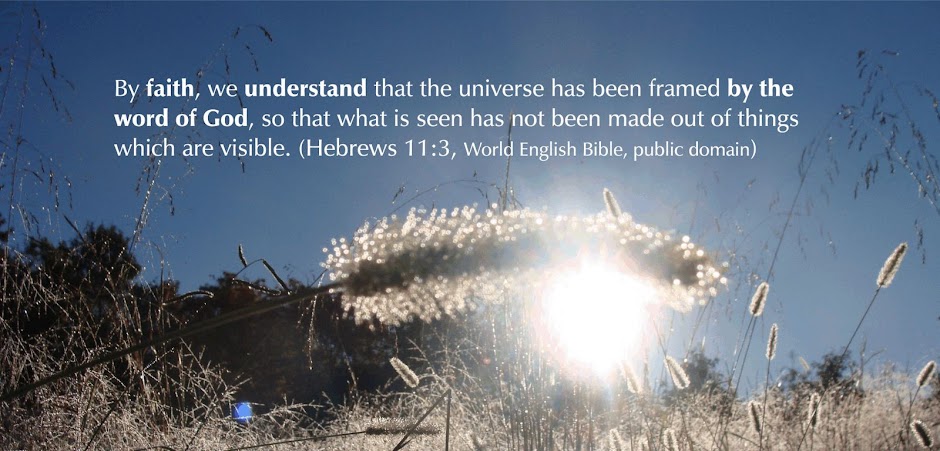
As Hebrews 11 puts it: 3 By faith, we understand
that the universe has been framed by the word of God, so that what is
seen has not been made out of things which are visible (World English Bible, public domain).
Some Christians, and others, claim that atheists/naturalists have no ground for finding purpose and meaning in life, or in existence. This article claims they do, indeed, have reason for meaning and purpose.
This post is revised from a previous one, now removed. Thanks for reading.
Notes
The paragraphs beginning "It's not the Bible," and "Some Christians, and others," were added on February 3, 2016.
*Note added, December 23, 2015. This originally was "type," rather than "race, or ethnic group." As I understand it, that original wording led to the first comment below. Sorry for the confusion that caused.
Note added, August 1, 2013. Commenter Laginestra (see below) points out that the Big Bang theory doesn't actually describe the origin of the universe, but the early development of the the universe. In other words, it doesn't specify where the universe, if it began with a big bang, came from. The universe had to be present, in some form, before there could have been a big bang. However, most people, including me at times, don't realize that, or don't make that distinction. Stephen Hawking is one scientist who has attempted to explain the origin of the universe. I thank the commenter for that important distinction.
Added, May 17, 2014. Here's a good article on the history of the discovery of the evidence for the Big Bang. The article also considers the possibility of multiple universes.
Added, May 29, 2014. Here's a good article the history of the idea of a Big Bang. Fred Hoyle, apparently an atheist, believed in a steady-state universe, one which didn't need some sort of start, apparently for religious reasons. (He was anti-Christian and anti-Jewish.) Hoyle is responsible for the term, "Big Bang," which was meant to be a mockery of the idea.
On January 23, 2017, the post was slightly edited for English usage mistakes.
Musings on science, the Bible, and fantastic literature (and sometimes basketball and other stuff).
God speaks to us through the Bible and the findings of science, and we should listen to both types of revelation.
The title is from Psalm 84:11.
The Wikipedia is usually a pretty good reference. I mostly use the World English Bible (WEB), because it is public domain. I am grateful.
License
I have written an e-book, Does the Bible Really Say That?, which is free to anyone. To download that book, in several formats, go here.

The posts in this blog are licensed under a Creative Commons Attribution-NonCommercial-ShareAlike 3.0 Unported License. You can copy and use this material, as long as you aren't making money from it. If you give me credit, thanks. If not, OK.
The posts in this blog are licensed under a Creative Commons Attribution-NonCommercial-ShareAlike 3.0 Unported License. You can copy and use this material, as long as you aren't making money from it. If you give me credit, thanks. If not, OK.
Showing posts with label Fred Hoyle. Show all posts
Showing posts with label Fred Hoyle. Show all posts
Monday, January 28, 2013


Subscribe to:
Posts (Atom)