I saw the movie, God's Not Dead, today. It stars Kevin Sorbo, as Professor Radisson, and Shane Harper as a university freshman, Josh Wheaton. Radisson begins his philosophy class by having the students all write "God is dead" on a sheet of paper, with their names, and hand it in. Wheaton says that he can't do that, and Radisson says that, as an alternative, Wheaton must prove, in three 20 minute presentations at the end of the next meetings of the class, that God is not dead.
This movie was obviously made by Christians, and the intended audience is also Christians. Sorbo, and, probably, all the other actors, are also Christians. The Newsboys and Willie and Korie Robinson, of Duck Dynasty, appear as themselves, and are portrayed as outspoken Christians.
Some (not all, I'm sure) Christians may be disturbed by some aspects of the film. A Christian character prepares a meal, and purchases and serves wine. Wheaton's defense of God's existence includes the following, which some will not appreciate: 1) It's not possible to disprove God's existence, but it's not possible to prove it, either. 2) God worked through the Big Bang in the origination of the universe (for more on that, see here) and this is consistent with "Let there be light!" in Genesis 1. 3) Evolution occurred, as God's method of establishing the diversity of living things. This last point got only a couple of sentences, and neither Radisson or Wheaton mentioned the origin of humans.
I will try not to give away much of the plot, and there is a plot. In fact, there are several plots, more or less woven together, involving several characters. I will say that three different couples broke up during the film, and one of the less believable aspects of it is how they stayed together long enough to be presented as couples in the first place, considering that each one had at least one seriously self-centered egotist as one partner. (One of these was supposedly a Christian.) I thought there was too much going on in the movie, actually.
The film is a dramatized version of Christian apologetics. In my view, it does this well, presenting most or all of the important reasons that atheists claim argue against God's existence, and some rebuttals of these reasons. One apologetic defense is to ask "Why is there something rather than nothing?" or to ask "Who started the Big Bang?"
Stephen Hawking is a prominent atheist, and was named, by Radisson, as the greatest scientific mind in the history of the world. (That claim could certainly be disputed, with, say, Newton, as another candidate!) In his book, The Grand Design, co-authored by Leonard Mlodinow, the following statement occurs, and Radisson quoted all or part of it: Because there is a law such as gravity, the universe can and will create
itself from nothing. Spontaneous creation is the reason there is
something rather than nothing, why the universe exists, why we exist. It
is not necessary to invoke God to light the blue touch paper and set
the universe going.
There are some problems with using this passage to disprove God's existence. First, as you will see if you go to the Wikipedia article on the book, you will read that by no means all scientists are in agreement with Hawking and Mlodinow, and apparently some who don't agree with them are also unbelievers. Second, why is there gravity at all? (I am sorry that I have yet to read this book -- possibly the authors answer that, but I really doubt it.) Third, as Wheaton pointed out to Radisson, ". . . philosophy is dead." (p. 5)
There was an apologetics advisor for the film. I glimpsed that in the opening credits, but do not recall the name given, and I haven't found it in the movie's web site. Whoever this was, I thought he did a good job. (It was a he. That much I can recall.) At the end of the film, as part of the credits, there was a rather long list of universities that had been sued by Christians (and possibly by some others) for denying Christians their constitutional rights. I'm not sure that any of these were directly related to the subject of the movie. I found one such case on the web site of the Alliance Defense Fund. A student was required to argue in favor of adoption by same-sex couples, and asked for a different assignment, but, instead, was subjected to an examination ". . . for hours about her Christian faith," by a faculty committee. Eventually, apparently after action by the Alliance Defense Fund, she was exonerated, the professor was fired, and she was offered compensation by the university. The credits also said that, at the University I graduated from, the Inter-Varsity Christian Fellowship was banned as a student organization, and that ruling was overturned, after intervention by the ADF. I checked, and found that that claim seems also to be true.
Is being told that there is no God, by a professor, persecution? I don't think so. Being required to act as if you agreed with it, when you don't, would seem to be, however. I don't think being asked to defend one's beliefs is persecution either, in and of itself. It is often part of a higher education, on all sorts of issues.
At least one university philosophy professor has written in defense of Radisson. One claim he makes is that it is Christian universities who deny freedom of thought, by expecting students and faculty to agree to statements of belief, and then expelling them, or firing them, if they don't live up to such an agreement. To some extent, this is true. However, I was on the faculty of a Christian university for over four decades, and never heard of a student being asked to leave for unbelief. (Some were asked to leave for various kinds of bad behavior.) Some students did not believe, of course. At least a couple of faculty were let go precipitously, also for behavior inconsistent with the university's statement of belief. The professor cited claims that state universities are tolerant of all beliefs, and allow freedom of thought. Cases like the ones mentioned above indicate that freedom of thought isn't always tolerated on secular campuses, in spite of what the professor believes. He makes other claims. Some of them seem to be at least partly valid.
I'm glad that I went to see God's Not Dead. It wasn't the greatest movie ever made, but it was thought-provoking.
Thanks for reading!
* * * * *
Note added, May 21, 2014. I have now read, and discussed, the book by Hawking that was so central to the conflict in the movie. My discussion is here.
June 17, 2014. The Speculative Faith blog has published a review of the film, which points out some of the same flaws as the post above.
Musings on science, the Bible, and fantastic literature (and sometimes basketball and other stuff).
God speaks to us through the Bible and the findings of science, and we should listen to both types of revelation.
The title is from Psalm 84:11.
The Wikipedia is usually a pretty good reference. I mostly use the World English Bible (WEB), because it is public domain. I am grateful.
License
I have written an e-book, Does the Bible Really Say That?, which is free to anyone. To download that book, in several formats, go here.

The posts in this blog are licensed under a Creative Commons Attribution-NonCommercial-ShareAlike 3.0 Unported License. You can copy and use this material, as long as you aren't making money from it. If you give me credit, thanks. If not, OK.
The posts in this blog are licensed under a Creative Commons Attribution-NonCommercial-ShareAlike 3.0 Unported License. You can copy and use this material, as long as you aren't making money from it. If you give me credit, thanks. If not, OK.
Showing posts sorted by relevance for query God's not dead. Sort by date Show all posts
Showing posts sorted by relevance for query God's not dead. Sort by date Show all posts
Friday, March 28, 2014


Thursday, May 01, 2014
Hawking's Grand Design and God's Not Dead
Stephen Hawking is one of the best-known scientists of our time. When he retired, he was occupying the same professorial chair that Isaac Newton once did. He is also an outspoken atheist.
In 2010, Hawking, in collaboration with Leonard Mlodinow, wrote The Grand Design, which became a best-seller, in spite of its non-fiction status and scientific content. The book argues that it is not necessary to suppose that God created the universe. It also says that "philosophy is dead," and suggests that the search for a unified field theory is futile, so it isn't exactly shy about attacking significant ideas. What they seem to mean by "philosophy is dead" is that some philosophers are not willing to agree with them on all points.
The Grand Design was referred to in the recent movie, God's Not Dead. (See here for my review of that film. That review includes the pivotal quotation from The Grand Design, which was used in the movie. That quotation is the second and third sentences from the second quotation from the book, below.) God's Not Dead did not claim that the existence of God can be proved, but that His existence cannot be disproved. The Grand Design doesn't disprove God's existence, although the authors seem to think that it does, or that it almost does.
As indicated above, Hawking and Mlodinow weren't bashful. They claim, on page 32, that "recent experiments" have shown that our brains operate according to physical laws. There are no notes in the book, so I don't know what experiments they were referring to, but never mind. What other laws would our brains operate by? They claim that, because our brains operate by physical laws, "[f]ree will is an illusion," (p. 32) but are willing for us to act as if we really did have free will. That's a good thing, because if we don't have free will, Hawking and Mlodinow didn't, either, and they therefore believe the things that they do, not because they are true, but because of the physical laws operating in their brains. (And, by the way, if that discussion isn't a matter for philosophy, I don't know what is.)
The fundamental argument of The Grand Design is that there are really many, very many universes, according to M-theory, and that we exist in one of those that is compatible with life. All those universes came into being somehow, and here we are, in this one, the result of a cosmic accident. There are some serious problems with this notion. One of them is that even Hawking and Mlodinow aren't sure what M-theory is:
No one seems to know what the "M" stands for, but it may be "master," "miracle," or "mystery." It seems to be all three. People are still trying to decipher the nature of M-theory, but that may not be possible. It could be that the physicist's traditional expectation of a single theory of nature is untenable, and there exists no single formulation. It might be that to describe the universe, we have to employ different theories in different situations. Each theory may have its own version of reality, but according to model-dependent realism, that is acceptable so long as the theories agree in their predictions whenever they overlap, that is, whenever they can both be applied. (p. 117)
The above is a quotation from the book. That quotation indicates that, whatever M-theory might be, if it is true here, it isn't true elsewhere. That, and their fuzzy description, don't inspire confidence in science based on M-theory.
Another serious problem is that there is no experimental proof for M-theory and its relatives. Granted, a few decades ago, there was no experimental proof for quarks, which were proposed as a way of making sense out of the many types of sub-atomic particles then thought to exist, and, hence, there was skepticism about their existence. But that skepticism has largely disappeared, and there is experimental evidence for the existence of quarks. However, quarks, so far as we know, are the same everywhere in the universe. Quark theory didn't propose that there were different kinds of quarks, or no quarks at all, in other universes. It's not clear that, even if other universes exist, we can access them in any way, which would be necessary, I think, to vindicate M-theory.
Then there's the matter of gravity.
Because there is a law like gravity, the universe can and will create itself from nothing in the manner described in Chapter 6. [Chapter Title - "Choosing Our Universe."] Spontaneous creation is the reason there is something rather than nothing, why the universe exists, why we exist. It is not necessary to invoke God to light the blue touch paper and set the universe going. (p. 180.)
But why is there gravity? If they explain that, I missed it, or didn't understand it. And even if gravity had the power to make the universe create itself from nothing, wouldn't the powers of gravity be different in all the other different universes, according to their own thesis? So why should other universes exist?
Another serious problem is that scientists, and others, are not universally in agreement with Hawking and Mlodinow's central idea, mostly because of the first two serious problems indicated above.
Peter Woit, of Columbia University, has written a severely critical review of The Grand Design. Woit wrote:
I’m in favor of naturalism and leaving God out of physics as much as the next person, but if you’re the sort who wants to go to battle in the science/religion wars, why you would choose to take up such a dubious weapon as M-theory mystifies me. . . . [T]hinking about it, [I] have to admit that the kind of pseudo-science going on here and being promoted in this book isn’t obviously any better than the faith-based explanations of how the world works favored by conventional religions.
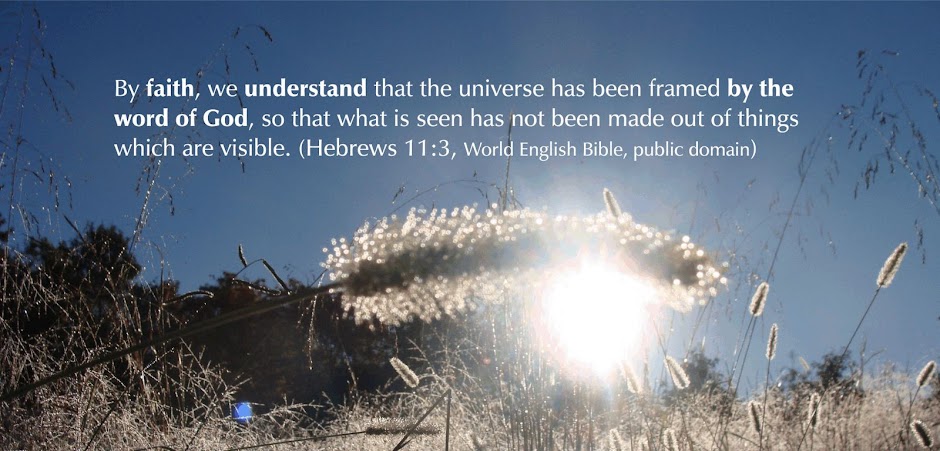
Well put, except that there shouldn't be "science/religion wars." If we really understood God's revelation in Christ, in the Bible, through the church, and in nature (which science unfolds for us) we would see that our existence is best explained by accepting, by faith, that God planned for our universe, and us, to exist. See Hebrews 11:3, which is quoted in the graphic at the top of this post.
I know of no evidence that Woit is a Christian. For other criticisms of the book, see its Wikipedia article.
See also the recent opinion piece in Time, "Why Science Does Not Disprove God."
Thanks for reading!
Monday, January 28, 2013
The Big Bang, second edition
I understand that there are conservative Christians who reject the
idea of a Big Bang. I suppose that most of these, at least the ones who
can give a good reason for such rejection, do so either because they
believe that the earth is only a few thousand years old, or because, in
their minds, the Big Bang is associated with evolution, which they
reject.
As to the first, it is possible, indeed, that the earth is only a few thousand years old. (But see this post, and others, on a book by a believing Christian, scientist, and Bible scholar, David Snoke, entitled A Biblical Case for an Old Earth.) Even if the earth were only a few thousand years old, the Bible does not explicitly say that the universe is the same age as the earth. I don't see anything in the Bible that would rule out an ancient universe.
I also take two Biblical statements seriously. These are Psalm 19:1-4 and Romans 1:20, both of which tell us that one of God's ways of revealing himself to us is through what nature tells us. Much of what nature tells us, especially about things which are very small, very large, or very far away, or were very long ago, can come to us only though scientific findings. These findings may be mistaken at times, but they should certainly not be rejected out of hand. There is good scientific evidence that there was a Big Bang, and that it took place a very long time ago.
The Big Bang was not proposed as some sort of anti-God crusade. On the contrary, the first good evidence for a Big Bang was discovered by accident, by scientists who weren't looking for such evidence. The Big Bang, as an explanation for the origin of the universe as we know it, is taken by some scientists, even unbelieving scientists, as evidence for the existence of a divine Creator. For example, here's what the late Robert Jastrow wrote, about the discovery of evidence for the Big Bang, in his book, God and the Astronomers:
For the scientist who has lived by his faith in the power of reason, the story ends like a bad dream. He has scaled the mountains of ignorance; he is about to conquer the highest peak; as he pulls himself over the final rock, he is greeted by a band of theologians who have been sitting there for centuries. (New York: Warner Books, 1978, pp. 105-106.) Jastrow, according to the Wikipedia article on him, was not a Christian, but an agnostic. However, he believed that science had no explanation for what came before, or caused, the Big Bang, and acknowledged that the Judeo-Christian religions do have an explanation, namely that an eternal God began the universe with a supernatural act, or acts, such as the Big Bang. When the Big Bang theory was first proposed, as Jastrow indicated, there were scientists who were pretty upset about the idea, because there was no good explanation for what caused it, or what, if anything, came before it. There still isn't an explanation that has been proved experimentally, although there have been attempts at such explanations, most notably by Stephen Hawking.
Acceptance of the idea of a Big Bang was slow. The evidence for a Big Bang is good, considering how long ago it would have happened, and the idea is accepted by most scientists. The evidence for it, to me, is an important part of God's revelation to us.
As to the connection to evolution, there is no direct connection. In the first place, evolution, like any controversial subject, should be defined before it is discussed at all. This, unfortunately, happens only rarely. In the second place, evolution is a biological process. The Big Bang was a physical process.
What Christians should be concerned about, even if they have the wrong name for it, is not evolution, but naturalism. That's what most conservative Christians really mean when they say that they don't believe in evolution. (There is good evidence, generally accepted, for at least some types of evolution. The most ardent Young-Earth Creationist scientists believe that humans evolved into more than one race, or ethnic group*, since the time of Noah, for example.) Naturalism is the idea that there are natural, as opposed to supernatural, explanations for everything. It is, therefore, a form of atheism. Naturalism is believed by many scientists, and others, although there is no definitive evidence for it. The most prominent naturalist is Richard Dawkins, a competent biologist, but also a popular writer, crusading against Christianity and other religions. But even Dawkins does not claim that he has disproved God's existence, which, if he had, would prove naturalism.
The Bible begins with a statement that, if true, destroys naturalism: In the beginning, God created . . . Genesis 1 doesn't tell us when, why, or how. It does tell us that there was a Who. Naturalism says that there wasn't, and isn't, any Who. Christians believe that there was, and is. Undoubtedly, some people who believe in naturalism do so because, if it were true, it would mean that there are no Divinely created moral laws, and they want to believe that there aren't any such.
If someone says that the Big Bang event proves that there is no God, they are mistaken. There is no such proof. On the contrary, supposing that God started the universe with a Big Bang makes good sense. If someone says that evolution, however defined, proves that there is no God, they are similarly mistaken. There is no such proof. On the contrary, God may have used natural selection, the Big Bang, or both, as part of His method of making things like they are now. Knowledge and prior planning like that would be as wonderful, or more so, as creating every type of atom, and every type of living thing, from scratch.
It's not the Bible, but the movie, God's Not Dead, was generally well-received by the conservative Christian community. (The more recent movie, Do You Believe? was made by the same group, and there was also a God's Not Dead 2.) See here for my review of God's not Dead. In that review, I point out that the fictional main Christian character accepts the ideas that God used the Big Bang, and evolution to bring the world to its current state, in his defense of the existence of God.
As Hebrews 11 puts it: 3 By faith, we understand that the universe has been framed by the word of God, so that what is seen has not been made out of things which are visible (World English Bible, public domain).
Some Christians, and others, claim that atheists/naturalists have no ground for finding purpose and meaning in life, or in existence. This article claims they do, indeed, have reason for meaning and purpose.
This post is revised from a previous one, now removed. Thanks for reading.
Notes
The paragraphs beginning "It's not the Bible," and "Some Christians, and others," were added on February 3, 2016.
*Note added, December 23, 2015. This originally was "type," rather than "race, or ethnic group." As I understand it, that original wording led to the first comment below. Sorry for the confusion that caused.
Note added, August 1, 2013. Commenter Laginestra (see below) points out that the Big Bang theory doesn't actually describe the origin of the universe, but the early development of the the universe. In other words, it doesn't specify where the universe, if it began with a big bang, came from. The universe had to be present, in some form, before there could have been a big bang. However, most people, including me at times, don't realize that, or don't make that distinction. Stephen Hawking is one scientist who has attempted to explain the origin of the universe. I thank the commenter for that important distinction.
Added, May 17, 2014. Here's a good article on the history of the discovery of the evidence for the Big Bang. The article also considers the possibility of multiple universes.
Added, May 29, 2014. Here's a good article the history of the idea of a Big Bang. Fred Hoyle, apparently an atheist, believed in a steady-state universe, one which didn't need some sort of start, apparently for religious reasons. (He was anti-Christian and anti-Jewish.) Hoyle is responsible for the term, "Big Bang," which was meant to be a mockery of the idea.
On January 23, 2017, the post was slightly edited for English usage mistakes.
Sunday, March 07, 2010
Thoughts on Creation
Thoughts on God’s creation
Genesis 1:1 In the beginning, God created the heavens and the earth.
“Scripture quotations are from The Holy Bible, English Standard Version®, copyright ©2001 by Crossway Bibles, a publishing ministry of Good News Publishers. Used by permission. All rights reserved.” See here. (You can search for a particular Bible passage, using the search box on the page opened by the link in the previous sentence.)
#1 God planned it.
Genesis 1 does not tell us:
When God created.
How God created.
Why God created.
It does tell us Where, namely "the heavens and the earth."
Most important, it tells us "Who?" God!
Creation was planned.
The most important argument about origins is not over whether the six days of Genesis 1 were consecutive 24-hour days or not. It is not about whether the Flood was responsible for geology as we know it.
The most important argument about creation is about whether it was done on purpose --with a plan --or not.
If God spoke the stars into existence in an instant, complete with their location and their direction of movement, that would be evidence of God’s power and planning.
If God brought the universe into existence, with built-in physical laws that resulted, over billions of years, in the stars, with their location and direction of movement, that also would be evidence of God’s power and planning.
God is a Trinity, Father, Son, and Holy Spirit.
Which of these do you think was most important in creation? According to the Bible, it is God the Son, Jesus Christ, who was.
Colossians 1:15 He is the image of the invisible God, the firstborn of all creation. 16 For by him all things were created, in heaven and on earth, visible and invisible, whether thrones or dominions or rulers or authorities—all things were created through him and for him. 17 And he is before all things, and in him all things hold together. 18 And he is the head of the body, the church. He is the beginning, the firstborn from the dead, that in everything he might be preeminent. 19 For in him all the fullness of God was pleased to dwell, 20 and through him to reconcile to himself all things, whether on earth or in heaven, making peace by the blood of his cross.
John 1 also indicates the importance of the Son in creation.
How do we know that God planned creation?
Hebrews 11:3 By faith we understand that the universe was created by the word of God, so that what is seen was not made out of things that are visible.
No experiment has, or will, disproved God’s activity
in creation. No experiment has, or will, prove it, either.
#2 God’s creation was good, and diverse.
Genesis 1:31a And God saw everything that he had made, and behold, it was very good.
Psalm 104:24 O Lord, how manifold are your works! In wisdom have you made them all; the earth is full of your creatures. 25 Here is the sea, great and wide, which teems with creatures innumerable, living things both small and great.
Below are some examples of the diversity of God's creation. You may click on the photo itself to see a larger version, or to read a description.





#3 Humans are unique.
The description of the creation of humans in Genesis 1 uses different language, and is more detailed, than the description of the creation of anything else.
Humans were put in charge of God’s creation.
Christ came to earth as a human.
#4 Jesus Christ has not abandoned His creation.
To review a verse used previously:
Colossians 1:17 And he is before all things, and in him all things hold together.
and also:
Hebrews 1:2 but in these last days he has spoken to us by his Son, whom he appointed the heir of all things, through whom also he created the world. 3a He is the radiance of the glory of God and the exact imprint of his nature, and he upholds the universe by the word of his power.
#5 We need to try to take care of God’s creation
Genesis 1:26 Then God said, "Let us make man in our image, after our likeness. And let them have dominion over the fish of the sea and over the birds of the heavens and over the livestock and over all the earth and over every creeping thing that creeps on the earth."
Psalm 24:1 The earth is the Lord's and the fullness thereof, the world and those who dwell therein,
There are a number of other scriptural reasons for believing that we need to try to take care of God’s creation. If anyone wants to read more on this, see here and here.
God reveals Himself to us in may ways, most importantly through His Son, God Himself.
#6 God’s creation is one of the ways God reveals Himself to us.
Psalm 19:1The heavens declare the glory of God, and the sky above proclaims his handiwork. 2 Day to day pours out speech, and night to night reveals knowledge. . . . 4a Their voice goes out through all the earth, and their words to the end of the world.
Romans 1:20 For his invisible attributes, namely, his eternal power and divine nature, have been clearly perceived, ever since the creation of the world, in the things that have been made. So they are without excuse.
If both our interpretation of the Bible, and of the findings of science, are part of God’s revelation to us, then, ideally, they shouldn’t conflict. If they conflict, we must be interpreting one or both of them wrongly. If a conflict simply can’t be resolved, then the Bible is the higher authority. But trying to resolve supposed conflicts is worth the effort, because we are learning about God, and how He works.
In recent years, scientific findings have too often been denounced in the conservative Christian community. This is a mistake.
Example 1: climate change
Why is this idea so often denounced by conservative Christians? Because Al Gore is a Democrat? Because there have been close ties between the oil industry and Republicans? I’m not sure. I have yet to read any valid arguments to reject the idea that we are affecting climate, based on scripture, and climate scientists are almost unanimous in believing that we are. (See here for more on this topic.)
Example 2: Young earth geology
The earth may be only a few thousand years old, but qualified Christian scientists, including the most important Young-Earth Creationist science organizations, are almost unanimous in believing that the scientific evidence is
strongly in favor of an earth that has been here for a long time. See here.
There are Bible-believing, God-honoring Bible scholars, who are familiar with the original language of the Old Testament, who do not believe that the Bible teaches Young-Earth Creationism. (There are others who do believe it, of course!)
If we just tell a non-Christian who is familiar with the scientific evidence that the earth is really only about 6,000 years old, their reaction may be, "OK, if that’s what their Bible teaches about geology, why should I believe what it says about sin and salvation?"
We may be misinterpreting the evidence, or there may be evidence we haven’t found, but just ignoring the evidence is a mistake.
The battle should not be so much about the when or how of creation, but about the Who.
To summarize, what does the Bible tell us about creation?
1. God planned it.
2. God’s creation was good, and diverse.
3. Humans are unique.
4. Jesus Christ has not abandoned His creation.
5. We need to try to take care of God’s creation.
6. Creation is one of the ways God reveals Himself to us.
Thanks for reading!

Thoughts on Creation by Martin LaBar is licensed under a Creative Commons Attribution-Noncommercial-No Derivative Works 3.0 United States License.
Genesis 1:1 In the beginning, God created the heavens and the earth.
“Scripture quotations are from The Holy Bible, English Standard Version®, copyright ©2001 by Crossway Bibles, a publishing ministry of Good News Publishers. Used by permission. All rights reserved.” See here. (You can search for a particular Bible passage, using the search box on the page opened by the link in the previous sentence.)
#1 God planned it.
Genesis 1 does not tell us:
When God created.
How God created.
Why God created.
It does tell us Where, namely "the heavens and the earth."
Most important, it tells us "Who?" God!
Creation was planned.
The most important argument about origins is not over whether the six days of Genesis 1 were consecutive 24-hour days or not. It is not about whether the Flood was responsible for geology as we know it.
The most important argument about creation is about whether it was done on purpose --with a plan --or not.
If God spoke the stars into existence in an instant, complete with their location and their direction of movement, that would be evidence of God’s power and planning.
If God brought the universe into existence, with built-in physical laws that resulted, over billions of years, in the stars, with their location and direction of movement, that also would be evidence of God’s power and planning.
God is a Trinity, Father, Son, and Holy Spirit.
Which of these do you think was most important in creation? According to the Bible, it is God the Son, Jesus Christ, who was.
Colossians 1:15 He is the image of the invisible God, the firstborn of all creation. 16 For by him all things were created, in heaven and on earth, visible and invisible, whether thrones or dominions or rulers or authorities—all things were created through him and for him. 17 And he is before all things, and in him all things hold together. 18 And he is the head of the body, the church. He is the beginning, the firstborn from the dead, that in everything he might be preeminent. 19 For in him all the fullness of God was pleased to dwell, 20 and through him to reconcile to himself all things, whether on earth or in heaven, making peace by the blood of his cross.
John 1 also indicates the importance of the Son in creation.
How do we know that God planned creation?
Hebrews 11:3 By faith we understand that the universe was created by the word of God, so that what is seen was not made out of things that are visible.
No experiment has, or will, disproved God’s activity
in creation. No experiment has, or will, prove it, either.
#2 God’s creation was good, and diverse.
Genesis 1:31a And God saw everything that he had made, and behold, it was very good.
Psalm 104:24 O Lord, how manifold are your works! In wisdom have you made them all; the earth is full of your creatures. 25 Here is the sea, great and wide, which teems with creatures innumerable, living things both small and great.
Below are some examples of the diversity of God's creation. You may click on the photo itself to see a larger version, or to read a description.
#3 Humans are unique.
The description of the creation of humans in Genesis 1 uses different language, and is more detailed, than the description of the creation of anything else.
Humans were put in charge of God’s creation.
Christ came to earth as a human.
#4 Jesus Christ has not abandoned His creation.
To review a verse used previously:
Colossians 1:17 And he is before all things, and in him all things hold together.
and also:
Hebrews 1:2 but in these last days he has spoken to us by his Son, whom he appointed the heir of all things, through whom also he created the world. 3a He is the radiance of the glory of God and the exact imprint of his nature, and he upholds the universe by the word of his power.
#5 We need to try to take care of God’s creation
Genesis 1:26 Then God said, "Let us make man in our image, after our likeness. And let them have dominion over the fish of the sea and over the birds of the heavens and over the livestock and over all the earth and over every creeping thing that creeps on the earth."
Psalm 24:1 The earth is the Lord's and the fullness thereof, the world and those who dwell therein,
There are a number of other scriptural reasons for believing that we need to try to take care of God’s creation. If anyone wants to read more on this, see here and here.
God reveals Himself to us in may ways, most importantly through His Son, God Himself.
#6 God’s creation is one of the ways God reveals Himself to us.
Psalm 19:1The heavens declare the glory of God, and the sky above proclaims his handiwork. 2 Day to day pours out speech, and night to night reveals knowledge. . . . 4a Their voice goes out through all the earth, and their words to the end of the world.
Romans 1:20 For his invisible attributes, namely, his eternal power and divine nature, have been clearly perceived, ever since the creation of the world, in the things that have been made. So they are without excuse.
If both our interpretation of the Bible, and of the findings of science, are part of God’s revelation to us, then, ideally, they shouldn’t conflict. If they conflict, we must be interpreting one or both of them wrongly. If a conflict simply can’t be resolved, then the Bible is the higher authority. But trying to resolve supposed conflicts is worth the effort, because we are learning about God, and how He works.
In recent years, scientific findings have too often been denounced in the conservative Christian community. This is a mistake.
Example 1: climate change
Why is this idea so often denounced by conservative Christians? Because Al Gore is a Democrat? Because there have been close ties between the oil industry and Republicans? I’m not sure. I have yet to read any valid arguments to reject the idea that we are affecting climate, based on scripture, and climate scientists are almost unanimous in believing that we are. (See here for more on this topic.)
Example 2: Young earth geology
The earth may be only a few thousand years old, but qualified Christian scientists, including the most important Young-Earth Creationist science organizations, are almost unanimous in believing that the scientific evidence is
strongly in favor of an earth that has been here for a long time. See here.
There are Bible-believing, God-honoring Bible scholars, who are familiar with the original language of the Old Testament, who do not believe that the Bible teaches Young-Earth Creationism. (There are others who do believe it, of course!)
If we just tell a non-Christian who is familiar with the scientific evidence that the earth is really only about 6,000 years old, their reaction may be, "OK, if that’s what their Bible teaches about geology, why should I believe what it says about sin and salvation?"
We may be misinterpreting the evidence, or there may be evidence we haven’t found, but just ignoring the evidence is a mistake.
The battle should not be so much about the when or how of creation, but about the Who.
To summarize, what does the Bible tell us about creation?
1. God planned it.
2. God’s creation was good, and diverse.
3. Humans are unique.
4. Jesus Christ has not abandoned His creation.
5. We need to try to take care of God’s creation.
6. Creation is one of the ways God reveals Himself to us.
Thanks for reading!
Thoughts on Creation by Martin LaBar is licensed under a Creative Commons Attribution-Noncommercial-No Derivative Works 3.0 United States License.
Friday, July 25, 2008
Would Lazarus have been better off dead?
Would Lazarus have been better off dead? Would he have been better off if Jesus had not called him back to life? That's a pretty presumptive question. It's questioning God. But I (think) I have a valid point. Bear with me, please.
Just in case you are wondering, my church's Sunday School lesson for the coming Sunday is based on 1 Corinthians 15, where Paul considers the resurrection at considerable length. Beginning with verse 12, Paul considers six consequences of no resurrection, with six if statements. Then, he hits us with the key word of the chapter, but:
20 But in fact Christ has been raised from the dead, the firstfruits of those who have fallen asleep. (ESV)
So what about Lazarus? Well, let's start earlier. The Bible contains the following stories of people being raised from the dead:
In 2 Kings 4, Elisha, with God's help, raised the young son of a woman from Shunem back to life, at her request.
One Old Testament storiy of a person coming back to life seems accidental. The apparent agent of this miracle was dead himself. In 2 Kings 13:21, a burial was interrupted, and the body thrown into the grave of Elisha, and the dead person revived.
In Luke 7:11-17, the widow of Nain's son had died. Jesus had compassion on her, and raised him back to life.
In Mark 5:21-43, Jairus begged Jesus to heal his daughter. She died before Jesus got there, but Jesus raised her from the dead.
In Acts 20:7-10, Paul brought Eutychus back to life. Eutychus was a victim of Paul's long preaching -- he went to sleep and fell out of a high window.
In Acts 9:36-42, Dorcas died. Peter brought her back to life, apparently out of sympathy for the poor widows that Dorcas had helped.
In John 11:1-44, there is a story with some of the same features. Lazarus, Jesus' friend, was sick, and his sisters, Mary and Martha, sent a message, urgently asking Jesus to come heal their brother. Jesus didn't get there before Lazarus died, apparently on purpose. Then, in seeming response to the chiding of the sisters that He hadn't been there when they needed Him, he brought Lazarus back to life.
I am omitting discussion of people being brought back to life in Revelation, because I'm not sure these events are meant to be taken literally.
One thing about all of these situations, even the one involving Elisha's grave, is that someone died twice. The Bible says nothing about the second death of Lazarus, or the daughter of Jairus, or any of the other people brought back to life, but they must have died a second time.
Notice something else about all of these stories but that of Elisha's grave, and, perhaps, that of Eutychus. That is that a person was brought back to life for the sake of someone else. Now, granted, a dead or dying individual would not be able to summon a miracle-worker for him or herself. But the emphases above make the point that Elisha, Jesus and Peter brought someone back to life because someone else loved him or her very much, and, at least in the case of the widow's son, and of Dorcas (and perhaps of Lazarus) needed the dead person back alive, to help them materially.
I hope you miss a story in the list above, the most important story, the one told in 1 Corinthians 15. Christ was also raised for others -- for me, for you. Without His resurrection, as Paul puts it, we would be "of all people most to be pitied." (verse 19b, ESV)
So what about Lazarus? Perhaps, on balance, he personally would have been spared great suffering, if he had only had to die once, not twice. We can't know. But God had a plan, to aid his sisters in their great need, and to publicly proclaim the power of Christ, even to the raising of a man who had been in the grave for over a day. It was better for others if Lazarus was brought back to life, only to go back through death again, instead of (presumably) to heaven. It was certainly better for me that Christ went through death and resurrection. And He didn't have to die a second time. (Except that I, or you, may crucify Him again by not living and being what we ought to be -- see Hebrews 6:4-7.)
Thanks for reading. Live so as to not put Christ through death again!
Sunday, December 24, 2017
The Art of Divine Contentment: An Exposition of Philippians 4:11 by Thomas Watson. Excerpt 8
Let us beg the Spirit of God to teach us; we must be “divinely taught;” the eunuch could read, but he could not understand, till Philip joined himself to his chariot. (Ac. 8.29) God’s Spirit must join himself to our chariot; he must teach, or we cannot learn: “all thy children shall be taught of the Lord”. (Is. 54.13) A man may read the figure on the dial, but he cannot tell how the day goes, unless the sun shines upon the dial: we may read the Bible over, but we can not learn the purpose, till the Spirit of God shines into our hearts. (2 Cor. 4.6) O implore this blessed Spirit! It is God’s prerogative-royal to teach: “I am the Lord thy God, which teacheth thee to profit.” (Is. 48.17) Ministers may tell us our lesson, God only can teach us; we have lost both our hearing and eye-sight, therefore are very unfit to learn. Ever since Eve listened to the serpent, we have been deaf; and since she looked on the tree of knowledge we have been blind; but when God comes to teach, he removes these impediments. (Is. 35.5) We are naturally dead; (Ep. 2.1) who will go about to teach a dead man? yet, behold, God undertakes to make dead men to understand mysteries! God is the grand teacher. This is the reason the word preached works so differently upon men; two in a pew, the one is wrought upon effectually, the other lies at the ordinances as a dead child at the breast, and gets no nourishment. What is the reason? Because the heavenly gale of the Spirit blows upon one, and not upon the other; one hath the anointing of God, which teacheth him all things,! (1 Jno. 2.27) the other hath it not. God’s Spirit speaks sweetly, but irresistably. In that heavenly doxology, none could sing the new song, but those who were sealed in their foreheads, (Re. 14.2) reprobates could not sing it. Those that are skilful in the mysteries of salvation, must have the seal of the Spirit upon them. Let us make this our prayer: Lord, breathe thy Spirit into thy word; and we have a promise, which may add wings to prayer; “if ye then being evil know how to give good gifts unto your children; how much more shall your heavenly Father give the Holy Spirit to them that ask him?” (Lu. 11.13) And thus much of the first part of the text, the scholar, which I intended only as a short gloss or paraphrase.
Thomas Watson lived from 1620-1686, in England. He wrote several books which survive. This blog, God willing, will post excerpts from his The Art of Divine Contentment: An Exposition of Philippians 4:11, over a number of weeks, on Sundays. My source for the text is here, and I thank the Christian Classics Ethereal Library for making this text (and many others) available. The previous excerpt is here.
Philippians 4:11 Not that I speak because of lack, for I have learned in whatever state I am, to be content in it. (World English Bible, public domain.)
Monday, April 01, 2013
The Resurrection, Superstition, and the Second Law of Thermodynamics

Death and the Second Law of Thermodynamics (The photo above is of a maple leaf. This post is not an April Fool joke!)
Ephesians 1:18b . . . that you may know what is the hope of his calling, and what are the riches of the glory of his inheritance in the saints, 19 and what is the exceeding greatness of his power toward us who believe, according to that working of the strength of his might 20 which he worked in Christ, when he raised him from the dead, and made him to sit at his right hand in the heavenly places, 21 far above all rule, and authority, and power, and dominion, and every name that is named, not only in this age, but also in that which is to come.
The definitions of life and death are complex, and philosophical as well as biological. Generally, living things are in a constant battle with the second law of thermodynamics. So long as they can obtain enough energy, they win this battle. They can build themselves. They build themselves as non-random, ordered objects. Living things do this, however, only at the expense of order in the universe at large. We can expend energy to build, but, when we do, we are unbuilding something else -- we are causing entropy to increase. However, when we do so, we are taking energy from somewhere else.
For example, we can straighten the back seat of our car, or the dining room table. We change disorder to order. But, to do so, we must use energy that we have taken in in the food we eat, or, perhaps, electrical energy to run various cleaning devices. Starch, say, is an ordered food molecule, containing usable stored energy. Breaking it down changes the combinations molecules of starch into less ordered molecules of carbon dioxide and water, releasing energy in the process, and giving off wasted energy. Disorder arises through almost all natural processes, because of the unbending second law of thermodynamics. The only way to stave off that disorder is by having a source of energy to draw on. However, drawing such energy for use is related to increased disorder somewhere else. For example, the sun is gradually becoming more disordered.
One of the things that happens as a result of death is that the ability of a living thing to stave off the inexorable increase of entropy is gone. Death leads to decay. As Polkinghorne puts it:
In our present world, change and decay are built into the fabric of the universe. The processes by which genetic mutations produce new forms of life are the processes by which cells become cancerous. Death is the necessary cost of life. In fact, a theological defense of the existence of physical evil is that it is not gratuitous but the inescapable price of an evolutionary world, free to make itself within the independence its Creator has granted to it. John C. Polkinghorne, Serious Talk: Science and Religion in Dialogue. Harrisburg, PA: Trinity Press International, 1995, p. 107.
Not only does death lead to decay, but this decay is, in the practical sense, irreversible. If I had the money, and offered some famous research institution a trillion dollars if they could bring one dead maple leaf back to life, I wouldn’t lose my money. It is not humanly possible to reverse the decay in a dead organism, or part of an organism, and bring it back to life. The second law of thermodynamics makes that impossible.
The resurrection, of course, is miraculous, any way you want to look at it. It wasn’t, or isn’t, humanly possible. (That doesn’t mean that it didn’t happen!) We cannot reverse the effects of the second law on a dead leaf, much less a dead human. No wonder Paul called resurrection power “immeasurable” in Ephesians 1:19-20. God’s promise is that Christians have this power working in us.
Superstition?
The biology text I am currently using says this: “The irrational belief that actions that are not logically related to a course of events can influence its outcome is called superstition. . . . different narratives, legends, fairy tales, and epics from all around the globe exist to help people understand the world around them. These stories explain everything from birth and death to disease and healing.” (Jay Phelan, What is Life? Second Edition. New York: Freeman, 2013, pp. 5-6. Emphasis in original.) To be fair, Phelan is not particularly attacking religious belief here, but casts a wider net, including, among other things, the ritualistic actions of baseball players.
Phelan goes on to say that there are “truths” in religion that the scientific method doesn't reveal to us, and that these are based on “personal faith, traditions, and mythology.” (p. 6. Phelan put quotation marks around “truths,” implying, I think, that he’s not sure that they are truths.)
Phelan is mostly right. Beliefs that are not logically related to a course of events are sometimes believed to cause things that they don’t. I classify the belief that vaccinations cause autism as one such superstition. There are religious beliefs that seem superstitious to me, and, no doubt, many of mine seem superstitious to, say, a Buddhist.
The resurrection, I claim (and I’m not nearly the first!), is an event that there is evidence for. Of course some of my belief in the resurrection is based on personal faith, traditions, and perhaps even mythology. But I submit that there is evidence for the resurrection. In 1 Corinthians 15, Paul says: 3 For I delivered to you first of all that which I also received: that Christ died for our sins according to the Scriptures, 4 that he was buried, that he was raised on the third day according to the Scriptures, 5 and that he appeared to Cephas, [Peter] then to the twelve. 6 Then he appeared to over five hundred brothers at once, most of whom remain until now, but some have also fallen asleep. 7 Then he appeared to James, [the half-brother of Christ] then to all the apostles, 8 and last of all, as to the child born at the wrong time, he appeared to me also. In other words, there were hundreds of people, in Paul’s day, who had seen the living, resurrected Christ. That’s evidence.
There is other evidence for the resurrection. How else can we explain the transformation of Peter from a coward who didn’t acknowledge that he was one of Christ's followers to a bold public speaker, proclaiming the gospel? How else can we explain the growth of the church? How else can I explain how a young lady of my acquaintance, with little interest in the things of God, living in sin with her boyfriend, and their child, had her life turned around, began attending church with her boyfriend and child, reconciled with her estranged mother, and was married to the boyfriend after the morning service on Super Bowl Sunday, 2013? (I know a similar story, about another young lady who married her boyfriend after church service in another place on the next Sunday. Both new wives said that they wanted to show others a life consistent with their faith. Both are living transformed lives.) I credit the power of the resurrection for these and other stories of transformation, and claim that such changes are evidence for the reality of the resurrection. I cannot prove, to the satisfaction of a confirmed atheist, that these events, in the First Century and the Twenty-First, are logically related to the Resurrection, but I submit that they are evidence for such a logical relationship.
Thanks for reading!
Sunday, April 12, 2009
The importance of the resurrection
A Sunday School class, some time ago, dealt with the resurrection of Christ. Why is that event so important? The Bible answers that, in these passages, and others:
Acts 2:32 This Jesus God raised up, and of that we all are witnesses. 33 Being therefore exalted at the right hand of God, and having received from the Father the promise of the Holy Spirit, he has poured out this that you yourselves are seeing and hearing. 34 For David did not ascend into the heavens, but he himself says,
“‘The Lord said to my Lord,
Sit at my right hand,
35 until I make your enemies your footstool.’
36 Let all the house of Israel therefore know for certain that God has made him both Lord and Christ, this Jesus whom you crucified.” (The resurrection was important enough that Peter mentioned it in his sermon on the day of Pentecost. It was also important enough that Peter had courage to give the sermon.)
Acts 17:18 Some of the Epicurean and Stoic philosophers also conversed with him. And some said, “What does this babbler wish to say?” Others said, “He seems to be a preacher of foreign divinities”—because he was preaching Jesus and the resurrection. (Apparently the philosophers on Mars Hill misunderstood Paul. He mentioned the resurrection so much that they thought it was another god.)
1 Corinthians 15:14 And if Christ has not been raised, then our preaching is in vain and your faith is in vain. 15 We are even found to be misrepresenting God, because we testified about God that he raised Christ, whom he did not raise if it is true that the dead are not raised. 16 For if the dead are not raised, not even Christ has been raised. 17 And if Christ has not been raised, your faith is futile and you are still in your sins. 18 Then those also who have fallen asleep in Christ have perished. 19 If in this life only we have hoped in Christ, we are of all people most to be pitied.
20 But in fact Christ has been raised from the dead, the firstfruits of those who have fallen asleep.
Ephesians 1:19 and what is the immeasurable greatness of his power toward us who believe, according to the working of his great might 20 that he worked in Christ when he raised him from the dead and seated him at his right hand in the heavenly places, 21 far above all rule and authority and power and dominion, and above every name that is named, not only in this age but also in the one to come.
1 Peter 1:3 Blessed be the God and Father of our Lord Jesus Christ! According to his great mercy, he has caused us to be born again to a living hope through the resurrection of Jesus Christ from the dead, 4 to an inheritance that is imperishable, undefiled, and unfading, kept in heaven for you, 5 who by God's power are being guarded through faith for a salvation ready to be revealed in the last time. (The resurrection, said Peter, is our only real hope.)
All scripture above is from the English Standard Version. I added the emphases.
Thanks for reading!
Saturday, August 11, 2012
Evidence for being a Christian: What the Bible says
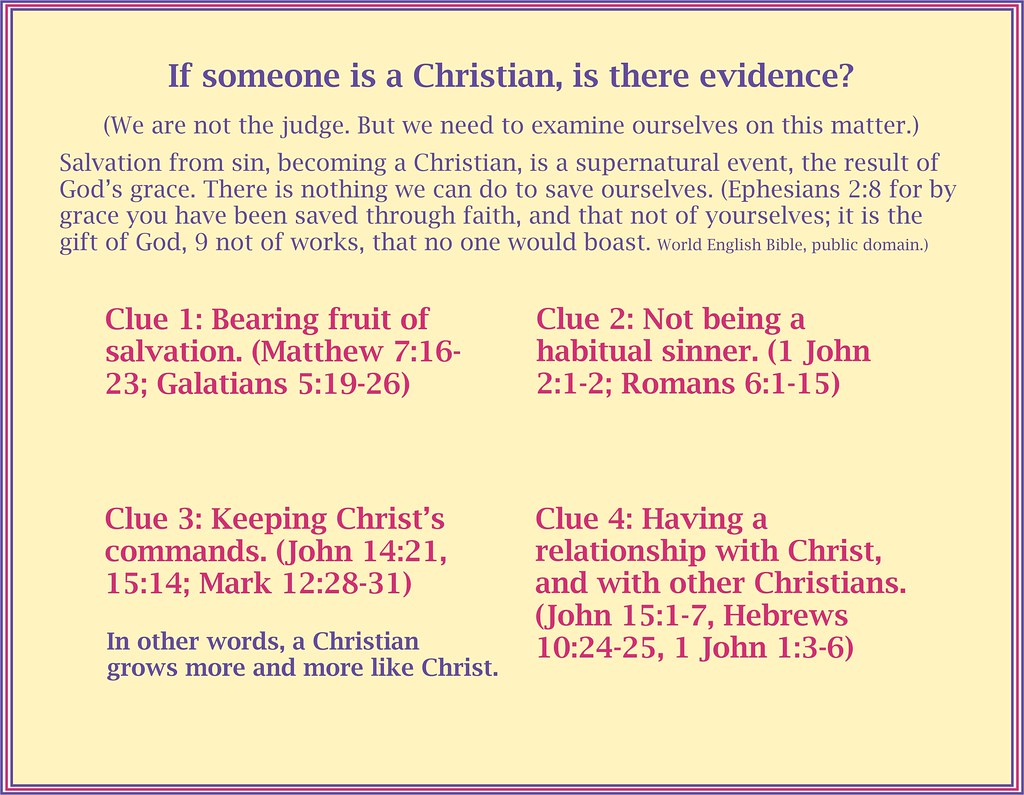
(The graphic above is a link to a larger version, which you are free to use for non-commercial purposes.)
Who is saved?
We cannot save ourselves, and the church cannot save us.
Salvation from sin is a supernatural event, the result of God’s grace. We can ask forgiveness for sin, and accept Christ’s atoning sacrifice, and the power of the resurrection. We need to do these things. But salvation is God’s work in us. (Ephesians 2:8 for by grace you have been saved through faith, and that not of yourselves; it is the gift of God, 9 not of works, that no one would boast. (Scripture quotations from the World English Bible, public domain)
Furthermore, raising our hands, saying a prayer, kneeling at a mourner’s bench, shaking a preacher’s hand, testifying to being saved, being baptized, having our names on a church roll do not and cannot save us, in and of themselves. (There is nothing wrong with these acts, or similar ones, and most converts ought to do most or all of them, especially baptism, but they don’t save us.) In other words, no one is saved because she thinks she is, or because he joined the church 15 years ago. If she or he is saved, it is because of God’s forgiveness. Whether we are saved or not is ultimately a question that only God can really answer. I once heard a Southern Baptist pastor say that about 50% of the people on the rolls of his church weren’t really saved. Why did he say that? Because, although they had participated in one or more of the acts listed above, they showed no evidence of salvation. (Southern Baptists are by no means alone in this!)
A person who is saved bears fruit of salvation
Matthew 13:18 “Hear, then, the parable of the farmer. 19 When anyone hears the word of the Kingdom, and doesn’t understand it, the evil one comes, and snatches away that which has been sown in his heart. This is what was sown by the roadside. 20 What was sown on the rocky places, this is he who hears the word, and immediately with joy receives it; 21 yet he has no root in himself, but endures for a while. When oppression or persecution arises because of the word, immediately he stumbles. 22 What was sown among the thorns, this is he who hears the word, but the cares of this age and the deceitfulness of riches choke the word, and he becomes unfruitful. 23 What was sown on the good ground, this is he who hears the word, and understands it, who most certainly bears fruit, and produces, some one hundred times as much, some sixty, and some thirty.”
Matthew 7:16 By their fruits you will know them. Do you gather grapes from thorns, or figs from thistles? 17 Even so, every good tree produces good fruit; but the corrupt tree produces evil fruit. 18 A good tree can’t produce evil fruit, neither can a corrupt tree produce good fruit. 19 Every tree that doesn’t grow good fruit is cut down, and thrown into the fire. 20 Therefore by their fruits you will know them. 21 Not everyone who says to me, ‘Lord, Lord,’ will enter into the Kingdom of Heaven; but he who does the will of my Father who is in heaven. 22 Many will tell me in that day, ‘Lord, Lord, didn’t we prophesy in your name, in your name cast out demons, and in your name do many mighty works?’ 23 Then I will tell them, ‘I never knew you. Depart from me, you who work iniquity.’
John 15:1 “I am the true vine, and my Father is the farmer. 2 Every branch in me that doesn’t bear fruit, he takes away. Every branch that bears fruit, he prunes, that it may bear more fruit. 3 You are already pruned clean because of the word which I have spoken to you. 4 Remain in me, and I in you. As the branch can’t bear fruit by itself, unless it remains in the vine, so neither can you, unless you remain in me. 5 I am the vine. You are the branches. He who remains in me, and I in him, the same bears much fruit, for apart from me you can do nothing. 6 If a man doesn’t remain in me, he is thrown out as a branch, and is withered; and they gather them, throw them into the fire, and they are burned. 7 If you remain in me, and my words remain in you, you will ask whatever you desire, and it will be done for you.
Jesus does not explain what “fruit” is. But He calls it “good fruit,” and says that we must remain in Him in order to produce it. The fruit is probably two related things: influencing people to be converted, and the Fruits of the Spirit, described in Galatians 5, which also describes bad fruit:
Galatians 5:19 Now the deeds of the flesh are obvious, which are: adultery, sexual immorality, uncleanness, lustfulness, 20 idolatry, sorcery, hatred, strife, jealousies, outbursts of anger, rivalries, divisions, heresies, 21 envy, murders, drunkenness, orgies, and things like these; of which I forewarn you, even as I also forewarned you, that those who practice such things will not inherit the Kingdom of God.
22 But the fruit of the Spirit is love, joy, peace, patience, kindness, goodness, faith, 23 gentleness, and self-control. Against such things there is no law. 24 Those who belong to Christ have crucified the flesh with its passions and lusts. 25 If we live by the Spirit, let’s also walk by the Spirit. 26 Let’s not become conceited, provoking one another, and envying one another.
A person who is saved is not a
habitual sinner.
(Note: To some people, sin is anything short of perfection – to them, honest mistakes, and
memory lapses, are sin. However, I am using a more restrictive definition, from
the Free Dictionary:
1. A transgression of a religious or moral law, especially when
deliberate.
2. Theology
a. Deliberate disobedience to the known will of God. b. A condition of estrangement from God resulting from such disobedience.
We should remember that there are sins of omission – things that we should do, but don’t – as well as sins of commission. See James 4:17 and Matthew 25:40-25.
Newly
saved people don't instantly become mature Christians. The Holy Spirit
works to develop us. Even mature Christians may newly realize some sin
as He reveals it to them. Psalm 86:11a Teach me your way, Yahweh.)
1 John 2:1 My little children, I write these things to you so that you may not sin. If anyone sins, we have a Counselor with the Father, Jesus Christ, the righteous. 2 And he is the atoning sacrifice for our sins, and not for ours only, but also for the whole world.
Romans 6:1 What shall we say then? Shall we continue in sin, that grace may abound? 2 May it never be! We who died to sin, how could we live in it any longer? 3 Or don’t you know that all we who were baptized into Christ Jesus were baptized into his death? 4 We were buried therefore with him through baptism to death, that just as Christ was raised from the dead through the glory of the Father, so we also might walk in newness of life. 5 For if we have become united with him in the likeness of his death, we will also be part of his resurrection; 6 knowing this, that our old man was crucified with him, that the body of sin might be done away with, so that we would no longer be in bondage to sin. 7 For he who has died has been freed from sin. 8 But if we died with Christ, we believe that we will also live with him; 9 knowing that Christ, being raised from the dead, dies no more. Death no more has dominion over him! 10 For the death that he died, he died to sin one time; but the life that he lives, he lives to God. 11 Thus consider yourselves also to be dead to sin, but alive to God in Christ Jesus our Lord. 12 Therefore don’t let sin reign in your mortal body, that you should obey it in its lusts. 13 Also, do not present your members to sin as instruments of unrighteousness, but present yourselves to God, as alive from the dead, and your members as instruments of righteousness to God. 14 For sin will not have dominion over you. For you are not under law, but under grace. 15 What then? Shall we sin, because we are not under law, but under grace? May it never be!
A person who is saved follows Christ’s commandments.
John 14:21
One who has my commandments, and keeps them, that person is one who loves me.
One who loves me will be loved by my Father, and I will love him, and will
reveal myself to him.”
23 Jesus
answered him, “If a man loves me, he will keep my word. My Father will love
him, and we will come to him, and make our home with him. 24 He who doesn’t
love me doesn’t keep my words.
John 15:14 You are my friends, if you do whatever I command you.
1 John 1:3 This is how we know that we know him: if we keep his commandments. 4 One who says, “I know him,” and doesn’t keep his commandments, is a liar, and the truth isn’t in him. 5 But whoever keeps his word, God’s love has most certainly been perfected in him. This is how we know that we are in him: 6 he who says he remains in him ought himself also to walk just like he walked.
Matthew 7:24 “Everyone therefore who hears these words of mine, and does them, I will liken him to a wise man, who built his house on a rock. 25 The rain came down, the floods came, and the winds blew, and beat on that house; and it didn’t fall, for it was founded on the rock. 26 Everyone who hears these words of mine, and doesn’t do them will be like a foolish man, who built his house on the sand. 27 The rain came down, the floods came, and the winds blew, and beat on that house; and it fell—and great was its fall.”
What are Christ’s commandments?
Many of them are found in the Sermon on the Mount (Matthew 5-7). Some of the commands in that Sermon are to keep our motives pure – don’t even want to commit adultery or murder; be reconciled to others, and forgive them; turn the other cheek; love even your enemies; don’t draw attention to your good deeds; don’t be anxious about worldly possessions; judge yourselves before judging others; beware of false prophets. He also told us to live the summary of the Old Testament Law:
Matthew 22:37 Jesus said to him, “‘You shall love the Lord your God with all your heart, with all your soul, and with all your mind.’ 38 This is the first and great commandment. 39 A second likewise is this, ‘You shall love your neighbor as yourself.’ 40 The whole law and the prophets depend on these two commandments.”
In Mark 12:14-19, Jesus commanded His listeners to honor the government, including paying taxes. We should remember that this was an occupying government, and its head was a Roman pagan emperor.
There are other commands, but one more is found in the last words of Matthew’s gospel: Matthew 28:19 Go, and make disciples of all nations, baptizing them in the name of the Father and of the Son and of the Holy Spirit, 20 teaching them to observe all things that I commanded you. Behold, I am with you always, even to the end of the age.” Amen.
A person who is saved continues in a relationship with Christ, and seeks the fellowship of other Christians.
John 15:1-7 (quoted above) uses the phrase “remain in me” or equivalent, seven times.
John 17:20 Not for these only do I pray, but for those also who believe in me through their word, 21 that they may all be one; even as you, Father, are in me, and I in you, that they also may be one in us; that the world may believe that you sent me. 22 The glory which you have given me, I have given to them; that they may be one, even as we are one; 23 I in them, and you in me, that they may be perfected into one; that the world may know that you sent me, and loved them, even as you loved me.
Hebrews 10:24 Let us consider how to provoke one another to love and good works, 25 not forsaking our own assembling together, as the custom of some is, but exhorting one another; and so much the more, as you see the Day approaching.
There are about 20 occurrences of groups of Christians being together in Acts. (See here.) Sometimes they met to worship, sometimes as a prayer meeting, sometimes to consider policy or doctrine. It was Paul’s practice to establish churches wherever he went as a missionary. Christ refers to seven churches in Revelation.
To summarize the evidences given above for being a Christian, a Christian becomes more and more like Christ. The Holy Spirit works in the life of a believer to bring these things about.
My conclusion is that as long as we remain in good relationship with God, we will keep Christ’s commandments, our lives will bear fruit, and we will not lose our salvation. Perhaps I ought to stop there, but the original question still remains. There are at least two views of the answer, both with Biblical support, but the question, and its answers, are trivial beside the more important question – am I saved now? Unfortunately, some people, who don't follow Christ's commandments, who do not have a relationship with Christ, who are persistent and unrepentant sinners, and whose lives show the wrong kind of fruit, are deluded by Satan into thinking that they are saved when they are not.
Thanks for reading!
Added October 26, 2012: You may want to see this post, on the warning passages in the book of Hebrews.
Added June 9, 2015: Neither the chart, nor the above discussion, consider baptism as evidence that one is a Christian. In Acts, baptism was perhaps the most important sign of being converted. Jesus commanded the church to baptize new believers. It's important! But what the chart and discussion are really about is ongoing evidence, up-to-date evidence. Baptism, for most believers, is a one-time event. The four evidences above are about our continuing life in Christ.
Tuesday, May 08, 2012
Dembski, Falk and Wood: Is Darwinism Theologically Neutral, part 2
In a previous post, I referred to a debate on origins through posts to the BioLogos Forum's blog. William Dembski, a mathematician, philosopher and theologian, and a proponent of Intelligent Design, wrote a position paper, at the request of the BioLogos Forum. In it, he argued that Darwinism is not theologically neutral. Darrel Falk, an official of that Forum, and probably best classified as an evolutionary creationist, responded. Todd Wood, a young-earth creationist, also reacted, in his own blog. I consider Wood's response in this post.
I suppose that I ought to say that one can believe that God is intelligent, and a designer, or creator, without agreeing with all of the positions of the Intelligent Design movement. The ID movement argues that it should be possible to find scientific evidence that God not only created life, but there is what Michael Behe has called irreducible complexity -- there are processes, or structures, that are so complex that they could not have arisen by natural selection, but that God must have intervened during their development, if they arose over a long period of time. (Some ID advocates also believe that the earth is only a few thousand years old, but some are not convinced of that. See here for information on ID, and here for some contrasts between ID and young-earth creationism.) ID scientists have actually not really come close to proving scientific evidence of God's intervention. They have, instead, tried to show that natural selection couldn't have produced some structures, or processes. Behe and Dembski are tow of the most important scientists who have attempted this. Their work has been seriously criticized by other scientists, Christian and not.
Dembski's paper is in two parts, here and here. Falk's response is also in two parts, here and here. Wood's reaction is here and here.
I first repeat the heart of Dembski's presentation, what he says are four non-negotiables of Christianity, and four of Darwinism:
Wood also believes that Dembski has misunderstood methodological naturalism, D4, and confused it with philosophical naturalism:
Methodological naturalism is an epistemological position that recognizes reasonable limitations to human abilities to sense the supernatural. In other words, methodological naturalism is a limitation on what I think I can know. How can that possibly "tie God's hands?" A consistent methodological naturalist when confronted with Christ's resurrection (or any miracle) could only say that science is extremely limited in such cases to understand what happened or how. There is no way that methodological naturalism could rule out the miraculous. That's what philosophical naturalism does.
See here for the Wikipedia article on Naturalism, which includes a discussion of methodological naturalism.
Perhaps most importantly, Wood is familiar with the writings of Darwin, and although he doesn't claim that Darwin was a Christian believer, he believes, and presents evidence to back it up, that Darwin was, like Einstein, sympathetic to the view that there was a Creator. Wood quotes from a letter Darwin wrote:
I can see no reason, why a man, or other animal, may not have been aboriginally produced by other laws; & that all these laws may have been expressly designed by an omniscient Creator, who foresaw every future event & consequence. But the more I think the more bewildered I become; as indeed I have probably shown by this letter.
I hope to deal with Falk's reaction to Dembski in a later post. Thanks for reading.
I suppose that I ought to say that one can believe that God is intelligent, and a designer, or creator, without agreeing with all of the positions of the Intelligent Design movement. The ID movement argues that it should be possible to find scientific evidence that God not only created life, but there is what Michael Behe has called irreducible complexity -- there are processes, or structures, that are so complex that they could not have arisen by natural selection, but that God must have intervened during their development, if they arose over a long period of time. (Some ID advocates also believe that the earth is only a few thousand years old, but some are not convinced of that. See here for information on ID, and here for some contrasts between ID and young-earth creationism.) ID scientists have actually not really come close to proving scientific evidence of God's intervention. They have, instead, tried to show that natural selection couldn't have produced some structures, or processes. Behe and Dembski are tow of the most important scientists who have attempted this. Their work has been seriously criticized by other scientists, Christian and not.
Dembski's paper is in two parts, here and here. Falk's response is also in two parts, here and here. Wood's reaction is here and here.
I first repeat the heart of Dembski's presentation, what he says are four non-negotiables of Christianity, and four of Darwinism:
Non-Negotiables of Christianity:
- (C1) Divine Creation: God by wisdom created the world out of nothing.
- (C2) Reflected Glory: The world reflects God’s glory, a fact that ought to be evident to humanity.
- (C3) Human Exceptionalism: Humans alone among the creatures on earth are made in the image of God.
- (C4) Christ’s Resurrection: God, in contravention of nature’s ordinary powers, raised Jesus bodily from the dead.
Non-Negotiables of Darwinism:
- (D1) Common Descent: All organisms are related by descent with modification from a common ancestor.
- (D2) Natural Selection: Natural selection operating on random variations is the principal mechanism responsible for biological adaptations.
- (D3) Human Continuity: Humans are continuous with other animals, exhibiting no fundamental difference in kind but only differences in degree.
- (D4) Methodological Naturalism: The physical world, for purposes of scientific inquiry, may be assumed to operate by unbroken natural law.
Wood also believes that Dembski has misunderstood methodological naturalism, D4, and confused it with philosophical naturalism:
Methodological naturalism is an epistemological position that recognizes reasonable limitations to human abilities to sense the supernatural. In other words, methodological naturalism is a limitation on what I think I can know. How can that possibly "tie God's hands?" A consistent methodological naturalist when confronted with Christ's resurrection (or any miracle) could only say that science is extremely limited in such cases to understand what happened or how. There is no way that methodological naturalism could rule out the miraculous. That's what philosophical naturalism does.
See here for the Wikipedia article on Naturalism, which includes a discussion of methodological naturalism.
Perhaps most importantly, Wood is familiar with the writings of Darwin, and although he doesn't claim that Darwin was a Christian believer, he believes, and presents evidence to back it up, that Darwin was, like Einstein, sympathetic to the view that there was a Creator. Wood quotes from a letter Darwin wrote:
I can see no reason, why a man, or other animal, may not have been aboriginally produced by other laws; & that all these laws may have been expressly designed by an omniscient Creator, who foresaw every future event & consequence. But the more I think the more bewildered I become; as indeed I have probably shown by this letter.
I hope to deal with Falk's reaction to Dembski in a later post. Thanks for reading.
Saturday, March 11, 2023
Women of the Bible: Martha
Luke 10:38 As they went on their way, he entered into a certain village, and a certain woman named Martha received him into her house. 39 She had a sister called Mary, who also sat at Jesus’ feet, and heard his word. 40 But Martha was distracted with much serving, and she came up to him, and said, “Lord, don’t you care that my sister left me to serve alone? Ask her therefore to help me.”
41 Jesus answered her, “Martha, Martha, you are anxious and troubled about many things, 42 but one thing is needed. Mary has chosen the good part, which will not be taken away from her.”
John 11: 11 Now a certain man was sick, Lazarus from Bethany, of the village of Mary and her sister, Martha. 2 It was that Mary who had anointed the Lord with ointment and wiped his feet with her hair, whose brother, Lazarus, was sick. 3 The sisters therefore sent to him, saying, “Lord, behold, he for whom you have great affection is sick.” 4 But when Jesus heard it, he said, “This sickness is not to death, but for the glory of God, that God’s Son may be glorified by it.” 5 Now Jesus loved Martha, and her sister, and Lazarus. 6 When therefore he heard that he was sick, he stayed two days in the place where he was. 7 Then after this he said to the disciples, “Let’s go into Judea again.”
8 The disciples asked him, “Rabbi, the Jews were just trying to stone you. Are you going there again?”
9 Jesus answered, “Aren’t there twelve hours of daylight? If a man walks in the day, he doesn’t stumble, because he sees the light of this world. 10 But if a man walks in the night, he stumbles, because the light isn’t in him.” 11 He said these things, and after that, he said to them, “Our friend, Lazarus, has fallen asleep, but I am going so that I may awake him out of sleep.”
12 The disciples therefore said, “Lord, if he has fallen asleep, he will recover.”
13 Now Jesus had spoken of his death, but they thought that he spoke of taking rest in sleep. 14 So Jesus said to them plainly then, “Lazarus is dead. 15 I am glad for your sakes that I was not there, so that you may believe. Nevertheless, let’s go to him.”
16 Thomas therefore, who is called Didymus, said to his fellow disciples, “Let’s go also, that we may die with him.”
17 So when Jesus came, he found that he had been in the tomb four days already. 18 Now Bethany was near Jerusalem, about fifteen stadia[b] away. 19 Many of the Jews had joined the women around Martha and Mary, to console them concerning their brother. 20 Then when Martha heard that Jesus was coming, she went and met him, but Mary stayed in the house. 21 Therefore Martha said to Jesus, “Lord, if you would have been here, my brother wouldn’t have died. 22 Even now I know that whatever you ask of God, God will give you.” 23 Jesus said to her, “Your brother will rise again.”
24 Martha said to him, “I know that he will rise again in the resurrection at the last day.”
25 Jesus said to her, “I am the resurrection and the life. He who believes in me will still live, even if he dies. 26 Whoever lives and believes in me will never die. Do you believe this?”
27 She said to him, “Yes, Lord. I have come to believe that you are the Christ, God’s Son, he who comes into the world.”*
28 When she had said this, she went away and called Mary, her sister, secretly, saying, “The Teacher is here and is calling you.”
29 When she heard this, she arose quickly and went to him. 30 Now Jesus had not yet come into the village, but was in the place where Martha met him. 31 Then the Jews who were with her in the house and were consoling her, when they saw Mary, that she rose up quickly and went out, followed her, saying, “She is going to the tomb to weep there.” 32 Therefore when Mary came to where Jesus was and saw him, she fell down at his feet, saying to him, “Lord, if you would have been here, my brother wouldn’t have died.”
33 When Jesus therefore saw her weeping, and the Jews weeping who came with her, he groaned in the spirit, and was troubled, 34 and said, “Where have you laid him?” They told him, “Lord, come and see.”
35 Jesus wept.
36 The Jews therefore said, “See how much affection he had for him!” 37 Some of them said, “Couldn’t this man, who opened the eyes of him who was blind, have also kept this man from dying?”
38 Jesus therefore, again groaning in himself, came to the tomb. Now it was a cave, and a stone lay against it. 39 Jesus said, “Take away the stone.”
Martha, the sister of him who was dead, said to him, “Lord, by this time there is a stench, for he has been dead four days.”
40 Jesus said to her, “Didn’t I tell you that if you believed, you would see God’s glory?”
41 So they took away the stone from the place where the dead man was lying. Jesus lifted up his eyes, and said, “Father, I thank you that you listened to me. 42 I know that you always listen to me, but because of the multitude standing around I said this, that they may believe that you sent me.” 43 When he had said this, he cried with a loud voice, “Lazarus, come out!”
44 He who was dead came out, bound hand and foot with wrappings, and his face was wrapped around with a cloth.
Jesus said to them, “Free him, and let him go.”
45 Therefore many of the Jews who came to Mary and saw what Jesus did believed in him.
John 12:12 Then six days before the Passover, Jesus came to Bethany, where Lazarus was, who had been dead, whom he raised from the dead. 2 So they made him a supper there. Martha served, but Lazarus was one of those who sat at the table with him. 3 Therefore Mary took a pound[a] of ointment of pure nard, very precious, and anointed Jesus’s feet and wiped his feet with her hair. The house was filled with the fragrance of the ointment.
*This may have been the first statement of belief in the adult Christ -- there were other statements about his status near the time He was born -- as Son of God. Peter made a similar statement, but I don't know whether he, or Martha, was first, or if the first such influenced the other. (See Matthew16:16, Mark 8:29, Luke 9:20, John 4:42.)
Subscribe to:
Posts (Atom)