License

I have written an e-book, Does the Bible Really Say That?, which is free to anyone. To download that book, in several formats, go here.
Creative Commons License
The posts in this blog are licensed under a Creative Commons Attribution-NonCommercial-ShareAlike 3.0 Unported License. You can copy and use this material, as long as you aren't making money from it. If you give me credit, thanks. If not, OK.
Showing posts with label Philip Yancey. Show all posts

Wednesday, February 22, 2023

Sunspots 924

Things I have recently spotted that may be of interest to others*:


Christianity: Philip Yancey, one of my favorite authors, has Parkinson's. He reflects on that situation for Christianity Today.

Computing: Gizmodo reports that an artificial intelligence managed to pass a qualifying medical exam.

Education: Grammarphobia explains why the letter W is called "double U," rather than "double V."

Environment: Gizmodo  reports on breakdown of plastic waste, in oceans, by sunlight and bacteria.

A Conversation writer says that truck crashes involving hazardous material are more common than train wrecks of that type. Train wrecks just get more headlines.

Finances: (or something) Gizmodo reports on a large study of changing from a 5-day to 4-day work week.:

Health: The Scientist tells us that syphilis cases are on the rise.

Politics: FiveThirtyEight discusses four factions of House Democrats.

NPR reports (and other outlets also report) that Fox News on-line personalities knew that there was no evidence that the 2020 election had been "stolen," but acted as if their was.

A The Conversation writer discusses the clothing worn by First Ladies.

Politico describes what happened when far right people took control of county government in a Michigan district.

Sports: A basketball that doesn't need (or can't) be blown up has been developed.

*I try not to include items that require a password or fee to view.

Thanks for reading.


Tuesday, May 03, 2016

Equipment and character for following Christ


Our Tools and Power - we have been given enough equipment to follow Christ
Ephesians 1:19b the exceeding greatness of his power toward us who believe, according to that working of the strength of his might 20a which he worked in Christ, when he raised him from the dead

Luke 12:11a “… don’t be anxious how or what you will answer, or what you will say; 12 for the Holy Spirit will teach you in that same hour what you must say.”

Colossians 1:9 For this cause, we also, since the day we heard this, don’t cease praying and making requests for you, that you may be filled with the knowledge of his will in all spiritual wisdom and understanding, 10 that you may walk worthily of the Lord, to please him in all respects, bearing fruit in every good work and increasing in the knowledge of God,

Galatians 5:22 But the fruit of the Spirit is love, joy, peace, patience, kindness, goodness, faith, 23a gentleness, and self-control. (These fruits are tools for following Christ -- see below.)

1 Peter 4:10 As each has received a gift, employ it in serving one another, as good managers of the grace of God in its various forms. 11b … that in all things God may be glorified through Jesus Christ, to whom belong the glory and the dominion forever and ever. Amen.

Ephesians 6:10 Finally, be strong in the Lord, and in the strength of his might. 11 Put on the whole armor of God, that you may be able to stand against the wiles of the devil. 12 For our wrestling is not against flesh and blood, but against the principalities, against the powers, against the world’s rulers of the darkness of this age, and against the spiritual forces of wickedness in the heavenly places. 13 Therefore put on the whole armor of God, that you may be able to withstand in the evil day, and having done all, to stand. 14 Stand therefore, having the utility belt of truth buckled around your waist, and having put on the breastplate of righteousness, 15 and having fitted your feet with the preparation of the Good News of peace, 16 above all, taking up the shield of faith, with which you will be able to quench all the fiery darts of the evil one. 17 And take the helmet of salvation, and the sword of the Spirit, which is the word of God;

Our Character: When I ask, “Tell me the first word that comes to your mind when I say Christian,” not one time has someone suggested the word love. – Philip Yancey, Vanishing Grace: What Ever Happened to the Good News?
But: 1 John 4:8 He who doesn’t love doesn’t know God, for God is love.

Thanks for reading. Be equipped!


Friday, February 21, 2014

What Christians should pray for in our private prayers, according to Philip Yancey


The graphic above is also a link to my Flickr photostream, where it is available in larger sizes.

In his excellent book, Prayer: Does It Make Any Difference? (Grand Rapids: Zondervan, 2006. See here for the book's web site.) Philip Yancey has a chapter on "What to Pray For." In it, he discusses these appropriate subjects for prayer:
Heart Desire
Yancey writes: "What is the point of prayer if not to express our heart's desire, especially when it matches what we know to be God's will on earth?" Of course, many of my prayers, and probably many of yours, are for things about which we do not know God's will for certain.
Peace, or Trust
Here Yancey is not speaking of world peace, but of praying for peace, because we believe that the matter we are praying about, whatever it may be, is in God's good hands.
Faith, or Trust
Yancey describes a special kind of faith, which he calls fidelity - "a hang-on-by-the-fingernails faith against all odds, no matter the cost."
Complaint, or Lament
Many prayers in the Bible are complaints to God, such as the book of Lamentations, a good many of the Psalms, and the complaints of Mary and Martha about the death of Lazarus. We think that God should have acted, and He doesn't seem to have done so.
God's presence Yancey believes that we should pray that the Holy Spirit would live through us. We must act that way, too!
Compassion
The author describes his own prayers for AIDS victims in Africa as an example. He says that he prays for health-care workers, and for philanthropic and governmental activity aimed at helping AIDS victims, and prevention.
Grace
No one deserves God's grace, but we should pray for it for ourselves, because God gives it to us, and no one deserves it. Paul prayed for grace for the new churches, in his letters.
Preparations
By this, Yancey means praying that we may be prepared for death, of ourselves, or of those we care for. He isn't talking about praying that we will go to heaven. He is telling me that I should pray that I will have a Christ-like attitude toward those around me as I begin to suffer from whatever it is that will end my life, and that I will manifest a Christ-like attitude toward anyone in that state, for example with dementia, if it becomes my responsibility to care for them.
Gratitude
Probably no one is as grateful to God as much as she should be, or grateful for all the things she should be. We take so much for granted -- air, beauty, water, the ability to listen and look, for example.

A great deal more could be said about each of these topics, and Yancey has said quite a bit about each of them.

Yancey writes: "At its best, my prayer does not seek to manipulate God into doing my will -- quite the opposite. Prayer enters the pool of God's own love and widens outward."

I have previously posted on what the New Testament church prayed for. There's almost no overlap with Yancey's discussion, in part because he is writing about personal prayer. I have also posted on the ACTS scheme of praying.

I originally posted this a few days ago, saying that I expected to modify the post in the near future, adding a graphic, and more explanation. I have added the graphic, and re-worked the post, on February 26, 2014. Thanks for reading, and looking!

Sunday, January 09, 2011

ACTS: Adoration, Confession, Thanksgiving, Supplication

ACTS  praying

You can see a larger version of this graphic by using it as a link.

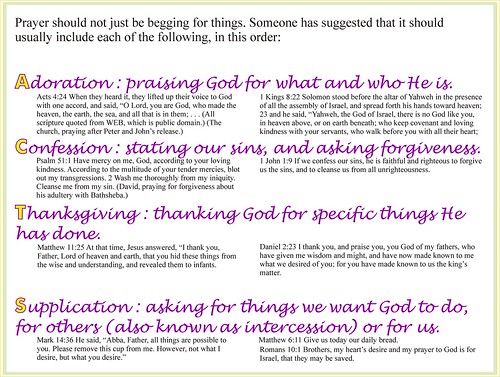
All too many of our prayers are asking for something, and, further, asking for ourselves, or our immediate associates. Someone -- I'm not sure who -- suggested that we use ACTS as an acrostic for some of our prayers: Adoration, Confession, Thanksgiving and Supplication. It's a good idea. We don't adore, confess, and thank God nearly enough, or at least I don't.

Adoration: praising God for what and who He is. Here are some ideas on doing that.
Confession: stating our sins, and asking forgiveness.
Thanksgiving: thanking God for specific things He has done.
Supplication: asking for things we want God to do, for others (also known as intercession) or for us.

The poster above includes some biblical examples of these types of prayers. 

The last type of prayer is only intercession when it's for someone else.

The verses used (from the WEB, which is public domain) are as follows:
Acts 4:24 When they heard it, they lifted up their voice to God with one accord, and said, “O Lord, you are God, who made the heaven, the earth, the sea, and all that is in them;

I Kings 8:22 Solomon stood before the altar of Yahweh in the presence of all the assembly of Israel, and spread forth his hands toward heaven; 23 and he said, “Yahweh, the God of Israel, there is no God like you, in heaven above, or on earth beneath; who keep covenant and loving kindness with your servants, who walk before you with all their heart;

Psalm 51:1 Have mercy on me, God, according to your loving kindness. According to the multitude of your tender mercies, blot out my transgressions. 2 Wash me thoroughly from my iniquity. Cleanse me from my sin.

1 John 1:9 If we confess our sins, he is faithful and righteous to forgive us the sins, and to cleanse us from all unrighteousness.

Matthew 11:25 At that time, Jesus answered, “I thank you, Father, Lord of heaven and earth, that you hid these things from the wise and understanding, and revealed them to infants.

Daniel 2:23 I thank you and praise you, the God of my fathers, who has given me wisdom and might, and has now made known to me what we desired of you; for you have made known to us the king’s mind.”

Mark 14:36 He said, “Abba, Father, all things are possible to you. Please remove this cup from me. However, not what I desire, but what you desire.”

Matthew 6:11 Give us today our daily bread.

Romans 10:1 Brothers, my heart’s desire and my prayer to God is for Israel, that they may be saved. 10:2 For I testify about them that they have a zeal for God, but not according to knowledge.

Thanks for reading. I wish I practiced this more. This will serve as part of my series on prayers in the Bible. I expect to use some of these texts in separate posts later.

The first post in this series is here.

A Flickr contact of mine referred me to an article in the New York Times. ("The Right Way to Pray," Sept. 16,2009, by Zef Chafets, who quotes Rabbi Marc Gellman in the following excerpt)

". . . really, when you come right down to it, there are only four basic prayers. Gimme! Thanks! Oops! and Wow! . . . Wow! are prayers of praise and wonder at the creation. Oops! is asking for forgiveness. Gimme! is a request or a petition. Thanks! is expressing gratitude. That’s the entire Judeo-Christian doxology.. . ." These four types correspond to the four in the ACTS acronym.

Added February 3rd, 2014: In Prayer: Does it Make Any Difference? (Grand Rapids, MI: Zondervan, 2006) by Philip Yancey, the author says that Rosalind Rinker used these four stages, or types of prayer:
1. Jesus is here (Matthew 18:19-20)
2. Help me, Lord (James 5:13-16)
3. Thank you, Lord (Philippians 4:4-7)
4. Help my brother (Mark 11:22-25) (Chapter 13, "Prayer Grammar")

On February 19, 2015, I added material to the opening section.

Wednesday, December 02, 2009

Sunspots 237

Things I have recently spotted that may be of interest to someone else:


Science:
(sort of) Wired shows us photos of some really big mechanical devices (using device loosely -- the first one is a cargo plane).

NPR reports on experiments showing that ants are able to keep track of the number of steps they have taken away from their anthill.


Christianity:
Jan paid her tithe, and tells us what happened.

Philip Yancey has written his last column, for a while, anyway, for Christianity Today . He takes a thoughtful look at the way evangelical Christians do things, and is not altogether pleased.

Image source (public domain)

Wednesday, April 15, 2009

Sunspots 207


Things I have recently spotted that may be of interest to someone else:


Science:
NPR reports that there are two kinds of fat. Obese people have very little of one kind, brown fat, the "good kind," which can burn off energy, and help us keep warm.

Computing:
Wired reports that the Library of Congress has come to YouTube, with some really old, and pioneering videos, including the first such ever made.

Literature:
(or Art, in this case) Catez considers some issues raised by Slumdog Millionaire.

Christianity:
Philip Yancey has a splendid essay in First Things, on what art can and can't do, and other questions, such as the influences that led to his conversion.


Image source (public domain)