Musings on science, the Bible, and fantastic literature (and sometimes basketball and other stuff).
God speaks to us through the Bible and the findings of science, and we should listen to both types of revelation.
The title is from Psalm 84:11.
The Wikipedia is usually a pretty good reference. I mostly use the World English Bible (WEB), because it is public domain. I am grateful.
License
I have written an e-book, Does the Bible Really Say That?, which is free to anyone. To download that book, in several formats, go here.

The posts in this blog are licensed under a Creative Commons Attribution-NonCommercial-ShareAlike 3.0 Unported License. You can copy and use this material, as long as you aren't making money from it. If you give me credit, thanks. If not, OK.

The posts in this blog are licensed under a Creative Commons Attribution-NonCommercial-ShareAlike 3.0 Unported License. You can copy and use this material, as long as you aren't making money from it. If you give me credit, thanks. If not, OK.
Showing posts with label 2000 or more views. Show all posts
Friday, December 27, 2019
Environmental Stewardship in the Bible, re-post
We have God-given responsibilities to non-human organisms
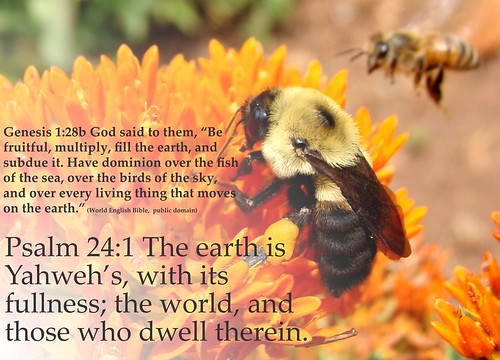
Genesis 1:26-28 seems to indicate clearly that humans were placed in charge of the non-human world. Psalm 8:6 reiterates that idea. Psalm 24:1 indicates that even though we are, in some sense, in charge, the world, and the things in it, are God’s. So does Psalm 50:10,11.* The story of Noah seems to indicate that, at one point, humans were directly responsible for the lives of many kinds of animals. Genesis 7:2-5, 14-16, Proverbs 12:10 and Proverbs 27:23 all have to do with caring for animals.
God seems to care not just for animals in general, but for kinds of animals. Psalms 104:24-25 praises God for the diversity of His creation, and His creatures. Since this explicitly includes the wide variety of ocean animals, it doesn’t seem possible that this praise is meant to be only because of their usefulness to humans. Genesis 7:3, 14-16 indicate God’s concern that the different kinds of animals would be preserved. Genesis 8:1 says that God had not forgotten Noah or the animals. Noah and his family were God’s agents in this care, of course, but they were God-directed agents. It would seem reasonable to argue that in our day, we also have responsibilities to the kinds of animals that exist in our time.
Does God care for individual non-human organisms? Perhaps. The question seems to be addressed in Matthew 10:29, which says that even individual sparrows do not fall without God’s knowledge. (Two verses later, Christ stated that the twelve were of more value than many sparrows. However, He didn’t say that sparrows were valueless.)
Does God’s care, and the care that humans are supposed to have, mean that we must refrain from killing animals deliberately? Apparently not. Jesus certainly condoned fishing (John 21:6, Matthew 17:27, Luke 5:4). He ate (Luke 24:36-43), and probably fished (John 21:9) even after His resurrection. Peter's vision, after the resurrection, and after Pentecost, used eating meat as a sign that God does not show favoritism (Acts 11:1-18). Paul referred disparagingly to people who forbid eating meat (I Timothy 4:1-3). There are no explicit commands forbidding the consumption of all meat in the Bible. This is not to say that the Bible condones killing of animals wantonly. That would be contradictory to benign dominion. Nor does the Bible condone consumption of animal flesh (or any other kind of food) selfishly, or to excess. But we are allowed to kill non-human organisms for cause, at least. Such causes include killing an animal because it threatens a human (Exodus 21:29), killing for meat (Genesis 9:2-3, Leviticus 11:1-22) and killing an animal for its skin (Genesis 3:21). Exodus 12:21-23 and 12:46, and Mark 14:12, indicate clearly that the Passover, one of the most important ceremonies of the Jews, and the last ceremony Jesus performed with His disciples, involved eating meat. The Bible is very clear that humans and animals are not equals. Christ came in human form, principally to redeem humans, although the effects of redemption will be felt through all of creation. We have dominion over animals, not the reverse. That dominion implies responsible use, including research and killing for good cause. (Nothing in this paragraph rules out the practice of vegetarianism. Some Christians may decide, or God may reveal to them, that they shouldn't eat meat. But they cannot prove that Scripture demands that Christians don't eat meat.)
Does God’s care extend to plants? To non-living entities? (The Bible, like present-day people, is more concerned with some kinds of animals than others. There is little, if any, mention of mollusks in scripture, for instance.) The Bible mentions God’s care of plants (Psalm 104:16, Matthew 6:30). It also states that everything He created was initially good (Genesis 1:31) and that creation as a whole, not just humans, groans, waiting for restoration (Romans 8:22). It is true that the Bible does not dwell on plants nearly as much as on animals. The creation of plants gets only one phrase in the Genesis account, whereas the creation of animals gets several. There is no mention of God’s concern for plants during the flood, nor are certain kinds of plants declared unclean in the Mosaic dietary laws. All this means that the Hebrews, like ourselves, were more interested in animals than in plants. Perhaps it means that God is also more interested.
From the above, we conclude that God’s care extends beyond humans, certainly to animals. Scripture is less explicit about God’s care for plants, and even less so about His care for rocks, streams, and clouds. However, there seems no reason to expect God to condone wanton destruction of any kind. If God cares for non-human creations, and we are responsible for His creation, then it behooves us to care for non-human creations as well. Proverbs 12:10 says that good people care for their domestic animals, and bad people are cruel to theirs. Caring for animals is usually consistent with caring for plants, or for rocks, streams and clouds. II Chronicles 36:21 tells us that the 70 years that the Israelites were to spend in captivity was not an arbitrary figure. God chose that because his people did not care for the land as he instructed them to. Jeremiah 2:7 and Habakkuk 2:17 condemn the Israelites because they hadn’t taken care of their land.
New Testament teaching on care of the environment
Most of the usual teaching on what the Bible says about care of the environment is from the Old Testament. However, there are two passages from the New Testament that also argue that we should be caring carefully for the environment. They are indirect, but their urgency is important.
Romans 1:20 tells us that observing and learning about nature are part of God’s revelation to humans. (So does Psalm 19:1-4). If that is so, isn’t that another reason to try to preserve nature as well as we can? The Bible is one of the ways that God reveals Himself to us. For a long time, Christians have believed that the Bible should be translated into the language people are most familiar with, so that that revelation may be as clear as possible. Similarly, it would seem that God's revelation through nature should be as clear as possible. A person is more likely to see God in a pristine stream than in a polluted river. Probably seeing bison herds roam freely in Western North America gave people a glimpse of one aspect of God’s power and majesty that they can’t really get now. Therefore, helping to preserve nature in as good a condition as we can is one way to bring people to a saving knowledge of Christ. Not the most direct way, and probably not the most effective, for many people, but it is still a way to do this.
Colossians 1:15-20 says, of Christ, that “in Him all things hold together.” (ESV -- other versions have similar language.) That passage also says that He is working to reconcile all things to Himself, and working to make peace through the blood of the cross. As Christians, we believe that it is our duty to be His instruments in reconciling sinners to Christ, and to help Him in the ministry of making peace. In fact, 2 Corinthians 5:18-19, tell us that: 18 But all things are of God, who reconciled us to himself through Jesus Christ, and gave to us the ministry of reconciliation; 19 namely, that God was in Christ reconciling the world to himself, not reckoning to them their trespasses, and having committed to us the word of reconciliation.
Doesn’t it follow that we should also participate in Christ’s work of sustaining “all things,” including endangered species and ecosystems or biological communities? (I realize that there are other places in the New Testament where reconciliation and peacemaking are mentioned, or implied, and this is probably the only one that mentions Christ's sustaining work. But that doesn't mean that His sustaining work can be dismissed, or that we have no responsibility to be His instruments in doing it.)
What must we do when our responsibilities seem to conflict?
One response is to ask, do they ever really conflict? We believe that our responsibilities do, in fact, appear to conflict, in these matters, and in others. As fallen, finite beings, we do not always interpret God’s directions correctly. We certainly do not know enough to always judge correctly. If we did possess the ability to decide correctly in all cases, perhaps God’s demands on us would never even seem to conflict. However, we can’t, and they do seem to conflict. Perhaps, this being a fallen world, they actually conflict.
The Bible does not present a formal hierarchy of principles to guide our behavior, in matters of environmental ethics, or in other matters. It does not tell us how to choose when, for instance, a decision we make will lead to either 5 minutes of misery for each of 2000 people, or 3 days of misery for a single individual. It does not tell us what to do when bringing a field under cultivation will help to feed hungry people, but also will kill native plants, deprive animals of homes, and use petroleum resources. As fallen beings in a fallen world, it is probably too much to expect that all our decisions will be correct.
Here are some attempts at principles which may be of help in making decisions about environmental matters:
This world is temporary. Temporal concerns of any kind should be carefully weighed against eternal values. The fossil record indicates that more species have become extinct than are now alive, and usually not because humans caused the extinction. This doesn’t excuse us from trying to save the organisms that live in our time, of course.
We should recognize that environmental concerns are sometimes overstated, not prioritized, or controversial. Some would have us believe that humans are choking to death and swimming in carcinogens. This is overstatement. The atmosphere may not be as clear as it ought to be, and we may indeed be exposed to cancer-causing substances, but people in North America are living longer than ever before. It seems certain that we can’t cure every ill, environmental or otherwise. Is it more important to try to stop global warming, to save the California condor, or to cut down on our consumption of fossil fuels? Is the cost, or risk, from pollution to landfills from disposable diapers more or less than the pollution to water from washing non-disposable ones? No one seems to know the answers. Solutions are not prioritized. We must be careful not to act precipitously just because someone has a concern.
Selfishness is wrong. Most North Americans seem to subconsciously believe that we are somehow entitled to more possessions than people in other parts of the world. Such a life style contributes to environmental degradation. It may also deprive people in other parts of the world, or future generations, of resources. It may mean that our church, and other charitable causes, do not have funds that we could well afford to give. We may not personally be able to change the way the world works very much. We can change it a little, and we should. We can avoid conspicuous consumption, we can avoid wanting things simply because they are newer than the things we already have. We can participate in recycling, even if it requires some effort on our part. We can think carefully about every purchase we make.
Isaiah 5:8-10 is a warning to the Hebrews. It tells them that God doesn’t condone selfishness in material things, including use of land. It predicts that the land will stop yielding enough, as God’s punishment for selfishness.
Knowledge is necessary. We are in God’s image. Part of the reflection of the omniscient God in us is the desire for knowledge. The Bible speaks approvingly of Solomon’s knowledge of the natural world (I Kings 4:32-33). We should learn to appreciate the world as God made it, and this requires knowledge of it. Knowledge is also necessary for wise alleviation of our own mistakes.
Unselfish love is a scriptural requirement. This unselfish love ought to color our relationships with others in every area, certainly including our environmental activities. It is not clear that we can, or ought, to have a relationship of unselfish love with non-human organisms, but it would seem consistent with God’s expectation of us that we act unselfishly toward non-human organisms.
We need guidance from God. All our important decisions need His help. Even with this guidance, we don’t always agree. God may well want some of us to be deeply involved in helping crisis pregnancies, but others to try to help clean up the environment. This doesn’t mean that both groups can’t assist in both efforts, but God may give our lives different emphases.
Having stated these principles, we realize anew that it is difficult to apply them to cases. In many cases, all we can say is “God help us.”
The Bible does not rule out the use of current technology, and the development of new technology
Since the development and use of technology has often been related to use of valuable resources, or contributed to greater “efficiency” in despoiling the landscape, we certainly need to be careful in developing and using technology, for our own sake, as well as that of the landscape. Is technology anti-God? The answer to that question seems to be “it depends.”
There are three biblical passages that indicate reasons why particular technological development may be wrong.
First, worshiping the results of our technology is clearly wrong, as well as just plain stupid (Isaiah 44:9-20).
Second, pride in our accomplishments is wrong (Daniel 4:30-32).
Third, supposing that there are no limits to human ability is wrong (Genesis 11:5-9).
On the other hand, there are biblical reasons for supposing that technological development is not always wrong, and, in fact, can sometimes glorify God. Noah’s ark, the tabernacle, and the temple, were technological constructs, and God gave instructions for the building of each of them. In fact, in the building of the temple, and other projects completed during the reign of Solomon, there was apparently extensive use of resources. Solomon sent 10,000 workers to Lebanon to cut down cedar trees each month (I Kings 5:14), in addition to the servants of King Hiram who helped them. They may have worked there for as long as seven (I Kings 6:38) or even twenty years (II Chronicles 8:1). All this was at least allowed by God, and some of it was directed by Him. Jeremiah 22:6 contains an amazing statement. This verse says that God finds the royal palace at Jerusalem as beautiful as the mountains of Lebanon. It would seem that technological development, by and of itself, is not wrong, although it may be done for wrong reasons, or with the wrong attitude.
Part of the image of God in humans is the desire to create things. The fact that we can create and use technology has certainly lead to some unfortunate consequences, such as deaths and injuries in highway accidents. However, it may also lead to some fortunate consequences, such as our being able to alleviate some of the consequences of our own mistakes of the past, or even some of the consequences of the fall.
+ + + + +
April 23, 2011:
On an earlier date, links to all the scripture referenced in this post, using the English Standard Version, were added. (See here for the ESV policy on copyright.) The section on New Testament teaching on care of the environment was inserted on this date. It had been part of a previous post. That post is still on-line. I have not removed any of the comments from the previous version of this post.
Thanks for reading!
*Added October 15, 2014: More scripture on God's ownership, and our stewardship: Jeremiah 27:5 ‘I have made the earth, the men, and the animals that are on the surface of the earth by my great power and by my outstretched arm. I give it to whom it seems right to me. 6 Now I have given all these lands into the hand of Nebuchadnezzar the king of Babylon, my servant. I have also given the animals of the field to him to serve him. (World English Bible, public domain)
Added April 20, 2017: E. Stephen Burnett has written a fine blog post on how care of the current earth relates to the New Earth.
Added December 27, 2019: Nancy Sleeth, in Relevant, demolishes some objections some Christians raise (such as "It's all going to be destroyed in the end, so why care for earth?")
This post originally appeared on April 22, 2006. I have re-posted it, after reading Sleeth's article. To see comments prior to December 2019, use the link in the previous sentence. Thanks for reading.
Wednesday, July 05, 2017
Sunspots 633
Things I have recently spotted that may be of interest to someone else:
The Arts: On The Writer's Almanac, Garrison Keillor reads a fine short poem, and discusses the beginning of National Parks in the U. S., and other things.
Christianity: Andy Crouch discusses the Creation in a thought-provoking and stimulating post from BioLogos.
Computing: Wired considers the possibility of having a simpler smartphone.
A Wired writer asked a cybersecurity company to send him phishing e-mails. He almost got caught.
Ethics: Wired has an essay on the ethics of the lies told by President Trump, and other people. The article references what some church fathers had to say on the subject of lying.
Food: National Public Radio reports that India is having political, religious, and economic disagreements over the use of cows as meat.
Humor: Relevant warns us of serious theological problems with fidget spinners.
(or something) Wired shows us a photo of an amazing "bicycle graveyard" in China.
Politics: Relevant on the danger of Christians entertaining conspiracy theories.
Image source (public domain)
Labels:
2000 or more views,
bicycles,
conspiracy theories,
creation,
Donald Trump,
ethics,
Genesis 1,
India,
lies,
links,
lying,
National Parks,
phishing,
poetry,
sacred cows
Wednesday, June 28, 2017
Sunspots 632
Things I have recently spotted that may be of interest to someone else:
Christianity: Relevant and Sojourners report that many evangelical organizations are calling for prison and sentencing reform -- there are too many people in prison for too long, and too many of them are African-American. Attorney General Sessions, on the other hand, seems to want to put as many people behind bars as possible, for as long as possible.
An article in Christianity Today argues that most evangelical Christians have either mostly ignored social injustices, or ignored Biblical principles about sex and family matters.
Computing: The Wikipedia is has competition various right-wing on-line encyclopedias, according to Wired.
(sort of) National Public Radio reports that a man has been fined $120,000,000 for placing millions of robocalls, including some to emergency numbers and hospitals.
Education: "Why teachers suck."
History: Listverse discusses 10 things about our history that most of us get wrong.
Politics: Sojourners reports that a broad coalition of Christians is expressing united opposition to the President's budget, and to the House's health-care bill, and warning against what they believe to be coming in the Senate version of this bill. Their chief complaint is that help for the poor would be cut drastically. (Note - budgets submitted by Presidents rarely, if ever, are approved without significant changes.)
Relevant says that it's time for the church to address gun violence.
National Public Radio reports on a survey, which indicates that more than 80% of Americans believe people with mental illness should not be allowed to have guns; background checks should be done for private sales and gun shows; and guns should not be sold to people on no-fly or terror watch lists.
Science: The Anchorage Daily News reports on how killer whales are interfering with fishermen, apparently communicating with each other, and teaching their young in interference techniques.
National Public Radio reports on why different bird species have eggs with different shapes.
Image source (public domain)
Labels:
2000 or more views,
eggs,
gun control,
gun violence,
Healthcare,
history,
killer whales,
links,
Politics,
prison,
robocalls,
sentencing,
teaching,
Wikipedia
Wednesday, June 21, 2017
Sunspots 631
Things I have recently spotted that may be of interest to someone else:
Christianity: Relevant reports that Congressional Democrats gathered to pray for Representative Scalise after the Alexandria shooting.
Relevant also asks if we need to go to church every Sunday.
A Relevant commentator points out that the oft-given advice to "always believe in yourself," is not very good advice.
And, again, it's Relevant (and other sources) reporting on the Southern Baptist denunciation of racism, including the so-called alt-Right movement.
Computing: Wired reports that the U. S. Supreme Court has ruled, unanimously, that a person, even a sex offender, cannot be barred from having a Facebook account. Such a prohibition would violate his freedom of speech. (He can be barred from contacting minors, and from some other activities on-line.)
Health: You may remember the tricorders used for non-invasive medical diagnosis in Star Trek. Scientific American says that we are getting there, in developing such devices.
Listverse discusses 10 theories on why we dream.
History: Listverse tells us about 10 times when a contest was won by a single vote.
Politics: An analysis by FiveThirtyEight indicates that President Trump's win, and his rhetoric, have made Europe less nationalistic -- politicians praised by Mr. Trump have lost ground in polls and in votes.
(sort of) A photo of Paul Ryan, Chuck Schumer, Mitch McConnell and Nancy Pelosi, smiling together at the recent congressional baseball game.
Science: Scientific American reports that we have discovered 69 moons that orbit Jupiter.
Scientific American also has an essay on why fathers downplay their expression of feelings for their children.
Image source (public domain)
Wednesday, June 07, 2017
Sunspots 629
Things I have recently spotted that may
be of interest to someone else:
Christianity: Christianity Today points out, with some examples, that spreading conspiracy theories and other fake news is, well, sin.
Education: Listverse discusses the origins of 10 widely used school supplies (such as backpacks and pencils).
Finance: (or something) Wired comments on the possible changes to the Federal Aviation Administration.
Health: Science reports that a new antibiotic, which may make it impossible for bacteria to develop resistance, has been produced. In tests, it seems to be very effective.
Politics: Scientific American fact-checks President Trump's speech on the Paris climate change accord.
Scientific American says that torture is not effective in extracting information.
Science: The Conversation says that killing coyotes does not make sheep and cattle safer, and explains why.
Scientific American reports on a long-term study of the social lives of wild horses.
Image source (public domain)
Christianity: Christianity Today points out, with some examples, that spreading conspiracy theories and other fake news is, well, sin.
Education: Listverse discusses the origins of 10 widely used school supplies (such as backpacks and pencils).
Finance: (or something) Wired comments on the possible changes to the Federal Aviation Administration.
Health: Science reports that a new antibiotic, which may make it impossible for bacteria to develop resistance, has been produced. In tests, it seems to be very effective.
Politics: Scientific American fact-checks President Trump's speech on the Paris climate change accord.
Scientific American says that torture is not effective in extracting information.
Science: The Conversation says that killing coyotes does not make sheep and cattle safer, and explains why.
Scientific American reports on a long-term study of the social lives of wild horses.
Image source (public domain)
Wednesday, May 31, 2017
Sunspots 628
Things I have recently spotted that may
be of interest to someone else:
Christianity: A Sojourners writer says that white evangelicals have been far too silent about high-profile African-American deaths.
Relevant says that Christians are too apathetic about sexual abuse.
Relevant also has a good article on being called to some sort of ministry.
Computing: Wired tells us that the .GIF graphics format has been around for 30 years, and is still widely used.
Listverse points out 10 disturbing facts about Facebook.
Education: FiveThirtyEight tells us why the National Spelling Bee is so difficult, and points out the most common types of spelling errors from previous contests.
Health: National Public Radio reports on a study of how accurate fitness tracker devices are.
Undark reports that, under "Trumpcare," as presently envisioned, it is likely that victims of domestic abuse will be denied reimbursement for injuries suffered from an abusive spouse, and, possibly, denied coverage for any problem, if there has been a history of domestic abuse.
Politics: The Wall Street Journal tells us that rural America is the new "inner city."
Science: Listverse tells us 10 interesting facts about eagles.
Listverse also tells us that pink is not really a color, and then goes on to describe 10 "Pink Wonders of the Natural World."
Scientific American reports that some cicadas, which were expected to emerge as adults in 2021, have emerged this year.
Sports: National Public Radio reports on shooting free throws underhanded, as NBA great Rick Barry did. So does his son, a collegiate player.
Image source (public domain)
Christianity: A Sojourners writer says that white evangelicals have been far too silent about high-profile African-American deaths.
Relevant says that Christians are too apathetic about sexual abuse.
Relevant also has a good article on being called to some sort of ministry.
Computing: Wired tells us that the .GIF graphics format has been around for 30 years, and is still widely used.
Listverse points out 10 disturbing facts about Facebook.
Education: FiveThirtyEight tells us why the National Spelling Bee is so difficult, and points out the most common types of spelling errors from previous contests.
Health: National Public Radio reports on a study of how accurate fitness tracker devices are.
Undark reports that, under "Trumpcare," as presently envisioned, it is likely that victims of domestic abuse will be denied reimbursement for injuries suffered from an abusive spouse, and, possibly, denied coverage for any problem, if there has been a history of domestic abuse.
Politics: The Wall Street Journal tells us that rural America is the new "inner city."
Science: Listverse tells us 10 interesting facts about eagles.
Listverse also tells us that pink is not really a color, and then goes on to describe 10 "Pink Wonders of the Natural World."
Scientific American reports that some cicadas, which were expected to emerge as adults in 2021, have emerged this year.
Sports: National Public Radio reports on shooting free throws underhanded, as NBA great Rick Barry did. So does his son, a collegiate player.
Image source (public domain)
Labels:
2000 or more views,
calling,
cicadas,
eagles,
Facebook,
fitness,
free throws,
Healthcare,
links,
pink,
poverty,
race,
sexual abuse,
spelling
Wednesday, May 24, 2017
Sunspots 627
Things I have recently spotted that may
be of interest to someone else:
Christianity: Benjamin L. Corey argues that a Christian pacifist, and/or a Christian who refuses to use a gun on others, is not, therefore, a coward.
FiveThirtyEight reports on a study that says that as much as 25% of the US population may be atheists, although most of them don't identify themselves as such.
Christianity Today analyzes the influence of theologian Reinhold Niebuhr on James Comey, the recently fired head of the FBI, and on other prominent public figures.
Computing: Pro Publica reports that some Trump properties, including Mar-a-Lago, used by the President and other important figures, have networks that could easily be hacked. Wired has more on this.
Open Broadcaster Software is a free tool for recording and live streaming video.
The Conversation argues that banning laptops on airplanes would do little to increase security.
Listverse discusses the origin of 10 fonts currently in use.
Politics: Scientific American reports that the Republican governors of Vermont and Massachusetts are seriously concerned about the current and future effects of global warming, and are urging the Trump administration to continue trying to slow it down.
FiveThirtyEight gives a thorough analysis of the likelihood of President Trump being removed from office by the Congress.
Science: The History Blog reports on a fossil Nodosaur.
Scientific American reports that plants may be able to hear.
Scientific American also reports on an apple-picking robot. (With video)
Image source (public domain)
Christianity: Benjamin L. Corey argues that a Christian pacifist, and/or a Christian who refuses to use a gun on others, is not, therefore, a coward.
FiveThirtyEight reports on a study that says that as much as 25% of the US population may be atheists, although most of them don't identify themselves as such.
Christianity Today analyzes the influence of theologian Reinhold Niebuhr on James Comey, the recently fired head of the FBI, and on other prominent public figures.
Computing: Pro Publica reports that some Trump properties, including Mar-a-Lago, used by the President and other important figures, have networks that could easily be hacked. Wired has more on this.
Open Broadcaster Software is a free tool for recording and live streaming video.
The Conversation argues that banning laptops on airplanes would do little to increase security.
Listverse discusses the origin of 10 fonts currently in use.
Politics: Scientific American reports that the Republican governors of Vermont and Massachusetts are seriously concerned about the current and future effects of global warming, and are urging the Trump administration to continue trying to slow it down.
FiveThirtyEight gives a thorough analysis of the likelihood of President Trump being removed from office by the Congress.
Science: The History Blog reports on a fossil Nodosaur.
Scientific American reports that plants may be able to hear.
Scientific American also reports on an apple-picking robot. (With video)
Image source (public domain)
Labels:
2000 or more views,
atheism,
Donald Trump,
fonts,
fossils,
Global warming,
hacking,
impeachment,
links,
pacifism,
plants,
Reinhold Niebuhr,
video
Tuesday, May 16, 2017
Sunspots 626
Things I have recently spotted that may be of interest to someone else:
Education: National Public Radio has published an in-depth report on the pluses and minuses of school voucher programs.
Ethics: Rerum Novarum, an encyclical issued in 1881, by Pope Leo XIII, on the treatment of laborers, and a lot more. Sample (from paragraph 28):
Neither must it be supposed that the solicitude of the Church is so preoccupied with the spiritual concerns of her children as to neglect their temporal and earthly interests. Her desire is that the poor, for example, should rise above poverty and wretchedness, and better their condition in life; and for this she makes a strong endeavor. By the fact that she calls men to virtue and forms them to its practice she promotes this in no slight degree.
Finance: Relevant reports on a study of repaying loans, which found that people who mentioned God when talking about paying back loans were less likely to pay them back.
Health: National Public Radio details two good methods for washing our hands. (Confession: I don't use either of them.)
History: Some historical facts you didn't learn in school, from Listverse.
Humor: (Sort of) Scientific American reports further on the question of why people take their empty shopping carts to a cart corral, or don't. The report is mostly interesting comments, from returners and non-returners.
Politics: Listverse tells us that free speech is being attacked from many sides, in many ways.
(And history) FiveThirtyEight discusses US political scandals of the past, and points out that even when Presidents were involved in some really bad stuff, many congresspeople stuck by them.
Science: (and Christianity) Relevant strongly defends the concept of human-caused climate change.
Wired reports that scientists have made functioning mouse ovaries with a 3-D printer. Really.
Listverse describes 10 fascinating facts about plants.
Image source (public domain)
Wednesday, May 10, 2017
Sunspots 625
Things I have recently spotted that may
be of interest to someone else:
Christianity: An article on the National Association of Evangelical's web site, indicating that almost 90% of "evangelical leaders" don't believe that pastors should endorse politicians from the pulpit. This survey was taken before President Trump's executive order of last week on (more or less) this subject. Christianity Today discusses the executive order, and says, among other things, that only a small minority of churchgoers believe that pastors should endorse politicians from the pulpit.
Computing: (or something) Elon Musk wants to attach our brains to the internet. We're a long way from being able to do this, but, if we could, there are all kinds of issues. "Could I be hacked?," for example.
Benjamin L. Corey asks "How many people in your local community does your church provide comprehensive medical care for?"
Finance: Listverse reports on the hidden costs of shopping at dollar stores.
Humor: (Not exactly) Listverse describes how people survived 10 different bear attacks. (In most or all cases, the bear was surprised. Normally, they don't go around looking for people to attack.)
(Also not exactly) Scientific American reports that all the TVs in the US Food and Drug Administration have been set to show only the Fox News channel.
Politics: NPR reports that President Trump doesn't like compromising, and claims that he hasn't done so.
NPR also informs us that, as of May 6, there are 129 people officially in the race for President of the USA in 2020. Plus some more who may end up running.
Science: Scientific American reports that, contrary to dogma, nerve cells in a single organism do not have identical DNA.
FiveThirtyEight reports on how many insects there are in the world. The answer? A lot, but not as many as there used to be.
Scientific American has a historical essay on our obsession with lawns.
Listverse reports on 10 strange objects in space, including an asteroid, planets, and galaxies.
Sports: (and finance) National Public Radio reports on the shockingly low pay of minor league baseball players.
Image source (public domain)
Christianity: An article on the National Association of Evangelical's web site, indicating that almost 90% of "evangelical leaders" don't believe that pastors should endorse politicians from the pulpit. This survey was taken before President Trump's executive order of last week on (more or less) this subject. Christianity Today discusses the executive order, and says, among other things, that only a small minority of churchgoers believe that pastors should endorse politicians from the pulpit.
Computing: (or something) Elon Musk wants to attach our brains to the internet. We're a long way from being able to do this, but, if we could, there are all kinds of issues. "Could I be hacked?," for example.
Benjamin L. Corey asks "How many people in your local community does your church provide comprehensive medical care for?"
Finance: Listverse reports on the hidden costs of shopping at dollar stores.
Humor: (Not exactly) Listverse describes how people survived 10 different bear attacks. (In most or all cases, the bear was surprised. Normally, they don't go around looking for people to attack.)
(Also not exactly) Scientific American reports that all the TVs in the US Food and Drug Administration have been set to show only the Fox News channel.
Politics: NPR reports that President Trump doesn't like compromising, and claims that he hasn't done so.
NPR also informs us that, as of May 6, there are 129 people officially in the race for President of the USA in 2020. Plus some more who may end up running.
Science: Scientific American reports that, contrary to dogma, nerve cells in a single organism do not have identical DNA.
FiveThirtyEight reports on how many insects there are in the world. The answer? A lot, but not as many as there used to be.
Scientific American has a historical essay on our obsession with lawns.
Listverse reports on 10 strange objects in space, including an asteroid, planets, and galaxies.
Sports: (and finance) National Public Radio reports on the shockingly low pay of minor league baseball players.
Image source (public domain)
Wednesday, May 03, 2017
Sunspots 624
Things I have recently spotted that may
be of interest to someone else:
Christianity: Reports on surveys about how much Americans read the Bible, here and here. Not very much, unfortunately.
Christianity Today reports on surveys of scientists, in many countries. Bottom line: many scientists do not believe in God, but most of these are not strongly anti-God.
Benjamin L. Corey argues that the so-called Prosperity Gospel isn't really Christian at all.
An article in Relevant asks "What would Jesus Post?"
Finance: (or something) Listverse tells us about 10 famous people who killed someone, but got off with small penalties.
Health: Relevant says that at least 300,000,000 people have malaria, and over 400,000 people died of it in a recent year. Malaria has not been conquered.
Home-based palliative care is much better for sick elderly people than hospitals, and cheaper, too, according to National Public Radio.
History: Listverse gives examples of nepotism by US Presidents (and, of course, their relatives). John Adams was the first, and Donald Trump probably won't be the last.
Humor: (Sort of. Not funny at all to some people) Wired tells us that Amazon will sell you a device that will assess the clothing you have on, and help you figure out what to wear. (And what to buy from Amazon, I guess.)
Politics: FiveThirtyEight says that a border wall won't stop drugs from coming into the US.
Sojourners says that the proposed border wall "would be a 2,200-mile-long monument to racism," and documents this claim. The article also says that it would be ineffective.
Science: Scientific American discusses shopping cart behavior -- leaving a shopping cart in a place other than the designated spot.
Image source (public domain)
Christianity: Reports on surveys about how much Americans read the Bible, here and here. Not very much, unfortunately.
Christianity Today reports on surveys of scientists, in many countries. Bottom line: many scientists do not believe in God, but most of these are not strongly anti-God.
Benjamin L. Corey argues that the so-called Prosperity Gospel isn't really Christian at all.
An article in Relevant asks "What would Jesus Post?"
Finance: (or something) Listverse tells us about 10 famous people who killed someone, but got off with small penalties.
Health: Relevant says that at least 300,000,000 people have malaria, and over 400,000 people died of it in a recent year. Malaria has not been conquered.
Home-based palliative care is much better for sick elderly people than hospitals, and cheaper, too, according to National Public Radio.
History: Listverse gives examples of nepotism by US Presidents (and, of course, their relatives). John Adams was the first, and Donald Trump probably won't be the last.
Humor: (Sort of. Not funny at all to some people) Wired tells us that Amazon will sell you a device that will assess the clothing you have on, and help you figure out what to wear. (And what to buy from Amazon, I guess.)
Politics: FiveThirtyEight says that a border wall won't stop drugs from coming into the US.
Sojourners says that the proposed border wall "would be a 2,200-mile-long monument to racism," and documents this claim. The article also says that it would be ineffective.
Science: Scientific American discusses shopping cart behavior -- leaving a shopping cart in a place other than the designated spot.
Image source (public domain)
Labels:
2000 or more views,
Aging,
Bible reading,
border wall,
links,
malaria,
murder,
nepotism,
palliative care,
racism,
shopping carts
Sunday, January 09, 2011
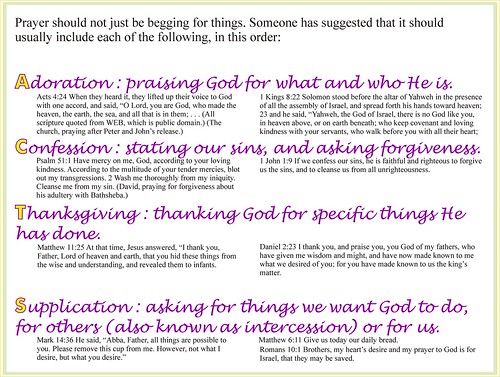
ACTS: Adoration, Confession, Thanksgiving, Supplication

You can see a larger version of this graphic by using it as a link.
All too many of our prayers are asking for something, and, further, asking for ourselves, or our immediate associates. Someone -- I'm not sure who -- suggested that we use ACTS as an acrostic for some of our prayers: Adoration, Confession, Thanksgiving and Supplication. It's a good idea. We don't adore, confess, and thank God nearly enough, or at least I don't.
Adoration: praising God for what and who He is. Here are some ideas on doing that.
Confession: stating our sins, and asking forgiveness.
Thanksgiving: thanking God for specific things He has done.
Supplication: asking for things we want God to do, for others (also known as intercession) or for us.
The poster above includes some biblical examples of these types of prayers.
The last type of prayer is only intercession when it's for someone else.
The verses used (from the WEB, which is public domain) are as follows:
Acts 4:24 When they heard it, they lifted up their voice to God with one accord, and said, “O Lord, you are God, who made the heaven, the earth, the sea, and all that is in them;
I Kings 8:22 Solomon stood before the altar of Yahweh in the presence of all the assembly of Israel, and spread forth his hands toward heaven; 23 and he said, “Yahweh, the God of Israel, there is no God like you, in heaven above, or on earth beneath; who keep covenant and loving kindness with your servants, who walk before you with all their heart;
Psalm 51:1 Have mercy on me, God, according to your loving kindness. According to the multitude of your tender mercies, blot out my transgressions. 2 Wash me thoroughly from my iniquity. Cleanse me from my sin.
1 John 1:9 If we confess our sins, he is faithful and righteous to forgive us the sins, and to cleanse us from all unrighteousness.
Matthew 11:25 At that time, Jesus answered, “I thank you, Father, Lord of heaven and earth, that you hid these things from the wise and understanding, and revealed them to infants.
Daniel 2:23 I thank you and praise you, the God of my fathers, who has given me wisdom and might, and has now made known to me what we desired of you; for you have made known to us the king’s mind.”
Mark 14:36 He said, “Abba, Father, all things are possible to you. Please remove this cup from me. However, not what I desire, but what you desire.”
Matthew 6:11 Give us today our daily bread.
Romans 10:1 Brothers, my heart’s desire and my prayer to God is for Israel, that they may be saved. 10:2 For I testify about them that they have a zeal for God, but not according to knowledge.
Thanks for reading. I wish I practiced this more. This will serve as part of my series on prayers in the Bible. I expect to use some of these texts in separate posts later.
The first post in this series is here.
A Flickr contact of mine referred me to an article in the New York Times. ("The Right Way to Pray," Sept. 16,2009, by Zef Chafets, who quotes Rabbi Marc Gellman in the following excerpt)
". . . really, when you come right down to it, there are only four basic prayers. Gimme! Thanks! Oops! and Wow! . . . Wow! are prayers of praise and wonder at the creation. Oops! is asking for forgiveness. Gimme! is a request or a petition. Thanks! is expressing gratitude. That’s the entire Judeo-Christian doxology.. . ." These four types correspond to the four in the ACTS acronym.
Added February 3rd, 2014: In Prayer: Does it Make Any Difference? (Grand Rapids, MI: Zondervan, 2006) by Philip Yancey, the author says that Rosalind Rinker used these four stages, or types of prayer:
1. Jesus is here (Matthew 18:19-20)
2. Help me, Lord (James 5:13-16)
3. Thank you, Lord (Philippians 4:4-7)
4. Help my brother (Mark 11:22-25) (Chapter 13, "Prayer Grammar")
On February 19, 2015, I added material to the opening section.
Monday, January 03, 2011
Galadriel, Fëanor, (Feanor, without Tolkien's umlaut) and the Silmarils
Fëanor, Galadriel, and the Silmarils
The central story of Tolkien's sub-creation, at least until the time of the rings, is the story of the Silmarils.
The elves, who were immortal, barring accident or violence, first appeared in what would become Middle-Earth. The Valar found them, and persuaded some of them to come into the West, to the realm of the Valar. Those who did so were known as the Noldor, and were led by Finwë, Olwë and Elwë. Finwë was considered the first High King of the elves. Finwë had three sons, Fëanor, Fingolfin and Finarfin. Galadriel was the daughter of Finarfin, hence Fëanor's niece. (For more on Galadriel, here. See here for a pictorial family tree.)
Fëanor had a mind that was ever busy, ever creative. Beside the creation of the typography named after him, he made the PalantÃri. His crowning achievement was the three Silmarils. These jewels captured the light of the two trees of Valinor, the main source of light in the world at that time. (The sun and moon had not yet appeared, but there were stars.) But Fëanor became so enamored of his own creation that it was easy for Morgoth, then still in the realm of the Valar, as one of them, to lead Fëanor astray through them. Morgoth also sowed seeds of jealousy between the sons of Finwë, and they became proud and haughty. (Not so haughty as Morgoth, who plotted to destroy the elves, and to do great evil to the Valar.)
Shippey believes that Fëanor's restless creativeness represents Tolkien's creativeness (pp. 239-240).
Tolkien wrote that Fëanor's character was deeply influenced by the death of his mother, MÃriel. In the Blessed Realm, at least, the elves could lay down their lives for a while, then could take them up again. MÃriel did not choose to return for a long time, even as elves count time, and eventually Fëanor's father was given permission to marry again. This embittered Fëanor, already a proud and haughty individual. Another reason for his bitterness, or at least for contention between Fëanor and other elves, was pronunciation. This may seem surprising, but shouldn't be. Tolkien, himself, was much concerned with language, and so was Fëanor. ("The Shibboleth of Fëanor," in The Peoples of Middle-Earth, Christopher Tolkien, editor. Boston: Houghton Mifflin, 1996.)
Fëanor kept the Silmarils locked up, except when he wore them himself. Morgoth, with Ungoliant, the great spider spirit, came to the realm of the Valar by stealth, and destroyed the two trees. They also killed Finwë, and took the Silmarils back to Middle-Earth. However, before this murder was known, the Valar asked Fëanor for the use of the Silmarils, the only way to revive the two trees. Fëanor, who had been previously punished by the Valar for a prideful act, refused.
Fëanor was a master of words, and his tongue had great power over hearts when he would use it; and that night he made a speech before the Noldor which they ever remembered. (Silmarillion, 82.)
He urged the elves who followed Finwë, his father, the Noldor, to leave the realm of the Valar and return to Middle-Earth, because the Valar could not protect their own realm, and because they were trying to hold the elves from their destiny. Then Fëanor swore that he would contest anyone who took a Silmaril into their possession, regardless of the consequences, and his seven sons joined him in that oath. Galadriel, the granddaughter of Olwë, did not swear the terrible oath of the house of Fëanor, but she decided that she wanted to return to Middle-Earth and establish a realm of her own. She eventually established Lothlorien, with her consort, Celeborn.
Tolkien wrote:
So it came to pass that when the light of Valinor failed, for ever as the Noldor thought, [Galadriel] joined the rebellion against the Valar who commanded them to stay; and once she had set foot upon that road of exile, she would not relent . . . Her pride was unwilling to return, a defeated suppliant for pardon; but now she burned with desire to follow Fëanor with her anger to whatever lands he might come, and to thwart him in all ways that she could. Pride still moved her when, at the end of the Elder Days after the final overthrow of Morgoth, she refused the pardon of the Valar for all who had fought against him, and remained in Middle-earth. It was not until two long ages more had passed, when at last all that she had desired in her youth came to her hand, the Ring of Power and the dominion of Middle-earth of which she had dreamed, that her wisdom was full grown and she rejected it, and passing the last test departed from Middle-earth forever. (The Peoples of Middle-Earth, p. 338. In Peoples, but not in all of his works, Tolkien put a symbol over the N at the beginning of the word, Noldor. I haven't found a way to place that symbol in this blog.)
(Galadriel's speech, rejecting the One Ring, is below.)
Fëanor and his followers needed ships to return to Middle-Earth. They came to the people of Olwë, who had made wonderful ships, "the fairest vessels that ever sailed the sea," (Silmarillion, 90.) and took them by force, killing many of Olwë's people. Fëanor had the ships burned. Galadriel fought against him, but sailed to Middle-Earth, as did Fëanor and many other elves, after the battle was over. Bob Downing suggests, in an on-line article that doesn't seem to be available anymore, entitled "Galadriel: Lady of Lóthlórien," that the reason Galadriel sailed may have been partly because she was disillusioned that the Valar were unable to protect the Two Trees.
Purtill writes (p. 158) that Tolkien:
". . . often gives us characters faced with basically the same problem and shows one handling the problem in the right way, the other in the wrong way . . . Insofar as it can be said that characters from two different stories (though with the same underlying mythology) are contrasted, I think that Galadriel is the intended contrast character to Fëanor; her rejection of the Ring contrasts with his refusal to give up the Silmarils."
The Noldor and the other peoples of Middle-Earth then endured long years of hostility from Morgoth and his followers. Many elves, including Fëanor and his seven sons, were killed. Eventually Beren, a human hero, and Luthien, daughter of Elwë, took a Silmaril from the iron crown of Morgoth. Idril Celebrindal, great-granddaughter of Finwë through his second son, Fingolfin, married Tuor, another human hero. Their son Eärendil, who married Elwing, granddaughter of Beren and Luthien, took a Silmaril to the realm of the Valar and asked for their help in overthrowing Morgoth, which was the eucatastrophe at the end of the First Age. Eärendil, who was the father of Elrond and Elros, and, hence, Aragorn's distant ancestor, was placed in the heavens with his ship, and the Silmaril became a star.
For more on Fëanor, see "It's All in the Family: The Elweans and Ingweans," by Michael Martinez. (Also published as Chapter 3 of Martinez' Understanding Middle Earth: Essays on Tolkien's Middle-Earth. Poughkeepsie, NY: ViviSphere, 2003, pp. 47-79.) Here's the Wikipedia article on Galadriel.
More on Galadriel
Gandalf and Galadriel both choose not to take the ring as their own. Galadriel tells Sam and Frodo that she has power to resist Sauron, near the end of The Fellowship of the Ring, in spite of Sauron's desire to discover what is going on in Lothlorien. Richard Purtill, in his J. R. R. Tolkien: Myth, Morality, and Religion (San Francisco: Ignatius Press, 2003) says that, as Galadriel confides this to Sam and Frodo, she shows that she has won "the battle to know the mind of the Dark Lord without being bent to his evil (p. 114)." This is a battle that Denethor, Steward of Gondor, and also Saruman, have lost. Then, Galadriel resists the temptation offered her by Frodo -- he offers her the One Ring. Here is Galadriel's speech to Frodo and Sam:
"And now at last it comes. You will give me the Ring freely! In place of the Dark Lord you will set up a Queen. And I shall not be dark, but beautiful and terrible as the Morning and the Night!" . . . She lifted up her hand and from the ring that she wore there issued a great light that illumined her alone and left all else dark. . . . Then she let her hand fall, and the light faded, and suddenly she laughed again, and lo! she was shrunken: a simple elf-woman, clad in simple white, whose gentle voice was soft and sad.
"I pass the test," she said. "I will diminish, and go into the West, and remain Galadriel." Fellowship, p. 381.This dialog is changed little, if at all, in the movie. Dickerson writes of this episode, in Following Gandalf, that "Galadriel summarizes the point . . . that moral victory is the most important victory; that it is better to suffer a military defeat and a loss of everything than to suffer a moral defeat; better to 'cast all away rather than to submit to Sauron." (p. 81)
In her "Mara and Galadriel: MacDonald’s and Tolkien’s Vehicles for Spiritual Truth," (Mara is a character in George MacDonald's Phantastes, a nineteenth-century work of fantasy which C. S. Lewis said influenced him. It is certainly still worth reading, and, I believe, still in print.) Betsy Matthews says:
. . . characters such as Mara and Galadriel hold such magnetism. Certainly, neither is the central character . . . but each . . . provides a very clear picture of God, a picture made clearer because they are female. Among the many characteristics these women share, they are beautiful, able to instill fear into others, know the suffering the future holds, and are compassionate. Mara and Galadriel are strikingly biblical in ways the traditional fairy tale "God-figures" (often the fairy godmothers) are not. This picture of God is not one merely of God the Father, but is a composite picture of the Trinity. [Note: as of January 2, 2018, I am unable to locate a current source for this quotation.]
One of the most remarkable facets of God portrayed through these characters is the clear picture of Jesus as the suffering servant and the suffering to which his followers are called. . . . These women suffer great sorrow and witness evil, yet remain pure and hopeful, thus pointing to the hope Jesus had on earth and God’s children have during their earthly sufferings as they anticipate their future glorification.
Tolkien wrote that Galadriel was not a stand-in for Mary:
I think it is true that I owe much of this character to Christian and Catholic teaching about Mary, but actually Galadriel was a penitent; in her youth a leader in the rebellion against the Valar (the angelic guardians). At the end of the First Age she proudly refused forgiveness or permission to return. She was pardoned because of her resistance to the final and overwhelming temptation to take the Ring for herself. (Letters, p. 407)
Stanford Caldecott disagrees with Tolkien, or my interpretation of Tolkien, on this matter. He thinks, and presents evidence that Galadriel, and, more so, Elbereth, are Mary-figures in Tolkien's work. He does not suppose that she started that way, during the long gestation of Tolkien's products, but that he gradually came to change her from a close follower of Fëanor to one in serious disagreement with him. (The Power of the Ring: The Spiritual Vision Behind of the Lord of the Rings. New York: Crossroad Publishing Company, 2005, p. 53-55.)
Galadriel played a central role in The Lord of the Rings trilogy, although a role mostly in the background, rather than on-stage. It was she who summoned the White Council, (over 400 years before Bilbo was born, according to the chronology in Return) with the idea of uniting the opposition to Sauron. She wanted Gandalf to be the leader of this Council. (Fellowship, p. 372) When Gandalf was overthrown by the Balrog (like him, a Maia, but one who had rejected good) the remaining Fellowship rested and were renewed in Lothlorien, which realm was an expression of Galadriel's power. Galadriel showed Frodo and Sam something of the importance of the choice they had made, to take the One Ring to the fire and destroy it. Galadriel warned Boromir of the spiritual peril that he was in. Galadriel won Gimli, the representative of the Dwarves, to friendship and appreciation for the elves, and it was during their time in Lothlorien that Gimli and Legolas, representative of the elves in the Fellowship, became such great friends. She gave gifts to the fellowship. Frodo's was a small vessel, or phial, containing the light of Eärendil's star. (Fellowship, p. 393)
Frodo used the star-glass when in the lair of Shelob, the great spider, and called upon Galadriel, probably as a war-cry of sorts. (Towers, pp. 329-330) Sam also used the star-glass (Frodo gave it to him while he was cutting spider-webs with his sword, with both hands.) When Sam thought Frodo was dead, and almost gave in to despair, he also called on Galadriel, and on Elbereth, the Queen of the Valar, and used the light-emitting phial to defeat the spider. (Towers, pp. 337-339) As Dickerson points out, Galadriel clearly had faith in a higher power, and communicated that to the Fellowship during their stay in Lothlórien. (Following Gandalf, p. 198.) That glass, Galadriel's great gift to the ring-bearer, was taken on the ship that bore Galadriel, Gandalf, Elrond, Bilbo, Frodo and others to the Blessed Realm, which was the last sight Sam had of Frodo. (Return, p. 310)
Galadriel gave other gifts in Lothlórien. One of these was to Gimli, the dwarf. Caldecott discusses that gift:
Her parting gift to Gimli is highly significant. He asks for a single hair from her head, which he intends to enshrine within imperishable crystal. In the elder days Fëanor had asked the same, and been refused three times, for her tresses were famed for seeming to contain the light of the Two Trees. . . . Now she gives Gimli three hairs, one for each of the ancient refusals, which were bound up with so much grief for the Elves. Galadriel's gift heals the long rift between her people and the Dwarves. It implies that she now repents of any part her pride may have played in the long tragedy. (The Power of the Ring, p. 54.)
When Gandalf fought the Balrog, during the journey of the Fellowship through Moria, He said that he "wandered far on roads that I will not tell." (Two Towers, p. 106) Mostly likely Tolkien meant that Gandalf somehow went back to the Blessed Realm, in the far West. He returned to the top of the mountain, with a body changed, and was carried, by an eagle, to Lothlórien, to meet with Galadriel. The eagle said that Galadriel had asked him to bring Gandalf to her. Gandalf told Aragorn, Legolas, and Gimli that he found healing, and counsel, in meeting with Galadriel, and also counseled her. Perhaps Galadriel's husband, Celeborn, was also involved, but Galadriel had the pre-eminence in such matters. From then on, Gandalf had new power, which enabled him to deal with Saruman.
Galadriel is perhaps the most intriguing character in Tolkien's writing, and I agree with Matthews that she is not the typical fairy godmother. She may provide a clearer picture of God than, say, Elrond. However, I'm not sure that Matthews has read, or understood, as much Tolkien as she might have. As the previous section indicates, Galadriel was not all, or always, goodness and light, and she made at least one choice against the good, and for pride. But, then, Mary, Christ's earthly mother, was born to a sinful race, and, according to most Protestants, was a sinner herself, like the rest of us, although redeemed. Perhaps Matthews is right about Galadriel. As Matthews says, she does exhibit hope, in spite of whatever her past may have been, and gives hope to the Fellowship as they part from the realm she shares with Celeborn. Surely Frodo and Sam would have failed to achieve their quest without the light she gave them, without its message of hope.
Tolkien wrote of Galadriel, after describing her desire to rule without oversight:
Yet deeper still there dwelt in her the noble and generous spirit . . . of the Vanyar, and a reverence for the Valar that she could not forget. From her earliest years she had a marvellous gift of insight into the minds of others, but judged them with mercy and understanding, and she withheld her good will from none save only Fëanor. In him she perceived a darkness that she hated and feared, though she did not perceive that the shadow of the same evil had fallen upon the minds of all the Noldor, and upon her own. (Peoples of Middle-earth, pp. 337-8)
Perhaps the best summary, for Galadriel and for us, is that we began as proud rebels, and end as penitents, rejecting, at the last, the worship of ourselves for the worship of the One. What a character, and what a sub-creation!
Today is Tolkien's birthday. He was born in 1892. Thanks for reading. (Revised slightly, April 2, 2011, and again on October 14, 2013, and January 2, 2018)
Sunday, September 19, 2010
How does God reveal Himself to humans?
God’s revelation is of two types: Special and General. Special Revelation is through Christ. General Revelation, through other means, does not necessarily tell us about the necessity for salvation. General Revelation may reveal various attributes of God, such as His power, majesty, omniscience, omnipresence, and eternal existence.
God reveals many things, including His attributes, His love, His holiness, how He wants us to act, and guidance in specific situations. How does He do this? Here is a partial list:
1. Through Christ (Hebrews 1:2)
2. Through the Bible (2 Timothy 3:16)
3. By the Holy Spirit (John 16:8-15)
4. Through nature (Romans 1:20, Psalm 19:1-4, and also Psalm 97:6, Acts 14:17)
5. By our conscience (Romans 2:15)
6. Through history (1 Corinthians 10:6-13)
7. In answer to prayer (1 Kings 18:36-39)
8. By angels, and in visions and dreams (Matthew 2:19-21)
9. Through miracles and providence (Exodus 4:1-5)
10. Through the church (Acts 15:22-29)
11. Through human creations (“I know three people who overcame temptations to atheism through the music of Johann Sebastian Bach.” - Peter Kreeft; “To him, art was God’s gift to make the earth bearable. Poetry and music were not luxuries, but necessities.” - David, McCasland, Oswald Chambers: Abandoned to God. The Life Story of the Author of My Utmost for His Highest. Grand Rapids, MI: Discovery House, 1993, p. 39; Jeremiah 22:6; Philippians 4:8)
Sources include Wikipedia articles on Revelation of God, and on Revelation. See also Peter Kreeft, “12 Ways to Know God, and also Twenty Arguments for the Existence of God.”
Please note that no single verse, or a few verses, should be taken as a firm basis for any doctrine. I have expanded item 11 more than the others, because the Biblical evidence is less direct.
Thanks for reading.
God reveals many things, including His attributes, His love, His holiness, how He wants us to act, and guidance in specific situations. How does He do this? Here is a partial list:
1. Through Christ (Hebrews 1:2)
2. Through the Bible (2 Timothy 3:16)
3. By the Holy Spirit (John 16:8-15)
4. Through nature (Romans 1:20, Psalm 19:1-4, and also Psalm 97:6, Acts 14:17)
5. By our conscience (Romans 2:15)
6. Through history (1 Corinthians 10:6-13)
7. In answer to prayer (1 Kings 18:36-39)
8. By angels, and in visions and dreams (Matthew 2:19-21)
9. Through miracles and providence (Exodus 4:1-5)
10. Through the church (Acts 15:22-29)
11. Through human creations (“I know three people who overcame temptations to atheism through the music of Johann Sebastian Bach.” - Peter Kreeft; “To him, art was God’s gift to make the earth bearable. Poetry and music were not luxuries, but necessities.” - David, McCasland, Oswald Chambers: Abandoned to God. The Life Story of the Author of My Utmost for His Highest. Grand Rapids, MI: Discovery House, 1993, p. 39; Jeremiah 22:6; Philippians 4:8)
Sources include Wikipedia articles on Revelation of God, and on Revelation. See also Peter Kreeft, “12 Ways to Know God, and also Twenty Arguments for the Existence of God.”
Please note that no single verse, or a few verses, should be taken as a firm basis for any doctrine. I have expanded item 11 more than the others, because the Biblical evidence is less direct.
Thanks for reading.
Tuesday, November 10, 2009
Heartbeat at 18 days?
While on a recent trip to Florida, I saw a number of billboards, saying that an embryo had a heart at 18 days of age.
I could not find this ad campaign on the Internet, but I found a web page, which makes this claim, among others: "18 days after conception the baby's heart is beating." The organization's web site indicates that this is an Irish pro-life organization. (By September 28, 2013, this web page had been removed, which is hardly surprising, considering the nearly four years since I saw it.)
Both the web site and the billboard campaign show a picture of a fetus, not an embryo. (The human becomes a fetus at eight weeks of pregnancy.) So does the heart really beat at 18 days?
The Wikipedia article on prenatal development is a good source for answering this question. It's a little confusing, because it gives both the age of the embryo/fetus and the gestational age, which is the time since the last menstruation.
According to that source, "Primitive heart tube is forming. Vasculature begins to develop in embryonic disc." at 20 days after fertilization, not 18 days. (Vasculature means the blood vessels needed for circulation.) The heart begins to beat between 22 and 28 days after fertilization. However, the first sign of a working circulatory system is later than that, at between days 29 and 35.
The billboard campaign, and the web page, seem to be wrong. The heart doesn't begin to beat until later than 18 days after fertilization, and it doesn't really start to function until even later than that. Besides, the graphic in both the web page and the billboard show a fetus, probably at least 12 weeks old, not an embryo at all.
There are reasons for arguing that unborn human entities should be protected, and I won't consider the validity of those reasons here. But, even if those reasons were completely uncontroversial arguments, that would not excuse the use of distortion in support of protecting embryos or fetuses, and that, unfortunately, is what the pro-life community has done, in the two instances described, and, I'm afraid, in other cases.
Thanks for reading. See here for a more comprehensive view of my thoughts on abortion.
I could not find this ad campaign on the Internet, but I found a web page, which makes this claim, among others: "18 days after conception the baby's heart is beating." The organization's web site indicates that this is an Irish pro-life organization. (By September 28, 2013, this web page had been removed, which is hardly surprising, considering the nearly four years since I saw it.)
Both the web site and the billboard campaign show a picture of a fetus, not an embryo. (The human becomes a fetus at eight weeks of pregnancy.) So does the heart really beat at 18 days?
The Wikipedia article on prenatal development is a good source for answering this question. It's a little confusing, because it gives both the age of the embryo/fetus and the gestational age, which is the time since the last menstruation.
According to that source, "Primitive heart tube is forming. Vasculature begins to develop in embryonic disc." at 20 days after fertilization, not 18 days. (Vasculature means the blood vessels needed for circulation.) The heart begins to beat between 22 and 28 days after fertilization. However, the first sign of a working circulatory system is later than that, at between days 29 and 35.
The billboard campaign, and the web page, seem to be wrong. The heart doesn't begin to beat until later than 18 days after fertilization, and it doesn't really start to function until even later than that. Besides, the graphic in both the web page and the billboard show a fetus, probably at least 12 weeks old, not an embryo at all.
There are reasons for arguing that unborn human entities should be protected, and I won't consider the validity of those reasons here. But, even if those reasons were completely uncontroversial arguments, that would not excuse the use of distortion in support of protecting embryos or fetuses, and that, unfortunately, is what the pro-life community has done, in the two instances described, and, I'm afraid, in other cases.
Thanks for reading. See here for a more comprehensive view of my thoughts on abortion.
Labels:
2000 or more views,
abortion,
embryo,
Embryos,
heart,
heart beat
Monday, November 09, 2009
Did it rain before the Flood?
These passages are the first mention of rain in the Bible:
Genesis 2:5 When no bush of the field was yet in the land and no small plant of the field had yet sprung up—for the Lord God had not caused it to rain on the land, and there was no man to work the ground, 6 and a mist was going up from the land and was watering the whole face of the ground— 7 then the Lord God formed the man of dust from the ground and breathed into his nostrils the breath of life, and the man became a living creature. (All Bible quotation from the ESV, unless otherwise noted. ESV copyright and usage information, see here.)
Genesis 7:4 For in seven days I will send rain on the earth forty days and forty nights, and every living thing that I have made I will blot out from the face of the ground.”
Is, then, Genesis 7:12 the first rainfall in the history of the earth? The passage doesn't say that. However, it may imply that. And, of course, Genesis 2:5 says that it hadn't rained yet, at the time Genesis 2 is describing. But I don't think that the rain that fell in Noah's time was the first rain ever, and, as you'll see if you read on, I'm in good company.
First, a little bit on the words used. The word for rain, in Hebrew, in Genesis 2:5 (see here) is a verb. It is used at least as often when God sends something besides water from the sky, as it is for what we commonly think of as rain. The same word is used in Genesis 7:4. Genesis 7:12 uses a different word, a noun. (See here.)
Now, to public domain commentaries, written by renowned Bible scholars. John Calvin does not consider the question of whether the rain that fell in Genesis 7 was the first rain that ever fell. Neither does John Wesley, not Matthew Henry, nor the commentary of Jamieson, Fausset, and Brown.
Matthew Henry does not consider the question of whether there had been a rainbow before the flood. (Genesis 9) Wesley believes that there had been: "The rainbow, 'tis likely was seen in the clouds before, but was never a seal of the covenant 'till now." The Jamieson, Fausset, and Brown commentary seems to agree with Wesley: "This common and familiar phenomenon being made the pledge of peace, its appearance when showers began to fall would be welcomed with the liveliest feelings of joy." Calvin not only agrees, but ridicules those who have claimed that there were no rainbows before the Flood: "From these words certain eminent theologians have been induced to deny, that there was any rainbow before the deluge: which is frivolous. For the words of Moses do not signify, that a bow was then formed which did not previously exist; but that a mark was engraven upon it, which should give a sign of the divine favor towards men."
Thus, even though these four commentaries are silent on the direct question of whether the rain that came in the time of Noah was the first rain, three of them answer it indirectly -- the rainbow mentioned as the pledge of God's promise not to destroy the earth by a flood was not the first rainbow, in their opinion. And, since a rainbow requires rain, a belief that it had rained before the time of Noah is at least respectable.
See here for a previous post on the title question, dealing with different evidence from the Bible, which also suggests that it rained before the Flood. See here for consideration of other questions related to the flood.
Thanks for reading!
Genesis 2:5 When no bush of the field was yet in the land and no small plant of the field had yet sprung up—for the Lord God had not caused it to rain on the land, and there was no man to work the ground, 6 and a mist was going up from the land and was watering the whole face of the ground— 7 then the Lord God formed the man of dust from the ground and breathed into his nostrils the breath of life, and the man became a living creature. (All Bible quotation from the ESV, unless otherwise noted. ESV copyright and usage information, see here.)
Genesis 7:4 For in seven days I will send rain on the earth forty days and forty nights, and every living thing that I have made I will blot out from the face of the ground.”
11 In the six hundredth year of Noah's life, in the second month, on the seventeenth day of the month, on that day all the fountains of the great deep burst forth, and the windows of the heavens were opened. 12 And rain fell upon the earth forty days and forty nights.
Is, then, Genesis 7:12 the first rainfall in the history of the earth? The passage doesn't say that. However, it may imply that. And, of course, Genesis 2:5 says that it hadn't rained yet, at the time Genesis 2 is describing. But I don't think that the rain that fell in Noah's time was the first rain ever, and, as you'll see if you read on, I'm in good company.
First, a little bit on the words used. The word for rain, in Hebrew, in Genesis 2:5 (see here) is a verb. It is used at least as often when God sends something besides water from the sky, as it is for what we commonly think of as rain. The same word is used in Genesis 7:4. Genesis 7:12 uses a different word, a noun. (See here.)
Now, to public domain commentaries, written by renowned Bible scholars. John Calvin does not consider the question of whether the rain that fell in Genesis 7 was the first rain that ever fell. Neither does John Wesley, not Matthew Henry, nor the commentary of Jamieson, Fausset, and Brown.
Matthew Henry does not consider the question of whether there had been a rainbow before the flood. (Genesis 9) Wesley believes that there had been: "The rainbow, 'tis likely was seen in the clouds before, but was never a seal of the covenant 'till now." The Jamieson, Fausset, and Brown commentary seems to agree with Wesley: "This common and familiar phenomenon being made the pledge of peace, its appearance when showers began to fall would be welcomed with the liveliest feelings of joy." Calvin not only agrees, but ridicules those who have claimed that there were no rainbows before the Flood: "From these words certain eminent theologians have been induced to deny, that there was any rainbow before the deluge: which is frivolous. For the words of Moses do not signify, that a bow was then formed which did not previously exist; but that a mark was engraven upon it, which should give a sign of the divine favor towards men."
Thus, even though these four commentaries are silent on the direct question of whether the rain that came in the time of Noah was the first rain, three of them answer it indirectly -- the rainbow mentioned as the pledge of God's promise not to destroy the earth by a flood was not the first rainbow, in their opinion. And, since a rainbow requires rain, a belief that it had rained before the time of Noah is at least respectable.
See here for a previous post on the title question, dealing with different evidence from the Bible, which also suggests that it rained before the Flood. See here for consideration of other questions related to the flood.
Thanks for reading!
Labels:
2000 or more views,
bible study,
flood,
genesis,
Noah,
rain,
rainbow
Subscribe to:
Posts (Atom)