License

I have written an e-book, Does the Bible Really Say That?, which is free to anyone. To download that book, in several formats, go here.
Creative Commons License
The posts in this blog are licensed under a Creative Commons Attribution-NonCommercial-ShareAlike 3.0 Unported License. You can copy and use this material, as long as you aren't making money from it. If you give me credit, thanks. If not, OK.
Showing posts with label birth. Show all posts

Friday, December 08, 2023

Christ didn't come as a baby

 We don't seem to know what day, or even what year, Christ was born, but he was born.


Christ didn't come as a baby. He came as an embryo. Did He retain any of His divine omniscience and omnipotence during that pre-natal period? I don't know, but I suspect that He didn't retain all of it. The Bible teaches that He was tempted like we are. I don't know if fetuses are tempted. However, to really be like us, He must have had an experience much like ours, and I suspect that that meant, after He was born, not being able to speak for a year or so, and, before He was born, giving up some of his powers and awareness. Was this easy for the Creator of the Universe? I wouldn't think so--the cross wasn't.

If He gave anything up, He did it for me, you, and everyone else.

P. S. December 8, 2023: Christ came a long time before coming as an embryo, as creator. See John 1, and, as Paul put it:
Colossians 1:16 For by him all things were created in the heavens and on the earth, visible things and invisible things, whether thrones or dominions or principalities or powers. All things have been created through him and for him. 17 He is before all things, and in him all things are held together. (World English Bible, public domain)

Sunday, March 15, 2015

Excerpts from Orthodoxy, by Gilbert K. Chesterton, 13

It is no argument for unalterable law (as Huxley fancied) that we count on the ordinary course of things. We do not count on it; we bet on it. We risk the remote possibility of a miracle as we do that of a poisoned pancake or a world-destroying comet. We leave it out of account, not because it is a miracle, and therefore an impossibility, but be cause it is a miracle, and therefore an exception.
Just as we all like love tales because there is an instinct of sex, we all like astonishing tales because they touch the nerve of the ancient instinct of astonishment. This is proved by the fact that when we are very young children we do not need fairy tales: we only need tales. Mere life is interesting enough. A child of seven is excited by being told that Tommy opened a door and saw a dragon. But a child of three is excited by being told that Tommy opened a door. Boys like romantic tales; but babies like realistic tales—because they find them romantic. In fact, a baby is about the only person, I should think, to whom a modern realistic novel could be read without boring him.


Children are grateful when Santa Claus puts in their stockings gifts of toys or sweets. Could I not be grateful to Santa Claus when he put in my stockings the gift of two miraculous legs? We thank people for birthday presents of cigars and slippers. Can I thank no one for the birthday present of birth?


Orthodoxy, first published in 1908, by G. K. Chesterton, is in the public domain, and available from Project Gutenberg. The previous post in this series is here.  Thanks for reading! Read Chesterton.

Friday, December 05, 2014

Are Christians over-emphasizing Christmas?

Importance of the resurrection

I have been reading N. T. Wright's Luke for Everyone. In discussing Luke 1 and 2, which describe the events of the birth of Jesus, and some of what came before, he wrote: "In all of Paul's writings, he never mentions that there had been anything unusual about Jesus' conception or birth. Jesus' death and resurrection remain, for him, far more significant." I had never thought of that, but Rev. Wright is, well, right. I checked the other New Testament writers, and Mark, Peter, James, nor Jude mention Jesus birth in any way at all. Luke does not mention it in Acts. John refers to the birth only obliquely. The author of Hebrews refers to the birth of Christ once. Paul not only doesn't mention that there was anything unusual about it, but scarcely mentions it at all.

Outside of the first two chapters of Matthew and Luke, and the list of the ancestors of Christ, in Luke 3:23-38, these are the only mentions of the birth of Christ in the New Testament, so far as I can determine:

John 7:40 Many of the multitude therefore, when they heard these words, said, “This is truly the prophet.” 41 Others said, “This is the Christ.” But some said, “What, does the Christ come out of Galilee? 42 Hasn’t the Scripture said that the Christ comes of the offspring of David, and from Bethlehem, the village where David was?” 43 So there arose a division in the multitude because of him.

Galatians 4:4 But when the fullness of the time came, God sent out his Son, born to a woman, born under the law, 5 that he might redeem those who were under the law, that we might receive the adoption of children.

Hebrews 1:6 
When he again brings in the firstborn into the world he says, “Let all the angels of God worship him.” (Quotations from the World English Bible, public domain.)

The resurrection of Christ is mentioned in most of the books of the New Testament, sometimes many times in one book. (I did not find explicit references to it in Titus, Philemon, James, 2 Peter, 1, 2, and 3 John, or Jude, but did find such statements in the other 19 books of the New Testament.)

You'd never know that Good Friday and Easter are more important than Christmas from Walmart, where Christmas trappings start going on sale in September. Nor would you know it from the lives of most Christians, including my own. My own church, part of The Wesleyan Church, has a special service where we explain how various symbols and events in the common celebration of Christmas have significance for Christians. (Candles, trees, wreaths, and the like.) We light candles to represent Christmas, and Christ's birth, on four consecutive Sundays. We often sing, or listen to, Christmas-related music for three or four weeks in December. We may put on a Christmas concert, or play, or pageant, or participate in a Christmas parade. Small groups may have a meal together, or a gift exchange. We usually engage in some special charitable activity in December, giving to needy people in some way. Some churches have special events right after December 25th. All of these things emphasize Christmas. None of these things are bad. We need fellowship, we should do charity, and cultural symbols are important.

But Easter? Not so much. Some churches do emphasize Lent, for 40 days before Easter, and some churches do observe Good Friday in a special way, but ours doesn't, and it's not the only church that doesn't. Easter Sunday is about all the emphasis non-liturgical churches give to Christ's death and Resurrection. From all of this, a Martian observing the behavior of Wesleyan, Southern Baptist, and other churches would conclude that Christ's birth was far more important than His death and resurrection.

Am I trying to kill Christmas? No. If Christ had never been born, we wouldn't have salvation. But I'm trying to re-think the importance of Good Friday and Easter, and, consequently, of Christmas.

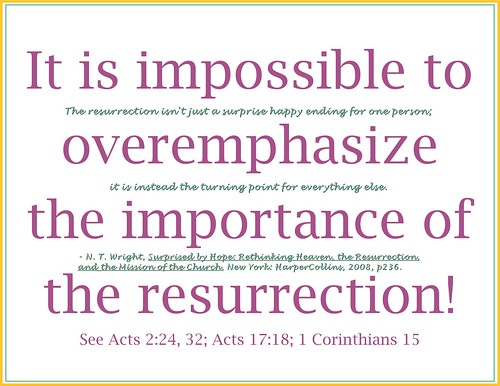
Whatever the commercial world does, to the Christian, the death and resurrection of Christ are more important than His birth, based on how the New Testament treats these subjects. It may be impossible to overemphasize the importance of the Resurrection, but it's easy to under-emphasize it. Thanks for reading.