
Musings on science, the Bible, and fantastic literature (and sometimes basketball and other stuff).
God speaks to us through the Bible and the findings of science, and we should listen to both types of revelation.
The title is from Psalm 84:11.
The Wikipedia is usually a pretty good reference. I mostly use the World English Bible (WEB), because it is public domain. I am grateful.
License
I have written an e-book, Does the Bible Really Say That?, which is free to anyone. To download that book, in several formats, go here.

The posts in this blog are licensed under a Creative Commons Attribution-NonCommercial-ShareAlike 3.0 Unported License. You can copy and use this material, as long as you aren't making money from it. If you give me credit, thanks. If not, OK.

The posts in this blog are licensed under a Creative Commons Attribution-NonCommercial-ShareAlike 3.0 Unported License. You can copy and use this material, as long as you aren't making money from it. If you give me credit, thanks. If not, OK.
Showing posts with label living. Show all posts
Friday, December 05, 2014
Are Christians over-emphasizing Christmas?
I have been reading N. T. Wright's Luke for Everyone. In discussing Luke 1 and 2, which describe the events of the birth of Jesus, and some of what came before, he wrote: "In all of Paul's writings, he never mentions that there had been anything unusual about Jesus' conception or birth. Jesus' death and resurrection remain, for him, far more significant." I had never thought of that, but Rev. Wright is, well, right. I checked the other New Testament writers, and Mark, Peter, James, nor Jude mention Jesus birth in any way at all. Luke does not mention it in Acts. John refers to the birth only obliquely. The author of Hebrews refers to the birth of Christ once. Paul not only doesn't mention that there was anything unusual about it, but scarcely mentions it at all.
Outside of the first two chapters of Matthew and Luke, and the list of the ancestors of Christ, in Luke 3:23-38, these are the only mentions of the birth of Christ in the New Testament, so far as I can determine:
John 7:40 Many of the multitude therefore, when they heard these words, said, “This is truly the prophet.” 41 Others said, “This is the Christ.” But some said, “What, does the Christ come out of Galilee? 42 Hasn’t the Scripture said that the Christ comes of the offspring of David, and from Bethlehem, the village where David was?” 43 So there arose a division in the multitude because of him.
Galatians 4:4 But when the fullness of the time came, God sent out his Son, born to a woman, born under the law, 5 that he might redeem those who were under the law, that we might receive the adoption of children.
Hebrews 1:6 When he again brings in the firstborn into the world he says, “Let all the angels of God worship him.” (Quotations from the World English Bible, public domain.)
The resurrection of Christ is mentioned in most of the books of the New Testament, sometimes many times in one book. (I did not find explicit references to it in Titus, Philemon, James, 2 Peter, 1, 2, and 3 John, or Jude, but did find such statements in the other 19 books of the New Testament.)
You'd never know that Good Friday and Easter are more important than Christmas from Walmart, where Christmas trappings start going on sale in September. Nor would you know it from the lives of most Christians, including my own. My own church, part of The Wesleyan Church, has a special service where we explain how various symbols and events in the common celebration of Christmas have significance for Christians. (Candles, trees, wreaths, and the like.) We light candles to represent Christmas, and Christ's birth, on four consecutive Sundays. We often sing, or listen to, Christmas-related music for three or four weeks in December. We may put on a Christmas concert, or play, or pageant, or participate in a Christmas parade. Small groups may have a meal together, or a gift exchange. We usually engage in some special charitable activity in December, giving to needy people in some way. Some churches have special events right after December 25th. All of these things emphasize Christmas. None of these things are bad. We need fellowship, we should do charity, and cultural symbols are important.
But Easter? Not so much. Some churches do emphasize Lent, for 40 days before Easter, and some churches do observe Good Friday in a special way, but ours doesn't, and it's not the only church that doesn't. Easter Sunday is about all the emphasis non-liturgical churches give to Christ's death and Resurrection. From all of this, a Martian observing the behavior of Wesleyan, Southern Baptist, and other churches would conclude that Christ's birth was far more important than His death and resurrection.
Am I trying to kill Christmas? No. If Christ had never been born, we wouldn't have salvation. But I'm trying to re-think the importance of Good Friday and Easter, and, consequently, of Christmas.
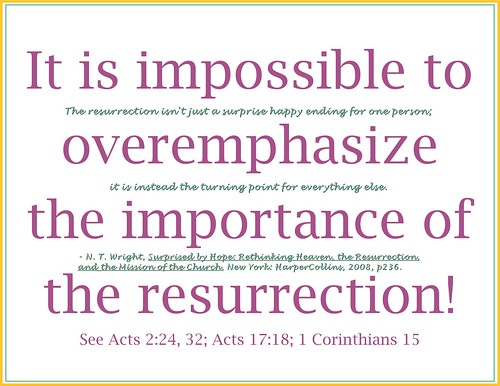
Whatever the commercial world does, to the Christian, the death and resurrection of Christ are more important than His birth, based on how the New Testament treats these subjects. It may be impossible to overemphasize the importance of the Resurrection, but it's easy to under-emphasize it. Thanks for reading.
Labels:
bible study,
birth,
Christ,
Christ's resurrection,
Christmas,
living,
N. T. Wright,
New Testament,
Paul,
resurrection
Saturday, January 17, 2009
Mrs. Hunter's Happy Death
Mrs. Hunter and her peers in the late eighteenth century did not consider questions of religious belief unimportant, but their primary concern was not that they get things right intellectually. For them the life of faith was more about the heart than it was about the head. So Mary Clulow -- not yet married and just a few months past her eighteenth birthday -- saw clearly what should be her life's principal ambition: to love God with her whole heart. (77)
Mary Clulow Hunter, an exemplary Methodist, was extraordinarily busy in "working out her own salvation." She was busy at worship and prayer, busy at reading the Bible, busy at doing good. She did not perceive her life to be divided into spheres -- "private" and "public," "work" and "play," "personal" and "social" -- as so many modern people are inclined to do. The whole of her life was consumed with her search for holiness, or "purity of heart." She perceived her every act -- from "attending to her little ones" to "visiting persons in the sick-ward," from "domestic duties" to her dedicated times of prayer -- as a part of this single, overriding concern. For Mrs. Hunter the life of faith was by no means confined to church -- to the contrary, she saw opportunities to exercise holiness at every turn and every avenue of life. She dedicated her daily living to fulfilling the most familiar phrase from Jesus' most familiar prayer: "Thy kingdom come, thy will be done, on earth as it is in heaven." (79) (Both quotes from Mrs. Hunter's Happy Death: Lessons on Living from People Preparing to Die. New York: Doubleday, 2006, by John Fanestil. The book has its own web site.)
Fanestil, until recently a twenty first century Methodist preacher, has written a fine book. The first half of it details some examples of "happy death" from his own experience, which he intersperses with the account of the life and death of Mrs. Hunter, who was twenty-six at the time of her death, in 1801. He makes clear that her life and death were typical, not exceptional, for the Methodists of her time. The second half is entitled "Lessons on Living from People Preparing to Die." The lessons are predictable enough -- prayer, Bible reading, taking up the cross, recognizing God's presence, praising God, loving one's neighbors, and similar portions of seeking God through our lives. In an appendix, the entire account of Mrs. Hunter's life and death, largely taken from her own journal, and edited by a J. Wood, is set forth.
Fanestil's people are diverse -- male and female, young and older, dying from various things.
The author spends a little time on doctrine, explaining something of the long-standing arguments between Arminians and Calvinists, but the book is, like Mrs. Hunter's life, about far more than that, and about something simpler than that.
Mrs. Hunter passed away on January 17, 1801.
Thanks for reading. Get this book, and read it, if you can.
Mary Clulow Hunter, an exemplary Methodist, was extraordinarily busy in "working out her own salvation." She was busy at worship and prayer, busy at reading the Bible, busy at doing good. She did not perceive her life to be divided into spheres -- "private" and "public," "work" and "play," "personal" and "social" -- as so many modern people are inclined to do. The whole of her life was consumed with her search for holiness, or "purity of heart." She perceived her every act -- from "attending to her little ones" to "visiting persons in the sick-ward," from "domestic duties" to her dedicated times of prayer -- as a part of this single, overriding concern. For Mrs. Hunter the life of faith was by no means confined to church -- to the contrary, she saw opportunities to exercise holiness at every turn and every avenue of life. She dedicated her daily living to fulfilling the most familiar phrase from Jesus' most familiar prayer: "Thy kingdom come, thy will be done, on earth as it is in heaven." (79) (Both quotes from Mrs. Hunter's Happy Death: Lessons on Living from People Preparing to Die. New York: Doubleday, 2006, by John Fanestil. The book has its own web site.)
Fanestil, until recently a twenty first century Methodist preacher, has written a fine book. The first half of it details some examples of "happy death" from his own experience, which he intersperses with the account of the life and death of Mrs. Hunter, who was twenty-six at the time of her death, in 1801. He makes clear that her life and death were typical, not exceptional, for the Methodists of her time. The second half is entitled "Lessons on Living from People Preparing to Die." The lessons are predictable enough -- prayer, Bible reading, taking up the cross, recognizing God's presence, praising God, loving one's neighbors, and similar portions of seeking God through our lives. In an appendix, the entire account of Mrs. Hunter's life and death, largely taken from her own journal, and edited by a J. Wood, is set forth.
Fanestil's people are diverse -- male and female, young and older, dying from various things.
The author spends a little time on doctrine, explaining something of the long-standing arguments between Arminians and Calvinists, but the book is, like Mrs. Hunter's life, about far more than that, and about something simpler than that.
Mrs. Hunter passed away on January 17, 1801.
Thanks for reading. Get this book, and read it, if you can.
Subscribe to:
Posts (Atom)
