License

I have written an e-book, Does the Bible Really Say That?, which is free to anyone. To download that book, in several formats, go here.
Creative Commons License
The posts in this blog are licensed under a Creative Commons Attribution-NonCommercial-ShareAlike 3.0 Unported License. You can copy and use this material, as long as you aren't making money from it. If you give me credit, thanks. If not, OK.
Showing posts with label guidance. Show all posts

Friday, January 12, 2018

Who the Holy Spirit is and what He does


The Holy Spirit
Based on The Holy Spirit: Activating God's Power in Your Life, Billy Graham. He points out that we need Christ for forgiveness of sin, and the Holy Spirit because we want to be good, but can’t do so ourselves. Scripture from World English Bible, public domain.

What He does:
He speaks: He who has an ear, let him hear what the Spirit says to the assemblies. (Rev. 2:7a) As they served the Lord and fasted, the Holy Spirit said, “Separate Barnabas and Saul for me, for the work to which I have called them.” (Acts 13:2)
He intercedes: But the Spirit himself makes intercession for us with groanings which can’t be uttered. (Rom. 8:26b)
He testifies: “When the Counselor has come, whom I will send to you from the Father, the Spirit of truth, who proceeds from the Father, he will testify about me.” (John 15:26)
He leads: The Spirit said to Philip, “Go near, and join yourself to this chariot.” (Acts 8:29) For as many as are led by the Spirit of God, these are children of God. (Rom. 8:14)
He commands: When they had gone through the region of Phrygia and Galatia, they were forbidden by the Holy Spirit to speak the word in Asia. 7 When they had come opposite Mysia, they tried to go into Bithynia, but the Spirit didn’t allow them. (Acts 16:6–7)
He guides: However when he, the Spirit of truth, has come, he will guide you into all truth (John 16:13a)
He teaches: We also speak these things, not in words which man’s wisdom teaches, but which the Holy Spirit teaches . . . (1 Corinthians 2:13)
He appoints: Take heed, therefore, to yourselves, and to all the flock, in which the Holy Spirit has made you overseers, to shepherd the assembly of the Lord (Acts 20:28a)

What we can do to the Holy Spirit: Lie: 3 But Peter said, “Ananias, why has Satan filled your heart to lie to the Holy Spirit and to keep back part of the price of the land? You haven’t lied to men, but to God. (Acts 5:3, 4b)
Insult: How much worse punishment do you think he will be judged worthy of who has trodden under foot the Son of God, … and has insulted the Spirit of grace? (Heb. 10:29a, c)
Blaspheme: Therefore I tell you, every sin and blasphemy will be forgiven men, but the blasphemy against the Spirit will not be forgiven men. (Matt. 12:31)
Grieve: Don’t grieve the Holy Spirit of God, in whom you were sealed for the day of redemption. (Eph. 4:30)
Receive: Acts 19:2-6

Attributes: He is eternal: how much more will the blood of Christ, who through the eternal Spirit offered himself without defect to God, cleanse your conscience from dead works to serve the living God? (Heb. 9:14)
He is powerful: The angel answered her, “The Holy Spirit will come on you, and the power of the Most High will overshadow you. (Luke 1:35)
He is omnipresent: Where could I go from your Spirit? Or where could I flee from your presence?” (Ps. 139:7).
He is omniscient: 10b For the Spirit searches all things, yes, the deep things of God. 11 For who among men knows the things of a man, except the spirit of the man, which is in him? Even so, no one knows the things of God, except God’s Spirit. (1 Cor. 2)
He is called God: See Acts 5:3–4, above.
He is Creator: Genesis 1:1 In the beginning, God created the heavens and the earth. 2 The earth was formless and empty. Darkness was on the surface of the deep and God’s Spirit was hovering over the surface of the waters.
Job 3:4 The Spirit of God has made me,
and the breath of the Almighty gives me life.


Thanks for reading!

Sunday, September 10, 2017

Impressions, by Martin Wells Knapp, 65

In a previous excerpt, Knapp stated that there are four features of "impressions" from God. These are Scriptural; Right (consistent with good morals); Providential (in harmony with God's will); and Reasonable. His discussion of the result of living by "Convictions from Above," according to Christ's example, continues:

Was it not reasonable also that Jesus should further enforce the truth of His gospel by practicing what he preached? Did He not do this? What a contrast in this particular between Him and the hypocritical pretenders of that age and this! He not only proclaimed the importance of prayer, fasting, self-denial, and personal work, but faultlessly exemplified these and all other truths which He preached. In these and all other particulars of His wonderful life He was always in harmony with an
enlightened reason. Calm, self-possessed, and luminous with holy light, He shines forth the great central sun in the gospel system, marred by no spots of ridiculous speech or action. May His misguided followers who are prompted to do absurd things in His name study more clearly this phase of His character, and then aim to be like Him.

4. Jesus' Life was Always in Harmony with Providential Events. Providential opportunities to perform the deeds the Spirit prompted Him to do sprang up as by magic before His coming steps.
 

He came in contact with the occasions and persons essential to His success as naturally as a magnet draws the steel. He never was guilty of the inconsistency of feeling that it was God's will that He should do things which God's providences did not allow Him to do. Forbidding circumstances, such as appall timid souls that know not the secret of God's full grace and guidance, to Him, as to all who will follow in His steps, proved golden chariots to bear Him up the heights of victory. Infuriated fellow-townsmen, ecclesiastical intrigue, and Roman power combined were unable to stop Him in the discharge of a single duty, but each in its way were made to contribute to His glory. He walked so fully in the providential path marked out for Him that there was not a single jar between Him and the events He daily met. Thus His life proves a forceful reminder that the door of providential opportunity always swings open before him whom God leads. May we continue to look to the "Model Man" until, like Him, our lives are thus adjusted to God's providential dealings.

Jesus Always Fully Met the Conditions of Being Divinely Led. His humanity reposed in the lap of the Divine. Dead to the world, saved from self, filled with the Spirit, always putting the interests of the kingdom first, and unhesitatingly following every prompting from above, no matter how great the cost to Himself, the life of Jesus hangs in the gallery of the centuries as "Man's Perfect Model" of meeting the conditions of heavenly guidance.

 
Excerpted from Impressions, by Martin Wells Knapp. Original publication date, 1892. Public domain. My source is here. The previous post in the series is here.

Tuesday, July 04, 2017

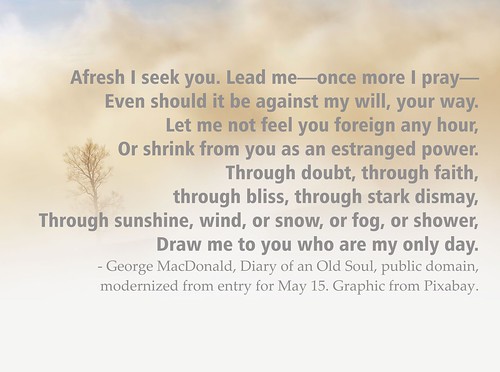
George MacDonald poster: Lead me

George MacDonald - draw me to you

George MacDonald was a writer who influenced C. S. Lewis greatly. Among other works, he wrote Diary of an Old Soul, a book with brief entries for every day in the year, published in 1880. This is one such entry, modernized a little.

This is Independence Day in the U. S., a celebration of national independence. But believers seek the opposite of  personal independence -- guidance and direction from God.

Thanks for looking, and reading.

Sunday, May 07, 2017

Impressions, by Martin Wells Knapp, 47

In a previous excerpt, Knapp stated that there are four features of "impressions" from God. These are Scriptural; Right (consistent with good morals); Providential (in harmony with God's will); and Reasonable. His discussion of "Impressions from Above" continues:

 Clark in his excellent book on "The Offices of the Holy Spirit," says:

"Whenever the will of God is clearly revealed in the Bible in regard to any subject, our duty in regard to that subject is determined. We are not to expect an inward revelation in addition to the outward one to show us what to do.

"If Jesus says: 'Do not kill, do not steal, do not bear false witness, defraud not, honor thy father and mother,' we need no other revelation in regard to our duty in these particulars.

"And the Scriptures do go into more detailed directions than we should imagine, until we acquaint ourselves thoroughly with them. If the Christian lady wishes to know how she may dress so as to please God, she finds that women are 'To adorn themselves in modest apparel;' and with God's providence and the Holy Spirit to assist the sincere inquirer in determining, I think few would be left long in doubt.

"If we want to know what kind of talk is acceptable to God, we read (1) that we are to let no corrupt communication proceed out of our mouth, nor any foolish talking, and (2) that our talk ought to be good 'to the use of edifying.'

"If we are in doubt how to treat our enemies and those who have injured us, we are told explicitly, 'Love your enemies,' 'Pray for them that despitefully use you,' 'Avenge not yourselves.' And if our civil or personal rights are invaded, we are asked, 'Why do ye not rather suffer wrong than go to law?' and told that charity, which is perfect love, 'seeketh not her own.' And the universal duty of Christians when praying is, 'Forgive, if ye have aught against any man.'

"If we want to understand our obligations to the civil magistrates and rulers, we are told to honor them, to obey them in all things, not in conflict with our duty to the King of kings, to pray for them, and to pay tribute to them.

"If we are at a loss as to how far we may join in the pleasures and customs of the world, we are enjoined not to be conformed to the world, and assured that 'If any man love the world, the love of the Father is not in him.' It is to the written Word then that we are first to look for the knowledge of our Christian duties as well as for the knowledge of salvation."

In applying these tests all light should be welcomed, the Scriptures should be diligently studied, good books read, wise counselors conferred with, and above all the presence and guidance of the Holy Spirit should be constantly claimed.

All the conditions mentioned in the preceding chapter should also be met. Converted, cleansed, filled, acknowledging God's guidance, persistently praying and believing for it, and patiently waiting for and expecting it in the use of all known means, it will be freely and graciously given.

Only a few of the practical questions which are daily arising have been noticed, but the same process of testing will apply to all.

It is the gracious privilege of every Christian in this way to be so assuringly convinced of the truthfulness and divinity of his convictions, that with Isaiah he can exclaim:

"For the Lord God will help me; therefore I shall not be confounded; therefore have I set my face like a flint, and I know I shall not be ashamed." 


Excerpted from Impressions, by Martin Wells Knapp. Original publication date, 1892. Public domain. My source is here. The previous post in the series is here.

Sunday, April 30, 2017

Impressions, by Martin Wells Knapp, 46

In a previous excerpt, Knapp stated that there are four features of "impressions" from God. These are Scriptural; Right (consistent with good morals); Providential (in harmony with God's will); and Reasonable. His discussion of "Impressions from Above" continues:

Associates. There are so many societies and lodges which crowd their claims upon people that the question of affiliation with them often arises. Such action should be summoned before these scrutinizing tests.

S. If the society has only worldly aims, is controlled by worldly people, and is sustained by worldly expedients, then the Scripture commands: "Come out from among them and be ye separate," and "Be not conformed to the world," should settle the matter without further investigation.

R. Would affiliation with it be right? Would time and money thus spent be for the glory of God? Would it lead to saying or doing anything that Jesus would not approve?

P. Is the way open for spending the time which would be thus taken without infringing on other sacred duties? Is there no other providential barrier?

R. Is it reasonable to unite with it? Will spirituality be blurred or brightened? Is it the best investment for the time and money it will take?

Will my example in uniting be such as I will be glad to have young converts and others follow? Have I reason to believe that Jesus would do likewise were He in my place? If there is doubt about a rightful answer to any of the above questions, reason will demand a stop, and refuse to affix her signet until the doubt disappears. He who turns a deaf ear to any one of these four friendly counselors does so at his peril, and sooner or later will find that he has grasped thorns instead of roses.


Excerpted from Impressions, by Martin Wells Knapp. Original publication date, 1892. Public domain. My source is here. The previous post in the series is here.

Sunday, April 23, 2017

Impressions, by Martin Wells Knapp, 45

In a previous excerpt, Knapp stated that there are four features of "impressions" from God. These are Scriptural; Right (consistent with good morals); Providential (in harmony with God's will); and Reasonable. His discussion of "Impressions from Above" continues, going from considering if, and who, to marry, to this topic:

The Baptism of the Holy Spirit. Every believer soon after conversion feels a heart longing for the blessed baptism of the Holy Spirit, which will fully cleanse from all inbred sin, and thus give complete victory over fear, impatience, unbelief, pride, and all the uprisings which are felt from time to time in the heart which has not accepted the Holy Spirit as its complete sanctifier. This longing may find but incomplete expression, yet a deep heart hunger it is there, and craves satisfaction.

A strong impression soon conies to such a soul that complete victory is provided through the atonement, that God requires entire holiness, and that it should be sought and received as definitely as conversion. Flying to the fourfold tests for light it is found first.

S. That the feeling is Scriptural. God commands: "Be ye holy." The Word also declares: "Be ye filled with the Spirit." "This is the will of God, even your sanctification." "For God hath not called us unto uncleanness but unto holiness."

It also promises cleansing from "All filthiness of the flesh and Spirit," and that "We being delivered out of the hand of our enemies might serve Him without fear in holiness and righteousness before Him all the days of our life."

Jesus also promised that He would send the Holy Spirit, and commanded His disciples to tarry until they received Him. The Apostles and members of the early church received this induement and the Word declares that it is for all believers.

Prophets, Apostles and Jesus possessed this experience, and under its influence their lives glowed with holy fire.

Scripture command, precept, promise, experience and prophecy, all combine to show that every believer may claim by faith this precious legacy, and be as conscious that the Holy Spirit fully sanctifies as he is that Jesus fully forgives. Glory be to God for such assurance!

R. In regard to the rightfulness of such an experience there can be no doubt. If it is right to obey God, to be pure, and live a holy life, then this is right.

P. Next, is it attainable? If the conditions of receiving it are such that they can not be met, then all are providentially debarred from this privilege. On the other hand, however, they are simple, plain and practicable. A complete consecration which yields every power and possession entirely to God forever, and then a present faith in the promises which offer the gift of the Holy Ghost, are the sole conditions upon which this priceless boon is granted. These conditions all can meet who will, so that
this voice unites with the two preceding in proclaiming, that the impulse to be filled with the Spirit, is of God.

R. That such an experience is "a reasonable service," is seen from the following facts: God commands it and promises it.

The wisest and most successful saints have claimed it and proclaimed it.

It satisfies the longings of the soul.

It delivers from besetments, and gives new power to work for God and resist the devil.

It convinces the world as nothing else will of the divinity of our religion.

God has given it to all who have met the conditions, and "He is no respecter of persons."

It is the only thing that will enable one to be perfectly holy.

Without it, it is impossible to be free from carnality.

With it growth in grace is greatly facilitated.

Without, our joy can not be full.


Excerpted from Impressions, by Martin Wells Knapp. Original publication date, 1892. Public domain. My source is here. The previous post in the series is here.

Sunday, April 02, 2017

Impressions, by Martin Wells Knapp, 42

In a previous excerpt, Knapp stated that there are four features of "impressions" from God. These are Scriptural; Right (consistent with good morals); Providential (in harmony with God's will); and Reasonable. His discussion of "Impressions from Above" continues:
I had always felt that if I was converted I would be called to preach. Soon after my conversion, the words: "Go ye into all the world and preach the gospel," was applied to me in a wonderful way. I felt that God was calling me. I was "unspeakably" diffident, and did not see how I could ever succeed, but dare not say no. I mentioned it to but one person, but did all I could to prepare for it. I was assured that it was Scriptural and right, but the way did not open to preach for over four years. I began my studies preparatory to conference examination, and felt sure in my heart that God would unfold the gift within in some way, and that in His time the way would open.

It opened first by my being given charge of a rural Sunday-school, and next by being sent for to preach in a neglected neighborhood, where a revival at once broke out, and a class was organized which stands today. When conference came I was duly recommended and given work, and God has let the fire fall all along. To Him be glory forever!

To a woman called to preach the way of work often seems more hedged up than to a man, because the church may not officially recognize her call, or provide for her preparation to fill it as with her brother. God, however, if He be fully followed, will open a way through every hedge, and lead His loyal children to the work to which He calls; and the four-fold test being met they will be as certain of the divinity of their call as of their own existence.

I know a successful woman preacher, wife of a Methodist minister, who, when called to preach, was firmly opposed by her father.

All the tests of a genuine call were met, but his opposition continued to increase. She was of age, but shrank from crossing her father's will. Finally a call came to aid in revival work. She felt that she must obey God rather than man, and decided to accept of it. "Tell Bro. _____ that you come without your father's consent," was the painful message which followed her from her father's lips as she left her home for the ripe harvest field.

She had scarcely reached her destination, however, when a letter reached her from him giving full and free consent.

God tested her obedience and tried her faith, and then melted the opposition, and blessed her ministry to the salvation of many.

In His own time and manner He will thus level all mountains which are in the way of all who fully follow Him.


A call to mission work can be tested the same as a call to the ministry.

Excerpted from Impressions, by Martin Wells Knapp. Original publication date, 1892. Public domain. My source is here. The previous post in the series is here.

Sunday, March 19, 2017

Impressions, by Martin Wells Knapp, 40

In a previous excerpt, Knapp stated that there are four features of "impressions" from God. These are Scriptural; Right (consistent with good morals); Providential (in harmony with God's will); and Reasonable. His discussion of "Impressions from Above" continues:

One Must be Dead. Dead to sin, to self, and dead to the world.

So dead to all voices from sinful and doubtful sources that they will influence our actions no more than if they had been silent. In the stillness of the funeral of self the voices from the skies are clearly heard. Therefore, "likewise reckon yourselves to be dead indeed unto sin, but alive unto God through Jesus Christ our Lord."

Be Filled with the Spirit. This is the all important preparation. It includes all of the others. It gives an insight into Satan's devices that can be possessed in no other way. It gives the ears a keen discernment that will detect the slightest deviation of any impression from the four-fold harmony.

"To him who is crucified to self," says Dr. Watson; "The Holy Spirit grants an illumination and direction, incomprehensible to imperfect believers. He can discern in the providence of the Father a special significance and minuteness which others are blind to. He can detect clear indications of God's will in the written Word which others grossly stumble over, and besides these he can hear that inner voice of the Spirit, can know the touches of a divine finger on his soul impelling him along his
God-given orbit."

Fully possessed of the Spirit, the soul becomes a magnet which draws to itself all good impressions, but leaves the dross behind.

It is, therefore, a qualification of being divinely led of such paramount importance that Jesus would allow no preacher, after the opening of the Holy Ghost dispensation, to go forth without it, and the church in its purity as it came fresh from the mind of God selected only those thus filled to oversee her temporal concerns. Acts 6:3.

He who meets the above conditions will be at his best to discern the nature of all impressions. Though like Job he may sometimes be sorely tried, yet God will not permit him to "walk in darkness."

Above all the din of voices which are not divine, he will be able to hear the still small voice saying: "This is the way, walk ye in it." Though Satan may come as an "angel of light," yet his presence will pale before the celestial sunshine which illuminates within, and his icy waves of false light will be lost amid the burning beams of the sun which never sets. Hallelujah! 

Excerpted from Impressions, by Martin Wells Knapp. Original publication date, 1892. Public domain. My source is here. The previous post in the series is here.   

Sunday, March 05, 2017

Impressions, by Martin Wells Knapp, 38

In a previous excerpt, Knapp stated that there are four features of "impressions" from God. These are Scriptural; Right (consistent with good morals); Providential (in harmony with God's will); and Reasonable. His discussion of "Impressions from Above" continues:

Patience. "Rest in the Lord and wait patiently for him." Jesus never seemed hurried, and yet how busy!

He who tramples beneath his feet the great Scriptural truth that "He that believeth shall not make haste," and is too hurried to candidly canvass the matter, and closes his eyes to reason and God's providences, is "too much possessed of self or Satanic influences" to be led by holy influences. In order to be divinely led we must, says Upham, "cease from self and from its turbulent and deceitful elements; cease to place ourselves and our personal interests foremost and keep our own plans, purposes and aims in entire subjection. For instance, when we ask God to guide us, we must not at the same time cherish in our hearts a secret determination and hope to guide ourselves. . . . The existence of undue eagerness of spirit is an evidence that we are in some degree afraid to trust God, and that we are still too much under the life of nature."

God says:" Be still and know that I am God," and such stillness is frequently necessary to enable one to discern the harmony of the four voices through which God speaks to the soul.

All who can say with the psalmist, "I waited patiently for the Lord," will soon with him be able to add: "And He inclined unto me and heard my cry."

He who attempts to test impressions in a nervous and hurried way, is as unwise as he who would listen to a response from a telephone in that manner. In both cases confusion instead of satisfaction will be the result.


Excerpted from Impressions, by Martin Wells Knapp. Original publication date, 1892. Public domain. My source is here. The previous post in the series is here.  

Sunday, February 26, 2017

Impressions, by Martin Wells Knapp, 37

In a previous excerpt, Knapp stated that there are four features of "impressions" from God. These are Scriptural; Right (consistent with good morals); Providential (in harmony with God's will); and Reasonable. His discussion of "Impressions from Above" continues:

Acknowledgment. Another divinely decreed condition of guidance is acknowledgment. "In all thy ways acknowledge Him and He shall direct thy paths.[*]" As justification is conditioned on an acknowledgment of Jesus as a personal Savior, and entire sanctification, an acknowledgment of the Holy Ghost as a personal sanctifier, so divine guidance is conditioned on the acknowledgment of the Spirit as a personal Guide. Nor will a wholesale theoretical acknowledgment answer this purpose.
[*Proverbs 3:6]

"In all thy ways" implies claiming His counsels in things small as well as great. We have Scripture warrant for acknowledging God in everything that is of as much concern to us as one of the hairs of our heads.

To withhold this hearty specific acknowledgment is as if a patient should decline to counsel with his physician on minor matters relating to disease, and refuse to own the complete committal of his case into his physician's hands. God will not honor those who would avail themselves of the advantages of His counsels, but are ashamed to own that they are thus' divinely directed. "In all thy ways" means business "ways," home "ways," church "ways," private "ways," public "ways," all "ways." May we each meet this condition, and test the blessedness of the promise, and whether we need wisdom to find a "lost key" or to prepare a revival sermon, verily, it will be given.
 

Goodness. "The steps of a good man are ordered of the Lord, and He delighteth in his way." The bad follow their own counsels and suffer the consequences, but the "good" man meets all the conditions whereby he is enabled to distinguish between impressions from below and voices from above, and hence his very "steps," as well as the path of his life, are ordered by God. No "step" should be taken which is not thus ordered. In the light of this bright and blessed promise there need not be. This is one of the special favors which God lavishes upon the "good."

Excerpted from Impressions, by Martin Wells Knapp. Original publication date, 1892. Public domain. My source is here. The previous post in the series is here. 

Sunday, February 12, 2017

Impressions, by Martin Wells Knapp, 35

In a previous excerpt, Knapp stated that there are four features of "impressions" from God. These are Scriptural; Right (consistent with good morals); Providential (in harmony with God's will); and Reasonable. His discussion of "Impressions from Above" continues:

There must be a belief that God will make His guidance known. "If any man lack wisdom let him ask of God, who giveth to all liberally and upbraideth not, and it shall be given him, but let him ask in faith nothing wavering, for he that wavereth is like a wave of the sea driven with the wind and tossed. For let not that man think he shall receive anything of the Lord." -- Jos. 1: 6-8.

Unbelief in God's ability and promises to guide will leave the soul like a ship at sea with no helm and at the mercy of wind and waves.

There must be complete commitment to God. Hence it is written: "Commit thy way unto the Lord, trust also in Him and He shall bring it to pass." Any mental reservation in the commitment will
deaden the discerning of the divine voice.

Spurgeon said: "Brethren, I can testify for my God that when I have submitted my will to His directing Spirit, I have always had reason to thank Him for His wise counsel. But when I have asked at His hands, having already made up my own mind, I have had my own way; but like as He fed the Israelites with quails from heaven, while the meat was yet in their mouth, the wrath of God came upon them."

He who employs a physician or attorney puts the case fully in their hands and follows their directions. Jesus is the soul's great Physician, and the lost man's lawyer. Infinite in wisdom and in love, the most timid soul need not fear to commit itself unreservedly to Him. Any shrinking here may cost what is worth more than worlds. The soul must be like a ship sailing under sealed orders unrevokably committed to execute the orders when opened, no matter what they are. It is God's to direct; ours to execute. We are accountable only for the execution; He for the results.


Praise His name!

Excerpted from Impressions, by Martin Wells Knapp. Original publication date, 1892. Public domain. My source is here. The previous post in the series is here

Sunday, February 05, 2017

Impressions, by Martin Wells Knapp, 34

In a previous excerpt, Knapp stated that there are four features of "impressions" from God. These are Scriptural; Right (consistent with good morals); Providential (in harmony with God's will); and Reasonable. His discussion continues:

CHAPTER VII
IMPRESSIONS FROM ABOVE -- CONDITIONS OF BEING LED BY THEM

In order to be at one's best for detecting impressions from below, and being led by those from above, the following conditions must be met:

Conversion. The unregenerated heart is a camera prepared for impressions from below, and it receives them as greedily as the parched earth drinks in a shower. It has no affinity for those from above, but resolutely repels them. All of its telegraph wires are manipulated by the enemy, and it is with great difficulty that its King can reach it with a message. Of such it is truly said: "For this people's heart is waxed gross, and their ears are dull of hearing, and their eyes they have closed, lest at any time they should see with their eyes, and hear with their ears, and be converted, and I should heal them." Conversion opens the spiritual eyes and ears, and enables to discern the spirits whether they be of God.

Purity. Inbred sin in the heart of the believer is a great hindrance to being divinely led. It is like dust in the eye which pains and blinds it; like wax in the ear which deadens the hearing.

"After you are sanctified," says Dr. Watson, "the devil comes up to you and hunts all around and says: 'Where is my instrument gone? I could run my fingers over the carnal mind and play a tune in this man's soul.' He finds no wire in your soul to pull on now. He used to pull on your judgment and reason and carnal nature, but that is all gone and he finds nothing but Christ.

"When the devil finds out he has no territory in you. he gets mad, flings off his coat, and begins to blaspheme. He will say: 'You have professed holiness, and you know you haven't it.' You never know how plainly the devil can talk to you until you are sanctified. Before he could run into the back door of your heart and pull the wires; but after you are sanctified the devil has got to fight you on the outside. He will come to your face and tell you you are not sanctified, and you know it! He will threaten you with falling; he will talk to you intellectually, and pronounce words in your mind.

"Before we are sanctified the method of the devil is to work in Christian people through their carnal mind without letting them know it is the devil. He will come to Christian men, to Christian women, Christian ministers, good people who are endeavoring to serve God, and are on the way to heaven; he will work his plans and purposes upon them by using their carnal mind, and so work that they think it is their wisdom. The devil will come to an unsanctified Christian who is converted, and will put a certain idea into his mind or heart, and he will say: 'Now, isn't that wise, isn't that prudent,
isn't that cautious?' Thus he will work on their prudential motives, on their reason, and on their carnal fears. He will work on their man-fearing spirit; he will work on their worldly policy and their worldly wisdom, making a playground upon their carnal mind.

"Now, mark you, he has no possession of God's children, but he will annoy them and disturb them and hinder them. They are doing ten thousand things in which they do not dream they are doing the devil's work. The devil goes to Christian people and gets them to have a church theatrical. He wouldn't dare have them start a regular theater with all the accessories, but he goes and works on their worldly policy and their worldly mind, so that when they have got these things up, church members do not know they are doing the devil's work. They say: "We are doing this to raise money for our church. It is laudable.' They think they are right. They simply are doing the devil's work by the devil's suggestions, only the devil is hiding himself, and laughing at them all the while."

If, then, we would be at our best to detect the impressions which are continually coming to us, we, having our hearts "purified by faith," must be cleansed from inbred sin.

George Muller says: "Only maintain an upright heart. But if you live in sin, if you willfully and habitually do things which you know to be contrary to the will of God, then you can not expect to be heard by Him. 'If I regard iniquity in my heart the Lord will not hear me."'


Excerpted from Impressions, by Martin Wells Knapp. Original publication date, 1892. Public domain. My source is here. The previous post in the series is here.

Sunday, January 29, 2017

Impressions, by Martin Wells Knapp, 33

In a previous excerpt, Knapp stated that there are four features of "impressions" from God. These are Scriptural; Right (consistent with good morals); Providential (in harmony with God's will); and Reasonable. His discussion continues:

4. Inspired Aspirations. There is a heaven-born aspiration in the heart of every truly converted person to be divinely led.

Without such leading there is a deep sense of inability to solve life's problems and meet its perplexities.

All other human needs are met and satisfied in Jesus, and this one is no exception.

For guilt there is provided pardon.
For pollution, purity.
For weakness, power.
For spiritual hunger, the Bread of Life.
For spiritual thirst, the Water of Life.
For spiritual sickness, a great Physician.
For spiritual poverty, an eternal inheritance.
For spiritual guidance, divine wisdom.

God creates the desire to receive this wisdom because He has made provision to give it, and the very fact that He inspires it is a token that He has it to give. God does not create desires in men to mock them with fruitless longings, but because He loves to supply their every need, and has planned so to do. This reason, combined with those before mentioned, shows conclusively our privilege in all things to avail ourselves of the services of a mighty Counselor. His unerring eye will lead us in the way that we should go. With Him enthroned within, neither poverty nor distance need keep us from His counsels, nor from knowing and doing His will.

In the light of the four-fold testimony given there remains not a shadow of doubt as to God's ability and willingness to lead all who will follow His instructions. Glorious privilege! The conditions upon which it may be realized are simple, plain and important, and will be noticed further on.

"He leadeth me! oh! blessed thought,
Oh! words with heav'nly comfort fraught;
Whate'er I do, where'er I be,
Still 'tis God's hand that leadeth me.

He leadeth me! He leadeth me!
By His own hand He leadeth me;
His faithful follower I would be,
For by His hand He leadeth me.

"Sometimes 'mid scenes of deepest gloom,
Sometimes where Eden's bowers bloom,
By waters still, o'er troubled sea, --
Still 'tis His hand that leadeth me.

"Lord, I would clasp Thy hand in mine,
Nor ever murmur nor repine --
Content, whatever lot I see,
Since 'tis my God that leadeth me.

"And when my task on earth is done,
When, by Thy grace the victory's won,
E'en death's cold wave I will not flee,
Since God through Jordan leadeth me."


Excerpted from Impressions, by Martin Wells Knapp. Original publication date, 1892. Public domain. My source is here. The previous post in the series is here.

Sunday, January 22, 2017

Impressions, by Martin Wells Knapp, 32

In a previous excerpt, Knapp stated that there are four features of "impressions" from God. These are Scriptural; Right (consistent with good morals); Providential (in harmony with God's will); and Reasonable. His discussion continues:

"The Living God," says George Muller, "is my partner." I have not sufficient wisdom to meet these difficulties, so as to be able to know what steps to take, but He is able to direct me. What I have therefore to do is this: in simplicity to spread my case before my heavenly Father and my Lord Jesus. They are my partners. I have to tell out my heart to God, and as I have no wisdom in myself to meet all the many difficulties which continually occur in my business, I ask Him that He would be pleased to guide and direct me, and supply me with the needful wisdom. Then I have to believe that God will do so, and go with good courage to my business, and expect help from Him in the next difficulty that may come before me. I have to look out for guidance; I have to expect counsel from the Lord, and as assuredly as I do so, I shall have it; I shall find that I am not nominally but really in partnership with the Father and with the Son."

By claiming this guidance Mr. Muller has been enabled to "remove mountains" of difficulty, and God through him has wrought marvels which will inspire the faith and zeal of His children while the world stands.

Frances Ridley Havergal, whose songs and books have thrilled the Christian world, in all things claimed this blessed privilege. Making mention of it in its application to the use of means she says: 

"We look up to our Lord for guidance to lay out His money prudently and rightly, and as He would have us lay it out. The gift or garment is selected under His eye, and with conscious reference to Him as our dear Master, for whose sake we shall give it, or in whose service we shall wear it, and whose own silver and gold we shall pay for it, and then it is all right."

Numberless living witnesses join their testimony to the many who have gone before, that God is a true, sure, constant and wonderful Counselor, and that His guidance is accessible to all who meet the conditions upon which it is promised. 

 
Excerpted from Impressions, by Martin Wells Knapp. Original publication date, 1892. Public domain. My source is here. The previous post in the series is here.

Sunday, January 15, 2017

Impressions, by Martin Wells Knapp, 31

In a previous excerpt, Knapp stated that there are four features of "impressions" from God. These are Scriptural; Right (consistent with good morals); Providential (in harmony with God's will); and Reasonable. His discussion continues:

3. Inspired Experiences. In addition to the inspired examples recorded in the Word, mention of which has just been made, there is also the experiences of all of God's children who "abide under the shadow of the Almighty," attesting the same truth.

Among the many remarkable instances of guidance recorded in the Life of Madam Guyon, who shone amid the darkness of papal superstition like the sun through a thunder cloud, we quote the following. It relates to a complex business matter, which unaided, she could not have handled. She says:

"The day when the trial was to come on, after prayer I felt myself strongly pressed to go to the judges. I was wonderfully assisted therein, even so as to discover and unravel all the turns and artifices of this affair, without knowing how I could have been able to do it. . . . . God enabled me to manifest the truth in so clear a light, and give me such power to my words that the intendant thanked me for having so seasonably come to undeceive, and set him right in the affair. Had I not have done this he assured me the cause had been lost."

Through prayer and faith God thus gave wisdom to this illustrious saint, and it was this wisdom which made her illustrious. She followed the divine voice so fully that she could say:

"It seemed to me that my soul became like the New Jerusalem spoken of in the Apocalypse, prepared as a bride for her husband, and where there is no woe, sorrow or sighing.

"I had a union so great with the good will of God that my own will seemed entirely lost. My soul could not incline itself on one side or the other, since another will had taken the place of its own, but only nourished itself with the daily providences of God."

Thus led by the Word, the Spirit and daily providences, she continued to glow with increasing splendor until she passed to her celestial home.


Excerpted from Impressions, by Martin Wells Knapp. Original publication date, 1892. Public domain. My source is here. The previous post in the series is here.