License

I have written an e-book, Does the Bible Really Say That?, which is free to anyone. To download that book, in several formats, go here.
Creative Commons License
The posts in this blog are licensed under a Creative Commons Attribution-NonCommercial-ShareAlike 3.0 Unported License. You can copy and use this material, as long as you aren't making money from it. If you give me credit, thanks. If not, OK.
Showing posts with label omniscience. Show all posts

Friday, October 03, 2025

Sunspots 990


Things I have spotted that may be of interest to others. Graphic from NASA.

Bible Scholar Ken Schenck on the different interpretations of early Genesis.

Schenck also has posted an analysis of what the Bible says about God's omniscience. It's not as straightforward as I thought..

Sojourners has an article on ministering to Christians with dementia (usually in their home). Sojourners allows you to read two articles a month, free.

Gizmodo has a chilling report on the firing of the Centers for Disease Control head, less than a month after she was confirmed, by Rober F. Kennedy, Jr., and how he is not using real science in his decision-making.  

Gizmodo also reports that a significant number of people say that they are in some sort of relationship with a chatbot.

Tuesday, January 15, 2019

The first day of creation: things we are never going to understand

Genesis 1:2 The earth was formless and empty. Darkness was on the surface of the deep and God’s Spirit was hovering over the surface of the waters. 3 God said, “Let there be light,” and there was light. 4 God saw the light, and saw that it was good. God divided the light from the darkness. 5 God called the light “day”, and the darkness he called “night”. There was evening and there was morning, the first day. (World English Bible, public domain)

There are plenty of possible questions about this passage, such as about how literally to take it, but I’d rather not explore the questions of what “day” means, and other such matters, important as they might be. I have some other questions in mind, questions that we will never understand in this life, and maybe not in the next one. We can, and may, have opinions about them, but the opinions are not strongly backed by the Scripture, or are not covered at all in the Bible, and Genesis 1 is interpreted in different ways by different people. For more on scriptural interpretation, see this post.

Questions:
If God spoke light into existence, what language did He use?
Does God, in this passage, mean God the Father, God the Son, God the Holy Spirit, or some combination of them?
Who did God speak to?
If He/They spoke to some other entity, who was it, and why was this said?
Did angels, or some other entity, actually create the light, at God’s command?
Was the creation of light preceded (whatever preceded  means to an eternal God!) by planning?
Was the entire electromagnetic spectrum, of which light is only a small part, created at once?
Did the creation of light cost God effort or resources of some sort?
Does this passage actually refer to the creation of the sun, or was that created later?
Was there light elsewhere in the universe, but not on earth, or, on the other hand, was the light created for the earth, or perhaps for the solar system, spread throughout the universe somehow, after this initial creation?
Was light created from something else?

Interesting questions. (There are more questions about origins in this post -- toward the end.) I have no answers. Thanks for reading.

Monday, December 03, 2012

Attributes and qualities of God

Attributes and qualities of God
Attributes and Qualities of God

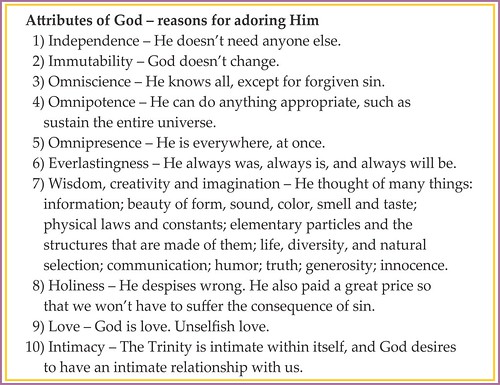
About a year ago, I posted a chart, illustrating an ideal pattern for prayer: Adoration, Confession, Thanksgiving and Supplication. Adoration, or praising God for who and what He is, is perhaps the most difficult of these for me to get a grip on. So I have attempted, and it is a feeble attempt, for sure, to set forth ten of God's special attributes. Some of these attributes, especially numbers 7 and 10, are shared, in a measure, by humans, and, I believe, make up part of the image of God in us.

No chart, however complex, or sophisticated, or clear, can capture who and what God is. This doesn't. But it's an attempt.

As with all my charts, you may use this freely, without restrictions, except that you are not to use it for commercial purposes. I would hope that you would credit me when you use any of my materials. Also, if you want a larger size, with better resolution, the chart, itself, is a link to the picture on my Flickr photostream

You may want to see this post, listing the the ways God reveals Himself to humans.

Thanks for reading and looking. 

December 30, 2016: On December 9, 2015, Jim Stump listed these attributes of God: mercy, forgiveness, tender affection, humility, mildness, compassion, loving-kindness, etc., which he calls gracious attributes, as opposed to glorious attributes, such as the ones in the chart above. Stump argues that God is mostly hidden so that He can be known for the gracious attributes, rather than the glorious attributes. 

Monday, November 19, 2012

I'm thankful for ignorance.

I'm thankful for ignorance -- mine, not yours -- because it's fun learning new things, or re-learning things I've forgotten, and I think that doing so is part of the image of God in humans. Babies are learning stuff all the time, so it's normal to want to learn things. We sometimes wonder, "What good is it to accumulate knowledge?" But there is potential good in learning.

I'm also thankful for God's ignorance. He forgets forgiven sin!

It is possible that God has set limits on knowing, in the universe that He has created, such that even He, abiding by those limits, does not know everything. I am referring to the Heisenberg Uncertainty Principle. I don't, if you will excuse the expression, know whether God is able to supersede the limits to human knowledge set by that principle. I also refer to the incompleteness theorems of Kurt Gödel, which say, more or less, that any mathematical system will be based, in part, on ideas, axioms, or statements that can't be proved -- in other words, there will always be doubt as to the rigor and consistency of mathematics. Again, I think it possible that God knows whether any axiom or statement is true or not, but it is also possible that God is Self-limited in this area, too.

It is also possible that God allows real randomness in the universe.

Thanks for reading! I learn things, or re-learn things, in the process of blogging.

Saturday, November 17, 2012

God doesn't know everything -- He forgets forgiven sin

God is omniscient -- He knows everything. But there is at least one limit. That Self-imposed limit is that God forgets forgiven sin.

I quote the evidence, using the World English Bible, which is in the public domain:

Isaiah 43:25 I, even I, am he who blots out your transgressions for my own sake;
and I will not remember your sins.

Micah 7:18 Who is a God like you, who pardons iniquity,
and passes over the disobedience of the remnant of his heritage?
He doesn’t retain his anger forever,
because he delights in loving kindness.
19 He will again have compassion on us.
He will tread our iniquities under foot;
and you will cast all their sins into the depths of the sea.

There are also pleas that God would forget past sins:
Psalm 25:7 Don’t remember the sins of my youth, nor my transgressions.
Remember me according to your loving kindness,
for your goodness’ sake, Yahweh.

Isaiah 64:9 Don’t be furious, Yahweh,
and don’t remember iniquity forever.
Look and see, we beg you,
we are all your people.

Thanks for reading!


Friday, February 02, 2007

Numbering the stars

How many stars are there? Good question.

The Bible makes a few references to counting the stars, or to their number. Some of these are Genesis 15:5 (there are similar passages) wherein God promises as many offspring to Abraham as the stars, Deuteronomy 28:62, in which Moses reminds the offspring of Abraham of this promise, and points out that it was achieved, in Egypt, but that the number has declined, because of disobedience. In Isaiah 40:25-6, God asks who created the stars, and says that He has them all numbered and named, and under His control.

So, how many stars are there? The short, and correct, answer, is that we don't know. However, there are estimates, based, as they must be, on various assumptions. Here's what the European Space Agency says about this question. Their estimate is on the order of 10 to the 22nd to 24th power. In other words, a 1 with from 22 to 24 zeros after it. The Cornell Astronomy Department has proposed a similar number. These numbers are obtained by estimating the number of stars in our galaxy, and multiplying that by the estimated number of galaxies. (Both numbers are estimated to be about 10 to the 11th power.) CNN reports a similar estimate, by a different method.

The Cornell Astronomy Department says that we can see (on a clear night, with no air pollution) a few thousand stars. Thinkquest gives a similar number. (Bear in mind that we can only see, at most, half of the sky from any single location -- there are stars visible from the Southern Hemisphere that I have never seen, and a person from, say, New Zealand, who has never traveled above the equator, must experience the same phenomenon in reverse.)

Did God mean to tell Abraham that he would have 10 to the 24th power offspring, or only a few thousand? I doubt if He meant either. My guess is that He was trying to say the sort of thing that we might say, and understand, namely the Abraham was going to have a lot of descendants. That has come true!

I'd like to muse a little about God having all the stars numbered and named. Wow!

We are so finite. We have only detected two hundred or so planets beyond our own solar system. One of the planets we thought we had has been downgraded to a "dwarf planet" in this century. In other words, we aren't even sure how many planets there are in our own solar system. We don't know for sure if any of them, or their moons, have living things on them, or used to. (Except, of course, for earth. I suppose that it is possible that there is some yet to be discovered life form on our own moon. Not probable, possible.) We surely don't know exactly how many stars are in our galaxy, or how many galaxies there are. We don't know how large the universe is. We don't know if it has a boundary or if it just goes on forever. Some scientists (I am not making this up!) speculate that there are a large, maybe infinite, number of universes that are parallel to ours, and that the entire group of such parallel universes makes up a multiverse. (See this Wikipedia article.) It may comfort your sanity to understand that these ideas are far from universally (sorry!) accepted. Philip Pullman, award-winning author, used these ideas in his books. (Pullman has been accused of attacking Christianity in his fiction, but that doesn't prove that the idea is wrong.)

How ever many planets, stars, locations where living things exist, galaxies, universes, and even multiverses, there may be, God has them all under control -- counted and named! As indicated above, he told Isaiah that. He also expresses this in Colossians 1:15-20, in which we are told that ". . . in him [Christ] all things hold together." (ESV)

Thanks for reading!

I have posted a follow-up to this, considering some of what the Bible says about Abraham's descendants.