Things I have recently spotted that may
be of interest to someone else:
Christianity: An essay in the Huffington Post tells us why we shouldn't use "I'm blessed," or the equivalent, as much as many of us do.
Computing: Wired tells us that Amazon
may be about to release a device that streams video to your TV.
Gizmo's Freeware on what they say is a great
free photo editor for iOS and Android devices.
Gizmo's also has an annotated list of 9
free apps that every Android device owner should consider installing.
Politics: (And Christianity) Charles Haynes on the continuing battles to
get officially-sanctioned prayer back in schools.
Science: National Public Radio reports that NASA has found 715
new planets.
Image
source (public domain)
Musings on science, the Bible, and fantastic literature (and sometimes basketball and other stuff).
God speaks to us through the Bible and the findings of science, and we should listen to both types of revelation.
The title is from Psalm 84:11.
The Wikipedia is usually a pretty good reference. I mostly use the World English Bible (WEB), because it is public domain. I am grateful.
License
I have written an e-book, Does the Bible Really Say That?, which is free to anyone. To download that book, in several formats, go here.

The posts in this blog are licensed under a Creative Commons Attribution-NonCommercial-ShareAlike 3.0 Unported License. You can copy and use this material, as long as you aren't making money from it. If you give me credit, thanks. If not, OK.

The posts in this blog are licensed under a Creative Commons Attribution-NonCommercial-ShareAlike 3.0 Unported License. You can copy and use this material, as long as you aren't making money from it. If you give me credit, thanks. If not, OK.
Showing posts with label planets. Show all posts
Wednesday, March 05, 2014
Wednesday, October 02, 2013
Sunspots 438
Things I have spotted that may be of interest to someone else:
Christianity: The Skeptical Zone has an analysis of the Intelligent Design movement, with documentation, that claims that the Intelligent Design Movement is trying to establish a theocracy, or, as the article puts it, "totalitarianism."
A post, in the BioLogos Forum, from a man who discovered that, unfortunately, some people have lost their faith because they have been told that you can't believe that the earth is very old, and be a Christian, and who also discovered that it is possible to disagree over origins, and still love and respect fellow believers.
Computing: Wired says that we shouldn't keep our laptops plugged in all the time.
Politics: (and health) National Public Radio has published an on-line Obamacare calculator, which is supposed to calculate how much you will have to pay for health insurance, if you purchase your own.
Science: NBC News reports that a new island has been formed, off the coast of Pakistan, as the result of a volcano.
NASA has found evidence of clouds on a planet outside the solar system, according to the Jet Propulsion Laboratory.
Image source (public domain)
documentation, that claims that the Intelligent Design Movement is trying to establish a theocracy, or, as the article puts it, "totalitarianism."
Christianity: The Skeptical Zone has an analysis of the Intelligent Design movement, with documentation, that claims that the Intelligent Design Movement is trying to establish a theocracy, or, as the article puts it, "totalitarianism."
A post, in the BioLogos Forum, from a man who discovered that, unfortunately, some people have lost their faith because they have been told that you can't believe that the earth is very old, and be a Christian, and who also discovered that it is possible to disagree over origins, and still love and respect fellow believers.
Computing: Wired says that we shouldn't keep our laptops plugged in all the time.
Politics: (and health) National Public Radio has published an on-line Obamacare calculator, which is supposed to calculate how much you will have to pay for health insurance, if you purchase your own.
Science: NBC News reports that a new island has been formed, off the coast of Pakistan, as the result of a volcano.
NASA has found evidence of clouds on a planet outside the solar system, according to the Jet Propulsion Laboratory.
Image source (public domain)
documentation, that claims that the Intelligent Design Movement is trying to establish a theocracy, or, as the article puts it, "totalitarianism."
Friday, September 28, 2012
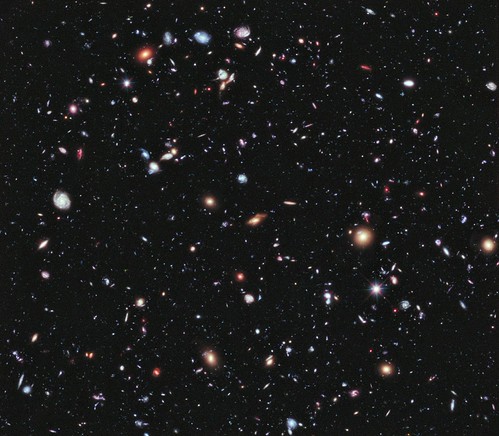
A source of interesting, and beautiful, photos from NASA
What does the photo show? It shows a small part of the sky out there, and about 5,500 galaxies, some nearer and/or larger, some smaller and/or further away. The Wikipedia article on galaxies indicates that the smallest ones have about ten million stars apiece, and the largest ones have about ten million times ten million stars each, which is about 10 times as many stars in each one as the dollar amount of the national debt. Clearly, there are a lot of stars out there! How many of these have planets? Obviously, we don't know, but, most likely, many millions of planets, some of them suitable for earth-type living things, are out there. The furthest galaxies in the picture are said to be over 13 billion light years away, which means that it took over 13 billion years for light from them to reach NASA's instruments.
I am a member of Flickr, a sort of hybrid between photography, a blog, and a social network. Members post photos, and other members can subscribe to those photos, which means that they can see, if they choose, all the photos published by such other members. I have been a subscriber to NASA's photostream for a few years, and there are often interesting, beautiful, or spectacular shots posted from current work. (See here for NASA's policy on use of their photographs, which allows use such as this.) Non-members, including you, can see Flickr photos without needing a password. The graphic above is also a link to the photo on Flickr, with description. Larger sizes are available, at least to other Flickr members. See here for a fuller explanation of the picture.
In addition to the above photo, which was assembled from years of data collection by orbiting telescopes, recent photos have included various weather phenomena, as seen by satellites, shots of equipment used, or soon to be used, by NASA, and a satellite photo of the result of the attack on the World Trade Center on September 11, 2001.
I have previously posted on related topics, including "extraterrestrial religion," "numbering the stars," and "God's complexity." I don't know whether there are other intelligent beings in the universe, and, if there are, whether they need salvation from sin or not. I believe that, should there be or have been such, God's plan includes their salvation, in ways we might, or might not, understand. It is likely, it seems to me, that Christ's death on the cross, on earth, and His subsequent resurrection, was sufficient atonement for all the intelligent beings that have ever sinned, whatever they might have looked like, or look like now, and whatever planet they lived on, or live on now, including me and you.
Thanks for reading.

Labels:
Astronomy,
galaxies,
meteorology,
NASA,
photography,
planets
Tuesday, August 12, 2008
Do the Narnia books tell us about the planets?
First Things has a review of a book by Michael Ward, entitled Planet Narnia: The Seven Heavens in the Imagination of C. S. Lewis. The theme of the book, published by Oxford University Press, no less, is that the seven Narnia books were consciously related to the seven heavenly bodies known to the ancients, by Lewis.
The author of the review says, understandably, that such a thesis sounds nutty. He goes on to say that, although Ward didn't convince him, his book did offer insights into the Narnia books that he hadn't had before, and that his idea isn't nearly as wrong as he thought it was when before he read Ward's book.
The review is long enough to explain what the book is about, with examples, but not too long for a reasonably easy read.
Thanks for reading. Thanks, First Things!
The author of the review says, understandably, that such a thesis sounds nutty. He goes on to say that, although Ward didn't convince him, his book did offer insights into the Narnia books that he hadn't had before, and that his idea isn't nearly as wrong as he thought it was when before he read Ward's book.
The review is long enough to explain what the book is about, with examples, but not too long for a reasonably easy read.
Thanks for reading. Thanks, First Things!
Subscribe to:
Posts (Atom)

