License

I have written an e-book, Does the Bible Really Say That?, which is free to anyone. To download that book, in several formats, go here.
Creative Commons License
The posts in this blog are licensed under a Creative Commons Attribution-NonCommercial-ShareAlike 3.0 Unported License. You can copy and use this material, as long as you aren't making money from it. If you give me credit, thanks. If not, OK.
Showing posts with label c. s. lewis. Show all posts

Monday, March 30, 2026

"There are no accidents." How I found Tolkien and C. S. Lewis

 Over six decades ago, I was a student worker in the library of Wisconsin State University at Superior. Student workers had access to the bookshelves (aka stacks), although other students generally did not. I was putting a shelf to order, or some such, when I saw Tolkien’s The Fellowship ot the Ring. I checked it out, and read it. I became so deeply involved with it that I took the book home to Birchwood, WI, for the weekend, and read the chapter on Gandalf’s battle with the Balrog to some or all of my three younger brothers. I eventually read the other two books of the trilogy. I don’t know what my brothers thought of this, or if all three of them heard it.

A few years later, while I was a graduate student at the University of Wisconsin, Madison, I was exploring the children’s fantasy section of the library – they were less restrictive on access to the collection than Superior had been – I found The Lion, the Witch and the Wardrobe by C. S. Lewis. I don’t remember the details of finding Lewis’s other works, including the other Narnia volumes, but I eventually read nearly all of his published books, both fiction and religion.

As a character from Lewis’s The Silver Chair put it, “There are no accidents.”

I thank God for the two encounters described above, and for the experiences that followed them. I learned something of honor, wisdom, self-sacrifice, worship, faith, loyalty and other virtues from Tolkien and Lewis.

Monday, November 10, 2025

Sunspots 991


Ken Schenck has been writing an up-to-date version of C. S. Lewis's Screwtape Letters. Here is the 23rd chapter.

A Conversation writer discusses maps created for her stories by Ursula  K. Le Guin, arguably the most importaant writer of fantastic literature in the past several decades.

The New Republic reports that obese people may not be allowed to get a US Visa.

Monday, April 27, 2015

Editing genes in human embryos -- we may be almost there, for better or for worse

And all long-term exercises of power, especially in breeding, must mean the power of early generations over later ones. - C. S. Lewis, The Abolition of Man. HarperOne, 2015 paperback edition, p. 57. (Originally published in 1943)


Wired has recently reported on what they are calling gene editing. (Another term is human genetic engineering.) The title of the article is "America Needs to Figure out the Ethics of Gene Editing Now." Yes.

What is gene editing? Gene editing is changing the DNA of an embryo. In the Wired report, it mentions that Chinese scientists attempted this, with the goal of curing an inherited disease before the embryo was born. According to the article, the experiment didn't work, and was terminated. My guess is that, even if there were no reasons not to do this, and government and industry invested heavily in it, we still wouldn't see any successful medical interventions of this type for several years.

The article includes several statements from scientists and others, all concerned that there is a possibility that this sort of treatment is likely to result in unforeseen bad consequences, most likely in deformed embryos or infants. (That seemed to happen in the Chinese experiments.) In other words, even if the techniques become well understood, and scientists and medical personnel become proficient in such techniques, the procedures won't always work.

Another reason for concern, not really raised in the statements, is the likelihood that human embryos will have to be used, and sacrificed, in the development of the techniques, for practice, as it were.

Yes, we need to have a conversation about this, and now. As the quotation at the beginning of this post indicates, C. S. Lewis, for one, was concerned about this sort of thing, although his statement was published about ten years before the discovery of the DNA double helix. Others, including ethicists, politicians, theologians, lawyers and scientists, have been concerned since that time. The reasons for their concerns are almost coming to fruition. (Not everyone is concerned. Some people want to forge ahead, and let the consequences fall where they may.)

The research discussed above is motivated by a desire to help children who have inherited diseases. But future gene editing might be for less beneficent purposes. For example, it might be possible to edit the genes of an embryo so that that embryo would be more likely to develop into someone with athletic prowess; or with a certain kind of hair, eye, or skin color; with the likelihood of getting better grades at school; or even with genes from other organisms -- firefly or jellyfish fluorescence comes to mind, as a cosmetic "enhancement." Such gene editing would most likely exaggerate the gap between the haves and the have-nots, even if there were no other bad consequences. It also might be an important step on the road towards re-defining what a human being is, and is not.

Thanks for reading.

Kathryn Applegate, at BioLogos, has commented on this research, and the questions surrounding it.

Monday, October 03, 2011

Remaking God in fiction, re-done

E. Stephen Burnett wonders if authors are on safe ground when they remake God in fiction. (He says that The Shack did that, for example.) He asks, but does not answer, three good questions, which he extrapolates from the writing of C. S. Lewis.

The questions (paraphrased) are:
1) Can a Christian writer write a story about a God who is different? (Different commands or personality.)
2) Can a Christian writer write a story with a character who defies God?
3) What purpose is served by doing either 1) or 2)?

Burnett is a good writer, but he does not make clear, at least to me, exactly what he is asking. I think he is asking if a Christian writer can do these things and remain in God's will.

Let me muse about these matters.

Question 1 - Can a Christian writer write a story about a God who is different?

As I see it, there is possible danger in such writing. I believe that it would be possible to write a story about a God who was so different from the Christian God that the story would be blasphemous. It would also be possible for a reader, or the writer, to become too interested in a false god -- a violation of the first of the Ten Commandments.

However, in a sense, the Old and New Testaments present seriously different views of God. The Old Testament God required sacrifices, and adherence to Jewish dietary laws. The New Testament God was a sacrifice, and Christians are no longer required to keep the dietary laws. But, of course, this was not fiction.

J. R. R. Tolkien, an influential writer, usually considered to have been a Christian, presented a false god, or several of them, in his writing. Sauron, although he was, in Tolkien's phrase, "but a servant,"of a more powerful being, was worshiped, and demanded such worship. He was clearly thoroughly evil. Melkor/Morgoth, the great enemy, Sauron's master, was even more powerful, and more evil, and also was a god, to some. In fact, Tolkien had a whole pantheon of lesser beings, some good, some not so. Was he blasphemous? Most would say that he was not. He was merely telling a story. These evil beings were the equivalent of Satan, the real enemy of God, and of God's people, and lesser demons. The good ones were something like angels. Some of them, possibly, were like saints, in the Roman Catholic sense of the term. (Tolkien was a Roman Catholic).

Even though Tolkien had some evil gods, they were not supreme. As in the real world, there was a supreme, good God.

It seems to me that it could be legitimate to present God in a different way, as Tolkien did, if maintaining his goodness, love and supremacy. Some readers might become too obsessed with such fictional deities, but that would be their doing, not the author's. It would be possible to fantasize lustfully about Salome, or Bathsheba, or to covet Solomon's wealth or wisdom, but that would not be the fault of Matthew and Mark, or of the author of 2 Samuel or of 1 Kings.

It seems to me that The Shack also presents God in a legitimate way, although apparently I disagree with Burnett about this.

Elizabeth Moon, an important writer of fantasy and science fiction, has written several novels in an imaginary setting. I have previously posted on the question of whether these works should be taken as Christian novels, or not. I am not sure if Moon meant to portray a polytheistic religion, with a supreme God, and lesser gods, or one that is like Roman Catholicism, with a supreme God, and saints, especially Gird, who was once a living man. As a Protestant, I don't believe in the efficacy of prayer to any but the Triune Supreme God, and believe that prayer to saints comes close to, perhaps is, a violation of the first of the Ten Commandments.* To expand on that, there are some Christian elements. (See my post.) Moon, who is an Episcopalian, and active in her church, has posted a summary of the religion in these books.

Lois McMaster Bujold is also an important writer of both fantasy and science fiction. Like Moon, she has incorporated religious ideas into the fabric of one of her imaginary worlds. (There is a fantasy series by Bujold that I have yet to read, and I would guess that she has done that for this sub-creation, also.) I have also written previously about whether one of her novels can be classified as Christian, and, again, concluded that, although there are Christian elements, it can not. Bujold has done some experimenting -- she has constructed a theology based on five more or less co-equal gods. These gods can reveal themselves to people, and are otherwise real to some of her characters. I do not know whether Bujold is a Christian. There are a few Christian ideas, and apparently a Christian character, in her science fiction series.

C. S. Lewis, perhaps the most important Christian writer of the twentieth century, wrote fantastic fiction, for children, and for adults, as well as about Christianity. In fact, Barnett uses Perelandra, a fantastic novel by Lewis, as a focal point in his essay. By emphasizing Lewis, I think Barnett has answered his own question, with a firm "yes." Why? Because Lewis also wrote a sequel, That Hideous Strength, wherein Merlin is possessed by angelic beings, a non-Biblical concept. And, especially, Lewis wrote Till We Have Faces, a book set in a pre-Christian time, with a pagan goddess, Ungit, who was represented by an idol, and with the god of the mountain, apparently the Greek Cupid.

Question 2 - Can a Christian writer write a story with a character who defies God?

Again, I turn to the Bible. Job and Paul defied God, at least at first. Pharaoh, and several Israelite and non-Israelite kings also did so, for their entire lives, or began by following God, but ended up defying Him, as apparently Saul and Solomon did. And let us not forget Satan.

Enough said. The answer is "yes."

Question 3 - What purpose is served by doing either 1) or 2)?

As to writing about a character who defies God, the purpose should be to set forth an example that we must not follow, or of the error of such defiance. (Kings David and especially Manasseh defied God, but repented, and so can and must we.)

What about writing about a different God, or god?

Till We Have Faces made a point that Christians must take to heart. That point is that God is not required to answer our questions. He is, Himself, the answer. Could this point have been made in a book written of a time and society where there were Christians? I suppose so, but it would have been a drastically different book, and perhaps Orual's defiance, had it been of the one true God, would have turned Christian readers off, whereas defying pagan gods is not so likely to. Defiance, and its answer, was necessary to make Lewis's point.

Bujold's gods of Chalion seem to me to be a different matter. She seems to have done what writers of fantastic literature should do, namely present us with a universe like ours, but with some substantial difference, then describe what that would be like. Ursula K. Le Guin did this about gender in her The Left Hand of Darkness, for example. What would it be like if gender was not fixed? But is it legitimate to tinker with a universe by imagining different gods? I'm not sure. Not to have done so would have made the story quite different, but there could still have been goodness, service, and sacrifice in it, as Bujold's Cazaril showed so well. And creating a theology with no single supreme being strikes me as dangerous.

Let me answer the question for Elizabeth Moon (I have used Bujold and Moon because I am familiar with their work, and because of their prominence.) What about Moon's whole zoo-full of gods (or maybe saints) and spirits? Is that wrong, for a Christian writer? Well, let's put it this way. I submit that Tolkien did the same thing. There are all sorts of evil spirits, and good ones, and a pantheon of gods, in his sub-creation. There is little or no worship of a supreme being, private or public. There is no clear Christ-figure. Yet what he did is accepted as having been good, even Christian fiction, by many Christian writers, probably including Burnett.

I would say that if there is a story that an author must tell, and the author herself is not in defiance of God, there may be legitimate reason to write such a story, even though it presents different gods. I think that's what happened to Tolkien. There are certainly dangers. Pride and idol worship, being attracted by the occult, or having gods before the one true God, come to mind. Prayerful care must be taken. I also think it is possible to write a story with a god who differs from God, or including defiance of God, if the author's intent is to present a lesson that is best presented in that way.

Thanks for reading. Read Burnett's essay.

*On October 2, 2011, I changed a key sentence about Elizabeth Moon's Paksenarrion novels, which was "In a word, they are polytheistic, hence not Christian," to the two sentences before the asterisk in the work above. The reason is that I have re-read the books, and it seems clear that they describe one Supreme God, who is to be worshiped. I didn't come away with that impression in my first reading, several years ago, but I should have. I also changed what I said about Tolkien, adding the idea that some of the good beings, who are no longer mortal, may have been saints, rather than minor gods, and made a few minor editorial changes, related to the ones just described, or to improve the clarity of the post.

This is a re-post, with some revisions, of a post from April 13, 2009. I have removed (unintentionally) the previous post.
Friday, August 19, 2011

We are what we read

Rebecca Luella Miller, of Speculative Faith, reports that there is some empirical evidence that what we read affects our personality. This is hardly a surprise, is it?

Consider this case. It is anecdotal, not experimental, but anyway:
"What made the change in Lewis? In a word, fantasy. It is no stretch to say that Lewis's faith journey began as a result of reading stories that were dripping with Christian truth -- awakening within him a desire for something he didn't possess." Kurt Bruner and Jim Ware, Finding God in the Land of Narnia (Tyndale House: 2005) The quotation is from p. xi. The stories referred to are those of George MacDonald.

Thanks for reading.

Tuesday, August 09, 2011

What good is accumulating knowledge?

I recently got a message from someone I don't know, who has been reading this blog. The reader had some questions, which were related to dementia, in someone dear to that reader. Here is one of them: "If our knowledge is in the end destroyed with our minds, then is it useful to accumulate it?"

This is my attempt at an answer:

Almost the same argument could be made for other human activities, such as, say, eating and having children. Nothing that most people do will survive much beyond their death, including the knowledge they have picked up. (A few will pass on some poem, or painting, or music, or some idea -- the latter often without anyone knowing where it came from.) Our children, or some succeeding generation, will eventually forget us, except for genealogy addicts, and even they won't really know much about us. But, in spite of that seeming futility, I believe that God has created us in His image, and part of that image causes us to want to learn, to discover.

Why did God do that? I can only guess. There is some potential for some of the knowledge that we have picked up over our life to be passed on to others, as in a book written, a new way of preparing food, an invention, or some other intellectual product. We may also make a living, using our knowledge. We may help to protect our children from danger, or make other people's lives better, because of the knowledge we have acquired. We also ought to glorify God through our knowledge. In my own poor way, that's what I'm trying to do with this blog.

I think we should have purposes for our lives, and collecting and dispensing knowledge can be a worthy goal, even if we know that that won't make a lasting difference.

C. S. Lewis preached a sermon, "Learning in War-time," in 1939, as the second World War was beginning in Europe. (The essay is published in The Weight of Glory.) In that sermon, Lewis said that each Christian "must ask himself how it is right, or even psychologically possible, for creatures who are every moment advancing either to heaven or to hell, to spend any fraction of the little time allowed them in this world on such comparative trivialities as literature or art, mathematics or biology. If human culture can stand up to that, it can stand up to anything."

He also said that "An appetite for these things exists in the human mind, and God makes no appetite in vain. We can therefore pursue knowledge as such, and beauty, as such, in the sure confidence that by so doing we are either advancing to the vision of God ourselves or indirectly helping others to do so."

So, if Lewis was right, and I believe he was, accumulating knowledge, in an unselfish, humble way, is part of what God made us, and wants us, to do, even though most of what we learn won't survive us, and a lot of it won't even last as long as we do, especially if we suffer from dementia.

I thank that reader, and hope that this further response is helpful.

Tuesday, February 22, 2011

C. S. Lewis on the ultimate meaning of things

Supposing science ever became complete so that it knew every single thing in the whole universe. Is it not plain that the questions, “Why is there a universe?” “Why does it go on as it does?” “Has it any meaning?” would remain just as they were? C. S. Lewis, Mere Christianity, HarperSanFrancisco, 2001, p. 23.

Saturday, January 22, 2011

J. R. R. Tolkien: Myth, Morality & Religion

I recently read the book with the name given in the title. There is at least one review available. Purtill, the author, who has written a considerable body of fantastic literature himself (I've not read any of it) has a Wikipedia article, and a web page. (See here for the main Wikipedia article on Tolkien.)

J. R. R. Tolkien: Myth, Morality & Religion (San Francisco: Ignatius Press, 2003) is a fine analysis of Tolkien's writing. The author makes extensive use of The Hobbit, the three volumes of The Lord of the Rings, The Silmarillion, Leaf by Niggle, "On Fairy-Stories" and Tolkien's letters. It was originally published in 1984, and the new release is said to be identical to the previous one, except for a Foreword. That being the case, it doesn't deal with the several volumes of Tolkien's work edited and published by Christopher Tolkien after his father's death. I don't take that as a major problem.

Purtill deals carefully with the topics of the title. He also deals with the question of whether or not Tolkien's work is Christian. On the one had, there is little or no worship in the books. On the other, Tolkien has re-told the creation story, which has put some Christians off. He concludes that the books are Christian, and spells out what that means.

The author writes as much as anyone I have seen on the difference between science fiction and fantasy, and what he says strikes me as correct. He also considers mortality, which Tolkien said was the theme of the books.

Perhaps the most valuable part of Purtill's book is his discussion of reactions to Tolkien by Ursula K. Le Guin, perhaps the most important writer of fantastic literature now alive, and by Tolkien's friend, C. S. Lewis. Lewis wrote fantastic literature himself, and wrote some books and essays on literary criticism. Le Guin has also written excellent works on critical analysis. She states that she is a Taoist, not a Christian. Purtill analyses her criticism of Tolkien, and also compares some of Le Guin's treatment of immortality with Tolkien's. He also compares the fantasy of Tolkien and Lewis, and discusses their assessment of each other's work.

A fine book! Thanks for reading.

Friday, January 07, 2011

The Redemption of Eustace: The Voyage of the Dawn Treader film

I have managed to see The Voyage of the Dawn Treader while it is still in theaters in our locality. I'm glad I did. There were a lot of differences with the book, but the critical point is given by my title, namely that Eustace, a thoroughly nasty boy, repents and is redeemed, in a way consistent with fantastic literature -- he becomes a dragon, then is "un-dragoned." The book and film also agree in having Aslan, the Lion, a Christ-figure, tell Lucy and Edmund that they must learn to know him by another name in their (our) world. I read a couple of reviews of the movie in the mainstream media, and neither of them were put off by these features.

So what about the differences with the book? As in the previous movie, Prince Caspian, there is a lot more graphic violence, and the score is loud. Apparently that's what sells, or what the movie company thinks will sell. There was some violence in the book, but there were also long periods of relative calm, which, among other things, allowed for character development.

Both the movie and the book describe how Lucy, Edmund and Eustace, their obnoxious cousin, are pulled into Narnia through a painting that comes to life, as it were. They tell that Caspian, King of Narnia, is on a voyage in the Dawn Treader, a small sailing ship, to try to find out what happened to seven of Caspian's father's noble friends. They are also exploring the sea to the east of Narnia, which is unknown territory. During this voyage, all of the five main characters, save Reepicheep, the talking mouse, are tempted in various ways. Eustace is transformed into a dragon, and while in that state, tries to be helpful to his shipmates. He also comes to admire and appreciate Reepicheep, which is a great change for Eustace. They both tell that the ship reaches an island where there is a table set with wondrous food, and which island is inhabited by human-appearing stars. (The father star does not appear in the movie.) They further tell that the Dawn Treader eventually comes as close as it can to the edge of the flat Narnian earth, which is near the way to Aslan's country, and that Reepicheep enters that country, Caspian begins the voyage back to Narnia, reluctantly, and Lucy, Edmund and Eustace go back to England, with Lucy and Edmund being told, by Aslan, that they will not be able to return to Narnia.

There are some other similarities between the book and the film, such as an adventure with water that changes anything put in it into gold, but many differences. One such difference is that, in the movie, Caspian must deliver the seven swords of the seven nobles to Aslan's table to defeat the center of evil influence in the islands and sea in this area. The most important difference is that, in the book, there is no such center of evil influence. Each person is, as James put it, drawn away by their own lusts. (There was some of that in the movie, such as Lucy's temptation to say a spell that would make her beautiful above all others, but not as much.)

A number of years ago, I posted a series on temptations in the Narnia books. The post on Dawn Treader is here, and, I believe, covers the various ways in which characters were tempted reasonably well. (One such is in my comment at the end of the post.)

Three final positives about this film. First, Georgie Henley was, again, a splendid Lucy. She showed adoration, character, bravery, envy, and other emotions very well indeed. Second, some of the effects in the movie were very good. The ship was well done. So was the dragon, and Reepicheep, the two-foot tall talking mouse. Third, original illustrations from the book, by Pauline Baynes, were used in the graphics shown during the final credits.

Here's the movie's home page. This is a review by Steven Graydanus, a Christian author, in the National Catholic Register. This is the Christianity Today review. Here's a review by Rebecca Luella Miller, a Christian who runs an blog which is essential reading for people interested in fantasy from a Christian world-view. All three reviews are insightful, and find the movie to be both good and bad, and "less Christian" than it might have been. This is the Wikipedia article on the book. This is the Wikipedia article on the film. Here's my post on the first film of the Narnia series, and here's my post on the second.

Thanks for reading. Read Lewis. See the movie.

Tuesday, October 19, 2010

Marriage ceremonies not religious in Bible times: musings

In a recent post, I concluded that marriage ceremonies, in Bible times, were not religious in nature, but were civil, social, and secular. (I also indicated that God is interested, deeply interested, in marriage!)

So what? What might happen if we went back to the way they did things in the Bible? Should we? Let me muse about this matter.

1) One disturbing trend is the number of young people who are living together, having children, but not marrying. I believe that one reason for an increase in such couples is economic. Weddings cost too much. They don't have to, of course, but they often do. So the couple decides to live together without marriage. Years ago, in the church I attend, a couple got married after the morning service. The pastor just said, to the congregation, something like, "You are dismissed. However, if you wish, you can stay for the wedding of X and Y, who will be undergoing their marriage ceremony right after the service." Most of us stayed. Some people were there for the ceremony, who wouldn't have been there otherwise. The pastor performed a simple marriage ceremony, and that was it. No big reception. No invitations. No florist. No photographer. The couple are now grandparents, and are still married. I don't know if they are part of a church now. The last I knew, they were. (My wife and I eloped, also getting married without any of the expensive trappings.)

(However, it seems that marriage ceremonies in Israel were also expensive, or at least often were, perhaps lasting several days, and requiring an abundance of food, and other preparations. See here for an article on marriage ceremonies in Bible times.)

I suggest that church wedding ceremonies should be short and simple. That way, people who want to marry and live together could do so, with the blessing of a church, without burdensome expense for the parents and themselves. Anyone who wants to could have a big party, with catered food, flowers, music, and photographer, but let that be separate from the church ceremony.

2) Consider how little time is spent on the religious part of getting married, compared to all the rest of it, in a "church wedding." The actual ceremony, conducted by a minister, is often considerably shorter than the time the guests have to wait for the family photographs to be taken. Throw in the showers, the rehearsal party, the reception, and other events, and the formal wedding ceremony, itself, becomes insignificant -- a minor appendage on a big event.

3) Churches, or pastors, or parents, often seem to hope that, if an unchurched couple is married in church, they will decide to become part of that church body. Perhaps that happens once in a while. I don't think it happens very often. In some respects, having an explicitly Christian ceremony for non-Christians seems like hypocrisy. On balance, wouldn't it better for churches and pastors to not encourage non-churched couples to get married in church, but rather to discourage it?

C. S. Lewis (who had never been married at the time) said this:
If people do not believe in permanent marriage, it is perhaps better that they should live together unmarried than that they should make vows they do not mean to keep. It is true that by living together without marriage they will be guilty (in Christian eyes) of fornication. But one fault is not mended by adding another: unchastity is not improved by adding perjury.

and this:
A great many people seem to think that if you are a Christian yourself you should try to make divorce difficult for every one. I do not think that. At least I know I should be very angry if the Mohammedans tried to prevent the rest of us from drinking wine. My own view is that the Churches should frankly recognise that the majority of the British people are not Christians and, therefore, cannot be expected to live Christian lives. There ought to be two distinct kinds of marriage: one governed by the State with rules enforced on all citizens, the other governed by the Church with rules enforced by her on her own members. The distinction ought to be quite sharp, so that a man knows which couples are married in a Christian sense and which are not. both quotes from "Christian Marriage," pp. 96-103, in Mere Christianity. (New York: Simon & Schuster, 1996. Orig. published by Macmillan, apparently in 1952) Quotes are from p. 98

Thanks for reading.

Sunday, September 26, 2010

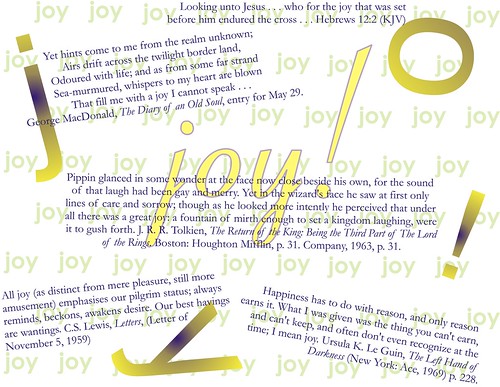
joy poster

joy poster

Some quotes, from some of my favorite authors, relating to the idea of joy. Larger sizes are available -- the photo is a live link to my Flickr photostream, where it originated.

Thanks for reading, and looking.

Wednesday, August 18, 2010

Sunspots 275

Things I have recently spotted that may be of interest to someone else:


Humor:
(Except that this is a sad note) Cathy, the cartoon strip written and drawn by Cathy Guisewite, is ending after 34 years of gentle humor.

Science:
The Panda's Thumb reports on experimental results indicating that seemingly directed growth in chick embryos is actually the result of random cell movement.

Computing:
Wired reports on the history of well-known symbols, such as that for the On button on this computer.

Christianity:N. T. Wright reflects on C. S. Lewis.


Image source (public domain)

Tuesday, April 20, 2010

Duriez on the fiction written by Tolkien and Lewis

My previous post was on Tolkien and C. S. Lewis: The Gift of Friendship, by Colin Duriez (Mahwah, New Jersey: HiddenSpring, an imprint of Paulist Press, 2003.)

I wish to summarize the book in this way: Both Tolkien and Lewis wrote as if they were convinced that the ways of the past were better than the ways of the present.

How does this show up? In many ways. There is no gunpowder, and there are no gasoline engines, in either Narnia or Middle-Earth. That's unless we count some of the machinery of Sauron and Saruman, both clearly evil characters. There are hereditary rulers. There's no newspaper, no radio, no electricity.

But the most fundamental way is that pagan, pre-Christian world-views (as in the Glome of Lewis's Till We Have Faces, or in Tolkien's Middle-Earth) are portrayed as leading up to Christianity, whereas modern views, like those of Saruman, or the NICE, are anti-God. As Duriez put it in his discussion of Till We Have Faces:

An important element in the story, therefore, is Psyche as an ancient anticipation of Christ. Psyche is able to see a glimpse of the true God himself, in all his beauty, and in his legitimate demand for a perfect sacrifice. . . . The novel explores the depths of insight possible within the limitations of the pagan imagination, which foreshadows the marriage of myth and fact in the Gospels. Till We Have Faces, therefore, reveals the imaginative and theological affinity between Lewis and Tolkien, perhaps  more than any other book by Lewis. It is ironic that the novel was written at a time when the two friends had grown apart. (163)

Thanks for reading. Read Lewis and Tolkien.

Monday, April 05, 2010

Are the ideas of the past always wrong? Chronological snobbery

I was reading a book about C. S. Lewis and Tolkien, and came across a discussion of an idea that was common to these two literary giants. That idea is that, just because an idea was held in the past, that, by itself, does not mean that it was false. In fact, it may still be valid, but have been discarded, like the fashions in apparel or hair styles of 40 years ago. The Wikipedia article on Chronological Snobbery gives a quotation from Lewis. In it, he says that we should ask if an idea was ever shown to be wrong, or did it just fade away?

We live too much in the present, and assume that all our ideas are fresh and new, until they quickly fade, into our past.

Read Lewis, and don't practice Chronological Snobbery.

Sunday, March 28, 2010

C. S. Lewis on death, and the end of the world

"Sir," said Caspian. "I've always wanted to have just one glimpse of their world. Is that wrong?"
"You cannot want wrong things any more now, that you have died, my son," said Aslan. C. S. Lewis, The Silver Chair, New York: Macmillan, 1953, p. 205.

. . . but the things that began to happen after that were so great and beautiful that I cannot write them. And for us this is the end of all stories, and we can most truly say that they all lived happily ever after. But for them it was only the beginning of the real story. All their life in this world and all their adventures in Narnia had only been the cover and the title page.: now at last they were beginning Chapter One of the Great Story, which no one on earth has read: which goes on for ever: in which every chapter is better than the one before. C. S. Lewis, The Last Battle, New York: Macmillan, 1956, pp. 173-4.

Monday, March 15, 2010

Why isn't there a Jewish Narnia or Middle-Earth?

I confess that I had never pondered that question, until reading an essay on that subject in what appears to be the first issue of something called The Jewish Review of Books, by Michael Weingrad.

Weingrad, clearly a Jew himself, is very familiar with C. S. Lewis, Tolkien, and has at least a nodding acquaintance with George MacDonald. The essay would have been worth reading if it had been only a consideration of those authors. But Weingrad attempts to answer the question, and his answer is multiple.

Historically, he says, Jews do not view the middle ages, which have so influenced Sword and Sorcery fantasy, because they were often persecuted, even put to the sword, during that period.

Weingrad says that the Jewish religion is less open to paganism than Christianity. (For a little more on that matter, see here.) Most fantasy literature has some pagan elements. (Bacchus appears in Narnia, for example.)

The author also says that Jews have "invested in modernity," and that, Weinberg points out, may explain the abundance of Jewish science-fiction authors, including Isaac Asimov and Robert Silverberg, to name two of the most prominent. (I would classify much of Silverberg's writing as fantasy, rather than science-fiction.) See here for more on Silverberg and religion.

This is a fine essay, and I'm glad that I found it, and read it.

Sunday, March 14, 2010

C. S. Lewis on Intelligent Design (in Narnia)

All this time the Lion's song, and his stately prowl, to and fro, backwards and forwards, was going on. . . . Polly was finding the song more and more interesting because she thought she was beginning to see the connection between the music and the things that were happening. When a line of dark firs sprang up on a ridge about a hundred yards away she felt that they were connected with a series of deep, prolonged notes which the Lion had sung a second before. And when he burst into a rapid series of lighter notes she was not surprised to see primroses suddenly appearing in every direction. Thus, with an unspeakable thrill, she felt quite certain that all the things were coming (as she said) "out of the Lion's head." When you listened to his song you heard the things he was making up; when you looked around you, you saw them.  - C. S. Lewis, The Magician's Nephew, New York: Macmillan, 1955, pp. 94-95.

Wednesday, December 23, 2009

Sunspots 240

Things I have recently spotted that may be of interest to someone else:


Science:
Wired reports that the Giant Panda genome has been sequenced. These animals, so beloved of zoo visitors, lack genes for molecules that would enable them to taste meat, and also lack genes for molecules that would enable them to digest bamboo -- apparently, like termites, they rely on microorganisms in their guts to do most of the digestion.

Wired also reports on the warming effect of black carbon soot, which may be worse, in some places, than the effect of Carbon Dioxide.

From the National Science Foundation, a tour of the cell

Christianity:
From the C. S. Lewis blog (about, not by, the late Lewis) some thoughts on how Lewis felt about Christmas celebrations and observances.


Image source (public domain)

Sunday, March 08, 2009

Blood in the New Testament

I a post a few years ago, I mused on why the Bible demands a blood sacrifice for sin. I don't know all the answers, but speculated about some of them, based on some of the science of blood. I also quoted an important passage on the subject from Hebrews, and quoted a relevant fictional passage by C. S. Lewis. Here are some more New Testament passages on blood, all using the ESV. They shed more light on what the shedding of the perfect God-man's blood makes possible in us. (The very word, Testament, is related to blood in Hebrews 9, although called a Covenant there.)

Romans 3:23 for all have sinned and fall short of the glory of God, 24 and are justified by his grace as a gift, through the redemption that is in Christ Jesus, 25a whom God put forward as a propitiation* by his blood , . . .

Ephesians 2:13 But now in Christ Jesus you who once were far off have been brought near by the blood of Christ.

1 John 1:7 But if we walk in the light, as he is in the light, we have fellowship with one another, and the blood of Jesus his Son cleanses us from all sin.

Revelation 5:9 And they sang a new song, saying, “Worthy are you to take the scroll and to open its seals, for you were slain, and by your blood you ransomed people for God from every tribe and language and people and nation, 10 and you have made them a kingdom and priests to our God, and they shall reign on the earth.”

Revelation 12:10 And I heard a loud voice in heaven, saying, “Now the salvation and the power and the kingdom of our God and the authority of his Christ have come, for the accuser of our brothers has been thrown down, who accuses them day and night before our God. 11 And they have conquered him by the blood of the Lamb and by the word of their testimony, for they loved not their lives even unto death.

*Propitiation has to do with appeasing, satisfying a strong claim. God's strong claim on us is that death is the punishment for sin, and we are all sinners.


"Let us say I have forgotten it," answered Aslan gravely. "Tell us of this Deep Magic."
"Tell you?" said the Witch, her voice growing suddenly shriller. "Tell you what is written on that very Table of Stone which stands beside us? Tell you what is written in letters deep as a spear is long on the trunk of the World Ash Tree? Tell you what is engraved on the sceptre of the Emperor-Beyond-the-Sea? You at least know the magic which the Emperor put into Narnia at the very beginning. You know that every traitor belongs to me as my lawful prey and that for every treachery I have a right to a kill."
. . . "And so," continued the Witch, "that human creature is mine. His life is forfeit to me. His blood is my property." (C. S. Lewis, The Lion, the Witch, and the Wardrobe; A Story for Children. New York: Macmillan, 1961. p. 114)

At last they heard Aslan's voice. "You can all come back," he said. "I have settled the matter. She has renounced the claim on your brother's blood." (p. 115) [The settlement was that Aslan, the great lion, and Christ-figure, agreed to take the place of Edmund, the traitor, thus becoming a propitiation for his traitorous behavior.]

"And now, who has won? Fool, did you think that by all this you would save the human traitor? Now I will kill you instead of him as our pact was and so the Deep Magic will be appeased. . ." (p. 125)

Thanks for reading.

Tuesday, August 12, 2008

Do the Narnia books tell us about the planets?

First Things has a review of a book by Michael Ward, entitled Planet Narnia: The Seven Heavens in the Imagination of C. S. Lewis. The theme of the book, published by Oxford University Press, no less, is that the seven Narnia books were consciously related to the seven heavenly bodies known to the ancients, by Lewis.

The author of the review says, understandably, that such a thesis sounds nutty. He goes on to say that, although Ward didn't convince him, his book did offer insights into the Narnia books that he hadn't had before, and that his idea isn't nearly as wrong as he thought it was when before he read Ward's book.

The review is long enough to explain what the book is about, with examples, but not too long for a reasonably easy read.

Thanks for reading. Thanks, First Things!