

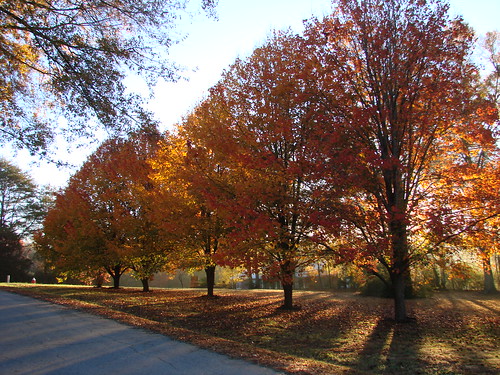
The above photo, of Bradford pear trees in morning sunlight, is from my Flickr photostream. The photo is a link to the original, which is posted there.
Back when I was a college biology professor, I would occasionally say something like this:
One way to understand a tree is to stand under it. You can listen to the wind blowing through the branches. You can feel the bark, and you can look at the leaves. You can watch for insects and spiders climbing up and down it, and look for birds and squirrels nesting in it. You can try to imagine the life of the tree, through years of growth, in various conditions. You can thank the tree for making shade, which can make life more comfortable, and for giving off Oxygen, which we can breathe. For many trees, you can also thank the tree for its fruit. You can thank it for its beauty during the various seasons of the year.
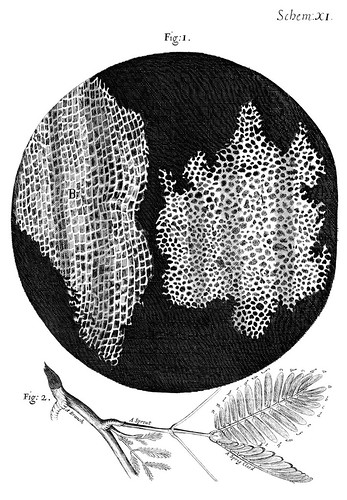
The picture above is, in part, of cells. It is from a public domain drawing of a microscopic view of part of the bark of a cork oak tree, by Robert Hooke, who named cells because of what he saw -- a resemblance to prison cells.
There's another way to understand a tree. You can take a core sample, and count the rings of annual growth, and make guesses about why some years' growth was larger than others. You can examine sample cells under a microscope, study its biochemistry with various analytic devices, measure the light absorption of the leaves, and count the root branches -- and, if you like, you can take the square root of that number!
Which of the two ways is better? That depends on what you are trying to accomplish, or what you need. Both ways have validity, with a legitimate purpose behind them. The first way can be called holistic, or wholistic. (See Wikipedia on holism.) It may help us to appreciate a tree in ways that the second sort of methods does not. An artist or poet, or a landscape architect, an ecologist, or a property owner, should use the first method.
But the second method is also legitimate. That way can be called reductionistic. As the Wikipedia article referred to above says, "Reductionism in science says that a complex system can be explained by reduction to its fundamental parts. For example, the processes of biology are reducible to chemistry and the laws of chemistry are explained by physics." (See also the Wikipedia article on reductionism, which is a complex subject!)
A wholistic examination of a tree would never discover an explanation for certain processes, such as how water gets to the leaves from the roots, or how photosynthesis works. It would probably not discover that certain medicines could be derived from parts of a tree. Science mostly uses reductionistic methods, so much so that some biologists may be accused of not knowing what the organism they are studying looks like -- they only study cell cultures, or enzymes, or DNA sequences.
The Psalmist said, about a righteous person:
He will be like a tree planted by the streams of water,
that produces its fruit in its season,
whose leaf also does not wither.
Whatever he does shall prosper. (Psalm 1:3, World English Bible, public domain.)
Both methods of looking at trees, or tarantulas, or trout, have their value, and neither method should be ignored or despised at the expense of the other. God presumably looks at trees in both ways, better than we could possibly do so. He has given us the ability to look at trees in both ways. Some of us have talent as photographers, or poets, and some as molecular biologists or geochemists.
One of my daughters gave me a book for Christmas. Soon after starting it, I came across a passage entitled Both methods of looking at trees, or tarantulas, or trout, have their value, and neither method should be ignored or despised at the expense of the other. God presumably looks at trees in both ways, better than we could possibly do so. He has given us the ability to look at trees in both ways. Some of us have talent as photographers, or poets, and some as molecular biologists or geochemists.
"I CONSIDER A TREE," and found that the author had thought many of the same thoughts that I had, and more deeply. Martin Buber said this (and more):
I can perceive it as movement: flowing veins on clinging, pressing pith, suck of the roots, breathing of the leaves, ceaseless commerce with the earth and air -- and the obscure growth itself.
I can classify it as a species and study it as a type in its structure and mode of life.
I can subdue its actual presence and form so sternly that I recognise it only as an expression of law -- of the laws in accordance with which a constant opposition of forces is continually adjusted, or of those in accordance with which the component substances mingle and separate.
. . .It can, however, also come about, if I have both will and grace, that in considering the tree I become bound up in relation to it. I and Thou, translated by Ronald Gregor Smith. New York: Scribner Classics, 2000. pp. 22-23.
I have posted on trees before, here. Thanks for reading.

