License

I have written an e-book, Does the Bible Really Say That?, which is free to anyone. To download that book, in several formats, go here.
Creative Commons License
The posts in this blog are licensed under a Creative Commons Attribution-NonCommercial-ShareAlike 3.0 Unported License. You can copy and use this material, as long as you aren't making money from it. If you give me credit, thanks. If not, OK.
Showing posts with label repentance. Show all posts

Monday, March 27, 2023

Women of the Bible: Mrs. Zacchaeus

Previous posts have tried to remind readers of various women, some in the Bible, but not named,  and some named, but mentioned only in part of a verse. Some, of course, have a lot of scripture telling about them. But we don't even know if there was a Mrs. Zacchaeus. So why write about her? Here is what we do know:

Luke 19:1 He entered and was passing through Jericho. 2 There was a man named Zacchaeus. He was a chief tax collector, and he was rich. 3 He was trying to see who Jesus was, and couldn’t because of the crowd, because he was short. 4 He ran on ahead, and climbed up into a sycamore tree to see him, for he was going to pass that way. 5 When Jesus came to the place, he looked up and saw him, and said to him, “Zacchaeus, hurry and come down, for today I must stay at your house.” 6 He hurried, came down, and received him joyfully. 7 When they saw it, they all murmured, saying, “He has gone in to lodge with a man who is a sinner.”

8 Zacchaeus stood and said to the Lord, “Behold, Lord, half of my goods I give to the poor. If I have wrongfully exacted anything of anyone, I restore four times as much.”

9 Jesus said to him, “Today, salvation has come to this house, because he also is a son of Abraham. 10 For the Son of Man came to seek and to save that which was lost.”

So Jesus, and Zacchaeus, almost certainly the twelve apostles (see Luke 18), perhaps others of the followers and supporters of Jesus, and perhaps friends and acquaintances of Zacchaeus, all came to eat, when Mrs. Zacchaeus, or some hard-worked servant(s), were expecting only Zacchaeus. Jesus may have been telling Zacchaeus to run home and warn Mrs. Zacchaeus, when He said to hurry and come down, but we can't be sure of that, and, even if that were true, it was an unexpected crowd, and surely the whole affair was going to be an unexpected event for an unprepared household. It is also possible that the family was going to give back some possessions that had been unjustly taken from their original owners, or bought with ill-gotten gains, but that the family of Zacchaeus liked to have around.

Have you ever been surprised by unexpected, perhaps even uninvited, guests? Mrs. Zacchaeus was. How did she react? We don't know. Perhaps she gave Zacchaeus a stern lecture later, or at least was planning to do so, until Zacchaeus showed a remarkable change of heart. If she hadn't served the meal, perhaps the story of Zacchaeus would have been lost to us. But it isn't. Zacchaeus, himself, has been the subject matter for many a sermon, Bible lesson, or song. And by implication, Mrs. Zacchaeus has been, too.

I need to take advantage of unexpected opportunities. Perhaps you do! 

Sunday, June 10, 2018

The Art of Divine Contentment: An Exposition of Philippians 4:11 by Thomas Watson. Excerpt 31

Watson has been writing about excuses for not being contented. He concludes this section:

The twelfth apology that discontent makes for itself, is this, it is not my trouble that troubles me, but it is my sins that do disquiet and discontent me.
 

Be sure it be so; do not prevaricate with God and thy own soul; in true mourning for sin when the present suffering is removed, yet the sorrow is not removed. But suppose the apology be real, that sin is the ground of your discontent; yet I answer, a man’s disquiet about sin may be beyond its bounds, in these three cases. 

1. When it is disheartening, that is, when it sets up sin above mercy. If Israel had only pored upon their sting, and not looked up to the brazen serpent, they had never been healed. That sorrow for sin which drives us away from God, is not without sin, for there is more despair in it than remorse; the soul hath so many tears in its eyes, that it cannot see Christ. Sorrow, as sorrow, doth not save, that were to make Christ of our tears, but is useful, as it is preparatory in the soul, making sin vile, and Christ precious. O look up to the brazen serpent, the Lord Jesus! A sight of his blood will revive, the plaster of his merits is broader than our sore. It is Satan’s policy, either
to keep us from seeing our sins, or, if we will needs see them that we may be swallowed up of sorrow; (2 Cor. 2. 7) either he would stupefy us, or affright us; either keep the glass of the law from our eyes, or else pencil out our sins in such crimson colours, that we may sink in the quicksands of despair.

2. When sorrow is indisposing, it untunes the heart for prayer, meditation, holy conference; it cloisters up the soul. This is not sorrow but rather sullenness, and doth render a man not so much penitential as cynical.
3. When it is out of season. God made us rejoice, and we hang up our harps upon the willows; he bids us trust and we cast ourselves down, and are brought even to the margin of despair. If Satan cannot keep us from mourning, he will be sure to put us upon it when it is least in season. When God calls us in a special manner to be thankful for mercy, and put on our white robes, Satan will be putting us into mourning, and instead of a garment of praise, clothe us with a spirit of heaviness; so God loseth the acknowledgement of mercy, and we the comfort. If thy sorrow hath turned and fitted thee for Christ, if it hath raised in thee high prizings of him, strong
hungerings after him, sweet delight in him; this is as much as God requires, and a Christian doth but sin to vex and torture himself further upon the rack of his own discontent.


And thus I hope I have answered the most material objections and apologies which this sin of discontent doth make for itself. I see no reason why a Christian should be discontented, unless for his discontent. Let me, in the next place, propound something which may be both as a loadstone and a whet-stone to contentation.


Thomas Watson lived from 1620-1686, in England. He wrote several books which survive. This blog, God willing, will post excerpts from his The Art of Divine Contentment: An Exposition of Philippians 4:11, over a number of weeks, on Sundays.

My source for the text is here, and I thank the Christian Classics Ethereal Library for making this text (and many others) available. The previous excerpt is here.
  
Philippians 4:11 Not that I speak because of lack, for I have learned in whatever state I am, to be content in it. (World English Bible, public domain.)  

Friday, August 25, 2017

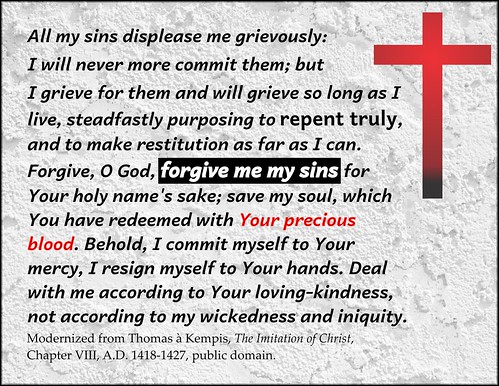
Repentance: with poster, from Thomas à Kempis, from The Imitation of Christ

Thomas à Kempis on repenting 
Repentance is the activity of reviewing one’s actions and feeling contrition or regret for past wrongs. … [It] is generally seen as involving a commitment to personal change and the resolve to live a more responsible and humane life. In other words, being sorry for one’s misdeeds. – Wikipedia.

All my sins displease me grievously: I will never more commit them; but I grieve for them and will grieve so long as I live, steadfastly purposing to repent truly, and to make restitution as far as I can. Forgive, O God, forgive me my sins for Your holy name's sake; save my soul, which You have redeemed with Your precious blood. Behold, I commit myself to Your mercy, I resign myself to Your hands. Deal with me according to Your loving-kindness, not according to my wickedness and iniquity. - Modernized from Thomas à Kempis, The Imitation of Christ, Chapter VIII, 1418-1427, public domain.

Some Biblical examples of repentance:
2 Chron. 32:24 In those days Hezekiah was terminally ill, and he prayed to Yahweh; and he spoke to him, and gave him a sign. 25 But Hezekiah didn’t reciprocate appropriate to the benefit done for him, because his heart was lifted up. Therefore there was wrath on him, and on Judah and Jerusalem. 26 Notwithstanding Hezekiah humbled himself for the pride of his heart, both he and the inhabitants of Jerusalem, so that Yahweh’s wrath didn’t come on them in the days of Hezekiah.

Job 42: 5 I had heard of you by the hearing of the ear, but now my eye sees you. 6 Therefore I abhor myself, and repent in dust and ashes.”

Matthew 3:1 In those days, John the Baptizer came, preaching in the wilderness of Judea, saying, 2 “Repent, for the Kingdom of Heaven is at hand!”
6 They were baptized by him in the Jordan, confessing their sins.
11a I indeed baptize you in water for repentance, but he who comes after me is mightier than I

Matthew describes the temptation of Jesus in chapter 3. This is part of chapter 4:17: From that time, Jesus began to preach, and to say, “Repent! For the Kingdom of Heaven is at hand.”

In Mark 6, Jesus sent the 12 out, in pairs:
12 They went out and preached that people should repent.

Mark 5:32 “… I have not come to call the righteous, but sinners to repentance.”

Luke 15:7 I tell you that even so there will be more joy in heaven over one sinner who repents, than over ninety-nine righteous people who need no repentance. (also see verse 10)

Acts 2:38 Peter said to them, “Repent, and be baptized, every one of you, in the name of Jesus Christ for the forgiveness of sins, and you will receive the gift of the Holy Spirit….” (Sermon at Pentecost. And, of course, lots of people did repent then.)

Acts 8:20 But Peter said to him, “May your silver perish with you, because you thought you could obtain the gift of God with money! 21 You have neither part nor lot in this matter, for your heart isn’t right before God. 22 Repent therefore of this, your wickedness ….”

2 Cor 7:10 For godly sorrow produces repentance to salvation, which brings no regret. But the sorrow of the world produces death.

2 Peter 3: The Lord is not slow concerning his promise, as some count slowness; but he is patient with us, not wishing that anyone should perish, but that all should come to repentance.

In addition to those mentioned above, others who repented: David (2 Samuel 12:15-23, Psalm 51); Manasseh (2 Chron 33:1-20. For some reason, 2 K 21:1-18 does not mention his repentance.); (Nebuchadnezzar (Daniel 4:28-37); Jonah (2:7-3:3); The Ninevites (Jonah 3:4-10); Saul of Tarsus (Acts 9:1-16); The jailer (Acts 16:22-34).

Examples of people who didn’t repent: The people of Noah’s day, and the Sodomites (2 Peter 2:4-8) (Genesis 19:1-8); Esau (Heb 12:14-17); Pharaoh; Judas, probably (Matt 27:3-19, Acts 1:21-26); The religious leaders (Matt 21:28-32).

Thanks for reading!

Wednesday, August 23, 2017

Sunspots 640


Things I have recently spotted that may be of interest to someone else:


Christianity: Relevant has an article on modesty. It points out that becoming lustful after seeing a woman is a man's choice, that what men are sexually attracted to varies from man to man, and is also different in different cultures, and that the only use of the word, modesty, in the Bible, in 1 Timothy 2:9, refers to ornaments, not to how much leg or whatever may be revealed.

David Drury urges so-called evangelicals to repentance.


Computing: Gizmo's Freeware recommends the Problem Steps Recorder, a free tool, built in to Windows computers, which records exactly what happened, and when.

National Public Radio reports that experts have changed their recommendations on choosing passwords. Their recommendations should make things simpler.

Gizmo's freeware also reports on a web site that will tell you what passwords have been compromised in the past (millions have).

Education: Listverse describes the right and wrong usage of 10 common words.

Food: NPR reports that men may be more attractive to  women if they eat certain foods.

History: Relevant points out that Robert E. Lee, himself, was not in favor of displaying confederate sympathy in statues, and in other ways, after the Civil War.
 
Politics: FiveThirtyEight presents a short, calm primer on the histories of black and white identity politics, and the role of President Trump.

The New York Times presents data on the frequency, by race, of killings by police being ruled justifiable.

Science: Statnews reports on the interesting things that have happened when white nationalists have genetic tests to examine their ancestry.

FiveThirtyEight reports that, with the exception of Saturn, solar eclipses would not be visible on any other planet in our solar system, and eclipses on earth are much better viewing than the possibility from Saturn.


Image source (public domain)

Sunday, May 25, 2014

Does the Bible really say that? Excerpt from my book, 36


A person who is saved is not a habitual sinner.

What is sin?

Note: To some people, sin is anything short of perfection – to them, honest mistakes, and memory lapses, are sin. However, I am using a more restrictive definition, as found in the Free Dictionary:
1. A transgression of a religious or moral law, especially when deliberate.
2. Theology
a. Deliberate disobedience to the known will of God. b. A condition of estrangement from God resulting from such disobedience.

Newly saved people don’t instantly become mature Christians. The Holy Spirit works to develop us. (Psalm 86:11a “Teach me your way, Yahweh.”) By the definition of sin given above, a new, undeveloped Christian who doesn’t know that behavior X is required of believers is not a sinner because of this, unless she becomes aware that such behavior is a requirement, and deliberately decides not to do X, whatever X might be.

There are sins of omission – things that we should do, but don’t – as well as sins of commission. See James 4:17 and Matthew 25:40-45.

Here is some scripture about the possibility of deliberate sin in the life of the believer:
1 John 2:1 My little children, I write these things to you so that you may not sin. If anyone sins, we have a Counselor with the Father, Jesus Christ, the righteous. 2 And he is the atoning sacrifice for our sins, and not for ours only, but also for the whole world.

1 John 3:3 Everyone who has this hope set on him purifies himself, even as he is pure. 4 Everyone who sins also commits lawlessness. Sin is lawlessness. 5 You know that he was revealed to take away our sins, and in him is no sin. 6 Whoever remains in him doesn’t sin. Whoever sins hasn’t seen him and doesn’t know him.
7 Little children, let no one lead you astray. He who does righteousness is righteous, even as he is righteous. 8 He who sins is of the devil, for the devil has been sinning from the beginning. To this end the Son of God was revealed: that he might destroy the works of the devil. 9 Whoever is born of God doesn’t commit sin, because his seed remains in him; and he can’t sin, because he is born of God. 10 In this the children of God are revealed, and the children of the devil. Whoever doesn’t do righteousness is not of God, neither is he who doesn’t love his brother.

John doesn’t seem to really mean that a believer never sins, which he seems to have said in 3:9, because, in 1 John 2:1, and also in 1 John 1:9, he indicates that there can be forgiveness for a believer who does sin. But we aren’t supposed to sin, and one aspect of that is that we are to “do righteousness.” (3:10) Not doing righteousness is a sin of omission.

Romans 6:1 What shall we say then? Shall we continue in sin, that grace may abound? 2 May it never be! We who died to sin, how could we live in it any longer? 3 Or don’t you know that all we who were baptized into Christ Jesus were baptized into his death? 4 We were buried therefore with him through baptism to death, that just as Christ was raised from the dead through the glory of the Father, so we also might walk in newness of life. 5 For if we have become united with him in the likeness of his death, we will also be part of his resurrection; 6 knowing this, that our old man was crucified with him, that the body of sin might be done away with, so that we would no longer be in bondage to sin. 7 For he who has died has been freed from sin. 8 But if we died with Christ, we believe that we will also live with him; 9 knowing that Christ, being raised from the dead, dies no more. Death no more has dominion over him! 10 For the death that he died, he died to sin one time; but the life that he lives, he lives to God. 11 Thus consider yourselves also to be dead to sin, but alive to God in Christ Jesus our Lord. 12 Therefore don’t let sin reign in your mortal body, that you should obey it in its lusts. 13 Also, do not present your members to sin as instruments of unrighteousness, but present yourselves to God, as alive from the dead, and your members as instruments of righteousness to God. 14 For sin will not have dominion over you. For you are not under law, but under grace. 15 What then? Shall we sin, because we are not under law, but under grace? May it never be!

The passages above strongly discourage sin in the life of a believer. However, should that occur, there is a remedy. That remedy is repentance – being truly sorry for our sin, asking forgiveness, and asking God to help us avoid sin in the future.


The above material is an excerpt from my self-published e-book, Does the Bible Really Say That?, which may be obtained free of charge, or purchased from Amazon for $0.99, which is the lowest price Amazon lets an author set. Scripture quotations are from the World English Bible, which is in the public domain.

The previous post in this series, which began this topic, is here. God willing, the next post in this series will continue the topic of this post. Thanks for reading.

Sunday, August 21, 2011

Prayers in the Bible: Manasseh repents

2 Chronicles 33:1 Manasseh was twelve years old when he began to reign; and he reigned fifty-five years in Jerusalem. 2 He did that which was evil in the sight of Yahweh, after the abominations of the nations whom Yahweh cast out before the children of Israel. 3 For he built again the high places which Hezekiah his father had broken down; and he reared up altars for the Baals, and made Asheroth, and worshiped all the army of the sky, and served them. 4 He built altars in the house of Yahweh, of which Yahweh said, “My name shall be in Jerusalem forever.” 5 He built altars for all the army of the sky in the two courts of the house of Yahweh. 6 He also made his children to pass through the fire in the valley of the son of Hinnom; and he practiced sorcery, and used enchantments, and practiced sorcery, and dealt with those who had familiar spirits, and with wizards: he worked much evil in the sight of Yahweh, to provoke him to anger. 7 He set the engraved image of the idol, which he had made, in God’s house, of which God said to David and to Solomon his son, “In this house, and in Jerusalem, which I have chosen out of all the tribes of Israel, will I put my name forever: 8 neither will I any more remove the foot of Israel from off the land which I have appointed for your fathers, if only they will observe to do all that I have commanded them, even all the law and the statutes and the ordinances given by Moses.” 9 Manasseh seduced Judah and the inhabitants of Jerusalem, so that they did more evil than the nations whom Yahweh destroyed before the children of Israel did. 10 Yahweh spoke to Manasseh, and to his people; but they gave no heed. 11 Therefore Yahweh brought on them the captains of the army of the king of Assyria, who took Manasseh in chains, and bound him with fetters, and carried him to Babylon. 12 When he was in distress, he begged Yahweh his God, and humbled himself greatly before the God of his fathers. 13 He prayed to him; and he was entreated by him, and heard his supplication, and brought him again to Jerusalem into his kingdom. Then Manasseh knew that Yahweh was God. 14 Now after this he built an outer wall to the city of David, on the west side of Gihon, in the valley, even to the entrance at the fish gate; and he encircled Ophel with it, and raised it up to a very great height: and he put valiant captains in all the fortified cities of Judah. 15 He took away the foreign gods, and the idol out of the house of Yahweh, and all the altars that he had built in the mountain of the house of Yahweh, and in Jerusalem, and cast them out of the city. 16 He built up the altar of Yahweh, and offered thereon sacrifices of peace offerings and of thanksgiving, and commanded Judah to serve Yahweh, the God of Israel. 17 Nevertheless the people sacrificed still in the high places, but only to Yahweh their God. 18 Now the rest of the acts of Manasseh, and his prayer to his God, and the words of the seers who spoke to him in the name of Yahweh, the God of Israel, behold, they are written among the acts of the kings of Israel. 19 His prayer also, and how God was entreated of him, and all his sin and his trespass, and the places in which he built high places, and set up the Asherim and the engraved images, before he humbled himself: behold, they are written in the history of Hozai. 20 So Manasseh slept with his fathers, and they buried him in his own house: and Amon his son reigned in his place. (World English Bible, public domain)

We are not told the words of Manasseh's prayer, but the substance is clear enough: "I'm sorry!" One of the four types of prayer (in one way of classifying them) is Confession. Clearly, Manasseh confessed. So must we. And God graciously answered Manasseh's prayer. Only God could have restored a captive to the kingship.

This is one of a series of posts on prayers in the Bible. The previous post in the series is here. Thanks for reading!