License

I have written an e-book, Does the Bible Really Say That?, which is free to anyone. To download that book, in several formats, go here.
Creative Commons License
The posts in this blog are licensed under a Creative Commons Attribution-NonCommercial-ShareAlike 3.0 Unported License. You can copy and use this material, as long as you aren't making money from it. If you give me credit, thanks. If not, OK.
Showing posts with label seven deadly sins. Show all posts

Wednesday, September 23, 2020

Sunspots 799

Things I have recently spotted that may be of interest to someone else:

Christianity: Relevant reports on a Barna study, which indicates that white Christians are less motivated to do something about racial injustice than they were a year ago.

Christianity Today tells us how we might commit one of the seven deadly sins in this political season.

Computing: Gizmo's Freeware recommends two bridge-building games, for iOS and Android.

Education: Grammarphobia tells us about the history and usage of "status quo."

Environment: Gizmodo reports that international plans to cut plastic pollution of the oceans just aren't good enough.

Gizmodo also reports on how the Trump administration is threatening wildlife, and indigenous peoples, across the US border.

Ethics: Gizmodo tells us how captive tigers are mistreated, and how most of them are  not really contributing to tiger conservation.

NPR interviews the author of a book on the finances of President Trump.

History: (and ornithology) Gizmodo reports on reflections on the life of John  James Audubon, who wasn't exactly a role model, scientifically, and in other ways.

Politics: (or something) Listverse tells us about the 10 safest large cities in the US.

FiveThirtyEight analyzes the Supreme Court situation, after Ginsburg's death.

FiveThirtyEight also analyzes the rural skew of the US Senate.

Science: Gizmodo reports that giraffes may be vulnerable to lightning strikes.

(or something) The Fall Foliage prediction map.

ListVerse has an essay on 10 gross things about the human body.

The graphic used in these posts is from NASA, hence, it is free to use like this.

Thanks for looking!

Saturday, January 19, 2019

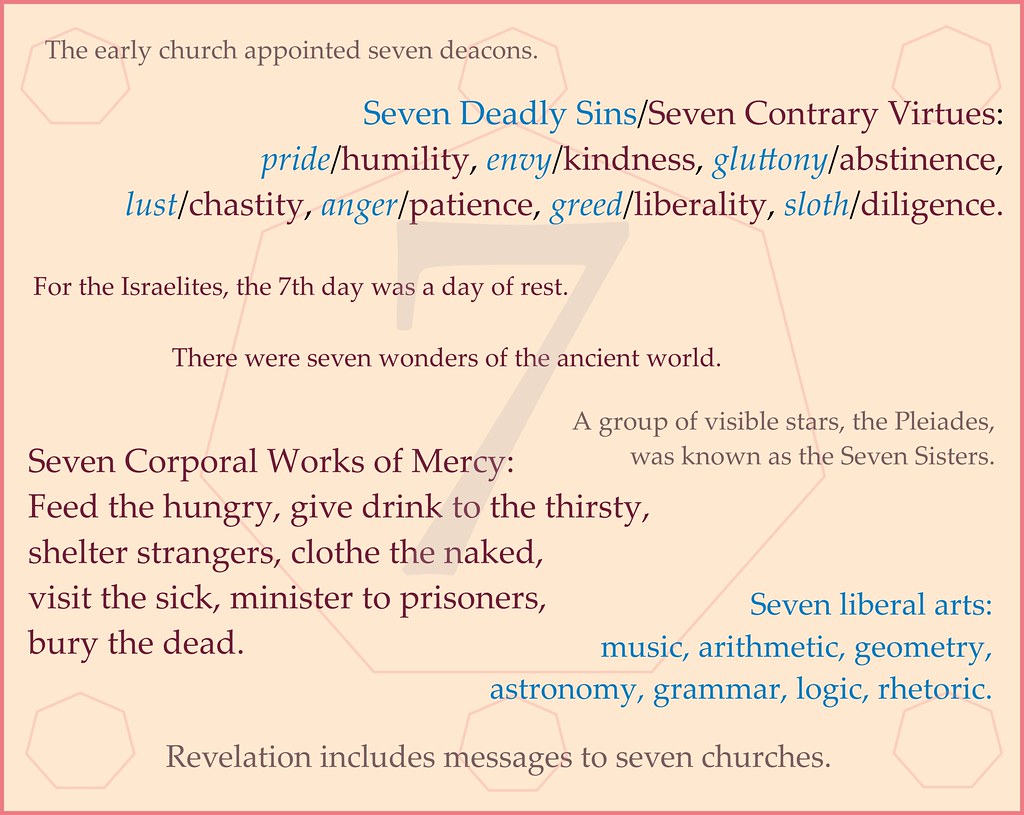
Some important uses of the number seven

7, uses of 7 
Some important uses of the number seven (7). One of a series.
This blog has previously had posts of posters displaying important uses of the numbers two - six, in our culture. Here's a poster for seven. God willing, there will be posters for eight, nine, ten and twelve in the next few days.

Clearly, seven was important in Biblical and religious culture. But sometimes the importance seems to be exaggerated. There are thirty-six occurrences of "seven" in Revelation, not just the one at the bottom of the poster. But none of these are about seven years, although some interpretations of the Bible hold that there will be a seven year tribulation during the end times. Perhaps. Perhaps not.

Thanks for looking! 

Monday, August 15, 2016

Pride goes before a fall

The Wikipedia defines pride thus:
Pride is an inwardly directed emotion that carries two antithetical meanings. With a negative connotation pride refers to a foolishly ... and irrationally corrupt sense of one's personal value, status or accomplishments, used synonymously with hubris. With a positive connotation, pride refers to a humble and content sense of attachment toward one's own or another's choices and actions, or toward a whole group of people, and is a product of praise, independent self-reflection, and a fulfilled feeling of belonging.

The word, pride, is used about 50 times in the Bible. (See here for a search, using the English Standard Version.) There are very few positive connotations of its use in the Bible. In 1 Corinthians 15:31 and 2 Corinthians 7:4, Paul says that he has pride in the Corinthian church. But there's plenty of pride that is condemned:
In Mark 7:21-23, Jesus lists pride as one aspect of the evil heart of humans.
1 John 2:16 says that the "pride of life" is not from God, but from the world.
Ezekiel 16:49-56 lists pride first among the sins of Sodom, which was destroyed by God in the time of Abraham.
Proverbs 16:18 "Pride goes before destruction, and a haughty spirit before a fall."
Pride is one of the so-called Seven Deadly Sins -- the Wikipedia lists it as the first one.
Satan is described so that his pride is obvious in John Milton's classic Paradise Lost.

Clearly, selfish pride is dangerous, and to be avoided. Submission does not come easily to us. Be we ought to submit to God, and, eventually, everyone will do so, willingly or not.

How is pride manifest? In at least these, and, no doubt, in other ways:
Superiority pride -- believing that I am more important than others. Expecting special treatment, and believing that I deserve it. Such special treatment may include from the police, from teachers, from companies that I do business with, maybe even from my parents.
Intellectual pride -- believing that I know more than others. I look down on those who don't agree with what I know, or think I know. For example, I might be a Republican who believes that all Democrats are deluded idiots.
Pride in origins and/or associates -- believing that my family, my tribe, my school, my church, my team, my group, is better than any other.
Self-righteous pride -- believing that I do not need to ask forgiveness for my sins, or that I have not sinned, or that my religious activity, or my charitable giving, or devotion to God, is responsible for my righteousness in the sight of God. (The only way to achieve such righteousness is to trust Christ for forgiveness of sin.)
Pride in my accomplishments -- believing that I'm important because I won the 5th-grade spelling bee, or because my lawn has just been mowed, or because I made that sale. Not considering that I had help with these achievements, a father who coached me in spelling, a spouse who mowed the lawn, a mechanic who fixed the lawnmower, a staff who helped me make the sale. Daniel 4 comes to mind. In this chapter, King Nebuchadnezzar bragged, in verse 30, that he had built Babylon, when he probably hadn't mortared in a brick or pounded a nail of it. He received punishment for his pride.

Thanks for reading. Be careful not to be proud. I need to be careful, too.


Thursday, October 21, 2010

The Forgotten Beasts of Eld, by Patricia A. McKillip

I have suddenly realized that I have never blogged about one of my all-time favorite books, The Forgotten Beasts of Eld, by Patricia A. McKillip. This is a gap that I wish to fill as soon as I possibly can. (I have blogged about several of her other works. If interested, click on the Patricia A. McKillip tag at the end of this post. Perhaps the most important of these posts is an analysis of Christian themes in a trilogy by McKillip.) I am not alone in thinking that this is a good book. It won the first World Fantasy Award ever given.

I will not try to set forth a summary of the book. The Wikipedia article on it does a good job of that. I will discuss one aspect of the book, which, I have argued elsewhere, is a frequent theme in McKillip's novels. That aspect is the rejection of vengeance. Several of McKillip's characters, although grievously wronged, decide not to take vengeance on those who have harmed them.

There is an important quotation from the book, found in two places, in both cases spoken by Cyrin, the magic boar. It is about the giant Grof, who was hit in an eye, and the eye changed, so as to look into his brain, and that killed him. In the first instance, it is spoken to Coren, who is in the process of falling in love with Sybel, the sorceress (and she with him). Coren is full of desire for revenge for a brother who has fallen in battle to the enemy of his family. In the second place, it is spoken to Sybel, herself. She was captured, and her mind examined deeply, by a magician in the pay of King Drede, who is also Coren's family's chief opponent. Sybel comes to see that, in her desire for vengeance, she has been using Coren, her husband, and his family, and that if she continues to be driven by that desire, she will lose everything that is important to her. She withdraws from pursuing vengeance. The statement made by Cyrin is on pages 106 and 249 of the 2006 edition of the book, published by Houghton Mifflin Harcourt.

The Bible has something to say about this matter:
Proverbs 25:21 If your enemy is hungry, give him food to eat.
    If he is thirsty, give him water to drink:
22 for you will heap coals of fire on his head,
    and Yahweh will reward you.

and, quoting and expanding on this:

Romans 12:19 Don’t seek revenge yourselves, beloved, but give place to God’s wrath. For it is written, “Vengeance belongs to me; I will repay, says the Lord.” 20 Therefore

“If your enemy is hungry, feed him.
    If he is thirsty, give him a drink;
    for in doing so, you will heap coals of fire on his head.” (Both quotations from the World English Bible.)

Thanks for reading.