License

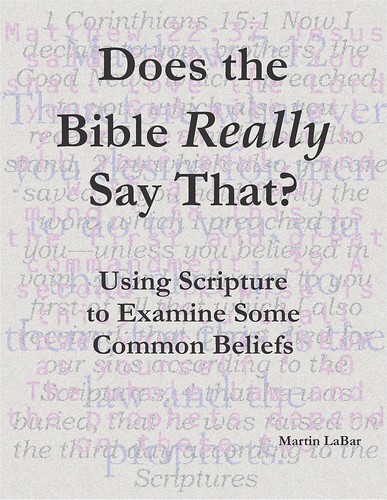
I have written an e-book, Does the Bible Really Say That?, which is free to anyone. To download that book, in several formats, go here.
Creative Commons License
The posts in this blog are licensed under a Creative Commons Attribution-NonCommercial-ShareAlike 3.0 Unported License. You can copy and use this material, as long as you aren't making money from it. If you give me credit, thanks. If not, OK.

Sunday, September 15, 2013

Does the Bible really say that? Excerpt from my book, 1


What the Bible says.

This book discusses some popular, but wrong, beliefs among Christians who take the Bible seriously, and some areas where there is disagreement among Christians. My goal is to examine what the Bible does say about these matters. It is more important to examine and know what the Bible really says, than to point out things that it doesn’t say, or that many Christians misunderstand. What does the Bible really say? Much of it has been summarized in the historic creeds of the church.


The most important content of the Bible is that Christ’s perfect life, as God in the flesh, and His death and resurrection, have paid the price for human sin:

1 Corinthians 15:1 Now I declare to you, brothers, the Good News which I preached to you, which also you received, in which you also stand, 2 by which also you are saved, if you hold firmly the word which I preached to you—unless you believed in vain. 3 For I delivered to you first of all that which I also received: that Christ died for our sins according to the Scriptures, 4 that he was buried, that he was raised on the third day according to the Scriptures . . .*


That truth is tremendous. But we shouldn’t stop there, but try to learn as much of what God has told us as we can. We should study the Bible, and read and listen to what godly people have said about it.


Much of this book is quotations from the Bible. Why? Because what the Bible says is much more important than anything you, or I, can write about what it says.


*(Unless otherwise specified, all scripture quotations in the book are from the World English Bible, which is in the public domain.)
 

The above is an excerpt from my recently published e-book, Does the Bible Really Say That?, which may be obtained free of charge, or purchased from Amazon for $0.99, which is the lowest price Amazon lets an author set.

If you obtained the book previously, I discovered a dozen or so errors, but have corrected them, I hope. Sorry about that! Amazon has a Manage Your Kindle page for anyone who has a Kindle or Kindle App. I recommend that you go to that page, and turn on Automatic Book Update, which is supposed to send you, free, any updated versions of a Kindle book.

Thanks for reading!

Wednesday, September 11, 2013

Sunspots 435

Things I have recently spotted that may be of interest to someone else:


Christianity: "The point of faith-filled education is not to indoctrinate but to bring faith into dialog with evidence and the flow of the discussion in humility. Education may not change your positions but hopefully frees you to take the positions you do with greater awareness of the evidence and options." - Ken Schenck, Dean of Wesley Seminary. Unfortunately, some believe that the point of education, faith-filled or not, is exactly to indoctrinate.

Science: National Public Radio reports on the discovery of the world's largest volcano, by far. It's inactive!

NPR also reports on the discovery of a region of the brain that enables us to quickly sense quantities, without having to manually count them. This works for small quantities. Few, if any, people can sense a hundred or so objects correctly.

Wired reports on the Bobbit worm, a really ghastly looking predator, which can grow to 10 feet in length.

Wired also reports on a huge storm circling Saturn.


Image source (public domain)  

Tuesday, September 10, 2013

Amazon has published my book


Book title

I am pleased to announce that Amazon has published my book, Does the Bible Really Say That? Using Scripture to Examine Some Common Beliefs. It is available for $0.99, here. This is the lowest price that Amazon allows authors to set. It is in Kindle format.

The book is also available at no cost, in Kindle and other digital formats, from this non-Amazon page.

Here's a brief description:

The topics covered, some in more depth than others, some with a rather firm conclusion, some not, are as follows:

The culture of Bible times and understanding the Bible
Genres of Biblical literature
Was praying for sinners important in the early church? What are the types of prayer, and what did the early church pray for?
Must the husband always be the spiritual leader in a home?
Must marriage ceremonies be conducted in church?
Is homosexuality the worst sexual sin?
Is prophecy easy to understand? How certain is prophecy about the tribulation, the rapture and the anti-Christ?
Can a believer lose her salvation? What does the Bible say about the characteristics of believers?
Do we go to heaven immediately upon death? Do resurrected believers have a body?

The World English Bible, which is in the public domain, is quoted extensively, which is fitting, since what the Bible has to say is more important than what I have to say. Besides being in the public domain, the language is mostly understandable to 21st-century readers. (No believeth, hath, thee, etc.)

Much of the material has already been published here as blog posts.

Thanks for reading.


Sunday, September 08, 2013

Prayer and missions, by E. M. Bounds, part 7

God’s decree for the glory of His Son’s kingdom is dependent on prayer for its fulfilment:
“Ask of me, and I will give thee the heathen for thy inheritance, and the uttermost part of the earth for thy possession.” God the Father gives nothing to His Son only through prayer. And the reason why the Church has not received more in the missionary work in which it is engaged is the lack of prayer. “Ye have not, because ye ask not.”
 

Every dispensation foreshadowing the coming of Christ when the world has been evangelised, at the end of time, rests upon these constitutional provisions, God’s decree, His promises and prayer. However far away that day of victory by distance or time, or remoteness of shadowy type, prayer is the essential condition on which the dispensation becomes strong, typical and representative. From Abraham, the first of the nation of the Israelites, the friend of God, down to this dispensation of the Holy Spirit, this has been true.

Our Lord’s plan for securing workers in the foreign missionary field is the same plan He set on foot for obtaining preachers. It is by the process of praying. It is the prayer plan as distinguished from all man-made plans. These mission workers are to be “sent men.” God must send them. They are God-called, divinely moved to this great work. They are inwardly moved to enter the harvest fields of the world and gather sheaves for the heavenly garners. Men do not choose to be missionaries any more than they choose to be preachers. 

God sends out labourers in His harvest field in answer to the prayers of His church. Here is the Divine plan as set forth by our Lord:
“But when he saw the multitudes, he was moved with compassion on them, because they fainted, and were as sheep having no shepherd. Then saith he unto his disciples, The harvest truly is plenteous, but the labourers are few. Pray ye, therefore, the Lord of the harvest that he will send forth labourers into his harvest.”


Although E. M. Bounds died in 1913, this book was first published in 1925, by an admirer of the author’s life. Bounds was known for praying from four until seven each morning.

This post is one of a series, taken from The Essentials of Prayer, by Bounds. Found through the Christian Classics Ethereal Library, here. The Essentials of Prayer is in the public domain. The previous post in the entire series on the book is here. Thanks for reading. Read this book, and, more importantly, practice, prayer. 

Friday, September 06, 2013

Why did Jesus pray?

Mark 1:32 At evening, when the sun had set, they brought to him all who were sick, and those who were possessed by demons. 33 All the city was gathered together at the door. 34 He healed many who were sick with various diseases, and cast out many demons. He didn’t allow the demons to speak, because they knew him.
35 Early in the morning, while it was still dark, he rose up and went out, and departed into a deserted place, and prayed there.
(World English Bible, public domain)


Why did Jesus pray?

He was God, but he still prayed. (This isn't the only place in the Gospels that mentions that -- see Mark 6:46, Luke 5:16, Luke 6:12, Luke 9:18, and Luke 22:41, and perhaps other locations.)

1) He may have prayed to set an example for us. Possibly He didn't need to pray at all, but knew that we would, so He did.

2) He may have prayed to the Father and the Holy Spirit to help Him hold out against temptation. Hebrews 4:15:
For we don’t have a high priest who can’t be touched with the feeling of our infirmities, but one who has been in all points tempted like we are, yet without sin.

Perhaps Jesus prayed, for example, that He wouldn't be tempted to pride, or to strike the Pharisees dead, or to become inappropriately involved with one of His female followers.

3) It seems that He prayed for strength and endurance. Note that in the passage quoted above, He had recently expended a lot of energy in interacting with people (and demons).

4) In the Garden, He prayed that His will might be aligned with the Father's.

5) In John 17, He prayed for us, His followers. Most of the prayers in the New Testament are of that type -- praying for other believers.

6) On some occasions, He prayed a prayer of thanksgiving, for food, for one thing, and this was done even after the resurrection. See Luke 24:30.

There are probably other reasons why Christ prayed. Feel free to mention them in a comment.

I don't pray enough. You probably don't, either. But Christ set an example for us, and most likely even Christ needed to pray, for strength for His tasks, to reject temptation, in gratitude, and certainly for us, His followers.

Pray! Thanks for reading.


Wednesday, September 04, 2013

Sunspots 434

Things I have recently spotted that may be of interest to someone else:

The Arts: Frederik Pohl, who wrote excellent science fiction novels from 1954 to 2011, recently passed away. (He also wrote many short stories.) His novel, Gateway, won about every award possible.

Computing: ABC News tells us that the next version of the Android operating system (used on over half of all smart phones, and on tablets) will be named Kit Kat, after the candy bar. (Previous versions have been named Jelly Bean and Ice Cream Sandwich, among other names.)

Health: (and Christianity) National Public Radio reports on a Texas megachurch where 21 people have caught the measles.

Science: National Public Radio reports on the discovery of a canyon, longer and wider (but not deeper) than the Grand Canyon, beneath the ice of the Antarctic.

Discovery.com reports that some tiny frogs use their mouths, rather than the middle ear, to magnify sound.


Image source (public domain)

Monday, September 02, 2013

"God Bless America": its history

National Public Radio recently did a report on the history of the song, "God Bless America." It's an interesting history, indeed.

The song was written by Irving Berlin, a Jewish immigrant, and introduced by Kate Smith, who was, at the time, the most widely known popular singer. (Berlin also wrote "Alexander's Ragtime Band," and "White Christmas," and other songs.) The report, drawing on a book on the subject of the history of the song by Sheryl Kaskowitz, describes how the song has been used by various groups, in various ways, throughout its history. Originally, it had phrases objecting to possible US involvement in World War II, for example. (These were changed.)

Thanks for reading.

Sunday, September 01, 2013

Prayer and missions, part 6, by E. M. Bounds

It is praying missionaries who are needed for the work, and it is a praying church who sends them out, which are prophecies of the success which is promised. The sort of religion to be exported by missionaries is of the praying sort. The religion to which the heathen world is to be converted is a religion of prayer, and a religion of prayer to the true God. The heathen world already prays to its idols and false gods. But they are to be taught by praying missionaries, sent out by a praying Church, to cast away their idols and to begin to call upon the name of the Lord Jesus Christ. No prayerless church can transport to heathen lands a praying religion. No prayerless missionary can bring heathen idolaters who know not our God to their knees to true prayer until he becomes pre-eminently a man of prayer. As it takes praying men at home to do God’s work, none the less does it take praying missionaries to bring those who sit in darkness to the light.

The most noted and most successful missionaries have been pre-eminently men of prayer. David Livingstone, William Taylor, Adoniram Judson, Henry Martyn, and Hudson Taylor, with many more, form a band of illustrious praying men whose impress and influence still abide where they laboured. No prayerless man is wanted for this job. Above everything else, the primary qualification for every missionary is prayer. Let him be, above everything else, a man of prayer. And when the crowning day comes, and the records are made up and read at the great judgment day, then it will appear how well praying men wrought in the hard fields of heathendom, and how much was due to them in laying the foundations of Christianity in those fields.


The one only condition which is to give world-wide power to this Gospel is prayer, and the spread of this Gospel will depend on prayer. The energy which was to give it marvelous momentum and conquering power over all its malignant and powerful foes is the energy of prayer.


The fortunes of the kingdom of Jesus Christ are not made by the feebleness of its foes. They are strong and bitter and have ever been strong, and ever will be. But mighty prayer—this is the one great spiritual force which will enable the Lord Jesus Christ to enter into full possession of His kingdom, and secure for Him the heathen as His inheritance, and the uttermost part of the earth for His possession.


It is prayer which will enable Him to break His foes with a rod of iron, that will make these foes tremble in their pride and power, who are but frail potter’s vessels, to be broken in pieces by one stroke of His hand. A person who can pray is the mightiest instrument Christ has in this world. A praying Church is stronger than all the gates of hell.


Although E. M. Bounds died in 1913, this book was first published in 1925, by an admirer of the author’s life. Bounds was known for praying from four until seven each morning.

This post is one of a series, taken from The Essentials of Prayer, by Bounds. Found through the Christian Classics Ethereal Library, here. The Essentials of Prayer is in the public domain. The previous post in the entire series on the book is here. Thanks for reading. Read this book, and, more importantly, practice, prayer. 


Thanks for reading.

Saturday, August 31, 2013

Jesus and football

Jesus would have probably gone to football games. He seemed to enjoy being with lots of people, except when He needed to get away to be with God, and rest.

He probably couldn’t have afforded a ticket, so someone else would have had to pay for His. He probably wouldn’t have been able to afford clothing in special colors. He would have sympathized with other people, too poor or too sick to go to games.

He probably wouldn’t have cared who won, but would have been more concerned for the needs of the people around him in the stands than for who scored what, or who was headed for a college scholarship, or an NFL position, or who was ranked where, or who was going to what bowl.

He wouldn’t have hated the other team, or the referees. Perhaps He would have been disturbed by the lack of clothing of the cheerleaders, or the drunkenness of some of the fans, or the attempts by some players to injure those on the other team. He probably would have been careful to not let attendance, or watching, at a late hour, interfere with His alertness in worship, or His ability to minister effectively.

He wouldn’t have been identified by a team, or its colors, or its nickname, or its mascot. He would have been identified as the founder and Lord of the Kingdom of Heaven. Football is transitory. Eternity is not.

Thursday, August 29, 2013

The Mixed-Up Files of Mrs. Basil E. Frankweiler

I recently re-read (after a long time) From The Mixed-Up Files of Mrs. Basil E. Frankweiler, a Newbery Award winning book. I won't give away the plot. You can look at the link in the first sentence if you want to know more about that.

I will say that the book is about adventure, and establishing relationships. And it is also a message to children, and to everyone, about learning, and processing that learning, and wisdom. Here's a quotation:

I think you should learn, of course, and some days you must learn a great deal. But you should also have days when you allow what is already in you to swell up inside of you until it touches everything. And you can feel it inside you. If you never take time out to let that happen, then you just accumulate facts, and they begin to rattle around inside of you. You can make noise with them, but never really feel anything with them. It’s hollow. - Mrs. Frankweiler to the children.

Thanks for reading.

Wednesday, August 28, 2013

Sunspots 433

Things I have recently spotted that may be of interest to someone else:

The Arts: Wired reports on how an artist has created art based on the movements of the London Underground (that's the subway, if you didn't know this.)

Christianity: E. Stephen Burnett heads an insightful discussion on whether the Harry Potter books teach occultism. (He doesn't believe so.) There are a lot of comments, almost all done in a respectful manner. Burnett says, among other things, that "trusting [occult practices] instead of God as a means to manipulate one’s world and control one’s life. (This is the goal behind any real occult/witchery attempts, including the infamous 'prosperity gospel' heresy.)"

Christianity Today reports that too many non-Christians don't even know a Christian.

Computing: A National Public Radio reporter allowed an MIT professor to examine the metadata from the reporter's Gmail account, in a way similar to how the NSA can use our metadata. The professor learned a lot, without reading any of the e-mail.

Education: None of the more than 24,000 students taking entrance exams for the University of Liberia obtained a score high enough for entrance.

Science: (And Philosophy, and Christianity) Books and Culture, sister publication to Christianity Today, has re-published an essay, by Karl Giberson, a physicist, about the theoretical work of Stephen Hawking.


Image source (public domain)

Tuesday, August 27, 2013

An important book on cancer

At the urging of a relative, who lent it to me, I recently read what some have labeled the most important book on cancer published in my lifetime. The book is The Emperor of all Maladies: A Biography of Cancer, by Siddhartha Mukherjee, and it won, among other awards, the Pulitzer Prize for non-fiction.

The book is written so as to be accessible to lay persons, although it has many notes, and a good index, so those seeking further information can explore further.

So what's it about? It's about the history of our attempt to prevent, and/or cure, cancer, from the beginnings of medical science until almost the present. Many names of important scientists and health professionals, and some philanthropists, politicians and what we now call activists are included, along with a sentence or more on what they were, or are, like. Many developments in the history of our work with cancer are described, such as establishing the link between tobacco and lung cancer.

What's the message of the book? More correctly, what are the messages of the book?

One of them is that cancer is many different ailments. The Human Genome Project "maps" the DNA bases of "normal" people. It's an enormous trove of data. The Cancer Genome Atlas, referred to in the book, and under development, promises to be much larger than the map of the human genome.

Another message is that we can't expect to cure cancer until we understand the workings of normal human cells better than we do now. Cancer occurs when the mechanisms that cause and control cell multiplication get out of kilter. Those mechanisms are complex. Our understanding is getting there, making some strides that scientists of a couple of generations ago wouldn't have even understood, but we aren't there yet.

Another message is that government, business, or academic bureaucracy can get in the way of doing some good things for people that are in desperate need. That's hardly a surprise, but the story of cancer has too many examples of this sort of thing.

Another message, although Mukherjee doesn't put it in those terms, is the way in which our progress toward curing and preventing cancer illustrates the thesis of The Structure of Scientific Revolutions, by Thomas S. Kuhn. Kuhn claimed that science changes, not so much because of experiments, as because of revolutions in the thinking of the scientific community. These revolutions usually leave some older scientists bypassed -- they are stuck in an old way of looking at natural phenomena, and don't ever accept more correct and fruitful ways. Over and over, this happened in the biography of cancer.

We have made some progress, in preventing some forms of cancer, and in curing some others. But there are many cancers we don't have much of a handle on yet, and many patients who suffer through chemotherapy without much benefit. A sobering story.

Cancer is such a complex subject that it is probably not possible to come close to understanding it without reading a book such as Mukherjee's, or the equivalent. I'm glad that I understand this disease, which stands a good chance of ending my own life, a little better. (I am not aware that I have any form of cancer, but you never know, especially the older you get.)

Thanks for reading.


Monday, August 26, 2013

Malaria vaccine?

The World Health Organization says that malaria is one of the six most important infectious diseases, killing about a million people a year, mostly children in third world countries. The Wikipedia says that the disease is not only more likely among poor people, but that it causes poverty.

Michael Gerson, a columnist for the Washington Post, has written a recent column on the successful development of an anti-malaria vaccine. He points out some of the amazing difficulties that had to be overcome, and those that will have to be overcome in the future, to make this a practical medical treatment. One such difficulty is that it was necessary to do surgery on individual mosquitoes to obtain cells for use in developing the vaccine. Malaria parasites are transmitted by mosquitoes, and some stages of the microbe live in human blood cells.

Thanks for reading! Thanks to God for this step toward eradicating this terrible scourge.

Sunday, August 25, 2013

Prayer and Missions, part 5, by E. M. Bounds

In the margin of our Bible, it reads, “Ye that are the Lord’s remembrancers.” The idea is, that these praying ones are those who are the Lord’s remembrancers, those who remind Him of what He has promised, and who give Him no rest till God’s Church is established in the earth.

And one of the leading petitions in the Lord’s Prayer deals with this same question of the establishing of God’s kingdom and the progress of the Gospel in the short, pointed petition, “Thy kingdom come,” with the added words, “Thy will be done on earth as it is done in heaven.”


The missionary movement in the Apostolic Church was born in an atmosphere of fasting and prayer. The very movement looking to offering the blessings of the Christian Church to the Gentiles was on the housetop on the occasion when Peter went up there to pray, and God showed him His Divine purpose to extend the privileges of the Gospel to the Gentiles, and to break down the middle wall of partition between Jew and Gentile. But more specifically Paul and Barnabas were definitely called and set apart to the missionary field at Antioch when the Church there had fasted and prayed. It was then the Holy Spirit answered from heaven: “Separate me Barnabas and Saul for the work whereunto I have called them.”


Please note this was not the call to the ministry of Paul and Barnabas, but more particularly their definite call to the foreign field. Paul had been called to the ministry years before this, even at his conversion. This was a subsequent call to a work born of special and continued prayer in the Church at Antioch. God calls men not only to the ministry but to be missionaries. Missionary work is God’s work. And it is the God-called men who are to do it. These are the kind of missionaries which have wrought well and successfully in the foreign field in the past, and the same kind will do the work in the future, or it will not be done.


Although E. M. Bounds died in 1913, this book was first published in 1925, by an admirer of the author’s life. Bounds was known for praying from four until seven each morning.

This post is one of a series, taken from The Essentials of Prayer, by Bounds. Found through the Christian Classics Ethereal Library, here. The Essentials of Prayer is in the public domain. The previous post in the entire series on the book is here. Thanks for reading. Read this book, and, more importantly, practice, prayer. 


Thanks for reading, especially if you read this post twice! This post was supposed to be published on August 25, 2013, but I hit the wrong button, and it was published early. On August 10th, I discovered this, and withdrew it until the 25th.

Wednesday, August 21, 2013

Sunspots 432

Things I have recently spotted that may be of interest to someone else:

Christianity: Leaving aside who is right and who is wrong, Charles Haynes, columnist, says, I believe correctly, that public school teachers and curricula are not adequately equipped to "teach the controversy" over origins.

Health: (And life and death) Wired reports on how we don't monitor carbon monoxide very well, with, sometimes, deadly consequences.

Politics: (and science) Four public servants, who served as heads of the Environmental Protection Agency under Republican presidents, for a total of 43 years of service, have combined to chastise all too many Republican legislators for dismissing climate change, and failing to act on it.

The lyrics to "When Did Jesus Become a Republican?"

Science: Wired reports on maps of past data, showing how likely you may be to suffer from floods, tornadoes, etc.


Image source (public domain)

Sunday, August 18, 2013

Prayer and Missions, by E. M. Bounds, part 4

Not a few of us have heard eloquent and earnest speeches stressing the imperative need of money for missions where we have heard one stressing the imperative need of prayer.
 

All our plans and devices drive to the one end of raising money, not to quicken faith and promote prayer. The common idea among Church leaders is that if we get the money, prayer will come as a matter of course. The very reverse is the truth. If we get the Church at the business of praying, and thus secure the spirit of missions, money will more than likely come as a matter of course. Spiritual agencies and spiritual forces never come as a matter of course. Spiritual duties and spiritual factors, left to the “matter of course” law, will surely fall out and die. Only the things which are stressed live and rule in the spiritual realm. They who give, will not necessarily pray. Many in our churches are liberal givers who are noted for their prayerlessness. One of the evils of the present-day missionary movement lies just there. Giving is entirely removed from prayer. Prayer receives scant attention, while giving stands out prominently. They who truly pray will be moved to give. Praying creates the giving spirit. The praying ones will give liberally and self-denyingly. He who enters his closet to God, will also open his purse to God. But perfunctory, grudging, assessment-giving kills the very spirit of prayer. Emphasising the material to the neglect of the spiritual, by an inexorable law retires and discounts the spiritual. 

It is truly wonderful how great a part money plays in the modern religious movements, and how little prayer plays in them. In striking contrast with that statement, it is marvellous how little part money played in primitive Christianity as a factor in spreading the Gospel, and how wonderful part prayer played in it.
 

The grace of giving is nowhere cultured to a richer growth than in the closet. If all our missionary boards and secretaryships were turned into praying bands, until the agony of real prayer and travail with Christ for a perishing world came on them, real estate, bank stocks, United States bonds would be in the market for the spreading of Christ’s Gospel among men. If the spirit of prayer prevailed, missionary boards whose individual members are worth millions, would not be staggering under a load of debt and great Churches would not have a yearly deficit and a yearly grumbling, grudging, and pressure to pay a beggarly assessment to support a mere handful of missionaries, with the additional humiliation of debating the question of recalling some of them. The on-going of Christ’s kingdom is locked up in the closet of prayer by Christ Himself, and not in the contribution box.

Although E. M. Bounds died in 1913, this book was first published in 1925, by an admirer of the author's life. Bounds was known for praying from four until seven each morning.

This post is one of a series, taken from The Essentials of Prayer, by Bounds. Found through the Christian Classics Ethereal Library, here. The Essentials of Prayer is in the public domain. The previous post in the entire series on the book is here. Thanks for reading. Read this book, and, more importantly, practice, prayer. 


Thanks for reading.

Friday, August 16, 2013

Medical ethics: Introduction, and questions for Christians

Bioethics is a word derived from the Greek words for biology and ethics. Biology is the study of life. Ethics is concerned with right behavior. So bioethics is an academic, and applied, discipline, about to proper behavior related to living things. You might suppose that bioethics concerns such matters as protecting endangered species, and, from the origin of the word, it should, but that branch of ethics is usually called environmental ethics, and will not be considered further here. (For more on that subject, see this post on “Environmental Stewardship in the Bible.”)


Bioethics, for this post, considers what behavior is right, in relation to health care. It is also called medical ethics.

Christians should be concerned with bioethics. Why? Here are some questions on the subject to consider:

1) Should a Christian seek medical treatment, or never do so, but trust in God to heal, in answer to prayer? Should a Christian avoid paying for health insurance, but trust in God’s provisions for financial needs?
2) Abortion, for some Christians, is the most important issue in society. Is this type of medical “care” ethical? If not, why not? Does the Bible clearly indicate that abortion is murder? If it doesn’t (or even if it does), is abortion ever justifiable? Are any forms of birth control acceptable for Christians to use? Are various forms of apparent wrong-doing, from deceit in anti-abortion ad campaigns, through murdering doctors who work in abortion clinics, things that Christians can do without sin?
(Here’s a more extensive discussion of abortion.)
3) What is a person -- that is, someone who should be treated as if they had rights? Is an infant a person, in that sense? A fetus? An embryo? A fertilized egg? A sperm? An unfertilized egg? A child? A person in a persistent coma or persistent vegetative state? A person who is temporarily unconscious? A person who has died within the past few hours? An intelligent animal, such as a dolphin, whale, chimpanzee or bonobo? A really fast computer with lots of processing ability and memory? A computer program capable of interacting in English with a human being such that the human can’t be sure whether the interaction is with a computer or another human? An intelligent alien organism? (Note that these are not scientific questions, or at least not mostly scientific questions. They are moral, religious, legal, political and philosophical. There have been times when, to our shame, blacks or women were not considered persons, in many senses.)
4) Some types of procedures or treatments strike some Christians (and some others) as so unnatural that they shouldn’t be allowed. Human cloning is one such procedure. Other types of “enhancements,” such as the use of drugs by athletes, are more common. Are there limits to what should be done to “enhance” the human body, including the brain?
5) Christ taught justice and concern for the poor, and Psalm 72 indicates that the government (in that case, King David, who was the government) has some responsibility for care of the poor. Is it right that the relatively wealthy, and seniors, should have access to expensive medical care, when the poor don’t? If not, why not?
6) Should Christians oppose the current fee-based “system” of medical care in the U. S., as unfair and wasteful? That “system” has financial rewards for medical facilities that encourage expensive procedures, as opposed to more simple treatments like exercise and diet. It also has financial rewards for doctors who become specialists, as opposed to those who become family practice, physicians, or geriatric physicians. It gives insurance companies incentives for not paying for treatments, for delaying payment, or for not covering sick people, who need insurance most, at all. It makes it likely that patients who are unable to pay for care will go to emergency rooms, where care, which someone has to pay for, is more expensive, and where their care may be interfering with true emergencies. The “system” emphasizes treatment, rather than prevention, which would often be cheaper and more effective.
(As I understand it, so-called Obamacare would do little, or nothing, to fix most of these issues, or might make the problems worse.)
7) Many people in the US have no healthcare insurance. Currently (Obamacare may change this) such insurance is most often obtained through employment. This often results in employers hiring people on a part-time basis, so they don’t have to pay for part of the employee’s health insurance, when, otherwise, that same employee might have been hired on a full-time basis. Also, health insurance costs for companies are high enough that it is difficult for them to compete with firms from other countries where health insurance is not a benefit of employment. Should Christians work to change this way of doing things? Do Christians have any special duty to advocate particular modes of governing, or of economics? Is trying to spread the gospel of salvation, which is important for eternity, compatible with trying to change laws, or trying to change those who have political power? Why or why not?
8) Research to bring new medicines and treatments to usefulness is expensive, and should be compensated, especially since the majority of such new treatments and drugs don’t turn out to be useful, and it is usually impossible to know that without years of expensive testing. But drug companies charge considerably more to US customers, in many cases, than they do to others, and they keep patents on medications active by tweaking minor features, such as the color or shape of the pill, when otherwise such medications could be sold as generic. Is this fair? Should Christians oppose this?
9) Everyone, barring the second coming, is going to die. When should we “let them go,” and let someone die, if ever? Should everything possible be done to keep someone breathing? If not, why not? Is it ever all right to administer treatment which will hasten death? If not, why not? Does God ever allow Christians to take their own lives, or to engage in actions that will lead to their deaths? A lot of healthcare resources are spent in taking care of persons who are within a few days of dying. Is this legitimate?
10) Are psychoses, addictions, emotional illnesses and physical handicaps the result of sin in the person’s life, or are they diseases, like, say, chicken pox, and the result of living in a fallen world? Should addictions and emotional illnesses receive any specialized treatment, other than prayer and care?
11) How do we deal with aging, or otherwise incapacitated, relatives and friends? Must a Christian put her life on hold to help such people? Is it ever right to act against their wishes, or even to deceive them?
12) Should there be differences in how people get health care, based on sex, age, income, ethnicity, religion, disability, and the like? If so, why? If there are such differences, should Christians oppose this?
13) Are we, as a society, spending too much on healthcare, at the expense of, say, public school education, or infrastructure?
14) Each Christian should examine her own life. Does she exercise properly? Get enough sleep? Eat healthful foods? Avoid exposure to UV rays, from the sun or tanning beds? Avoid harmful foods and drinks?

Where can we get guidance on such issues, and others?
There are several candidates for such guidance, among those who claim expertise in bioethics. They include:
1) Deontological ethics. This type of ethics holds that some things are always wrong, or always right, no matter what the circumstances. For example, it could be argued that it is never right to deliberately deceive a patient. Following deontological ethics doesn’t answer the question of how to decide what’s always right and always wrong. The Ten Commandments, the Bible as a whole, or the Hippocratic Oath, might be taken as guides for this, but they don’t cover all questions in bioethics. (There have been many attempts to modify the Oath for our culture -- Hippocrates lived four centuries before Christ. Here is one such.)
2) Consequentialist ethics. This type of ethics holds that what is right and wrong depends on the consequences, so we should try to make as many people happy as possible, and as few unhappy. Perhaps the Golden Rule of Matthew 7:12 is a form of this type of decision-making. One problem with this approach is that we don’t always know what the consequences will be.  Another problem is that this approach seems to deny the possibility of absolute moral directives.
3) Be virtuous. (See Virtue Ethics in the Wikipedia.)
4) Establish principles, and work from them. The book that was, for many years, the most important text in biomedical ethics was built around four such principles, in order from the most important to less so: Autonomy, giving the patient power over decisions; Beneficence, doing good; Nonmaleficence, not doing harm; Justice, treating people fairly.

If principles are to be the touchstone for medical ethics for Christians, the following is a proposed set of Christian principles which are relevant:
A. Treat others with unselfish agape love (1 Corinthians 13, and the Golden Rule); 
B. Treat one’s body as if it were the temple of the Holy Spirit (1 Corinthians 6:19-20).
C. Treat resources as if they came from God, (1 Chronicles 29:10-14) as responsible stewards.
D. Remember that life and death are ultimately in God's hands (Deuteronomy 32:39).

This was originally posted on August 16, 2013, but has since been tweaked a little. Thanks to anyone who may read this post.