License

I have written an e-book, Does the Bible Really Say That?, which is free to anyone. To download that book, in several formats, go here.
Creative Commons License
The posts in this blog are licensed under a Creative Commons Attribution-NonCommercial-ShareAlike 3.0 Unported License. You can copy and use this material, as long as you aren't making money from it. If you give me credit, thanks. If not, OK.
Showing posts with label genetics. Show all posts

Thursday, November 02, 2023

Sunspots 957

Things I have recently spotted that may be of interest to others* 


Computing: Gizmodo reports that the Biden administration has produced an executive order on artificial intelligence.

Health: NPR reports that the Food and Drug Administration appears to be going to approve the use of a gene editing technique as a treatment for sickle cell disease.

Politics: A Conversation writer discusses the violence of former President Trump's rhetoric.

Science: SciTech Daily has a report on the genetics of skin color in humans.

Phys.org reports on extensive study of the body of sea stars (aka starfish). It turns out that they are mostly head.

*I try not to include items that require a password or fee to view

Thanks for reading.

Wednesday, October 26, 2022

Sunspots 907

Things I have recently spotted that may be of interest to others*:


Christianity: Heart, Mind, Soul and Strength has posted a word cloud, showing how often a word is used, based on use of words in Proverbs. There are (to me, anyway) some surprises.

Computing: Gizmodo reports that Russia is assessing fines on Internet companies, mostly for disagreeing with the Russian characterization of the war with Ukraine.

Environment: NPR reports that fires in California and elsewhere in the west make storms in other parts of the US worse.

Politics: A Conversation writer examines trends in crime in the US. Is crime rising? It's complicated.

Science: A Conversation writer discusses the presence of virus genes in the human genome. There are a lot of them.

The Scientist reports that scientists have been able to determine what words a subject is thinking of, by scanning the subject's brain, non-invasively, under experimental conditions.

The Scientist also reports that swarms of bees can produce a substantial electric charge.

Gizmodo says that if you live in Pennsylvania, or states near it, you have probably seen spotted lanternflies. They are easy to identify, and, as far as I'm concerned, rather pretty. They are also destructive pests, eating several kinds of trees. I have seen them in Maryland and Pennsylvania. Here's the Wikipedia article on the insect.

NPR reports on a study that indicates that a protective mutation helped people survive the black death. It is still found in human populations, and makes carriers more susceptible to auto-immune diseases.

Sports: A Conversation writer tells us that abuse by coaches, and people with similar positions, is not just individual bad behavior, but part of the whole atmosphere of sports.

*I try not to include items that require a password or fee to view.

Thanks for reading.

Wednesday, February 16, 2022

Sunspots 871

Things I have recently spotted that may be of interest to others*:


Education: Grammarphobia discusses watching "on the TV," vs. watching "on TV."

Environment:  Gizmodo reports that the number of serious earthquakes in Texas increased markedly recently. Fracking is probably the main cause.

Gizmodo also reports that Florida utility companies are fighting solar panel installation in the state.

Gizmodo also reports that about 25% of wild large cats in Zambia had been injured by traps or guns before death.

Gizmodo reports on "rogue waves," waves twice as tall, or more, as those surrounding them.

Finances: Gizmodo discusses the causes of inflation. It's not simple.

Health: NPR shows us a graphic history of the connections between the variations of the SARS-COVID comples of viruses. There are some surprises.

Politics: Gizmodo reports that a majority of donations to the supposedly Canadian "Freedom Convoy" are from the US. Canada has taken action to require reporting of large donations to such groups.

The graphic used in these posts is from NASA, hence, it is free to use like this.

*I try not to include items that require a password or fee to view.

Thanks for reading.

Wednesday, May 05, 2021

Sunspots 831

Things I have recently spotted that may be of interest to others:


Computing: Gizmodo reports that a number of entities are calling for a national strategy on fighting ransomware.

Education: A ListVerse writer tells us about 10 subjects that used to be taught in public schools, but aren't any more, and, says the writer, should be.

I am presently a member of a Wesleyan church. The Wesleyan Church has 5 institutions of higher learning in North America. An African-American has been selected as President of one of them, for the first time.

Health: Gizmodo on home smell training to help recover from loss of the sense of smell due to COVID.

And Gizmodo on why our skin itches, sometimes (or, in some of us, all the time).

FiveThirtyEight analyzes the likelihood of getting COVID from un-vaccinated children.

The Scientist reports that the risk of blood clots is higher in those infected by COVID than the risk of such in those who have been vaccinated.

Humor: (and Christianity) A Relevant writer has ranked worship instruments in order of their expense and/or complexity, or something.

Science: Scientists are trying to sequence the DNA of all animals with backbones, according to NPR.

Gizmodo reports on glacier melting, caused by climate change.

The Scientist reports that single-celled organisms, or single cells in higher organisms, may be capable of learning.

Sports: FiveThirtyEight says that you can't really tell how good an NFL team's draft picks were.

The graphic used in these posts is from NASA, hence, it is free to use like this.

Thanks for looking!

Wednesday, April 14, 2021

Sunspots 828

Things I have recently spotted that may be of interest to someone else:


Christianity: He Lives on the requirements for being baptized. (Many churches have a lot more than the New Testament church had.)

Relevant reports on a survey that indicates that over 40% of self-identified evangelicals go to church less than twice a year.

Peaceful Science has a good discussion of ways that Adam and Eve could have come to be.

Environment: Gizmodo on a report that methane release was alarmingly high in 2020. (Methane is a greenhouse gas.)

Science: Phys.org reports on greatly enhanced ability to turn genes off. This technique, a variation of the CRISP procedure, when studied further, might, for example, be used to fight Alzheimer's.

The graphic used in these posts is from NASA, hence, it is free to use like this.

Thanks for looking!

Monday, February 18, 2019

Germline gene modification: the issues. (Book by Jennifer Doudna)

"And all long-term exercises of power, especially in breeding, must mean the power of early generations over later ones." - C. S. Lewis, The Abolition of Man 

I have recently read a book by Jennifer Doudna, entitled A Crack in Creation: Gene Editing and the Unthinkable Power to Control Evolution. There is a co-author, but it seems clear that most of what is said came from Doudna. As the Wikipedia puts it, "Doudna has been a leading figure in what is referred to as the 'CRISPR revolution' for her fundamental work and leadership in developing CRISPR-mediated genome editing." I would expect that she will be getting a Nobel Prize in the next year or so. (She is also part owner of a company which has, or is expected to commercialize these techniques.)

CRISPR stands for clustered regularly interspaced short palindromic repeats, [and] is a family of DNA sequences found within the genomes of ... organisms such as bacteria ... These sequences are derived from DNA fragments from viruses that have previously infected the [organisms] and are used to detect and destroy DNA from similar viruses during subsequent infections. Hence these sequences play a key role in the antiviral defense system of prokaryotes. (From the Wikipedia article on CRISPR.)

The discoveries of Doudna, and many others, have made it possible to use the CRISPR immune system of bacteria to make targeted changes in DNA. It's a little more complicated than this, but, basically, if you know the nucleotide sequence of the DNA you want to change, you can use CRISPR to delete as little as a single base pair, or to change small sections of DNA. The technique does not require lots of expensive equipment. This has made it possible to alter the genomes of laboratory organisms, domestic animals, crop plants, and even human cells. In a recent case, it may have been used to modify human embryos. A Chinese scientist claims to have modified twin girls so that they could not contract AIDS. The claim has been questioned, and the timing, if the report is correct, has been seriously questioned -- preliminary experiments, at least, should have been done. The Chinese government has acted to punish the scientist. Many people fear that we don't know enough about the safety of the CRISPR system. Could it be that other DNA can be altered, rather than the target, with unforseen consequences?

The book is well written, although there is a lot of name-dropping -- scientists Doudna has worked with. Documentation is good, and it is at the end of the book, where it doesn't interfere with the train of thought.

It is clear that Doudna believes that CRISPR should be used on humans, carefully, and after considerable thought and planning. (Lots of which we haven't done yet.) She even believes that, after considerable more study and experimentation, we (speaking for the majority) may come to accept alteration of germ cells in humans.

What's a germ cell? First, what isn't one? Almost all of our cells are somatic cells. That is, they are cells that do not become sperm or eggs. Somatic cells may be altered -- in fact are altered, all the time, by random mistakes in cell copying, or by agents like Ultraviolet light, or others that cause cancers. Or we remove billions of them when we take out an appendix, or some other part of us. But the offspring of people with changed somatic cells do not inherit these changes. I had a skin cancer removed from my face. If I were to get married, and my wife have a child, the child would not be more likely to have skin cancer than another baby born to a couple who had never had skin cancer. I had my tonsils out when I was a child, but my daughters were born with tonsils.

Germ cell alteration, changing the cells that produce sperm, or egg cells, would mean that an organism's offspring, for the forseeable future, would be different, in subtle or major ways, from what that organism was. And, eventually, that change might spread through an entire population, or an entire species, as more and more descendants of that organism appeared.

Why not encourage germ cell alteration? There are some possible objections:

It's unnatural. But so are lots of things that most of us take for granted, such as eyeglasses, Caesarean sections and other surgery, antibiotics made from fungi, artificial limbs, and much more, which are unnatural -- not the way things would be without deliberate action by humans. Unless there's some safety problem, such as if eyeglasses caused cancer, or the procedure or apparatus is prohibitively expensive, there doesn't seem to be a good reason to object to these types of things.

There was a time when the use of anesthetics was considered to be unnatural, and one when vaccination for smallpox (using material from cows) was so considered. Hardly anyone thinks that way now.

C. S. Lewis, for one, would have thought the idea unnatural -- see the opening quotation.

It might lead to ethical problems. Doudna points out that it might be possible for wealthy or powerful people to have germ cell alteration in the early embryos they have as their offspring, and thus to make class differences of power or money even more pronounced, by having more intelligent, talented, athletic, or disease-resistant descendants, because of genetic changes. (Intelligence is not easy to pinpoint, and is not simply inherited, and it's doubtful that we could modify an embryo to make it more intelligent, even if we badly wanted to, at present. Maybe never. But it's an example of something that might lead to class differentiation by inheritance, in addition to the class disparity problems that already exist.)

An ethical problem that Doudna doesn't consider a lot is the likelihood that human embryos will be produced, and discarded, which would be a serious ethical problem for many people. There are some embryos that are produced during in vitro fertilization that are not able to develop much past fertilization, and these might be used in experiments without cutting off the potential life of an embryo. But, of course, this begs the question of whether in vitro fertilization should be allowed.

There's the question of safety. By this, Doudna means that unforeseen consequences, changes in DNA that weren't planned, might be possible. It seems impossible to know about this possibility without engaging in extensive laboratory experiments.

So why should anyone want to do germ line alteration with CRISPR? It might, in fact has, produced crops and animals that are beneficial to us, cows with more muscle and less fat, for example. But the most important possibility is that an inherited disease might be eliminated, in some people, or in humans as a whole. An acquaintance of mine recently passed away because she had Huntington's disease, which is inherited. If the germ cells of people with this terrible condition could be modified, the disease could theoretically be eliminated, except for persons having it because of a new mutation. Doudna has spoken to people who are parents of children with genetic diseases, and they are much in favor of moving toward use of CRISPR to attack such conditions.

The Golden Rule of Matthew 7:12 says "Therefore whatever you desire for men to do to you, you shall also do to them; for this is the law and the prophets." This could be taken as guidance toward developing the technology, and using it to eliminate genetic diseases. However, on the other hand, it may be taken as guidance toward not doing anything that would harm a human embryo. See here for a discussion of abortion, in light of the Bible, a related topic.

The scientific community, with lots of input from others, has already considered the potential risks and benefits of altering genes, in bacteria and other organisms. One part of such consideration was the Asilomar Conference on recombinant DNA, in 1975. This led to a general consensus as to what kinds of work could be done, and what safety precautions should be used, and there have, to date, been no disasters because of recombinant DNA research.

I'm not aware of any conferences on human cloning, but the scientific community, at large, seems to have decided that such procedures simply shouldn't be done, and it is doubtful that they have been done. If they had, they would have led to an adult human with the same genes as some previous one.

Doudna and others, including some participants in the Asilomar Conference, met a couple of years ago, and collaborated on a document, "A prudent path forward for genomic engineering and germline gene modification," in April of 2015. This document has been published elsewhere, including here.

The following recommendations are given at the end of the article:
  1. Strongly discourage, even in those countries with lax jurisdictions where it might be permitted, any attempts at germline genome modification for clinical application in humans, while societal, environmental, and ethical implications of such activity are discussed among scientific and governmental organizations. (In countries with a highly developed bioscience capacity, germline genome modification in humans is currently illegal or tightly regulated.) This will enable pathways to responsible uses of this technology, if any, to be identified.
  2. Create forums in which experts from the scientific and bioethics communities can provide information and education about this new era of human biology, the issues accompanying the risks and rewards of using such powerful technology for a wide variety of applications including the potential to treat or cure human genetic disease, and the attendant ethical, social, and legal implications of genome modification.
  3. Encourage and support transparent research to evaluate the efficacy and specificity of CRISPR-Cas9 genome engineering technology in human and nonhuman model systems relevant to its potential applications for germline gene therapy. Such research is essential to inform deliberations about what clinical applications, if any, might in the future be deemed permissible.
  4. Convene a globally representative group of developers and users of genome engineering technology and experts in genetics, law, and bioethics, as well as members of the scientific community, the public, and relevant government agencies and interest groups—to further consider these important issues, and where appropriate, recommend policies.
National Public Radio and other sources report that the World Health Organization has appointed a group to establish "uniform guidelines for editing human DNA in ways that can be passed down to future generations." Doudna is not part of the group. That group seems to fulfill item 4 in the above list. (I checked the WHO web site on February 15, 2019, and was unable to find any reference to this group.)

How CRISPR works:
Vox has published an explanation of how CRISPR works, with graphics, and lists some of the things it might be used for.  Carl Zimmer, noted science writer, wrote another article on CRISPR, which, although a little older than the Vox article, is a fine introduction to how CRISPR was discovered, and how it works. This is the Wikipedia article, which is more technical than the others linked above.

Thanks for reading. We have responsibilities to other people, less fortunate than we are. Perhaps, in the near future, we may decide that those responsibilities are best carried out by somatic or germline DNA modification. May God help us.

Thanks for reading! 

Note: on February 20, 2019, I ran across an article that discusses most or all of the ethical issues involved in germline gene modification. It may be read here.

Saturday, February 09, 2019

Using your DNA to explore your ancestry -- beware

I've recently read a great book entitled A Brief History of Everyone Who Ever Lived: The Human Story Retold Through Our Genes, by Adam Rutherford. It's about using DNA for anthropological purposes, such as finding the relationship between humans and Neanderthals. (You and I have Neanderthal DNA.) Rutherford says that the companies who tell people that they are 24% Cherokee, or whatever, are on a par with the horoscopes in the newspaper.

There are many reasons for this. One of them is that humans are all related. One evidence for that is  that many pieces of DNA are shared between various ethnic groups.

Another lesson, repeatedly told, is that the concept of race has no genetic basis. Again, we are all related. By this, Rutherford means that two people from different locations in Africa are likely to have less common DNA than either one of them and someone from, say, Belgium, have in common.

It's impossible to do justice to the book in this brief post. It is readable by people without strong backgrounds in science.

Note this passage from the Bible: Acts 17:26 He made from one blood every nation of men to dwell on all the surface of the earth, having determined appointed seasons, and the boundaries of their dwellings, 27 that they should seek the Lord, if perhaps they might reach out for him and find him, though he is not far from each one of us.

Thanks for reading.

Wednesday, January 02, 2019

Sunspots 709

Things I have recently spotted that may be of interest to someone else:


The Arts: Christianity: (and Education) Ken Schenck tells us 10 top reasons for going to a Christian college.

Relevant quotes from Queen Elizabeth's Christmas message, which included some preaching!

(and Science) David Heddle points out a serious problem for young-earth creationists -- how did so many species come about after the flood?


Education: NPR reports that many teachers are using the Harry Potter books in class. The series was published in the US about 20 years ago. (I have posted about the series, which I like, and think kids should be encouraged to read, here and elsewhere.)

Finance: Catherine Rampell says that the Trump administration's recent handling of the financial system is about as competent as if they had been the Keystone Kops.

The Motley Fool on the future of Social Security.

Politics: Catherine Rampell on how President Trump did not stick to agreements before he became President, and doesn't do so now.

Michael Gerson thinks the Wall is not a good idea. He says it's not a Reagan-like idea.

The Associated Press fact-checks the President on the children who have died while in Border Patrol custody, and, of course, he has twisted these facts.

Science: Listverse tells us about 10 strange species of birds, and their habits and appearance.

A clear and understandable guide to what CRISPR is, why it's important, and the possible dangers, in Vox. I thank one of my brothers for bringing this article to my attention.

Sports: I missed Bob Cousy's 90th birthday, in 2018. Here's a video of some of his best basketball passing. Amazing!


The graphic used in these posts is from NASA, hence, I believe, it is public domain.

Thanks for looking!

Wednesday, August 24, 2016

Sunspots 588

Things I have recently spotted that may be of interest to someone else:


Christianity: A Relevant columnist discusses her experiences with online dating.
 
Benjamin L. Corey re-examines Romans 8:28, the verse that seems to be saying that all things work together for our good.

Relevant tells us that being in the center of God's will isn't always safe.

Literature: Listverse notes 10 important works written while the author was in prison. (Not included: Revelation, and Martin Luther King, Jr.'s "Letter from Birmingham Jail.")


Politics: Relevant points out that "Jesus Never Worried About Politics."

Science: Listverse on ten animal species that show real intelligence.
 
Listverse also has an article on ten of the most important crop plants, that had their genomes changed significantly by ancient humans.


Wired reports that horse racers are using DNA testing in developing successful race horses.

Wired reports that there are underwater heat waves, and they are devastating to marine life.

DarkSiteFinder is designed to show us how well we can, or can't, see the stars at night, because of light pollution. It has a link to an detailed map.


Sports: Wired tells us that athletes in most Olympic events are helped by various equipment enhancements, and, actually, are cyborgs, rather than pure humans.


Image source (public domain)

Wednesday, April 27, 2016

Sunspots 571

Christianity: Like many of us, the author of an article in Relevant is troubled by the idea of eternity in hell, for some people. But he decides that God knows more than we do.

Health: NPR reports that Utah has declared pornography a health hazard, and indicates why.

Literature: Listverse describes 10 attempts at punctuation marks that didn't catch on.

Politics: Relevant warns us not to confuse America with God's Kingdom. Some Christians have done that.

Surprise! FiveThirtyEight finds that politicians, as a whole (both parties, in both Congress and the Presidency) keep most of their promises.

Science: Wired reports on the difficulties of using modern genetic techniques on marijuana plants.

Science News discusses the "Goldilocks Zone" -- conditions on a planet, necessary for life as we know it.

Sports: Oksana Chusovitina has qualified for the Olympic gymnastics team from Uzbekistan. She is 41 years old. Good for her!

UK astronaut Tim Peake was the official starter of the London Marathon, and finished the 2016 marathon, while in the International Space Station, according to NPR. However, US Astronaut Sunita Williams ran the first Marathon in the ISS, competing, and finishing, the 2007 Boston Marathon. (She also competed, and finished, on earth, in the 2008 Boston Marathon.)

Image source (public domain)

Friday, October 23, 2015

"We don't have a single example of a mutation resulting in a net gain of information. Not one" (But we do)

The title of this post quotes Eric Metaxas, and is part of a post, by him, on BreakPoint: "We don't have a single example of a mutation resulting in a net gain of information. Not one."

I appreciate Mr. Metaxas. I have read a couple of excellent books by him, and have previously posted about his writing, here and here. However, Mr. Metaxas, who has many gifts, and has done a great deal of good, is not an expert in genetics. He seems to be repeating a statement that he has heard from the Discovery Institute, an organization which argues that mutations did not bring about new functions in organisms. Please note that it is always possible to argue that any difference, however small, between two organisms is the result of God's specific miraculous intervention, and this cannot be experimentally disproved. (It has not been proved, either, and probably couldn't be, even if true.) But it can be doubted, and alternative mechanisms for the rise of new genetic information have been found.The Discovery Institute promotes the idea that God has, indeed, caused all changes in the DNA of two related species, because random changes cannot produce new functions. However, most scientists, Christian and otherwise, believe that most, or all, of such differences have come about through random mutation, followed by selection. Many Christian scientists believe that God has allowed random mutation and selection to exist, as a means of bringing about the diversity of organisms present on earth.

I'm not completely clear as to what Mr. Metaxas means by information. That is a complex subject, and different experts define it in different ways. But it seems clear that he is claiming that living things have never added a function as a result of a mutation. Sorry, but we do have such examples.

The first comment on Mr. Metaxas's post proposes that frameshift mutations have been a common means for the arrival of new functions, and provides a URL, which leads to this article, which is quite technical. The article claims that searching the genome of mice and humans has led to the discovery of several hundred genes that must have arisen by this type of mutation. The first two sentences of this article (after the abstract) are as follows:
"Several mechanisms, such as exon shuffling and alternative splicing, are responsible for novel gene functions, but they generate homologous domains and do not usually lead to drastic innovation. Major novelties can potentially be introduced by frameshift mutations and this idea can explain the creation of novel proteins."
The authors, then, believe that there are "several" mechanisms for the origin of novel gene functioning, including frameshift mutations.

The matter of the rise of new information has been discussed, in six posts in the BioLogos forum, by Dennis Venema. I briefly summarize these posts:
In the first, Venema discusses the position of the Discovery Institute, and the Intelligent Design Movement, and is related to the second paragraph of this post.
He says: "... describing how specified information can arise through natural means does not in any way imply God’s absence from the process. After all, natural processes are equally a manifestation of God’s activity as what one would call supernatural events."

In the second post, Venema describes the Long-Term Evolution Experiment. During this experiment, a colony of sexually reproducing bacteria experienced a mutation which allowed them to use citrate as an energy source, when, prior to that mutation, or series of mutations, they had not been able to do so.

In the third post, Venema discusses evidence that genes for hormone receptor proteins developed, in vertebrates, from duplication, and subsequent alteration, of an ancestral gene.

The fourth post argues, with evidence, that even the DNA responsible for complexly folded proteins may change so that a new function comes about, and that this has happened many times.

In his fifth post, Venema summarizes evidence that the entire vertebrate genome was duplicated, in an ancestor in the distant past, and that some of the "extra" copies of the genes thus formed have gone on to be responsible for new functions in vertebrates:
"This evidence is a strong indication that the modern vertebrate genome went through two rounds of [Whole Genome Duplication] early in its evolution, and that these events provided substantial 'raw material' for the acquisition of new information through gene divergence and neofunctionalization."

In his sixth, and last, post, Venema discusses the differences between the genes of humans and our closest relatives, the chimpanzees.

Thanks for reading. Mr. Venema, nor I, doubt that God is able to create, and change His creations, by any way He sees fit, including the miraculous. However we, and many other Christian scientists, believe that God designed the world so that random mutations, of various types, and natural selection, have given rise to much of the variety that is found in God's good creation. The assertion by Mr. Metaxas that forms the title of this post does not stand up the the evidence.

Added April 8, 2016: A later post on this blog refers to two other examples of recently arising functional genes.
describing how specified information can arise through natural means does not in any way imply God’s absence from the process. After all, natural processes are equally a manifestation of God’s activity as what one would call supernatural events. - See more at: https://biologos.org/blogs/dennis-venema-letters-to-the-duchess/evolution-and-the-origin-of-biological-information-part-1-intelligent-design#sthash.baHk5Eyt.dpuf

Friday, July 24, 2015

Revolutions in genetics - again, part two

A previous post considered new techniques in genetic engineering, and pointed to some discussions of these techniques. This one considers another type of revolution in genetics.

A recent report in Wired indicates that some scientists have figured out how to add additional Nitrogen bases to the standard Adenine, Cytosine, Guanine and Thymine found in the organisms around us, including ourselves. It seems too early to predict what, if any, impact this will have on our lives, but it is possible that this revolution, still in its infancy, will have consequences that are far-reaching.

Adding new bases has the potential of making DNA more efficient at its job, which is carrying hereditary information -- more information in less space. This would be something like adding a few new letters to ordinary English. One question, as with adding letters, is: would someone (or a cell, or an organism) confronted with such understand the message?

Interesting. We'll see where this goes, if anywhere.

Thanks for reading.

Wednesday, May 27, 2015

Sunspots 523

Things I have recently spotted that may be of interest to someone else:

Christianity: Some interesting, and thought-provoking, thoughts on modesty, from Relevant.

Computing: Gizmo's Freeware tells us about a free MP3 editor.


Politics: Benjamin L. Corey believes he knows what a truly Bible-based nation would look like. Maybe not like you think.


Science:  Wired tells us about a woman who has deliberately let 200,000 bedbugs bite her.


National Public Radio reports that lots of human genes work just fine in yeast organisms.


Image source (public domain)

Monday, April 27, 2015

Editing genes in human embryos -- we may be almost there, for better or for worse

And all long-term exercises of power, especially in breeding, must mean the power of early generations over later ones. - C. S. Lewis, The Abolition of Man. HarperOne, 2015 paperback edition, p. 57. (Originally published in 1943)


Wired has recently reported on what they are calling gene editing. (Another term is human genetic engineering.) The title of the article is "America Needs to Figure out the Ethics of Gene Editing Now." Yes.

What is gene editing? Gene editing is changing the DNA of an embryo. In the Wired report, it mentions that Chinese scientists attempted this, with the goal of curing an inherited disease before the embryo was born. According to the article, the experiment didn't work, and was terminated. My guess is that, even if there were no reasons not to do this, and government and industry invested heavily in it, we still wouldn't see any successful medical interventions of this type for several years.

The article includes several statements from scientists and others, all concerned that there is a possibility that this sort of treatment is likely to result in unforeseen bad consequences, most likely in deformed embryos or infants. (That seemed to happen in the Chinese experiments.) In other words, even if the techniques become well understood, and scientists and medical personnel become proficient in such techniques, the procedures won't always work.

Another reason for concern, not really raised in the statements, is the likelihood that human embryos will have to be used, and sacrificed, in the development of the techniques, for practice, as it were.

Yes, we need to have a conversation about this, and now. As the quotation at the beginning of this post indicates, C. S. Lewis, for one, was concerned about this sort of thing, although his statement was published about ten years before the discovery of the DNA double helix. Others, including ethicists, politicians, theologians, lawyers and scientists, have been concerned since that time. The reasons for their concerns are almost coming to fruition. (Not everyone is concerned. Some people want to forge ahead, and let the consequences fall where they may.)

The research discussed above is motivated by a desire to help children who have inherited diseases. But future gene editing might be for less beneficent purposes. For example, it might be possible to edit the genes of an embryo so that that embryo would be more likely to develop into someone with athletic prowess; or with a certain kind of hair, eye, or skin color; with the likelihood of getting better grades at school; or even with genes from other organisms -- firefly or jellyfish fluorescence comes to mind, as a cosmetic "enhancement." Such gene editing would most likely exaggerate the gap between the haves and the have-nots, even if there were no other bad consequences. It also might be an important step on the road towards re-defining what a human being is, and is not.

Thanks for reading.

Kathryn Applegate, at BioLogos, has commented on this research, and the questions surrounding it.

Thursday, November 27, 2014

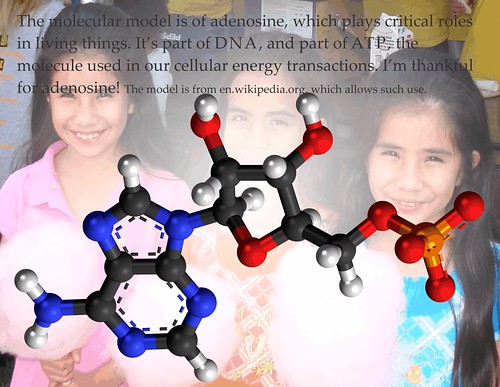
I'm thankful for Adenosine

Thankful for adenosine

I'm thankful for adenosine. You should be, too. Adenosine plays some critical roles in our lives. The graphic above shows a molecular model, found in the Wikipedia article on adenosine. (Such use of the graphic is allowed.) The black spheres represent Carbon atoms, the red, Oxygen, the black, Nitrogen, the white, Hydrogen, and the yellow-orange sphere represents Phosphorus. The rods represent covalent bonds. The dotted lines indicate some movement of some of the electrons. Adenosine is also known as adenine monophosphate (AMP). The Phosphorus on the right, with its attached four Oxygens, is a phosphate. The hexagon and pentagon, on the left, are Adenine, a Nitrogen base. The middle part is deoxyribose, a 5-Carbon sugar.

It is pretty well known that DNA uses Nitrogen bases A, C, G and T to make up our hereditary code. The A stands for Adenine. However, A is connected to a 5-Carbon sugar, Deoxyribose, and to a phosphate, in actual DNA. (C, G and T are also so connected.) The actual genetic code is the sequence of AT, TA, CG and GC pairs, in the double helix, but there wouldn't be a double helix without the deoxyribose and the phosphate.

I used a photo of three girls to represent heredity. I'm not sure how they are related, but I think that two of them are identical twins. In any case, even if one of them is a cousin, rather than a sibling, they clearly share some external characteristics. These characteristics are largely determined by the common DNA that they got from their parents. You may not have thought of it, but the heredity-determining ability of DNA is important, even if you don't have any children. The left half of your body gets the same DNA as the right, the top as the bottom, etc. That's important to make us what we are. Besides, all of us have parents, living or dead.

Adenosine has another important function. It is the raw material for ATP, adenosine triphosphate. ATP has two more phosphates attached to it, in addition to the one in adenosine (AMP).

In most automobiles, the energy stored in gasoline is released, a little at a time, in the cylinders. That's a much better way of using the chemical energy of gasoline than causing an explosion in the gas tank would be! In a similar way, energy from food, say a sugar molecule, is captured, temporarily, in several ATP molecules, which can be transported within the cell. (One part of such capturing is glycolysis.) When energy is needed, for example to make a hormone, ATP is turned back into Adenosine/AMP, as the high-energy bonds that held the two additional phosphates are broken. It sounds complicated, and it is, but is works, and it's a good thing it does! So the energy from food is divided into ATPs, and these are used, a little of the energy at a time.

Because adenosine, and other important molecules, have Carbon, Hydrogen, Oxygen, Nitrogen and Phosphorus in them, living things all need such elements. They need other elements, too, especially Sulfur, which is found in proteins.

I'm convinced that God knew about adenosine, and how it would work, and planned for this. I can't prove it, and it can't be disproved, either. Thanks for reading.

Wednesday, November 19, 2014

Sunspots 496

Things I have recently spotted that may be of interest to someone else:

Education: A former University of North Carolina football player has filed suit, claiming that the university did not provide him with the substantial education that he was promised when recruited. (The university apparently let some students "take" classes that they didn't even attend.)
Health: (or not) We're running out of chocolate, according to The Washington Post and other outlets.
Science: Wired reports on how a study of the cat genome sheds some light on how domestic cats are genetically different from their wild relatives.

National Public Radio has a fine series on color. One post is about how our perception plays tricks on us when we are considering color. Another is about how animals get color from what they eat, partly -- flamingos are an example -- and how rare blue coloring in animals is.
Wired also reports on nudibranches, sea slugs, who eat defensive mechanisms from other creatures, and use them to defend themselves. They are also spectacularly colored -- some are blue.

 Image source (public domain)

Thursday, July 31, 2014

"Evolution Refuted" video, from Answers in Genesis

The Evolution Refuted video, from Answers in Genesis, (AIG) a leading Young-Earth Creationist organization, was published in 2011, but I hadn't seen it until recently. (The video is a little over two and a half minutes long.) I'd like to muse about it.

Evolution Refuted makes two claims:
1) "Fact One: There is no known observable process by which new genetic information can be added to an organism's genetic code."
2) "Life has never been observed to come from non-life."
Let me consider these claims, in reverse order.

Life from non-life
My own position is that life would not be present on earth without God's activity, however and whenever that was.

The second claim is true, but trivial. Either life has always been present, since the beginning of the universe, or it somehow came to be, from non-life. Few, if any, people believe the first alternative. The second is true, whether or not anyone observed this. The claim, quoted above, includes not only natural processes (if any such exist) but God's creative actions. Neither of these have been observed. Does AIG wish to claim that God didn't create, because no one observed it? Surely not.

The claim stands in for a more specific, less trivial claim, which was not expressed in the video. That claim is that life can't come from non-life by natural means. Perhaps not. Perhaps it can. We can't observe the entire biosphere all the time. Far from it. It is possible that, somewhere, perhaps in an ocean, a microscopic new living thing has just come into existence, from non-living precursors. If that were to happen, how would we know this? How could we be sure, in the very unlikely event that we found the resulting living organism, that it didn't descend from some previously unknown type, that's been around for a long time? If a new living thing really came to be, in this way, most likely it would not be as good at obtaining energy, reproducing, and protecting itself, as organisms that have been around for a while in the same location, and subject to adaptation and natural selection. So, most likely, it would quickly go extinct, and we would never know of its existence.

(For all we know, God is creating some new form of life right now, somewhere, as far as that goes. We can't really disprove that!)

Can life come from non-life by natural means? As I said, maybe, maybe not. If it did, it couldn't be through natural selection, the mechanism of evolution. (Natural selection really does exist. There's no reasonable argument about that, but there are arguments about its power. See below.) Natural selection requires reproduction, and variety in the offspring. Non-living entities don't reproduce. 

What AIG is really against is not exactly evolution. Evolution, through natural selection, is a fact, for example in the descent of different racial groups from the original human stock. The Bible teaches that. AIG is really against two ideas. One of them is the idea that the earth is billions of years old, rather than a few thousand years old. The other is naturalism. (See here and here for a discussion of the Young-Earth part of Young-Earth Creationism.) Naturalism should be opposed, and is opposed by most Christians, and others. Even if things take place through natural processes, that doesn't mean that God didn't create the processes.

So, for the first claim, the video is really against the possibility of living things arising from non-living by natural means. As indicated above, the claim that this has never been observed is correct. But AIG accepts God's creative activity, and that hasn't been observed, either. But what if natural processes really can be observed to bring about life from non-life? What if, in some yet-to-be-invented experimental system, life is observed to come from a mixture of non-living substances? So what if this did happen? The Bible doesn't rule this out, and it was God who planned for the Carbon atoms that are central to life, and, somehow, brought them into being. It was God who planned for, and brought into existence, the processes, the energy, the substances, necessary for life. Such a discovery would not rule out God's creativity and intelligence.

New genetic information
What about the second claim, which is that new genetic information can't be added to an organism's genome?

One proposed mechanism for this is by duplication, followed by mutation. For example, there are four different globin proteins in humans, including hemoglobin. This article has a table, comparing the amino acids (building blocks of protein) found in all four of them. The table indicates that the four different proteins are similar in their make-up, and scientists believe that all four of them descended from an organism that had only one gene for hemoglobin, but, over time, that gene was duplicated, due to some error in copying, and, once a second (or, eventually, in another organism, a third or fourth) copy existed, it was not critical to the organism, since the first one was still present, so changes in the second copy weren't selected against, and, eventually, it produced a protein with a somewhat different function, because changes eventually led to organisms with these changes were selected for. There are a number of genetic systems where the same thing seems to have happened. New genes, with new genetic information, have become critical to the life of organisms. Can we prove that God didn't specially create these four hemoglobins? No, of course not. But natural processes can explain the existence of similar, but different, functional genes from a single gene ancestor. The AIG claim is really that there is no way this could have happened, without a miracle. All that is needed to refute that claim is to show that there are such mechanisms.

Besides new genes arising by duplication, it is also possible for new functions, from new or modified genes, to arise by mutation. One example is the rise of the ability to use citrate (see also here) in an experimental population of bacteria.

See here for more on the addition of information to an organism's genome.

AIG's claim is really that there is no way that genetic information could be added to an organism's genome, except by Divine action. That claim is false.

In summary, at best, the claims of the AIG video are over-simplistic. At worst, one of those claims is false. Thanks for reading.

Saturday, May 17, 2014

Did living things come from a common ancestor, or were they created separately?

The title asks an important question. It's also a broad question. Let me re-phrase it, more narrowly:

Do some living things resemble each other because of descent from a common ancestor, or because they were created to be similar?

Some people do not believe that the earth is old enough for there to have been distant common ancestors. They might believe that, say, cows and bison came from a common ancestor, or at least that all the breeds of cows did, but that cows and deer could not have, because there wasn't enough time. Some people, often the same ones, believe that the language of Genesis 1 indicates that God created the varieties of organisms by separate creative acts. Some people, usually the same ones as mentioned above, do not believe that humans and non-human primates share any common ancestry, because they believe that the language of Genesis 1 indicates that humans were created specially from non-living material. On the other hand, there are Bible-believing, God-fearing Christians, who are not so sure of all of this, and believe that the earth is very old. Such people may also believe that God especially endowed some pre-existing primate with the image of God (whatever that is) and that, therefore, non-human primates were distant biological ancestors of humans. Billy Graham has said that that may have been what happened.

If humans and chimpanzees were created separately, then how do people who believe this explain the similarities between the two? In particular, how do they explain the genetic similarity? The usual response is that, in order to function properly, genes have to fall within a narrow range of structural constraints. Therefore, human genes, and chimpanzee genes, were created to be much alike. Although we aren't really sure that there is only one way to make, say, an Oxygen-carrying molecule like hemoglobin, this argument of those who believe in special creation has some plausibility. But not enough.

A recent article, by a scientist who is a Christian, and well-qualified to discuss the matter, examines a situation where genes don't function. And, in this case, vitamin C production, it turns out that non-functioning genes of humans and non-human primates are very similar. The only reasonable explanation seems to be that humans and non-humans inherited their genes for vitamin C production from an ancestor which had lost the capacity to produce enzymes that could synthesize vitamin C. Thus neither humans nor orangutans can produce vitamin C, but both have the apparent remains of the genes that produced it in the presumed common ancestor, and these remains are almost identical.

Thanks for reading.


Tuesday, August 27, 2013

An important book on cancer

At the urging of a relative, who lent it to me, I recently read what some have labeled the most important book on cancer published in my lifetime. The book is The Emperor of all Maladies: A Biography of Cancer, by Siddhartha Mukherjee, and it won, among other awards, the Pulitzer Prize for non-fiction.

The book is written so as to be accessible to lay persons, although it has many notes, and a good index, so those seeking further information can explore further.

So what's it about? It's about the history of our attempt to prevent, and/or cure, cancer, from the beginnings of medical science until almost the present. Many names of important scientists and health professionals, and some philanthropists, politicians and what we now call activists are included, along with a sentence or more on what they were, or are, like. Many developments in the history of our work with cancer are described, such as establishing the link between tobacco and lung cancer.

What's the message of the book? More correctly, what are the messages of the book?

One of them is that cancer is many different ailments. The Human Genome Project "maps" the DNA bases of "normal" people. It's an enormous trove of data. The Cancer Genome Atlas, referred to in the book, and under development, promises to be much larger than the map of the human genome.

Another message is that we can't expect to cure cancer until we understand the workings of normal human cells better than we do now. Cancer occurs when the mechanisms that cause and control cell multiplication get out of kilter. Those mechanisms are complex. Our understanding is getting there, making some strides that scientists of a couple of generations ago wouldn't have even understood, but we aren't there yet.

Another message is that government, business, or academic bureaucracy can get in the way of doing some good things for people that are in desperate need. That's hardly a surprise, but the story of cancer has too many examples of this sort of thing.

Another message, although Mukherjee doesn't put it in those terms, is the way in which our progress toward curing and preventing cancer illustrates the thesis of The Structure of Scientific Revolutions, by Thomas S. Kuhn. Kuhn claimed that science changes, not so much because of experiments, as because of revolutions in the thinking of the scientific community. These revolutions usually leave some older scientists bypassed -- they are stuck in an old way of looking at natural phenomena, and don't ever accept more correct and fruitful ways. Over and over, this happened in the biography of cancer.

We have made some progress, in preventing some forms of cancer, and in curing some others. But there are many cancers we don't have much of a handle on yet, and many patients who suffer through chemotherapy without much benefit. A sobering story.

Cancer is such a complex subject that it is probably not possible to come close to understanding it without reading a book such as Mukherjee's, or the equivalent. I'm glad that I understand this disease, which stands a good chance of ending my own life, a little better. (I am not aware that I have any form of cancer, but you never know, especially the older you get.)

Thanks for reading.


Wednesday, June 19, 2013

Sunspots 423

Things I have recently spotted that may be of interest to someone else:

The Arts: I've missed Garrison Keillor on "The Writer's Almanac." He's on summer hiatus. The replacement is OK, but, for one thing, doesn't do Keillor's great sign-off, which is "Be well, do good work, and keep in touch," with a Keillor-esque pause or two.

Health: (or politics, or science) The opinion of the US Supreme Court in the gene patenting case, delivered, for a unanimous court (!) by Justice Clarence Thomas.

Politics: Many Americans are more loyal to their party than to their church, or their religion, according to NPR.

Science: NPR tells us, with photos, and a video, about some enormous walking stick insects, which were thought to have become extinct, but aren't. Their re-discovery is an amazing story.

I just read about the idea of Pleistocene rewilding. If carried out, species similar to those who have gone extinct in Asia, Europe, and the Americas would be introduced. For example, cheetahs would be introduced to the plains of North America. Some such introductions have already taken place, but only on a small scale.


Image source (public domain)