License

I have written an e-book, Does the Bible Really Say That?, which is free to anyone. To download that book, in several formats, go here.
Creative Commons License
The posts in this blog are licensed under a Creative Commons Attribution-NonCommercial-ShareAlike 3.0 Unported License. You can copy and use this material, as long as you aren't making money from it. If you give me credit, thanks. If not, OK.

Wednesday, November 09, 2011

Sunspots 339

Things I have recently spotted that may be of interest to someone else:

Science: The Hubble space telescope has gotten a picture of material around a black hole, according to Wired. The article also notes that there are objects further away from us, in light-years, than the age of the universe, in years.

Wired also reports that bacteria are far more able to exchange genes with other species than we had thought. These genes may include genes for antibiotic resistance.

Christianity: (Well, not exactly) Two Pakistani Muslims are keeping a formerly Jewish business going, and using kosher methods, says CNN.


Image source (public domain)

Sunday, November 06, 2011

Prayers in the Bible: Paul prays for the Thessalonians

1 Thessalonians 3:11 Now may our God and Father himself, and our Lord Jesus Christ, direct our way to you; 12 and the Lord make you to increase and abound in love one toward another, and toward all men, even as we also do toward you, 13 to the end he may establish your hearts blameless in holiness before our God and Father, at the coming of our Lord Jesus with all his saints.

This is one of several prayers by Paul, for the Christians in various parts of the world he knew. We should be praying for other Christians, too.

Thanks for reading. This is one of a series. The previous post in the series is here.

Wednesday, November 02, 2011

Sunspots 338

Things I have recently spotted that may be of interest to someone else:
Science: Karl Zimmer has posted the winners of a science movie festival.

Politics: (or Philosophy) PETA plans to take Sea World to court, on the grounds that dolphins under their care, and displaying as an attraction for customers, are being held in slavery.

Christianity:  Russell Purvis challenges our thinking on how to explain and understand salvation.

Image source (public domain)

Sunday, October 30, 2011

Prayers in the Bible: Paul prays for the Philippians

Philippians 1:9 This I pray, that your love may abound yet more and more in knowledge and all discernment; so that you may approve the things that are excellent; that you may be sincere and without offense to the day of Christ; 11 being filled with the fruits of righteousness, which are through Jesus Christ, to the glory and praise of God. (World English Bible, public domain)

A most appropriate prayer for Christians to pray for other believers!

Thanks for reading. Pray for me. This is part of a series on prayers in the Bible. The previous post is here.

Saturday, October 29, 2011

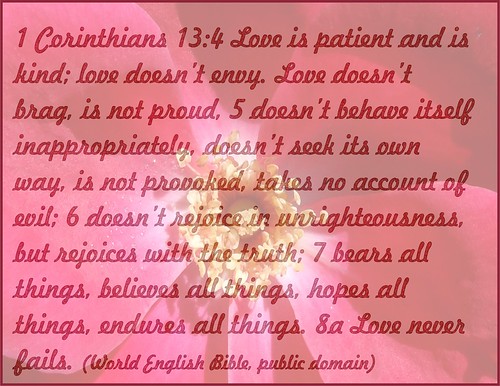
Happy anniversary to us

1 Corinthians 13 behind rose, excerpt

Today is our anniversary. This is posted in honor of my wife.

Wednesday, October 26, 2011

Sunspots 337

Things I have recently spotted that may be of interest to someone else:


Science: Wired reports on how we alter each other's memories of events. A little scary -- I may not remember correctly what happened to me, but think I do.

Christianity: Weekend Fisher has done a study on the Gnostic gospels, comparing them to the canonical four gospels. (I have never read the Gnostic gospels.) She points out that two of the Gnostic gospels have no mention of place, at all, whereas all four canonical gospels are rich in geographic, or more localized, location information. 

Here's her post on one of the Gnostic gospels. Here's her post on John. 

The Biologos Forum has a post about research into why Christian young people leave church.

Image source (public domain)

Monday, October 24, 2011

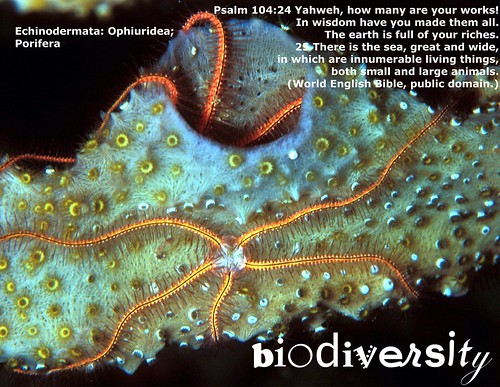
Psalm 104:24-25: Biodiversity, with Echinoderms (starfish and their relatives)

Biodiversity poster, Psalm 104: brittle star and sponge
The animals in the picture above are brittle stars, a member of the same phylum as starfish, sea urchins, and others, and a sponge, also an animal. Echinoderms, among other oddities, have five-fold symmetry. The graphic serves as a link to a Flickr picture, which, among other information, has the credit for the original photo. (Altered and posted with permission of the underwater photographer.)

Here's an amazing video, less than three minutes, from the BBC, showing starfish (also known as sea stars), Nemertean worms, and sea urchins, swarming around a dead seal pup, off the coast of Antarctica.

I thank a friend who looked at one of the previous posts in this series for the tip on this video.

Thanks for looking and reading.

Sunday, October 23, 2011

Prayers in the Bible: Paul's benediction on the Ephesians

Ephesians 6:23 Peace be to the brothers, and love with faith, from God the Father and the Lord Jesus Christ. 24 Grace be with all those who love our Lord Jesus Christ with incorruptible love. Amen. (World English Bible.)

That pretty well covers it. In fact, grace covers it.

Thanks for reading. This is part of a series. The previous post is here.

Friday, October 21, 2011

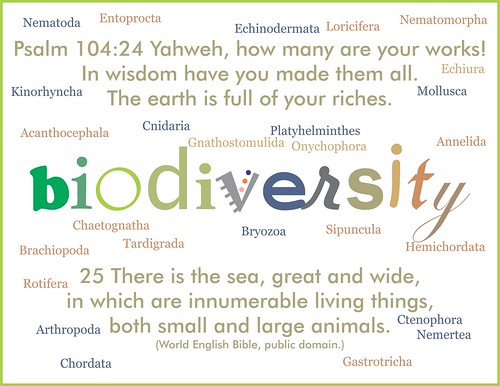
Psalm 104:24-25: How diverse are marine animals?

biodiversity word poster 2 with phyla

The graphic above gives the names of most (not all) of the 36 phyla of animals which are currently known. (There are 36 recognized phyla, at present.) You probably have little or no idea as to what a member of the Loricifera or the Echiura would be like. I don't either. (If you want to know, use the link in this paragraph.)

A phylum is a large group of animals. For example, mice belong to the Chordata (so do we) and ladybugs belong to the Arthropoda. Mice and ladybugs are not very much alike, and those two phyla are probably as much like each other as any two other phyla of animals. What amazing diversity. In the previous paragraph, I said "at present" because we may discover other animals that don't belong to any of the 36 phyla, or we may learn more about one of the phyla, and this knowledge may lead zoologists to divide that phylum into two such.

What amazing diversity! Thank God. Thanks for reading.

Thursday, October 20, 2011

Psalm 104:24-25: Biodiversity in marine animals

Psalm 104 is a fine nature poem, indeed. It was apparently written by David.

As a biologist, I have been struck, for many years, with verses 24-25:
24 Yahweh, how many are your works!
In wisdom have you made them all.
The earth is full of your riches.
25 There is the sea, great and wide,
in which are innumerable living things,
both small and large animals. (World English Bible, public domain)

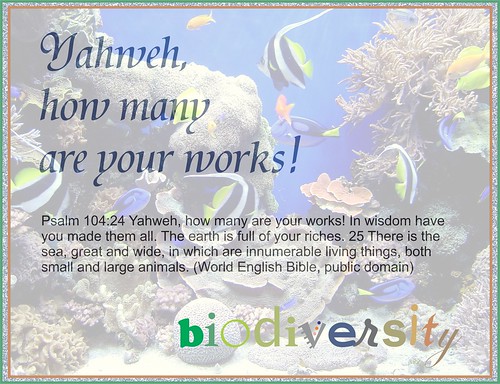
I have recently made some attempts to illustrate this, using computer graphics, and some photos, of marine animals, from Flickr members, with their permission. This picture:
Yahweh, how many are your works 1

is the first in a series of these attempts. It was first posted on Flickr, with appropriate credit given to the photographer -- the photograph was taken at the Monterey, California, aquarium. (The picture serves as a link to the Flickr post.) There are at least three phyla, represented by the fish, the sponges, and the corals, in the photo. The word, biodiversity, was produced using a different color, and a different typeface, for each letter, to represent diversity. The colors of the letters were chosen to be colors that could be found in marine organisms.

Thanks for looking!

Wednesday, October 19, 2011

Sunspots 336

Things I have recently spotted that may be of interest to someone else:

Humor: (sort of) A curry eating contest put two contestants in the hospital, according to National Public Radio.

Science: Wired reports that scientists have found that meerkats can recognize other meerkat individuals by the sound of their "voice."

Carl Zimmer discusses a recent finding -- the largest known virus.

A video from TED on how babies learn languages.
 
The Arts: (sort of) The New York Times has discovered books written by robots.

Image source (public domain)

Sunday, October 16, 2011

Prayers in the Bible: Hezekiah prays for deliverance

Isaiah 37:8 So Rabshakeh returned, and found the king of Assyria warring against Libnah, for he had heard that he was departed from Lachish. 9 He heard news concerning Tirhakah king of Ethiopia, “He has come out to fight against you.” When he heard it, he sent messengers to Hezekiah, saying, 10 “Thus you shall speak to Hezekiah king of Judah, saying, ‘Don’t let your God in whom you trust deceive you, saying, “Jerusalem won’t be given into the hand of the king of Assyria.” 11 Behold, you have heard what the kings of Assyria have done to all lands, by destroying them utterly. Shall you be delivered? 12 Have the gods of the nations delivered them, which my fathers have destroyed, Gozan, Haran, Rezeph, and the children of Eden who were in Telassar? 13 Where is the king of Hamath, and the king of Arpad, and the king of the city of Sepharvaim, of Hena, and Ivvah?’”
14 Hezekiah received the letter from the hand of the messengers and read it. Then Hezekiah went up to Yahweh’s house, and spread it before Yahweh. 15 Hezekiah prayed to Yahweh, saying, 16 “Yahweh of Armies, the God of Israel, who is enthroned among the cherubim, you are the God, even you alone, of all the kingdoms of the earth. You have made heaven and earth. 17 Turn your ear, Yahweh, and hear. Open your eyes, Yahweh, and behold. Hear all of the words of Sennacherib, who has sent to defy the living God. 18 Truly, Yahweh, the kings of Assyria have destroyed all the countries and their land, 19 and have cast their gods into the fire; for they were no gods, but the work of men’s hands, wood and stone; therefore they have destroyed them. 20 Now therefore, Yahweh our God, save us from his hand, that all the kingdoms of the earth may know that you are Yahweh, even you only.”
21 Then Isaiah the son of Amoz sent to Hezekiah, saying, “Thus says Yahweh, the God of Israel, ‘Because you have prayed to me against Sennacherib king of Assyria, 22 this is the word which Yahweh has spoken concerning him. The virgin daughter of Zion has despised you and ridiculed you. The daughter of Jerusalem has shaken her head at you. 23 Whom have you defied and blasphemed? Against whom have you exalted your voice and lifted up your eyes on high? Against the Holy One of Israel. 24 By your servants, have you defied the Lord, and have said, “With the multitude of my chariots I have come up to the height of the mountains, to the innermost parts of Lebanon. I will cut down its tall cedars and its choice fir trees. I will enter into its farthest height, the forest of its fruitful field. 25 I have dug and drunk water, and with the sole of my feet I will dry up all the rivers of Egypt.” 26 Have you not heard how I have done it long ago, and formed it in ancient times? Now I have brought it to pass, that it should be yours to destroy fortified cities, turning them into ruinous heaps. 27 Therefore their inhabitants had little power. They were dismayed and confounded. They were like the grass of the field, and like the green herb, like the grass on the housetops, and like a field before its crop has grown. 28 But I know your sitting down, your going out, your coming in, and your raging against me. 29 Because of your raging against me, and because your arrogance has come up into my ears, therefore will I put my hook in your nose and my bridle in your lips, and I will turn you back by the way by which you came. 30 This shall be the sign to you. You will eat this year that which grows of itself, and in the second year that which springs from the same; and in the third year sow and reap and plant vineyards, and eat their fruit. 31 The remnant that is escaped of the house of Judah will again take root downward, and bear fruit upward. 32 For out of Jerusalem a remnant will go forth, and survivors will escape from Mount Zion. The zeal of Yahweh of Armies will perform this.’ 33 Therefore thus says Yahweh concerning the king of Assyria, ‘He will not come to this city, nor shoot an arrow there, neither will he come before it with shield, nor cast up a mound against it. 34 By the way that he came, by the same he shall return, and he shall not come to this city,’ says Yahweh. 35 ‘For I will defend this city to save it, for my own sake, and for my servant David’s sake.’”
36 The angel of Yahweh went out and struck one hundred and eighty-five thousand men in the camp of the Assyrians. When men arose early in the morning, behold, these were all dead bodies. 37 So Sennacherib king of Assyria departed, went away, returned to Nineveh, and stayed there. 38 It happened, as he was worshiping in the house of Nisroch his god, that Adrammelech and Sharezer his sons struck him with the sword; and they escaped into the land of Ararat. Esar Haddon his son reigned in his place. (World English Bible)

Hezekiah, and the nation, were threatened with destruction. Hezekiah did the right thing. He prayed. And God answered his prayer!

This is one of a series of posts quoting prayers from the Bible. The previous post is here. Thanks for reading.

Saturday, October 15, 2011

Mouse gene works in fish

Stephen Matheson has been writing a series of posts about the limbs of vertebrates, and their relationships. In one of this series, he discusses experiments in which a mouse regulatory gene works in fish embryos, which strikes me as simply amazing.

Thanks for reading

Tuesday, October 11, 2011

Sunspots 335

Things I have recently spotted that may be of interest to someone else:

 
Science: Wired reports that fear of failure can inhibit learning, and does.


Sports: National Public Radio reports that the Women's NBA league has improved in attendance and TV viewing, but is not exactly a great success.

Christianity:  (Or Judaism) Heart, Mind, Soul and Strength has posted a list of the categories of the commandments found in the first five books of the Bible. (For example, of over 600 laws found there, 14 had to do with business practices.) That wasn't her main purpose, which was to deal with worship.

From the same blog -- a fine piece on what worship pleases God, and what doesn't.

Image source (public domain)

Faster than light?

A (mostly) political columnist, no less, has devoted an entire column to the possible discovery that some neutrinos may travel faster than the velocity of light. As he says, this is a discovery that will change the way we look at the world, in a profound way.

If it's true, that is. Krauthammer seems to think it is. See here for the Wikipedia's take on the experiments. These results had not been reported in earlier, similar experiments.

Thanks for reading.

Monday, October 10, 2011

Lisa Randall on science and religion

Can a scientist be religious? Only at the price of inconsistency, she argues, because scientific determinism is not compatible with belief in a deity who can willfully intervene in the world. Sympathetic though I am to her conclusion, I would point out that scientific determinism is equally incompatible with free will and moral responsibility. Jim Holt, "Will the Large Hadron Collider Explain Everything?" a review of Knocking on Heavens Door, by Lisa Randall, Harvard physicist, New York Times Book Review, October 9, 2011.

Thanks for reading.

Sunday, October 09, 2011

Prayers in the Bible: one from Isaiah

Isaiah 33:Yahweh, be gracious to us. We have waited for you.
Be our strength every morning,
our salvation also in the time of trouble. (World English Bible, public domain.)

A great prayer to start the day with.

This is one of a series on prayers in the Bible. The previous post is here. Thanks for reading.

Thursday, October 06, 2011

Climate change and the velocity of light

"Last month, scientists at CERN, the prestigious high-energy physics lab in Switzerland, reported that neutrinos might—repeat, might—travel faster than the speed of light. If serious scientists can question Einstein's theory of relativity, then there must be room for debate about the workings and complexities of the Earth's atmosphere." Robert Bryce, "Five Truths About Climate Change," Wall Street Journal, October 6, 2011.

I am not a climatologist. Neither is Mr. Bryce, according to the Wikipedia article on him. But, like him, I want to enter the discussion on global climate change.


Bryce refers to a recent experimental result, which may mean that some neutrinos travel may travel faster than the velocity of light. Bryce correctly notes that this result has not been confirmed. But I believe that he has compared apples and oranges.

The theory of relativity (actually, there are two of these, both due to Einstein) is a theory. That is, it is a group of ideas that attempts to explain the way things are. As I understand it, the evidence for global climate change is not theoretical, but, rather, is data, collected over a number of years, and Bryce is questioning the evidence -- the data, not a theory.

Scientists have frequently made mistakes. One kind of mistake is working with an inadequate theory. Another is experimental errors -- equipment malfunctions, for example. Usually, science is self-correcting. A better theory is proposed. Someone tries to repeat the data collection, and finds experimental errors. I don't think that either of these has occurred as relates to global climate change, at least not on a large scale. I think Bryce is wrong.

Thanks for reading.

Wednesday, October 05, 2011

Sunspots 334

Things I have recently spotted that may be of interest to someone else:

 
Science: National Public Radio reports on the paw paw, a fruit native to North America that you may have never heard of.

Wired reports on a possible case of human change in response to natural selection, namely lowering of the age when women had their first child, within the past 200 years.

Christianity: E Stephen Burnett points out that our own fallen human nature is never a movie villain. It's usually some monster, or some monstrous human.

Image source (public domain)

Tuesday, October 04, 2011

Elizabeth Moon's Paksenarrion -- Christian or not?

This is a rewrite of a post of June 6, 2007.

I have previously posted about Elizabeth Moon's trilogy, The Deed of Paksenarrion (Riverdale, NY: Baen, 1992 -- combines three novels published previously). One question I wish to muse about is the question of Christianity in this work.

The Wikipedia article on Moon, dated June 6, 2007, discusses the question of religion, and the relation of the trilogy to board games, briefly:

Elizabeth Moon, not gaming herself, heard some people playing "Paladins" (Holy warriors in the service of a god) and doing so very poorly. Her reaction was of course that "such a person wouldn't act like that"... and in thinking about what they would act like, Paksenarrion was born.

The Wikipedia article on the trilogy, on the same date, says:

The Deed of Paksenarrion has an engrossing religious theme with Christian aspects. While this world appears to be polytheistic, there is a "High Lord" and saints, such as Gird, Falk, etc, who serve him. Also, there are prominent themes of atoning sacrifice and redemptive love, with Paksenarrion becoming a kind of Christ figure. However, some believe that comparing this work to themes such as "Hero as Redeemer" and "Hero as Saint" from The Hero with a Thousand Faces shows this is not particularly Christian. There are also several references to the World tree. [The links in this paragraph were copied from the Wikipedia article on the trilogy.]

In other words, religious, yes. Christian, maybe. I concur. This page states that Moon is an Episcopalian. Elliot has posted on religion in these books, and on Moon. One of his posts quotes a web page with an interview with Moon, describing her conversion experience.

I have previously laid out the following characteristics, one or more of which must be present, to satisfy myself that a novel is a Christian novel:
1) A Christ-figure
2) Belief, by central characters, in important Christian doctrines, such as a belief in the Trinity, or the resurrection
3) Monotheistic prayer or other worship
4) Expression of a relationship with God as Lord, by a main character
5) Consciousness of supernatural guidance
6) Explicit rejection of evil, by a main character

And I also said that if the work shows an overall Christian world-view, even though those characteristics aren't present, it could rightly be called a Christian novel, and I categorized Susan Palwick's The Necessary Beggar as Christian for that reason.

I have found some of these characteristics in The Deed of Paksenarrion, but most or all of them are polytheistic. That is, there is a High Lord, to be sure, but there are also saints. Gird, in particular, is one that Paksenarrion relies on. (There is occasional mention of Falk, and of Camwyn, both apparently of status like that of Gird.)

One of the characters in the book explains it like this, in response to a question on how Gird got his powers:
"Then came a new threat. Powers of evil, exactly what we don't know. Many feared them too much to resist, and fled far away. But Gird went out to face them with his old cudgel. No one saw that battle, but the dark powers fled the land for many years, and Gird was not seen on earth again. Gird's best friend, who had been away on a journey, had a dream in which he saw Gird ascending to the Court of the High Lord—saw him honored there, and given a cudgel of light to wield. It was after that, when he told his dream, that the priests of the High Lord recognized Gird as a saint. We don't claim Gird is a god. We say he is a favored servant of the High Lord; he has been given powers to aid his followers and the cause of right." (Chapter 25 of Sheepfarmer's Daughter, which is the first part of the Deed, pp. 255-6 of the combined book. This first part is on-line here.) It isn't just Gird, either. On p. 96, chapter 10, followers of Falk are also said to have healing powers. Some soldiers follow Tir. I'm not sure whether Tir is a saint or not.

There is a two-book combined prequel, The Legacy of Gird, and I am currently reading that, but expect to post this before I finish finding out about Gird.

I recognize that the Catholic church believes in saints, and that, as I understand it, they aren't recognized as such until after death, and until a process has proceeded that, among other things, requires that some after-death miracles are attributed to them. As a life-long Protestant, I have trouble with what I see as rivals to the work of Christ, including saints. However, the Bible does suggest that Peter's brief presence was sufficient to bring about healing.

1) So, is there a Christ-figure in the Deed? That, of course, depends on how you define Christ-figure. Paksenarrion, in some senses, qualifies. She is celibate throughout the book, and apparently throughout her life, except for being brutally raped. She is given some power to heal. She has a strong sense of right and wrong. Finally, and most importantly, she willingly offers herself to the evil priests of Liart (Chapter 27 of the last part of the book) expecting that they will torture her for five days, and finally kill her, in order that they give up five captives, including Duke Phelan, who is to be king. She is tortured publicly, expertly and brutally, and the torture includes rape. She depends on her call to be a servant of the High Lord, and of Gird, to endure this, and, finally, she is rescued -- miraculously healed of most of the damage from the torture, and freed from the evil group. At least one reader thinks that she died and was resurrected during this episode. I didn't interpret the events that way.

An especially interesting parallel is that the Thieves' Guild is purified of its worshipers of Liart because of what happened to Paksenarrion, so that, in a sense, her sacrifice redeems thieves:

"Arvid, there may have been another way to save Phelan: I don't know. Paladins don't know everything; we only know where we must go. But think of this: was there any other way to save the Thieves Guild?"
He stared at her, mouth open like any yokel's. "Thieves Guild," he said finally. "What does Gird care about the Thieves Guild?"
"I don't know," said Paks. "But he must care something, to spend a paladin's pain on it . . ." (P. 992 of the combined book, Chapter 28 of Oath of Gold, the last part of the trilogy. Arvid was chief of the Guild.)

So we have a good figure who offers herself as a living sacrifice for others. A Christ-figure.

Moon, herself, has written about the sacrifice and torture of Paksenarrion, here. I didn't read anything in her post that changes my assessment of the book. It seems clear from other posts by Moon that she is a practicing Christian.

2) I don't find any belief in the essential Christian doctrines in the book. There is no explicit prayer for forgiveness of sin.

3) Intercessory prayer is mentioned several times, but it is often to, or through, Gird or another saint, as much as to the High Lord. However, Paksenarrion, herself, prays mostly, to the High Lord. It is the High Lord who comes to her aid during her torture.

4) Paksenarrion comes to realize that she has been specially called for a purpose, by the High One. There are a few paladins of Gird, but she is not one of them. The realization is a slow process, and others see this, sometimes, before she does.

It is clearly the High Lord who rehabilitates her after her torture. A symbol of Liart, an evil god, which has been branded onto her forehead, is replaced, miraculously, with a circle, a symbol of the High God.

5) Paksenarrion does come to recognize supernatural guidance (see above).

6) There are a number of instances where Paksenarrion explicitly rejects evil. Perhaps the most important is early in her career, when she tells the Duke not to torture an evil man, because the Duke's army is not like them, and she wants it to stay that way. (pp. 307-8, Chapter 31 of Sheepfarmer's Daughter) Many of the others involve sensing, and combating, evil non-human beings.

Perhaps the most remarkable episode is this one:
It was then as if several selves were present, mysteriously separate and conjoined. Trapped inside her body was the same child she had been, feeling each new torment as a wave of intolerable pain,each ragged scream as a fresh humiliation. The seasoned soldier watched with pity as her body gave way to exhaustion and pain as any body would, feeling no shame at the sight or sound or smell of it, for this was something that could happen to anyone, and she had never inflicted it on others. And someone else, someone newer, refused the soldier's tactics of defiance, anger, vengeance, and looked into her own fear to find the link to those around her, to find the way to reach those frightened tormentors, the ones not already lost to evil. (978, Chapter 27 f Oath of Gold.) Here Paksenarrion not only rejects evil, but does not allow herself to desire vengeance, even while she is being tortured cruelly by experts over a five-day period. She also tries to find a way to change some of those who are watching this torture from evil to good.

7) Does Elizabeth Moon's trilogy have a Christian world-view? I would have to say that it is not strictly Christian, but that the leading character comes to have a fictionalized Christian world-view.

Probably no one cares, but here's my bottom line. The Deed of Paksenarrion, though it has polytheistic elements, has an essentially Christian idea, that of a good person sacrificing herself to rescue someone else from punishment. On that score, it's a Christian novel, as much as, say Tolkien's The Lord of the Rings. But it's certainly not explicitly Christian, and is not sold as such. Thus, in my view, Moon's work has much more opportunity to be salt and light to a world that needs such things.

Do Christians have to write only books that are explicitly Christian? Should they read only such books? No, and no. I am reminded of Till We Have Faces, by C. S. Lewis. Lewis was a Christian, but this book, arguably his best novel, has characters with a pre-Christian, or pagan, world-view. Nonetheless, it's a great read, and presents Christian truth, especially that God Himself is the only real answer to our questions about justice.

I have found a few other web pages that briefly mention Christianity in the Deed. This page says that the trilogy has "Christian themes," and recognizes the sacrifice of Paksenarrion for others. This post says that there are parallels to Christian ideas, and that the trilogy, especially the last part, is about "Faith," even faith in miraculous resurrection.

This page may be modified later, as I think of things, as you comment, or as I read about Gird.

Thanks for reading.

See this post for links to references to this topic in the Claw of the Concilator blog.

See here for a subsequent post on biblical morals in the Paksenarrion books.

On April 2, 2009, E Stephen Burnett wrote an essay, asking questions about how far a Christian author could go in writing fiction which has a God who is significantly different from the Christian God, and whether a Christian could legitimately create a fictional character who is in defiance of God. I posted tentative answers to these questions, which are related to the subject of the post above, on April 13, 2009.

Thanks for reading. Read Moon, if you have to time to commit to reading about 1,000 pages!