License

I have written an e-book, Does the Bible Really Say That?, which is free to anyone. To download that book, in several formats, go here.
Creative Commons License
The posts in this blog are licensed under a Creative Commons Attribution-NonCommercial-ShareAlike 3.0 Unported License. You can copy and use this material, as long as you aren't making money from it. If you give me credit, thanks. If not, OK.
Showing posts with label fish. Show all posts

Wednesday, January 21, 2026

Sunspots 995


Things I have spotted that may be of interest to others.

Discover Wildlife reports on a fish with a hole in its head, and what that hole probably does. Photos included.

National Public Radio reports that a Texas A&M professor has been told to not consider Plato in his philosophy class.

Gizmodo reports that rich people, world-wide, are responsible for a large portion of greenhouse gasses emitted.

A BigThink writer discusses the question "Why does something exist instead of nothing?" (The writer says that there is no possible scientific answer to this question.)

BisThink also discusses the state of particle physics, with discussion and diagrams.

ZDNet tested six chatbots, and found that all of them made a serious error on at least one of the tasks posed by the author.

Thanks for reading.

Friday, March 07, 2025

Sunspots 978

Things that I have spotted that may be of interest to others: 

SciTech Daily reports that fish can recognize and react to human divers.

Naturalis Historia concludes a series on the Bible and the geology of the Dead Sea,

ZDNet describes 10 on-line sites that carry free, or inexpensive digital books.

NPR and other outlets report on progress towards bringing live mammoths back, Their work has involved changing the genes of mice, so that they have long, fuzzy hair, and are able to use fat efficiently to keep warm.

Neuroscience News reports that detecting pain and itch is accomplished with two different sets of neurons.

NPR tries to keep track of President Trump's tariffs.

Thanks for reading!

Wednesday, July 26, 2023

Sunspots 933

Things I have recently spotted that may be of interest to others*

Christianity: Christianity Today reports that an important source of congregational songs, especially in Southern Baptist churches, is ceasing to publish.

Environment:  NPR discusses those Canadian wildfires.

A Conversation article on how important rip currents are. (They aid the ocean's ecology.)

Another Conversation article examines recycling in depth. We aren't doing very well at it.

Food: (and finances) Fortune tells us why hamburgers are relatively cheap, compared to salads.

Health: A Conversation article discusses the dangers of exposure to heat.

Science: Gizmodo reports that two new species of sabertooth cats have been discovered.

The Smithsonian reports that we discover a new species of dinosaur nearly every two weeks.

An article in the Conversation tells us about huge freshwater fish, some weighing 500 pounds or more.

*I try not to include items that require a password or fee to view.

Thanks for reading.

Wednesday, September 07, 2022

Sunspots 900

Things I have recently spotted that may be of interest to others*:


The Arts: A Christianity Today writer on Tolkien's world, and ours.

Christianity: A Christianity Today writer on how corporate worship may bond us together in ways we don't realize.

Christianity Today has posted links to several articles on the late Mickail Gorbachev.

Politics:  A Conversation writer says that Iran is winning the war between Russia and Ukraine.

Gizmodo notes that former President Trump has incriminated himself on his own social media platform.

Science: Gizmodo on 7 animals that use tools.

A web page that tells us that fruit flies have been important in Nobel-prize-winning research.

A writer for The Conversation points out that over half of human fertilized eggs die before the woman knows that she is pregnant, but that laws protecting human embryos don't take this into account.

Another writer for The Conversation discusses what we know about fish sleep.

Sports: FiveThirtyEight tells us which of the big universities are football schools, and which are basketball schools.

*I try not to include items that require a password or fee to view.

Thanks for reading.

Wednesday, May 04, 2022

Sunspots 882

 Things I have recently spotted that may be of interest to others*:


The Arts: NPR has posted an essay that considers the question of whether there's too much TV -- it's impossible to watch it all.

Christianity: Relevant argues that boycotts by Christians don't really do any good.

Environment: Gizmodo reports that incandescent light bulbs are now supposed to be phased out.

NPR discusses the idea of removing Carbon Dioxide from the air to fight global climate change. There are downsides to this.

NPR tells us that California condors are increasing in number and range.

Health: Gizmodo reports that a bacterium can trigger the release of snot (mucus) which serves as a food source for the bacterium.

Politics: Relevant quotes US Representative Marjorie Taylor Greene, who said that churches that are trying to help refugees are "controlled by Satan." Really?

Science: (and Christianity) Christianity Today tells us what black holes tell us about God.

The Scientist reports that lots of kinds of fish can make sounds, and that making sound seems to be important.

Sports: (and health) NPR reports on how Muslims adjust to fasting during Ramadan.

The graphic used in these posts is from NASA, hence, it is free to use like this.

*I try not to include items that require a password or fee to view.

Thanks for reading.

Wednesday, April 06, 2022

Sunspots 878

Things I have recently spotted that may be of interest to others*:


Christianity: (or something) Relevant describes how well-meaning people have followed being against sex trafficking into conspiracy theories like QAnon.

Finances: NPR reports that large corporations are avoiding paying damages by spinning off a subsidiary to take over the lawsuits, and then declaring that the subsidiary is bankrupt, even though the parent corporation has plenty of money, and, in some cases, has done plenty of damage.

Science: (or something) A flamingo that escaped from a zoo in Kansas in 2005 has been spotted in Texas, according to NPR. Another source says that the bird was identified by a video, which showed its leg band number.

Gizmodo reports that the human genome has been almost mapped (about 20 years ago, we were given the impression that that had been done. About 8% of the human genome was not sequenced at that time.)

The Scientist reports that some fish can react to "more objects than before," or "less objects than before," indicating perception of quantities.

The Scientist also reports that Chicago-area birds are nesting a few weeks earlier than they did a century ago, probably because of climate change.

And The Scientist reports that dwarf mongooses punish bullies by shunning them.

The graphic used in these posts is from NASA, hence, it is free to use like this.

*I try not to include items that require a password or fee to view.

Thanks for reading.


Wednesday, January 19, 2022

Sunspots 867

Things I have recently spotted that may be of interest to others*: 


The Arts: Listverse tells us about 10 literary locations that you can actually visit, in the UK.

Computing: Gizmodo reports that Gettr, a social network that claims not to censor user's posts, is deeply connected to Facebook and Google.

Environment:  Gizmodo has posted a slide show of the 9 worst invading species in the US, including one plant.

Finances: ABC News reports that the 10 richest men in the world doubled their worth during the pandemic, while the rest of us mostly lost worth.

History: NPR reports that authorities may have finally discovered the name of the person who turned in Anne Frank and her sister and parents to the Nazis. For more on Anne Frank, go here.

Humor:  (or something) Lego has released a build-it-yourself globe that can spin, according to Gizmodo.

Politics: According to NPR, the Supreme Court justices aren't getting along very well, and there was a time in the past when they got along even more poorly.

Science: Gizmodo reports on analysis of horse bones from the Middle Ages, that indicates that war horses from that time were smaller than modern horses.

SciTechDaily reports that a huge fish nesting area (60 million nests, from one species, estimated) has been found near Antarctica.

The graphic used in these posts is from NASA, hence, it is free to use like this.

*I try not to include items that require a password or fee to view.

Thanks for reading.

Wednesday, May 12, 2021

Sunspots 832

Things I have recently spotted that may be of interest to others:


The Arts: (and Christianity) A Relevant writer analyzes the theology of Star Wars.

Christianity: (and Politics) A Christianity Today writer presents data, comparing most of the countries of the world, indicating that the more Christianity becomes entangled with the government, the weaker it becomes.

A Relevant writer says that, too often, we assume that the woman described in Proverbs 31 is what a woman should be like. The writer points out that none of the women in the Bible seem to have held up that ideal.

Environment: Gizmodo has yet another warning about rising temperatures and Antarctica.

Health: The Scientist reports that COVID vaccination does protect against the most common variant strains.

Politics: FiveThirtyEight finds that our political views largely determine how we think the economy is doing, rather than the reverse.

Science: A Gizmodo report indicates that cats like to sit in squares, even illusory squares.

NPR reports on a fish, seven feet long, and probably 100 years old or more, that was caught and released by scientists.

The graphic used in these posts is from NASA, hence, it is free to use like this.

Thanks for looking!


Saturday, February 16, 2019

Fish in the Sea of Galilee

Fish, and fishing, in the Sea of Galilee (aka the Lake Galilee, and other names) are mentioned a few times in the Gospels.

What is the Sea of Galilee like? What kind of fish live there?

The Wikipedia says that the Sea of Galilee is the lowest freshwater lake in the world, that is, that it is further below sea level than any other lake on earth. The reason it is so low is that it is in a rift valley, where two of the earth's tectonic plates, the African and Asian Plates, are pulling apart.

The most ready sources that I found (here and here) say that there have been about 18 species of indigenous fish in the Sea, and that there are three main types of edible fish. These are tilapia (locally called musht), three species of carp, and sardines. A cichlid type of fish has apparently gone extinct, due to habitat loss.

We cannot be sure as to what fish Peter and his companions caught, when Jesus told them to cast in their nets (when they hadn't caught anything all night -- Luke 5:6-9), what kind of fish Jesus was preparing on the shore after His resurrection (John 21:9), or what kind of fish the boy with five loaves and two fish had with him (Matthew 14:17-19).

Thanks for reading!

Wednesday, September 12, 2018

Sunspots 694


Things I have recently spotted that may be of interest to someone else:


Education: Grammarphobia tells us about roads and rivers that branch -- both branches are called "forks," not "tines."

Health: (or something) National Public Radio reports that having been sexually abused by a priest can lead to issues with dealing with authority figures (such as bosses) and to financial burdens.

Scientific American asks why we haven't cured the common cold yet.

New Scientist reports that probiotics probably don't do much good, and may do harm, in some conditions. See also here.

Gizmodo reports that hot-air hand dryers are not as good at keeping germs down as paper towels.

NPR reports that Alzheimer's may be caused by some infectious agent.

Politics: Slate, and other news sources, report that the Trump administration is not renewing passports for some Hispanic US citizens.

Science: Gizmodo reports on the discovery that a particular kind of shark is an omnivore. (Eating both plants and animals.)

Scientific American and other outlets report that Jocelyn Bell Burnell has received a $3,000,000 prize for the discovery of pulsars.

Earther reports on the discovery of three previously unknown fish species, found in a deep ocean trench.

Thanks for looking!

Wednesday, June 14, 2017

Sunspots 630


Things I have recently spotted that may be of interest to someone else:


Christianity: Relevant and other sources report that the US Government is rounding up Christians from Iraq and sending them back, which is probably putting them at risk to their lives.

Benjamin L. Corey tells us 5 things that he wishes conservative Christians knew about Muslims.


Food: The Associated Press tells you more than you knew about cucumber sex and edible cucumbers.

Listverse reports on 10 foods, most of which are regularly eaten elsewhere, but are banned in the US, for various reasons.

Health: UnDark reviews a book about the US health care system, and seriously questions the use of "system" and of "care," in describing it.

Statnews.com reports on a study that indicates that even a small amount of regular alcohol consumption causes some brain damage.

History: Listverse tells us about 10 American inventions that changed the world, mostly for good.
 
Politics: Wired reports that President Trump may be taken to court for blocking some users from his Twitter account, because they disagree with him, on free speech grounds. He IS the President, after all, hence his Tweets may be, legally, a public forum. (The courts may rule otherwise.)

Science: According to a review in Scientific American, some fish can solve fairly complex problems, and can use tools.

Scientific American also reports that asking someone for a favor, through e-mail, is not as effective as asking in person.

Listverse tells us how different colors affect our behavior.

Listverse also describes 10 geological oddities, all of them rather large.


Image source (public domain)

Wednesday, January 11, 2017

Sunspots 608


Things I have recently spotted that may be of interest to someone else:


The Arts: From "The Writer's Almanac," a fine poem on fish.

Christianity: Benjamin L. Corey wishes that atheists would stop talking about Christians in some ways that aren't really valid.


Computing: Gizmo's Freeware evaluates some free video editing software.

Christianity Today warns against using "Jesus," "john316," and the like as passwords. They're too easy to guess.

And Christianity Today reports that Amazon's Alexa will read the Bible, or from a variety of daily devotionals, on command.

Food: Scientific American reports that eating certain foods makes men more attractive to women.

Health: Scientific American, and many more outlets, report that scientists are now recommending that all babies be exposed to peanuts.

History: Listverse reports on 10 interesting things found below present-day cities.

Science: Listverse reports on "10 fascinating wonders of Antarctica."

The BBC reports on research which may lead to growing our own dental fillings, rather than having them made of foreign materials, and put in by dentists.

Sports: Relevant reports on a 105-year-old cyclist.


Image source (public domain)

Wednesday, April 08, 2015

Sunspots 516

Things I have recently spotted that may be of interest to someone else:
Christianity: (and politics, unfortunately) Never mind homosexual couples who want to marry. Patheos suggests 10 other situations where a Christian baker should refuse to participate in wedding arrangements.
A blogger at Relevant asks: "since when was worship about making me feel good?"

National Public Radio tells us some things I'm not sure I wanted to know about Easter.

Health: According to the History Channel, researchers have discovered that a 10th century remedy is effective in treating MRSA.
The New York Times says that women in the U.S. are getting too much medication, and it's not good for them, or for the rest of us.
Science: A video, about two minutes long, of rays (the large fish with "wings") jumping out of the water. One of the most amazing videos I've ever seen.

Image source (public domain)

Wednesday, September 17, 2014

Sunspots 488

Things I have recently spotted that may be of interest to someone else:

Christianity: Relevant discusses the problem of loving others, when we have a hard time doing it.
E. Stephen Burnett claims that popular culture is a good thing, and will probably be present in the Final Kingdom.

Humor: (And Christianity) Peanuts on suffering and the book of Job.
Science:
Wired reports that some fish, not generally believed to be very smart, show the ability to collaborate intelligently.

Wired also reports on naked mole rats, almost the only non-insect that has queens in a colony. In addition to this, and other interesting details of their lives, they don't get cancer.


Image source (public domain)

Thursday, October 20, 2011

Psalm 104:24-25: Biodiversity in marine animals

Psalm 104 is a fine nature poem, indeed. It was apparently written by David.

As a biologist, I have been struck, for many years, with verses 24-25:
24 Yahweh, how many are your works!
In wisdom have you made them all.
The earth is full of your riches.
25 There is the sea, great and wide,
in which are innumerable living things,
both small and large animals. (World English Bible, public domain)

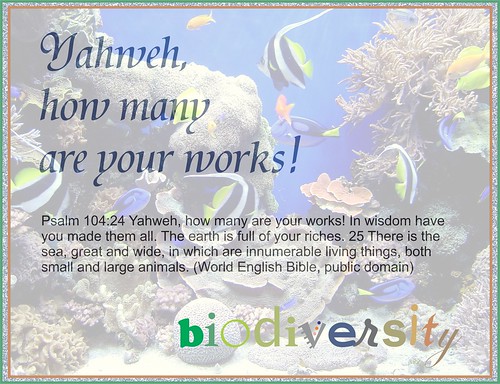
I have recently made some attempts to illustrate this, using computer graphics, and some photos, of marine animals, from Flickr members, with their permission. This picture:
Yahweh, how many are your works 1

is the first in a series of these attempts. It was first posted on Flickr, with appropriate credit given to the photographer -- the photograph was taken at the Monterey, California, aquarium. (The picture serves as a link to the Flickr post.) There are at least three phyla, represented by the fish, the sponges, and the corals, in the photo. The word, biodiversity, was produced using a different color, and a different typeface, for each letter, to represent diversity. The colors of the letters were chosen to be colors that could be found in marine organisms.

Thanks for looking!

Wednesday, June 03, 2009

Sunspots 213


Things I have recently spotted that may be of interest to someone else:


Science:
Wired reports that genetic modification has not only produced marmosets with skin that glows green in the dark, but that one such animal sired offspring with the same trait.

Wired also has a report on how scientists are looking for planets in other solar systems that might support life.

Philosophy:
(or something) Slate has an essay on whether or not fish feel pain.

Christianity:
Christianity Today has a book review of a book that considers the nature of spiritual experiences -- what is happening in our brain when we have one?


Image source (public domain)