Some scientists, and others, believe that it is possible that there is a multiverse. Trivial example: I purchase an ice cream cone. I can choose chocolate ice cream, or butter pecan. The universe lets me do both, but splits, and, in each case, goes on from there, with a chocolate universe, and a butter pecan universe. In other words, lots of universes, a multiverse. Each choice I can make causes the universe to split, again. Philip Pullman's fiction, the "His Dark Materials" works, are set in such a multi-universe.
Travis Perry, writing on the Speculative Faith blog, has considered the possibility that the choices we make create alternative universes, and
the question of whether God could have allowed such a situation. If there were such alternate universes, would, or could, there be a unique Bible for each? Or at least, for each major moral choice -- for example, a world where Adam and Eve never fell, or one where the Jewish authorities accepted the Gospel?
Perry doesn't believe in the many-worlds interpretation, but his thoughts are interesting.
Thanks for reading. Read Perry.
Musings on science, the Bible, and fantastic literature (and sometimes basketball and other stuff).
God speaks to us through the Bible and the findings of science, and we should listen to both types of revelation.
The title is from Psalm 84:11.
The Wikipedia is usually a pretty good reference. I mostly use the World English Bible (WEB), because it is public domain. I am grateful.
License
I have written an e-book, Does the Bible Really Say That?, which is free to anyone. To download that book, in several formats, go here.

The posts in this blog are licensed under a Creative Commons Attribution-NonCommercial-ShareAlike 3.0 Unported License. You can copy and use this material, as long as you aren't making money from it. If you give me credit, thanks. If not, OK.
The posts in this blog are licensed under a Creative Commons Attribution-NonCommercial-ShareAlike 3.0 Unported License. You can copy and use this material, as long as you aren't making money from it. If you give me credit, thanks. If not, OK.
Showing posts with label Choice. Show all posts
Showing posts with label Choice. Show all posts
Thursday, June 27, 2019


Sunday, January 31, 2016
Excerpts from Orthodoxy, by G. K. Chesterton, 58
All Christianity concentrates on the man at the crossroads. The vast and
shallow philosophies, the huge syntheses of humbug, all talk about ages and evolution and ultimate developments. The true philosophy is concerned
with the instant. Will a man take this road or that?—that is the only thing to think about, if you enjoy thinking. The eons are easy enough to
think about, any one can think about them. The instant is really awful: and it is because our religion has intensely felt the instant, that it has
in literature dealt much with battle and in theology dealt much with hell. It is full of danger, like a boy’s book: it is at an immortal crisis.
There is a great deal of real similarity between popular fiction and the religion of the western people. If you say that popular fiction is vulgar
and tawdry, you only say what the dreary and well-informed say also about the images in the Catholic churches. Life (according to the faith) is very
like a serial story in a magazine: life ends with the promise (or menace) “to be continued in our next.” Also, with a noble vulgarity, life imitates
the serial and leaves off at the exciting moment. For death is distinctly an exciting moment.
But the point is that a story is exciting because it has in it so strong an element of will, of what theology calls free will. You cannot finish a sum how you like. But you can finish a story how you like. When somebody discovered the Differential Calculus there was only one Differential Calculus he could discover. But when Shakespeare killed Romeo he might have married him to Juliet’s old nurse if he had felt inclined. And Christendom has excelled in the narrative romance exactly because it has insisted on the theological free will. It is a large matter and too much to one side of the road to be discussed adequately here; but this is the real objection to that torrent of modern talk about treating crime as disease, about making a prison merely a hygienic environment like a hospital, of healing sin by slow scientific methods. The fallacy of the whole thing is that evil is a matter of active choice whereas disease is not. If you say that you are going to cure a profligate as you cure an asthmatic, my cheap and obvious answer is, “Produce the people who want to be asthmatics as many people want to be profligates.” A man may lie still and be cured of a malady. But he must not lie still if he wants to be cured of a sin; on the contrary, he must get up and jump about violently. The whole point indeed is perfectly expressed in the very word which we use for a man in hospital; “patient” is in the passive mood; “sinner” is in the active. If a man is to be saved from influenza, he may be a patient. But if he is to be saved from forging, he must be not a patient but an impatient. He must be personally impatient with forgery. All moral reform must start in the active not the passive will.
Orthodoxy, first published in 1908, by G. K. Chesterton, is in the public domain, and available from Project Gutenberg. The previous post in this series is here. Thanks for reading! Read Chesterton.
But the point is that a story is exciting because it has in it so strong an element of will, of what theology calls free will. You cannot finish a sum how you like. But you can finish a story how you like. When somebody discovered the Differential Calculus there was only one Differential Calculus he could discover. But when Shakespeare killed Romeo he might have married him to Juliet’s old nurse if he had felt inclined. And Christendom has excelled in the narrative romance exactly because it has insisted on the theological free will. It is a large matter and too much to one side of the road to be discussed adequately here; but this is the real objection to that torrent of modern talk about treating crime as disease, about making a prison merely a hygienic environment like a hospital, of healing sin by slow scientific methods. The fallacy of the whole thing is that evil is a matter of active choice whereas disease is not. If you say that you are going to cure a profligate as you cure an asthmatic, my cheap and obvious answer is, “Produce the people who want to be asthmatics as many people want to be profligates.” A man may lie still and be cured of a malady. But he must not lie still if he wants to be cured of a sin; on the contrary, he must get up and jump about violently. The whole point indeed is perfectly expressed in the very word which we use for a man in hospital; “patient” is in the passive mood; “sinner” is in the active. If a man is to be saved from influenza, he may be a patient. But if he is to be saved from forging, he must be not a patient but an impatient. He must be personally impatient with forgery. All moral reform must start in the active not the passive will.
Orthodoxy, first published in 1908, by G. K. Chesterton, is in the public domain, and available from Project Gutenberg. The previous post in this series is here. Thanks for reading! Read Chesterton.
Sunday, January 24, 2016
Excerpts from Orthodoxy by G. K. Chesterton, 57
Again, the same is true of that difficult matter of the danger of the
soul, which has unsettled so many just minds. To hope for all souls is imperative; and it is quite tenable that their salvation is inevitable. It
is tenable, but it is not specially favourable to activity or progress. Our fighting and creative society ought rather to insist on the danger of
everybody, on the fact that every man is hanging by a thread or clinging to a precipice. To say that all will be well anyhow is a comprehensible
remark: but it cannot be called the blast of a trumpet. Europe ought rather to emphasize possible perdition; and Europe always has emphasized
it. Here its highest religion is at one with all its cheapest romances. To the Buddhist or the eastern fatalist existence is a science or a plan,
which must end up in a certain way. But to a Christian existence is a story, which may end up in any way. In a thrilling novel (that purely
Christian product) the hero is not eaten by cannibals; but it is essential to the existence of the thrill that he might be eaten by cannibals. The
hero must (so to speak) be an eatable hero. So in Christian morals, in short, it is wicked to call a man “damned”: but it is strictly religious
and philosophic to call him damnable.
Orthodoxy, first published in 1908, by G. K. Chesterton, is in the public domain, and available from Project Gutenberg. The previous post in this series is here. Thanks for reading! Read Chesterton.
Orthodoxy, first published in 1908, by G. K. Chesterton, is in the public domain, and available from Project Gutenberg. The previous post in this series is here. Thanks for reading! Read Chesterton.
Monday, April 14, 2014
Some blog posts on chance versus God's omnipotence
Are there things that an omnipotent God leaves to chance? Or is every change in every particle in the universe ordered and directed by God? Clearly, the answer has to be that we do not know, but it's an interesting question. Here are some blog posts by other people on this subject:
Henry Neufeld believes that perhaps God used pure chance to get to where the universe is now, and he includes humans, and their intelligence. He isn't even sure that God directed things at the sub-atomic level. Interesting. I'll have to think about that one.
Here's one from a Christian involved in forecasting the weather, who says that it makes sense to pray for particular kinds of weather (and other things) in spite of God's omnipotence. Weather, of course, is notoriously unpredictable.
Thanks for reading. For more on what I think about these matters, click on the "randomness" or "chance" in the tags at the end of this post. Let's put it this way -- I haven't solved the problem.
Henry Neufeld believes that perhaps God used pure chance to get to where the universe is now, and he includes humans, and their intelligence. He isn't even sure that God directed things at the sub-atomic level. Interesting. I'll have to think about that one.
Here's one from a Christian involved in forecasting the weather, who says that it makes sense to pray for particular kinds of weather (and other things) in spite of God's omnipotence. Weather, of course, is notoriously unpredictable.
Thanks for reading. For more on what I think about these matters, click on the "randomness" or "chance" in the tags at the end of this post. Let's put it this way -- I haven't solved the problem.
Wednesday, February 05, 2014
Sunspots 456

Christianity: A fine article by a historian of science, on the question of whether God had any choices when He made the world, based on the thoughts of Galileo and Boyle, two of the greatest scientists of the past.
Computing: Gizmo's Freeware reports on a web page that helps you send out a newsletter, free.
If you are a Facebook member, Facebook automatically puts together a short video of your most popular posts.
Science: Nature says that the Lacks family, and the National Institutes of Health, have reached an agreement over the question of publishing the DNA sequence of HeLa cells, the most important human cell culture. These cells were taken, without the consent or knowledge of Henrietta Lacks, decades ago. Oprah Winfrey's film company is making a file of the story of Mrs. Lacks, and her cells.
National Public Radio reports that modern humans (many of them, anyway) are carrying genes from Neanderthals.
NPR also reports on what happens to our actual achievement when our self-esteem is artificially boosted, or lowered. Perhaps not what you'd expect.
Image source (public domain)
Monday, July 22, 2013
How much does the Bible say we should spend on sunglasses?
There seem to be some things that the Bible makes clear -- we should do them, or we shouldn't. Examples: love your enemies; don't commit adultery. But there are all sorts of areas where we have to make decisions on our own. There's no scriptural guidance.
One example: how should we dress? I happen to belong to a denomination (it's not the only one like this) that has a history with some legalism in it. People believed that they should wear certain types of clothing, usually no jewelry, and their hair should be prepared in a certain way, especially when they came to church. We're pretty much over that now, thank God. But why was it so appealing to some, in the past?
I don't know all the answers. One possible answer is that the Bible does say that we should dress modestly. But modesty is mostly a state of mind. It's possible to appear in public without being mostly covered, but with a modest attitude -- that is, without wanting to draw attention to yourself, or how you are dressed, made up, hair fixed, and otherwise ornamented. It's possible to cover yourself up rather thoroughly, but have a desire to show off your body, or your clothes, or your new watch, in a proud manner.
Another reason is that we like to conform. Even people who call themselves nonconformists like to conform.
But there's a third reason. Having a set of standards that can be followed, by anyone, regardless of the state of their relationship to Christ, is tempting. It tempts people to follow those standards, and not engage in the deeper walk that comes to us as the Holy Spirit draws us deeper and deeper into the attitude of conformity to Christ. And it tempts people to even think that there is no such conformity with Christ's attitude, but just a set of external standards. I'm not saying that those who did, or do, dress a certain way, and leave off some ornamentation, as part of their religious culture, cannot be also conformed to the mind of Christ. Some of them were, and some of them are. But it's too easy to think that conformity to a human standard is all that is expected of us, when it isn't.
What does all this have to do with the title of this post? Good question. Here's my answer. God leaves us to make decisions on all sorts of things, without explicit scriptural guidance? Why is that? Well, one reason has to do with the culture of Bible times. If Paul had spelled out what kind of sunglasses to wear, if any, and how much to pay for them, his contemporaries would probably have thought him crazy, and he wouldn't have understood what he was writing about, himself. But there's another, more important reason, spelled out above. If there was a 21st Century rule book on dress, and spending money, and how we can and can't entertain ourselves and eat, and it was comprehensive, we would think that we could redeem ourselves by our adherence to that rule book. But we couldn't. We can only redeem ourselves by accepting Christ's sacrifice for sin, and following Him as our Lord. Uncertainty on what to do in these matters should drive me to keeping a warm and living relationship with God, who can help me make such decisions.
Deciding how to spend money, what to wear, what to eat, and the like, should be informed by our relationship with Christ. We should pray, and try to think what He would do. And we should realize that we may get such matters wrong, or disagree with fellow believers about these things. (And we need to be tolerant of the behavior of other Christians.) Being wrong, or being different, should remind us that we aren't redeemed by following rules. We are redeemed by Christ's sacrifice!
Although I have spoken only of individual decisions on behavior, group decisions also should be made in this way. We should pray, and seek the mind of Christ, and Biblical guidance, if there is any, on important issues as groups of believers. And, when we do, we should recognize that different groups may come to different conclusions about ritual, doctrine, how a church building looks, church government, and many other things, without either one being sinful in their belief and practice.
Thanks for reading!
One example: how should we dress? I happen to belong to a denomination (it's not the only one like this) that has a history with some legalism in it. People believed that they should wear certain types of clothing, usually no jewelry, and their hair should be prepared in a certain way, especially when they came to church. We're pretty much over that now, thank God. But why was it so appealing to some, in the past?
I don't know all the answers. One possible answer is that the Bible does say that we should dress modestly. But modesty is mostly a state of mind. It's possible to appear in public without being mostly covered, but with a modest attitude -- that is, without wanting to draw attention to yourself, or how you are dressed, made up, hair fixed, and otherwise ornamented. It's possible to cover yourself up rather thoroughly, but have a desire to show off your body, or your clothes, or your new watch, in a proud manner.
Another reason is that we like to conform. Even people who call themselves nonconformists like to conform.
But there's a third reason. Having a set of standards that can be followed, by anyone, regardless of the state of their relationship to Christ, is tempting. It tempts people to follow those standards, and not engage in the deeper walk that comes to us as the Holy Spirit draws us deeper and deeper into the attitude of conformity to Christ. And it tempts people to even think that there is no such conformity with Christ's attitude, but just a set of external standards. I'm not saying that those who did, or do, dress a certain way, and leave off some ornamentation, as part of their religious culture, cannot be also conformed to the mind of Christ. Some of them were, and some of them are. But it's too easy to think that conformity to a human standard is all that is expected of us, when it isn't.
What does all this have to do with the title of this post? Good question. Here's my answer. God leaves us to make decisions on all sorts of things, without explicit scriptural guidance? Why is that? Well, one reason has to do with the culture of Bible times. If Paul had spelled out what kind of sunglasses to wear, if any, and how much to pay for them, his contemporaries would probably have thought him crazy, and he wouldn't have understood what he was writing about, himself. But there's another, more important reason, spelled out above. If there was a 21st Century rule book on dress, and spending money, and how we can and can't entertain ourselves and eat, and it was comprehensive, we would think that we could redeem ourselves by our adherence to that rule book. But we couldn't. We can only redeem ourselves by accepting Christ's sacrifice for sin, and following Him as our Lord. Uncertainty on what to do in these matters should drive me to keeping a warm and living relationship with God, who can help me make such decisions.
Deciding how to spend money, what to wear, what to eat, and the like, should be informed by our relationship with Christ. We should pray, and try to think what He would do. And we should realize that we may get such matters wrong, or disagree with fellow believers about these things. (And we need to be tolerant of the behavior of other Christians.) Being wrong, or being different, should remind us that we aren't redeemed by following rules. We are redeemed by Christ's sacrifice!
Although I have spoken only of individual decisions on behavior, group decisions also should be made in this way. We should pray, and seek the mind of Christ, and Biblical guidance, if there is any, on important issues as groups of believers. And, when we do, we should recognize that different groups may come to different conclusions about ritual, doctrine, how a church building looks, church government, and many other things, without either one being sinful in their belief and practice.
Thanks for reading!
Monday, March 18, 2013
How to be saved
I believe in a God who wants
everyone to become a Christian.
The Bible uses the word “saved” for this, sometimes. There are other words, too, such as redeemed and believer. What word is used doesn’t matter. Being sorry for what we’ve done wrong, asking forgiveness, and believing that Christ’s death paid the price for our misdeeds does matter.
Romans 3:23 for all have sinned, and fall short of the glory of God; 24 being justified freely by his grace through the redemption that is in Christ Jesus; 25a whom God sent to be an atoning sacrifice, through faith in his blood
That passage says a lot:
1) I am a sinner by nature.
2) I cannot fix this problem.
3) The problem can be fixed, through receiving, by faith, Christ’s sacrifice. Receiving includes being sorry for the bad things I have done, admitting that I am a sinner, and need help. Part of what I should have faith in is Christ’s resurrection, which proved that His sacrifice for sin was acceptable.
There is nothing I can do to earn salvation. It is provided freely, but I must desire it, and believe that Christ’s sacrifice pays the penalty for my sin (which penalty is eternal death, according to Romans 6:23)
Salvation doesn’t come because I have cleaned up my life. I don’t need to clean up my life to be saved. We can’t clean it up as it really should be, without supernatural help, which mostly comes after salvation. I don’t need to join a church, although doing so is usually a good idea. Joining a church, of itself, will not take care of the problem of sin, unless it’s accompanied by belief in the effectiveness of Christ’s sacrifice. No human action will fix my sin problem. I need to believe in Christ’s payment, already made, for my sin.
Salvation may or may not be accompanied by feelings. But we must not demand or expect that we feel some special way -- some people don’t. And we must not rely on feelings. We can fool ourselves into believing all sorts of things about our feelings. Feelings are temporary. I love my wife, and often I feel that strongly. But sometimes I don’t feel it so strongly. I must still act as if I love her, and believe that I do, regardless of the feeling of the moment. The same is true of salvation.
There are some things that God will help me to do, once I have been saved. These include:
1) Confession of my belief to others. Joining a church, and being baptized, are important forms of confession, but, they won’t save us. In most cases, we also need to tell other people about our choice.
Romans 10:9 that if you will confess with your mouth that Jesus is Lord, and believe in your heart that God raised him from the dead, you will be saved. 10 For with the heart, one believes unto righteousness; and with the mouth confession is made unto salvation.
2) Taking Jesus as Lord. This is referred to in the quotation immediately above. It means following Christ’s teachings, as we understand them, and trying to understand them better, by studying the Bible, and being around experienced, victorious Christians. It means not doing what I want, when I know that it would conflict with what Christ wants.
3) Being baptized. Jesus instructed his disciples, in his last words to them, as recorded in Matthew, to baptize new believers, in the name of the Father, the Son, and the Holy Spirit. There are a number of occasions in Acts where new Christians were baptized soon after receiving Christ as savior, and we need to continue with that pattern.
4) Associate with other believers. (Hebrews 10:25) In most cases, this means joining a church, attending that church’s services, and otherwise participating in the life of the church. Unfortunately, there are some organizations that call themselves churches that do not follow the teachings of Christ, in important ways. For example, they may not speak of the need to be sorry for sin, or of the necessity of following Jesus as Lord. If in doubt, ask God to guide you to a church that honors Him. This is not an excuse for church-shopping. All churches, being made up of humans, have some problems. So it is pointless to look for a perfect church. Look for one that honors Christ and His teachings, and helps you to learn more about His teachings, by what the church teaches, and what it shows in actions.
5) As opportunity allows, try to gently and lovingly persuade other people of their need for salvation.
6) Remind yourself of what you believe, and learn more of what Christians believe, on a regular basis, by personal prayer, Bible reading and study, as well as church participation. (Here’s a post on “What Christians Believe.”) Personal prayer, devotional reading, and study should take place at least daily, in most cases. You should find other books, beside the Bible, to be helpful, but don’t leave the Bible out.
New Christians should use a Bible version which has language easy to understand.
What happens if we fail, knowing that we have not done what Christ wants us to do? We ask forgiveness, and help in doing better, or not doing badly, and go on in our Christian life.

To summarize: Ask Christ to forgive your sins, and make you a new person, with a relationship with God. Believe that He can do this, as evidenced by what the Bible says about Him, and by changes you may have seen in the lives of others. Confess this belief, and your intention, with God’s help, to lead a new life.
Become Discipled -- start, and continue, good habits of prayer, Bible reading, learning how Christians are supposed to act, and telling others of your experience.
Thanks for reading. Much more could, and has, been said on this topic, by others. This is a re-do of a previous post.
For more information, see this post on the evidence that one is a Christian.
The Bible uses the word “saved” for this, sometimes. There are other words, too, such as redeemed and believer. What word is used doesn’t matter. Being sorry for what we’ve done wrong, asking forgiveness, and believing that Christ’s death paid the price for our misdeeds does matter.
Romans 3:23 for all have sinned, and fall short of the glory of God; 24 being justified freely by his grace through the redemption that is in Christ Jesus; 25a whom God sent to be an atoning sacrifice, through faith in his blood
That passage says a lot:
1) I am a sinner by nature.
2) I cannot fix this problem.
3) The problem can be fixed, through receiving, by faith, Christ’s sacrifice. Receiving includes being sorry for the bad things I have done, admitting that I am a sinner, and need help. Part of what I should have faith in is Christ’s resurrection, which proved that His sacrifice for sin was acceptable.
There is nothing I can do to earn salvation. It is provided freely, but I must desire it, and believe that Christ’s sacrifice pays the penalty for my sin (which penalty is eternal death, according to Romans 6:23)
Salvation doesn’t come because I have cleaned up my life. I don’t need to clean up my life to be saved. We can’t clean it up as it really should be, without supernatural help, which mostly comes after salvation. I don’t need to join a church, although doing so is usually a good idea. Joining a church, of itself, will not take care of the problem of sin, unless it’s accompanied by belief in the effectiveness of Christ’s sacrifice. No human action will fix my sin problem. I need to believe in Christ’s payment, already made, for my sin.
Salvation may or may not be accompanied by feelings. But we must not demand or expect that we feel some special way -- some people don’t. And we must not rely on feelings. We can fool ourselves into believing all sorts of things about our feelings. Feelings are temporary. I love my wife, and often I feel that strongly. But sometimes I don’t feel it so strongly. I must still act as if I love her, and believe that I do, regardless of the feeling of the moment. The same is true of salvation.
There are some things that God will help me to do, once I have been saved. These include:
1) Confession of my belief to others. Joining a church, and being baptized, are important forms of confession, but, they won’t save us. In most cases, we also need to tell other people about our choice.
Romans 10:9 that if you will confess with your mouth that Jesus is Lord, and believe in your heart that God raised him from the dead, you will be saved. 10 For with the heart, one believes unto righteousness; and with the mouth confession is made unto salvation.
2) Taking Jesus as Lord. This is referred to in the quotation immediately above. It means following Christ’s teachings, as we understand them, and trying to understand them better, by studying the Bible, and being around experienced, victorious Christians. It means not doing what I want, when I know that it would conflict with what Christ wants.
3) Being baptized. Jesus instructed his disciples, in his last words to them, as recorded in Matthew, to baptize new believers, in the name of the Father, the Son, and the Holy Spirit. There are a number of occasions in Acts where new Christians were baptized soon after receiving Christ as savior, and we need to continue with that pattern.
4) Associate with other believers. (Hebrews 10:25) In most cases, this means joining a church, attending that church’s services, and otherwise participating in the life of the church. Unfortunately, there are some organizations that call themselves churches that do not follow the teachings of Christ, in important ways. For example, they may not speak of the need to be sorry for sin, or of the necessity of following Jesus as Lord. If in doubt, ask God to guide you to a church that honors Him. This is not an excuse for church-shopping. All churches, being made up of humans, have some problems. So it is pointless to look for a perfect church. Look for one that honors Christ and His teachings, and helps you to learn more about His teachings, by what the church teaches, and what it shows in actions.
5) As opportunity allows, try to gently and lovingly persuade other people of their need for salvation.
6) Remind yourself of what you believe, and learn more of what Christians believe, on a regular basis, by personal prayer, Bible reading and study, as well as church participation. (Here’s a post on “What Christians Believe.”) Personal prayer, devotional reading, and study should take place at least daily, in most cases. You should find other books, beside the Bible, to be helpful, but don’t leave the Bible out.
New Christians should use a Bible version which has language easy to understand.
What happens if we fail, knowing that we have not done what Christ wants us to do? We ask forgiveness, and help in doing better, or not doing badly, and go on in our Christian life.
To summarize: Ask Christ to forgive your sins, and make you a new person, with a relationship with God. Believe that He can do this, as evidenced by what the Bible says about Him, and by changes you may have seen in the lives of others. Confess this belief, and your intention, with God’s help, to lead a new life.
Become Discipled -- start, and continue, good habits of prayer, Bible reading, learning how Christians are supposed to act, and telling others of your experience.
Thanks for reading. Much more could, and has, been said on this topic, by others. This is a re-do of a previous post.
For more information, see this post on the evidence that one is a Christian.
Thursday, November 29, 2012
Predestination, foreknowledge and choice
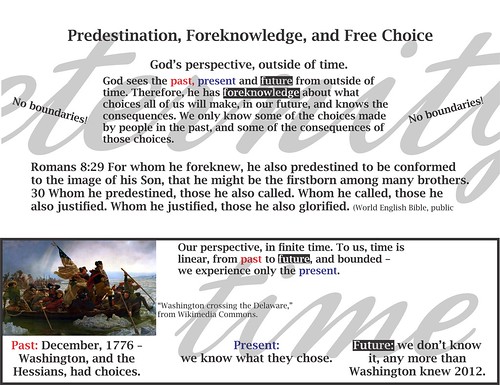
The above graphic is an attempt to illustrate a controversial and complex subject, predestination, foreknowledge, and free choice. (The word, eternity, isn't completely shown in the illustration, on purpose, to symbolize the boundlessness of eternity.) The graphic should serve as a link to the original graphic on Flickr. Flickr members, at least, and perhaps others -- I'm not sure -- can see larger sizes of the graphic, by clicking on the magnifying glass icon above the graphic on its Flickr page. There is no password required to view Flickr pictures.
I believe that the Bible teaches that people have the ability to choose, at least in some areas. Here's some of the evidence.
The Bible also teaches predestination, for example in the verses quoted above, which are from Romans 8:
28 For whom he foreknew, he also predestined to be conformed to the image of his Son, that he might be the firstborn among many brothers. 29 Whom he predestined, those he also called. Whom he called, those he also justified. Whom he justified, those he also glorified. (World English Bible, public domain)
As I understand things, God is outside of time. Consider this: I think that Jane Smith is going to enter a situation that I wish to pray about, at two in the afternoon, and pray for this at that time. However, without my knowledge, the situation actually occurred three hours earlier. God could have taken my praying into account when influencing the situation, even though I hadn't prayed yet when it happened, because God knew that I would, and, in fact, God had experience my prayer when the event happened. God's knowledge, or foreknowledge, doesn't mean that I didn't have a choice about whether to pray. I did. But God knew that I would.
The graphic incorporates an image of General George Washington crossing the Delaware. I modified it by rotating it horizontally.

Thanks for looking! Make right choices.
Friday, November 16, 2012
Bible passages indicating that humans can choose salvation (or not)
I am aware that there are those, and they may be right, who believe that we can't really choose whether ot not to accept Christ's resurrected sacrifice for our sins, and His lordship. However, there are some Bible passages that indicated that we do have a choice in the matter. I will give them below, without presenting the Biblical evidence to the contrary -- and there is such evidence. See the Wikipedia article on predestination.
All quotations are from the World English Bible, which is public domain.
Some of these passages don't seem to say anything directly about free choice, but I have also included passages that indicate that salvation is for all people.
John 3:16 For God so loved the world, that he gave his one and only Son, that whoever believes in him should not perish, but have eternal life.
Acts 2:21 It will be that whoever will call on the name of the Lord will be saved.
Romans 5:17 For if by the trespass of the one, death reigned through the one; so much more will those who receive the abundance of grace and of the gift of righteousness reign in life through the one, Jesus Christ. 18 So then as through one trespass, all men were condemned; even so through one act of righteousness, all men were justified to life.
Romans 10:13 For, “Whoever will call on the name of the Lord will be saved.” (This quotes Leviticus 18:5, as does Acts 2:21.)
1 Timothy 2:5 For there is one God, and one mediator between God and men, the man Christ Jesus, 6 who gave himself as a ransom for all; the testimony in its own times;
1 Timothy 4:10 For to this end we both labor and suffer reproach, because we have set our trust in the living God, who is the Savior of all men, especially of those who believe.
1 John 2:2 And he is the atoning sacrifice for our sins, and not for ours only, but also for the whole world.
Revelation 3:20 Behold, I stand at the door and knock. If anyone hears my voice and opens the door, then I will come in to him, and will dine with him, and he with me.
Revelation 22:17 The Spirit and the bride say, “Come!” He who hears, let him say, “Come!” He who is thirsty, let him come. He who desires, let him take the water of life freely.
Thanks for reading!
* * * * *
Added November 29, 2012: I have now posted a graphic attempt to explain predestination, foreknowledge and choice, with some explanation.
All quotations are from the World English Bible, which is public domain.
Some of these passages don't seem to say anything directly about free choice, but I have also included passages that indicate that salvation is for all people.
John 3:16 For God so loved the world, that he gave his one and only Son, that whoever believes in him should not perish, but have eternal life.
Acts 2:21 It will be that whoever will call on the name of the Lord will be saved.
Romans 5:17 For if by the trespass of the one, death reigned through the one; so much more will those who receive the abundance of grace and of the gift of righteousness reign in life through the one, Jesus Christ. 18 So then as through one trespass, all men were condemned; even so through one act of righteousness, all men were justified to life.
Romans 10:13 For, “Whoever will call on the name of the Lord will be saved.” (This quotes Leviticus 18:5, as does Acts 2:21.)
1 Timothy 2:5 For there is one God, and one mediator between God and men, the man Christ Jesus, 6 who gave himself as a ransom for all; the testimony in its own times;
1 Timothy 4:10 For to this end we both labor and suffer reproach, because we have set our trust in the living God, who is the Savior of all men, especially of those who believe.
1 John 2:2 And he is the atoning sacrifice for our sins, and not for ours only, but also for the whole world.
Revelation 3:20 Behold, I stand at the door and knock. If anyone hears my voice and opens the door, then I will come in to him, and will dine with him, and he with me.
Revelation 22:17 The Spirit and the bride say, “Come!” He who hears, let him say, “Come!” He who is thirsty, let him come. He who desires, let him take the water of life freely.
Thanks for reading!
* * * * *
Added November 29, 2012: I have now posted a graphic attempt to explain predestination, foreknowledge and choice, with some explanation.
Tuesday, October 30, 2012
Isn't God a great artist?
I don't think it's original with me, but I sometimes place, in the description of a photo I post, such as those on Flickr, the question, "Isn't God a great artist?" (This is, I believe, the latest of these.)
God as artist
What do I mean by that? What should I mean? I wish to muse about these questions. First, some scripture:
Genesis 2:19 Out of the ground Yahweh God formed every animal of the field, and every bird of the sky, and brought them to the man to see what he would call them. Whatever the man called every living creature became its name. 20 The man gave names to all livestock, and to the birds of the sky, and to every animal of the field; but for man there was not found a helper comparable to him. 21 Yahweh God caused the man to fall into a deep sleep. As the man slept, he took one of his ribs, and closed up the flesh in its place. 22 Yahweh God made a woman from the rib which had taken from the man, and brought her to the man. 23 The man said, “This is now bone of my bones, and flesh of my flesh. She will be called ‘woman,’ because she was taken out of Man.” (all Bible quotations from World English Bible, public domain)
Isaiah 64:8 But now, Yahweh, you are our Father.
God as artist
What do I mean by that? What should I mean? I wish to muse about these questions. First, some scripture:
Genesis 2:19 Out of the ground Yahweh God formed every animal of the field, and every bird of the sky, and brought them to the man to see what he would call them. Whatever the man called every living creature became its name. 20 The man gave names to all livestock, and to the birds of the sky, and to every animal of the field; but for man there was not found a helper comparable to him. 21 Yahweh God caused the man to fall into a deep sleep. As the man slept, he took one of his ribs, and closed up the flesh in its place. 22 Yahweh God made a woman from the rib which had taken from the man, and brought her to the man. 23 The man said, “This is now bone of my bones, and flesh of my flesh. She will be called ‘woman,’ because she was taken out of Man.” (all Bible quotations from World English Bible, public domain)
Isaiah 64:8 But now, Yahweh, you are our Father.
We are the clay, and you our potter.
We all are the work of your hand.
Leaving aside questions about how literally we are supposed to take these passages, the language indicates clearly that God can be described as an Artist, a Craftsman who takes existing ordinary material and does something wonderful with it.
Is God an artist? Of course. Orthodox Christian belief includes this:
We believe in one God, the Father, the Almighty maker of heaven and earth,of all that is, seen and unseen. (Taken from a version of the Nicene Creed, 1975)
If God is Almighty, He clearly can be an Artist. If He is "maker of heaven and earth," then that required Him to be an artist, in the sense that He took, not "existing ordinary material," but nothing, and made a lot of something, wonderful something, from it. See the graphic at the top of this page for more about this question. Not only did God make things, but He sustains the universe -- see Colossians 1:16-17, and Hebrews 1:3 for part of the evidence for that.
Christians also usually believe that God is Omnipotent and Omniscient. Such a powerful Creator should, then, be able to design every leaf on every tree on earth, and every water ripple and dewdrop on earth, and every human face, individually, and to the finest detail. I suppose that human faces are altered by human activity, such as disease, emotions, bad nutrition, exposure to the sun, accidents, and, of course, makeup. But I believe that God could have designed each face, exercising complete control over its appearance. I'm not sure that God did, for reasons I hope to explain below. There are those who believe that not only could God have designed each face, but that He did, and that He is also in control of how each face changes as it matures and is exposed to the environment, including emotions and human activity.
Free will and randomness
We come, thus, to the question of free will, at least for humans. I'm not suggesting that leaves, water ripples and dewdrops have a will at all, free or not. But humans do, and I'm certainly not alone in believing so. If they do, part of what a human face looks like is because of choices that human has made, or that others have made affecting that person.
How about leaves and ripples? Although God created the universe, and sustains it now, it is possible that God's artistry is not so much expressed in His work in each leaf, ripple, or face, but in the creation of the laws that determine how things develop. For example, God could have created the universe in such a way that the Big Bang produced the elements with small nuclei, and in such a way that supernovae produce the elements with heavier nuclei. He could also have created the universe in such a way that Carbon atoms bind rather easily with Hydrogen, Oxygen, Nitrogen, Sulfur and Phosphorus so as to assemble the complex organic molecules that make life possible. Creation of a universe with laws and properties resulting in the way things are now would have been as great, or even greater, artistry than assembling each leaf, atom by atom.
God could also have built some randomness (or maybe a lot of it) into the universe. I have posted previously on this idea, asking "Is there such a thing as chance?" and on "God and Chance," here and yet again, and also on the idea of randomness at the subatomic level. Henry Neufeld, theologian, has also written about this subject. C. S. Lewis, on the other hand, had one of his best characters, Puddleglum, in The Silver Chair, say that "there are no accidents."
The fact is that we have no way of determining whether God controls all events in the universe, or whether he lets some of them be determined by the properties He has built in to the universe, or by those properties, plus chance. So God could have specially designed each and every leaf, and its changing fall colors, or God could have built laws and principles and properties into the universe which lead to the changing fall colors of each leaf, or God could also let random events, at the subatomic level, or higher, determine the appearance of such a leaf, over time. But, in all of these cases, God either controls or allows. If random processes produce a beautiful leaf, God be praised! If intricate control does, God be praised! God is a great artist.
An illustration of what Puddleglum said: While thinking about this subject, and preparing to write about it, I came upon a discussion of the artistry of Linnéa Spransy, who, she says, attempts to express "the tension between freedom and constraint" in her paintings. Spransy is a Christian. The post says this:
Like many working scientists, she is seeking a way of understanding how the creator engages with His creation, and a better grasp on how we creatures should make our way in response. On one hand, her attentiveness to the basic orderliness of the material creation has a corollary in the familiar disciplines of faith, including reading the scriptures, prayer, and responding with mercy to ruptures in human lives and communities. But on the other hand, her embrace of surprise and chaos is, as she says, an “invitation to the otherness of God,”. . .
You may wish to see my recent post on the use of the words, beauty and beautiful, in the Bible.
Thanks for reading, whether by chance or design.
Leaving aside questions about how literally we are supposed to take these passages, the language indicates clearly that God can be described as an Artist, a Craftsman who takes existing ordinary material and does something wonderful with it.
Is God an artist? Of course. Orthodox Christian belief includes this:
We believe in one God, the Father, the Almighty maker of heaven and earth,of all that is, seen and unseen. (Taken from a version of the Nicene Creed, 1975)
If God is Almighty, He clearly can be an Artist. If He is "maker of heaven and earth," then that required Him to be an artist, in the sense that He took, not "existing ordinary material," but nothing, and made a lot of something, wonderful something, from it. See the graphic at the top of this page for more about this question. Not only did God make things, but He sustains the universe -- see Colossians 1:16-17, and Hebrews 1:3 for part of the evidence for that.
Christians also usually believe that God is Omnipotent and Omniscient. Such a powerful Creator should, then, be able to design every leaf on every tree on earth, and every water ripple and dewdrop on earth, and every human face, individually, and to the finest detail. I suppose that human faces are altered by human activity, such as disease, emotions, bad nutrition, exposure to the sun, accidents, and, of course, makeup. But I believe that God could have designed each face, exercising complete control over its appearance. I'm not sure that God did, for reasons I hope to explain below. There are those who believe that not only could God have designed each face, but that He did, and that He is also in control of how each face changes as it matures and is exposed to the environment, including emotions and human activity.
Free will and randomness
We come, thus, to the question of free will, at least for humans. I'm not suggesting that leaves, water ripples and dewdrops have a will at all, free or not. But humans do, and I'm certainly not alone in believing so. If they do, part of what a human face looks like is because of choices that human has made, or that others have made affecting that person.
How about leaves and ripples? Although God created the universe, and sustains it now, it is possible that God's artistry is not so much expressed in His work in each leaf, ripple, or face, but in the creation of the laws that determine how things develop. For example, God could have created the universe in such a way that the Big Bang produced the elements with small nuclei, and in such a way that supernovae produce the elements with heavier nuclei. He could also have created the universe in such a way that Carbon atoms bind rather easily with Hydrogen, Oxygen, Nitrogen, Sulfur and Phosphorus so as to assemble the complex organic molecules that make life possible. Creation of a universe with laws and properties resulting in the way things are now would have been as great, or even greater, artistry than assembling each leaf, atom by atom.
God could also have built some randomness (or maybe a lot of it) into the universe. I have posted previously on this idea, asking "Is there such a thing as chance?" and on "God and Chance," here and yet again, and also on the idea of randomness at the subatomic level. Henry Neufeld, theologian, has also written about this subject. C. S. Lewis, on the other hand, had one of his best characters, Puddleglum, in The Silver Chair, say that "there are no accidents."
The fact is that we have no way of determining whether God controls all events in the universe, or whether he lets some of them be determined by the properties He has built in to the universe, or by those properties, plus chance. So God could have specially designed each and every leaf, and its changing fall colors, or God could have built laws and principles and properties into the universe which lead to the changing fall colors of each leaf, or God could also let random events, at the subatomic level, or higher, determine the appearance of such a leaf, over time. But, in all of these cases, God either controls or allows. If random processes produce a beautiful leaf, God be praised! If intricate control does, God be praised! God is a great artist.
An illustration of what Puddleglum said: While thinking about this subject, and preparing to write about it, I came upon a discussion of the artistry of Linnéa Spransy, who, she says, attempts to express "the tension between freedom and constraint" in her paintings. Spransy is a Christian. The post says this:
Like many working scientists, she is seeking a way of understanding how the creator engages with His creation, and a better grasp on how we creatures should make our way in response. On one hand, her attentiveness to the basic orderliness of the material creation has a corollary in the familiar disciplines of faith, including reading the scriptures, prayer, and responding with mercy to ruptures in human lives and communities. But on the other hand, her embrace of surprise and chaos is, as she says, an “invitation to the otherness of God,”. . .
You may wish to see my recent post on the use of the words, beauty and beautiful, in the Bible.
Thanks for reading, whether by chance or design.
Monday, October 29, 2012
Scripture that indicates that humans can choose salvation
This is a thorny topic, and one that I'm not expecting to settle. There are intelligent, Bible-believing people who disagree with the title of this post. See the Wikipedia articles on Free Will, Free will in theology, and Predestination for good treatment of this subject, including views opposed to mine. Now to what the title says, below. Some of these verses don't say anything directly about free choice, but these were chosen because they indicate that anyone may accept Christ's sacrifice for sin, thus implying that they may choose it:
John 3:16 For God so loved the world, that he gave his one and only Son, that whoever believes in him should not perish, but have eternal life. (All scripture quotations from the World English Bible, which is public domain.)
Acts 2:20 The sun will be turned into darkness,
and the moon into blood,
before the great and glorious day of the Lord comes.
21 It will be that whoever will call on the name of the Lord will be saved.’ (quoting Joel 2)
Romans 5:17 For if by the trespass of the one, death reigned through the one; so much more will those who receive the abundance of grace and of the gift of righteousness reign in life through the one, Jesus Christ. 18 So then as through one trespass, all men were condemned; even so through one act of righteousness, all men were justified to life.
Romans 10:12 For there is no distinction between Jew and Greek; for the same Lord is Lord of all, and is rich to all who call on him. 13 For, “Whoever will call on the name of the Lord will be saved.” (quoting Joel 2)
1 Corinthians 15:22 For as in Adam all die, so also in Christ all will be made alive.
1 Timothy 2:5 For there is one God, and one mediator between God and men, the man Christ Jesus, 6a who gave himself as a ransom for all;
1 Timothy 4:10 For to this end we both labor and suffer reproach, because we have set our trust in the living God, who is the Savior of all men, especially of those who believe.
1 John 2:2 And he is the atoning sacrifice for our sins, and not for ours only, but also for the whole world.
Revelation 3:20 Behold, I stand at the door and knock. If anyone hears my voice and opens the door, then I will come in to him, and will dine with him, and he with me.
Revelation 22:17 The Spirit and the bride say, “Come!” He who hears, let him say, “Come!” He who is thirsty, let him come. He who desires, let him take the water of life freely.
Thanks for reading, whether you did it by a free choice, or not!
John 3:16 For God so loved the world, that he gave his one and only Son, that whoever believes in him should not perish, but have eternal life. (All scripture quotations from the World English Bible, which is public domain.)
Acts 2:20 The sun will be turned into darkness,
and the moon into blood,
before the great and glorious day of the Lord comes.
21 It will be that whoever will call on the name of the Lord will be saved.’ (quoting Joel 2)
Romans 5:17 For if by the trespass of the one, death reigned through the one; so much more will those who receive the abundance of grace and of the gift of righteousness reign in life through the one, Jesus Christ. 18 So then as through one trespass, all men were condemned; even so through one act of righteousness, all men were justified to life.
Romans 10:12 For there is no distinction between Jew and Greek; for the same Lord is Lord of all, and is rich to all who call on him. 13 For, “Whoever will call on the name of the Lord will be saved.” (quoting Joel 2)
1 Corinthians 15:22 For as in Adam all die, so also in Christ all will be made alive.
1 Timothy 2:5 For there is one God, and one mediator between God and men, the man Christ Jesus, 6a who gave himself as a ransom for all;
1 Timothy 4:10 For to this end we both labor and suffer reproach, because we have set our trust in the living God, who is the Savior of all men, especially of those who believe.
1 John 2:2 And he is the atoning sacrifice for our sins, and not for ours only, but also for the whole world.
Revelation 3:20 Behold, I stand at the door and knock. If anyone hears my voice and opens the door, then I will come in to him, and will dine with him, and he with me.
Revelation 22:17 The Spirit and the bride say, “Come!” He who hears, let him say, “Come!” He who is thirsty, let him come. He who desires, let him take the water of life freely.
Thanks for reading, whether you did it by a free choice, or not!
Tuesday, September 11, 2012
Veiled Rose by Anne Elisabeth Stengl
I have recently read Veiled Rose by Anne Elisabeth Stengl. The book is the second in a series. Three have been published, and the fourth is due out next month. Here's my post on the first book, Heartless. There is not a Wikipedia article on Stengl, or her books, as yet. Here is the Amazon page for the author, and she has a blog, which sometimes includes material on her books.
Heartless was the author's first novel. There was no sign of her lack of experience in that book, and there is none in this one. The characters are three-dimensional, the plot is complex, and not easily predictable, there are a multitude of settings. The second book is mostly about events that took place before those in the first book, but they are told from a different viewpoint, and this unusual time sequence should not hinder readers. Either book should be enjoyable on its own.
I will try not to give away the plot in this post, but will muse on certain aspects of Veiled Rose.
First, a little about the world of Goldstone Wood. The land (perhaps a continent, perhaps an entire world) is divided into uplands, where humans live, by lowlands, where they don't. There are bridges between the uplands, not made by mortals. Stengl has also divided the lands into the Near World, which, as I understand it, contains the uplands, the Between, which contains the lowlands, and the Far World. (See here for more on this, from Stengl.) Fairies can enter the Near World, where mortals live, but they also live in the Between, and perhaps in the Far World. These three are perhaps three different dimensions, or three different universes, co-inhabiting the same space. Stengl doesn't make a huge deal of this -- her characters, and their lives, are more important -- but the idea of living in more than one world at once definitely adds to the book. Tolkien, for one, had a similar construction, as his elves and their evil adversaries lived in two worlds at the same time. But their appearance was different, depending on which world they were seen in. In Stengl, the appearance of a character seems to be the same in whichever World they are found. (Some characters, such as dragons and fairy knights, have two different forms, but they can take these without changing Worlds.)
There are Paths, made by the fairies, within the Near World, and, probably the other Worlds. Characters who can find those Paths can move rapidly between locations.
Stengl is a bit coy about these aspects of her sub-creation: "So we know of at least three realms of existence, three levels of reality. Might there be more?" Perhaps she didn't know, herself, when she wrote that, in June of 2011. Perhaps she did, but wasn't going to tell us yet.
Second, the characters. One of the main characters in the book is Lionheart, who is also known as Leo, and by other names. He is the crown prince of one of the realms in the Near World, and young enough to play in the woods, but old enough that he is allowed to play in them without supervision. The second main character is Rosie. Lionheart meets Rosie, a girl, perhaps human, perhaps not, while playing in the wood. Rosie's origin is uncertain, and she doesn't know it herself. She always wears a veil. Lionheart doesn't know why, but doesn't really care, as she becomes his best friend. But their friendship has restrictions. She doesn't come into the castle where he lives, and he can't always go into the woods to be with her. Their friendship, by the way, seems to be quite innocent. Perhaps they are somewhat in love with each other, but perhaps not. Very few people have seen Rosie, and when people do, many of them think she is some sort of monster. She can use the Paths, at least the ones in her area, and take Lionheart on them.
Third, evil beings. One type of evil beings is the dragons. The dragons are like dragons in many other books -- they can send fire out of their mouths, they can fly, they are intelligent and can speak, they can trap unwary humans who look into their eyes, or listen to them too willingly. But, like at least one of the dragons of Ursula Le Guin's Tehanu, they can exist in human form or dragon form.
There is some other sort of evil being, perhaps also a dragon, in the books. There are at least two of these, who have the power to tempt by speaking directly to the mind of mortals. The two are in some sort of competition. The theology, or whatever it should be called, of the Goldstone Wood books is complex, and much of it is not merely an imaginary replication of Christian theology, or any other kind that I am aware of. I do believe, as I indicated in the post on the previous work, that the Goldstone Wood books are written with a Christian world-view, but that the fact that it's only a world-view, not the message of the books, is a plus, as I see it.
Fourth, I will say this about the plot. Rosie and Lionheart do not get married in this book. There are other characters, one of them named Daylily, who has decided to do what her father wants her to, and get Lionheart to marry her. He doesn't do that, either. Daylily is a complex character, and a strong one, and there are things that she does that I didn't expect.
More could be said, but I'll stop. I will confess that I have already read the third book in the series. In fact, I've read all three books twice.
Thanks for reading.
Heartless was the author's first novel. There was no sign of her lack of experience in that book, and there is none in this one. The characters are three-dimensional, the plot is complex, and not easily predictable, there are a multitude of settings. The second book is mostly about events that took place before those in the first book, but they are told from a different viewpoint, and this unusual time sequence should not hinder readers. Either book should be enjoyable on its own.
I will try not to give away the plot in this post, but will muse on certain aspects of Veiled Rose.
First, a little about the world of Goldstone Wood. The land (perhaps a continent, perhaps an entire world) is divided into uplands, where humans live, by lowlands, where they don't. There are bridges between the uplands, not made by mortals. Stengl has also divided the lands into the Near World, which, as I understand it, contains the uplands, the Between, which contains the lowlands, and the Far World. (See here for more on this, from Stengl.) Fairies can enter the Near World, where mortals live, but they also live in the Between, and perhaps in the Far World. These three are perhaps three different dimensions, or three different universes, co-inhabiting the same space. Stengl doesn't make a huge deal of this -- her characters, and their lives, are more important -- but the idea of living in more than one world at once definitely adds to the book. Tolkien, for one, had a similar construction, as his elves and their evil adversaries lived in two worlds at the same time. But their appearance was different, depending on which world they were seen in. In Stengl, the appearance of a character seems to be the same in whichever World they are found. (Some characters, such as dragons and fairy knights, have two different forms, but they can take these without changing Worlds.)
There are Paths, made by the fairies, within the Near World, and, probably the other Worlds. Characters who can find those Paths can move rapidly between locations.
Stengl is a bit coy about these aspects of her sub-creation: "So we know of at least three realms of existence, three levels of reality. Might there be more?" Perhaps she didn't know, herself, when she wrote that, in June of 2011. Perhaps she did, but wasn't going to tell us yet.
Second, the characters. One of the main characters in the book is Lionheart, who is also known as Leo, and by other names. He is the crown prince of one of the realms in the Near World, and young enough to play in the woods, but old enough that he is allowed to play in them without supervision. The second main character is Rosie. Lionheart meets Rosie, a girl, perhaps human, perhaps not, while playing in the wood. Rosie's origin is uncertain, and she doesn't know it herself. She always wears a veil. Lionheart doesn't know why, but doesn't really care, as she becomes his best friend. But their friendship has restrictions. She doesn't come into the castle where he lives, and he can't always go into the woods to be with her. Their friendship, by the way, seems to be quite innocent. Perhaps they are somewhat in love with each other, but perhaps not. Very few people have seen Rosie, and when people do, many of them think she is some sort of monster. She can use the Paths, at least the ones in her area, and take Lionheart on them.
Third, evil beings. One type of evil beings is the dragons. The dragons are like dragons in many other books -- they can send fire out of their mouths, they can fly, they are intelligent and can speak, they can trap unwary humans who look into their eyes, or listen to them too willingly. But, like at least one of the dragons of Ursula Le Guin's Tehanu, they can exist in human form or dragon form.
There is some other sort of evil being, perhaps also a dragon, in the books. There are at least two of these, who have the power to tempt by speaking directly to the mind of mortals. The two are in some sort of competition. The theology, or whatever it should be called, of the Goldstone Wood books is complex, and much of it is not merely an imaginary replication of Christian theology, or any other kind that I am aware of. I do believe, as I indicated in the post on the previous work, that the Goldstone Wood books are written with a Christian world-view, but that the fact that it's only a world-view, not the message of the books, is a plus, as I see it.
Fourth, I will say this about the plot. Rosie and Lionheart do not get married in this book. There are other characters, one of them named Daylily, who has decided to do what her father wants her to, and get Lionheart to marry her. He doesn't do that, either. Daylily is a complex character, and a strong one, and there are things that she does that I didn't expect.
More could be said, but I'll stop. I will confess that I have already read the third book in the series. In fact, I've read all three books twice.
Thanks for reading.
Monday, March 26, 2012
That Hideous Strength, by C. S. Lewis
The last moments before damnation are not often so dramatic. Often the man knows with perfect clarity that some still possible action of his own will could yet save him. But he cannot make this knowledge real to himself. Some tiny habitual sensuality, some resentment too trivial to waste on a blue-bottle, the indulgence of some fatal lethargy, seems to him at that moment more important than the choice between total joy and total destruction. C. S. Lewis, That Hideous Strength: A Modern Fairy-Tale for Grown-Ups. (New York: Collier, 1962) p. 353.
That Hideous Strength is the third book in the Space Trilogy, by Lewis. As that book has its own Wikipedia article, I won't say a lot about the plot. I will say that the book can be read on its own, even though it is the third in a series, without missing much. It is set in England, in the mid-1940s.
In the first book, Out of the Silent Planet, Lewis set forth a theme that comes into play somewhat in the second, Perelandra. That theme is that there are people who believe that it is the duty and privilege of humans to take full control of this planet, and to spread humanity to as many other planets as possible. That theme is part of Hideous Strength, too. In Silent Planet, Lewis makes that notion seem ridiculous in two ways. First, there are three species of intelligent, rational beings on Mars, where the novel is set. Not only are they intelligent and rational, but they are good. Sin is not known there. Why should humans have any right to remove such organisms? (Not only are there beings roughly equal to humans, but there are also higher beings, eldils, one for each planet.) Second, Weston, an obviously evil character makes a speech, advocating spreading humanity, to non-humans. Elwin Ransom, the main character, a human, who has learned Martian speech, translates. In translation, Weston's views seem laughable. Lewis didn't preach, or not too much. Silent Planet is readable, and has been, and continues to be enjoyed, for a number of reasons, including the imaginary three species. Earth is called the Silent Planet, and is so because its eldil is evil. This, of course, refers to Satan, the "prince of the powers of the air."
Hideous Strength preaches a little more, but, again, is readable. The main evil idea that it combats is that there is no objective truth. The book shows us a college where most of the faculty believe that, but also shows us an evil organization that puts it into practice, and shows us that that college faculty has not thought that philosophy through to see what would and must come of it. The names of the two main members of the evil organization are significant: Wither and Frost. (So is Ransom's name.) The human part of the evil organization, (apparently Satan himself is the real leader, although the members don't recognize this) and many of its members, are eventually brought to a final end by Ransom and some companions, who have supernatural help from the eldila of Saturn, Jupiter, Mars, Venus and Mercury. The idea of taking over earth completely, eventually stamping out all other life, or at least bringing it under control, is also part of the evil shown. Merlin is an important character in the book.
It is interesting that the idea that humans have a right to propagate humanity to other planets, and to control the earth, cannot logically be defended as an important principle if there is no objective truth.
As indicated in the quotation at the beginning, spiritual choice, accepting or rejecting salvation through Christ (Maleldil in the Space Trilogy) is also part of the book.
Thanks for reading. Read Lewis.
That Hideous Strength is the third book in the Space Trilogy, by Lewis. As that book has its own Wikipedia article, I won't say a lot about the plot. I will say that the book can be read on its own, even though it is the third in a series, without missing much. It is set in England, in the mid-1940s.
In the first book, Out of the Silent Planet, Lewis set forth a theme that comes into play somewhat in the second, Perelandra. That theme is that there are people who believe that it is the duty and privilege of humans to take full control of this planet, and to spread humanity to as many other planets as possible. That theme is part of Hideous Strength, too. In Silent Planet, Lewis makes that notion seem ridiculous in two ways. First, there are three species of intelligent, rational beings on Mars, where the novel is set. Not only are they intelligent and rational, but they are good. Sin is not known there. Why should humans have any right to remove such organisms? (Not only are there beings roughly equal to humans, but there are also higher beings, eldils, one for each planet.) Second, Weston, an obviously evil character makes a speech, advocating spreading humanity, to non-humans. Elwin Ransom, the main character, a human, who has learned Martian speech, translates. In translation, Weston's views seem laughable. Lewis didn't preach, or not too much. Silent Planet is readable, and has been, and continues to be enjoyed, for a number of reasons, including the imaginary three species. Earth is called the Silent Planet, and is so because its eldil is evil. This, of course, refers to Satan, the "prince of the powers of the air."
Hideous Strength preaches a little more, but, again, is readable. The main evil idea that it combats is that there is no objective truth. The book shows us a college where most of the faculty believe that, but also shows us an evil organization that puts it into practice, and shows us that that college faculty has not thought that philosophy through to see what would and must come of it. The names of the two main members of the evil organization are significant: Wither and Frost. (So is Ransom's name.) The human part of the evil organization, (apparently Satan himself is the real leader, although the members don't recognize this) and many of its members, are eventually brought to a final end by Ransom and some companions, who have supernatural help from the eldila of Saturn, Jupiter, Mars, Venus and Mercury. The idea of taking over earth completely, eventually stamping out all other life, or at least bringing it under control, is also part of the evil shown. Merlin is an important character in the book.
It is interesting that the idea that humans have a right to propagate humanity to other planets, and to control the earth, cannot logically be defended as an important principle if there is no objective truth.
As indicated in the quotation at the beginning, spiritual choice, accepting or rejecting salvation through Christ (Maleldil in the Space Trilogy) is also part of the book.
Thanks for reading. Read Lewis.
Monday, October 10, 2011
Lisa Randall on science and religion
Can a scientist be religious? Only at the price of inconsistency, she argues, because scientific determinism is not compatible with belief in a deity who can willfully intervene in the world. Sympathetic though I am to her conclusion, I would point out that scientific determinism is equally incompatible with free will and moral responsibility. Jim Holt, "Will the Large Hadron Collider Explain Everything?" a review of Knocking on Heavens Door, by Lisa Randall, Harvard physicist, New York Times Book Review, October 9, 2011.
Thanks for reading.
Thanks for reading.
Thursday, April 14, 2011
The Two Towers by J. R. R. Tolkien
I have re-read The Hobbit, and the Lord of the Rings trilogy, by J. R. R. Tolkien, once again, and, this time, am blogging about the books. My post on The Hobbit is here, and that on The Fellowship of the Ring is here. There is, of course, a good Wikipedia article on the book, and also one on the Peter Jackson film based on it. I won't concern myself with the film here.
One of the most remarkable features of Towers is the resurrection (?) of Gandalf. In Fellowship, the last we see of Gandalf, he had fallen into an abyss, while in single combat with an evil being. In Towers, he appears, to the surprise and joy of Aragorn, Legolas, Gimli, Merry and Pippin. But there is serious work to be done. Gandalf explains that he destroyed the Balrog, but that he was changed in the process. He does not describe what happened to him, but does indicate that the eagle who carried him to consult with Galadriel after his restoration said that he weighed a lot less. The Encyclopedia of Arda article on The Battle of the Peak between Gandalf and the Balrog unambiguously describes what happened to Gandalf as a resurrection, without using that word.
There are many moral choices confronting the characters. The one described in the most detail is the choice of Saruman, offered by Gandalf. Saruman, of the same order as Gandalf, was sent to earth, like Gandalf, to help elves, men, and others to withstand Sauron and other evil beings. But Saruman fell, mostly because he became fascinated with Sauron and his doings. As Elrond put it: ' . . . It is perilous to study too deeply the arts of the Enemy, for good or for ill.' J. R. R. Tolkien, The Fellowship of the Ring: Being the First Part of The Lord of the Rings. Boston: Houghton Mifflin Company, 1963, p. 278. In Towers, Gandalf asks Saruman if he will renounce his attempt to mimic Sauron, and rejoin the battle against evil. Saruman refuses. Gandalf tells Merry that, although he did not have much hope that Sauron would choose to change, he had to try, and that Saruman almost chose to join Gandalf. But he did not.
Pippin also was confronted with a choice:
'I wish I had known all this before,' said Pippin. 'I had no notion of what I was doing.'
'Oh yes, you had,' said Gandalf. 'You knew you were behaving wrongly and foolishly; and you told yourself so, though you did not listen. . . .' (about ) J. R. R. Tolkien, The Two Towers: Being the Second Part of The Lord of the Rings. Boston: Houghton Mifflin Company, 1962. p. 204. Pippin took the palantír from Gandalf, while Gandalf slept. Gandalf's speech to him, quoted above, would be widely applicable now.
Frodo, Sam, and even Gollum have moral choices to make, as Frodo tries to enter Mordor so that the Ring can be destroyed, accompanied by faithful Sam, and by Gollum, who is anything but faithful. Among these choices are what to do with Gollum. Frodo does not have Gollum killed, even though Sam wishes that he would choose to do so. Gollum sees, in Frodo and Sam, something of what he might have become, but remains self-centered as he has been for centuries. Sam chooses to follow Frodo, no matter what.
There is a little evidence of providence in this book, but not as much as in Fellowship. Sam blurts out the nature of Frodo's quest to Faramir, then is immediately afraid that Faramir will take the Ring. Faramir doesn't, and tells Sam that perhaps he was supposed to impart this information.
There is a female character, Eowyn, who is of some importance, and a spider-like monster who is said to be female. But, as in the previous books, this one is male-dominated. There is an entire species, the Ents, who have been separated from the females for centuries, perhaps millenia. There is no appearance of female orcs. Toward the end of the book, two orcs discuss getting away from the "bosses" -- Sauron, Saruman and others, with a few trusty lads, to start up somewhere on their own. In this Wikipedia article on orcs, there is a statement that female orcs do not appear in any of Tolkien's writings, except in a letter, wherein he indicated that he realized that there must have been females.
The only occasion of worship in all three of the books is this:
Thanks for reading!
One of the most remarkable features of Towers is the resurrection (?) of Gandalf. In Fellowship, the last we see of Gandalf, he had fallen into an abyss, while in single combat with an evil being. In Towers, he appears, to the surprise and joy of Aragorn, Legolas, Gimli, Merry and Pippin. But there is serious work to be done. Gandalf explains that he destroyed the Balrog, but that he was changed in the process. He does not describe what happened to him, but does indicate that the eagle who carried him to consult with Galadriel after his restoration said that he weighed a lot less. The Encyclopedia of Arda article on The Battle of the Peak between Gandalf and the Balrog unambiguously describes what happened to Gandalf as a resurrection, without using that word.
There are many moral choices confronting the characters. The one described in the most detail is the choice of Saruman, offered by Gandalf. Saruman, of the same order as Gandalf, was sent to earth, like Gandalf, to help elves, men, and others to withstand Sauron and other evil beings. But Saruman fell, mostly because he became fascinated with Sauron and his doings. As Elrond put it: ' . . . It is perilous to study too deeply the arts of the Enemy, for good or for ill.' J. R. R. Tolkien, The Fellowship of the Ring: Being the First Part of The Lord of the Rings. Boston: Houghton Mifflin Company, 1963, p. 278. In Towers, Gandalf asks Saruman if he will renounce his attempt to mimic Sauron, and rejoin the battle against evil. Saruman refuses. Gandalf tells Merry that, although he did not have much hope that Sauron would choose to change, he had to try, and that Saruman almost chose to join Gandalf. But he did not.
Pippin also was confronted with a choice:
'I wish I had known all this before,' said Pippin. 'I had no notion of what I was doing.'
'Oh yes, you had,' said Gandalf. 'You knew you were behaving wrongly and foolishly; and you told yourself so, though you did not listen. . . .' (about ) J. R. R. Tolkien, The Two Towers: Being the Second Part of The Lord of the Rings. Boston: Houghton Mifflin Company, 1962. p. 204. Pippin took the palantír from Gandalf, while Gandalf slept. Gandalf's speech to him, quoted above, would be widely applicable now.
Frodo, Sam, and even Gollum have moral choices to make, as Frodo tries to enter Mordor so that the Ring can be destroyed, accompanied by faithful Sam, and by Gollum, who is anything but faithful. Among these choices are what to do with Gollum. Frodo does not have Gollum killed, even though Sam wishes that he would choose to do so. Gollum sees, in Frodo and Sam, something of what he might have become, but remains self-centered as he has been for centuries. Sam chooses to follow Frodo, no matter what.
There is a little evidence of providence in this book, but not as much as in Fellowship. Sam blurts out the nature of Frodo's quest to Faramir, then is immediately afraid that Faramir will take the Ring. Faramir doesn't, and tells Sam that perhaps he was supposed to impart this information.
There is a female character, Eowyn, who is of some importance, and a spider-like monster who is said to be female. But, as in the previous books, this one is male-dominated. There is an entire species, the Ents, who have been separated from the females for centuries, perhaps millenia. There is no appearance of female orcs. Toward the end of the book, two orcs discuss getting away from the "bosses" -- Sauron, Saruman and others, with a few trusty lads, to start up somewhere on their own. In this Wikipedia article on orcs, there is a statement that female orcs do not appear in any of Tolkien's writings, except in a letter, wherein he indicated that he realized that there must have been females.
The only occasion of worship in all three of the books is this:
Before they ate, Faramir and all his men turned and faced west in a moment of silence. Faramir signed to Frodo and Sam that they should do likewise.
'So we always do,' he said, as they sat down: 'we look towards Númenor that was, and beyond to Elvenhome that is, and to that which is beyond Elvenhome and will ever be. Have you no such custom at meat?' (284-5, to Frodo and Sam, who do not have any such custom.)Thanks for reading!
Tuesday, April 12, 2011
The Fellowship of the Ring, by J. R. R. Tolkien
I have read Tolkien's The Lord of the Rings novels several times, the first being over five decades ago. (The Wikipedia page on Tolkien is here, on The Fellowship of the Ring, the book, here, and on the recent movie derived from the book, here.) I decided that it was time to not only re-read these books, but to blog about them. This post is on the first of the three books.
My first impression was that providence, or destiny, or divine guidance, is an important part of this book. Here's a statement by Gandalf: 'Behind that there was something else at work, beyond any design of the Ring-maker. I can put it no plainer than by saying that Bilbo was meant to find the Ring, and not by its maker. In which case you also were meant to have it. . . .' (p. 65 -- the book I am using is J. R. R. Tolkien, The Fellowship of the Ring: Being the First Part of The Lord of the Rings. Boston: Houghton Mifflin Company, 1963. The book uses single quote marks, and I am quoting them, too.)
And: 'Such questions cannot be answered,' said Gandalf. 'You may be sure that it was not for any merit that others do not possess: nor for power or wisdom, at any rate. But you have been chosen, and you must therefore use such strength and heart and wits as you have.' (to Frodo, again about the fact that Frodo has found himself in possession of the Ring, left him by his uncle Bilbo, p. 70)
On page 94, the elf, Gildor Inglorion, tells Frodo that his group of elves has not met Frodo by chance. On page 137, Tom Bombadil tells Frodo much the same thing. Gildor and his elves seem to have scared the Black Riders away from Frodo and his companions, and Bombadil rescued them from Old Man Willow. On page 255, Elrond tells those who have come to Rivendell with Frodo, and the others who are there, including Boromir, Gimli and Legolas, that they are not there by accident. On page 423, Frodo tells Sam that the two of them are "meant to go together" in carrying the ring on. In no case, in the entire trilogy, is the nature of the guidance specified, but Tolkien clearly wants us to know that it is there. (There is an on-line Encyclopedia of Arda, which has hundreds of entries on characters and aspects of Tolkien's work. I have not linked to individual entries, except for this sample -- Gildor Inglorion.)
The most important passage in the entire trilogy is this:
Besides the matter of providence, three other aspects of Fellowship should be mentioned. One of them is the matter of choice. As quoted immediately above, Frodo chooses to take the Ring. But this is not the only important choice made by characters. Sam, Pippin and Merry choose to go with Frodo. Bilbo chooses to give the Ring to Frodo, although he needs help in doing this. Elrond, Gandalf, and Aragorn choose not to take the Ring. Most notably, Galadriel also chooses not to do so. (See a quotation of her speech, in this post. That speech is repeated, almost verbatim, in Peter Jackson's movie based on this book.)
A second aspect is the matter of time, in Lothlórien, and for the Elves. The Elves are immortal, and many of them, such as Galadriel, have lived for thousands of years. But time seems to run differently in their realms than in the realms outside of their most important influence.
The book, A Question of Time: J. R. R. Tolkien's Road to Faërie, Kent, Ohio: Kent State University Press, 1997, by Verlyn Flieger, deals with the importance of time to Tolkien's narrative. Part of Tolkien's use of time is as a way of escape. This is clearest in the episode in Lórien:
" . . . Frodo felt that he was in a timeless land that did not fade or change or fall into forgetfulness. When he had gone and passed again into the outer world, still Frodo the wanderer from the Shire would walk there . . ." (pp. 365-6)
The third aspect, and I hate to do this, is to question the presence of Tom Bombadil in the book. I'm not sure that he was needed. Jackson's movie ignores him, and that episode.
It was a joy to re-read this book. It is readable, and at times inspiring. Thanks for reading.
My first impression was that providence, or destiny, or divine guidance, is an important part of this book. Here's a statement by Gandalf: 'Behind that there was something else at work, beyond any design of the Ring-maker. I can put it no plainer than by saying that Bilbo was meant to find the Ring, and not by its maker. In which case you also were meant to have it. . . .' (p. 65 -- the book I am using is J. R. R. Tolkien, The Fellowship of the Ring: Being the First Part of The Lord of the Rings. Boston: Houghton Mifflin Company, 1963. The book uses single quote marks, and I am quoting them, too.)
And: 'Such questions cannot be answered,' said Gandalf. 'You may be sure that it was not for any merit that others do not possess: nor for power or wisdom, at any rate. But you have been chosen, and you must therefore use such strength and heart and wits as you have.' (to Frodo, again about the fact that Frodo has found himself in possession of the Ring, left him by his uncle Bilbo, p. 70)
On page 94, the elf, Gildor Inglorion, tells Frodo that his group of elves has not met Frodo by chance. On page 137, Tom Bombadil tells Frodo much the same thing. Gildor and his elves seem to have scared the Black Riders away from Frodo and his companions, and Bombadil rescued them from Old Man Willow. On page 255, Elrond tells those who have come to Rivendell with Frodo, and the others who are there, including Boromir, Gimli and Legolas, that they are not there by accident. On page 423, Frodo tells Sam that the two of them are "meant to go together" in carrying the ring on. In no case, in the entire trilogy, is the nature of the guidance specified, but Tolkien clearly wants us to know that it is there. (There is an on-line Encyclopedia of Arda, which has hundreds of entries on characters and aspects of Tolkien's work. I have not linked to individual entries, except for this sample -- Gildor Inglorion.)
The most important passage in the entire trilogy is this:
At last with an effort he spoke, and wondered to hear his own words, as if some other will was using his small voice.
'I will take the Ring,' he said, 'though I do not know the way.' (284. Frodo, to the Council of Elrond.)Besides the matter of providence, three other aspects of Fellowship should be mentioned. One of them is the matter of choice. As quoted immediately above, Frodo chooses to take the Ring. But this is not the only important choice made by characters. Sam, Pippin and Merry choose to go with Frodo. Bilbo chooses to give the Ring to Frodo, although he needs help in doing this. Elrond, Gandalf, and Aragorn choose not to take the Ring. Most notably, Galadriel also chooses not to do so. (See a quotation of her speech, in this post. That speech is repeated, almost verbatim, in Peter Jackson's movie based on this book.)
A second aspect is the matter of time, in Lothlórien, and for the Elves. The Elves are immortal, and many of them, such as Galadriel, have lived for thousands of years. But time seems to run differently in their realms than in the realms outside of their most important influence.
The book, A Question of Time: J. R. R. Tolkien's Road to Faërie, Kent, Ohio: Kent State University Press, 1997, by Verlyn Flieger, deals with the importance of time to Tolkien's narrative. Part of Tolkien's use of time is as a way of escape. This is clearest in the episode in Lórien:
" . . . Frodo felt that he was in a timeless land that did not fade or change or fall into forgetfulness. When he had gone and passed again into the outer world, still Frodo the wanderer from the Shire would walk there . . ." (pp. 365-6)
The third aspect, and I hate to do this, is to question the presence of Tom Bombadil in the book. I'm not sure that he was needed. Jackson's movie ignores him, and that episode.
It was a joy to re-read this book. It is readable, and at times inspiring. Thanks for reading.
Monday, March 07, 2011
Movie: The Adjustment Bureau
The Adjustment Bureau, starring Matt Damon and Emily Blunt, was released in our area a few days ago. (Wikipedia article here.) After reading the Christianity Today review, I decided to take my wife to see it, as it was the closest thing to a "date movie" that was on. (I advise looking at this review before spending money on the film, because the review indicates aspects of the movie that might be troubling for some.) The movie is based on a short story by Philip K. Dick, which story is available here. Dick's daughter was involved in the film's production.
I'll try to avoid giving away much of the plot, but the title comes from a mysterious group, apparently all male, and all wearing hats, that is tasked with making sure that each person follows a Plan. There is a Chairman, who directs all this, but he is only referred to, not seen or heard.
Christianity Today also interviewed the writer and director of the movie.
When a Bureau person refers to The Chairman, he makes gestures upward, or looks upward. The Matt Damon character directly asks the member of the Bureau assigned to him if the Bureau are angels. The answer is ambiguous, but not a denial. So is The Chairman supposed to be God? Are the Bureau men angels? I don't know, and the answer seems to be deliberately indefinite. It is clear that Bureau members don't know everything, that they make mistakes, and that they don't have anything like full knowledge of The Plan. Does The Chairman? That isn't clear. Do real angels have complete knowledge of what God wants? I doubt it. Do they sometimes make mistakes? I have no idea.
CNN, I find, has a Belief Blog. This entity devoted a posting to an interview, by Fredericka Whitfield, of the writer/director, and the actor who plays the Damon character's Bureau assignee, Anthony Mackie. Parts of the film are shown. The emphasis of the CNN piece was on free will vs. fate.
I understand that the question of free will vs. fate (or determinism) is an important and difficult one. (See, for example, the Wikipedia article on Free Will.) It is not reasonable to expect a popular film to provide definitive answers to such questions. But the movie deserves good marks for bringing it up, in dramatic fashion.
Do I really have choices? I think so. John 3:16, the Bible verse most often quoted, indicates that I do have a real choice as to whether I take Christ as Lord and Saviour. It's not the only such verse. Is my behavior partly determined by my experience and heredity? I'm sure that it is. Does God know what I am going to choose, in advance? I believe so. But I also believe that I have real choices. I could have chosen differently. It's a complex subject.
Thanks for choosing to read this.
I'll try to avoid giving away much of the plot, but the title comes from a mysterious group, apparently all male, and all wearing hats, that is tasked with making sure that each person follows a Plan. There is a Chairman, who directs all this, but he is only referred to, not seen or heard.
Christianity Today also interviewed the writer and director of the movie.
When a Bureau person refers to The Chairman, he makes gestures upward, or looks upward. The Matt Damon character directly asks the member of the Bureau assigned to him if the Bureau are angels. The answer is ambiguous, but not a denial. So is The Chairman supposed to be God? Are the Bureau men angels? I don't know, and the answer seems to be deliberately indefinite. It is clear that Bureau members don't know everything, that they make mistakes, and that they don't have anything like full knowledge of The Plan. Does The Chairman? That isn't clear. Do real angels have complete knowledge of what God wants? I doubt it. Do they sometimes make mistakes? I have no idea.
CNN, I find, has a Belief Blog. This entity devoted a posting to an interview, by Fredericka Whitfield, of the writer/director, and the actor who plays the Damon character's Bureau assignee, Anthony Mackie. Parts of the film are shown. The emphasis of the CNN piece was on free will vs. fate.
I understand that the question of free will vs. fate (or determinism) is an important and difficult one. (See, for example, the Wikipedia article on Free Will.) It is not reasonable to expect a popular film to provide definitive answers to such questions. But the movie deserves good marks for bringing it up, in dramatic fashion.
Do I really have choices? I think so. John 3:16, the Bible verse most often quoted, indicates that I do have a real choice as to whether I take Christ as Lord and Saviour. It's not the only such verse. Is my behavior partly determined by my experience and heredity? I'm sure that it is. Does God know what I am going to choose, in advance? I believe so. But I also believe that I have real choices. I could have chosen differently. It's a complex subject.
Thanks for choosing to read this.
Monday, January 03, 2011
Galadriel, Fëanor, (Feanor, without Tolkien's umlaut) and the Silmarils
Fëanor, Galadriel, and the Silmarils
The central story of Tolkien's sub-creation, at least until the time of the rings, is the story of the Silmarils.
The elves, who were immortal, barring accident or violence, first appeared in what would become Middle-Earth. The Valar found them, and persuaded some of them to come into the West, to the realm of the Valar. Those who did so were known as the Noldor, and were led by Finwë, Olwë and Elwë. Finwë was considered the first High King of the elves. Finwë had three sons, Fëanor, Fingolfin and Finarfin. Galadriel was the daughter of Finarfin, hence Fëanor's niece. (For more on Galadriel, here. See here for a pictorial family tree.)
Fëanor had a mind that was ever busy, ever creative. Beside the creation of the typography named after him, he made the Palantíri. His crowning achievement was the three Silmarils. These jewels captured the light of the two trees of Valinor, the main source of light in the world at that time. (The sun and moon had not yet appeared, but there were stars.) But Fëanor became so enamored of his own creation that it was easy for Morgoth, then still in the realm of the Valar, as one of them, to lead Fëanor astray through them. Morgoth also sowed seeds of jealousy between the sons of Finwë, and they became proud and haughty. (Not so haughty as Morgoth, who plotted to destroy the elves, and to do great evil to the Valar.)
Shippey believes that Fëanor's restless creativeness represents Tolkien's creativeness (pp. 239-240).
Tolkien wrote that Fëanor's character was deeply influenced by the death of his mother, Míriel. In the Blessed Realm, at least, the elves could lay down their lives for a while, then could take them up again. Míriel did not choose to return for a long time, even as elves count time, and eventually Fëanor's father was given permission to marry again. This embittered Fëanor, already a proud and haughty individual. Another reason for his bitterness, or at least for contention between Fëanor and other elves, was pronunciation. This may seem surprising, but shouldn't be. Tolkien, himself, was much concerned with language, and so was Fëanor. ("The Shibboleth of Fëanor," in The Peoples of Middle-Earth, Christopher Tolkien, editor. Boston: Houghton Mifflin, 1996.)
Fëanor kept the Silmarils locked up, except when he wore them himself. Morgoth, with Ungoliant, the great spider spirit, came to the realm of the Valar by stealth, and destroyed the two trees. They also killed Finwë, and took the Silmarils back to Middle-Earth. However, before this murder was known, the Valar asked Fëanor for the use of the Silmarils, the only way to revive the two trees. Fëanor, who had been previously punished by the Valar for a prideful act, refused.
Fëanor was a master of words, and his tongue had great power over hearts when he would use it; and that night he made a speech before the Noldor which they ever remembered. (Silmarillion, 82.)
He urged the elves who followed Finwë, his father, the Noldor, to leave the realm of the Valar and return to Middle-Earth, because the Valar could not protect their own realm, and because they were trying to hold the elves from their destiny. Then Fëanor swore that he would contest anyone who took a Silmaril into their possession, regardless of the consequences, and his seven sons joined him in that oath. Galadriel, the granddaughter of Olwë, did not swear the terrible oath of the house of Fëanor, but she decided that she wanted to return to Middle-Earth and establish a realm of her own. She eventually established Lothlorien, with her consort, Celeborn.
Tolkien wrote:
So it came to pass that when the light of Valinor failed, for ever as the Noldor thought, [Galadriel] joined the rebellion against the Valar who commanded them to stay; and once she had set foot upon that road of exile, she would not relent . . . Her pride was unwilling to return, a defeated suppliant for pardon; but now she burned with desire to follow Fëanor with her anger to whatever lands he might come, and to thwart him in all ways that she could. Pride still moved her when, at the end of the Elder Days after the final overthrow of Morgoth, she refused the pardon of the Valar for all who had fought against him, and remained in Middle-earth. It was not until two long ages more had passed, when at last all that she had desired in her youth came to her hand, the Ring of Power and the dominion of Middle-earth of which she had dreamed, that her wisdom was full grown and she rejected it, and passing the last test departed from Middle-earth forever. (The Peoples of Middle-Earth, p. 338. In Peoples, but not in all of his works, Tolkien put a symbol over the N at the beginning of the word, Noldor. I haven't found a way to place that symbol in this blog.)
(Galadriel's speech, rejecting the One Ring, is below.)
Fëanor and his followers needed ships to return to Middle-Earth. They came to the people of Olwë, who had made wonderful ships, "the fairest vessels that ever sailed the sea," (Silmarillion, 90.) and took them by force, killing many of Olwë's people. Fëanor had the ships burned. Galadriel fought against him, but sailed to Middle-Earth, as did Fëanor and many other elves, after the battle was over. Bob Downing suggests, in an on-line article that doesn't seem to be available anymore, entitled "Galadriel: Lady of Lóthlórien," that the reason Galadriel sailed may have been partly because she was disillusioned that the Valar were unable to protect the Two Trees.
Purtill writes (p. 158) that Tolkien:
". . . often gives us characters faced with basically the same problem and shows one handling the problem in the right way, the other in the wrong way . . . Insofar as it can be said that characters from two different stories (though with the same underlying mythology) are contrasted, I think that Galadriel is the intended contrast character to Fëanor; her rejection of the Ring contrasts with his refusal to give up the Silmarils."
The Noldor and the other peoples of Middle-Earth then endured long years of hostility from Morgoth and his followers. Many elves, including Fëanor and his seven sons, were killed. Eventually Beren, a human hero, and Luthien, daughter of Elwë, took a Silmaril from the iron crown of Morgoth. Idril Celebrindal, great-granddaughter of Finwë through his second son, Fingolfin, married Tuor, another human hero. Their son Eärendil, who married Elwing, granddaughter of Beren and Luthien, took a Silmaril to the realm of the Valar and asked for their help in overthrowing Morgoth, which was the eucatastrophe at the end of the First Age. Eärendil, who was the father of Elrond and Elros, and, hence, Aragorn's distant ancestor, was placed in the heavens with his ship, and the Silmaril became a star.
For more on Fëanor, see "It's All in the Family: The Elweans and Ingweans," by Michael Martinez. (Also published as Chapter 3 of Martinez' Understanding Middle Earth: Essays on Tolkien's Middle-Earth. Poughkeepsie, NY: ViviSphere, 2003, pp. 47-79.) Here's the Wikipedia article on Galadriel.
More on Galadriel
Gandalf and Galadriel both choose not to take the ring as their own. Galadriel tells Sam and Frodo that she has power to resist Sauron, near the end of The Fellowship of the Ring, in spite of Sauron's desire to discover what is going on in Lothlorien. Richard Purtill, in his J. R. R. Tolkien: Myth, Morality, and Religion (San Francisco: Ignatius Press, 2003) says that, as Galadriel confides this to Sam and Frodo, she shows that she has won "the battle to know the mind of the Dark Lord without being bent to his evil (p. 114)." This is a battle that Denethor, Steward of Gondor, and also Saruman, have lost. Then, Galadriel resists the temptation offered her by Frodo -- he offers her the One Ring. Here is Galadriel's speech to Frodo and Sam:
"And now at last it comes. You will give me the Ring freely! In place of the Dark Lord you will set up a Queen. And I shall not be dark, but beautiful and terrible as the Morning and the Night!" . . . She lifted up her hand and from the ring that she wore there issued a great light that illumined her alone and left all else dark. . . . Then she let her hand fall, and the light faded, and suddenly she laughed again, and lo! she was shrunken: a simple elf-woman, clad in simple white, whose gentle voice was soft and sad.
"I pass the test," she said. "I will diminish, and go into the West, and remain Galadriel." Fellowship, p. 381.This dialog is changed little, if at all, in the movie. Dickerson writes of this episode, in Following Gandalf, that "Galadriel summarizes the point . . . that moral victory is the most important victory; that it is better to suffer a military defeat and a loss of everything than to suffer a moral defeat; better to 'cast all away rather than to submit to Sauron." (p. 81)
In her "Mara and Galadriel: MacDonald’s and Tolkien’s Vehicles for Spiritual Truth," (Mara is a character in George MacDonald's Phantastes, a nineteenth-century work of fantasy which C. S. Lewis said influenced him. It is certainly still worth reading, and, I believe, still in print.) Betsy Matthews says:
. . . characters such as Mara and Galadriel hold such magnetism. Certainly, neither is the central character . . . but each . . . provides a very clear picture of God, a picture made clearer because they are female. Among the many characteristics these women share, they are beautiful, able to instill fear into others, know the suffering the future holds, and are compassionate. Mara and Galadriel are strikingly biblical in ways the traditional fairy tale "God-figures" (often the fairy godmothers) are not. This picture of God is not one merely of God the Father, but is a composite picture of the Trinity. [Note: as of January 2, 2018, I am unable to locate a current source for this quotation.]
One of the most remarkable facets of God portrayed through these characters is the clear picture of Jesus as the suffering servant and the suffering to which his followers are called. . . . These women suffer great sorrow and witness evil, yet remain pure and hopeful, thus pointing to the hope Jesus had on earth and God’s children have during their earthly sufferings as they anticipate their future glorification.
Tolkien wrote that Galadriel was not a stand-in for Mary:
I think it is true that I owe much of this character to Christian and Catholic teaching about Mary, but actually Galadriel was a penitent; in her youth a leader in the rebellion against the Valar (the angelic guardians). At the end of the First Age she proudly refused forgiveness or permission to return. She was pardoned because of her resistance to the final and overwhelming temptation to take the Ring for herself. (Letters, p. 407)
Stanford Caldecott disagrees with Tolkien, or my interpretation of Tolkien, on this matter. He thinks, and presents evidence that Galadriel, and, more so, Elbereth, are Mary-figures in Tolkien's work. He does not suppose that she started that way, during the long gestation of Tolkien's products, but that he gradually came to change her from a close follower of Fëanor to one in serious disagreement with him. (The Power of the Ring: The Spiritual Vision Behind of the Lord of the Rings. New York: Crossroad Publishing Company, 2005, p. 53-55.)
Galadriel played a central role in The Lord of the Rings trilogy, although a role mostly in the background, rather than on-stage. It was she who summoned the White Council, (over 400 years before Bilbo was born, according to the chronology in Return) with the idea of uniting the opposition to Sauron. She wanted Gandalf to be the leader of this Council. (Fellowship, p. 372) When Gandalf was overthrown by the Balrog (like him, a Maia, but one who had rejected good) the remaining Fellowship rested and were renewed in Lothlorien, which realm was an expression of Galadriel's power. Galadriel showed Frodo and Sam something of the importance of the choice they had made, to take the One Ring to the fire and destroy it. Galadriel warned Boromir of the spiritual peril that he was in. Galadriel won Gimli, the representative of the Dwarves, to friendship and appreciation for the elves, and it was during their time in Lothlorien that Gimli and Legolas, representative of the elves in the Fellowship, became such great friends. She gave gifts to the fellowship. Frodo's was a small vessel, or phial, containing the light of Eärendil's star. (Fellowship, p. 393)
Frodo used the star-glass when in the lair of Shelob, the great spider, and called upon Galadriel, probably as a war-cry of sorts. (Towers, pp. 329-330) Sam also used the star-glass (Frodo gave it to him while he was cutting spider-webs with his sword, with both hands.) When Sam thought Frodo was dead, and almost gave in to despair, he also called on Galadriel, and on Elbereth, the Queen of the Valar, and used the light-emitting phial to defeat the spider. (Towers, pp. 337-339) As Dickerson points out, Galadriel clearly had faith in a higher power, and communicated that to the Fellowship during their stay in Lothlórien. (Following Gandalf, p. 198.) That glass, Galadriel's great gift to the ring-bearer, was taken on the ship that bore Galadriel, Gandalf, Elrond, Bilbo, Frodo and others to the Blessed Realm, which was the last sight Sam had of Frodo. (Return, p. 310)
Galadriel gave other gifts in Lothlórien. One of these was to Gimli, the dwarf. Caldecott discusses that gift:
Her parting gift to Gimli is highly significant. He asks for a single hair from her head, which he intends to enshrine within imperishable crystal. In the elder days Fëanor had asked the same, and been refused three times, for her tresses were famed for seeming to contain the light of the Two Trees. . . . Now she gives Gimli three hairs, one for each of the ancient refusals, which were bound up with so much grief for the Elves. Galadriel's gift heals the long rift between her people and the Dwarves. It implies that she now repents of any part her pride may have played in the long tragedy. (The Power of the Ring, p. 54.)
When Gandalf fought the Balrog, during the journey of the Fellowship through Moria, He said that he "wandered far on roads that I will not tell." (Two Towers, p. 106) Mostly likely Tolkien meant that Gandalf somehow went back to the Blessed Realm, in the far West. He returned to the top of the mountain, with a body changed, and was carried, by an eagle, to Lothlórien, to meet with Galadriel. The eagle said that Galadriel had asked him to bring Gandalf to her. Gandalf told Aragorn, Legolas, and Gimli that he found healing, and counsel, in meeting with Galadriel, and also counseled her. Perhaps Galadriel's husband, Celeborn, was also involved, but Galadriel had the pre-eminence in such matters. From then on, Gandalf had new power, which enabled him to deal with Saruman.
Galadriel is perhaps the most intriguing character in Tolkien's writing, and I agree with Matthews that she is not the typical fairy godmother. She may provide a clearer picture of God than, say, Elrond. However, I'm not sure that Matthews has read, or understood, as much Tolkien as she might have. As the previous section indicates, Galadriel was not all, or always, goodness and light, and she made at least one choice against the good, and for pride. But, then, Mary, Christ's earthly mother, was born to a sinful race, and, according to most Protestants, was a sinner herself, like the rest of us, although redeemed. Perhaps Matthews is right about Galadriel. As Matthews says, she does exhibit hope, in spite of whatever her past may have been, and gives hope to the Fellowship as they part from the realm she shares with Celeborn. Surely Frodo and Sam would have failed to achieve their quest without the light she gave them, without its message of hope.
Tolkien wrote of Galadriel, after describing her desire to rule without oversight:
Yet deeper still there dwelt in her the noble and generous spirit . . . of the Vanyar, and a reverence for the Valar that she could not forget. From her earliest years she had a marvellous gift of insight into the minds of others, but judged them with mercy and understanding, and she withheld her good will from none save only Fëanor. In him she perceived a darkness that she hated and feared, though she did not perceive that the shadow of the same evil had fallen upon the minds of all the Noldor, and upon her own. (Peoples of Middle-earth, pp. 337-8)
Perhaps the best summary, for Galadriel and for us, is that we began as proud rebels, and end as penitents, rejecting, at the last, the worship of ourselves for the worship of the One. What a character, and what a sub-creation!
Today is Tolkien's birthday. He was born in 1892. Thanks for reading. (Revised slightly, April 2, 2011, and again on October 14, 2013, and January 2, 2018)
Thursday, November 04, 2010
Reporting vote counts and God's perspective on time
Even in the 21st century, news stories about elections often say something like "Jones was ahead in the early returns, but, by the time all the precincts had reported, Smith won."
(I'm ignoring absentee ballots, and the like, in this discussion, just as news reports like the above often do.)
That's the way it looked to those who summarized the voting, or who reported the summaries. But, if, as usually happens, the polls closed at the same time in all the precincts, the winner had already been determined. If we assume an entity with a limited omniscience, enough to know how everyone voted, to that entity, the election result is known as soon as the polls are all closed. But election commissions and reporters don't have omniscience, of any kind (although reporters sometimes act as if they did!). To them, the winner is determined only after counting and adding up a significant fraction of the amount, which takes some time.
God is, we are told, outside of time. He is omniscient. He knows what has happened, what is happening, and what will happen. Just as that knowledge does not prevent a voter, me, say, from exercising free will in my choices on the ballot, perhaps even finally making up my mind when I'm in the actual process of voting, God's knowledge of what I will do does not mean that I don't have real choices in deciding what I will do.
That's my view of God's foreknowledge, which is related to, but not the same as predestination. (Not everyone shares my view.) I chose to write this post on November 3rd. I chose to have it posted on the 4th. But God knew, on the 2nd, even the 2nd of October, or the 2nd of November, 1876, that I would do this.
Thanks for reading.
(I'm ignoring absentee ballots, and the like, in this discussion, just as news reports like the above often do.)
That's the way it looked to those who summarized the voting, or who reported the summaries. But, if, as usually happens, the polls closed at the same time in all the precincts, the winner had already been determined. If we assume an entity with a limited omniscience, enough to know how everyone voted, to that entity, the election result is known as soon as the polls are all closed. But election commissions and reporters don't have omniscience, of any kind (although reporters sometimes act as if they did!). To them, the winner is determined only after counting and adding up a significant fraction of the amount, which takes some time.
God is, we are told, outside of time. He is omniscient. He knows what has happened, what is happening, and what will happen. Just as that knowledge does not prevent a voter, me, say, from exercising free will in my choices on the ballot, perhaps even finally making up my mind when I'm in the actual process of voting, God's knowledge of what I will do does not mean that I don't have real choices in deciding what I will do.
That's my view of God's foreknowledge, which is related to, but not the same as predestination. (Not everyone shares my view.) I chose to write this post on November 3rd. I chose to have it posted on the 4th. But God knew, on the 2nd, even the 2nd of October, or the 2nd of November, 1876, that I would do this.
Thanks for reading.
Sunday, July 11, 2010
Saul - bad choices
The story of Saul, in the Bible, is about as sad a tale as has ever been told. Why do I say this?
God chose Saul to be king. See here and here.
Saul was a humble person. He told Samuel that he wasn't worthy of the office. At the convocation where Saul knew that he was going to be named as king, instead of getting a new robe and hiring a band, Saul hid himself away from the people. When he was named king publicly by Samuel, and acclaimed by the people, there is no record that he started out to build himself a palace, or hire bodyguards. Instead, he apparently went home to the family farm and went back to work.
Saul had some sort of conversion-like experience, and prophesied.
But Saul made some terrible choices.
The first one recorded is when he took upon himself to offer a sacrifice to God, rather than waiting for Samuel to do it.
Another bad choice was when he was told to lead the Israelites against the Amalekites, and to destroy their entire population, and their animals. Saul didn't kill the Amalekite king, nor did he and his soldiers kill all of the animals. He told Samuel that the animals were kept so that they could be offered as sacrifices.
God chose Saul to be king. See here and here.
Saul was a humble person. He told Samuel that he wasn't worthy of the office. At the convocation where Saul knew that he was going to be named as king, instead of getting a new robe and hiring a band, Saul hid himself away from the people. When he was named king publicly by Samuel, and acclaimed by the people, there is no record that he started out to build himself a palace, or hire bodyguards. Instead, he apparently went home to the family farm and went back to work.
Saul had some sort of conversion-like experience, and prophesied.
But Saul made some terrible choices.
The first one recorded is when he took upon himself to offer a sacrifice to God, rather than waiting for Samuel to do it.
Another bad choice was when he was told to lead the Israelites against the Amalekites, and to destroy their entire population, and their animals. Saul didn't kill the Amalekite king, nor did he and his soldiers kill all of the animals. He told Samuel that the animals were kept so that they could be offered as sacrifices.
1Sa 15:22 And Samuel said, Hath Jehovah as great delight in burnt-offerings and sacrifices, as in obeying the voice of Jehovah? Behold, to obey is better than sacrifice, and to hearken than the fat of rams.
23 For rebellion is as the sin of witchcraft, and stubbornness is as idolatry and teraphim. Because thou hast rejected the word of Jehovah, he hath also rejected thee from being king.(ASV)
Saul also knew that David was going to be the king, but he kept on trying to kill him.
In the end, Saul was defeated in battle, and tried to commit suicide. (The Bible is not clear as to whether he succeeded, or whether someone else finished him off.)
A sad story. No wonder that there are a lot more boys named David than Saul.
Thanks for reading.
Subscribe to:
Posts (Atom)