Thanks to God for:
1) Light: I'm
thankful for light. It's significance is emphasized, as it was the first thing
mentioned as created, in the Genesis story. We depend on it so much, and take
it for granted -- at least I do.
2) I'm
thankful not only for light, but that light is part of the electromagnetic
spectrum, meaning that light appears in a range of colors, visible in rainbows
and in other ways, and also in mixtures of these colors, such as brown, which
doesn't appear in the rainbow. They say that some animals have no color vision.
TVs used to be black-and-white only. I'm glad that we can see colors.
3) I’m
thankful that light can be reflected. Without reflection, I couldn’t see myself
in the bathroom mirror. I couldn’t back my car up safely. I couldn’t see
colorful trees reflected in bodies of water. Without reflection, I couldn’t see
the moon, which reflects the sun’s light. Telescopes and microscopes use
reflection to help us see wonders that we couldn’t’ see without reflection.
4) I’m thankful
for a special use of reflected light – reading print. The white part of a
printed page (or sign, or food label, or our credit card, or whatever) reflects
more light than the dark part – the words. I know that much reading today is
not of this sort. I’m reading this as I type because the computer screen emits
light, except where the letters are. But we still depend a lot on reading
print.
5) I’m
thankful for refraction. Refraction means that light is bent as it goes from
one medium, like air, into another, like glass or water. Without refraction, I
couldn’t see. My eye lenses refract light so that it can be focused on my
retina. My glasses refract light, assisting my eye lenses, so that I can see
close up. Different colors of light are refracted differently, thus making
rainbows possible.
6) I’m
thankful for water, the only common substance that can exists in solid, liquid
and gaseous form under ordinary conditions. It’s also the only common substance
that has a solid that floats on its liquid. Without these properties, the
oceans would be solid ice, and we wouldn’t ever get rained on.
7) I’m
thankful that water is able to dissolve many other substances. The ancient
alchemists were said to be searching for some wondrous things, including the
“philosopher’s stone,” that would turn things into gold, and the “universal
solvent,” that would dissolve anything. As someone said a long time ago, water
is the nearly universal solvent. It can combine with other substances,
especially acids, to dissolve even more things. Some geological features are
the result of mildly acid water dissolving rocks. Consider, in us: our blood, a
solution of many substances in water, carries Oxygen, Carbon Dioxide, hormones,
enzymes, antibodies, red and white blood cells, food particles, Nitrogen waste,
food waste, and other items, in our blood stream and body fluids, which are all
mostly water.
8) I’m
thankful that light is a form of energy. Much of the sun’s energy, that keeps
the earth warm enough to be livable, has come to earth in the form of light.
Light energy can be absorbed, and does various things, many of them important,
after such absorption. One such thing is illustrated by the brick wall on the
west side of our house. After a sunny afternoon, the bricks have absorbed energy,
and feel warm. Light energy, turned to heat, melts snow and ice.
9) I’m
thankful for Carbon. Carbon atoms can connect with as many as four other atoms.
This makes complicated molecules, like protein, DNA, steroids, cellulose, and
many more, possible. If, for example, Carbon could connect with only two other
atoms, nothing more complicated than a long chain would be possible. We are
called Carbon-based life forms for a good reason. Carbon is an abundant
element, and its atoms are light, so some Carbon compounds can enter the air,
and, for example, make molecules that we can smell. Coffee, anyone?
10) I’m
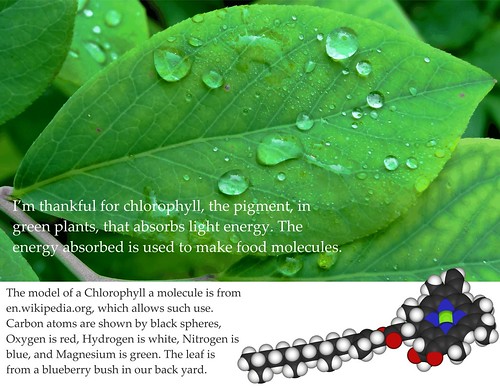
thankful for what is arguably the most important process on earth –
photosynthesis. Light energy is captured by green plants and used to turn
Carbon Dioxide and water into food molecules. Food is something we eat that
gives us energy (which is measured in calories). Most likely, all the food you
have consumed in the past year came from photosynthesis in some green plant.
Thank God!
11) I’m
thankful for carbohydrates. They are made of Carbon, Hydrogen and Oxygen, and
their names usually end in “ose,” as in glucose, fructose, cellulose, and more.
Starches are complex carbohydrates. Some of us eat too much carbohydrate, and
expand, as a consequence. But we need energy to live, and carbohydrates are a
good source of food energy. Cellulose is taken in in the form of fiber, and we
should eat fiber, too. Some carbohydrates such as sucrose, common table sugar, taste
sweet. I like it, more than I should.
12) I’m
thankful for my sense organs. Our tongue and nose can detect certain molecules,
apparently because of their 3-dimensional shape. Sugar molecules have a
distinctive shape. Sugar molecules fit into sweet-detecting sense structures in
the tongue which detect that shape, and these structures send a message to the
brain: “that was sweet!” Scientists have figured out how to make sugar
substitutes, which have a shape that activates the same sensors, and cause the
same message to go to the brain. Sugar substitutes are usually indigestible, or
don’t turn into as many calories as sugar, hence you may gain less weight from
eating or drinking them than from the equivalent food/drink with sugar in it.
The senses
of taste detects various chemicals that touch the tongue. The sense of smell
detects molecules that come to the nose through the air. I’m thankful for the
smell of coffee, even though I don’t drink it, and for lots of other
smell-producing materials. When I was in college, my nose was cauterized to
stop frequent nosebleeds. As a result, I don’t have much sense of smell. Be
thankful for yours!
13) I’m
thankful for deoxyribose, a 5-Carbon sugar that is an essential part of DNA –
in fact, DNA is named for it: Deoxyribose Nucleic Acid. As surely you know, your
heredity is carried from generation to generation by DNA. It’s also carried
from cell to cell in your body. The trillions of cells in your body all came
from a single fertilized egg. Most of your cells have the same DNA, with some
exceptions. Occasionally you may see someone with two different iris colors, or
with strange patches of skin or hair. But these are rare. Your left side mostly
mirrors your right. Be thankful for your heredity, and that it’s all the same
throughout your body, except for occasional mutations.
In addition
to deoxyribose, DNA contains Nitrogen bases and Phosphate. I’m thankful for
them, too.
14) I’m
thankful for cellulose. Cellulose is a complex carbohydrate, made of hundreds,
or more, of glucose molecules strung together. Plants use it as structural
material in their cell walls. Since it is structural, it has numerous uses. We
get fiber in our diet mostly from plant cell walls in our food. Cotton and
linen fibers contain cellulose, so most of us are clothed with this, some of the
time. Paper, including cardboard, includes cellulose. Cellulose is the most
common constituent of wood, which is used in structures and implements of many
kinds, as well as being a fuel.
Without
cellulose, there would be no trees, with all the joy, majesty, and utility that
they bring. No forests, no leaves falling.
15) I’m
thankful for Silicon, an element. It’s the second most abundant element in the
earth’s crust, behind Oxygen. In the earth’s crust – the rocks, dirt, etc.,
that we can access fairly easily with a shovel or a drill – Silicon is almost
always in combination with some other elements, like Oxygen or Aluminum. Quartz
is mostly Silicon Dioxide. Quartz, mica, feldspar, and other materials make up
granite, one of the most common types of rock on earth. Mica and feldspar also
contain Silicon. Minerals containing Silicon make up about 90% of the earth’s
crust.
16) As
yesterday, I’m again thankful for Silicon. Here’s the Wikipedia: “The most
widely used silicon device is the MOSFET (metal-oxide-silicon field-effect
transistor), which has been manufactured in larger numbers than any other
device in history.” In other words, the computer I’m typing this on, and all
the devices that could read this, use Silicon-based transistors, in order to do
their jobs.
17) I’m
thankful for sand. Many sands are mostly Silicon Dioxide. SiO2 sand is the main
constituent of glass. Can you imagine life without glass? Touchscreens on
smartphones and similar devices contain glass. So do many glasses that people
wear. Then there are windows, and drinking glasses, and lots of other stuff. (Some
sands, for example from corals, are mostly Calcium Carbonate, but most sands
are Silicon Dioxide.) The Wikipedia lists a couple of dozen or so uses for
sand.
18) You are
breathing it right now, even though you can’t smell it or see it. What is it?
Nitrogen, which I’m very thankful for. Nitrogen gas makes up about 80% of the
earth’s atmosphere. Oxygen is the second most common gas in the atmosphere.
Without that Nitrogen, an increase in Oxygen would mean that fires would spread
more rapidly and be more devastating and dangerous.
19) I’m
thankful for Nitrogen. DNA, the heredity molecule, has a Nitrogen-containing
base in each unit, which means that we probably have trillions of Nitrogen
bases in our bodies. The Nitrogen bases, ACGT, make up the genetic code. Nitrogen
is also part of every amino acid. Amino acids make up protein, and, of course,
we need protein for structure, for making up enzymes, and for other things.
Life, as we know it, would be impossible without DNA, its close relative, RNA,
ATP, and amino acids. Each of these contains Nitrogen.
20) I’m
thankful for Nitrogen-fixing bacteria. We need Nitrogen, which is part of many
of the most important molecules in living things. But, even though most of what
we breathe is Nitrogen gas, we can’t use that to make amino acids or RNA. We
have to get Nitrogen in what we eat. Some bacteria in the soil, often in
special structures on the roots of members of the pea family, such as peas,
beans, peanuts, alfalfa, clover, and many more, can take Nitrogen from the air
in the soil. The plants that they are growing with can access this Nitrogen.
Members of the pea family are good sources of Nitrogen, in the form of protein.
We can get Nitrogen from other kinds of food, especially food high in protein,
but, in most cases, such Nitrogen was first captured by bacteria in the nodules
on the roots of plants.
21) I’m
thankful for Hydrogen. There are more atoms of Hydrogen than of any other
element in the universe. Hydrogen is part of water, which is enough to make it
very important, but there’s more. Hydrogen is part of almost all of the
molecules of living things, such as carbohydrates, steroids, proteins, lipids,
DNA, RNA, ATP and more. It also is part of Hydrocarbons, which we use to make
plastics, and burn as fuel in our automobiles. It’s easy to ignore Hydrogen. It
doesn’t seem to be the central part of any of these important types of
molecule. But it’s there, in all of them. Life would not be possible without
it.
22) I’m
thankful, again, for Hydrogen. Almost all of the energy we use depends on it.
Why? Because there are processes in the sun that take Hydrogen, and fuse it
together into Helium, releasing energy in the process. (Hydrogen bombs, if ever
used, would engage in similar processes.) Energy released by this nuclear
fusion escapes into space, some of it in the form of light, and a small part of
it hits the earth, warming it, and providing energy for the food manufacturing
processes of photosynthesis.
23) I’m
thankful for Oxygen. Oxygen reacts easily. We can see the results in flames,
and in rust (which is oxidized iron). Because this is true, living things use
it to access energy from the food they make, in photosynthesis, or the food they
eat. They oxidize this food, which results in the production of Carbon Dioxide
and water, and the release of energy. This oxidation is slower, and much less
destructive, than ordinary burning. (Most foods can be burned, giving off
energy in a different way.) When we exercise, we need Oxygen, so that we can
release energy stored in our bodies. That’s why we may gasp and pant after
running, for example – we need Oxygen to replenish our accessible energy.
There are
some organisms (you won’t find them in zoos) that get their food, and access
the energy from it, in different ways.
24) I’m
thankful for Oxygen. Besides the fact that we need to breathe it, Oxygen is
part of the essentially all of chemicals that living things are made of. Most
living things, including us, are mostly water. Water is a combination of
Hydrogen and Oxygen. Besides that, DNA, RNA, ATP, starch, sugar, fats,
hormones, vitamins, proteins, and more, all have Oxygen as part of their
structures.
25) I’m
thankful for metabolism. The rest of this post was extracted from the
Wikipedia: “Metabolism … is the set of life-sustaining chemical reactions in
organisms. The three main purposes of metabolism are: the conversion of food to
energy to run cellular processes; the conversion of food/fuel to building
blocks for proteins, lipids, nucleic acids, and some carbohydrates; and the
elimination of nitrogenous wastes. These enzyme-catalyzed reactions allow
organisms to grow and reproduce, maintain their structures, and respond to
their environments. (The word metabolism can also refer to the sum of all
chemical reactions that occur in living organisms, including digestion and the
transport of substances into and between different cells, in which case the
above described set of reactions within the cells is called intermediary
metabolism or intermediate metabolism).”
26) I’m
thankful for enzymes. Enzymes are proteins that speed up chemical reactions,
such as the ones in metabolism (see yesterday’s post). In effect, they make
these chemical reactions possible. Without enzymes, they wouldn’t take place at
all, or they would be so slow that they wouldn’t do us any good. Enzymes help
convert food to useful energy, help convert food molecules to the more complex
molecules necessary for life, such as proteins, hormones, DNA and RNA. They
help eliminate nitrogenous wastes. They are necessary in the formation of new
cells, as when an embryo grows, or an older person replaces dead cells, such as
skin cells.
27) I’m
thankful for the parts of my body that produce digestive enzymes. The salivary
glands produce enzymes that digest starch, breaking it down to sugar. (Chew on
a cracker for a few minutes. It will probably begin to taste sweet.) There are
enzymes in the stomach that help break down food molecules. These enzymes
require an acid environment, in order to work. The pancreas and the liver
produce enzymes that help digest food molecules. If food wasn’t digested, it
wouldn’t do us any good. We would get just as much good from eating sand as
from eating turkey.
28) I’m
thankful for Sulfur. It’s one of the more prevalent elements in my body, after
Carbon, Hydrogen, Oxygen, Nitrogen, Calcium, and maybe Potassium. Amino acids
make up proteins. Proteins can be enzymes, or part of our structure (hair is
mostly protein) or perform other functions, such as fighting infection. Two of
the amino acids that make up proteins, cysteine and methionine, contain Sulfur.
Cysteines bonded together help to give hair, and other body parts, their
structure. If hair is burnt, there’s a bad smell, which is mostly due to
Sulfur.
Sulfur is a
necessary part of sulfuric acid, which is used in making fertilizer, and used
in some kinds of batteries. Sulfur is used as a fungicide and pesticide. Some
of the most important antibiotics contain Sulfur. Sulfur is necessary for life
on this planet.
29) I’m
thankful for Sodium. Sodium is part of common table salt, Sodium Chloride. We
need Sodium in order to live. However, too much Sodium can lead to high blood
pressure, and, if it’s really too much, even to death. Salt is used as a
preservative. Sodium is used to manufacture chlorophyll, which is used in
photosynthesis, the basic food-making process that we all depend on. Sodium is
necessary for the functioning of the nervous system. As you read this, Sodium
is migrating across the membranes of your nerve cells, making perception of
what you are reading, and thought about it, possible. Yellow colors in
fireworks are due to Sodium.
30) I’m
thankful for Phosphorus. Phosphorus is an essential part of DNA and RNA, the
molecules that carry our genetic code, and help to express it. It’s also part
of ATP (Adenosine Triphosphate) which is used in the processes that release
energy from food. Our cell membranes contain Phosphorus. It’s no wonder that
almost all fertilizers contain Phosphorus.
Many matches
contain Phosphorus.
I could have
been thankful for Potassium, Calcium, Chlorine, Iron, and other elements of the
periodic table, but will stop here. Thanks for reading.