License

I have written an e-book, Does the Bible Really Say That?, which is free to anyone. To download that book, in several formats, go here.
Creative Commons License
The posts in this blog are licensed under a Creative Commons Attribution-NonCommercial-ShareAlike 3.0 Unported License. You can copy and use this material, as long as you aren't making money from it. If you give me credit, thanks. If not, OK.
Showing posts with label Colossians 1. Show all posts

Monday, July 27, 2020

Christian stewardship of the environment, from the New Testament


Romans 1:20 For the invisible things of him since the creation of the world are clearly seen, being perceived through the things that are made, even his everlasting power and divinity, that they may be without excuse.

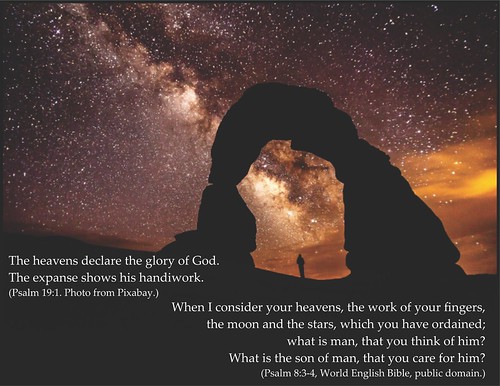
Psalm 19:1-3 The heavens declare the glory of God. The expanse shows his handiwork. Day after day they pour out speech, and night after night they display knowledge. There is no speech nor language, where their voice is not heard.


God’s revelation should be as clear as possible. Christians have translated the Bible into many languages, revised translations so that they speak more clearly, and created and updated church music, so that it fits the culture better. Nature also speaks of God. The message of God through nature should be as clear – free of extinction, pollution and destruction – as we can make it. Unfortunately, we are gradually degrading God’s revelation through nature. For example, a third of the people on earth can’t see the Milky Way now, because of “light pollution.”


Colossians 1 describes Christ, and his mission, which includes reconciliation, and holding things together:
17 He is before all things, and in him all things are held together. 18 He is the head of the body, the assembly, who is the beginning, the firstborn from the dead, that in all things he might have the preeminence. 19 For all the fullness was pleased to dwell in him, 20 and through him to reconcile all things to himself by him, whether things on the earth or things in the heavens, having made peace through the blood of his cross.


Christ holds things together, and reconciles all things to himself.

 
2 Corinthians 5 indicates that believers are to carry out Christ’s ministry of reconciliation: 18 But all things are of God, who reconciled us to himself through Jesus Christ, and gave to us the ministry of reconciliation; 19 namely, that God was in Christ reconciling the world to himself, not reckoning to them their trespasses, and having committed to us the word of reconciliation. (scripture from the World English Bible, public domain)


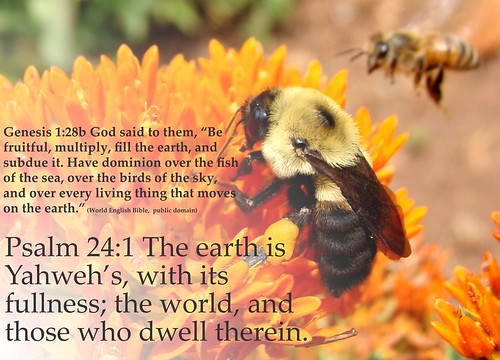
If believers are responsible for helping Christ in reconciliation, aren’t we also responsible for helping Him to hold all things together? (Which means, in part, caring for the environment.) See also Psalm 24:1, Genesis 1:28, 31, Psalm 104:24-5 and more. This post considers what the Old Testament says about our responsibility to care for the environment.

Friday, December 27, 2019

Environmental Stewardship in the Bible, re-post

Two Days late for Earth Day - Environmental stewardship

We have God-given responsibilities to non-human organisms
Genesis 1:26-28 seems to indicate clearly that humans were placed in charge of the non-human world. Psalm 8:6 reiterates that idea. Psalm 24:1 indicates that even though we are, in some sense, in charge, the world, and the things in it, are God’s. So does Psalm 50:10,11.* The story of Noah seems to indicate that, at one point, humans were directly responsible for the lives of many kinds of animals. Genesis 7:2-5, 14-16, Proverbs 12:10 and Proverbs 27:23 all have to do with caring for animals.

God seems to care not just for animals in general, but for kinds of animals. Psalms 104:24-25 praises God for the diversity of His creation, and His creatures. Since this explicitly includes the wide variety of ocean animals, it doesn’t seem possible that this praise is meant to be only because of their usefulness to humans. Genesis 7:3, 14-16 indicate God’s concern that the different kinds of animals would be preserved. Genesis 8:1 says that God had not forgotten Noah or the animals. Noah and his family were God’s agents in this care, of course, but they were God-directed agents. It would seem reasonable to argue that in our day, we also have responsibilities to the kinds of animals that exist in our time.

Does God care for individual non-human organisms? Perhaps. The question seems to be addressed in Matthew 10:29, which says that even individual sparrows do not fall without God’s knowledge. (Two verses later, Christ stated that the twelve were of more value than many sparrows. However, He didn’t say that sparrows were valueless.)

Does God’s care, and the care that humans are supposed to have, mean that we must refrain from killing animals deliberately? Apparently not. Jesus certainly condoned fishing (John 21:6Matthew 17:27Luke 5:4). He ate (Luke 24:36-43), and probably fished (John 21:9) even after His resurrection. Peter's vision, after the resurrection, and after Pentecost, used eating meat as a sign that God does not show favoritism (Acts 11:1-18). Paul referred disparagingly to people who forbid eating meat (I Timothy 4:1-3). There are no explicit commands forbidding the consumption of all meat in the Bible. This is not to say that the Bible condones killing of animals wantonly. That would be contradictory to benign dominion. Nor does the Bible condone consumption of animal flesh (or any other kind of food) selfishly, or to excess. But we are allowed to kill non-human organisms for cause, at least. Such causes include killing an animal because it threatens a human (Exodus 21:29), killing for meat (Genesis 9:2-3Leviticus 11:1-22) and killing an animal for its skin (Genesis 3:21). Exodus 12:21-23 and 12:46, and Mark 14:12, indicate clearly that the Passover, one of the most important ceremonies of the Jews, and the last ceremony Jesus performed with His disciples, involved eating meat. The Bible is very clear that humans and animals are not equals. Christ came in human form, principally to redeem humans, although the effects of redemption will be felt through all of creation. We have dominion over animals, not the reverse. That dominion implies responsible use, including research and killing for good cause. (Nothing in this paragraph rules out the practice of vegetarianism. Some Christians may decide, or God may reveal to them, that they shouldn't eat meat. But they cannot prove that Scripture demands that Christians don't eat meat.)

Does God’s care extend to plants? To non-living entities? (The Bible, like present-day people, is more concerned with some kinds of animals than others. There is little, if any, mention of mollusks in scripture, for instance.) The Bible mentions God’s care of plants (Psalm 104:16Matthew 6:30). It also states that everything He created was initially good (Genesis 1:31) and that creation as a whole, not just humans, groans, waiting for restoration (Romans 8:22). It is true that the Bible does not dwell on plants nearly as much as on animals. The creation of plants gets only one phrase in the Genesis account, whereas the creation of animals gets several. There is no mention of God’s concern for plants during the flood, nor are certain kinds of plants declared unclean in the Mosaic dietary laws. All this means that the Hebrews, like ourselves, were more interested in animals than in plants. Perhaps it means that God is also more interested.
From the above, we conclude that God’s care extends beyond humans, certainly to animals. Scripture is less explicit about God’s care for plants, and even less so about His care for rocks, streams, and clouds. However, there seems no reason to expect God to condone wanton destruction of any kind. If God cares for non-human creations, and we are responsible for His creation, then it behooves us to care for non-human creations as well. Proverbs 12:10 says that good people care for their domestic animals, and bad people are cruel to theirs. Caring for animals is usually consistent with caring for plants, or for rocks, streams and clouds. II Chronicles 36:21 tells us that the 70 years that the Israelites were to spend in captivity was not an arbitrary figure. God chose that because his people did not care for the land as he instructed them to. Jeremiah 2:7 and Habakkuk 2:17 condemn the Israelites because they hadn’t taken care of their land.

New Testament teaching on care of the environment
Most of the usual teaching on what the Bible says about care of the environment is from the Old Testament. However, there are two passages from the New Testament that also argue that we should be caring carefully for the environment. They are indirect, but their urgency is important. 
Romans 1:20 tells us that observing and learning about nature are part of God’s revelation to humans. (So does Psalm 19:1-4). If that is so, isn’t that another reason to try to preserve nature as well as we can? The Bible is one of the ways that God reveals Himself to us. For a long time, Christians have believed that the Bible should be translated into the language people are most familiar with, so that that revelation may be as clear as possible. Similarly, it would seem that God's revelation through nature should be as clear as possible. A person is more likely to see God in a pristine stream than in a polluted river. Probably seeing bison herds roam freely in Western North America gave people a glimpse of one aspect of God’s power and majesty that they can’t really get now. Therefore, helping to preserve nature in as good a condition as we can is one way to bring people to a saving knowledge of Christ. Not the most direct way, and probably not the most effective, for many people, but it is still a way to do this.
 
Colossians 1:15-20 says, of Christ, that “in Him all things hold together.” (ESV -- other versions have similar language.) That passage also says that He is working to reconcile all things to Himself, and working to make peace through the blood of the cross. As Christians, we believe that it is our duty to be His instruments in reconciling sinners to Christ, and to help Him in the ministry of making peace. In fact, 2 Corinthians 5:18-19, tell us that:  18 But all things are of God, who reconciled us to himself through Jesus Christ, and gave to us the ministry of reconciliation; 19 namely, that God was in Christ reconciling the world to himself, not reckoning to them their trespasses, and having committed to us the word of reconciliation. 
Doesn’t it follow that we should also participate in Christ’s work of sustaining “all things,” including endangered species and ecosystems or biological communities? (I realize that there are other places in the New Testament where reconciliation and peacemaking are mentioned, or implied, and this is probably the only one that mentions Christ's sustaining work. But that doesn't mean that His sustaining work can be dismissed, or that we have no responsibility to be His instruments in doing it.)

What must we do when our responsibilities seem to conflict?
One response is to ask, do they ever really conflict? We believe that our responsibilities do, in fact, appear to conflict, in these matters, and in others. As fallen, finite beings, we do not always interpret God’s directions correctly. We certainly do not know enough to always judge correctly. If we did possess the ability to decide correctly in all cases, perhaps God’s demands on us would never even seem to conflict. However, we can’t, and they do seem to conflict. Perhaps, this being a fallen world, they actually conflict.
The Bible does not present a formal hierarchy of principles to guide our behavior, in matters of environmental ethics, or in other matters. It does not tell us how to choose when, for instance, a decision we make will lead to either 5 minutes of misery for each of 2000 people, or 3 days of misery for a single individual. It does not tell us what to do when bringing a field under cultivation will help to feed hungry people, but also will kill native plants, deprive animals of homes, and use petroleum resources. As fallen beings in a fallen world, it is probably too much to expect that all our decisions will be correct.

Here are some attempts at principles which may be of help in making decisions about environmental matters:
This world is temporary. Temporal concerns of any kind should be carefully weighed against eternal values. The fossil record indicates that more species have become extinct than are now alive, and usually not because humans caused the extinction. This doesn’t excuse us from trying to save the organisms that live in our time, of course.

We should recognize that environmental concerns are sometimes overstated, not prioritized, or controversial. Some would have us believe that humans are choking to death and swimming in carcinogens. This is overstatement. The atmosphere may not be as clear as it ought to be, and we may indeed be exposed to cancer-causing substances, but people in North America are living longer than ever before. It seems certain that we can’t cure every ill, environmental or otherwise. Is it more important to try to stop global warming, to save the California condor, or to cut down on our consumption of fossil fuels? Is the cost, or risk, from pollution to landfills from disposable diapers more or less than the pollution to water from washing non-disposable ones? No one seems to know the answers. Solutions are not prioritized. We must be careful not to act precipitously just because someone has a concern.

Selfishness is wrong. Most North Americans seem to subconsciously believe that we are somehow entitled to more possessions than people in other parts of the world. Such a life style contributes to environmental degradation. It may also deprive people in other parts of the world, or future generations, of resources. It may mean that our church, and other charitable causes, do not have funds that we could well afford to give. We may not personally be able to change the way the world works very much. We can change it a little, and we should. We can avoid conspicuous consumption, we can avoid wanting things simply because they are newer than the things we already have. We can participate in recycling, even if it requires some effort on our part. We can think carefully about every purchase we make.
Isaiah 5:8-10 is a warning to the Hebrews. It tells them that God doesn’t condone selfishness in material things, including use of land. It predicts that the land will stop yielding enough, as God’s punishment for selfishness.

Knowledge is necessary. We are in God’s image. Part of the reflection of the omniscient God in us is the desire for knowledge. The Bible speaks approvingly of Solomon’s knowledge of the natural world (I Kings 4:32-33). We should learn to appreciate the world as God made it, and this requires knowledge of it. Knowledge is also necessary for wise alleviation of our own mistakes.

Unselfish love is a scriptural requirement. This unselfish love ought to color our relationships with others in every area, certainly including our environmental activities. It is not clear that we can, or ought, to have a relationship of unselfish love with non-human organisms, but it would seem consistent with God’s expectation of us that we act unselfishly toward non-human organisms.
We need guidance from God. All our important decisions need His help. Even with this guidance, we don’t always agree. God may well want some of us to be deeply involved in helping crisis pregnancies, but others to try to help clean up the environment. This doesn’t mean that both groups can’t assist in both efforts, but God may give our lives different emphases.

Having stated these principles, we realize anew that it is difficult to apply them to cases. In many cases, all we can say is “God help us.”

The Bible does not rule out the use of current technology, and the development of new technology
Since the development and use of technology has often been related to use of valuable resources, or contributed to greater “efficiency” in despoiling the landscape, we certainly need to be careful in developing and using technology, for our own sake, as well as that of the landscape. Is technology anti-God? The answer to that question seems to be “it depends.”
There are three biblical passages that indicate reasons why particular technological development may be wrong.
First, worshiping the results of our technology is clearly wrong, as well as just plain stupid (Isaiah 44:9-20).

Second, pride in our accomplishments is wrong (Daniel 4:30-32).

Third, supposing that there are no limits to human ability is wrong (Genesis 11:5-9).

On the other hand, there are biblical reasons for supposing that technological development is not always wrong, and, in fact, can sometimes glorify God. Noah’s ark, the tabernacle, and the temple, were technological constructs, and God gave instructions for the building of each of them. In fact, in the building of the temple, and other projects completed during the reign of Solomon, there was apparently extensive use of resources. Solomon sent 10,000 workers to Lebanon to cut down cedar trees each month (I Kings 5:14), in addition to the servants of King Hiram who helped them. They may have worked there for as long as seven (I Kings 6:38) or even twenty years (II Chronicles 8:1). All this was at least allowed by God, and some of it was directed by Him. Jeremiah 22:6 contains an amazing statement. This verse says that God finds the royal palace at Jerusalem as beautiful as the mountains of Lebanon. It would seem that technological development, by and of itself, is not wrong, although it may be done for wrong reasons, or with the wrong attitude.
Part of the image of God in humans is the desire to create things. The fact that we can create and use technology has certainly lead to some unfortunate consequences, such as deaths and injuries in highway accidents. However, it may also lead to some fortunate consequences, such as our being able to alleviate some of the consequences of our own mistakes of the past, or even some of the consequences of the fall.


+  +  +  +  +

April 23, 2011:

On an earlier date, links to all the scripture referenced in this post, using the English Standard Version, were added. (See here for the ESV policy on copyright.) The section on New Testament teaching on care of the environment was inserted on this date. It had been part of a previous post. That post is still on-line. I have not removed any of the comments from the previous version of this post.

Thanks for reading!

*Added October 15, 2014: More scripture on God's ownership, and our stewardship: Jeremiah 27:5 ‘I have made the earth, the men, and the animals that are on the surface of the earth by my great power and by my outstretched arm. I give it to whom it seems right to me. 6 Now I have given all these lands into the hand of Nebuchadnezzar the king of Babylon, my servant. I have also given the animals of the field to him to serve him. (World English Bible, public domain) 

Added April 20, 2017: E. Stephen Burnett has written a fine blog post on how care of the current earth relates to the New Earth.

Added December 27, 2019: Nancy Sleeth, in Relevantdemolishes some objections some Christians raise (such as "It's all going to be destroyed in the end, so why care for earth?")

This post originally appeared on April 22, 2006. I have re-posted it, after reading Sleeth's article. To see comments prior to December 2019, use the link in the previous sentence. Thanks for reading.

Tuesday, August 14, 2018

Meditation in Scripture


I am ashamed to admit that, until this year, I have not thought seriously about the Spiritual Disciplines. (Also called spiritual exercises or spiritual practices.) As I understand these, they are things that believers ought to do regularly, so as to follow Christ, and to be more like him. I began reading a couple of books (see here and here) on the subject a few months ago. Our pastor just finished a short series based on Spiritual Disciplines. The Bible does not have a list of Spiritual Disciplines, and different authors suggest somewhat different lists.

1 Timothy 4:7b ("Exercise yourself toward godliness.") and Philippians 2:12b ("Work out your own salvation with fear and trembling.") are two places where the Spiritual Disciplines are alluded to. Reading the Gospels shows us that Jesus practiced at least some of them, especially prayer, submission, service and solitude. Reading Acts shows us that the early church practiced at least prayer, fasting, and service.

Most or all lists of Spiritual Disciplines include Meditation. There is a type of meditation that, although it may have some benefits, is not Christian. Scriptural meditation, however, is not the same thing. It is not “new age.” New age meditation is about you. Scriptural meditation is about God. Meditation, as defined in Webster’s dictionary of 1913, is “To contemplate; to keep the mind fixed upon; to study.” Here are most of the references to meditation in the Bible, using the World English Bible, which is public domain, except as indicated:

Genesis 24:63a Isaac went out to meditate in the field at the evening.

Joshua 1:8a This book of the law shall not depart from your mouth, but you shall meditate on it day and night, that you may observe to do according to all that is written in it.

Psalm 1:1 Blessed is the man who doesn’t walk in the counsel of the wicked, … 2 but his delight is in Yahweh’s law. On his law he meditates day and night.

63:5b My mouth shall praise you with joyful lips, 6 when I remember you on my bed, and think about you in the night watches.

77:11 I will remember [the Lord’s] deeds; … I will remember your wonders of old. 12 I will also meditate on all your work, and consider your doings.

119:15 (Also Psalm 119:78) I will meditate on your precepts, and consider your ways,

23 Though princes … slander me, your servant will meditate on your statutes. 

119:27 Let me understand the teaching of your precepts! Then I will meditate on your wondrous works.

119:48 I reach out my hands for your commandments, which I love. I will meditate on your statutes.

119:97 How I love your law! It is my meditation all day.

119:99b your testimonies are my meditation.

119:148 My eyes stay open through the night watches, that I might meditate on your word.

143:5 I remember the days of old. I meditate on all your doings. I contemplate the work of your hands.

145:5 Of the glorious majesty of your honor, of your wondrous works, I will meditate.

1 Timothy 4:15a Meditate upon these things; give thyself wholly to them; (KJV. Here is chapter 4 of 1 Timothy, which indicates what Paul meant by "these things.")

Most of the occurrences of meditation in the Bible refer to the Law, or to various synonyms for it in Psalm 119. Presumably, the authors were referring to the Torah, the first five books of the Bible, because, in many cases, the rest of the Bible hadn't been written.

There are three places, indicated in green above, where the meditation was to be on what God has done.

We don't know what Isaac was meditating about. The first five books of the Bible weren't written, or weren't mostly written in his time.

One of the occurrences above is marked in red. That one seems to say that, if we run into opposition for our faith, the best strategy is to remember God's power, rather than worry about responding.

I should meditate daily. On what? It's a good idea to meditate -- "contemplate; to keep the mind fixed upon; to study" -- on the Bible. One aspect of the Bible that I should meditate on is to meditate on the life, mission, and character of Jesus Christ. (Passages that should help in that are John 15, Philippians 2, Colossians 1, Hebrews 2, and many others.) 1 Timothy 4 seems to indicate that we should meditate on end times*. It's a good idea to remind myself of what God has done for me, and those I care for, daily. It's a good idea to meditate on the wonders, both spectacular and "ordinary," of God's creation.

Thanks for reading. Meditate on Christ, and the Bible. May I do so, too!

*It's probably not wise to let our meditation on end times dwell too much on whether or not there will be a rapture, and, if there is, when it will be, or about the existence and timing of the tribulation. See here. Rather, we should comfort ourselves by remembering that Christ is returning, at some point, that we will have eternal fellowship with Him, that things that are out of sorts will be put right, and that Christ will be recognized as Lord of all. We should probably also meditate on people who are not ready for Christ's return, and what we might do so that they will become so.

Monday, December 04, 2017

The magnificence of Christ, creator and sustainer

God revealed through the Milky Way


God the Son was important in the creation, and in sustaining that which He created!

John 1:1 In the beginning was the Word, and the Word was with God, and the Word was God. 2 The same was in the beginning with God. 3 All things were made through him. Without him, nothing was made that has been made. 10 He was in the world, and the world was made through him, and the world didn’t recognize him. 12a But as many as received him, to them he gave the right to become God’s children . . .

Colossians 1:14 in whom we have our redemption, the forgiveness of our sins. 15 He is the image of the invisible God, the firstborn of all creation. 16 For by him all things were created in the heavens and on the earth, visible things and invisible things, whether thrones or dominions or principalities or powers. All things have been created through him and for him. 17 He is before all things, and in him all things are held together.

Hebrews 1:3 His Son is the radiance of his glory, the very image of his substance, and upholding all things by the word of his power, who, when he had by himself purified us of our sins, sat down on the right hand of the Majesty on high ...

(Although the passages above indicate that God the Son was the most important agent in the creation, there are scriptural indications that God the Father and God the Holy Spirit were also involved.)

Perhaps you and I don't fully appreciate the magnificence of creation, and, therefore, we may not fully appreciate the magnificence of Christ.

Creation shows that God the son loves diversity. There are about 400,000 species of beetles, and probably at least a million yet to be discovered. (Psalm 104:24 Yahweh, how many are your works! In wisdom, you have made them all. The earth is full of your riches. 25 There is the sea, great and wide, in which are innumerable living things, both small and large animals.)

Creation is unimaginably large. “Recent estimates of the number of galaxies in the observable universe range from 200 billion [(2×10 to the 11th power) to 2 trillion (2×10 to the 12th power)] or more, … containing more stars than all the grains of sand on planet Earth.” (Wikipedia) And that’s only the observable universe.

Creation shows the power of God the Son. Most of the energy on earth comes from the sun. In the sun, Hydrogen nuclei bombard each other at several million degrees, and turn into Helium nuclei, releasing energy by e =m c-squared. The sun is about 93 million miles away. Since it is emitted in all directions, the vast majority of the sun’s emitted energy goes off into space, never hitting the earth, or any other body in the Solar System. But it’s warm enough for life on earth, and light enough for photosynthesis, just from the tiny fraction of the sun’s emitted energy that strikes it. We can scarcely imagine the power of the sun, and it’s a fairly small star.

Creation shows that God the Son likes beauty. He didn’t have to make the universe so that rainbows, or fall foliage, or butterflies, or eclipses, exist. But He did. Using scientific tools, such as microscopes and telescopes, we have found that there is amazing beauty, even in things we can’t get to, or can’t see with the naked eye.


The Creation is sustained by God the Son. How? By laws, like gravity, and created properties, such as that water can exist in three different forms at reasonably normal temperatures. The laws of gravity ensure, for example, that the planets continue to orbit the sun. The properties of water make rain possible, among many other things. God also sustains by processes, like erosion, plate tectonics, and natural selection. We can’t be sure if God is intimately involved in making every raindrop, or lets nature take its course to make each one, but He could make each and every one carefully and magnificently. 

God the Son can, and, at least sometimes, does, change the “normal” course of nature. We call that a miracle.


God, the Son’s, creation is beyond our imagination! He created time and space! God created matter and energy! God created the four fundamental forces, (also called the four interactions) – gravity, the electromagnetic force, the strong force and the weak force. God created the entire electromagnetic spectrum: light, radio waves, wi-fi, microwaves, X-rays, and more. God created the universe with appropriate physical properties for the existence of life

We should not forget that, even though He was largely responsible for the creation of the entire universe, He came to earth. Not as a baby, but as an embryo, a being with just a few cells, and hardly any connection to the world outside his mothers womb. Then, of course, He became a fetus, and, after about nine months, a baby. Still helpless, dependent, and, presumably, severely limited in His ability to communicate.

And we should not forget what St. Paul said about the Creator and Sustainer of the universe:
Have this in your mind, which was also in Christ Jesus, who, existing in the form of God, didn’t consider equality with God a thing to be grasped, but emptied himself, taking the form of a servant, being made in the likeness of men. And being found in human form, he humbled himself, becoming obedient to the point of death, yes, the death of the cross. Therefore God also highly exalted him, and gave to him the name which is above every name, 10 that at the name of Jesus every knee should bow, of those in heaven, those on earth, and those under the earth, 11 and that every tongue should confess that Jesus Christ is Lord, to the glory of God the Father. (From Philippians 2)

Thanks for reading! To God be the glory!