License

I have written an e-book, Does the Bible Really Say That?, which is free to anyone. To download that book, in several formats, go here.
Creative Commons License
The posts in this blog are licensed under a Creative Commons Attribution-NonCommercial-ShareAlike 3.0 Unported License. You can copy and use this material, as long as you aren't making money from it. If you give me credit, thanks. If not, OK.
Showing posts with label Connie Willis. Show all posts

Wednesday, September 25, 2013

Sunspots 437

Things I have recently spotted that may be of interest to someone else:

The Arts: Connie Willis, winner of Nebula and Hugo awards, on why she is fascinated by stories about time travel.

Health: NPR reports on how people eat more food that isn't all good for them when their sports team loses, and less when it wins.

NPR also reports on "Mountain Dew Mouth," and, in particular, how some health professionals want to restrict the intake of soft drinks with sugar and acid.

The BBC reports on a 'dramatic' drop in the number of HIV infections, world-wide.

Science: A golden eagle has been photographed in the act of attacking (and bringing down) a deer, with a report by Nature World News.


Image source (public domain)

Saturday, April 16, 2011

To Say Nothing of the Dog, by Connie Willis

I recently posted on Doomsday Book, by Connie Willis. That book, which won both the Nebula and Hugo awards, was a serious work, in tone, and in subject matter.

The second of Willis's time travel books is much less serious. In fact, it may well be the funniest book I have ever read. The title of that book is To Say Nothing of the Dog: or How we Found the Bishop's Bird Stump at Last. You can get a good summary of the plot by following the link in the previous sentence, which is to the Wikipedia article on the book. Although this book and the previous one are related, they are independent, and enjoyment and understanding don't require that both be read, or that they be read in sequence. The main characters in the two books appear only in one of them. The idea of historical time travel, and the Oxford University time travel team, based in a history department, and headed by James Dunworthy, are common. The novel gets its title from the subtitle of a hilarious novel, Three Men in a Boat (To Say Nothing of the Dog), by Jerome K. Jerome, which was published in the Victorian era, and is still in print, and available in its entirety on-line. Willis refers to this book in the novel.

I wish to muse on a few aspects of To Say Nothing.

First, Willis can detail you almost to death, so if you aren't up to reading details of, for example, what the time travelers were thinking, you probably won't like Willis. But the details are a way of establishing character, setting, and plot. What do I mean, detail? Well, for one thing, the details of Victorian life, or at least Willis's view of Victorian life. We read about how rooms were furnished, what they wore, what luggage they took on short journeys, whether by boat or coach, and what they had for breakfast. We also read about jumble sales (known to some of us as yard or garage sales). There is an ongoing dialogue between two Victorian professors about the importance -- or not -- of the individual in history. That dialogue is related to the science fiction aspect of the book, which is on time travel.

It is the details that make the book funny. The book is entirely told from the viewpoint of Ned Henry, who has been sent into the past for reasons he doesn't really understand. One detail is that time travel may cause lack of sleep, and inability to concentrate. The results of these symptoms, which are evident in Ned, are hilarious. So are his attempts to sleep comfortably.

Second, Willis has made the book a mystery novel. There are two ongoing mysteries. One of them is the mystery of who Tossie Mering will marry. Tossie is a Victorian who is an ancestor of an important person from Ned's Oxford time frame. When I first read the book, I was taken completely by surprise when I found out the answer. My latest reading discovered clues, which I had missed. The second mystery is, as suggested by the subtitle, the question of what happened to the Bishop's bird stump. (The detailed description of that object, which is a large vase for holding flowers, but a garish, and seemingly indestructible one, is another funny aspect of the book.) There are clues, again -- Willis likes Agatha Christie, who makes a token appearance in a subsequent time travel book, and Ned's fellow time traveler, Verity Kindle, is an expert on mystery novels -- and they are used to solve the theft.

Third, as in Doomsday Book, the characters, both in 21st century Oxford, and in Victorian England, are very well drawn. Some of them are to be endured. Some are to be emulated. They are by no means constructed of cardboard. By the way, the characters include a dog and a cat, who are also not cardboard -- they are fictionally substantial.

Fourth, Willis does examine time travel. The historians of the Oxford group, and others using time travel, had previously concluded that the past cannot be substantially changed, and that significant objects cannot be brought from the past to the present. The first conclusion remains in doubt through much of the book -- the historians are afraid that they have changed the past in such a way that it affects their own time. The second is discarded, under certain circumstances -- they find that it is possible to bring objects, including live animals, from the past into the future, if that is done just prior to their destruction in past history. 

To Say Nothing of the Dog is a fine book, and I'm glad that I read it again.

Sunday, November 14, 2010

Doomsday Book, by Connie Willis


Connie Willis has won more Hugo and Nebula awards (counting each award, of both types, once) for her novels than any other author. I have read and enjoyed her work for years, and I'm not the only one. Somehow, although I have posted on her seven times before now, I haven't produced a major post on any of her novels. I'm ashamed of myself. In this post, I intend to begin to make up for that lack.

Willis has written four novels about a professor, who is in charge of time travel for historical purposes, that is, to check facts about the past, and to learn something about what life then was really like. Actually, the novels are more about the students (apparently graduate students) who do most of the time traveling, than they are about Mr. Dunworthy, the director of the group. They are set in England, in both the past and the near future, where the time travel supposedly starts. The first such novel is Doomsday Book. This novel won both the Hugo and Nebula awards. It is about Kivrin Engle, who went into the 14th century.

The Wikipedia article on the book gives a good summary of the plot, and other features. I wish to muse on three areas.

First, Willis can detail you almost to death, so if you aren't up to reading details of, for example, what the time travelers were thinking, you probably won't like Willis. But the details are a way of establishing character, setting, and plot. What do I mean, detail? One example, in Doomsday Book, is that Finch, Dunworthy's administrative assistant, has great difficulty getting some supplies, when Oxford University is quarantined because of an epidemic. In particular, he can't find lavatory paper (toilet paper, to North Americans). Over and over, he tries to get some, and can't.

Another detail is that there is an American handbell choir stranded in Oxford, where Dunworthy's group works. The handbell choir keeps coming back into the story, in various ways, and for various reasons. Many authors would not have included them at all.

Another such detail is bureaucracy. Willis's characters seem to be constantly beset by bureaucratic idiocy, described in maddening detail.

Second, Willis can present some fully dimensional characters. Kivrin, Dunworthy, and some of the "contemps" (people visited in the past) are such. The two, detail and character, work together. The troubles of Dunworthy, Kivrin, and others are presented over and over again. Not all of Willis's characters are likable. Some can be downright mean and nasty. But they are well drawn.

Third, one of Willis's characters, in this book, is good. He is unselfishly good. He is the local priest, in the 14th century. He works tirelessly to help the sick and the suffering. He thinks the best of others -- he saw Kivrin come into his time, and is convinced that she is an angel, sent from God to help them fight the Black Death. He is illiterate, and doesn't have the clothes and grooming that some people want in their priest, but he is a servant of God for them. I have prepared a graphic, illustrating a quotation from the book
Father Roche is not the only really good person in the book. I would say that Dunworthy, who tirelessly fights the university bureaucracy to get Kivrin back to her own time, and Dr. Mary Ahrens, who tirelessly fights to help the sick during the epidemic, also are. So is Kivrin, herself, who comes to identify with, and love unselfishly, the people she meets in a small village in the 14th century.

Thanks for reading. Read Willis.

Thursday, November 05, 2009

Connie Willis on how we feel about death

“Death is a subject Americans don’t like to talk about. I guess nobody does, but our American culture is especially in denial about death. If they do want to think about it, it’s in non-threatening Hallmark terms. Polls show these people don’t go to church, they don’t have any organized religion, but they all somehow think they’re going to heaven. They are in love with happy thoughts about death and at the same time they’re very frightened about death. You can see it in the culture everywhere - the way people jog frenetically, not to feel better or to be healthy but to be immortal. I’ve been on some convention panels where the overriding topic has been immortality: ‘The last person to die has already been born and the next generation will live forever.’ This is actually religion masquerading as science, and it speaks to how terrified people are about death.”

Connie Willis, interviewed by Locus, January, 2003. Willis is an award-winning author of fantastic literature.

Monday, September 21, 2009

Cautions on interpreting what the Bible says about end times


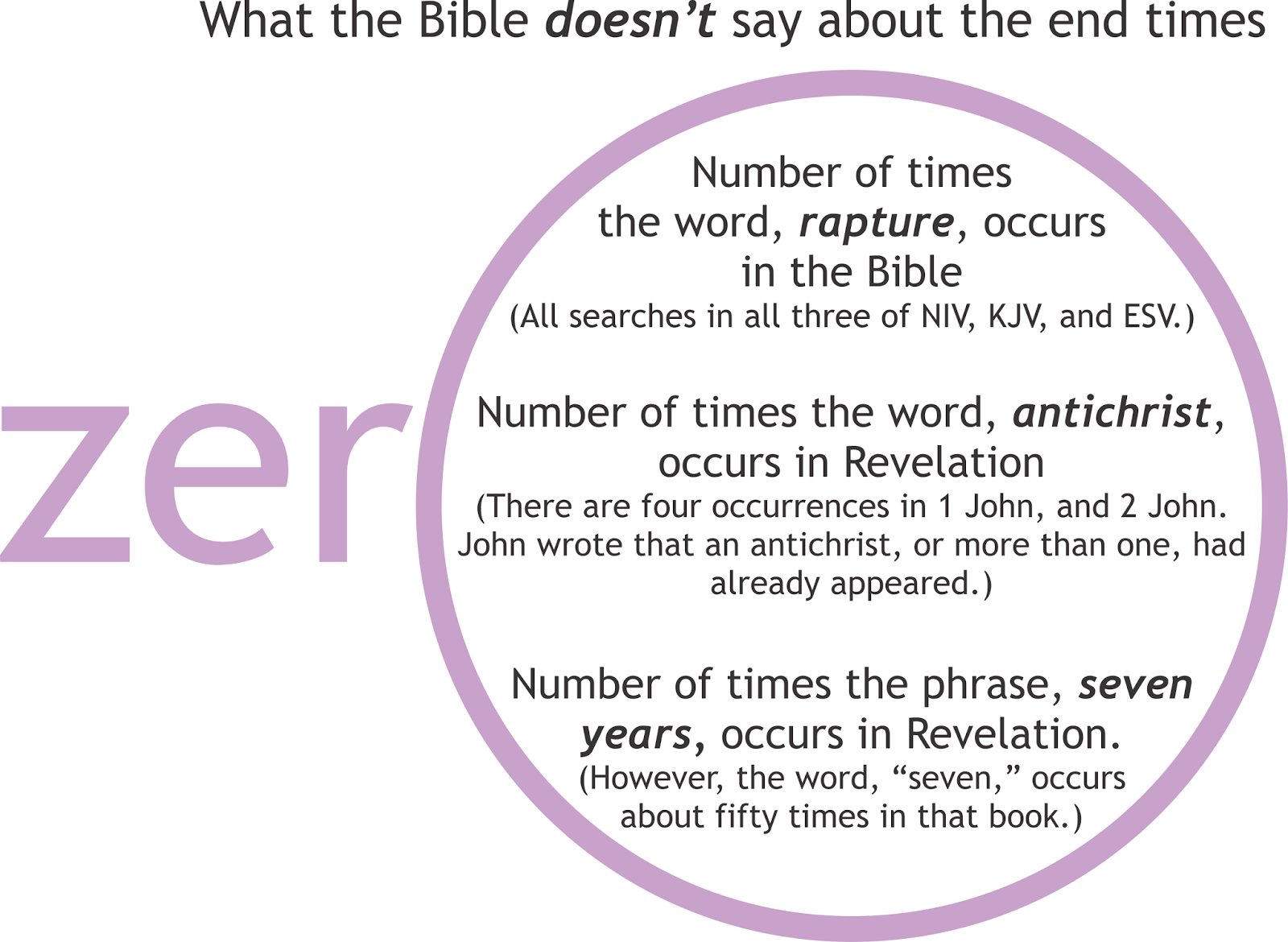
I believe that you can get a larger version of the graphic below, by right-clicking on it. You may feel free to use the graphic, as long as you do not use it for any commercial purpose -- it must remain free for all to use.

I don't have a lot of answers on end times. Some people seem to have answers, and they may be right. The above graphic illustrates reasons for caution. The Bible is not as clear about the end times as some people seem to believe that it is.

"Rapture" is not a word used in the Bible. The presentation of the idea of a rapture, a sudden removal of Christians from the world, that is most familiar to me is based on 1 Thessalonians 4:17. However, as you may learn from the comments on this post, below, that familiar presentation is probably mistaken, and a misinterpretation of scripture. (This paragraph was amended on September 28, 2009)

There are other reasons for caution. The Bible says this:
Matthew 24:36 “But concerning that day and hour no one knows, not even the angels of heaven, nor the Son, but the Father only. (All scripture from the ESV. See here for information on the ESV policy on on-line usage.)
and
Matthew 24:44 Therefore you also must be ready, for the Son of Man is coming at an hour you do not expect.

A serious warning, widely ignored, occurs in Revelation: 22:18 I warn everyone who hears the words of the prophecy of this book: if anyone adds to them, God will add to him the plagues described in this book, 19 and if anyone takes away from the words of the book of this prophecy, God will take away his share in the tree of life and in the holy city, which are described in this book.


Connie Willis, an author of fantastic literature, put it this way, probably a little too cynically, and, perhaps, even violating the warning above -- but she has a point -- in a short story:
The radio evangelists made it sound like the story of the Second Coming was a single narrative, but it was actually a hodgepodge of isolated scriptures -- Matthew 24 and sections of Isaiah and Daniel, verses out of Second Thessalonians and Joel, stray ravings from Revelation and Jeremiah, all thrown together by the evangelists as if the authors were writing at the same time. If they were even writing about the same thing. Connie Willis, "Epiphany," pp. 653-700, in The Winds of Marble Arch and Other Stories -- Burton, MI: Subterranean Press, 2007 -- p. 671. For similar thoughts, from an expert in Biblical interpretation, see here. (The expert doesn't call Revelation "ravings.") The expert, Kenneth Schenck, of Indiana Wesleyan University, is referring to the Dispensationalist view of end times, in particular the idea that there will be a seven year tribulation, and he points out that that view has, at best, very weak support in the Bible.
 
Thanks for reading. The Bible is clear on one idea about the end times: He is returning! We don't know when.

*    *    *    *    *

Added August 3, 2011: Here is a post, by me, on the first four prophecies mentioned by Matthew as being fulfilled by the coming, and early life, of Christ, and how difficult it must have been for those who first heard these prophecies, or even spoke and wrote them, to understand them as being about what actually happened.

Since these prophecies were difficult to interpret -- in some cases, impossible to interpret correctly until after the prediction came about -- why should we expect easy interpretations of prophecies about end times?

Added March 13, 2010:

David Heddle, of the He Lives blog, has recently posted on a particular word that occurs sometimes in prophecy, namely soon, and also this generation. He points out that some who claim to be interpreting the Bible very literally ignore, for example, part of the very first verse of Revelation, which says that Jesus told John that He was going to show him what would happen soon. Heddle doesn't seem to have a solution to how to deal with soon. I don't either. But, as I said in the title, it's best to be cautious, very cautious, about interpreting end times. Some people aren't very careful.

Added September 18, 2010:
Heddle has also posted on Armageddon, making a case for the idea that the Battle of Armageddon has already occurred.

Sunday, September 13, 2009

Some thoughts on church choirs

The entire range of human experiences is present in a church choir, including but not restricted to jealousy, revenge, horror, pride, incompetence (the tenors have never been on the right note in the entire history of church choirs, and the basses have never been on the right page), wrath, lust, and existential despair. Connie Willis, "An Introduction to This Book, or 'These Are a Few of My Favorite Things,'" in The Winds of Marble Arch and Other Stories -- Burton, MI: Subterranean Press, 2007 -- p. 14.

2 Chronicles 20:21 And when he had taken counsel with the people, he appointed those who were to sing to the Lord and praise him in holy attire, as they went before the army, and say,
“Give thanks to the Lord,
for his steadfast love endures forever.”
22 And when they began to sing and praise, the Lord set an ambush against the men of Ammon, Moab, and Mount Seir, who had come against Judah, so that they were routed. (ESV, as are all quotations from the Bible in this post. "he" was king Jehoshaphat. This may be the only time in history when a choir defeated an army. Of course, it was God who actually did it.)
2 Chronicles 29:27 Then Hezekiah commanded that the burnt offering be offered on the altar. And when the burnt offering began, the song to the Lord began also, and the trumpets, accompanied by the instruments of David king of Israel. 28 The whole assembly worshiped, and the singers sang, and the trumpeters sounded. All this continued until the burnt offering was finished. 29 When the offering was finished, the king and all who were present with him bowed themselves and worshiped. 30 And Hezekiah the king and the officials commanded the Levites to sing praises to the Lord with the words of David and of Asaph the seer. And they sang praises with gladness, and they bowed down and worshiped.
Colossians 3:14 And above all these put on love, which binds everything together in perfect harmony. 15 And let the peace of Christ rule in your hearts, to which indeed you were called in one body. And be thankful. 16 Let the word of Christ dwell in you richly, teaching and admonishing one another in all wisdom, singing psalms and hymns and spiritual songs, with thankfulness in your hearts to God.
Revelation 5:8 And when he had taken the scroll, the four living creatures and the twenty-four elders fell down before the Lamb, each holding a harp, and golden bowls full of incense, which are the prayers of the saints. 9 And they sang a new song, saying,
“Worthy are you to take the scroll
and to open its seals,
for you were slain, and by your blood you ransomed people for God
from every tribe and language and people and nation,
10 and you have made them a kingdom and priests to our God,
and they shall reign on the earth.”
Sing on!

Saturday, July 25, 2009

Brief book report: Solstice Wood, Inside Job, and Afternoon of the Elves

I have recently read Solstice Wood (New York: Ace Books, 2006) by Patricia A. McKillip. I don't want to give away the plot. This is a reasonably good summary.

The book brings the setting of McKillip's Winter Rose into the present. Characters have cell phones, watch TV, take airplanes, and drive. All this is new territory for McKillip, but she handles it well. Let's just say that the setting of Winter Rose, and of this book, is on the border, or at the interface, of fairyland. She also writes from the viewpoints of a half dozen different characters. Each chapter is from a single viewpoint. I found this an interesting literary device.

McKillip is a good writer. Her settings and characterizations sometimes obscure her plots, but there is a plot in this book. There are real characters in the book. She uses interesting figures of speech, as in "Seven years had done nothing to diminish the force and energy of her voice, which could have cut short a brawl between sea lions." (p. 12. I believe that McKillip lives on the coast of Oregon. The book has no sea, or lions, in it.)

* * * *

I also read Janet Taylor Lisle's Afternoon of the Elves (New York: Orchard Books, 1989). I was attracted by the title, and the fact that the book was a Newbery Honor winner. Let's just say that I liked the book, which is supposedly aimed at middle schoolers, but didn't really meet any elves. I wouldn't call it fantastic literature, because it could have been real.

* * * *
The Wikipedia article on Connie Willis says that she is a highly honored writer, and no wonder. Her Bellwether and Doomsday Book are splendid, and her other works are also good. Inside Job (Burton, MI: Subterranean Press, 2005) is about debunking spiritism, etc. One of the beliefs being debunked by the main characters is Intelligent Design. Willis doesn't say much about that theory. The title, at least in part, is because the late H. L. Mencken, one of the most diligent debunkers of the past, is being channeled by a medium who is otherwise a charlatan, debunking her to her own audience. Short, and funny, and the guy marries the beautiful and brilliant girl in the end.

Thanks for reading.

Friday, January 04, 2008

Where is God when things hurt us badly?

Theresia hugged her knees. "It hurts," she said again.
"Why has God abandoned us?" Gregor asked.
Dietrich tried to pry Theresia's arm loose so he could lance the last pustule. He did not think that it mattered. "God will never abandon us," he insisted, "but we may abandon God."
The mason swept his arm wide, relinquishing his grip on Theresia's shoulder. "Then where is He in all this?" he shouted. Theresia flinched at the bellow and he immediately took a more tender note and stroked her hair with his great stubby fingers.
Dietrich thought of all the reasoned arguments, of Aquinas and the other philosophers. He wondered how Joachim would have answered. Then he thought that Gregor did not need an answer, did not want an answer, or that the only answer was hope. Michael Flynn, Eifelheim. New York: Tor, p. 297.

"Katherine," Roche called.
. . . "What is it?" she demanded.
He looked at her solemnly. "We must not give up hope," he said.
"Why not?" she burst out. "We're up to eighty-five percent, and we haven't even got started. The clerk is dying, Rosemund's dying, you've all been exposed. Why shouldn't I give up hope?"
"God has not abandoned us utterly," he said. "Agnes is safe in His arms."
Safe, she thought bitterly. In the ground. In the cold. In the dark. She put her hands up to her face.
"She is in heaven, where the plague cannot reach her. And God's love is ever with us," he said, "and naught can separate us from it, neither death, nor life, nor angels, nor things present -- "
"Nor things to come," Kivrin said.
"Nor height, nor depth, nor any other creature," he said. He put his hand on her shoulder, gently, as if he were anointing her. "It was his love that sent you to help us."
She put her hand up to his where it rested on her shoulder and held it tightly. "We must help each other," she said. Connie Willis, Doomsday Book. New York: Bantam, 1992, p. 381.

These were, and are, important science-fiction novels. Eifelheim was a nominee for the Hugo Award in 2007. Doomsday Book won both the Hugo and Nebula awards. Although both are clearly legitimate science fiction works, the crisis of faith posed by the title of this post is a central part of each book, and, in both cases, one of the things that hurts badly is the black plague in Europe of the 1300s. They both present answers. In Eifelheim, it is God's love, expressed through the unselfish love of fellow creatures, hope of heaven, and hope of ultimate redemption. In Doomsday Book, it is God's love, and that love expressed through the unselfish love of fellow creatures.

Thanks for reading.

* * * * * *

January 8: I have received some comments, for which I am grateful. I have responded to one of those comments in this subsequent post (which includes the entire comment), and to another.

* * * * *

Added Jan 21, 2008: I have come to see that there is a serious omission in my musing on this subject, which I have attempted to repair with a fourth post on the subject.

Wednesday, December 05, 2007

Sunspots 137


Things I have recently spotted that may be of interest to someone else:


Politics:
Paul Hyde, of the Greenville [SC] News on how universal healthcare isn't nearly as bad as some would have us believe, with statistics.

Computing:
Bonnie, on a case of Internet deception, with serious consequences.

The bad stuff out there is getting even more scary. A CNet article discusses viruses/trojan horses/botnets/etc. sponsored by governments, and coming with a guarantee that they'll be effective, no less. Wow, and ouch!

Literature:
Excerpts from a splendid interview with Connie Willis (nearly five years ago, by Locus magazine) in which she, among other things, says that seeking immortality is a secular religion in North America, and pooh-poohs the idea that you can't find real life in books.

"Fear Not The Compass," from Christianity Today, by Jeffrey Overstreet. Among other things, the article discusses Philip Pullman's agenda in The Golden Compass (and the other two books of the trilogy, and complains that some Christians went way overboard about the Harry Potter books and movies.

A Slate commentator thinks there is too much shopping and other consumerism in Disney's Enchanted .

Christianity:
He Lives asks if the New Testament is anti-semitic.

This week's Christian Carnival is here. For information on these Carnivals, go here.


Thanks for reading! Keep clicking away.

Thursday, January 04, 2007

Miracle and Other Christmas Stories by Connie Willis

I recently reread parts of Miracle and Other Christmas Stories (New York: Bantam, 2000) by Connie Willis, a gift from one of my daughters (Thanks!). (for more on Willis, see this unofficial web page; Wikipedia article) Willis is one of the best science fiction authors of our time, and, I believe, has more Nebula and Hugo awards than any other author, living or dead. Her writing is probably more accessible to people who don't generally read science fiction than that of most other science fiction authors. I think everybody ought to read her Bellwether, which is short, but her best book is Doomsday Book, which won both the Hugo and Nebula awards. The first of these is about fads, and how they get started. The second is about time travel to the Middle Ages. Her books give a great amount of ordinary, and often frustrating, ordinary detail about what the characters are experiencing. Willis is at least respectful of Christianity. There is, for example, a monk who is a great example of unselfish devotion to God and others in Doomsday Book.

Miracle is a collection of stories. I won't consider all of them, but will muse briefly about two.

"Cat's Paw" relates to environmental ethics. It supposes that a wealthy woman is trying to integrate apes into human society. The apes have implanted vocal apparatus, and are able to read. They actually prove their "worth" to the narrator, who had some doubts, in a most interesting way (I won't give away the plot -- there certainly is one). The Christmas aspect is that this story takes place in an English country mansion, at Christmastime, but there isn't a lot about Christmas. Some of the stories are much more intimately related to various aspects of Christmas, however, and, as is typical with Willis, they include lots of frustrations for her characters, about the office party, or about getting gifts, or about finding a husband.

Here's a quotation from one of the stories:
They had never recognized Him. Isaiah had plainly predicted a virgin who would bring forth a child "out of the root of Jesse," a child who would redeem Israel. But nobody had thought that meant a baby in a stable.
They had thought he was talking about a warrior, a king who would raise an army and drive the hated foreigners out of the country, a hero on a white horse who would vanquish their enemies and set them free. And He had, but not in the way they expected.
Nobody had expected Him to be a poor itinerant preacher from an obscure family, with no college degree and no military training, a nobody. Even the Wise Men had expected Him to be royalty. "Where is the king whose star we have seen in the east?" they had asked Herod. "Epiphany," pp. 233-288, in Miracle and Other Christmas Stories. New York: Bantam, 2000. Quote is from p. 270.

This story has many quotations from the Bible, and characters look to the Bible for guidance. The only thing I will say about the plot is that it concerns a preacher who believes he has had a revelation about Christ's second coming.

In some cultures, Christmas hasn't come yet, and in others, there are twelve days of Christmas, so this should still be within the deadline.

Thanks for reading.