License

I have written an e-book, Does the Bible Really Say That?, which is free to anyone. To download that book, in several formats, go here.
Creative Commons License
The posts in this blog are licensed under a Creative Commons Attribution-NonCommercial-ShareAlike 3.0 Unported License. You can copy and use this material, as long as you aren't making money from it. If you give me credit, thanks. If not, OK.
Showing posts with label revelation. Show all posts

Tuesday, September 02, 2025

New Testament teaching on care of the environment

 New Testament teaching on care of the environment

Most of the usual teaching on what the Bible says about care of the environment is from the Old Testament. However, there are two passages from the New Testament that also argue that we should be caring carefully for the environment. They are indirect, but their urgency is important.
Romans 1:20 tells us that observing and learning about nature are part of God’s revelation to humans. (So does Psalm 19:1-4). If that is so, isn’t that another reason to try to preserve nature as well as we can? The Bible is one of the ways that God reveals Himself to us. For a long time, Christians have believed that the Bible should be translated into the language people are most familiar with, so that that revelation may be as clear as possible. Similarly, it would seem that God's revelation through nature should be as clear as possible. A person is more likely to see God in a pristine stream than in a polluted river. Probably seeing bison herds roam freely in Western North America gave people a glimpse of one aspect of God’s power and majesty that they can’t really get now. Therefore, helping to preserve nature in as good a condition as we can is one way to bring people to a saving knowledge of Christ. Not the most direct way, and probably not the most effective, for many people, but it is still a way to do this.


Colossians 1:15-20 says, of Christ, that “in Him all things hold together.” (ESV -- other versions have similar language.) That passage also says that He is working to reconcile all things to Himself, and working to make peace through the blood of the cross. As Christians, we believe that it is our duty to be His instruments in reconciling sinners to Christ, and to help Him in the ministry of making peace. In fact, 2 Corinthians 5:18-19, tell us that:  18 But all things are of God, who reconciled us to himself through Jesus Christ, and gave to us the ministry of reconciliation; 19 namely, that God was in Christ reconciling the world to himself, not reckoning to them their trespasses, and having committed to us the word of reconciliation.

Doesn’t it follow that we should also participate in Christ’s work of sustaining, or holding “all things” together, including endangered species and ecosystems or biological communities? (I realize that there are other places in the New Testament where reconciliation and peacemaking are mentioned, or implied, and this is probably the only one that mentions Christ's sustaining work. But that doesn't mean that His sustaining work can be dismissed, or that we have no responsibility to be His instruments in doing it.)

This is an excerpt from a post on July 16, 2009, modified slightly.

Thanks for reading!

Wednesday, April 10, 2024

Sunspots 971

Things I have spotted that may be of interest to others. I try not to post anything that requires a

password, and/or money, to access. 

A PhysOrg writer discusses the two species of rats that live in the US.

Learn about the matador bug, which waves warning signs, which are part of the insect's back legs.

Newsweek (and other outlets) point out that Hawaii is not protected by NATO. (It's in the Pacific, not the Atlantic).

Bible scholar Ken Schenck gives us a one-post interpretation of Revelation.


PhysOrg also reports on how we are losing estuaries, which are important out of proportion to their sizes.

Saturday, October 09, 2021

New Testament teaching on care of the environment

New Testament teaching on care of the environment
Most of the usual teaching on what the Bible says about care of the environment is from the Old Testament. However, there are two passages from the New Testament that also argue that we should be caring carefully for the environment. They are indirect, but their urgency is important. 
Romans 1:20 tells us that observing and learning about nature are part of God’s revelation to humans. (So does Psalm 19:1-4). If that is so, isn’t that another reason to try to preserve nature as well as we can? The Bible is one of the ways that God reveals Himself to us. For a long time, Christians have believed that the Bible should be translated into the language people are most familiar with, so that that revelation may be as clear as possible. Similarly, it would seem that God's revelation through nature should be as clear as possible. A person is more likely to see God in a pristine stream than in a polluted river. Probably seeing bison herds roam freely in Western North America gave people a glimpse of one aspect of God’s power and majesty that they can’t really get now. Therefore, helping to preserve nature in as good a condition as we can is one way to bring people to a saving knowledge of Christ. Not the most direct way, and probably not the most effective, for many people, but it is still a way to do this.
 
Colossians 1:15-20 says, of Christ, that “in Him all things hold together.” (ESV -- other versions have similar language.) That passage also says that He is working to reconcile all things to Himself, and working to make peace through the blood of the cross. As Christians, we believe that it is our duty to be His instruments in reconciling sinners to Christ, and to help Him in the ministry of making peace. In fact, 2 Corinthians 5:18-19, tells us that:  18 But all things are of God, who reconciled us to himself through Jesus Christ, and gave to us the ministry of reconciliation; 19 namely, that God was in Christ reconciling the world to himself, not reckoning to them their trespasses, and having committed to us the word of reconciliation. 
Doesn’t it follow that we should also participate in Christ’s work of sustaining “all things,” including endangered species and ecosystems or biological communities? (I realize that there are other places in the New Testament where reconciliation and peacemaking are mentioned, or implied, and this is probably the only one that mentions Christ's sustaining work. But that doesn't mean that His sustaining work can be dismissed, or that we have no responsibility to be His instruments in doing it.)

This post was taken, as is, from a longer post on what the Bible says about environmental stewardship. 

Monday, May 18, 2020

Creation Unfolding by Ken Coulson

I recently read Creation Unfolding: A New Perspective on Ex Nihilo (available to read free to Kindle Unlimited members) by Ken Coulson.

It was an interesting book, and I'm glad I read it.

Coulson is a Young-earth creationist (YEC). He is a geologist, not a biologist. The book says very little about biology, nor, of course, about evolution. The author has researched his subject thoroughly, except that he doesn't deal with the interpretation of Genesis 1 and 2. He takes both chapters as if they were meant to be literal, history-like descriptions.

How is Coulson different from many other YECs? I point out three significant ways.

First, he doesn't believe that nature, general revelation, was meant to reveal God as creator. He puts it this way:
In 1 Corinthians 1:21 (ESV), Paul makes God’s design abundantly clear: “For since, in the wisdom of God, the world did not know God through wisdom, it pleased God through the folly of what we preach to save those who believe.” The world is not allowed to come to know the God of creation by pursuing its own wisdom (e.g., through scientific endeavor). This is by God’s sovereign design.

Coulson goes on to say that, if God had wanted to make His creativity indubitably clear, He could have stamped each child born with a stamp proclaiming this. He doesn't say so, but perhaps, if Coulson had thought of this, he might have said that cloud formations could have said "made by God," in the language appropriate to each area of the world.

There are YECers, and other Christians, who would argue that Psalm 19 and Romans 1 tell us that God has revealed Himself though His creation, and holds us responsible for understanding that. Statements like this are made: "Look at the retina of the eye. (or some other natural wonder) How marvelous it is! You should believe in the God who created it!"

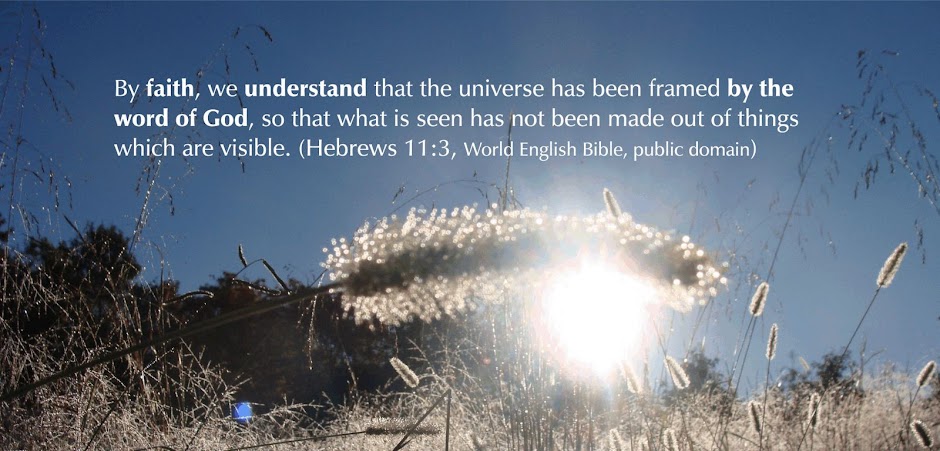
The picture at the top of this post, quoting Hebrews 11:3, indicates that we understand God's creative power through faith, and that perhaps those without faith cannot grasp this.

Second,  here's what he has to say about the Flood:
The Flood of Noah was a real, world-wide watery catastrophe. As such, geological evidence should exist that supports this catastrophe. Many YEC, however, have overstepped the line here by proposing that almost all the world’s sedimentary layers were deposited in the Flood. To think otherwise is sometimes viewed sacrilegiously. Now, it may be that nearly all the Earth’s geological layers were in fact deposited during Noah’s Flood, but there is nothing in Scripture that demands this. For all we know, the entire Flood record could extend to a single geological package of strata that represents a single geological period.

Not many YECers would agree with that.

Third, Coulson introduces a concept, and a term, that, as far as I know, is his, er, creation.

The term is Supernatural Formative Process(es) (SFP) which acronym is abundant throughout the book. For example: "In other words, although Adam’s bones and Eden’s trees would suggest processes leading to real histories, those processes and histories, as with those of the crust’s first crystals, are only apparent." In other words, Coulson argues that the earth, and the surrounding universe, only appear to be billions of years old, because God changed the rates of natural processes. And,

For example, if all rates everywhere in the universe were doubled, the participant would not notice this doubling unless there existed an unaltered rate that could serve as a frame of reference (Poythress 2019, p. 221). I propose that God has provided this frame of reference in the refrain that occurs at the end of each creative day: “And there was evening and there was morning.” This would mean that except for the rhythm of night and day, all other rhythms were accelerated in a time-lapse fashion.

So SPF are "natural" processes, which may be accelerated by God, and, if appropriate, kept in synchrony with other such processes, because the rates of each are sped up proportionally.

Coulson discusses several events, some biblical (like the water being transformed into wine in John 3) and some not so (the discovery of SN1987A, a supernova that looks like the light from it started heading toward us a long time before 6000 BC.)

Although Coulson claims that an appearance of age is not God being deceptive, because God altered various rates of processes, it's hard for me, after reading the book, to accept any Appearance of Age concept without thinking that God has unnecessarily hidden what He has done, and maybe is even being deceptive. God, of course, could have modified all sorts of rates, maybe even all of them except night and day, and presented us with an earth that is, actually, only a few thousand years old, in a universe that is also only a few thousand years old, regardless of their appearance. But did He? I don't think so. Perhaps I'm wrong.

It seems to me, and to many others, in the present, and in the history of the church, that most YECers, including Coulson, are starting from wrong presuppositions, namely that the days of Genesis 1 were consecutive 24-hour days, and that the Bible teaches that the earth, and the universe, were created in about 6000 BC. Many Christians, of the present and the past, believe that the first part of Genesis was not meant to be interpreted in a literal fashion. It is easier for me to believe that it was not so meant, than to believe that God adjusted all sorts of geophysical, chemical, astronomical and biological processes.

For some discussion of the interpretation of Genesis 1 and 2, see here.

There's also this simple graphic:


Which, I believe, shows that Genesis 1 and 2 cannot both (or either) taken literally.

Thanks for reading!

Thursday, October 15, 2015

Tenses in the book of Revelation

Revelation 1:4 John, to the seven assemblies that are in Asia: Grace to you and peace from God, who is and who was and who is to come; and from the seven Spirits who are before his throne;
 

1:7 Behold, he is coming with the clouds, and every eye will see him, including those who pierced him. All the tribes of the earth will mourn over him. Even so, Amen.
 

3:11a I am coming quickly!
 

3:15 “I know your works, that you are neither cold nor hot. I wish you were cold or hot. 16  So, because you are lukewarm, and neither hot nor cold, I will vomit you out of my mouth.
 

4:1 After these things I looked and saw a door opened in heaven, and the first voice that I heard, like a trumpet speaking with me, was one saying, “Come up here, and I will show you the things which must happen after this.”
 
4:8 The four living creatures, each one of them having six wings, are full of eyes around and within. They have no rest day and night, saying, “Holy, holy, holy is the Lord God, the Almighty, who was and who is and who is to come!”
9 When the living creatures give glory, honor, and thanks to him who sits on the throne, to him who lives forever and ever, 10a the twenty-four elders fall down before him who sits on the throne, and worship him who lives forever and ever...


5:3 No one in heaven above, or on the earth, or under the earth, was able to open the book or to look in it. 4 Then I wept much, because no one was found worthy to open the book or to look in it. 5 One of the elders said to me, “Don’t weep. Behold, the Lion who is of the tribe of Judah, the Root of David, has overcome: he who opens the book and its seven seals.” 6a I saw in the middle of the throne and of the four living creatures, and in the middle of the elders, a Lamb standing, as though it had been slain ...


6:1 I saw that the Lamb opened one of the seven seals, and I heard one of the four living creatures saying, as with a voice of thunder, “Come and see!”
 

7:13 One of the elders answered, saying to me, “These who are arrayed in the white robes, who are they, and where did they come from?”
14 I told him, “My lord, you know.”
He said to me, “These are those who came out of the great tribulation. They washed their robes, and made them white in the Lamb’s blood. 15a Therefore they are before the throne of God, they serve him day and night in his temple. 


11:3 I will give power to my two witnesses, and they will prophesy one thousand two hundred sixty days, clothed in sackcloth.” 4 These are the two olive trees and the two lamp stands, standing before the Lord of the earth. 5 If anyone desires to harm them, fire proceeds out of their mouth and devours their enemies. If anyone desires to harm them, he must be killed in this way. 6 These have the power to shut up the sky, that it may not rain during the days of their prophecy. They have power over the waters, to turn them into blood, and to strike the earth with every plague, as often as they desire. 7 When they have finished their testimony, the beast that comes up out of the abyss will make war with them, and overcome them, and kill them. 8 Their dead bodies will be in the street of the great city, which spiritually is called Sodom and Egypt, where also their Lord was crucified. 9 From among the peoples, tribes, languages, and nations, people will look at their dead bodies for three and a half days, and will not allow their dead bodies to be laid in a tomb. 10 Those who dwell on the earth rejoice over them, and they will be glad. They will give gifts to one another, because these two prophets tormented those who dwell on the earth. 11 After the three and a half days, the breath of life from God entered into them, and they stood on their feet. Great fear fell on those who saw them.
 

14:17 Another angel came out of the temple which is in heaven. He also had a sharp sickle. 18 Another angel came out from the altar, he who has power over fire, and he called with a great voice to him who had the sharp sickle, saying, “Send your sharp sickle, and gather the clusters of the vine of the earth, for the earth’s grapes are fully ripe!” 19 The angel thrust his sickle into the earth, and gathered the vintage of the earth, and threw it into the great wine press of the wrath of God. 20 The wine press was trodden outside of the city, and blood came out of the wine press, even to the bridles of the horses, as far as one thousand six hundred stadia.

Revelation 17:8 The beast that you saw was, and is not; and is about to come up out of the abyss and to go into destruction. Those who dwell on the earth and whose names have not been written in the book of life from the foundation of the world will marvel when they see that the beast was, and is not, and shall be present.
 

20:7 And after the thousand years, Satan will be released from his prison, 8 and he will come out to deceive the nations which are in the four corners of the earth, Gog and Magog, to gather them together to the war; the number of whom is as the sand of the sea. 9 They went up over the width of the earth, and surrounded the camp of the saints, and the beloved city. Fire came down out of heaven from God and devoured them. 10 The devil who deceived them was thrown into the lake of fire and sulfur, where the beast and the false prophet are also. They will be tormented day and night forever and ever. 

21:1 I saw a new heaven and a new earth: for the first heaven and the first earth have passed away, and the sea is no more. 2 I saw the holy city, New Jerusalem, coming down out of heaven from God, prepared like a bride adorned for her husband.


21:5 He who sits on the throne said, “Behold, I am making all things new.” He said, “Write, for these words of God are faithful and true.” 6 He said to me, “I have become the Alpha and the Omega, the Beginning and the End. I will give freely to him who is thirsty from the spring of the water of life. 7  He who overcomes, I will give him these things. I will be his God, and he will be my son.
 

22:12 “Behold, I come quickly. My reward is with me, to repay to each man according to his work. 13 I am the Alpha and the Omega, the First and the Last, the Beginning and the End.

All Bible quotations above, from Revelation, are from the World English Bible, public domain. I am grateful. Emphasis added. These quotations are among many which have some indication of tense -- whether things have already happened, or will happen in the future. There are many other such passages in Revelation. I make no claim to be an expert on Revelation, which is, to say the least, a difficult book to understand, and have seldom posted on that book. (But see here.)

One thing that Revelation indicates is that Christ is eternal, as in 1:4, 21:6, and 22:12-13. He was, and is, and will be. Another truth is that He is returning in triumph. See the first three quotations above, and the last one, and many others throughout the book. Whatever the beast of Revelation 17 represents, is almost eternal -- was, is not, and is again, long enough to be destroyed.

Chapters 2 and 3 are, apparently, messages to seven churches. (They are probably also meant as messages to subsequent readers, including us.) Verses 3:15-16 are an example that seems to say that Christ is going to judge these churches, in the future, perhaps in the near future.

4:1 introduces us to the rest of the book, which is apocalyptic and prophetic, and, based on that verse, is about things which are to come.

4:8-10 reiterate that the triumphant Christ is eternal -- He was victorious before the earth appeared, and will be victorious for eternity.

John's narrative is not entirely linear. There are some cases where he says something like "xyz is going to happen," then describes the results of xyz, after it has happened. 5:3-6 may be an example of this. It starts out by saying that no one can open the book (or scroll, in some versions) then we are told that the Lamb is honored as one who "opens the book." But 6:1 describes what happened, as if John had just seen it, when one of the seals is, in fact, opened.

11:3-11 is a better example of the "xyz phenomenon". The beast will kill the two witnesses, but then John tells us that they have already been killed, and have been resurrected. 14:17-20 is another example. An angel is told to act, then John writes as if the action had already taken place. 20:7-10 is an especially good example. We are told that Satan will be released from prison, then John tells us what happened when he was released. 21:5-7 may be another example. God is making all things new, but the rewards will come later, as if He hasn't done so yet.

21:1-2 seem to be about after the Final Kingdom is established, which, to us at least, is some time in the future, and was also even further into John's future. But John describes it as if he has seen it. 7:13-15 seem to be about what happened in the Great Tribulation, but also about the reward for those who went through it, after Christ's triumph.

Conclusion? God is outside of our time. To him, the past, the present, and the future are all accessible. John was given a vision of the present and the future, and did his best to describe it, but it was probably impossible for him to explain what he experienced in such a way that we can fully understand it.

What is the message of Revelation? There are at least two messages for us, related ones. "Be faithful" is one such, especially in the second and third chapters. "Christ is triumphant" is another one. These messages are more important than having a bullet-proof timetable for future events, events that are in our past, our present, and our future.

Thanks for reading!


Sunday, March 30, 2014

Does the Bible really say that? Excerpt from my book, 29


[Continuing a discussion of End Times.]

Sometimes people try to identify the Antichrist. Hitler and Stalin were put forth as candidates years ago. One or more of the Popes also have been, at various times. Here’s a recent example, copied from a mass e-mail received during the 2008 Presidential campaign. Its purpose was to imply that Barack Obama was the Antichrist:

How long is the beast allowed to have authority in Revelations?
Revelations Chapter 13 tells us it is 42 months, and you know what that is. Almost a four-year term of a Presidency.
All I can say is "Lord, Have mercy on us!"
According to The Book of Revelations the anti-Christ is:
The anti-Christ will be a man, in his 40’s, of MUSLIM descent, who will deceive the nations with persuasive language, and have a MASSIVE Christ-like appeal....the prophecy says that people will flock to him and he will promise false hope and world peace, and when he is in power, will destroy everything.

I should point out something that Revelation says:

Revelation 22:18 I testify to everyone who hears the words of the prophecy of this book, if anyone adds to them, may God add to him the plagues which are written in this book. 19 If anyone takes away from the words of the book of this prophecy, may God take away his part from the tree of life, and out of the holy city, which are written in this book.

Now, back to the e-mail. Here’s the passage referred to:

Revelation 13:1 Then I stood on the sand of the sea. I saw a beast coming up out of the sea, having ten horns and seven heads. On his horns were ten crowns, and on his heads, blasphemous names. 2 The beast which I saw was like a leopard, and his feet were like those of a bear, and his mouth like the mouth of a lion. The dragon gave him his power, his throne, and great authority. 3 One of his heads looked like it had been wounded fatally. His fatal wound was healed, and the whole earth marveled at the beast. 4 They worshiped the dragon, because he gave his authority to the beast, and they worshiped the beast, saying, “Who is like the beast? Who is able to make war with him?” 5 A mouth speaking great things and blasphemy was given to him. Authority to make war for forty-two months was given to him.
11 I saw another beast coming up out of the earth. He had two horns like a lamb, and he spoke like a dragon. 12 He exercises all the authority of the first beast in his presence. He makes the earth and those who dwell in it to worship the first beast, whose fatal wound was healed. 13 He performs great signs, even making fire come down out of the sky to the earth in the sight of people. 14 He deceives my own people who dwell on the earth because of the signs he was granted to do in front of the beast; saying to those who dwell on the earth, that they should make an image to the beast who had the sword wound and lived.

Revelation 13 refers to a “beast,” and the Antichrist is not mentioned. Forty-two months is almost the term of a Presidency. But so are 39 months, and 45 months. So what? As to Revelation saying that the Antichrist will be of Muslim descent, John didn’t say that. He couldn’t have, as there were no Muslims at the time John wrote Revelation. Nothing in Revelation tells us how old anyone is, or will be. Mr. Obama did have some powers of persuasion, or he wouldn’t have been the nominee of his party, but so do a lot of other people. He probably wishes that his powers were stronger than they are. (Actually, Revelation 13 doesn’t mention powers of persuasion, just power.) Some people think that Mr. Obama is a deceiver, and a destroyer. Perhaps. He has his faults, and I have no wish to defend them, or point them out, in this space, but to claim that he, or any other prominent person, is the Antichrist is a real stretch. Whoever wrote this e-mail should have been much more afraid of having violated John’s command not to add to the Book of Revelation than he or she should have feared for the election of President Obama.

With the advantage of hindsight, we can now say that Mr. Obama served as President for more than forty-two months!

It is as foolish to claim someone is the Antichrist as it is foolish to predict a date for Christ to return.


The above is an excerpt from my recently published e-book, Does the Bible Really Say That?, which may be obtained free of charge, or purchased from Amazon for $0.99, which is the lowest price Amazon lets an author set. Scripture quotations are from the World English Bible, which is in the public domain.

The previous post in this series is here. God willing, the next post in this series will continue a discussion of this topic, prophecy. Thanks for reading.

Tuesday, December 17, 2013

Harold Camping, Rest in Peace

The Washington Post, and other outlets, report that Harold Camping, who predicted that Christ would return on May 21, 2011, and, thank God, later apologized for that prediction, has passed away.

There are two things we can be confident about, concerning end times:
1) Christ will return, and we should be ready for that.
2) We don't know when this will be.

Many Christians apparently have a strong desire to know more than that. We shouldn't succumb to that temptation. The previous paragraph tells us what Christ, Himself, told us, and that should be sufficient.

Some more food for thought, related to what some people want us to believe about Christ's return:
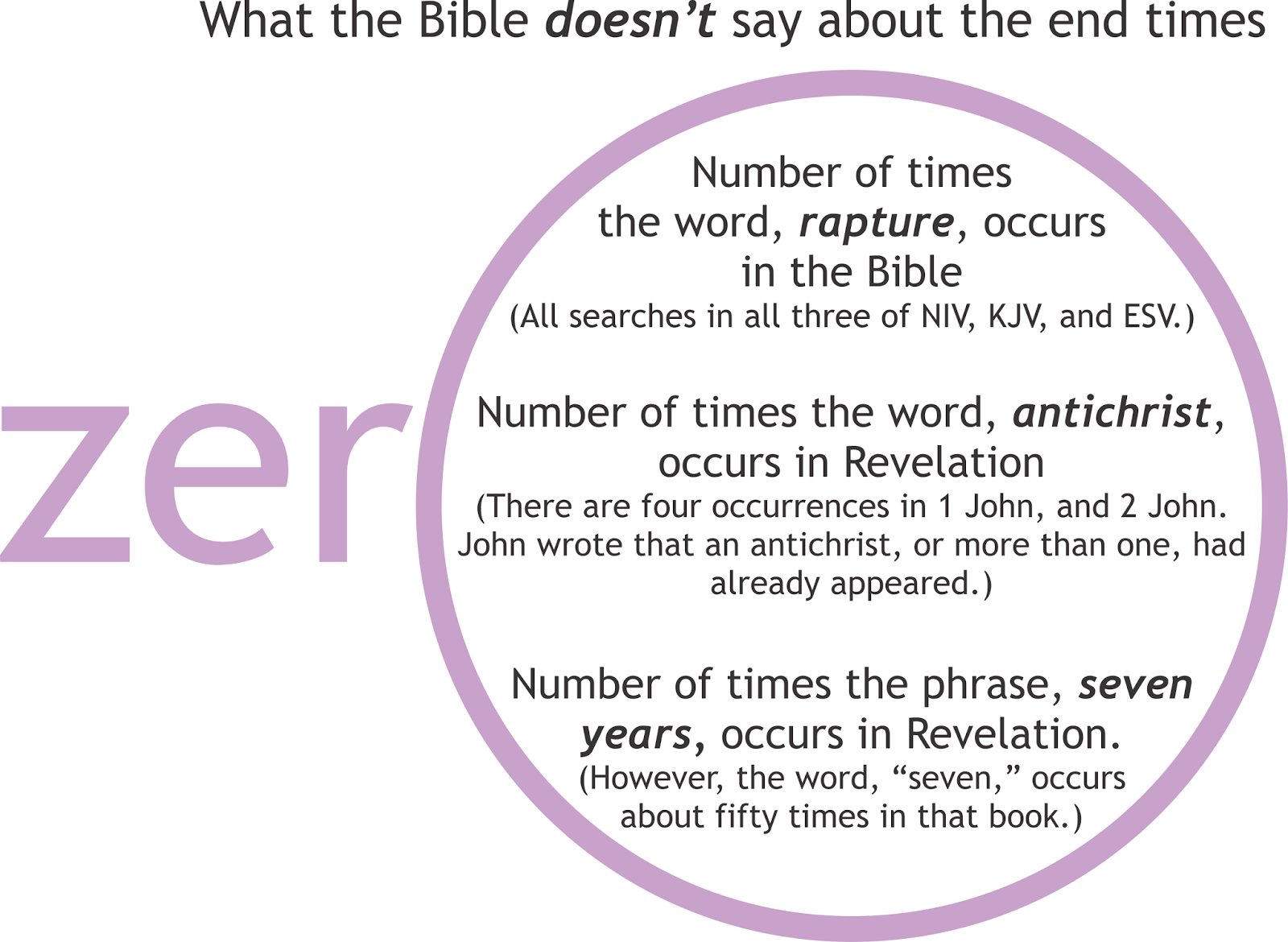
The word, "rapture," does not occur in the Bible.
The word, "anti-Christ" does not occur in Revelation.
The phrase, "seven years" does not occur in Revelation, either, even though the number seven occurs a few dozen times.
The nation of Israel, re-founded in 1948, may be related to Bible prophecy, (or may not) but the government discourages conversion to Christianity, and, in order to be classified as a Jew, a person does not have to so much as believe in God.

Thanks for reading.

Sunday, September 19, 2010

How does God reveal Himself to humans?

God’s revelation is of two types: Special and General. Special Revelation is through Christ. General Revelation, through other means, does not necessarily tell us about the necessity for salvation. General Revelation may reveal various attributes of God, such as His power, majesty, omniscience, omnipresence, and eternal existence.

God reveals many things, including His attributes, His love, His holiness, how He wants us to act, and guidance in specific situations. How does He do this? Here is a partial list:

  1. Through Christ (Hebrews 1:2)
  2. Through the Bible (2 Timothy 3:16)
  3. By the Holy Spirit (John 16:8-15)
  4. Through nature (Romans 1:20, Psalm 19:1-4, and also Psalm 97:6, Acts 14:17)
  5. By our conscience (Romans 2:15)
  6. Through history (1 Corinthians 10:6-13)
  7. In answer to prayer (1 Kings 18:36-39)
  8. By angels, and in visions and dreams (Matthew 2:19-21)
  9. Through miracles and providence (Exodus 4:1-5)
  10. Through the church (Acts 15:22-29)
  11. Through human creations (“I know three people who overcame temptations to atheism through the music of Johann Sebastian Bach.” - Peter Kreeft; “To him, art was God’s gift to make the earth bearable. Poetry and music were not luxuries, but necessities.” - David, McCasland, Oswald Chambers: Abandoned to God. The Life Story of the Author of My Utmost for His Highest. Grand Rapids, MI: Discovery House, 1993, p. 39; Jeremiah 22:6; Philippians 4:8)

Sources include Wikipedia articles on Revelation of God, and on Revelation. See also Peter Kreeft, “12 Ways to Know God, and also Twenty Arguments for the Existence of God.”

Please note that no single verse, or a few verses, should be taken as a firm basis for any doctrine. I have expanded item 11 more than the others, because the Biblical evidence is less direct.

Thanks for reading.

Thursday, March 11, 2010

"Soon" in Revelation 1:1, from He Lives

In a recent post, He Lives points out that there is a "soon" (or equivalent word, depending on the translation) in Revelation 1:1, and discusses the implications of that.

Thanks, He Lives!

Wednesday, December 30, 2009

Sunspots 241

Things I have recently spotted that may be of interest to someone else:


Science:
From Audubon magazine: what happens when a whale's body falls to the ocean floor.

(or something) CNN says that there will be a blue moon on New Year's Eve.


Christianity:
Todd Wood argues, pretty convincingly, that God wants His will and purposes to be known.

"God does not leave an empirical bread crumb trail in order to demonstrate His existence." (from here.)

Kerry I Am posted a New Year's Prayer a few days early.


Image source (public domain)

Sunday, November 15, 2009

Romans 1:20b poster: God's revelation through nature

Romans 1:20 poster

This is an attempt to illustrate Romans 1:20b (ESV), wherein God indicates that He reveals Himself to us through nature.

That's not the only way God is revealed. I would say that Christ, Himself, is the most important way, and that the Holy Spirit, the Bible, our conscience, and the church, are other ways that God is revealed.

The original photo is on our Flickr photostream. ESV copyright information is here.

I have previously blogged about this verse. One such attempt is here. In that post, I argue that, if God reveals Himself through nature, it is important that we keep nature as beautiful and diverse as possible, because, if we don't, we are making it more difficult for God to reveal Himself to us.

Thanks for reading, and looking.

Monday, September 21, 2009

Cautions on interpreting what the Bible says about end times


I believe that you can get a larger version of the graphic below, by right-clicking on it. You may feel free to use the graphic, as long as you do not use it for any commercial purpose -- it must remain free for all to use.

I don't have a lot of answers on end times. Some people seem to have answers, and they may be right. The above graphic illustrates reasons for caution. The Bible is not as clear about the end times as some people seem to believe that it is.

"Rapture" is not a word used in the Bible. The presentation of the idea of a rapture, a sudden removal of Christians from the world, that is most familiar to me is based on 1 Thessalonians 4:17. However, as you may learn from the comments on this post, below, that familiar presentation is probably mistaken, and a misinterpretation of scripture. (This paragraph was amended on September 28, 2009)

There are other reasons for caution. The Bible says this:
Matthew 24:36 “But concerning that day and hour no one knows, not even the angels of heaven, nor the Son, but the Father only. (All scripture from the ESV. See here for information on the ESV policy on on-line usage.)
and
Matthew 24:44 Therefore you also must be ready, for the Son of Man is coming at an hour you do not expect.

A serious warning, widely ignored, occurs in Revelation: 22:18 I warn everyone who hears the words of the prophecy of this book: if anyone adds to them, God will add to him the plagues described in this book, 19 and if anyone takes away from the words of the book of this prophecy, God will take away his share in the tree of life and in the holy city, which are described in this book.


Connie Willis, an author of fantastic literature, put it this way, probably a little too cynically, and, perhaps, even violating the warning above -- but she has a point -- in a short story:
The radio evangelists made it sound like the story of the Second Coming was a single narrative, but it was actually a hodgepodge of isolated scriptures -- Matthew 24 and sections of Isaiah and Daniel, verses out of Second Thessalonians and Joel, stray ravings from Revelation and Jeremiah, all thrown together by the evangelists as if the authors were writing at the same time. If they were even writing about the same thing. Connie Willis, "Epiphany," pp. 653-700, in The Winds of Marble Arch and Other Stories -- Burton, MI: Subterranean Press, 2007 -- p. 671. For similar thoughts, from an expert in Biblical interpretation, see here. (The expert doesn't call Revelation "ravings.") The expert, Kenneth Schenck, of Indiana Wesleyan University, is referring to the Dispensationalist view of end times, in particular the idea that there will be a seven year tribulation, and he points out that that view has, at best, very weak support in the Bible.
 
Thanks for reading. The Bible is clear on one idea about the end times: He is returning! We don't know when.

*    *    *    *    *

Added August 3, 2011: Here is a post, by me, on the first four prophecies mentioned by Matthew as being fulfilled by the coming, and early life, of Christ, and how difficult it must have been for those who first heard these prophecies, or even spoke and wrote them, to understand them as being about what actually happened.

Since these prophecies were difficult to interpret -- in some cases, impossible to interpret correctly until after the prediction came about -- why should we expect easy interpretations of prophecies about end times?

Added March 13, 2010:

David Heddle, of the He Lives blog, has recently posted on a particular word that occurs sometimes in prophecy, namely soon, and also this generation. He points out that some who claim to be interpreting the Bible very literally ignore, for example, part of the very first verse of Revelation, which says that Jesus told John that He was going to show him what would happen soon. Heddle doesn't seem to have a solution to how to deal with soon. I don't either. But, as I said in the title, it's best to be cautious, very cautious, about interpreting end times. Some people aren't very careful.

Added September 18, 2010:
Heddle has also posted on Armageddon, making a case for the idea that the Battle of Armageddon has already occurred.

Monday, February 09, 2009

A preterist view of origins

I have posted several times on a book by David Snoke, which argues, quite convincingly, in my view, that the Bible doesn't teach Young-Earth Creationism (YEC). (This is the last such post.) Although it's not perfect, I think the book is pretty good. Better than anything I might write, no doubt. An author, probably because he had read one or more of these posts, e-mailed me, and offered to send me a copy of a book he had written, which, although Christian in world-view, is also critical of YEC. I responded that I would be glad to see such a book. I was expecting a book that, like Snoke's, argues against YEC, and gives theological, Biblical, and other reasons for such an argument. When the book arrived, I found that it does argue against YEC, but that isn't what it's mostly about. The book, Beyond Creation Science: New Covenant Creation from Genesis to Revelation, by Timothy L. Martin and Jeffrey L. Vaughn, begins by explaining the preterist view of Revelation and other New Testament prophecy. (The book's web site is here. It was published in 2007 by Apocalyptic Vision Press, of Whitehall, Montana. If the book says so, I missed it, but I think that the press is a subsidiary of the church were author Martin is pastor. That doesn't mean that there is anything wrong with it, of course. I'm giving information here.) It is secondarily an indictment of YEC. As I understand the book, and preterist views, the authors are what Wikipedia calls Full Preterists.

I didn't know about the preterist leanings of the authors until I started looking at the book. It didn't take long. After getting past the cover, my first view of the contents was the 19 endorsements, on the first three pages of the book. As usual, such endorsements give a statement praising the book, followed by from one to three lines of identification of the endorser. Of these, five list some sort of preterist organization as the part or all of the affiliation of the endorser, and at least two more mentioned preterism as part of their endorsement. That struck me. I had a hard time remembering what preterism is, but it came to me -- it's a view of prophecy. Preterists believe that most or all Biblical prophecies, including those concerning the return of Christ, have already been fulfilled.

None of the endorsers were scientists, although there was an M.D. and an engineer. One of them said that he thought, in advance, that the book would be "beyond the pail" [sic] -- (see here) which led me to think that the book might be in need of some editing help -- but he was convinced as he read. I didn't find any other usage problems in the chapters that I read. The book is well put together. There are many pages of notes, an extensive scripture index, a bibliography, and an author index. For some reason, there is no subject index, which would have been helpful.

What does a preterist view of prophecy have to do with YEC? The authors contend that the modern YEC movement was heavily influenced by a dispensational view of prophecy. I'm no expert on the history of North American Christianity, but their case seems to be convincing, and I have seen it in other places, with no preterist beliefs. However, it does not logically follow, just because there are serious problems with YEC, and it was influenced by dispensational views, that preterist views are correct.

This is my first real experience with preterist views. I have known, for some time, that they exist, but I had not read them. The first four chapters of the book set forth these views. For example, preterists say that Jesus's statement, in Matthew 24, supports their view:
34 Truly, I say to you, this generation will not pass away until all these things take place. (All Scripture quotations are from the ESV.)
Other New Testament passages are cited as teaching the preterist view, including 1 Thessalonians 4:14-17, and James 5:8-9.

This is not the place, nor am I the person, to enter into an in-depth analysis of the preterist view. I do wonder about how that view explains two points of prophecy, however. One of them is the last trumpet, which is mentioned in Matthew 24:31 and 1 Thessalonians 4:16, among other places. If there was, indeed, a trumpet blown to announce the gathering of the elect (which both of these verses mention) why is there no historical record of that? The book points out places in the after-New Testament historical record which, the authors say, document the fulfillment of prophecy in the first century. But they don't seem to have any historical record showing the blowing of the trumpet, the appearance of Christ, and the removal of the saints.

The second point is the spread of the gospel to all peoples. As Jesus put it:
Matthew 24:14
And this gospel of the kingdom will be proclaimed throughout the whole world as a testimony to all nations, and then the end will come.
(See also other places, such as Revelation 7.) I don't understand how this could possibly have happened by the end of the first century. How could the gospel have gotten to the New World? To Australia? (But see the first comment on this post.)

This passage relates to both of my questions:
Matthew 24:30
Then will appear in heaven the sign of the Son of Man, and then all the tribes of the earth will mourn, and they will see the Son of Man coming on the clouds of heaven with power and great glory. 31 And he will send out his angels with a loud trumpet call, and they will gather his elect from the four winds, from one end of heaven to the other.

Preterists may have good arguments for points like these. I don't know. But, so far, I'm not convinced.

The majority of the book is devoted to a discussion of dispensationalist theology, which, as many Bible scholars have pointed out, has some serious weaknesses, even though it seems the most popular belief on end times among conservative Christians. (See here for one discussion of the weaknesses.) The book considers how this view has influenced the treatment of origins among the conservative Christian community. I agree that the two seem to be connected, although I'm not certain that the connection is as strong as Martin and Vaughn have set forth. Then, the final three chapters set forth what they believe is a proper view of prophecy, history, and Bible interpretation, including origins. Their term for this is "covenant creation."

Since I remain unconvinced about preterism, which is its foundation, I can't endorse this book. Re-examination of dispensational theology, Young-Earth creationism, and the proper role of the church in the world is a good, even great idea. But I'm not sure that Martin and Vaughn are on the right track.

Thanks for reading.

* * * *

On August 17, 2009, I cleaned up some sloppy English in this post, and made a reference to the first comment, which mentions a verse which seems to be in favor of preterism.