License

I have written an e-book, Does the Bible Really Say That?, which is free to anyone. To download that book, in several formats, go here.
Creative Commons License
The posts in this blog are licensed under a Creative Commons Attribution-NonCommercial-ShareAlike 3.0 Unported License. You can copy and use this material, as long as you aren't making money from it. If you give me credit, thanks. If not, OK.
Showing posts with label Genesis 1 and 2. Show all posts

Tuesday, September 05, 2023

Is Genesis straightforward historical narrative? Genesis 1 and 2

The Answers in Genesis Statement of Faith says, in part: “The account of origins presented in Genesis 1–11 is a simple but factual presentation of actual events, and therefore, provides a reliable framework for scientific research into the question of the origin and history of life, mankind, the earth, and the universe.” … and “The days in Genesis do not correspond to geologic ages but are six consecutive, 24-hour days of creation; …”

Two previous posts (genre, and culture) on this blog describe the effect of genre, and of the culture of the writers, and listeners/readers, in ancient times, on what the Bible communicates. Those effects, and other reasons, indicate that Genesis 1-2, in particular, is not simple, and does not necessarily communicate consecutive events. 

Let’s consider the questions of simplicity and of consecutive events.
 
Genesis 1 puts the creation of humans, male and female, on Day 6. If Genesis 2 does, it doesn’t do so simply. Adam comes at the beginning, and Eve at the end, in chapter 2. It is possible to reconcile these accounts on this point, but, to do so, one must depart from a “plain reading of scripture.*” Genesis 1 also puts land plants in day 3, before the creation of humans, whereas Genesis 2 seems to put Adam before the plants. Genesis 1 puts the creation of animals on day 6, whereas Genesis 2 appears to put that creation after the appearance of Adam. Answers in Genesis, and others, believe that Genesis 2:19 should be translated to say that God “had formed” -- already done it -- before presenting the animals to Adam. Perhaps, but only four of the Bible versions given in the Blueletter Bible say that. The other thirteen say “formed,” as if it happened as they were presented to Adam. One of the four that says “had formed” gives “formed" as an alternate reading.

There are many God-fearing, Christ-believing Bible scholars who are convinced that Genesis 1 and 2 were not intended to be step-by-step historical narrative, and/or who do not think that their purpose was to establish the timing of creation. Listen to N. T. Wright, for one.

There are other reasons for doubting that Genesis 1 and 2 were meant to give us a step-by-step historical narrative of the creation. God willing, I shall continue this series.

Answers in Genesis zealously defends the Bible, if the Bible needs any defense, but they propose at least one really strange idea of how to look at the Bible.

*Ken Ham, Answers in Genesis, “Pausing for a Leaven warning,” March 2, 2023, writes “we should always be suspicious when the secular world proclaims anything at odds with a plain reading of Scripture.” That phrase, “plain reading of scripture,” is claimed as the foundation of Answers in Genesis, the most influential young-earth entity.

Thursday, February 25, 2021

Denis Lamoureux on the Bible and ancient science

Denis Lamoureux has written a good book. The title is The Bible & Ancient Science: Principles of Interpretation. (Note that there's an ampersand, not an "and" in the title.) The point, made over and over, by analyzing the original language of the Bible, is that the Bible was written from the standpoint of ancient science.

Lamoureux discusses the statement, by Jesus, that the mustard seed is the smallest seed (it isn't) in Mark 4:30-32. Jesus wasn't teaching botany, nor was He mistaken, or lying. He was speaking to the people of the day, using the knowledge that they had. The message, about the Kingdom, was far more important than the size of the seed.
 

The author also discusses the beliefs of Biblical writers on human reproduction. They thought that a woman was merely a sort of field, where the male implanted something which grew into a child. Infertility was always the "fault" of the woman. The Bible reflects that belief. Again, the Bible isn't a text on human reproduction. It's a text on God's plan of redemption, and false beliefs about peripheral issues are just that, peripheral.

Another item. The Biblical authors thought that the earth was circular and flat, surrounded by water, and that there was a solid firmament above it. But Genesis 1-2 isn't a textbook of astronomy, geology, meteorology or oceanography. It was written from the standpoint of the beliefs of the people of the day, and tells us that God is creator, that the creation was good, that humans sinned and need a Redeemer. There is no firmament, even though the Bible writers thought that there is. The earth is not flat -- careful study of the Hebrew of the Bible, which Lamoureux appears well-qualified to do, shows that the Bible does not teach that the earth is a globe, but describes it as if it was flat.


(The illustration above is not from the book)

Lamoureux, like many others, points out that the apparent sequences of events in Genesis 1 vs. 2 seem to be contradictory. But Genesis 1-2 was not meant to be taken as a literal, step-by-step account (or accounts) of what happened at the beginning, and it isn't that. Does this downgrade the Bible, or the Gospel? No, argues Lamoureux. The first part of Genesis was made to teach eternal truths, namely that one God created, without using stuff from some other entity, that creation was good, and that sin entered the world.

Although he doesn't mention Ken Ham and Answers in Genesis much, the book demonstrates that the AiG thesis, that the earth is only a few thousand years old, is not really based on scripture, in spite of what AiG believes  the Bible says. Lamoureux directly criticizes the writings of Henry Morris, the most important young-earth creationist of the 20th century, for the same reason -- he took Bible passages that were not meant to be taken literally, and not meant to describe the world in terms that we would use now, and took them literally, and as if they describe the world as we now understand it.

There's more serious, and good, thinking and teaching in the book.

I was pleased to be able to read this in Kindle format, using my Kindle Unlimited membership. But the Kindle version's type size was almost too small to read on my 9 inch tablet, and, unlike most books in Kindle format, the type size can't be changed on this one. 

Thanks for reading. Read Lamoureux.
Monday, May 18, 2020

Creation Unfolding by Ken Coulson

I recently read Creation Unfolding: A New Perspective on Ex Nihilo (available to read free to Kindle Unlimited members) by Ken Coulson.

It was an interesting book, and I'm glad I read it.

Coulson is a Young-earth creationist (YEC). He is a geologist, not a biologist. The book says very little about biology, nor, of course, about evolution. The author has researched his subject thoroughly, except that he doesn't deal with the interpretation of Genesis 1 and 2. He takes both chapters as if they were meant to be literal, history-like descriptions.

How is Coulson different from many other YECs? I point out three significant ways.

First, he doesn't believe that nature, general revelation, was meant to reveal God as creator. He puts it this way:
In 1 Corinthians 1:21 (ESV), Paul makes God’s design abundantly clear: “For since, in the wisdom of God, the world did not know God through wisdom, it pleased God through the folly of what we preach to save those who believe.” The world is not allowed to come to know the God of creation by pursuing its own wisdom (e.g., through scientific endeavor). This is by God’s sovereign design.

Coulson goes on to say that, if God had wanted to make His creativity indubitably clear, He could have stamped each child born with a stamp proclaiming this. He doesn't say so, but perhaps, if Coulson had thought of this, he might have said that cloud formations could have said "made by God," in the language appropriate to each area of the world.

There are YECers, and other Christians, who would argue that Psalm 19 and Romans 1 tell us that God has revealed Himself though His creation, and holds us responsible for understanding that. Statements like this are made: "Look at the retina of the eye. (or some other natural wonder) How marvelous it is! You should believe in the God who created it!"

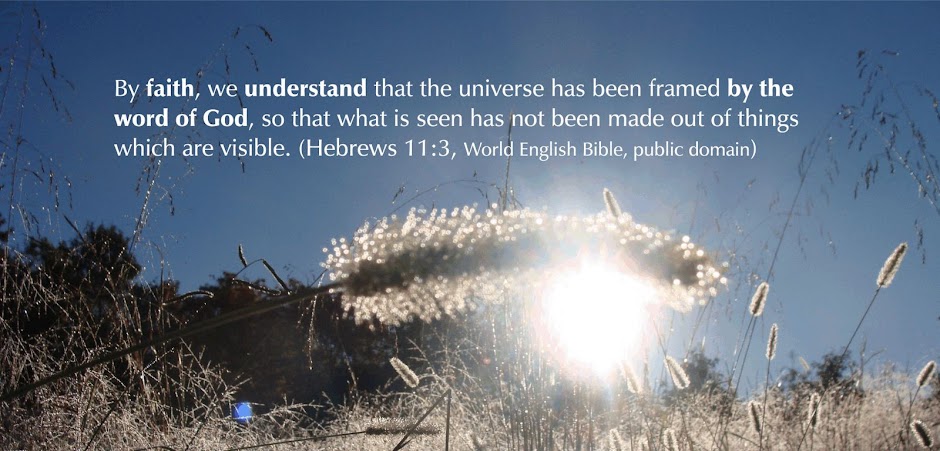
The picture at the top of this post, quoting Hebrews 11:3, indicates that we understand God's creative power through faith, and that perhaps those without faith cannot grasp this.

Second,  here's what he has to say about the Flood:
The Flood of Noah was a real, world-wide watery catastrophe. As such, geological evidence should exist that supports this catastrophe. Many YEC, however, have overstepped the line here by proposing that almost all the world’s sedimentary layers were deposited in the Flood. To think otherwise is sometimes viewed sacrilegiously. Now, it may be that nearly all the Earth’s geological layers were in fact deposited during Noah’s Flood, but there is nothing in Scripture that demands this. For all we know, the entire Flood record could extend to a single geological package of strata that represents a single geological period.

Not many YECers would agree with that.

Third, Coulson introduces a concept, and a term, that, as far as I know, is his, er, creation.

The term is Supernatural Formative Process(es) (SFP) which acronym is abundant throughout the book. For example: "In other words, although Adam’s bones and Eden’s trees would suggest processes leading to real histories, those processes and histories, as with those of the crust’s first crystals, are only apparent." In other words, Coulson argues that the earth, and the surrounding universe, only appear to be billions of years old, because God changed the rates of natural processes. And,

For example, if all rates everywhere in the universe were doubled, the participant would not notice this doubling unless there existed an unaltered rate that could serve as a frame of reference (Poythress 2019, p. 221). I propose that God has provided this frame of reference in the refrain that occurs at the end of each creative day: “And there was evening and there was morning.” This would mean that except for the rhythm of night and day, all other rhythms were accelerated in a time-lapse fashion.

So SPF are "natural" processes, which may be accelerated by God, and, if appropriate, kept in synchrony with other such processes, because the rates of each are sped up proportionally.

Coulson discusses several events, some biblical (like the water being transformed into wine in John 3) and some not so (the discovery of SN1987A, a supernova that looks like the light from it started heading toward us a long time before 6000 BC.)

Although Coulson claims that an appearance of age is not God being deceptive, because God altered various rates of processes, it's hard for me, after reading the book, to accept any Appearance of Age concept without thinking that God has unnecessarily hidden what He has done, and maybe is even being deceptive. God, of course, could have modified all sorts of rates, maybe even all of them except night and day, and presented us with an earth that is, actually, only a few thousand years old, in a universe that is also only a few thousand years old, regardless of their appearance. But did He? I don't think so. Perhaps I'm wrong.

It seems to me, and to many others, in the present, and in the history of the church, that most YECers, including Coulson, are starting from wrong presuppositions, namely that the days of Genesis 1 were consecutive 24-hour days, and that the Bible teaches that the earth, and the universe, were created in about 6000 BC. Many Christians, of the present and the past, believe that the first part of Genesis was not meant to be interpreted in a literal fashion. It is easier for me to believe that it was not so meant, than to believe that God adjusted all sorts of geophysical, chemical, astronomical and biological processes.

For some discussion of the interpretation of Genesis 1 and 2, see here.

There's also this simple graphic:


Which, I believe, shows that Genesis 1 and 2 cannot both (or either) taken literally.

Thanks for reading!