This is another excerpt from
Murray's discussion of the Lord's Prayer. God willing, there will be
more excerpts from this discussion later:
‘Hallowed be Thy name.’ What name? This new name of Father. The word Holy is the central word of the Old Testament; the name Father of the New. In this name of Love all the holiness and glory of God are now to be revealed. And how is the name to be hallowed?
By God Himself: ‘I will hallow My great name which ye have profaned.’ Our prayer must be that in ourselves, in all God’s children, in presence of the world, God Himself would reveal the holiness, the Divine power, the hidden glory of the name of Father. The Spirit of the Father is the Holy Spirit: it is only when we yield ourselves to be led of Him, that the name will be hallowed in our prayers and our lives. Let us learn the prayer: ‘Our Father, hallowed be Thy name.’
‘Thy kingdom come.’ The Father is a King and has a kingdom. The son and heir of a king has no higher ambition than the glory of his father’s kingdom. In time of war or danger this becomes his passion; he can think of nothing else. The children of the Father are here in the enemy’s territory, where the kingdom, which is in heaven, is not yet fully manifested.
What more natural than that, when they learn to hallow the Father-name, they should long and cry with deep enthusiasm: ‘Thy kingdom come.’ The coming of the kingdom is the one great event on which the revelation of the Father’s glory, the blessedness of His children, the salvation of the world depends. On our prayers too the coming of the kingdom waits. Shall we not join in the deep longing cry of the redeemed: ‘Thy kingdom come’? Let us learn it in the school of Jesus.
This post continues what is intended to be a series of excerpts from With Christ in the School of Prayer,
by Andrew Murray. I thank the Christian Classics Ethereal Library for
making this public domain work available. To see their post of the book,
go here. The previous post is here. As usual in this blog, long quotations are in this color.

Musings on science, the Bible, and fantastic literature (and sometimes basketball and other stuff).
God speaks to us through the Bible and the findings of science, and we should listen to both types of revelation.
The title is from Psalm 84:11.
The Wikipedia is usually a pretty good reference. I mostly use the World English Bible (WEB), because it is public domain. I am grateful.
License
I have written an e-book, Does the Bible Really Say That?, which is free to anyone. To download that book, in several formats, go here.

The posts in this blog are licensed under a Creative Commons Attribution-NonCommercial-ShareAlike 3.0 Unported License. You can copy and use this material, as long as you aren't making money from it. If you give me credit, thanks. If not, OK.
The posts in this blog are licensed under a Creative Commons Attribution-NonCommercial-ShareAlike 3.0 Unported License. You can copy and use this material, as long as you aren't making money from it. If you give me credit, thanks. If not, OK.
Showing posts with label KIngdom. Show all posts
Showing posts with label KIngdom. Show all posts
Sunday, March 01, 2020


Tuesday, June 27, 2017
God will care for us, if we put His Kingdom first
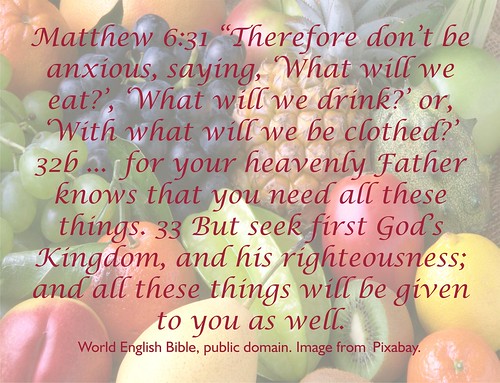
A graphic interpretation of Jesus's question to the disciples, in the Sermon on the Mount: "won't God take care of you?"
(He will.)
And His command, to put the kingdom of God first.
Thanks for looking.
Sunday, July 20, 2008
What Christians Believe
What do Christians believe? That's a good question, and the answer, whatever it may be, will certainly not please everyone. However, let me have a stab at it.
C. S. Lewis wrote Mere Christianity, a twentieth-century attempt to explain what Christians believe. He attempted, I believe successfully, to consider the beliefs that are common among Christians.
The Wikipedia tells us that a creed is "a statement or confession of belief," and that such creeds are often part of a religious service.
Two of the most important creeds in the history of Christianity are The Apostles' Creed, and, later in history, The Nicene Creed, which was developed from the earlier one. Many Christian denominations use one or the other of these creeds in their services, and one or the other (or both) of them are often used as a distillation of the beliefs common to Christians.
Here is the 1975 Ecumenical version of the Nicene Creed:
These 30 or so lines do, indeed, cover what strikes me as essential Christian beliefs, and I would say that if a person does not believe these things, such a person should not be called a Christian.
There are some problems, however.
One of those problems has to do with the acceptance, or use, of one or the other of the two most important creeds by evangelical churches. There is little such use. Why? Not, I think, because evangelicals don't agree with the creeds. But evangelicals emphasize the Bible as the source of God's revelation, and these two creeds are not biblical. They were written after the last book of the Bible was written. It is also true that the creeds only speak of what Christians believe about God. They don't speak of how we know about God -- the means of revelation -- very much. True, the Nicene Creed does mention the scriptures, and could be taken as implying that its entirety comes from the Bible, but it doesn't say that.
It is also true that evangelicals largely have distanced themselves from formal rituals in worship, except, of course, that we have our own rituals. There is, I think, a fear that reciting the same thing, however good it may be, over and over, tends to turn it into a meaningless ritual. That danger is real. However, my personal view is that there is an even larger danger in not reminding ourselves of our core beliefs, perhaps not at every service, but often.
In evangelical services, the sermon is usually the high point. In other churches, the recitation of one of the two great creeds often is the high point.
Another problem with the Nicene Creed above is that it says nothing about Christian behavior. To state the obvious, it says nothing at all about sex, power, or money (and a lot of other things).
(Paragraph Added March 24, 2015) N. T. Wright, in his How God Became King: The Forgotten Story of the Gospels, points out that the creeds leave out the entire history of Israel, and say nothing about the Kingdom that Christ established, while He was here in His human incarnation. He says that the main purpose of the creeds was to establish orthodoxy -- to settle controversial points, not to set forth a summary of Christian truth.
In subsequent posts, I hope to consider the issue raised in the previous paragraph. I also hope to consider the question of Christian tolerance, or intolerance -- must Christians believe that those from other faiths cannot be saved from eternal death? (The next post, on the matter of behavior, is here.)
I have also posted on "Evidence of God's Reality."
Thanks for reading.
Added January 10, 2018: In relation to the paragraph added in March, 2015, see this post, from the He Lives blog, which goes into detail on how various statements in the creeds were meant to combat heresies.
C. S. Lewis wrote Mere Christianity, a twentieth-century attempt to explain what Christians believe. He attempted, I believe successfully, to consider the beliefs that are common among Christians.
The Wikipedia tells us that a creed is "a statement or confession of belief," and that such creeds are often part of a religious service.
Two of the most important creeds in the history of Christianity are The Apostles' Creed, and, later in history, The Nicene Creed, which was developed from the earlier one. Many Christian denominations use one or the other of these creeds in their services, and one or the other (or both) of them are often used as a distillation of the beliefs common to Christians.
Here is the 1975 Ecumenical version of the Nicene Creed:
- We believe in one God,
- the Father, the Almighty
- maker of heaven and earth,
- of all that is, seen and unseen.
- We believe in one Lord, Jesus Christ,
- the only Son of God,
- eternally begotten of the Father,
- God from God, Light from Light,
- true God from true God,
- begotten, not made,
- of one Being with the Father.
- Through him all things were made.
- For us men and for our salvation
- he came down from heaven:
- by the power of the Holy Spirit
- he became incarnate from the Virgin Mary, and was made man.
- For our sake he was crucified under Pontius Pilate;
- he suffered death and was buried.
- On the third day he rose again
- in accordance with the Scriptures;
- he ascended into heaven
- and is seated at the right hand of the Father.
- He will come again in glory to judge the living and the dead,
- and his kingdom will have no end
- We believe in the Holy Spirit, the Lord, the giver of Life,
- who proceeds from the Father and the Son.
- With the Father and the Son he is worshipped and glorified.
- He has spoken through the Prophets.
- We believe in one holy catholic* and apostolic Church.
- We acknowledge one baptism for the forgiveness of sins.
- We look for the resurrection of the dead,
- and the life of the world to come. Amen.
These 30 or so lines do, indeed, cover what strikes me as essential Christian beliefs, and I would say that if a person does not believe these things, such a person should not be called a Christian.
There are some problems, however.
One of those problems has to do with the acceptance, or use, of one or the other of the two most important creeds by evangelical churches. There is little such use. Why? Not, I think, because evangelicals don't agree with the creeds. But evangelicals emphasize the Bible as the source of God's revelation, and these two creeds are not biblical. They were written after the last book of the Bible was written. It is also true that the creeds only speak of what Christians believe about God. They don't speak of how we know about God -- the means of revelation -- very much. True, the Nicene Creed does mention the scriptures, and could be taken as implying that its entirety comes from the Bible, but it doesn't say that.
It is also true that evangelicals largely have distanced themselves from formal rituals in worship, except, of course, that we have our own rituals. There is, I think, a fear that reciting the same thing, however good it may be, over and over, tends to turn it into a meaningless ritual. That danger is real. However, my personal view is that there is an even larger danger in not reminding ourselves of our core beliefs, perhaps not at every service, but often.
In evangelical services, the sermon is usually the high point. In other churches, the recitation of one of the two great creeds often is the high point.
Another problem with the Nicene Creed above is that it says nothing about Christian behavior. To state the obvious, it says nothing at all about sex, power, or money (and a lot of other things).
(Paragraph Added March 24, 2015) N. T. Wright, in his How God Became King: The Forgotten Story of the Gospels, points out that the creeds leave out the entire history of Israel, and say nothing about the Kingdom that Christ established, while He was here in His human incarnation. He says that the main purpose of the creeds was to establish orthodoxy -- to settle controversial points, not to set forth a summary of Christian truth.
In subsequent posts, I hope to consider the issue raised in the previous paragraph. I also hope to consider the question of Christian tolerance, or intolerance -- must Christians believe that those from other faiths cannot be saved from eternal death? (The next post, on the matter of behavior, is here.)
I have also posted on "Evidence of God's Reality."
Thanks for reading.
Added January 10, 2018: In relation to the paragraph added in March, 2015, see this post, from the He Lives blog, which goes into detail on how various statements in the creeds were meant to combat heresies.
Subscribe to:
Posts (Atom)