License

I have written an e-book, Does the Bible Really Say That?, which is free to anyone. To download that book, in several formats, go here.
Creative Commons License
The posts in this blog are licensed under a Creative Commons Attribution-NonCommercial-ShareAlike 3.0 Unported License. You can copy and use this material, as long as you aren't making money from it. If you give me credit, thanks. If not, OK.
Showing posts with label carbohydrate. Show all posts

Saturday, December 06, 2014

I'm thankful for Glucose! You should be, too.

Thankful for glucose

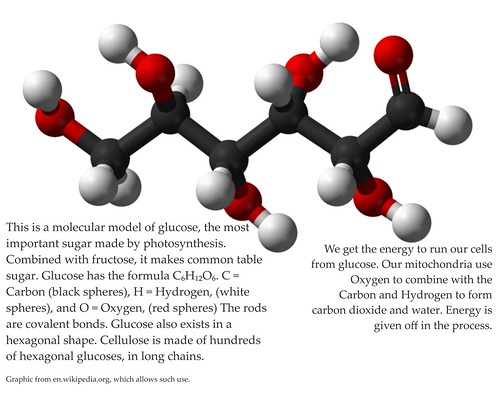
I'm thankful for glucose. Why? It's the most important product of photosynthesis. In other words, all food comes from glucose, somehow. If you are hospitalized, and need to be given nutrition intravenously, you'll get glucose. That makes sense, because glucose is the main source of energy in our cells. It's absolutely important.

The figure above shows a molecule of glucose in one configuration, a chain of six Carbon atoms. There is another configuration, namely hexagonal. In this picture, you can see a chain of these hexagons, each made of 5 Carbon molecules and 1 Oxygen molecule, with other atoms, including 1 Carbon, attached to the central hexagon. That picture is of a molecular model of cellulose, which is a critical component of the structure of plants. That's another reason why glucose is important, besides its use as an energy source.

Common table sugar is made of a molecule of glucose and a molecule of fructose, which is quite similar to glucose, but not identical to it.

Sugar substitutes, or artificial sweeteners, contain a hexagon much like that in glucose. Presumably, the sweetness receptors in our tongues are stimulated by molecules closely resembling glucose in shape, that fit into the sweetness receptors.

Plants store chemical energy (food) as starch, which is made up of many glucose molecules. When we eat starchy foods, we break up the starch, into glucose. One enzyme that does that is amylase, which is secreted in our saliva. If you keep a starchy food, such as a soda cracker or a piece of raw potato, in your mouth, and keep chewing it, you will experience a sweet taste. That taste comes from glucose. Animals store glucose as glycogen.

The Wikipedia says: "It is unclear why glucose, as opposed to other hexose sugars, is so widely used in living organism." So far, anyway. It's not unclear to the Creator, who planned for a carbohydrate, made from Carbon, Hydrogen and Oxygen, with the formula C6H1206, and the shape of a hexagon, to be so important to us. I can't prove that, but no one can disprove it, either.

This is the last in a series, expressing gratitude for a few molecules or elements that are crucial for life on earth. This one is posted between Thanksgiving and Christmas, which is an appropriate time for posting about sugar.

Monday, November 19, 2007

Dare I say it? I'm thankful for carbohydrates

I'm thankful for carbohydrates! I know, carbohydrates have gotten a rather bad reputation. There have been fashionable diets that tried to eliminate them. In fact, this Wikipedia article on carbohydrates says that they are not absolutely needed in our diet -- we can get the energy and nutrients we need entirely from other sources. So why be thankful for carbohydrates?

Well, for one thing, I like sugar and sweet things. Sugars are carbohydrates. So are starches, which are complex molecules made from many sugars. Starches are broken down into sugars as part of digestion. Some of that digestion takes place in the mouth, and mouth-digested starchy foods can taste sweet.

For another, much more important reason, carbohydrates are the first usable food products of the processes that make up photosynthesis, the amazing, and absolutely essential activity that turns water, carbon dioxide, and light into food. Carbohydrates are also turned into almost every other organic molecule in living things, by metabolism. The D in DNA stands for deoxyribose, a sugar. Amino acids, which make up protein, are synthesized, directly or indirectly, from molecules produced in making or breaking down sugars in our cells, or the cells of other organisms. Vitamins, steroids, and other critical cell components are made from carbohydrate raw materials. Plants use cellulose, a carbohydrate, for much of the structure of their cell walls. Lignin, synthesized from carbohydrates, makes up most of the rest. Without cell walls, plants wouldn't have the essential structures that they do, such as roots, stems, flowers and leaves. (Cell walls are also a major constituent of cotton and other natural fibers, and of paper.) In other words, without carbohydrates, life as we know it would be impossible.

Jesus said, in the Lord's prayer, "Give us our daily bread." Bread was an essential part of the diet of people of Bible times. David brought loaves of bread to the army. Bread was put out as a sort of offering in the Tabernacle. Bread contains carbohydrate. However, it also has protein, fiber, important minerals, and other things we ought to take in.

Sure, I can eat too many carbohydrates, and be a sugar glutton, but, all in all, I'm thankful to God for carbohydrates. Thanks for reading.

This post was expanded on November 24, 2018.

I have posted about other things I am thankful for, probably including carbohydrates, at other times. See here and here for links to these posts.

I'm also thankful to you, my reader!