License

I have written an e-book, Does the Bible Really Say That?, which is free to anyone. To download that book, in several formats, go here.
Creative Commons License
The posts in this blog are licensed under a Creative Commons Attribution-NonCommercial-ShareAlike 3.0 Unported License. You can copy and use this material, as long as you aren't making money from it. If you give me credit, thanks. If not, OK.
Showing posts with label extinction. Show all posts

Sunday, July 26, 2026

Sunspots 1004


Things I have spotted that may be of interest to others:

An extensive web site on Charles Wesley.

Gizmodo reports on terrible conditions for living things in ancient times. Probably these threats were caused, or enhanced, by ferns. That's right, ferns.

An article in The Conversation, discusses testosterone levels carefully. Unlike some.

NPR, and other outlets on a rogue artificial intelligence, which hacked into another AI, without help from real humans.

SpaceDaily reports on exploration, deep in ocean tranches, by a Chinese group, which found large ecosystems, getting their energy from methane and other molecules.

Joel Duff has posted a careful analysis of Intelligent Design ideas.

Heart, Mind,, Soul and Strength gives a list of Greek words for kinds of love, and, also, Greek words for love that weren't used in the New Testament.

Friday, November 24, 2023

Sunspots 959

Things I have recently spotted that may be of interest to others*


Computing: A Christianity Today author warns of the danger of spending time in cyberspace. In addition to pornography and misinformation, internet use distorts the importance of the real world.

(or something:) NPR tells what happens to lost luggage. There's a lot of it!

Science: ScienceAlert describes an amazing newly found area on the ocean bottom.

A Conversation writer discusses genetic and other changes in species, which help them avoid extinction, due to climate change. Most of these strategies are not enough.

NPR reports on an attempt to grow food plants on simulated Martian soil.

(or something): NPR tells us about big tumbleweeds, lots of them.

Sports:

*I try not to include items that require a password or fee to view

Thanks for reading.

Wednesday, November 08, 2023

Sunspots 957

Things I have recently spotted that may be of interest to others*


Health: A Conversation writer tells us why we often get nasal congestion when we're sick, and about the functions of snot.

Politics: (or something) A Conversation writer tells us that young black men are more likely to die in certain small areas of large cities than as if they were engaged in battle as part of the US military.

Russia has withdrawn support for the nuclear test ban treaty, according to Reuters.

A Conversation article tells us that Democrats and Republicans differ widely on whether or not to remove misinformation from social platforms.

Science: Gizmodo reports on how the Yucatán asteroid may have wiped out the dinosaurs.

Gizmodo also reports that scientists have found that an asteroid, less than a kilometer in size, has an even smaller asteroid orbiting it. A later report shows that the smaller asteroid is actually two rocks.

Phys.Org reports that studies of DNA from many species of crabs indicates that crabs took up residence out of the ocean about 17 different times.

A Conversation writer tells us how we come up with the word we want, fast.

*I try not to include items that require a password or fee to view

Thanks for reading.

Wednesday, April 05, 2023

Sunspots 930

Things I have recently spotted that may be of interest to others:*


Christianity: The Natural Historian considers LeBron James in light of Psalm 139:13 ("For you formed my inmost being. You knit me together in my mother’s womb."

Computing: (and the Arts)  The Conversation reports on the use of 3-D printing in producing buildings, and architecture.

Education: Grammarphobia discusses laundry lists.

Environment: Gizmodo reports that it's not just oceans that are rising. It's also groundwater, and that is causing big problems.

Gizmodo also reports that cats have hunted several animal species to extinction.

Health: Gizmodo reports that we are running out of effective antibiotics, as bacteria have quickly adapted.

Science: The Conversation presents a discussion on the relationship between tornadoes and global warming.

Another Conversation writer tells us why snails and slugs are so slow.

Thanks for reading. 

Wednesday, December 29, 2021

Sunspots 864

Things I have recently spotted that may be of interest to others*:

The Arts: A BBC report (about 3 minutes long, video) on some amazing paper folding.

Christianity: Singer Mariah Carey insists that she is NOT the queen of Christmas. Mary is.

Relevant is not happy with Christians who think that there is a so-called "war on Christmas."

Education: (or something) NPR discusses the significance and history of piñatas.

Environment: Gizmodo reports that Halliburton, a large corporation, claims to have lost important evidence related to two different massive fuel leaks.

Health: NPR discusses mask types, with recommendations.

Science: Gizmodo reports on a study that found a hundred or more "rogue planets." (A rogue planet is one that doesn't orbit a sun/star.

Gizmodo also reports that the ivory-billed woodpecker seems to be extinct.

Edward O. Wilson, perhaps the most influential biologist of the 20th Century, passed away recently. 

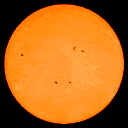
The graphic used in these posts is from NASA, hence, it is free to use like this.

*I try not to include items that require a password or fee to view.

Thanks for reading.

Wednesday, October 13, 2021

Sunspots 853

Things I have recently spotted that may be of interest to others*:


Environment: Gizmodo considers the question of whether city living or country living is easier on the environment.

Health: (and Computing) Gizmodo reports on a watch that alerts you to breathing issues, including sleep apnea.

Politics: (And Christianity) an article on the dangers of populism, which affects both the left and the right.

Science: NPR reports that the ivory-billed woodpecker, and other species, have been declared extinct.

NPR also reports on a gene editing experiment that worked.

The Scientist reports on a study showing that barnacles don't always stay in the same place.

Relevant reports that bumblebees have disappeared from eight states. The states are widely distributed.

The graphic used in these posts is from NASA, hence, it is free to use like this.

*I try not to include items that require a password or fee to view.

Thanks for reading.


Wednesday, September 22, 2021

Sunspots 851

Things I have recently spotted that may be of interest to others*:


Christianity (and Health): Relevant reports that public support for allowing religious exemptions against being vaccinated is declining. Christianity Today has a somewhat different take on this matter.

Education: Grammarphobia discusses the history of the expression "put English on the ball."

Environment: (and Computing) Gizmodo reports on the amount of environmental damage from bitcoin transactions.

Relevant reports that 27 species have recently been moved from "endangered," to "extinct." The article also mentions a joint statement by the Pope, the Archbishop of Canterbury, and the Orthodox Patriarch, on climate change.

Health: (and Politics, unfortunately) NPR reports on ivermectin, which has been used to treat COVID, without solid evidence than it works.

Science: The Scientist reports on successful attempts to potty-train cows, and why it's a good idea to do so.

Gizmodo reports that Martian colonists could produce concrete-like building materials from Martian soil mixed with their own blood.

Gizmodo also reports that two more murder hornet nests have been found in Washington State.

Gizmodo also reports on a new tool that should help remove stuck screws.

The graphic used in these posts is from NASA, hence, it is free to use like this.

*I try not to include items that require a password or fee to view.

Thanks for reading.

Thursday, April 22, 2021

How many offspring will a maple tree have?

Maple seeds, older Maple seeds/fruit

The maple seeds/fruit (known to botanists as samaras, and, in some cultures, as whirlybirds or helicopters), are usually abundant. There are a couple of dozen of them in this photo, which is of a small part, maybe 2 or 3 percent or less, of the whole tree.

How many of these would you expect to grow to be mature maple trees? And, more broadly, how many new adult trees would you expect this maple tree to have as offspring, during its life?

The answers to these questions may surprise you. They are none, and one. Why? Here's why. If each and every one of just the seeds in this photo grew to maturity, and other maple seeds did the same, and continued to do so for a few generations, the world would be covered in maple trees. It isn't. Unless there is an expansion of maples, each maple, on average, produces one offspring that reaches maturity and makes another generation's worth of maple seeds. On the other hand, if the replacement rate is less than one new maple per maple tree, it wouldn't take long for maples to vanish.

The usual replacement rate for organisms is one adult descendant in the next generation.

There are exceptions, but they must be temporary. Humans have often produced more than enough to replace themselves, and human populations have expanded. But this can't, and won't, go on forever. Other organisms have also had growing populations. Fire ants in the southeast US come to mind. There didn't used to be any, but now many a pasture has lots of nests visible. And, conversely, other types of living things have disappeared, or have nearly done so, such as cougars, because they don't replace their population numbers.

Darwin's concept of natural selection used the ideas of lots of offspring, and that the fittest survive. Although we can see no important differences between the maple seeds in the photo, it is likely that there are some genetic differences, giving some seeds a better chance than others. (Chance also plays a role -- where the seeds land surely would make a difference in their ability to survive.)

Keep growing and multiplying, but don't take over the earth's surface! Thanks for reading.

Wednesday, September 16, 2020

Sunspots 798

Things I have recently spotted that may be of interest to someone else: 

Christianity: Relevant has an article on the idolatry of patriotism.

Environment: Gizmodo says that animal extinction is increasing, but that it doesn't have to be that way.

Gizmodo also reports that the city of Charleston, South Carolina, is one of several that are suing oil companies because of increased flooding.

NPR reports on how oil companies knew plastic recycling wouldn't work, but promoted it heavily. It still doesn't work for plastics, and it's still being promoted.

Gizmodo reports that climate change denial is alive and well in Australia, as well as in the US.

Gizmodo also reports that international biodiversity goals have not been met, although there has been some progress. We are "rapidly losing the rainforests that play an important role in protecting us from our own carbon pollution, the bees we depend on to pollinate our food, and the coral reefs that shield millions of people from flooding ..." 

Politics:  FiveThirtyEight on Republican efforts to make it harder to vote (the report says that some Republicans are making it easier to vote).

Relevant reports that there was no child trafficking ring taken down in a raid in Georgia.

FiveThirtyEight on how, and why, white seniors in Florida are less likely to support Trump than in 2016.

Gizmodo reports that conservative media are influencing people to not evacuate when there's a hurricane warning.

It also reports that the Department of Health and Human Services is attempting to alter CDC reports.

Science: Gizmodo reports that new studies indicate that several species of fish can walk on land.

Gizmodo also reports that a molecule produced by living things, and perhaps in no other way, has been discovered in the atmosphere of Venus.

The graphic used in these posts is from NASA, hence, it is free to use like this.

Thanks for looking!

Wednesday, June 03, 2020

Sunspots 783

Things I have recently spotted that may be of interest to someone else:


Christianity: Christianity Today was not pleased by President Trump's photo-op with a Bible in front of a church in the Washington D. C. area.

Computing: Gizmodo describes a system that allows you to send large files without signing in being required by the sender or recipient.

Gizmo's Freeware has published an extensive guide to keyboard shortcuts for Windows 10 and various apps.


Environment: Gizmodo reports on a study, which shows that the size of the earth's forests is declining, and, also, the size, and age, of trees in those forests are also getting less. These changes have serious environmental effects.

Gizmodo reports on a study that indicates that 500 species of land vertebrates are close to extinction.


Health: FiveThirtyEight considers why COVID-19, a respiratory disease, affects hearts and brains.


Politics: FiveThirtyEight discusses President Trump's complaints about voting by mail.

Gizmodo reports that a lawsuit, claiming that major social media companies have conspired to suppress conservative views, was dismissed by a court. (President Trump was not part of this legal dispute.)

Twitter has reacted to a tweet by President Trump (and an identical one from the White House) saying that, if there is looting, the National Guard, or other military or police, should shoot them.

FiveThirtyEight reports that killings by police, in our largest cities, have become somewhat less common, although the total number of killings by police has not gone down recently.

FiveThirtyEight also reports that escalation of force by police, in protest situations, causes the situation to get worse.

Science: Gizmodo discusses cicadas (a large brood has recently emerged from 17 years underground.)


Science reports on how carnivorous plants probably evolved their meat-eating tendencies.


Sports: FiveThirtyEight says that Cynthia Cooper, now known as Cynthia Cooper-Dyke, is the best women's pro basketball player of all time. I recall watching her play on TV, and have no disagreement with that assessment. See here for more.


The graphic used in these posts is from NASA, hence, it is free to use like this.


Thanks for looking!