License

I have written an e-book, Does the Bible Really Say That?, which is free to anyone. To download that book, in several formats, go here.
Creative Commons License
The posts in this blog are licensed under a Creative Commons Attribution-NonCommercial-ShareAlike 3.0 Unported License. You can copy and use this material, as long as you aren't making money from it. If you give me credit, thanks. If not, OK.
Showing posts with label fantasy. Show all posts

Monday, March 30, 2026

"There are no accidents." How I found Tolkien and C. S. Lewis

 Over six decades ago, I was a student worker in the library of Wisconsin State University at Superior. Student workers had access to the bookshelves (aka stacks), although other students generally did not. I was putting a shelf to order, or some such, when I saw Tolkien’s The Fellowship ot the Ring. I checked it out, and read it. I became so deeply involved with it that I took the book home to Birchwood, WI, for the weekend, and read the chapter on Gandalf’s battle with the Balrog to some or all of my three younger brothers. I eventually read the other two books of the trilogy. I don’t know what my brothers thought of this, or if all three of them heard it.

A few years later, while I was a graduate student at the University of Wisconsin, Madison, I was exploring the children’s fantasy section of the library – they were less restrictive on access to the collection than Superior had been – I found The Lion, the Witch and the Wardrobe by C. S. Lewis. I don’t remember the details of finding Lewis’s other works, including the other Narnia volumes, but I eventually read nearly all of his published books, both fiction and religion.

As a character from Lewis’s The Silver Chair put it, “There are no accidents.”

I thank God for the two encounters described above, and for the experiences that followed them. I learned something of honor, wisdom, self-sacrifice, worship, faith, loyalty and other virtues from Tolkien and Lewis.

Thursday, January 25, 2018

Ursula K. Le Guin has died

The New York Times, National Public Radio, and other news outlets are reporting the death of Ursula K. Le Guin, an author, mostly of fantastic literature, at the age of 88. She passed away on January 22, 2018, in Portland, Oregon, her long-time home.

Le Guin wrote carefully and well, and with a deep understanding of the human condition. Her parents were anthropologists, and the background of some of her novels reflected that -- different societies and races were portrayed in credible ways. The most different society is that of Gethen, where the inhabitants are mostly non-sexual, externally or in thought, for most of the time, but enter a sexual phase, where they can be either male or female, every few weeks. Gethen is also remarkable because it is so cold most of the time. The people have adapted to this in various ways. See here and here for my posts on the novel about Gethen, The Left Hand of Darkness. The Tombs of Atuan presented a religion, and its practices and those who led in worship, in a credible way. That book is part of a trilogy, with A Wizard of Earthsea and The Farthest Shore as the first and third books. The books have one character, Ged, who matures and changes roles as the stories progress. The trilogy, about the wizards, and the planet with so many islands, and with dragons, was extended later.

Le Guin's The Dispossessed was about two different societies, and their political and economic systems, seemingly very different. See here for my post on that novel.

The books cited above won numerous awards, which were well-deserved. Le Guin was also outspoken about fantastic literature, arguing that it really is literature, and that it is, or at least can be, important.

Le Guin was, as far as I know, a Taoist.

I shall miss expecting new works from her. May she rest in peace, really.

Thanks for reading. Read Le Guin.

Tuesday, July 18, 2017

George MacDonald: following God leads to the source of good dreams

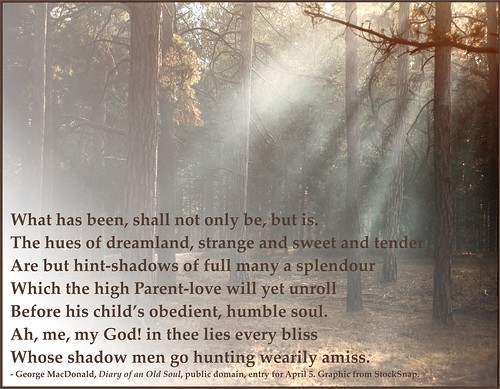
George MacDonald - dreamland as a hint of the future

What has been, shall not only be, but is,
The hues of dreamland, strange and sweet and tender
Are but hint-shadows of full many a splendour
Which the high Parent-love will yet unroll
Before his child's obedient, humble soul.
Ah, me, my God! in thee lies every bliss
Whose shadow men go hunting wearily amiss.
- George MacDonald, Diary of an Old Soul, 1880, public domain, entry from April 5.


Thanks for looking!

Monday, April 24, 2017

The Deryni novels by Katherine Kurtz

I recently finished the Deryni novels, by Katherine Kurtz. There are, so far, sixteen of these works, published over a span from 1970 to 2014, an impressive output, indeed. (Kurtz has written other books.)

What is a Deryni? The Deryni are people with magical/psychic powers. Many of them can read the minds of others well enough to know if they are telling the truth. A few of them can heal serious sickness or wounds. They can communicate with other Deryni over long distances, using telepathy. They have built a network of portals, places where they can magically travel, almost instantaneously over long distances, from one portal to another. The Deryni mostly live among ordinary people, and can't be told from them by appearance. They can marry non-Deryni. Some Deryni can appear to be someone else. (One Deryni, Camber of Culdi, took on another man's appearance for years, for unselfish reasons.) The only humans with Deryni powers have one or more Deryni ancestors.

The setting of these works is from AD 903 to 1128, in a fictional Europe, probably the British Isles. The geography appears to be fictional, too. The culture is based on the culture of the area during the times specified. That is, government is by a hereditary monarchy and aristocracy. The most important people live in castles, or other impressive dwellings, with their subordinates. The church is very powerful, in some things more so than the king. There are several female orders, and several male ones, all related to the church. There are priests, and bishops, and archbishops, one of which is always the highest authority in the land of Gwynedd, where almost all of the books take place. There is no mention of a pope in any of the books. The religion practiced is a form of Catholicism, or much like Catholicism. Young men of high blood become pages, squires, and knights. There are battles, using swords, lances, knives and bows and arrows.

Much of the plots involve Deryni keeping themselves secret from non-Deryni, especially from most of the church hierarchy, who persecute, and even kill, people with Deryni powers. There are evil Deryni who misuse their powers, which is one reason, other than fear of the unknown, that leads to occasional persecution of the Deryni. Most of the Deryni are not evil, however. I would say that, although there are important plots in all of these books, that they are also character-driven, and, furthermore, rely on descriptions -- their setting. Kurtz seems to enjoy describing church and state ceremonies. In most cases, ceremonies of state, such as becoming a knight, or swearing fealty to the king, are both spiritual and temporal. The books also have lots of descriptions of what the characters are wearing, and of the dwellings they inhabit.

Kurtz is not shy about allowing her characters to die. Some die by violence, in battle, or by magic. Some die from sickness.

The kings of Gwynedd are all members of the Haldane family. All of them possess some psychic, or magical, powers, although not all who have such abilities are held to be Deryni.

A few years ago, I attempted to ask, and answer, the question, "what makes a novel a Christian novel?" My answer is this:
A Christian novel should include three things. First, some sort of important choice between good and evil. Second, there should also be evidence that a character has hope, beyond despair. These two are, in my opinion, required conditions for a Christian novel. Third, such a work should also contain at least one of the following options, as a significant part of the plot, or the theme, or as an attribute of an important character: 1) A Christ-figure 2) Belief in important orthodox Christian doctrine, on the part of a narrator or character 3) Practicing prayer to a monotheistic divine being 4) Having a relationship with such a monotheistic divine being in other significant ways, including receiving guidance from him, or being placed in his presence. (For more discussion of these points, see this earlier post.)

How do the Deryni novels measure up?

There are many choices between good and evil, and the protagonists almost always choose the good.

Several characters exhibit hope beyond despair. For example, Camber searches for a Haldane to place on the throne, even though there doesn't seem to be one. He finds such a man. There are several occasions where there is hope that children will prove to be worthy kings.

These two required conditions are met.

As to the optional conditions, I'm not sure that any character in these novels qualifies fully as a Christ figure. But there is plenty of belief in orthodox Christian doctrine. Here, for example, is a quotation from The Quest for Saint Camber:

“Why? Don’t you think God has a plan for each of us?” “Well, of course,” Dhugal said uncomfortably. “But only in a general sort of way. We have free will.” “To an extent,” Duncan agreed. “But what was my will, set against the will of God, Dhugal? He wanted me to be His priest. I’m not sure I ever had a choice in the matter—not really. Not that I mind,” he added. “Not now, at any rate, and not for many years—though I certainly minded after your mother’s death. “But there’s a certain heady comfort in knowing one has been chosen, warts and all. I don’t know why He wanted me so badly, but other than that one brief flare-up of rebellion—which may have been all in His plan anyway—I’ve been content in His service. No, more than content. He’s brought me joy."


Several characters, in most or all of the books, offer sincere prayer to God, or they are described as spending time in prayer, sometimes for hours. There may be occasions where someone received direct Divine guidance, but I can't think of one such.

There are two other features that are relevant. One of them is that every chapter, in all sixteen of these books, begins with a Biblical quotation. (A few of these are from the Apocrypha, or other non-canonical sources.) Another feature is that there are four Archangels who are occasionally dimly perceived, and exert influence, especially during the practice of Deryni magic for good causes.

I am satisfied that the Deryni novels, by Katherine Kurtz, are Christian in nature, without being preachy. They read, rather, like historical fiction, in imagined times, but with a Christian world-view.

Thanks for reading. Read Kurtz.

Thursday, October 02, 2014

100 works of Fantastic Literature

I just discovered National Public Radio's list (with brief annotations, and cover art) of 100 most important works of fantastic literature. Here it is. I haven't read them all, and am not going to, but have read many of these, some several times. It's a good list. One unfortunate omission -- Ursula K. Le Guin's Earthsea books. Oh, well. Here's my take on the third book in that series.

Monday, March 17, 2014

Waylander, by David Gemmell

I recently read Waylander, (New York: Ballantine, a Division of Random House. A Del Rey book, 1986.) by David Gemmell, who passed away in 2006. There is a Wikipedia article on the book, and also one on the author. For more on the plot and characters, read the Wikipedia article on the book. I prefer not to give away much of the plot.

I believe, but am not sure, that I purchased my used copy of the book because I had read that Gemmell is at least influenced by Christianity. See here for a discussion, in this blog, of what makes a novel Christian. The Wikipedia article on the author says this: 
The consistent presence of redemption in Gemmell's work reflected his Christian beliefs. He claimed that all of his novels have a religious basis, calling them "essentially Christian books" . . .

What evidence is there that Waylander is an "essentially Christian book?" Here's some of it:

Waylander presents a number of choices between good and evil. The main character, Waylander, chooses to rescue a Source priest, and a woman who is trying to save three children from the ravages of war and bandits. Such behavior is uncharacteristic of him. A couple of characters, who are hired assassins, or who have preyed upon suffering people, bringing them to financial ruin, unselfishly choose to help Waylander.

There is also hope in the face of seeming despair. Dardalion, the priest that Waylander helped, believes that evil can be vanquished. Orien, who was the king, has hope that a quest, which will help a general defeat the forces of evil, can be fulfilled.

There is evidence that some of the characters believe in a god, or God, the Source. Toward the end of the events in the book, Dardalion reflects on what has happened:
"It was all a pattern, created from an interweaving series of apparently random threads. Dardalion fell to his knees." (p. 288)

Clearly, Dardalion believes, and he prays. (So do other characters.) On one occasion, he prays that he and his companions will not hate their enemies.

The Wikipedia article on the book, which is a stub, does not mention any of these things. I may add them myself.

Waylander was not marketed as Christian fiction. But it has Christian elements, and seems to have been written from a Christian world-view. I'm glad that I read it. I expect to read more of Gemmell's work, including two sequels to this book.

I should say that the book has a lot of violence in it. It is, I suppose, rather typical sword and sorcery fiction.

Thanks for reading!

Wednesday, November 20, 2013

Sunspots 445

Things I have recently spotted that may be of interest to someone else:


Literature: “But what the best fantasy does, in my opinion, is to transform it into something truer, and more real, than it was to begin with.” Ashlee Willis, Speculative Faith blog.

Politics: A Pennsylvania newspaper, which called Lincoln's Gettysburg Address "silly," 150 years ago, took it all back.

National Public Radio, optimistic as ever, reports that some states are trying to end extreme partisanship (both sides of it) by changing the way primaries are conducted, or changing the way congressional districts are drawn. I hope so.

Science: NBC News, and other news outlets, tell us about the oldest living animal -- now dead, and killed by scientists -- a clam.

Wired reports on yet another theory of what causes consciousness.

NPR reports on gut bacteria again. This time, it's about how they may influence how we think. Possibly some mental illnesses could be treated by infusing bacteria from a "normal" person into the gut of the sufferers. Amazing, but very preliminary.

Sports: Sports Illustrated says that Michael Jordan, perhaps the greatest basketball player of all time, has selected his most memorable dunk.


Image source (public domain)

Tuesday, September 24, 2013

The Well at the World's End, by William Morris

I recently read The Well at the World's End, by William Morris. It's a public domain work, originally published in 1896.

Morris must have been an interesting character. The Wikipedia article on him says that he was influential in textile design, book publishing, preservation of old buildings, and "As an author, illustrator and medievalist, he helped to establish the modern fantasy genre, and was a direct influence on postwar authors such as J. R. R. Tolkien." He was also a "libertarian Marxist," whatever that means, or meant.

The book is still considered important enough that there's a Wikipedia article on it. This article says that "Although the novel is relatively obscure by today's standards, it has had a significant influence on many notable fantasy authors. C. S. Lewis and J. R. R. Tolkien both seem to have found inspiration in The Well at the World's End: ancient tables of stone, a 'King Peter', and a quick, white horse named 'Silverfax' are only a few." The article doesn't say that having wise old men (and women) living in out-of-the-way places, and setting the story in a time before gunpowder and internal combustion engines, in a feudal society, are all conventions often used by modern-day fantasy authors, and are part of this book. I don't suppose that Morris invented any of these conventions, but he used them well. (See here for musings on "sword and sorcery" fiction.)

The "obscure" adjective, in the Wikipedia article, seems to refer to the language in the book. Morris used a few words that I have never seen before, such as sele and thorp, for two of them. They don't distract much from the novel. What's it about? It's about Ralph, the youngest member of a royal family, who decides that he doesn't want to stay home and look after his parents as they age. He goes off on adventures. The greatest adventure is to drink from the Well at the World's End. It's not giving away too much to say that he achieves that adventure. For whatever reason, Ralph is very attractive to women. He attracts two, one who would have become his wife, but is killed, and another, who does marry him. He also attracts the queen of another area, and another lady or two. I guess that's part of the magic of the book. He also is an excellent swordsman. Drinking from the Well gives the few that achieve that quest a longer life, and also seems to infuse them with wisdom and goodness. (Morris died in the year that the book was published.)

The church, probably the Roman Catholic church, is alive and well, and not villainous, in the book. There is almost no magic, other than what I have described.

The book is a good read. It's available cheaply, or freely, from Amazon and the Project Gutenberg web site, as an e-book.

Thanks for reading!


Wednesday, August 14, 2013

He died of what he saw there: Vengeance as a theme in the writings of Patricia A. McKillip


Other aspects of McKillip's work are also considered on this page.

Originally written, as a web page, which was not part of this blog, on May 2, 2008 (Links checked May 11, 2011). The latest version of that web page is here.

This post considers most of the fantasy writing of Patricia A. McKillip, with some reference to that of Jack Vance.


"I write fantasy because it's there. I have no other excuse for sitting down for several hours a day indulging my imagination. Daydreaming. Thinking up imaginary people, impossible places." Patricia McKillip (1948 - ____) US science fiction writer
In "Faces of Fantasy," by Patti Perret. (source: http://creativequotations.com/)


Darko Suvin, in "Considering the Sense of 'Fantasy' or 'Fantastic Fiction': An Effusion," in Extrapolation 41:209-247, 2000 describes much fantastic literature as parable. He says: "For the parable consists of a narrative body as 'vehicle' and an intended meaning as 'tenor,' as a way of intimately relating art to truth or narrative and metaphoric imagination to conceptualized, normative doctrine." (p. 211) I can only speculate about McKillip's intent, but some of her narrative body seems to have, as a significant part of its tenor, that vengeance is dangerous to the avenger, and good characters, although they may be tempted to seek revenge, draw back from it.

Vengeance in The Forgotten Beasts of Eld:
Any discussion of McKillip should start with The Forgotten Beasts of Eld, (New York: Avon) Published in 1974, this book has deservedly remained in print ever since. The book is deep, with many characters, some magical, some normal, some human, some not so. The themes are love and vengeance. Sybel, a beautiful enchantress who is the daughter and granddaughter of wizards, lives in isolation on Eld Mountain, with her collection of magical animals, including Cyrin, the talking boar. Out in the world at large, the house of Sirle and Drede, king of Eldwold, are at war. Norrel, one of the seven Sirle lords, fell in love with Rianna, Drede's queen, a relative of Sybel, and Rianna with him. The two armies fought, and Norrel was killed, as the Sirle lords lose the battle. Coren of Sirle, full of hatred for Drede, brings Tamlorn, Rianna's child, to Sybel to keep. Sybel knows nothing of keeping a child, but agrees to take Tamlorn.


While Coren is at Sybel's house, Cyrin tells him a cautionary tale: "The giant Grof was hit in one eye by a stone, and that eye turned inward so that it looked into his mind, and he died of what he saw there." (p. 70) This, and a gradual falling in love with Sybel, shows Coren that he had been nursing a desire for revenge toward Drede, and that it was destroying him.

Sybel raises Tamlorn until he is in his teens, then agrees to let him live with his father, Drede. She has been calling for one last animal, a great crane, the Liralen. It does not seem to respond, but a ghostly creature, the Blammor, having power to use the evil within people against themselves, appears. Drede and Sirle are still enemies. Drede finds a wizard, more powerful even than Sybel, and asks him to destroy her freedom of choice, so she will be his queen, with her animals serving him through her. The wizard calls Sybel from her house to Drede's city, where he is about to take her will from her. He momentarily succumbs to lust for Sybel. As he does, she calls the Blammor, which kills the wizard. Drede comes in to claim Sybel, and finds the wizard dead. He guesses what has happened.

Sybel agrees to marry Coren. She has come to love him, but her main motive is to use the Sirle war to destroy Drede. She does not want Coren to know how much she wants revenge, so hides her plot from him. In a moment of panic, she even removes some of his memory, not unlike Drede's wizard might have done to her.
Sybel calls all of her animals to her at the house of Sirle, Cyrin last. The boar speaks, telling Sybel the same tale that he once told Coren. Sybel, unlike Coren, does not give up her revenge. She proceeds with her plans for war. The night before the war is to begin, with neighbor armies called magically by Sybel, paid for by her dragon's gold, however, she gives it up. That night, in a nightmare, she sees the Liralen, the beautiful magic bird that she has been looking for, dead with a broken neck. She sees what a desire for revenge has done to her, and tells all her animals that they are free--they don't have to participate in the war, and goes back to her mountain retreat.
Seven days later, Tamlorn comes to the mountain. His father has died of fear, and the Blammor. The armies of both sides have been led magically away from the battle by Sybel's animals, and he is now king. Shortly thereafter, Coren comes to find Sybel. He forgives her, after she explains how she nursed a desire for revenge, even stronger than her love for him, but gave that up on the night before the battle. They forgive each other. Suddenly Sybel realizes that the Blammor and the Liralen are one and the same, and the Liralen appears, and carries the two of them back to happiness at the Sirle house.

I am not the only person to realize that vengeance is an important part of McKillip's plots. Says an author who reviewed The Forgotten Beasts of Eld for Amazon: "McKillip's thoughts on revenge are intertwined with the 'Riddle-Master' trilogy, 'Fool's Run,' and 'Song for the Basilisk.' Here we see how hatred and its offspring, vengeance, might destroy a person from the inside out and destroy what they most care for." Indeed.

Vengeance in the Riddle-Master trilogy:
This splendid trilogy consists of three books, The Riddle-Master of Hed (abbreviated RH), Heir of Sea and Fire (HS) and Harpist in the Wind (HW), all published in New York by Ballantine, in 1976, 1977, and 1979. They have been re-published, as a single volume, with a new introduction by McKillip, as Riddle-Master (New York: Ace, 1999). The best summaries/reviews of these books that I have found are by Geoffrey Prewett (Riddle-Master, Heir, Harpist). There is a concise, but accurate summary of the trilogy here. The author likes the first two books, but not the third, and says why.

In Tree and Leaf (Boston: Houghton Mifflin, 1965), Tolkien proposed the term eucatastrophe for a great change that brings about ultimate good. His own Lord of the Rings trilogy is an example, of course. The Hed trilogy is, like Tolkien's, about the ending of an age. At that ending, many good things are lost, but evil is averted.
McKillip certainly can't be accused of lacking imagination, or of making the rules of her fantastic worlds explicit. They just are, and the reader will grasp most of the rules by reading. As an anonymous reviewer of her Song for the Basilisk put it:
In most of McKillip's novels (Winter Rose, etc.) and short stories, this veteran author, a World Fantasy Award winner (for Forgotten Beasts of Eld, 1975), uses words in precisely the same way her mages do, to shape images and create fantastic visions where none previously existed. Sometimes the images are grotesque and violent, but more frequently they are ethereal and exquisite. (Publishers Weekly, August 10, 1998 p. 373)

Another writer put it this way: Have you ever started on book two or three (or later) of a series that doesn't s[t]and alone well or at all? If it's a good series, you enjoy the book, but you spend a lot of the time confused, because there are references to things that happened earlier in the series and you have no idea what those things are. 

That's how I felt when reading The Riddle-Master of Hed, despite the fact that it was the first book in the series. McKillip gives absolutely no explanation of anything, expecting the reader to infer what and who things and people are from the context of the book. Things like descriptions are almost completely left out, even when they're central to the plot.

The last writer still said that she liked the trilogy. Here's why, in the words of yet another blogger:
Words seem ironically inadequate to describe the skill with which McKillip spins the English language into magic. Lyrical is one word that is often used in reviews, but it's so much more. Most of McKillip's work deals with magic, and if there is any true magic in the world, I would suspect it would be found in her use of language. I could luxuriate in work written by McKillip regardless of the story, simply to enjoy her use of words. 

I agree.
The Hed Trilogy is about a land in an unspecified place. This land, at the time of the narrative, appears to be overruled by the High One, with six land-rulers under him. Most of the land is in one of the six areas ruled by the land-rulers, but there is wilderness that does not fall under them. In part of this wilderness is the city of Lungold, where, centuries before, Ghistestlwchlohm, perhaps a wizard himself, perhaps more than that, built a school for wizards, who came to him to learn. He betrayed them, and no wizards have been seen since. The High One hasn't been seen for a long time, either, but that is to be expected. He lives in Erlenstar Mountain, which is also not in any of the areas ruled by the land-rulers, and is also isolated. His harpist, Deth, travels around the land, acting for the High One.

The reader eventually learns that land-rule is a special knowledge of, and bonding with, the area and all the rocks, streams, plants, people and animals that are there. In An, Mathom, the land-ruler, also has special knowledge of, and some control over, ghosts of the past. One of those ghosts, Peven, was once king over one of the three portions of An. Each land-ruler has a land-heir, who becomes land-ruler when the former one passes.

In Caithnard, a city on the sea, is the College. The College is where Riddle-Masters are trained, and, if they are skilled enough, eventually become teachers themselves. Riddles are not just puzzles, as in Tolkien's The Hobbit. They are apparently some sort of supernaturally revealed wisdom, with special morals. The overall theme of the College, of riddles, and of riddle-mastery, is to seek the truth, regardless of the consequences.

Hed is an island, the smallest of the areas with a land-ruler. It has never had a wizard, or a riddle-master, until Morgon, son of the land-heir of Hed, a young man who was born with three stars on his forehead, has a desire to attend the College. He goes there, and learns a great deal, but one riddle that he doesn't try to answer is who he, Morgon, really is. His parents come to see him in a boat, and are drowned, so Morgon becomes land-ruler of Hed. His brother, Eliard, is his land-heir.

Morgon goes to Peven's castle, and wins a riddle-game with Peven, a dangerous thing to do. His prize is Peven's crown. Morgon doesn't know it, but Mathom has also promised his daughter, Raederle, to whoever wins the crown.

RH begins with Deth visiting Hed. This leads to Morgon and Deth sailing to the College, where one of the masters is Ohm. Then the two of them sail to An, so that Morgon can seek Raederle's hand in marriage. On the way, the sailors all disappear, and the ship sinks. This is Morgon's first experience with the shape-changers, who are trying to kill him. Morgon is washed ashore, but has lost his memory. Eventually, he recovers, in the house of Heureu, land-ruler of Ymris. There he is given a harp, made long ago, with three stars on it, that no one but he can play. Heureu's wife, unknown to Heureu, is a shape-changer, and tries to kill him again. The upshot of these events is that Morgon decides to go to Erlenstar Mountain to ask the High One who he is--what is the significance of the stars on his face?

The journey is a long one, through all the lands of the land-rulers except An. In Herun, where the Morgol rules, she tells Morgon that she suspects that Ohm, one of the Masters of the College, is Ghisteslwchlom. In Osterland, Har, the land-ruler, teaches him how to change into an animal. In the form of an animal, he finds one of the wizards, who has been hiding in animal form for centuries. That wizard tells Morgon that Ohm is the one he has been hiding from, and dies. In the depths of Isig mountain, the land that Danan rules, he finds the graves of the Earth-masters' children. These children, though dead for millenia, have been awaiting the Starbearer. They give him a sword, with three stars on it.

When Morgon finally gets to Erlenstar Mountain, he finds, to his horror, that Ohm, or Ghisteslwchlom, is sitting in the High One's seat. Deth has brought him there, in a monstrous act of betrayal. RH ends at that point.
In HS, we learn that Morgon has been held in captivity by Ghisteslwchlom for months. Ohm has tried to capture Morgon's mind. Occasionally Morgon hears Deth harping in the background. Morgon finally escapes. When he does, he is bent on killing not Ohm, but Deth, supposedly his friend during his long journey to see the High One, but his betrayer. Also, the land-rule of Hed has passed to Eliard, who thinks that means that Morgon has died.
Through the books, we gradually learn more about the shape-changers, and the Earth-masters. Apparently the High one was an Earth-master, and the Earth-masters and the shape-changers were originally one and the same, but the High One and the other Earth-masters wanted to use their tremendous powers, over land, sea, animals, and plants, to heal and preserve. The shape-changers wanted to use these powers unchecked, without regard for the other beings in their world. As one of them says, "Not compassion, but passion . . ." characterized the shape-changers. (HS, p. 115) So they fought, over a thousand years ago, and the war is not over.

Raederle has a major role in HS. We learn that one of Raederle's ancestors was a shape-changer, but that she doesn't want to yield to that heritage. And we learn that Morgon is beginning to see that his thirst for vengeance is destroying him. "I am so blind with hatred I can't even see my own land or the people I loved once." (HS, p. 163) The College, and the land-rulers, sympathize with Morgon, but are not sure that revenge is right. "Is there a riddle on the master lists that permits the wise man to revenge?" (HS, p. 152) asks Har, a riddle-master as well as a land-ruler, of the College. The implied answer is that there is none. Raederle knows that there is a person of power coming through An, bent on vengeance, and that he is pursuing someone. She makes a bargain with the ghosts of An to protect the pursued, thinking that Ghisteslwchlohm is pursuing Morgon. But Morgon has become such a creature of vengeance that he is pursuing Deth, and thus Raederle makes this mistake. As HS ends, Morgon confronts Deth in the house of An, and raises the sword with three stars to kill Deth, but he does not. He lets the sword drop to the floor, and lets Deth walk away. 

HW begins with Morgon learning the land-law of An, and, using it, taking a ghostly army to Hed to protect it from the shape-changers, who have lived in the sea since the war. Then Morgon and Raederle make the long journey to Lungold, hoping to get answers there. On the way, Raederle yields to her heritage, and changes shape, so she can fly there as a crow with Morgon. On the way, the shape-changers try to kill Morgon again, and Morgon again meets Deth, but doesn't kill him. When they get there, the remaining wizards of the realm are present at the destroyed school for wizards, burying their dead. Morgon freed them when he broke free from Ghistestlwchlohm. There is a battle at Lungold, between the wizards and Morgon, against the shape-changers, but it is inconclusive.
As HW proceeds, Morgon learns the land-law of the other areas. He and Raederle meet Deth again, not as himself, but as one of the ancient wizards. Morgon realizes that he loves and, somehow, trusts Deth. The three of them proceed to King's Mouth Plain, where the ruined cities of the Earth-masters are, and where sits Wind Tower, which, legend says, has never been climbed. All of the land-rulers are there, too. Before the final conflict, the ending of the age, the eucastrophe, Morgon climbs the tower, where Deth is waiting. Morgon realizes that Deth is the High One. Deth tells Morgon that he has been hiding from the shape-changers, as a wizard, and then as the High One's harpist, and that Morgon is his land-heir. Ghistestlwchlohm kills Deth with Morgon's sword, and that act destroys Ohm. Deth welcomes death, believing that Morgon is ready to become his heir. Morgon, now taking the power of the winds, drives the shape-changers to Erlenstar Mountain, not killing them, but binding them there. He is now the High One. Raederle wants to know what Morgan has done with the shape-changers, fearing that he has destroyed them. He tells her.

Morgon, then, as the trilogy progresses, has had opportunities to kill Deth, but does not take them. He has had the opportunity to destroy the shape-changers, but does not do so. He withdraws from vengeance-seeking. Ghistestlwchlohm, on the other hand, kills Deth, the High One, and is destroyed. The lesson is clear--don't take vengeance.

I have posted, on my blog, a summary of the Riddle-Master trilogy, and an essay on "Christian themes in Patricia A. McKillip's Riddle-Master Trilogy." (I do not claim that McKillip is a Christian. She may be, she may not be.)


Vengeance in Song for the Basilisk:
Victoria Strauss mentions vengeance in her synopsis of Song for the Basilisk. (Ace, 1999) So does Jackie Cassada, in a one-paragraph summary in Library Journal, Sept 15, 1998, p116. It's there, alright, but, as with other McKillip tales, it's not quite so simple as to be that easily summarized.


The Basilisk is a terrible man, a practitioner of poisoning. He is leader of Pellior, one of the four houses of Berylon, and has tried to minimize two of the other two houses, and entirely eliminate the house of Tourmalyne. He didn't succeed. Caladrius, of the house of Tourmalyne, survived a fire, meant to kill his whole family. A relative took him to the school for bards, far away from Berylon. He remained there for over 30 years, producing a son, Hollis. After discovering a flute made of bone, which has dangerous powers, Caladrius feels drawn to Berylon. Hollis follows him.

The Basilisk has three children, an ineffectual son, Taur, his heir, Damiet, a woman whose life centers on how she looks, and Luna, who seems to follow her father in many ways. The music scores of Tourmalyne house have been moved to Pellior, and a librarian is wanted. Caladrius, incognito, takes the job. Hexel is hired to write an opera for the Basilisk's birthday. (There's a lot of music in this book.) Damiet has fallen in love with Caladrius, who has not encouraged her. She is a poor singer, but Hexel, who has never heard her sing, writes the opera with her as the lead. The opera is about the destruction of Tourmalyne house, and a mysterious survivor who returns to Berylon. The performance of the opera is sensational, in several ways. Damiet doesn't sing well. Some Tourmalyne survivors, carrying swords under their robes, have joined the chorus. One of them is Hollis. Caladrius, in the audience, plans to play his flute at the finale. Instead, Hollis plays, hoping, like Caladrius, that the piping will kill the Basilisk. It doesn't. Their vengeance, or self-defense, is thwarted.

The Basilisk, confined to bed, orders the city blockaded, intending to destroy the last Tourmalyne survivors. His son gives an order in his father's name, and his father, enraged, disinherits him, making Luna his heir. This is what she does:
She looked at Caladrius. . . . "I think," she said softly, "that Pellior House has tormented Tourmalyne House enough." She turned back to the captain of the guard. "Let Lord Tourmalyne and his son go free."
. . . noises came from the Basilisk, who, struggling to rise, stared blindly at his daughter, his face purple, a vein throbbing furiously above his brow. He tried to speak, produced only a long, inarticulate word that ended in a moan. He stiffened in amazement, one hand groping at his heart. The blood receded in his face; it grew paler and paler as he struggled for one last word . . .
The physician, with a sudden exclamation, felt for his heartbeat. . .
"He's dead, my lady," the physician said incredulously.
"What killed him?" Damiet whispered. Luna lifted a finger, touched her father's motionless hand; she could not seem to speak.
"Kindness," the physician guessed blankly.
Luna looked silently at Caladrius, the mask of her smile fraying at last to reveal the strength behind it, the bitter love and weariness.
He bowed his head, blind himself now with unshed tears.
"Thank you," he said. "My lady."
(pp. 298-9)
If Luna's refusal of vengeance is foreshadowed in the book, I, at least, didn't see it coming. However, now that I have read Basilisk more than once, there is a clue. Early in the book, the Basilisk sets Luna the task of preparing a "gift" for her brother Taur's mistress, a glass rose that contains poison that will kill her. The poison doesn't do so, but it turns the mistress into an old woman. Luna, who doesn't seem to make any mistakes, tells a henchman that the Basilisk will not be pleased that the mistress isn't dead. Then, near the end, after the Basilisk is dead, Caladrius sees Luna give an old woman a rose. He asks her if it is a poison. "'This one heals,' she said enigmatically . . ." (p. 303) McKillip, too, is enigmatic, and it is left to her readers to decide if the old woman is the mistress, and the healing is going to give her back her youth.
Vengeance in other works by McKillip:
Yoon Ha Lee, in a five-sentence summary of The Tower at Stony Wood, which is apparently no longer available on-line, mentions that a man surrenders his vengeance. (I mention the length not to criticize Lee, but to point out that vengeance, or surrendering it, was important enough to Lee that it was included in a five-sentence summary.)

Fool's Run (New York: Warner Books/Popular Library, 1987) is a science fiction novel about many characters, including Aaron Fisher, a policeman whose wife was killed in a mass murder by Terra Viridian. She has been tried and sentenced to a satellite orbiting prison. For seven years, Fisher has been looking for her twin sister, Michele Viridian. He finds her, without knowing it, when she joins his favorite band, which is going to play for the prisoners. His motivation is complex. He wants to understand the death of his wife, he wants to find his wife again. He says that he didn't want revenge, but that was probably only partly true:
"Revenge?"
"No."
"Then why?"
"She--nothing made sense. Why she was killed. I just wanted to understand why. I loved--I loved her." (p. 148)

Terra breaks out of the prison, taking the band, and Fisher, with her. She is on a quest to fulfill a vision about an alien being, which is why she killed over a thousand people. The vision is fulfilled, and she dies. Her last words are an "I'm sorry" to Fisher, who has not tried to avenge his wife.
Moon-Flash (Berkley,1985) is also about earth. There is no vengeance in the book. The story is about primitive people living in a future world, and some of them discovering that there is more to the world than their immediate surroundings. It is, in other words, about our modern dilemma of the effects of technology on our environment, and on ourselves. It is a beautiful book, but I won't give away the twist at the end.
 
Fool's Run and Moon-Flash are clearly about earth. Many of McKillip's books may be, or may be about some alternate world, or about some indefinite time in our world's past. They are apparently based on the middle ages, or something like the middle ages. That is true of the Hed books, and of Forgotten Beasts. The same things are also true of Winter Rose (Ace, 1997). It isn't necessarily about our earth, and is not of our time, and it has no main character driven by revenge. Both of these books are about someone being lost in an alternate, magical world, and someone who isn't sacrificing so that they can be rescued. In Sea, a prince is trapped in a sea-monster's body. In Winter, Corbet Lynn is trapped in the world of the queen of the wood. Solstice Wood (New York: Ace Books, 2006) uses the same setting as Winter Rose, but is set in the present, which is unusual for McKillip. It doesn't have vengeance as a main theme, either.

The Changeling Sea, (Ballantine, 1988) one of McKillip's most beautiful books, is all about magic, losing and regaining, and love. It does have a character out for revenge, but not on a person. Peri, short for Periwinkle, is a young woman, the daughter of a fisherman, in a little fishing village, apparently in one of McKillip's alternate worlds. Her father has drowned. Her mother withdraws from everthing. Peri has befriended an old woman, who has disappeared, leaving her cottage behind. Peri takes to living there, because she doesn't want to see her unresponsive mother. The old woman must have been something of a witch. Peri, based on things she has seen the old woman do, and especially based on her hate for what has happened, casts a "hex" on the Sea. She tries to bind the Sea's magic, and its ability. She later learns that it worked, and, on p. 139-140, unhexes the sea, and takes back her hate. There's more to the book than this, of course, but one consequence of Peri's withdrawal from vengeance is that her mother becomes normal.

 
The Book of Atrix Wolfe (Ace, 1996) has much the same theme as the two works mentioned in the previous paragraph. It is about an alternate world, and someone, actually more than one someone, who is trapped. However, it also has the capacity for revenge as a possibility, which, finally, is rejected. Atrix Wolfe is a great mage. He believes that the ruler of Kardeth will not only destroy Pelucir, where he holds siege, but that he will go on to capture and control Chaumenard, home of the mages. Mages have rules. One of them is that they not participate in wars. Atrix Wolfe believes that the need of the moment, and of the mages, overrides this rule, and casts a spell which creates the Hunter, a fearsome being who ends the war in front of Pelucir Castle by destroying most of the participants.

Twenty years later, there are still ghosts in Pelucir Castle. Talis Pelucir, brother of the king, who was born at the time of the battle, is summoned from the school for mages in Chaumenard. He has the ability to find Atrix Wolfe, who has been hiding, not practicing magic, as a healer of animals. He also has the ability to find, and read, a book which Atrix Wolfe wrote after the terrible battle.

Jack Vance is accused of not paying much attention to most of his plots, and of creating cardboard characters, and the charges have some truth. He is, however, noted for his prodigal imagination, almost creating a new culture, with exotic customs, on every page, in some of his works. In Wolfe, not only does McKillip create characters that have substance, but she has also created an exotic culture, and, unlike Vance, dwells on it intermittently throughout almost the entire book, adding more substance as she goes. That culture is that of the kitchen of Pelucir Castle. The foods, the fires, the wide array of servants, filling many niches, are portrayed carefully. One niche is pot-scrubber. Saro (presumably rhymes with sorrow) fills that niche. She can't speak, but she can move through the kitchen almost invisibly, and she does her job, because it is the only thing she knows, or so it seems. She was found on the woodpile the night of the battle, and named because she must have been some one's sorrow.

As the book progresses, Talis discovers that the Queen of the Wood is trying to trap him, because she wants to find Atrix Wolfe. Her consort and her daughter have been snatched from her by his terrible spell, trapped, in different ways, in a world alternate to the Queen's. Talis is told, by the Queen, that her consort has become the terrible Hunter. The Queen doesn't know what has happened to Saro, who, of course, is the daughter, trapped in a body that no one but Talis pays attention to, unable to speak. Saro is rescued, and Saro and Talis are apparently going to live happily ever after, as the book ends. But, near the end, the Queen, who believes that she will never have her consort with her again, because he has been so terribly changed by Atrix Wolfe's spell, decides that she doesn't really want to kill Atrix Wolfe for this terrible deed, which, after all, he did not forsee. She is right about her consort--he comes back to her for a little while, then turns into a tree--but he does not take vengeance on Atrix Wolfe. This, my reader, is a marvelous book.

McKillip has created another alternate world, or perhaps two of them, in her related works, The Sorceress and the Cygnet (Ace, 1991) and The Cygnet and the Firebird (Ace, 1995). In the first, she begins with Corleu, supposedly a common man, part of a group of migrating people called the Wayfolk. Corleu's group gets lost, going nowhere, and no one but Corleu realizes it. The Wayfolk have songs about the constellations, and their constellations are also the emblems of the Holders, richer folk who do not migrate. By the time the book has ended, the constellations have come to life in Ro Holding, and Corleu has played a significant role in rescuing Ro Holding, and his own people. Astor Ro, the Holder of Ro, and her three daughters, Nyx, Iris, and Calyx, and her niece, Meguet Vervaine, have been introduced, and play a major role in the drama, as does Hew, the gatekeeper of Ro. Nyx is a mage, living in a swamp, trying to learn whatever magic she can in whatever way. Meguet is the protector of the Cygnet, the emblem of Ro Holding. Hew, also from the swamp, is more than an ordinary gatekeeper--he has powers to protect Ro Holding, as does Meguet, who is not an ordinary soldier.
 
McKillip evidently knew that she was onto something when she created the family of Ro Holding, because she brought them back in the second book. (Corleu is restricted to a few lines.) There Ro Holding is challenged by a firebird who becomes a human, Brand, at night. In the process of trying to help him/it, Nyx and Meguet travel, by magical means, to Saphier, a kingdom ruled by a mage, near the Luxour desert. It is not clear whether Saphier and the Luxour are physically close to Ro Holding, or even if they are in the same time. Traveling through time by magical paths is a major theme of the book, as are dragons. At the end, Brand is human again, and Nyx and Meguet have saved Ro Holding by averting an attack by soldier mages from Saphier. These summaries, of course, do not do justice to these works. Neither of them have vengeance as a major theme, although Brand began by wanting to kill the mage he thought had enchanted him, but discovers that it was his father, the ruler of Saphier, who did it.

In the Forests of Serre (New York: Ace, 2003) is a book that I read three times, trying to get a handle on the book. I believe that I finally did, and it's not McKillip's fault that it took me so long. It's about the heart. The word, referring to the seat of the emotions, is used over and over again, and two of the main characters give up their hearts for something else, and regret this.
I don't see how I can summarize the plot, or even describe the characters (there are nine that I would consider main characters) in anything like a post length that's reasonable, even for me. So I'll just summarize the book this way:
McKillip has again written a book with excellent use of language, describing a marvelous forest, wizardry, and a cold castle. The Princess Sidonie decides that she doesn't want to marry Prince Ronan unless he re-claims his heart. He gave it away because his first wife and child died. After numerous trips, by several characters, into and through the forest, all is well. Everyone who should have a heart does, and the two really can fall in love and be married. Vengeance doesn't play a significant role in this book.

Alphabet of Thorn (New York: Berkley, 2004) is a fine book, but I couldn't find vengeance in it. I would say that it does have a plot, though, more than some of McKillip's work. The book is a coming-of-age story. Nepenthe is a translator for the library of Raine, an institution that is large, old, and full of lots of books. Her name is Nepenthe because she was a foundling, and foundlings are named in alphabetical order by the librarians. Tessera, a mousy young teen, has suddenly become queen, due the the accidental death of her father. And Kane? Kane is a powerful sorceress, legendary, because some of her exploits are thousands of years old. Her exploits are to help her cousin, and lover, Axis, to conquer yet another kingdom. Kane appears to others as a man, but is a woman, who found her life in Axis when they were both young children. So she disguises herself, and has herself given to Axis on his wedding day. What Axis wants is to conquer yet another kingdom.
 
Finally, Axis and Kane run out of kingdoms, so Kane discovers that she can bring Axis's army through time. Axis asks her if she wants anything else. She wants a child by Axis. But she cannot raise a child while supposing to be a male warrior mage, so she leaves her baby, who becomes Nepenthe, at the library for the librarians to find, and has no more contact with her, except for a message, hidden in a book, with an alphabet constructed of thorns, in the secret language Axis and Kane have used between each other.

When the book unfolds, Axis is ready to conquer another kingdom, and Kane will lead his army to Raine, in the time when Nepenthe has grown into a young woman, fallen in love with a young wizard, and fallen under the spell of the book with the alphabet of thorns. She is almost done translating it. Tessera comes of age by discovering that Axis's army is coming, and figuring out how to defeat it --she will hide her entire kingdom by magic. Nepenthe comes of age by deciding that she will reject the parents she has never known, to live her life in Raine. And Kane? Kane decides that she will leave Axis, and live with her daughter, in a world where she knows no one, and doesn't know the language. So Axis goes back with his army, and the rest of them start their lives, as mature individuals. I'd like to know how it all came out, but suppose that McKillip won't tell us.

A couple of interesting quotes:
"Epics are never written about libraries. They exist on whim; It depends if the conquering army likes to read." p. 68.
"We don't choose our passions." p. 70 (Nepenthe, about her passion to translate the book.)
"History moves in great, messy shifts of power, in choices made as though by too many people building a house, where one misplaced stone in the foundation slips under the weight of another stone near the roof. . . ." (Laidley, a librarian, to Nepenthe.) Alphabet of Thorn (New York: Berkley, 2004) pp. 296-7.
Ombria in Shadow (New York: Ace, 2002) is a dark work. There isn't much vengeance in it, although the evil Domina Pearl is finally defeated in the end. There's a lot of murky stuff, unresolved. Even a second reading left me unsure what had gone on, although sure that McKillip had created a world that somehow drew me in. Ombria is a large old city. Is there really a shadow city? If so, can you only get to it by some sort of magic, or is it just old and forgotten? Are Domina Pearl's guards alive, and, if so, are they human? What is Domina Pearl? What is on her black ships? These are some of the questions I can't answer.
It is often true, in McKillip's books, that parentage is obscure, or that parents have died untimely deaths. That's especially so in Ombria. Mag is told that she is a creature of wax, but she isn't. Whose child is she? Kyel Greve, the child prince, has lost both mother and father. Ducon Greve's mother is dead, and his father is unknown. Lydea's mother has died. These four are more or less normal, and they are the characters who, with help from Faey, the sorceress Mag works for, finally destroy Domina Pearl.
One theme throughout the book is art. Ducon Greve and Kyel communicate through sketches. Ducon sketches a lot of things, in fact, this is his main occupation, seemingly.
Something that's usually found in McKillip's writing, but not in this book, is trees and forests. Not only in In the Forests of Serre, but in most of her other works, there are trees and forests. Not so in Ombria. There are weeds growing on the dock, and a patch of sunflowers near the palace gate, but that's about it. I missed them.
Od Magic (New York: Ace, 2005) is a book that reminds me, although it's much shorter, of course, than the Hed trilogy, although there is no noticeable vengeance. Od is a female sorceress. She started a school for wizards in Numis centuries ago. As in the Hed books, the school has gotten rather restricted. Real events, real powers (as in the Hed trilogy, formless, hidden, and undefined) exist. McKillip uses the word power. Much of the book is about freedom -- King Galin expects the school for wizards, which is in part of the palace, to abide by his rules, and to study nothing else. His daughter, Sulys, a traveling trickster, his chief wizard, Yar, and Od, herself, bring him to his senses. I would say that this book certainly has a plot, and some notable characters. Although there's no forest, per se, there is close attention to the things of nature, and it is clear that paying such attention is related to being the best wizard, or person, that you can be. Perhaps this book is as good an introduction to McKillip's work as any, if The Forgotten Beasts of Eld is not available. These books, written over a quarter century apart, by a master, or mistress, of the craft of fantasy, are splendid, if you can stand McKillip's murkiness about power.
As in most or all of McKillip's work, there are young people who have lost one or both parents in Od Magic. Another interesting tidbit is that the school for wizards has a door which only appears to a few people. In the book, 19 years separate the most recent entrances. (There are other ways of getting in, but they don't appear unless you really want to do real magic.) This is a reminder of the door to the school for wizards in Ursula K. Le Guin's Earthsea books, of the door to the train to Hogwarts in the Harry Potter books, and, especially, of Christ, the only true door to the narrow way. (John 10:1-7)
Magic will spring up where it wills, King, and in a lifetime you couldn't make enough laws to stop it, any more than you can put out all the night fires in Numis with a breath, or contain the wind within four  vengawalls. Trust your wizards; let them come and go. What they find outside these walls and bring back to you may be worth more than you can imagine. Od speaking, pp.311-12.
Harrowing the Dragon (New York: Ace, 2005) is a collection of short stories by McKillip. The longest of these is the second, "A Matter of Music," which was originally published in 1984. As in Basilisk, musical performance is a major feature of the culture, and of the plot. There's a long-standing feud between the Daghian and the Jazi, two of the music-oriented groups in the story. The Jazi allow a Daghian leader to live, although it takes some musical persuasion.
I hope to consider more of McKillip's work as I continue to work on this page, and as more becomes available.
Comparison with Vance
As concerns vengeance, there is a contrast with the writings of Jack Vance. In Vance, the sympathetic characters take revenge--not necessarily a gruesome, terrible revenge, but an administering of punishment, whereas in McKillip, they may give it up entirely. In The Forgotten Beasts, both Coren and Sybel give revenge up entirely. In the Hed trilogy, Morgon has the chance to take vengeance on Deth, but doesn't. Another character destroys Deth, and is himself destroyed in the act. Although Tourmalyne House has been aggrieved more, Pellior House has some claim to vengeance, too, but Luna renounces it. In other words, Vance's characters usually follow the Old Testament's "eye for an eye" (Leviticus 24:19-20), while McKillip's may take the New Testament "vengeance is mine (God's)" (Romans 12:18-20) approach.

Both writers consider the effect of vengeance on the avenger. However, Gersen finds himself empty and without purpose, when the destruction of the five Demon Princes is complete. Sybel renounces vengeance before it is completed, because she sees that dwelling on it would destroy her. To a lesser extent, the same thing happens to Morgon.
 
To put all this another way, the examination of vengeance is central to some of McKillip's work, whereas I would argue that, even in the Demon Princes books, it is not central to Vance's work. A number of authors have pointed out that Vance is really a stylist, using baroque language. Others say that what Vance is really up to is the invention of strange cultures. As Tom Shippey's title puts it, "People are Plastic: Jack Vance and the Dilemma of Cultural Relativism." (in Jack Vance: Critical Appreciations and a Bibliography, Edited by A. E. Cunningham. Boston Spa and London: The British Library, 2000, pp. 67 - 84). Vance's central features, his cultures and his style, happen to be found often in stories of vengeance. McKillip has been, at least some of the time, interested in exploring the effect of vengeance on the would-be avenger.

Aside: McKillip's names.
McKillip is good with names. Most of the names of her characters (and locations, and, in one case, a species of animal) are close to those in normal North American English usage, but few of them are commonly used in our culture, if at all. Some of them stick in my mind: Raederle, Atrix Wolfe, Nyx Ro, Caladrius, Lungold, Ombria, Vesta, for example. Sometimes the names are puns, that confuse other characters who hear them: Deth and Saro are understood as Death and Sorrow, at least sometimes.


Thanks for reading. Read McKillip. A post on Christian themes, not just rejection of vengeance, in McKillip's writing is here.

Tuesday, September 11, 2012

Veiled Rose by Anne Elisabeth Stengl

I have recently read Veiled Rose by Anne Elisabeth Stengl. The book is the second in a series. Three have been published, and the fourth is due out next month. Here's my post on the first book, Heartless. There is not a Wikipedia article on Stengl, or her books, as yet. Here is the Amazon page for the author, and she has a blog, which sometimes includes material on her books.

Heartless was the author's first novel. There was no sign of her lack of experience in that book, and there is none in this one. The characters are three-dimensional, the plot is complex, and not easily predictable, there are a multitude of settings. The second book is mostly about events that took place before those in the first book, but they are told from a different viewpoint, and this unusual time sequence should not hinder readers. Either book should be enjoyable on its own.

I will try not to give away the plot in this post, but will muse on certain aspects of Veiled Rose.

First, a little about the world of Goldstone Wood. The land (perhaps a continent, perhaps an entire world) is divided into uplands, where humans live, by lowlands, where they don't. There are bridges between the uplands, not made by mortals. Stengl has also divided the lands into the Near World, which, as I understand it, contains the uplands, the Between, which contains the lowlands, and the Far World. (See here for more on this, from Stengl.) Fairies can enter the Near World, where mortals live, but they also live in the Between, and perhaps in the Far World. These three are perhaps three different dimensions, or three different universes, co-inhabiting the same space. Stengl doesn't make a huge deal of this -- her characters, and their lives, are more important -- but the idea of living in more than one world at once definitely adds to the book. Tolkien, for one, had a similar construction, as his elves and their evil adversaries lived in two worlds at the same time. But their appearance was different, depending on which world they were seen in. In Stengl, the appearance of a character seems to be the same in whichever World they are found. (Some characters, such as dragons and fairy knights, have two different forms, but they can take these without changing Worlds.)

There are Paths, made by the fairies, within the Near World, and, probably the other Worlds. Characters who can find those Paths can move rapidly between locations.

Stengl is a bit coy about these aspects of her sub-creation: "So we know of at least three realms of existence, three levels of reality. Might there be more?" Perhaps she didn't know, herself, when she wrote that, in June of 2011. Perhaps she did, but wasn't going to tell us yet.

Second, the characters. One of the main characters in the book is Lionheart, who is also known as Leo, and by other names. He is the crown prince of one of the realms in the Near World, and young enough to play in the woods, but old enough that he is allowed to play in them without supervision. The second main character is Rosie. Lionheart meets Rosie, a girl, perhaps human, perhaps not, while playing in the wood. Rosie's origin is uncertain, and she doesn't know it herself. She always wears a veil. Lionheart doesn't know why, but doesn't really care, as she becomes his best friend. But their friendship has restrictions. She doesn't come into the castle where he lives, and he can't always go into the woods to be with her. Their friendship, by the way, seems to be quite innocent. Perhaps they are somewhat in love with each other, but perhaps not. Very few people have seen Rosie, and when people do, many of them think she is some sort of monster. She can use the Paths, at least the ones in her area, and take Lionheart on them.

Third, evil beings. One type of evil beings is the dragons. The dragons are like dragons in many other books -- they can send fire out of their mouths, they can fly, they are intelligent and can speak, they can trap unwary humans who look into their eyes, or listen to them too willingly. But, like at least one of the dragons of Ursula Le Guin's Tehanu, they can exist in human form or dragon form.

There is some other sort of evil being, perhaps also a dragon, in the books. There are at least two of these, who have the power to tempt by speaking directly to the mind of mortals. The two are in some sort of competition. The theology, or whatever it should be called, of the Goldstone Wood books is complex, and much of it is not merely an imaginary replication of Christian theology, or any other kind that I am aware of. I do believe, as I indicated in the post on the previous work, that the Goldstone Wood books are written with a Christian world-view, but that the fact that it's only a world-view, not the message of the books, is a plus, as I see it.

Fourth, I will say this about the plot. Rosie and Lionheart do not get married in this book. There are other characters, one of them named Daylily, who has decided to do what her father wants her to, and get Lionheart to marry her. He doesn't do that, either. Daylily is a complex character, and a strong one, and there are things that she does that I didn't expect.

More could be said, but I'll stop. I will confess that I have already read the third book in the series. In fact, I've read all three books twice.

Thanks for reading.

Thursday, August 16, 2012

Heartless, by Anne Elisabeth Stengl

Heartless (Tales of Goldstone Wood), by Anne Elisabeth Stengl, is a fantasy book, with swords, magic, and dragons. (See here for my musings on why sword and sorcery fiction is popular). It won the Christy award for Best First Novel in 2011. I haven't read the other winners, and I'm not sure if a fantasy novel has won this particular Christy Award previously, but the award was well deserved.

Stengl does not have a Wikipedia article on her, and Heartless doesn't, either. Here is the Amazon page for the author, and she has a blog.

I'll try to give away as little as possible of the plot, but will muse on various aspects of the novel. The plot is complex.

First, I confess that I have read two novels, by the same author, published after Heartless, in her series, Tales of Goldstone Wood. The second one, Veiled Rose, mostly takes place before the events in Heartless. There are some allusions to these events in Heartless, indicating that the author didn't just write a second novel based on the first one -- the first one foreshadows the second, and she already had largely it in mind when writing the first. (There is supposed to be a fourth novel, to be released later this year.)

Second, there is no doubt in my mind that this qualifies as a Christian novel, by almost any standard. I don't say this because it mentions Christ, or God, or the Bible, or salvation. It doesn't. In fact, the theology of the characters is nearly non-existent. They don't worship together, and they don't pray on a regular basis. I hope to post later, giving more detail on why I say that the book is Christian. My guess is that the fact that there is no direct "preaching" in the book might make it more attractive to non-Christians.

There is a Christ-figure, not in the sense that he dies to pay for the sins of others, at least not within the events of this book, but in the sense that he comes from another realm -- fairyland -- with the purpose of taking a bride for himself.

There are, as I said, dragons. Stengl's dragons live a very long time. They can appear as dragons, huge lizards with wings and fiery breath, or as human, or at least human-like, beings. They can talk, and are intelligent. They love treasure. They are almost entirely evil. No dragon is a main character, but a few of them appear in the book, and they are important in it.

The theme of the book is trust. Una, a princess coming into adulthood, and who is one of the main characters, trusts the wrong person for much of the story, but finally comes to trust the right one. In fact, she trusts him enough to let him kill her, as a dragon, so that she may live as a human. The episode reminded me of the experience of Eustace Scrubb, transformed from a dragon to a human by Aslan, in The Voyage of the Dawn Treader, by C. S. Lewis, but Stengl's depiction is more gripping, and, as I said, coming to that point is, in large part, what the book is about.

This is a fine book, and compares well with good fantasy from mainstream publishers. I confess that I have read Heartless twice in less than two months, and I am glad that I did.

I have read both the hardback book and the Kindle edition. Bethany House, the publisher, is to be commended for the latter. Not only are there color ornaments, and the like, and not many typos, but you can go to page numbers in the book, if you need to.

The book could have used a map, but there isn't one, in either edition.

Thanks for reading. Read Heartless.

Wednesday, August 15, 2012

Sunspots 379

Things I have recently spotted that may be of interest to someone else:

Science: Wired reports on a study that shows that social connectedness as a teenager is much more important than academic achievement in adult happiness.

Sports: Syndicated columnist George F. Will says that football has gotten too big and too dangerous for the players.

The Arts: Rebecca Luella Miller, of Speculative Faith, tells us why fantasy is so appealing to so-called young adults.

Politics: (or something) National Public Radio reports that a book on Thomas Jefferson, by David Barton, has been pulled from their offerings, because of errors of fact.

Computing: Fox News reports that the bad guys use suddenly popular searches (related to some scandal, for example) as a way to mess up our computers.

Christianity: From the BioLogos Foundation, a brief summary of the history of how Darwin was received by Christians, in his own time. By no means all Christians were hostile. (Some were.)

Image source (public domain)