License

I have written an e-book, Does the Bible Really Say That?, which is free to anyone. To download that book, in several formats, go here.
Creative Commons License
The posts in this blog are licensed under a Creative Commons Attribution-NonCommercial-ShareAlike 3.0 Unported License. You can copy and use this material, as long as you aren't making money from it. If you give me credit, thanks. If not, OK.
Showing posts with label photography. Show all posts

Wednesday, June 12, 2024

Sunspots 964


Things I have spotted that may be of interest to others:

Politics: S. E. Cupp analyzes the effect of spending lots of money, your own, or other people's, on political races.

Quanta has a report on a newly discovered protein, that puts a microbe into a dormant state, in unfavorable conditions.

NPR reports that Bill Anders, who took the iconic photo of the earth, as background to the moon, has died.

NPR also reports on how big business pushed the use of one-time-use plastic.

Wednesday, February 01, 2023

Sunspots 921

Things I have recently spotted that may be of interest to others*:


Christianity: The Conversation reports that evangelical Christians used to support protecting the environment, but that most of them no longer do so.

Environment: Gizmodo discusses the environmental effects of allowing grazing on federal lands in the West.

Gizmodo also reports that Exxon and Chevron made their largest profits ever, and are still bad for the environment.

Finances: Condominium owners in Texas may be forced to sell, according to NPR.

Science: Gizmodo reports on "rubble pile" asteroids.

Gizmodo also reports on the best ocean photography of the year.

*I try not to include items that require a password or fee to view.

Thanks for reading. 

Wednesday, December 14, 2022

Sunspots 914

Things I have recently spotted that may be of interest to others*:


The Arts: NPR has posted on the wildlife comedy photo awards. Worth seeing!

Christianity: A Christianity Today article examines the effect of  reading the Bible on a device, rather than from a book.

Reader's Digest tells us why red and green colors are symbolic of Christmas. (They mention some other colors, too.)

Computing: Gizmodo reports that Elon Musk now wants employees to sleep at the office.

Politics: NPR reports that nearly a million people became US citizens in the past year.

Science: NPR reports on a 190-year-old tortoise.

2.4 million year-old DNA has been used to determine what organisms lived in the locale where it was deposited, according to an article in The Scientist.

NPR reports on a new type of treatment for cancer, using gene editing.

When I was in college, over 5 decades ago, there was discussion of using atomic fusion (the sun, and Hydrogen bombs, use this) for power generation, but a drawback was that it took more energy than it released. That has been licked, apparently, according to NPR, but we are still a long way from using fusion as a power source.

*I try not to include items that require a password or fee to view.

Thanks for reading.

Wednesday, December 27, 2017

Sunspots 658


Things I have recently spotted that may be of interest to someone else:

Christianity: A Relevant write says that we shouldn't always say "it's OK," w
hen someone tells us that they are sorry for something they have done to us.

Tim Keller has written "Can Evangelicalism Survive Donald Trump and Roy Moore," for The New Yorker. Among other things, Keller offers a short list of characteristics of evangelicals, and points out that "'Evangelical' used to denote people who claimed the high moral ground; now, in popular usage, the word is nearly synonymous with 'hypocrite.'"

A Relevant writer writes about the dumbing down (knowing little theology, and even exalting those who don't know much of it) of Christianity,  and how this hurts the cause of Christ.


Relevant reports that Chick-Fil-A, which normally does not open on Sundays, opened, in the Atlanta airport, during a massive flight cancellation problem, so that people could get food. 


Computing: Gizmo's Freeware reports on a free application that takes screenshots of your computer automatically, every 5 seconds, or at longer intervals. This may help you to remember what you did, or it may help you see if someone unauthorized is using your computer, and what they are doing on it.

Politics: (or something) Listverse gives the terrible stories of people who managed to survive North Korea's prison camps, and escape the country.

National Public Radio reports on how Russian operatives sowed discord in the US, and other countries, through web attacks of various kinds.

David Brooks, of the New York Times, writes a good piece on how to get us back together.

Science: (or photography) The BBC has posted some photos of amazing cloud formations, plus one of a moonbow. Flickr has a Gallery, currently with six photos of moonbows.

Wired compares LED and incandescent Christmas tree lights. (The kind that makes a string of 50 or more lights.)


Sports: Listverse discusses the history of balls used in several sports.

I thank one of my brothers for suggesting some of these items.

Thanks for looking!

Image source (public domain)

Wednesday, October 18, 2017

Sunspots 648


Things I have recently spotted that may be of interest to someone else:


The Arts: A photo of two children, exploring the outdoors, which is really a commentary on war.
(And Christianity) A Relevant writer argues that horror films often have Christian values, and that the genre can teach us important truths.

Christianity: (And Politics) Sojourners is not happy with the recent actions of Vice-President Pence, at a football game.

Christianity Today reports on bias against Christians. A quotation: “We have a right as Americans not to be persecuted. ... We don’t have a right not to be ridiculed.”

FiveThirtyEight reports that going to a university is not a major factor in young people's loss of faith.

Benjamin L. Corey doesn't think we should say, "God never gives us more than we can handle," and explains why.


Computing: Wired on how difficult it would be to hack North Korea's computers.

Health: The BBC reminds us that flush toilets have a simple mechanism that keeps almost all of the stink from coming back up to us.

Politics: (or something) FiveThirtyEight says that we don't really know what a "typical" sexual harasser is like.

Science: Scientific American reports on a new kind of telescope for amateurs, that makes what you see in it look like what you see in good stellar photos.

A Scientific American writer says that we use far too much plastic, and suggests some ways to change that.

Scientific American also reports on a dwarf planet (of the sun) which isn't a sphere, has some satellites, and also rings.


Image source (public domain)

Wednesday, May 13, 2015

Sunspots 521

Things I have recently spotted that may be of interest to someone else:

The Arts: Left Behind is going to be available through Netflix. E. Stephen Burnett does not recommend it, from any source.


Christianity: The New English Translation of the Bible, which can be downloaded free, in various formats. It is not public domain.

A Christianity Today columnist has begun wearing the same outfit to work all week. (In this case, the columnist is a female.)


Computing: Metaflop is a web site that lets you create your own fonts by modifying a pre-existing one.

Wired says that Coolors is a web site that lets you create your own color palettes, easily. It works. I plan to post a poster, with colors selected from that site, tomorrow.

Gizmo's Freeware has a Free Windows Desktop Software Security list, annotated.


The History Blog tells us about the first selfie, taken in 1839.


Health:
Christianity Today reviews a book that claims that Christians, historically, have embraced advancements in medicine, and should continue to do so.


Politics: Benjamin L. Corey gives statistics on how much (or little) Christians actually give that goes to help the poor, and says that his support of government assistance isn't because he is a socialist, but because, if the church isn't coming anywhere close to meeting needs, then government should, by default.

Science:
Time reports on a baby, conceived in vitro, with mitochondria, taken from the mother, and inserted into the egg.


National Public Radio reports on miscarriages. They are more common than you think, and the most common cause is a chromosomal abnormality. In other words, miscarriage prevents births of severely abnormal babies.


Wired on why, and how, cats purr.

Image source (public domain)

Monday, April 06, 2015

Easter poster

sun between clouds resurrection 
He is risen! It is impossible to overemphasize the importance of the resurrection.

The photo was taken out of the window of an airplane, flying somewhere between Dulles International Airport, near Washington, DC, and Charlotte, North Carolina. The sun was visible, or nearly so, between two cloud layers.

Thanks for looking!

Wednesday, January 14, 2015

Sunspots 504

Things I have recently spotted that may be of interest to someone else:

Christianity: Relevant tells us the real reasons why we don't invite others to church.
Relevant also has a fine article on the so-called Culture Wars. Christians shouldn't be fighting them.

Computing: Relevant says that we can now play MS-DOS games, such as Oregon Trail. I was able to get that game visible on our system, but couldn't get it to play, probably because we don't have a game controller.
National Public Radio says that Americans aren't getting the best smartphones, at the best prices.

Wired tells us why we don't usually like photos of ourselves very much.

Sports: A fantastic buzzer-beating basketball shot -- so fantastic that the shooter didn't think it had a chance. Brief video. The buzzer was the shot clock, not the game or half-time clock.

 Image source (public domain)

Wednesday, December 17, 2014

Sunspots 500

Things I have recently spotted that may be of interest to someone else:
Christianity: A video rendering of John Michael Talbot's "Holy is His Name," which is a modernization of the Magnificat, from Luke 1, sung by a young lady. The lyrics are here.

Relevant names seven prominent Christians who have struggled with doubt. You probably have, too.
Computing: Gizmo's Freeware points us to an on-line Color Scheme Generator. It looks like a fine tool.
Wired points out that "many devices are all but impossible to recycle efficiently." The article points out why this is true, and notes some manufacturers that are making recycling easier.
Science: (And photography) A collection of amazing close-ups of insects and their relatives, collected (but not photographed) by me. To see the individual photos, which, sometimes, have a description of what you are seeing, right-click on the photo and open it in a new tab.
Image source (public domain)

Wednesday, May 14, 2014

Sunspots 470

Things I have recently spotted that may be of interest to someone else:

The Arts: One of my brothers is an excellent photographer. Two of his recent offerings are a photo of a moonbow (a rainbow caused by moonlight) and one of "ghosts" walking on a stairs -- see his explanation.

Christianity: Ken Schenck discusses Calvinism and Arminianism, including the question of free will.
Computing: (sort of) a picture, a visual comment on some of us and our information utilities.
Humor: A video, about two minutes long, of a crow, playing in the snow on top of cars.
Politics: The New York Times report on a study of how individual Supreme Court justices voted in free speech cases.
Science: Scientific American reports on a report in Nature that migratory birds are confused by electronic signals given off by us, at least in places where there are a lot of us.
Image source (public domain)

Wednesday, February 26, 2014

Sunspots 459

Things I have recently spotted that may be of interest to someone else:

The Arts: Wired has posted a series of stunning photos of the African Savannah, and the creatures that live there.

Buzzfeed reports, with photos and videos, on the amazing art collection of the U. S. Army.

Computing: Gizmo's Freeware discusses some tips and tricks related to four very useful free programs, namely VLC Media Player, Paint.net, Notepad + +, and the NoScript Extension for Firefox.

Humor: (sort of) The Huffington Post tells us more than we knew about differences between redheaded people and the rest of us.

Politics: A fine column by George F. Will, a conservative's conservative, on what the Republicans should really be doing about immigration.

A sobering piece, with thoughts for and against, on whether prisoners who committed serious crimes as children should be granted parole, from Al Jazeera.

(sort of) From Reuters: What French healthcare is like. (Patient-centered, not much waiting, not so many trips to an office, specialists talk to each other, inexpensive.)


Image source (public domain)

Wednesday, January 29, 2014

Sunspots 455

Things I have recently spotted that may be of interest to
someone else:
Computing: Gizmo's Freeware has found a web site that will turn your handwriting into a usable Windows font, for free. Amazing!


Gizmo's has also found a free on-line Office suite.


Science: Wired reports on foot-long invading snails that eat the stucco off of houses, in Florida.

From the blog of the wife of one of my nephews, some stunning photos of the Aurora Borealis, the Northern Lights. (You can right-click on the photos to see a larger version of any or all of them.) She is an assistant to a sled dog racer in Alaska.


It's amazing how much women (and, presumably, men) don't know about how to go about conceiving a child, according to National Public Radio.


Image source (public domain)

Monday, April 01, 2013

The Resurrection, Superstition, and the Second Law of Thermodynamics

Maple leaf on concrete
Death and the Second Law of Thermodynamics (The photo above is of a maple leaf. This post is not an April Fool joke!)

Ephesians 1:18b . . . that you may know what is the hope of his calling, and what are the riches of the glory of his inheritance in the saints, 19 and what is the exceeding greatness of his power toward us who believe, according to that working of the strength of his might 20 which he worked in Christ, when he raised him from the dead, and made him to sit at his right hand in the heavenly places, 21 far above all rule, and authority, and power, and dominion, and every name that is named, not only in this age, but also in that which is to come.  

The definitions of life and death are complex, and philosophical as well as biological. Generally, living things are in a constant battle with the second law of thermodynamics. So long as they can obtain enough energy, they win this battle. They can build themselves. They build themselves as non-random, ordered objects. Living things do this, however, only at the expense of order in the universe at large. We can expend energy to build, but, when we do, we are unbuilding something else -- we are causing entropy to increase. However, when we do so, we are taking energy from somewhere else.

For example, we can straighten the back seat of our car, or the dining room table. We change disorder to order. But, to do so, we must use energy that we have taken in in the food we eat, or, perhaps, electrical energy to run various cleaning devices. Starch, say, is an ordered food molecule, containing usable stored energy. Breaking it down changes the combinations molecules of starch into less ordered molecules of carbon dioxide and water, releasing energy in the process, and giving off wasted energy. Disorder arises through almost all natural processes, because of the unbending second law of thermodynamics. The only way to stave off that disorder is by having a source of energy to draw on. However, drawing such energy for use is related to increased disorder somewhere else. For example, the sun is gradually becoming more disordered.

One of the things that happens as a result of death is that the ability of a living thing to stave off the inexorable increase of entropy is gone. Death leads to decay. As Polkinghorne puts it:
In our present world, change and decay are built into the fabric of the universe. The processes by which genetic mutations produce new forms of life are the processes by which cells become cancerous. Death is the necessary cost of life. In fact, a theological defense of the existence of physical evil is that it is not gratuitous but the inescapable price of an evolutionary world, free to make itself within the independence its Creator has granted to it. John C. Polkinghorne, Serious Talk: Science and Religion in Dialogue. Harrisburg, PA: Trinity Press International, 1995, p. 107.

Not only does death lead to decay, but this decay is, in the practical sense, irreversible. If I had the money, and offered some famous research institution a trillion dollars if they could bring one dead maple leaf back to life, I wouldnt lose my money. It is not humanly possible to reverse the decay in a dead organism, or part of an organism, and bring it back to life. The second law of thermodynamics makes that impossible.

The resurrection, of course, is miraculous, any way you want to look at it. It wasn’t, or isn’t, humanly possible. (That doesnt mean that it didnt happen!) We cannot reverse the effects of the second law on a dead leaf, much less a dead human. No wonder Paul called resurrection power immeasurable in Ephesians 1:19-20. God’s promise is that Christians have this power working in us.

Superstition?
The biology text I am currently using says this: The irrational belief that actions that are not logically related to a course of events can influence its outcome is called superstition. . . . different narratives, legends, fairy tales, and epics from all around the globe exist to help people understand the world around them. These stories explain everything from birth and death to disease and healing. (Jay Phelan, What is Life? Second Edition. New York: Freeman, 2013, pp. 5-6. Emphasis in original.) To be fair, Phelan is not particularly attacking religious belief here, but casts a wider net, including, among other things, the ritualistic actions of baseball players.

Phelan goes on to say that there are truths in religion that the scientific method doesn't reveal to us, and that these are based on personal faith, traditions, and mythology. (p. 6. Phelan put quotation marks around truths,” implying, I think, that hes not sure that they are truths.)

Phelan is mostly right. Beliefs that are not logically related to a course of events are sometimes believed to cause things that they dont. I classify the belief that vaccinations cause autism as one such superstition. There are religious beliefs that seem superstitious to me, and, no doubt, many of mine seem superstitious to, say, a Buddhist.

The resurrection, I claim (and Im not nearly the first!), is an event that there is evidence for. Of course some of my belief in the resurrection is based on personal faith, traditions, and perhaps even mythology. But I submit that there is evidence for the resurrection. In 1 Corinthians 15, Paul says: 3 For I delivered to you first of all that which I also received: that Christ died for our sins according to the Scriptures, 4 that he was buried, that he was raised on the third day according to the Scriptures, 5 and that he appeared to Cephas, [Peter] then to the twelve. 6 Then he appeared to over five hundred brothers at once, most of whom remain until now, but some have also fallen asleep. 7 Then he appeared to James, [the half-brother of Christ] then to all the apostles, 8 and last of all, as to the child born at the wrong time, he appeared to me also. In other words, there were hundreds of people, in Pauls day, who had seen the living, resurrected Christ. Thats evidence.

There is other evidence for the resurrection. How else can we explain the transformation of Peter from a coward who didnt acknowledge that he was one of Christ's followers to a bold public speaker, proclaiming the gospel? How else can we explain the growth of the church? How else can I explain how a young lady of my acquaintance, with little interest in the things of God, living in sin with her boyfriend, and their child, had her life turned around, began attending church with her boyfriend and child, reconciled with her estranged mother, and was married to the boyfriend after the morning service on Super Bowl Sunday, 2013? (I know a similar story, about another young lady who married her boyfriend after church service in another place on the next Sunday. Both new wives said that they wanted to show others a life consistent with their faith. Both are living transformed lives.) I credit the power of the resurrection for these and other stories of transformation, and claim that such changes are evidence for the reality of the resurrection. I cannot prove, to the satisfaction of a confirmed atheist, that these events, in the First Century and the Twenty-First, are logically related to the Resurrection, but I submit that they are evidence for such a logical relationship.

Thanks for reading!

Wednesday, March 06, 2013

Sunspots 408

Things I have recently spotted that may be of interest to someone else:

Science: Chimpanzees and humans are often claimed to have DNA which is over 90% similar, or identical. A recent analysis claims that the similarity, or identity, is, rather, on the order of 60-70%.

A 37 second video in the Huffington Post on the creation of knots with water -- you have to read the description to see what's going on.

Reports in TGDaily and elsewhere that the Arctic icecap is expected to be so reduced (or gone) that ships could sail across the North Pole within 50 years.

Politics: NPR on the President's message about the sequester, and on Speaker Boehner's. There's  plenty of blame to go around.

Computing: (Actually, Photography) A 5 minute 42 second video from the BBC, showcasing entries to their garden photography of the year contest. The entries are broader, being from nature in general, not always obviously from gardens.


Image source (public domain)

Wednesday, January 02, 2013

Sunspots 399

Yes, you read that title correctly. I have been posting these for nearly 399 consecutive weeks. Thanks to God for the opportunity.

Things I have recently spotted that may be of interest to someone else:

Science: Comet Ison is supposed to be visible late in 2013.

An amazing photo, with accompanying shots, and description, of the turbinate eyes of a male mayfly.

The Arts: (also science, politics, and probably philosophy) A web site that lists, rates, and categorizes free documentary films.

Here's information on the White Council, consisting of Gandalf, Saruman, Galadriel, Elrond, and others (although only those four seem to be shown in The Hobbit: An Unexpected Journey.)

Christianity:  He Lives on faith. Says the writer, "I'm convinced there is no adequate word in English." (To describe Abraham's faith/trust/something.)

Image source (public domain)

Wednesday, December 26, 2012

Sunspots 398

Things I have recently spotted that may be of interest to someone else:

Science: Wired has posted the year's best microscopic views of living things. Spectacular (in a small way).

Wired has also compiled a presentation of the top scientific discoveries of 2012. These include confirmation of the Higgs field, and synthesis of an alternate information molecule, XNA.

Sports: (and academics!) USA Today tells us that the number one teams in men's college basketball and football, as of December 18, 2012, are also number one in graduation rate. That would be Duke basketball, at 100%, and Notre Dame football, at 97%.

Politics: (sort of) Kathleen Parker, columnist, says that one of the factors contributing to the decline of the middle class is that fewer people with high school education, but not a college education, get, or stay married. She makes some suggestions for fixing this.

According to a report in Wired, there is little or no correlation between video game playing and carrying out acts of violence.

Computing: Gizmo's freeware tells us about two on-line services that will help us save a web page, graphics and text, to our computers, as a single .PDF file.

"Viruses and malware don't teleport into your PC — they're let in. In almost all cases, that means opening a seemingly innocent attachment, clicking a bogus 'You're infected!' popup, or visiting malware havens such as porn sites." - Fred Langa, Windows Secrets, December 20, 2012


Image source (public domain)
Wednesday, December 12, 2012

Sunspots 396

Things I have recently spotted that may be of interest to someone else:

Humor: (or engineering) BBC News reports on how tall a Lego tower could be. I thank one of my brothers for the link.

Science: Wired has assembled the twenty best scientific figures -- charts, drawings, etc -- of 2012. (I know -- it's not over yet). I found all 20 of them to be just amazing. Note: For some reason, I was unable to view these using Firefox, my usual browser. I did see them using Chrome and Internet Explorer. Some of the diagrams showing climate change were really scary. I guess I liked the last one, showing how geese from Asia fly at great heights, the best.

Computing: Snapseed, an award-winning app for photo-editing, is now available free for iPads, iPhones, and Android cell phones and tablets.


Angus T. Jones, the young star of Two and a Half Men has recently become a Christian. He has stated that the show he's on is "filth," and that people shouldn't watch it. Christianity Today has posted some reactions from Christians (some of them not totally supportive). There's also an interview with Jones, who calls himself a "paid hypocrite."

Image source (public domain)

Wednesday, December 05, 2012

Sunspots 395

Things I have recently spotted that may be of interest to someone else:
Humor:  The Onion has named Kim Jong-Un, of North Korea, the sexiest man alive. The Chinese People's Daily took them seriously.

(Not exactly humor . . .) The Huffington Post has a slideshow on signs that celebrity marriages were doomed from the start.

Science:  Wired reports that microbes have been found in a body of water in Antarctica, 65 feet under the ice.

Business Line (!) speculates that planets around other stars may be "more habitable than earth."

From Flickr, a photo of a turtle's face, close-up.

 Image source (public domain)

Tuesday, November 20, 2012

I'm thankful for refraction!

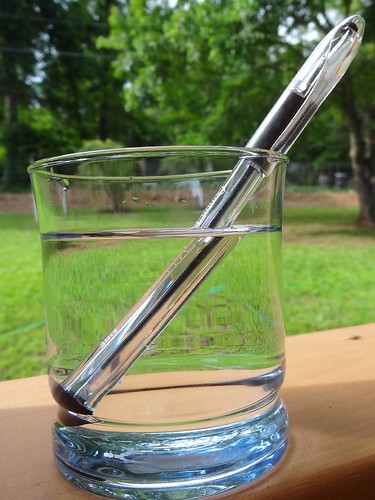
refraction - ball point pen in water
 I'm thankful for refraction. Without it, the ball point pen above would have appeared to be quite straight. As a matter of fact, it was quite straight. But when light travels from one medium to another (water and air in this case), and the velocity of light in the two mediums is not the same, we can get refraction, the bending of light. Without this phenomenon, the camera that I used to take this picture wouldn't have worked, and without it, your eyes wouldn't have been able to see the image properly. Lenses in cameras and eyes (and eyeglasses and contacts) use refraction in order to function. (I know, there was some refraction when the light went between the glass and the air, or the water and the glass, or the glass and the water, but let's not go there!)

Refraction is an amazing phenomenon, and I'm grateful for it!

Wednesday, November 14, 2012

Sunspots 392

Things I have recently spotted that may be of interest to someone else:
Science:  Naked mole rats don't get cancer, or at least don't die from it, according to a report in Wired, which report also indicates the mechanism of protection.

Sports: Sports Illustrated has posted their version of the 100 greatest sports photos of all time.
 
Politics:  The transcript of re-elected President Obama's speech.

Henry Neufeld points out two extreme reactions to the Obama victory. An owner of a coal company read a prayer to some of his employees, and then fired 156 of them, because, he said, of the election results. A self-identified Libertarian advised people to remove anyone who voted Democrat from their Facebook Friend list, and men (No corresponding advice to women) to break up with a girlfriend, or divorce a spouse, who voted Democratic. (He said more than that, but that's enough.)

Image source (public domain)