In previous posts, I described the setting and the theme of the four Sharing Knife novels, by Lois McMaster Bujold. A later post, on religion in the books, is here.The final post in the series, on how I found illustrations of important Christian ideas in the books, whether Bujold intended them or not, is here.
I now expand on the setting, by describing one special aspect of Bujold's sub-creation, namely, ground. A Wikipedia author, in the article on Passage, the third book in the series, compared ground to the traditional Chinese concept of ch'i, or qi. The comparison seems to have some merit. I would like to describe Bujold's ground, as well as I am able. I do not think in those terms, myself.
All material objects possess ground. Living things have more of it than non-living objects, and humans have more of it than any other living things. Embryos and fetuses have especially active ground. Some adults have more active, or intense, ground than others. A person with groundsense can distinguish between people, using only this sense, which tells us that there must be some property, or properties, of ground that make it so distinguishable.
Lakewalkers all develop groundsense during adolescence. The amount of groundsense varies. Groundsense has a range. For Dag, this is about a mile, normally, although during some times when he has been stressed, it is much less. Most Lakewalkers do not have a range as great as Dag's. Some Lakewalkers are especially talented. They are healers, or makers of sharing knives. I described sharing knives in my first post in this series.
Some farmers have a little groundsense. Fawn's Aunt Nattie has some. Fawn, herself, has none.
Not only can Lakewalkers detect individual humans, other living things, and inanimate objects (such as hidden sandbars in rivers) but they can manipulate other objects with groundsense. They can, for example, make mosquitoes stay away from them. Dag, at least, can attract fireflies to himself. He can also fish and hunt using his groundsense, attracting game animals and fish to him, using his ground.
Dag puts a broken glass bowl together, using his groundsense. Healers, and even ordinary Lakewalker patrollers, can do some medical work with their groundsense. When doing so, they lose contact with the ordinary world, and sense details of the body to be healed that would not be perceptible to a person lacking groundsense. They can set a bone, remove infection, and other remarkable things. They don't seem to be able to sense microscopic objects, such as blood cells or platelets.
The loss of contact with the ordinary world gives the healer the ability to sense, as it were, a second, parallel world, the world sensed only by groundsense. The same ability, in a lesser degree, seems to be expressed on other occasions. This reminds me of the two worlds seen by some of Tolkien's characters. In The Fellowship of the Ring, just as Frodo is crossing the Ford of the River Bruinen, on the way to Rivendell, the house of Elrond, he sees that parallel world, rather than the ordinary one. Glorfindel, an elf-lord, and the Riders of the enemy are "seen" especially well by Frodo, his peers, and Aragorn, a human, less so.
There are dangers in becoming too obsessed with the parallel world shown by groundsense. A Lakewalker, especially a healer, can become groundlocked -- conscious only of the world shown by groundsense so long that she cannot come back to the ordinary world. If this happens, she dies.
Ground, as indicated above, can be detected by others. So, to a Lakewalker, being with lots of people can be like receiving too many radio broadcasts at once -- noisy and distracting. Lakewalkers can voluntarily shield their grounds from other people. When they do so effectively, they cannot use their groundsense.
Dag discovers that he can extend, and use, a hand he doesn't really have (he lost his real hand in a fight with a malice). Arkady, an accomplished maker, can also do this.
Dag also discovers that he can groundrip other objects -- remove the ground from them, so that they die, or if not living, lose their structural integrity. He uses this as a weapon, ground-ripping a small cross-section of Crane's spinal cord, which paralyzes Crane, and making a hole in the heart of a bat-based slave of a malice, thus causing its death.
Ground, and the story of Fawn and Dag, are essential to the Sharing Knife books.
Thanks for reading.
Musings on science, the Bible, and fantastic literature (and sometimes basketball and other stuff).
God speaks to us through the Bible and the findings of science, and we should listen to both types of revelation.
The title is from Psalm 84:11.
The Wikipedia is usually a pretty good reference. I mostly use the World English Bible (WEB), because it is public domain. I am grateful.
License
I have written an e-book, Does the Bible Really Say That?, which is free to anyone. To download that book, in several formats, go here.

The posts in this blog are licensed under a Creative Commons Attribution-NonCommercial-ShareAlike 3.0 Unported License. You can copy and use this material, as long as you aren't making money from it. If you give me credit, thanks. If not, OK.
The posts in this blog are licensed under a Creative Commons Attribution-NonCommercial-ShareAlike 3.0 Unported License. You can copy and use this material, as long as you aren't making money from it. If you give me credit, thanks. If not, OK.
Thursday, August 06, 2009


Wednesday, August 05, 2009
Sunspots 222

Things I have recently spotted that may be of interest to someone else:
Science: CBS News, and many other sources, report that tanning beds cause skin cancer. Duh!
Wired reports that the swimming activity of jellyfish may influence climate. Amazing.
It's probably not going to convince anyone who doesn't want to be convinced, but there's a web page, with extensive links, on "How to Talk to a Climate Skeptic" who doubts the reality of global warming.
Music: CNN reports that Mozart may have started composing music even earlier than we knew that he did.
Christianity:
". . . kingdom service is not a program, nor is it a checklist, nor is it an organizational manual. It’s a surrender." - Threads from Henry's Web.
Image source (public domain)
Tuesday, August 04, 2009
The Sharing Knife, theme
In the first post in this series, I attempted to set the stage, including some description of the two types of people in these books. A later post, on the subject of ground (unique to these books) is here. A later post, on religion in the books, is here.The final post in the series, on how I found illustrations of important Christian ideas in the books, whether Bujold intended them or not, is here.
In this one, I'll discuss the theme of the four books.
That theme is that Lakewalkers and farmers should, even must, get along, and respect each other and interact more. Does this have political overtones? Probably, but the idea could be applied to many pairs of cultures, religions, ethnic groups. Bujold has said that ". . . if romances are fantasies of love, and mysteries are fantasies of justice, F&SF [Fantasy and Science Fiction stories] are fantasies of political agency." (See here.)
Most obviously, this theme is set forth explicitly in action at the end of the second volume. Dag's mother insists that Dag is not really married to Fawn. She demands that he abandon her, and a council of Lakewalkers, from that particular area, is called to deal with the matter. When Dag sees that half of the council is going to agree with his mother, and believes that they are doing so out of prejudice, he declares that he is going to leave the camp with Fawn, and does. In part, this is out of protest, but Dag has also had conversations with the captain of the Lakewalker patrol, and with the most important healer, and told them that he believes that farmers and Lakewalkers are too distant from each other. Dag's mother is not receptive to such an argument, but the captain and the healer see that it has merit. The third and fourth volumes describe how Dag and Fawn connect with farmers and Lakewalkers, and how they get at least a few of these to see that Dag's vision is correct.
Why does Dag feel as strongly as he does about Fawn, his farmer wife?
One reason is because he sees Fawn as a woman with great ability. She cannot sense and manipulate ground, except that the bit of Dag's ground in her marriage cord tells her whether he is alive or not. Although she lacks this special ability, found in Lakewalkers, she has great courage, an ability to grasp what needs to be done, and can understand and articulate the heart of important issues. She is a loving wife, and a hard-working companion. Fawn is involved in each of the four malice kills described in the books. She personally killed the first one. The story of how Dag threw Fawn his sharing knife, and she killed that malice, the Glassforge malice, guided Dag's aunt, and patrol captain, Mari to throw her knife to Dirla, who killed the second malice in these stories, the Bonemarsh malice. After that malice was killed, Fawn sensed, from miles away, that Dag was in deep trouble, and rescued Dag and several other Lakewalkers, including an important healer, from the aftereffects of the encounter with the second one, acting in a way that no Lakewalker had understood how to do, namely using a sharing knife on Dag's leg. In the third encounter, she was nearby when Rase, working under Dag's leadership, killed a young malice. In the fourth encounter, she encouraged her brother, Whit, to make the actual kill, and crafted the weapon that did the killing. That weapon included a sharing knife, already made and primed by Lakewalkers.
If Fawn is so capable, in spite of her short stature, her youth, and her lack of groundsense, there must be other farmers who also have great ability.
Another reason for Dag's pursuit of a better relationship is that Dag sees farmer abilities as equivalent to the Lakewalker's ability to manipulate ground. In the first book, Dag and Fawn watch glassblowers in action. Dag examines the ground of a bowl that a farmer craftsman has made, and finds that its ground is well made, even though the farmer is not aware of ground. Later, he describes farmer commerce -- ordering goods from hundreds of miles away, and paying for them with coin minted by remote towns -- as a sort of farmer magic.
Also, Dag is afraid that, if farmers aren't taught about malices, and ground, and sharing knives, a malice will emerge close to a large farmer town, and, in enslaving a large group of farmers, gain energy, ground and knowledge that will make it impossible to destroy. But, if they are taught what to look for, and how to react to malice threats, most of the townspeople could escape, and they could warn Lakewalkers early, so that the malice can be killed. This argument resonates most clearly with Lakewalkers.
I believe that Bujold wants us to see that Dag's most important reason for trying to begin a fusion of the two groups is that Dag sees their common humanity. He understands and respects the farmers he has grown to know. He sees their hurts as worth as much care as Lakewalker injuries, and believes that their medical needs cannot be ignored, as they have been. In spite of prohibitions against explaining ground, and sharing knives, to farmers, he begins to do just that, in part so that farmers won't see Lakewalkers as cannibals or ghouls.
In all this, Fawn supports him. There are farmer prejudices against Lakewalkers, too, and she tries to combat those. The two of them have begun to achieve their vision by the end of the books. The last scene takes place in the home that Dag and Fawn share with Fawn's brother, Whit, and his wife, Berry. Dag has become a healer of all who come to him, using his ability to manipulate ground to repair their injuries. He does not always succeed, but usually does. Barr, who entered in the third book as a self-centered, immature Lakewalker, comes to them. He confesses that he had a fling with a farmer girl, and that he has discovered that the result was a daughter. The girl's mother doesn't want anything to do with Barr. Barr is disturbed, and seeks advice from Dag and Fawn. They tell him to not give up on the possibility of helping out his daughter, and Barr is eased by that. Then Fawn's infant daughter, also a half-breed, the future of the two cultures, must be cared for, by both her parents, as Barr observes.
Bujold doesn't sugar-coat the difficulty of getting along with people of a different culture. She indicates that doing so must be done on a one-on-one basis, and that both groups must make changes in their way of thinking. I think she has hit the nail on the head.
Thanks for reading.
In this one, I'll discuss the theme of the four books.
That theme is that Lakewalkers and farmers should, even must, get along, and respect each other and interact more. Does this have political overtones? Probably, but the idea could be applied to many pairs of cultures, religions, ethnic groups. Bujold has said that ". . . if romances are fantasies of love, and mysteries are fantasies of justice, F&SF [Fantasy and Science Fiction stories] are fantasies of political agency." (See here.)
Most obviously, this theme is set forth explicitly in action at the end of the second volume. Dag's mother insists that Dag is not really married to Fawn. She demands that he abandon her, and a council of Lakewalkers, from that particular area, is called to deal with the matter. When Dag sees that half of the council is going to agree with his mother, and believes that they are doing so out of prejudice, he declares that he is going to leave the camp with Fawn, and does. In part, this is out of protest, but Dag has also had conversations with the captain of the Lakewalker patrol, and with the most important healer, and told them that he believes that farmers and Lakewalkers are too distant from each other. Dag's mother is not receptive to such an argument, but the captain and the healer see that it has merit. The third and fourth volumes describe how Dag and Fawn connect with farmers and Lakewalkers, and how they get at least a few of these to see that Dag's vision is correct.
Why does Dag feel as strongly as he does about Fawn, his farmer wife?
One reason is because he sees Fawn as a woman with great ability. She cannot sense and manipulate ground, except that the bit of Dag's ground in her marriage cord tells her whether he is alive or not. Although she lacks this special ability, found in Lakewalkers, she has great courage, an ability to grasp what needs to be done, and can understand and articulate the heart of important issues. She is a loving wife, and a hard-working companion. Fawn is involved in each of the four malice kills described in the books. She personally killed the first one. The story of how Dag threw Fawn his sharing knife, and she killed that malice, the Glassforge malice, guided Dag's aunt, and patrol captain, Mari to throw her knife to Dirla, who killed the second malice in these stories, the Bonemarsh malice. After that malice was killed, Fawn sensed, from miles away, that Dag was in deep trouble, and rescued Dag and several other Lakewalkers, including an important healer, from the aftereffects of the encounter with the second one, acting in a way that no Lakewalker had understood how to do, namely using a sharing knife on Dag's leg. In the third encounter, she was nearby when Rase, working under Dag's leadership, killed a young malice. In the fourth encounter, she encouraged her brother, Whit, to make the actual kill, and crafted the weapon that did the killing. That weapon included a sharing knife, already made and primed by Lakewalkers.
If Fawn is so capable, in spite of her short stature, her youth, and her lack of groundsense, there must be other farmers who also have great ability.
Another reason for Dag's pursuit of a better relationship is that Dag sees farmer abilities as equivalent to the Lakewalker's ability to manipulate ground. In the first book, Dag and Fawn watch glassblowers in action. Dag examines the ground of a bowl that a farmer craftsman has made, and finds that its ground is well made, even though the farmer is not aware of ground. Later, he describes farmer commerce -- ordering goods from hundreds of miles away, and paying for them with coin minted by remote towns -- as a sort of farmer magic.
Also, Dag is afraid that, if farmers aren't taught about malices, and ground, and sharing knives, a malice will emerge close to a large farmer town, and, in enslaving a large group of farmers, gain energy, ground and knowledge that will make it impossible to destroy. But, if they are taught what to look for, and how to react to malice threats, most of the townspeople could escape, and they could warn Lakewalkers early, so that the malice can be killed. This argument resonates most clearly with Lakewalkers.
I believe that Bujold wants us to see that Dag's most important reason for trying to begin a fusion of the two groups is that Dag sees their common humanity. He understands and respects the farmers he has grown to know. He sees their hurts as worth as much care as Lakewalker injuries, and believes that their medical needs cannot be ignored, as they have been. In spite of prohibitions against explaining ground, and sharing knives, to farmers, he begins to do just that, in part so that farmers won't see Lakewalkers as cannibals or ghouls.
In all this, Fawn supports him. There are farmer prejudices against Lakewalkers, too, and she tries to combat those. The two of them have begun to achieve their vision by the end of the books. The last scene takes place in the home that Dag and Fawn share with Fawn's brother, Whit, and his wife, Berry. Dag has become a healer of all who come to him, using his ability to manipulate ground to repair their injuries. He does not always succeed, but usually does. Barr, who entered in the third book as a self-centered, immature Lakewalker, comes to them. He confesses that he had a fling with a farmer girl, and that he has discovered that the result was a daughter. The girl's mother doesn't want anything to do with Barr. Barr is disturbed, and seeks advice from Dag and Fawn. They tell him to not give up on the possibility of helping out his daughter, and Barr is eased by that. Then Fawn's infant daughter, also a half-breed, the future of the two cultures, must be cared for, by both her parents, as Barr observes.
Bujold doesn't sugar-coat the difficulty of getting along with people of a different culture. She indicates that doing so must be done on a one-on-one basis, and that both groups must make changes in their way of thinking. I think she has hit the nail on the head.
Thanks for reading.
Monday, August 03, 2009
The Sharing Knife tetralogy, by Lois McMaster Bujold
I have recently read the Sharing Knife tetralogy, by Lois McMaster Bujold. Bujold is one of the few authors who have won both the Hugo and Nebula awards, and also a Mythopoeic Award. The Sharing Knife books haven't won any of these awards, so far as I know, perhaps because they are low-key -- there aren't any major wars, there's no evil human wizard -- but they are well done, and I enjoyed reading them. They are fantasy literature. I expect to base my next few posts (except for a Sunspots) on these books.
I plan to summarize the books in this post, because some background will be necessary to set the stage for some additional posts. The four books are Beguilement (2006), Legacy (2007), Passage (2008) and Horizon (2009), all published by Eos (HarperColllins).
The setting appears to be North America, after some unspecified disaster, several centuries previous to the time of the books. The culture is pretty standard for sword and sorcery works, in that there is no gunpowder, and no internal combustion engines, and there is magic, or at least there are abilities and a sense that we don't possess. There are two types of humans. They speak the same language, exchange goods, can produce half-breed offspring, and live in close proximity. The Lakewalkers are taller, and live longer than the farmers. (Bujold does not capitalize "farmer," but does capitalize "Lakewalker.") The Lakewalkers can practice magic, although they don't call it that, and farmers can do little or none of this. The Lakewalkers usually see themselves as noble guardians of the ungrateful farmers. Farmers usually see Lakewalkers as proud and aloof, and, to some farmers, as cannibals and grave-robbers.
The main characters are Fawn, a farmer girl, who is eighteen, newly pregnant, and running away from home at the beginning of the series, and Dag, a Lakewalker who has lost most of one arm in a battle. He is over fifty. Bujold uses each of them about equally to establish her point of view, as the tale progresses.
To summarize the four books, Dag and Fawn fall in love, and marry, to some opposition from both groups, especially the Lakewalkers. They overcome four malices, the evil spirit beings that are the bad guys of the books. Dag decides that the two groups have been too separate, and should respect each other more, and work together. He and Fawn travel across hundreds of miles, first by boat, then by wagon train, and, in the process, begin to bring Lakewalkers and farmers more closely together.
What, you may ask, is a sharing knife? First, I need to discuss the concept of ground. Ground, in these books, is some sort of non-material property or essence that is possessed by everything in existence. Humans, including unborn ones, have ground, more than all other material living things. Animals, even insects, have ground, but not as much as humans. Plants, rocks, and even human-made artifacts have ground. Ground is said not be the same as a soul. Lakewalkers can sense the ground of other entities, whether they are animate, or even if they are underwater obstacles in a river. They can do this over a range, which varies from Lakewalker to Lakewalker. Dag's range is normally a little over a mile. That is exceptional, but not unprecedented. Lakewalkers can shield their grounds from other beings able to sense it -- which means that they also are curbing their own groudsense. They can also manipulate ground. Some of them are very good at this, and use this ability to aid their work as healers. When healing, a healer loses awareness of the visible physical world, but becomes aware of the parts of the body to be healed, in intimate detail, including, for example, blood vessels. A healer can connect blood vessels, and do other major repairs, through ground manipulation.
It is possible to rip the ground out of some organism, which kills it. (A similar operation can be done on an inanimate object, but is rarely done. If it were, the essential structure of that object would be destroyed.) When this is done, the victim's ground becomes a detectable addition to the ground of the manipulator, until fully assimilated. It is dangerous to rip the ground out of any complex and intelligent organism, because it may be difficult to assimilate that much ground.
It is possible to become ground-locked. That can happen during healing, when the healer, in effect, is unable to leave the state of heightened ground-senses required for healing, and return to the real physical world. If another person with skill at manipulating ground is not available to help, a ground-locked Lakewalker will die.
Another danger to farmers and Lakewalkers is that, when a Lakewalker does groundwork on a farmer, usually to heal, the farmer may become beguiled -- strongly emotionally attached to the Lakewalker, and desiring more groundwork by the Lakewalker, whether it is needed or not.
Now, I need to consider malices. A malice is a powerful evil being that lives by taking ground from other entities, including the very rocks and plants. An area where a malice has lived is unlivable, often for many years after the malice has been killed. Material that has had its ground taken out of it is gray and loses most of its features and structure, and an area of this type is called a blight. Blights are eventually healed by natural processes -- living things gradually invade and replace the blight. Malices live and grow by not only taking ground from other things, but by taking the attributes and abilities of vertebrates, including humans. They can gain the power of speech by capturing a human. They can use animals or humans as slaves, and are also able to change animals into an almost human form, making them more valuable slaves, in a ghastly metamorphosis. (They can also produce animals which are unlike anything normal, including extra-large wolflike beings, and creatures like bats, able to fly, but much larger, and with the power of speech.) These changed, or created beings are called mud men. They die quickly when their malice is killed. Malices can control the thought and actions of their slaves. Left unchecked, malices would destroy the world for all life. Malices seem to have originated during some sort of unspecified experiment, that went badly awry, probably connected to the disaster referred to above. This is apparently meant to have been a result of our own real civilization doing something stupid. They have been seeded throughout the land, and remain dormant, until they appear at unpredictable times and places. They start as sessile -- not moving. When they have grown for a while, they become mobile, taking their slave armies with them to better sources of ground, such as human settlements. Human children and the unborn have ground which malices find to be especially valuable.
A sharing knife is a device constructed by certain Lakewalker craftspeople. (Males and females are equal in both societies, or at least any position of leadership, or any craft, seems open to both sexes.) A sharing knife is made from one of the long bones of a dead Lakewalker. When another Lakewalker is about to die, he or she is, if possible, killed by such a knife, or commits suicide with a prepared knife. The death is with the consent of the dying person. Part of their ground goes into the knife, which, thus, has some part of two different Lakewalkers, and is both prepared, from a bone, and primed, with ground. A prepared and primed knife can be used to kill a malice, and is the only way this can be done. Malices do not die natural deaths. Groups of trained Lakewalkers patrol the entire land, as often and as thoroughly as possible. Each group must have at least one sharing knife. Because of these patrols, no malice has threatened to destroy the entire land. There have been malices that grew large, with large armies. As human populations get larger, the malice threat becomes more dangerous, as a malice might be able to capture the humans from a large town, and thus obtain lots of valuable ground, and a large army, which would make getting close enough to kill the malice difficult, perhaps even impossible. When possible, Lakewalker patrollers carry two sharing knives, one primed, to kill a malice, and one prepared, to be primed with their own death. The books do not consider the question of whether a sharing knife could be made from a farmer bone, or using a farmer's ground.
Lakewalkers use other weapons, including knives, swords, and bows and arrows.
In future posts, I hope to say more about the characters, and about religious aspects of these books. Thanks for reading.
The next post, on the theme of these books, is here. A later post, on the subject of ground (unique to these books) is here. A later post, on religion in the books, is here. The final post in the series, on how I found illustrations of important Christian ideas in the books, whether Bujold intended them or not, is here.
I plan to summarize the books in this post, because some background will be necessary to set the stage for some additional posts. The four books are Beguilement (2006), Legacy (2007), Passage (2008) and Horizon (2009), all published by Eos (HarperColllins).
The setting appears to be North America, after some unspecified disaster, several centuries previous to the time of the books. The culture is pretty standard for sword and sorcery works, in that there is no gunpowder, and no internal combustion engines, and there is magic, or at least there are abilities and a sense that we don't possess. There are two types of humans. They speak the same language, exchange goods, can produce half-breed offspring, and live in close proximity. The Lakewalkers are taller, and live longer than the farmers. (Bujold does not capitalize "farmer," but does capitalize "Lakewalker.") The Lakewalkers can practice magic, although they don't call it that, and farmers can do little or none of this. The Lakewalkers usually see themselves as noble guardians of the ungrateful farmers. Farmers usually see Lakewalkers as proud and aloof, and, to some farmers, as cannibals and grave-robbers.
The main characters are Fawn, a farmer girl, who is eighteen, newly pregnant, and running away from home at the beginning of the series, and Dag, a Lakewalker who has lost most of one arm in a battle. He is over fifty. Bujold uses each of them about equally to establish her point of view, as the tale progresses.
To summarize the four books, Dag and Fawn fall in love, and marry, to some opposition from both groups, especially the Lakewalkers. They overcome four malices, the evil spirit beings that are the bad guys of the books. Dag decides that the two groups have been too separate, and should respect each other more, and work together. He and Fawn travel across hundreds of miles, first by boat, then by wagon train, and, in the process, begin to bring Lakewalkers and farmers more closely together.
What, you may ask, is a sharing knife? First, I need to discuss the concept of ground. Ground, in these books, is some sort of non-material property or essence that is possessed by everything in existence. Humans, including unborn ones, have ground, more than all other material living things. Animals, even insects, have ground, but not as much as humans. Plants, rocks, and even human-made artifacts have ground. Ground is said not be the same as a soul. Lakewalkers can sense the ground of other entities, whether they are animate, or even if they are underwater obstacles in a river. They can do this over a range, which varies from Lakewalker to Lakewalker. Dag's range is normally a little over a mile. That is exceptional, but not unprecedented. Lakewalkers can shield their grounds from other beings able to sense it -- which means that they also are curbing their own groudsense. They can also manipulate ground. Some of them are very good at this, and use this ability to aid their work as healers. When healing, a healer loses awareness of the visible physical world, but becomes aware of the parts of the body to be healed, in intimate detail, including, for example, blood vessels. A healer can connect blood vessels, and do other major repairs, through ground manipulation.
It is possible to rip the ground out of some organism, which kills it. (A similar operation can be done on an inanimate object, but is rarely done. If it were, the essential structure of that object would be destroyed.) When this is done, the victim's ground becomes a detectable addition to the ground of the manipulator, until fully assimilated. It is dangerous to rip the ground out of any complex and intelligent organism, because it may be difficult to assimilate that much ground.
It is possible to become ground-locked. That can happen during healing, when the healer, in effect, is unable to leave the state of heightened ground-senses required for healing, and return to the real physical world. If another person with skill at manipulating ground is not available to help, a ground-locked Lakewalker will die.
Another danger to farmers and Lakewalkers is that, when a Lakewalker does groundwork on a farmer, usually to heal, the farmer may become beguiled -- strongly emotionally attached to the Lakewalker, and desiring more groundwork by the Lakewalker, whether it is needed or not.
Now, I need to consider malices. A malice is a powerful evil being that lives by taking ground from other entities, including the very rocks and plants. An area where a malice has lived is unlivable, often for many years after the malice has been killed. Material that has had its ground taken out of it is gray and loses most of its features and structure, and an area of this type is called a blight. Blights are eventually healed by natural processes -- living things gradually invade and replace the blight. Malices live and grow by not only taking ground from other things, but by taking the attributes and abilities of vertebrates, including humans. They can gain the power of speech by capturing a human. They can use animals or humans as slaves, and are also able to change animals into an almost human form, making them more valuable slaves, in a ghastly metamorphosis. (They can also produce animals which are unlike anything normal, including extra-large wolflike beings, and creatures like bats, able to fly, but much larger, and with the power of speech.) These changed, or created beings are called mud men. They die quickly when their malice is killed. Malices can control the thought and actions of their slaves. Left unchecked, malices would destroy the world for all life. Malices seem to have originated during some sort of unspecified experiment, that went badly awry, probably connected to the disaster referred to above. This is apparently meant to have been a result of our own real civilization doing something stupid. They have been seeded throughout the land, and remain dormant, until they appear at unpredictable times and places. They start as sessile -- not moving. When they have grown for a while, they become mobile, taking their slave armies with them to better sources of ground, such as human settlements. Human children and the unborn have ground which malices find to be especially valuable.
A sharing knife is a device constructed by certain Lakewalker craftspeople. (Males and females are equal in both societies, or at least any position of leadership, or any craft, seems open to both sexes.) A sharing knife is made from one of the long bones of a dead Lakewalker. When another Lakewalker is about to die, he or she is, if possible, killed by such a knife, or commits suicide with a prepared knife. The death is with the consent of the dying person. Part of their ground goes into the knife, which, thus, has some part of two different Lakewalkers, and is both prepared, from a bone, and primed, with ground. A prepared and primed knife can be used to kill a malice, and is the only way this can be done. Malices do not die natural deaths. Groups of trained Lakewalkers patrol the entire land, as often and as thoroughly as possible. Each group must have at least one sharing knife. Because of these patrols, no malice has threatened to destroy the entire land. There have been malices that grew large, with large armies. As human populations get larger, the malice threat becomes more dangerous, as a malice might be able to capture the humans from a large town, and thus obtain lots of valuable ground, and a large army, which would make getting close enough to kill the malice difficult, perhaps even impossible. When possible, Lakewalker patrollers carry two sharing knives, one primed, to kill a malice, and one prepared, to be primed with their own death. The books do not consider the question of whether a sharing knife could be made from a farmer bone, or using a farmer's ground.
Lakewalkers use other weapons, including knives, swords, and bows and arrows.
In future posts, I hope to say more about the characters, and about religious aspects of these books. Thanks for reading.
The next post, on the theme of these books, is here. A later post, on the subject of ground (unique to these books) is here. A later post, on religion in the books, is here. The final post in the series, on how I found illustrations of important Christian ideas in the books, whether Bujold intended them or not, is here.
Sunday, August 02, 2009
The diversity of God's creation
I have been struck by the number of times that the Bible is inclusive about God's creation, in reference to how good it is, and, I believe, to our responsibility to care for all of it. (See here and here for posts on what the Bible says about environmental stewardship.)
Genesis 1 concludes by saying that everything God had made was very good.
In Genesis 6:19-20, God's instructions to Noah were to have representatives of all of the animals on the ark. (I have questions about Noah's flood, a lot of questions. One of them is as to whether the flood was world-wide or not. I'm not sure. But I am sure that Noah thought it was, and, therefore, he must have believed that he needed to preserve all the animals from the area around him, if not from the entire earth.)
In Psalm 24:1, the Psalmist tells us that the entire earth, and the things that live on it, belong to God.
Psalm 104:24-25 attempts, in two verses, to describe the amazing diversity that God created. It also says that God made them all in His wisdom.
Colossians 1:15-20 speaks of Christ, and says that He created all things, and that He holds all things together.
All things were made good, in God's wisdom. Therefore, we have a responsibility to preserve them.
Thanks for reading.
Genesis 1 concludes by saying that everything God had made was very good.
In Genesis 6:19-20, God's instructions to Noah were to have representatives of all of the animals on the ark. (I have questions about Noah's flood, a lot of questions. One of them is as to whether the flood was world-wide or not. I'm not sure. But I am sure that Noah thought it was, and, therefore, he must have believed that he needed to preserve all the animals from the area around him, if not from the entire earth.)
In Psalm 24:1, the Psalmist tells us that the entire earth, and the things that live on it, belong to God.
Psalm 104:24-25 attempts, in two verses, to describe the amazing diversity that God created. It also says that God made them all in His wisdom.
Colossians 1:15-20 speaks of Christ, and says that He created all things, and that He holds all things together.
All things were made good, in God's wisdom. Therefore, we have a responsibility to preserve them.
Thanks for reading.
Saturday, August 01, 2009
Very strange fungal parasites in action
Carl Zimmer has hit another home run in this blog post from Discover Magazine.
He has learned about fungi that parasitize insects. Nothing special about that. But what is special is the way the insects behave when parasitized. Amazing.
A short video is included.
He has learned about fungi that parasitize insects. Nothing special about that. But what is special is the way the insects behave when parasitized. Amazing.
A short video is included.
Thursday, July 30, 2009
The recent eclipse, seen from space
Since you didn't see the recent solar eclipse, you can see the shadow of the moon on the earth, on China, as posted by Wired. Amazing!
Wednesday, July 29, 2009
Sunspots 221

Things I have recently spotted that may be of interest to someone else:
Science:
Did you ever wonder about the adaptive significance of toucan's bills? The BBC reports on research into the function of these large bird parts.
Philosophy:
(or something) Wired has an article on guidelines (ethics, if you please) for robot behavior.
Christianity:
The problem of how a good God can allow bad things is addressed again, in Christianity Today. The article asks "Why do we Need Earthquakes?" and goes on from there.
Image source (public domain)
Tuesday, July 28, 2009
We are all human.
When you hear a baby cry, you can't tell the sex, skin color, national origin, ethnicity, or language group of the child from the sound. We just know that it's an important person crying. We are all that much alike.
Thanks for reading.
Thanks for reading.
Monday, July 27, 2009
Water: an amazing substance
Water is a very common substance, so common that we take it for granted, but it is also unusual. How so? Why is that important?
1. Water is the only common substance that may be found in all three states under common conditions. This means that we can have a water cycle, wherein water moves all over the earth in the gaseous state, and precipitates in the liquid or solid state. If it weren't for that, agriculture would be mostly impossible. It also means that we can have snow and ice, which are important for many reasons, including the fact that snow and ice insulate organisms that live under them, greatly slowing heat loss from bodies of water with ice and snow covering them.
Mars is the only planet, other than Earth, in our solar system where conditions are enough like earth that all three states might occur there, but there doesn't seem to be much water on Mars at all now (there may have been in the past). There may be water on Enceladus, a satellite of Saturn.
2. Water is the only common substance that becomes less dense when it becomes a solid. This means that ice floats. If it didn't, polar bears would have a hard time, and bodies of water (except for very shallow ones) would be mostly solid, even in the summer, because the ice would be denser, and would stay on the bottom, where the sun wouldn't melt it. If that were so, many water-living organisms couldn't exist.
3. Water is unique in that it becomes most dense at 4 degrees Celsius (approximately the temperature inside a refrigerator) when it is still liquid. This means that bodies of water tend to become uniform in temperature when they cool in the fall, and when they warm up in the spring, as liquid water, either colder or warmer than 4 degrees, rests on top of the 4 degree water, until it either cools to 4 degrees in the fall, or warms to 4 degrees in the spring, so that eventually the whole body of water is at 4 degrees. The resulting uniformity means that nutrients that have sunk to the bottom can be stirred by the wind while the body of water is uniform. Again, if this were not true, many water-living organisms couldn't exist. (for more on this topic, see here)
4. Water is transparent. This means that your eye can see, as light goes through the eye (which is mostly water) to the retina. It also means that fish can see, and that plants below the surface of a body of water can carry out photosynthesis, the food-making process that requires light.
5. Water has a high specific heat, meaning that it takes a lot of energy to change the temperature of water without changing its state.
6. Water has a high heat of fusion, meaning that it takes a lot of energy to melt ice, or that you must remove a lot of energy for water to freeze.
Properties 5 and 6 help to stabilize the climate near bodies of water. They also allow fruit-growers to protect their crops from freezing by spraying them with water when a freeze is predicted.
7. Water has a high heat of vaporization, meaning that it takes a lot of energy to vaporize water, ("A watched pot never boils") or that you must remove a lot of energy to condense vapor. Properties 5-7 mean that water stabilizes temperature. For example, a human at 37 degrees C (normal body temperature) can remain in air at 45 degrees C or 0 degrees (freezing temperature) for a long time without damage. It also means that deserts are subject to a great deal of temperature fluctuation compared to areas near large bodies of water.
8. Water makes up most of the mass of most living things, including green plants. It is, of course, made of molecules with two Hydrogen atoms and one Oxygen atom. One reason that this is vitally important is that water is one of the raw materials of photosynthesis, the process by which green plants make food for the rest of living things. Photosynthesis attaches the Hydrogen from water to Carbon from Carbon Dioxide.
9. Water is self-attractive, which means that it makes drops -- water molecules sticking together. This property helps tall plants get water up to their tops, and also makes it possible for some organisms to walk or run on top of the surface of bodies of water.
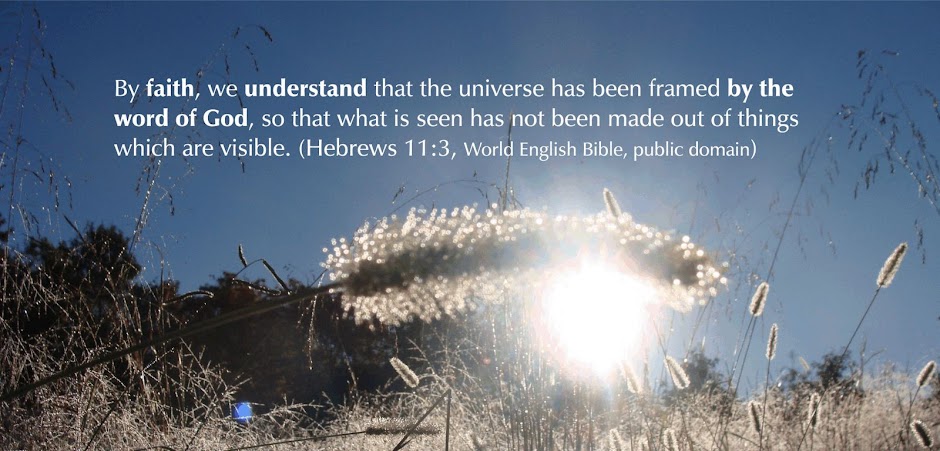
Some would argue that these, and other properties of water, are so unique, and so important, that water must necessarily have been specially created as it is. I believe that God designed water with these, and probably other, unique properties, but don't believe that I can prove this. In the Bible, Hebrews 11:3 implies that we understand God's creative power by faith.
Thanks for reading.
See this post on the times that water is mentioned in the book of John. Here's a post on the importance of water, from a different author.
This is a re-post from July 26, 2007, changed slightly.
1. Water is the only common substance that may be found in all three states under common conditions. This means that we can have a water cycle, wherein water moves all over the earth in the gaseous state, and precipitates in the liquid or solid state. If it weren't for that, agriculture would be mostly impossible. It also means that we can have snow and ice, which are important for many reasons, including the fact that snow and ice insulate organisms that live under them, greatly slowing heat loss from bodies of water with ice and snow covering them.
Mars is the only planet, other than Earth, in our solar system where conditions are enough like earth that all three states might occur there, but there doesn't seem to be much water on Mars at all now (there may have been in the past). There may be water on Enceladus, a satellite of Saturn.
2. Water is the only common substance that becomes less dense when it becomes a solid. This means that ice floats. If it didn't, polar bears would have a hard time, and bodies of water (except for very shallow ones) would be mostly solid, even in the summer, because the ice would be denser, and would stay on the bottom, where the sun wouldn't melt it. If that were so, many water-living organisms couldn't exist.
3. Water is unique in that it becomes most dense at 4 degrees Celsius (approximately the temperature inside a refrigerator) when it is still liquid. This means that bodies of water tend to become uniform in temperature when they cool in the fall, and when they warm up in the spring, as liquid water, either colder or warmer than 4 degrees, rests on top of the 4 degree water, until it either cools to 4 degrees in the fall, or warms to 4 degrees in the spring, so that eventually the whole body of water is at 4 degrees. The resulting uniformity means that nutrients that have sunk to the bottom can be stirred by the wind while the body of water is uniform. Again, if this were not true, many water-living organisms couldn't exist. (for more on this topic, see here)
4. Water is transparent. This means that your eye can see, as light goes through the eye (which is mostly water) to the retina. It also means that fish can see, and that plants below the surface of a body of water can carry out photosynthesis, the food-making process that requires light.
5. Water has a high specific heat, meaning that it takes a lot of energy to change the temperature of water without changing its state.
6. Water has a high heat of fusion, meaning that it takes a lot of energy to melt ice, or that you must remove a lot of energy for water to freeze.
Properties 5 and 6 help to stabilize the climate near bodies of water. They also allow fruit-growers to protect their crops from freezing by spraying them with water when a freeze is predicted.
7. Water has a high heat of vaporization, meaning that it takes a lot of energy to vaporize water, ("A watched pot never boils") or that you must remove a lot of energy to condense vapor. Properties 5-7 mean that water stabilizes temperature. For example, a human at 37 degrees C (normal body temperature) can remain in air at 45 degrees C or 0 degrees (freezing temperature) for a long time without damage. It also means that deserts are subject to a great deal of temperature fluctuation compared to areas near large bodies of water.
8. Water makes up most of the mass of most living things, including green plants. It is, of course, made of molecules with two Hydrogen atoms and one Oxygen atom. One reason that this is vitally important is that water is one of the raw materials of photosynthesis, the process by which green plants make food for the rest of living things. Photosynthesis attaches the Hydrogen from water to Carbon from Carbon Dioxide.
9. Water is self-attractive, which means that it makes drops -- water molecules sticking together. This property helps tall plants get water up to their tops, and also makes it possible for some organisms to walk or run on top of the surface of bodies of water.
Some would argue that these, and other properties of water, are so unique, and so important, that water must necessarily have been specially created as it is. I believe that God designed water with these, and probably other, unique properties, but don't believe that I can prove this. In the Bible, Hebrews 11:3 implies that we understand God's creative power by faith.
Thanks for reading.
See this post on the times that water is mentioned in the book of John. Here's a post on the importance of water, from a different author.
This is a re-post from July 26, 2007, changed slightly.
Sunday, July 26, 2009
Loose talk
Mark 7:20 And he said, “What comes out of a person is what defiles him. 21 For from within, out of the heart of man, come evil thoughts, sexual immorality, theft, murder, adultery, 22 coveting, wickedness, deceit, sensuality, envy, slander, pride, foolishness. 23 All these evil things come from within, and they defile a person.” (ESV, emphasis added. "He" is Jesus.)
The Bible has a lot to say about sins of communication, including slander and gossip. The Wikipedia (accessed July 4, 2009) says this about gossip: "Gossip is idle talk or rumour, especially about the personal or private affairs of others. It forms one of the oldest and most common means of sharing (unproven) facts and views, but also has a reputation for the introduction of errors and other variations into the information transmitted. The term also carries implications that the news so transmitted (usually) has a personal or trivial nature, as opposed to normal conversation."
The Wikipedia (accessed on the same date) says this about slander: "slander refers to a malicious, false and defamatory spoken statement or report . . ."
The Bible condemns both of these, but there is some difference. Slander may be a crime, and it involves deliberate spreading of falsehoods. Gossip is talking too freely about the personal affairs of others. Much of what passes for news, in this day and time, also constitutes gossip. Was, for instance, the pervasive media coverage of the crimes connected with the Watergate affair, or of former President Clinton's activity with Monica Lewinsky, or of the adulterous affair of current (so far) South Carolina Governor Mark Sanford news or gossip? Why was I interested in these matters? To be an informed citizen, or because I wanted to hear about all the dirty details, and, especially, to hear speculation about more possible revelations? It's hard to say, but I'm afraid that I haven't always paid attention to the news for good reasons.
It seems clear that exactly when talk becomes gossip is difficult to pin down. We surely may be legitimately concerned about people, and share these concerns when asking for prayer. But we have no business circulating statements about the private affairs of other people just to have something to say, at least not when those statements do not portray those people in a positive way. (It may not just be to have something to say -- we may be passing on gossip so as to receive some of the same in return, and have an unhealthy, and sinful interest in gossip.)
The New Testament condemns slander in at least these passages, besides the quotation above: (Matthew 15:19, Ephesians 4:31, Colossians 3:8, 2 Peter 2:1) Gossip is forbidden in 1 Timothy 5:13 and 2 Corinthians 12:20.
Romans 1 condemns both slander and gossip: 1:28 And since they did not see fit to acknowledge God, God gave them up to a debased mind to do what ought not to be done. 29 They were filled with all manner of unrighteousness, evil, covetousness, malice. They are full of envy, murder, strife, deceit, maliciousness. They are gossips, 30 slanderers, haters of God, insolent, haughty, boastful, inventors of evil, disobedient to parents, 31 foolish, faithless, heartless, ruthless. (ESV, emphasis added.)
2 Corinthians 12:20 also condemns both, although not in quite as strong a language as Paul used in Romans 1: 20: For I fear that perhaps when I come I may find you not as I wish, and that you may find me not as you wish—that perhaps there may be quarreling, jealousy, anger, hostility, slander, gossip, conceit, and disorder. (ESV, emphasis added.)
I close with this statement from the Proverbs: 11:13 Whoever goes about slandering reveals secrets,
but he who is trustworthy in spirit keeps a thing covered. (ESV)
God help me. Thanks for reading.
The Bible has a lot to say about sins of communication, including slander and gossip. The Wikipedia (accessed July 4, 2009) says this about gossip: "Gossip is idle talk or rumour, especially about the personal or private affairs of others. It forms one of the oldest and most common means of sharing (unproven) facts and views, but also has a reputation for the introduction of errors and other variations into the information transmitted. The term also carries implications that the news so transmitted (usually) has a personal or trivial nature, as opposed to normal conversation."
The Wikipedia (accessed on the same date) says this about slander: "slander refers to a malicious, false and defamatory spoken statement or report . . ."
The Bible condemns both of these, but there is some difference. Slander may be a crime, and it involves deliberate spreading of falsehoods. Gossip is talking too freely about the personal affairs of others. Much of what passes for news, in this day and time, also constitutes gossip. Was, for instance, the pervasive media coverage of the crimes connected with the Watergate affair, or of former President Clinton's activity with Monica Lewinsky, or of the adulterous affair of current (so far) South Carolina Governor Mark Sanford news or gossip? Why was I interested in these matters? To be an informed citizen, or because I wanted to hear about all the dirty details, and, especially, to hear speculation about more possible revelations? It's hard to say, but I'm afraid that I haven't always paid attention to the news for good reasons.
It seems clear that exactly when talk becomes gossip is difficult to pin down. We surely may be legitimately concerned about people, and share these concerns when asking for prayer. But we have no business circulating statements about the private affairs of other people just to have something to say, at least not when those statements do not portray those people in a positive way. (It may not just be to have something to say -- we may be passing on gossip so as to receive some of the same in return, and have an unhealthy, and sinful interest in gossip.)
The New Testament condemns slander in at least these passages, besides the quotation above: (Matthew 15:19, Ephesians 4:31, Colossians 3:8, 2 Peter 2:1) Gossip is forbidden in 1 Timothy 5:13 and 2 Corinthians 12:20.
Romans 1 condemns both slander and gossip: 1:28 And since they did not see fit to acknowledge God, God gave them up to a debased mind to do what ought not to be done. 29 They were filled with all manner of unrighteousness, evil, covetousness, malice. They are full of envy, murder, strife, deceit, maliciousness. They are gossips, 30 slanderers, haters of God, insolent, haughty, boastful, inventors of evil, disobedient to parents, 31 foolish, faithless, heartless, ruthless. (ESV, emphasis added.)
2 Corinthians 12:20 also condemns both, although not in quite as strong a language as Paul used in Romans 1: 20: For I fear that perhaps when I come I may find you not as I wish, and that you may find me not as you wish—that perhaps there may be quarreling, jealousy, anger, hostility, slander, gossip, conceit, and disorder. (ESV, emphasis added.)
I close with this statement from the Proverbs: 11:13 Whoever goes about slandering reveals secrets,
but he who is trustworthy in spirit keeps a thing covered. (ESV)
God help me. Thanks for reading.
Saturday, July 25, 2009
Brief book report: Solstice Wood, Inside Job, and Afternoon of the Elves
I have recently read Solstice Wood (New York: Ace Books, 2006) by Patricia A. McKillip. I don't want to give away the plot. This is a reasonably good summary.
The book brings the setting of McKillip's Winter Rose into the present. Characters have cell phones, watch TV, take airplanes, and drive. All this is new territory for McKillip, but she handles it well. Let's just say that the setting of Winter Rose, and of this book, is on the border, or at the interface, of fairyland. She also writes from the viewpoints of a half dozen different characters. Each chapter is from a single viewpoint. I found this an interesting literary device.
McKillip is a good writer. Her settings and characterizations sometimes obscure her plots, but there is a plot in this book. There are real characters in the book. She uses interesting figures of speech, as in "Seven years had done nothing to diminish the force and energy of her voice, which could have cut short a brawl between sea lions." (p. 12. I believe that McKillip lives on the coast of Oregon. The book has no sea, or lions, in it.)
* * * *
I also read Janet Taylor Lisle's Afternoon of the Elves (New York: Orchard Books, 1989). I was attracted by the title, and the fact that the book was a Newbery Honor winner. Let's just say that I liked the book, which is supposedly aimed at middle schoolers, but didn't really meet any elves. I wouldn't call it fantastic literature, because it could have been real.
* * * *
The Wikipedia article on Connie Willis says that she is a highly honored writer, and no wonder. Her Bellwether and Doomsday Book are splendid, and her other works are also good. Inside Job (Burton, MI: Subterranean Press, 2005) is about debunking spiritism, etc. One of the beliefs being debunked by the main characters is Intelligent Design. Willis doesn't say much about that theory. The title, at least in part, is because the late H. L. Mencken, one of the most diligent debunkers of the past, is being channeled by a medium who is otherwise a charlatan, debunking her to her own audience. Short, and funny, and the guy marries the beautiful and brilliant girl in the end.
Thanks for reading.
The book brings the setting of McKillip's Winter Rose into the present. Characters have cell phones, watch TV, take airplanes, and drive. All this is new territory for McKillip, but she handles it well. Let's just say that the setting of Winter Rose, and of this book, is on the border, or at the interface, of fairyland. She also writes from the viewpoints of a half dozen different characters. Each chapter is from a single viewpoint. I found this an interesting literary device.
McKillip is a good writer. Her settings and characterizations sometimes obscure her plots, but there is a plot in this book. There are real characters in the book. She uses interesting figures of speech, as in "Seven years had done nothing to diminish the force and energy of her voice, which could have cut short a brawl between sea lions." (p. 12. I believe that McKillip lives on the coast of Oregon. The book has no sea, or lions, in it.)
* * * *
I also read Janet Taylor Lisle's Afternoon of the Elves (New York: Orchard Books, 1989). I was attracted by the title, and the fact that the book was a Newbery Honor winner. Let's just say that I liked the book, which is supposedly aimed at middle schoolers, but didn't really meet any elves. I wouldn't call it fantastic literature, because it could have been real.
* * * *
The Wikipedia article on Connie Willis says that she is a highly honored writer, and no wonder. Her Bellwether and Doomsday Book are splendid, and her other works are also good. Inside Job (Burton, MI: Subterranean Press, 2005) is about debunking spiritism, etc. One of the beliefs being debunked by the main characters is Intelligent Design. Willis doesn't say much about that theory. The title, at least in part, is because the late H. L. Mencken, one of the most diligent debunkers of the past, is being channeled by a medium who is otherwise a charlatan, debunking her to her own audience. Short, and funny, and the guy marries the beautiful and brilliant girl in the end.
Thanks for reading.
Friday, July 24, 2009
Elizabeth Moon's Vatta's War books.
Elizabeth Moon has become one of my favorite authors. Evidently others like her work, too. Her The Speed of Dark won the Nebula award for best novel in 2003. I have posted on her five Paksenarrion novels. (See here for perhaps the most important of these posts. See here for a blog by Moon, currently mostly on another book in the Paksenarrion series.)
One interesting aspect of Moon's work is that she doesn't stick to a single genre. The Speed of Dark is straightforward science fiction, set on earth in near future, and extrapolates science only a little from what we know today. The Paksenarrion books are sword and sorcery fantasy, set we know not where, and we know not when. There is magic, but the technology is primitive. In her Vatta's War series, Moon takes us to the far future, when humans have migrated to many planets, and some aspects of science, especially human-computer interfaces and communication, have advanced a great deal. This series comes close to space opera, but probably doesn't quite make that. Go here for more on this series, including plot details.
This post is on the first two of these books. The protagonist is Kylara Vatta, part of a large family that owns an interstellar trading company. She begins Trading in Danger in a military academy. I won't give away any of the plot, except that, which the reader will discover right away. Marque and Reprisal continues the series. (See here for the meaning of the title phrase.)
A few musings:
1) Religion is present in these books. About half a dozen times, praying is mentioned, although there is no specification as to who is prayed to. One of the characters, having suffered the loss of his family, complains that their various religions were not effective in saving them. Thismention, though not emphasis, is not surprising. Moon is an active Episcopalian.
2) Moon pays attention to details. In these books, there is quite a lot about trading, provisioning a spaceship, how a spaceport must work, and cargo storage. (The Paksenarrion series dealt a lot with battle camp hygiene, and other such details.) Moon handles these things well, and they add to the interest. Part of this is because of her own military training, no doubt.
3) I found these books gripping. I had trouble putting them down.
4) As with the Paksenarrion series, Kylara Vatta doesn't seem to fall in love, or have any affairs, during the two books, which is fine, unless someone read them hoping to find romance or erotic love.
5) Although Moon can portray male characters well, she seems to like female ones, and does a good job with them.
Thanks for reading. Read Moon.
One interesting aspect of Moon's work is that she doesn't stick to a single genre. The Speed of Dark is straightforward science fiction, set on earth in near future, and extrapolates science only a little from what we know today. The Paksenarrion books are sword and sorcery fantasy, set we know not where, and we know not when. There is magic, but the technology is primitive. In her Vatta's War series, Moon takes us to the far future, when humans have migrated to many planets, and some aspects of science, especially human-computer interfaces and communication, have advanced a great deal. This series comes close to space opera, but probably doesn't quite make that. Go here for more on this series, including plot details.
This post is on the first two of these books. The protagonist is Kylara Vatta, part of a large family that owns an interstellar trading company. She begins Trading in Danger in a military academy. I won't give away any of the plot, except that, which the reader will discover right away. Marque and Reprisal continues the series. (See here for the meaning of the title phrase.)
A few musings:
1) Religion is present in these books. About half a dozen times, praying is mentioned, although there is no specification as to who is prayed to. One of the characters, having suffered the loss of his family, complains that their various religions were not effective in saving them. Thismention, though not emphasis, is not surprising. Moon is an active Episcopalian.
2) Moon pays attention to details. In these books, there is quite a lot about trading, provisioning a spaceship, how a spaceport must work, and cargo storage. (The Paksenarrion series dealt a lot with battle camp hygiene, and other such details.) Moon handles these things well, and they add to the interest. Part of this is because of her own military training, no doubt.
3) I found these books gripping. I had trouble putting them down.
4) As with the Paksenarrion series, Kylara Vatta doesn't seem to fall in love, or have any affairs, during the two books, which is fine, unless someone read them hoping to find romance or erotic love.
5) Although Moon can portray male characters well, she seems to like female ones, and does a good job with them.
Thanks for reading. Read Moon.
Thursday, July 23, 2009
Oswald Chambers on conversion versus redemption
I am ashamed to confess that, until recently, I had never read My Utmost for His Highest, by Oswald Chambers. It's a challenging devotional book. Since it is not public domain, I won't be quoting lots from it.
The entry for January 10th (the book is designed to be read as a devotional for each day of the year) discusses conversion versus redemption. I confess that I had supposed that they are the same thing. Chambers thought not. He quotes from Acts 26:18. Here is the entire verse:
The entry for January 10th (the book is designed to be read as a devotional for each day of the year) discusses conversion versus redemption. I confess that I had supposed that they are the same thing. Chambers thought not. He quotes from Acts 26:18. Here is the entire verse:
'. . . to open their eyes, so that they may turn from darkness to light and from the power of Satan to God, that they may receive forgiveness of sins and a place among those who are sanctified by faith in me.'
Chambers said that conversion is a human act -- turning away from sin, and a sinful lifestyle. Redemption, however, is something that is received. God does it for us. He wrote that too many so-called Christians have not gotten beyond conversion -- they have joined a church, and given up some old habits, but they have not yet received anything from God, and are satisfied as they are.
I can see that Chambers is going to be well worth reading!
Wednesday, July 22, 2009
Sunspots 220

Things I have recently spotted that may be of interest to someone else:
Science:
Wired reports that a human egg has now been grown from an immature follicle cell.
Carl Zimmer writes about how complicated living things really are, and how far we are from understanding them.
There's a fascinating report in the New Yorker on obesity -- what causes it, why is it so prevalent?
Computing:
CNet has published the results of a survey on why people respond to spam. (And a lot of us do!)
Image source (public domain)
Tuesday, July 21, 2009
Fireflies: how to communicate with them
Carl Zimmer, science writer, and a good one, has recently written a piece as a blog post for Discover magazine.
In his article, Zimmer discusses the flashing of fireflies, reporting on research on the subject -- there is some such research. He even describes how it is possible to use a small light to communicate with fireflies. You can't say much to them that way, except "I'm over here, and I'm the gender and species you are looking for."
Like most scientific research, research in fireflies opens up more questions than it answers, but it's interesting.
Thanks for reading.
In his article, Zimmer discusses the flashing of fireflies, reporting on research on the subject -- there is some such research. He even describes how it is possible to use a small light to communicate with fireflies. You can't say much to them that way, except "I'm over here, and I'm the gender and species you are looking for."
Like most scientific research, research in fireflies opens up more questions than it answers, but it's interesting.
Thanks for reading.
Monday, July 20, 2009
Yet another proof that sex does not equal love
I'm old enough to remember some of the stir created by Masters and Johnson, who boldly went where very few had gone before, namely into research on human sexual intercourse. They published four books, beginning with Human Sexual Response, first published in 1966.
The New York Times has published a book review of a study of their lives, named
Masters of Sex: The Life and Times of William Masters and Virginia Johnson, the Couple Who Taught America How to Love, by Thomas Maier (Basic Books: 2009). I have no plans to read the book. Based on the review, it would be too depressing to do so. Christina Nehring, the author of the review, places this sentence early in the review: Can the life of a man who spent most of the waking hours of his adult life either having sex, watching sex or talking sex be sad? The answer, says Nehring, is "YES."
As C. S. Lewis said, at some length, in his The Four Loves, Greek has four words for love. Agape love, as described in 1 Corinthians 13, is the highest form, according to the Bible. English has only one, which has the burden, then, of use to describe affection for a pet, or a child, liking certain foods, lifelong happy matrimony, one-night stands, and all sorts of other things. That's too much work for the word. Apparently Masters and Johnson understood this, but some of their readers didn't, becoming too interested in "love" as merging biological plumbing, and way too uninterested in developing a Christ-honoring relationship with a member of the opposite sex.
According to the reviewer, Masters and Johnson, who may have engaged in intercourse with each other as often as 10,000 times, both before they were married, and during their marriage, never loved each other. Masters eventually left Johnson, and married a high school sweetheart, and found a form of love, perhaps even agape love, beyond mere sex. Virginia Johnson still hasn't.
Christians have often been reluctant to discuss sexual matters openly. There are reasons for such reluctance, but there are also reasons, in appropriate forums and settings, to discuss such matters. Masters and Johnson put us on track to discuss such things too much, in all sorts of settings, many of them inappropriate. Too bad.
Thanks for reading.
The New York Times has published a book review of a study of their lives, named
Masters of Sex: The Life and Times of William Masters and Virginia Johnson, the Couple Who Taught America How to Love, by Thomas Maier (Basic Books: 2009). I have no plans to read the book. Based on the review, it would be too depressing to do so. Christina Nehring, the author of the review, places this sentence early in the review: Can the life of a man who spent most of the waking hours of his adult life either having sex, watching sex or talking sex be sad? The answer, says Nehring, is "YES."
As C. S. Lewis said, at some length, in his The Four Loves, Greek has four words for love. Agape love, as described in 1 Corinthians 13, is the highest form, according to the Bible. English has only one, which has the burden, then, of use to describe affection for a pet, or a child, liking certain foods, lifelong happy matrimony, one-night stands, and all sorts of other things. That's too much work for the word. Apparently Masters and Johnson understood this, but some of their readers didn't, becoming too interested in "love" as merging biological plumbing, and way too uninterested in developing a Christ-honoring relationship with a member of the opposite sex.
According to the reviewer, Masters and Johnson, who may have engaged in intercourse with each other as often as 10,000 times, both before they were married, and during their marriage, never loved each other. Masters eventually left Johnson, and married a high school sweetheart, and found a form of love, perhaps even agape love, beyond mere sex. Virginia Johnson still hasn't.
Christians have often been reluctant to discuss sexual matters openly. There are reasons for such reluctance, but there are also reasons, in appropriate forums and settings, to discuss such matters. Masters and Johnson put us on track to discuss such things too much, in all sorts of settings, many of them inappropriate. Too bad.
Thanks for reading.
Sunday, July 19, 2009
Revealing Christ
I recently had the privilege of hearing Pastor Kerry Willis present, to a small group, what he said was his main theme, namely demonstrating Christ's presence. He used Galatians 1:15-16, which says, in part: ". . . God . . . called me by his grace, 16 To reveal his Son in me . . ."* As Willis says, on his blog's main page (see previous link) "I only exist so that Christ can manifest Himself in/through me."
Willis also used the familiar story of the call of Isaiah, in chapter 6. He emphasized verse 8, wherein God asked Isaiah who would go for Him, and Isaiah responded that he, Isaiah, would. Willis said that that response was a good one. Isaiah didn't say "here's my agenda. I'll go." He just said that he would go. Willis said that we, Christ's servants, need to go, showing Christ to others. That's God's plan. Some other things are human plans.
Willis illustrated, using his trip from Virginia to South Carolina. He said that he had packed an SUV with his and his wife's luggage, and with his preaching references, but the vehicle had trouble, and he had to go back and take a smaller one, costing him about an hour. He said that he wondered what God had in store for him -- who was he supposed to show Christ to that day? He said that that answer was two children beside the road, who were having a yard sale, of their own toys. Willis believes that God arranged things so that he would take that particular exit, at that particular time, so that he could speak to those kids. No one else was buying anything. The toys were old and of little or no value. But Willis bought one, paying more than was asked, and told them that he had been sent there to tell them that Jesus loved them.
May I represent Christ to someone, each day of my life.
Thanks for reading. Try Willis's blog. The entries tend to be a lot shorter than for this one.
*(KJV. The ASV is very similar. So is the NIV, which is not public domain. I usually use the ESV, but, in this case, it uses "to," rather than "in," in verse 16, with "in" given as an alternate reading. The point I am trying to make requires "in.")
Willis also used the familiar story of the call of Isaiah, in chapter 6. He emphasized verse 8, wherein God asked Isaiah who would go for Him, and Isaiah responded that he, Isaiah, would. Willis said that that response was a good one. Isaiah didn't say "here's my agenda. I'll go." He just said that he would go. Willis said that we, Christ's servants, need to go, showing Christ to others. That's God's plan. Some other things are human plans.
Willis illustrated, using his trip from Virginia to South Carolina. He said that he had packed an SUV with his and his wife's luggage, and with his preaching references, but the vehicle had trouble, and he had to go back and take a smaller one, costing him about an hour. He said that he wondered what God had in store for him -- who was he supposed to show Christ to that day? He said that that answer was two children beside the road, who were having a yard sale, of their own toys. Willis believes that God arranged things so that he would take that particular exit, at that particular time, so that he could speak to those kids. No one else was buying anything. The toys were old and of little or no value. But Willis bought one, paying more than was asked, and told them that he had been sent there to tell them that Jesus loved them.
May I represent Christ to someone, each day of my life.
Thanks for reading. Try Willis's blog. The entries tend to be a lot shorter than for this one.
*(KJV. The ASV is very similar. So is the NIV, which is not public domain. I usually use the ESV, but, in this case, it uses "to," rather than "in," in verse 16, with "in" given as an alternate reading. The point I am trying to make requires "in.")
Saturday, July 18, 2009
Stem cells and Lou Gehrig's disease
On July 2nd, CBS Evening News reported on what they say is a ground-breaking new technique, aimed at treating Lou Gehrig's disease, or Amyotrophic lateral sclerosis. According to the report, it is possible to take skin cells from a patient, modify them genetically so that they become like, perhaps even identical to, embryonic stem cells, which, then, can be turned into motor neurons.
If this is true, and repeatable -- the mainstream media occasionally reports on "breakthroughs" in science that turned out to be neither -- it is remarkable, not only for the potential for treating this disease, but, probably, treating other diseases. It is also remarkable in that, as I listened to the report, and read it, I didn't see any indication that any human embryos were used in the process. Opponents of using embryos occasionally have reported that adult stem cells were as useful as embryonic ones, and that may be true, but doesn't seem to have been demonstrated yet. The research reported here seems to be a case of a non-opponent reporting a potentially important use for stem cells derived from embryos. That would be splendid.
Thanks for reading.
If this is true, and repeatable -- the mainstream media occasionally reports on "breakthroughs" in science that turned out to be neither -- it is remarkable, not only for the potential for treating this disease, but, probably, treating other diseases. It is also remarkable in that, as I listened to the report, and read it, I didn't see any indication that any human embryos were used in the process. Opponents of using embryos occasionally have reported that adult stem cells were as useful as embryonic ones, and that may be true, but doesn't seem to have been demonstrated yet. The research reported here seems to be a case of a non-opponent reporting a potentially important use for stem cells derived from embryos. That would be splendid.
Thanks for reading.
Friday, July 17, 2009
The Footprints of God by Greg Iles
I read The Footprints of God (2003) by Greg Iles, some time ago. Somewhere, I had read that it raised questions about ethical and religious issues. It does. I was hoping that it would be a good fantastic fiction novel. The Wikipedia article on the novel says that it is a "thriller," and I believe that that is a good one-word description, and that the book is not really serious science fiction. It is a page-turner.
The book is about the development of Trinity, a powerful quantum computer, in the near future. The protagonist, David Tennant, is a doctor who has written a best-selling book on medical ethics, and, because of this, has been assigned to the Trinity project by the President of the US. Why a medical ethicist, you may ask? Because the Trinity computer is supposed to replicate the synaptic connections (or something -- that part wasn't well explained) of a live human, and, therefore, replicate that person's consciousness, but in a device that could think much more rapidly than a human brain.
OK so far. However, there's more, in two more areas, that isn't OK. In the first place, the computer, when the project succeeds, apparently thinks of itself as a god, even quoting some of God's words about Himself in its communications with the outside world.
In the second place, the book gives a naturalistic explanation for the existence of God the Father, and also, a naturalistic explanation for the existence of Jesus. Tennant, in fact, experiences parts of God's memory, and that of Jesus. (In spite of the name of the computer, I found no reference to the Holy Spirit.) I would classify the explanations as unsatisfactory and somewhat incoherent, but I'm biased, I guess.
I found that these themes bordered on, or achieved, blasphemy. I can't really recommend the book.
The book is about the development of Trinity, a powerful quantum computer, in the near future. The protagonist, David Tennant, is a doctor who has written a best-selling book on medical ethics, and, because of this, has been assigned to the Trinity project by the President of the US. Why a medical ethicist, you may ask? Because the Trinity computer is supposed to replicate the synaptic connections (or something -- that part wasn't well explained) of a live human, and, therefore, replicate that person's consciousness, but in a device that could think much more rapidly than a human brain.
OK so far. However, there's more, in two more areas, that isn't OK. In the first place, the computer, when the project succeeds, apparently thinks of itself as a god, even quoting some of God's words about Himself in its communications with the outside world.
In the second place, the book gives a naturalistic explanation for the existence of God the Father, and also, a naturalistic explanation for the existence of Jesus. Tennant, in fact, experiences parts of God's memory, and that of Jesus. (In spite of the name of the computer, I found no reference to the Holy Spirit.) I would classify the explanations as unsatisfactory and somewhat incoherent, but I'm biased, I guess.
I found that these themes bordered on, or achieved, blasphemy. I can't really recommend the book.
Subscribe to:
Posts (Atom)