Thus ends, in unavoidable inadequacy, the attempt to utter the unutterable
things. These are my ultimate attitudes towards life; the soils for the seeds of doctrine. These in some dark way I thought before I could write,
and felt before I could think: that we may proceed more easily afterwards, I will roughly recapitulate them now. I felt in my bones; first, that this
world does not explain itself. It may be a miracle with a supernatural explanation; it may be a conjuring trick, with a natural explanation. But
the explanation of the conjuring trick, if it is to satisfy me, will have to be better than the natural explanations I have heard. The thing is
magic, true or false. Second, I came to feel as if magic must have a meaning, and meaning must have some one to mean it. There was something
personal in the world, as in a work of art; whatever it meant it meant violently. Third, I thought this purpose beautiful in its old design, in
spite of its defects, such as dragons. Fourth, that the proper form of thanks to it is some form of humility and restraint: we should thank God
for beer and Burgundy by not drinking too much of them. We owed, also, an obedience to whatever made us. And last, and strangest, there had come
into my mind a vague and vast impression that in some way all good was a remnant to be stored and held sacred out of some primordial ruin.
Orthodoxy, first published in 1908, by G. K. Chesterton, is in the public domain, and available from Project Gutenberg. The previous post in this series is here.
Thanks for reading! Read Chesterton.
Musings on science, the Bible, and fantastic literature (and sometimes basketball and other stuff).
God speaks to us through the Bible and the findings of science, and we should listen to both types of revelation.
The title is from Psalm 84:11.
The Wikipedia is usually a pretty good reference. I mostly use the World English Bible (WEB), because it is public domain. I am grateful.
License
I have written an e-book, Does the Bible Really Say That?, which is free to anyone. To download that book, in several formats, go here.

The posts in this blog are licensed under a Creative Commons Attribution-NonCommercial-ShareAlike 3.0 Unported License. You can copy and use this material, as long as you aren't making money from it. If you give me credit, thanks. If not, OK.
The posts in this blog are licensed under a Creative Commons Attribution-NonCommercial-ShareAlike 3.0 Unported License. You can copy and use this material, as long as you aren't making money from it. If you give me credit, thanks. If not, OK.
Sunday, April 19, 2015


Friday, April 17, 2015
Lloyd Alexander's Prydain books
I recently re-read the five Chronicles of Prydain, by the late Lloyd Alexander. The books, in order, are The Book of Three, The Black Cauldron (which was a Newbery Honor book), The Castle of Llyr, Taran Wanderer, and The High King (which won the 1969 Newbery medal). If you are interested in plot details, the previous links are to the Wikipedia articles for each book. The series is loosely based on Welsh mythology, but, at its core, it is a coming-of-age story.
There are some real characters in the books, which are easily distinguishable by their voices. Fflewdur Fflam, a minor king who prefers to travel as a bard, but has never met all the requirements for being one, has a harp with strings that break whenever he exaggerates. He exaggerates a lot. He also says "A Fflam is always ... (ready, brave, loyal, etc.)" on all sorts of occasions. Gurgi, a strange creature, perhaps something like Sasquatch, or an intelligent ape, or a very hairy human, uses rhyme most of the time (sneakings and peekings, crunchings and munchings, etc.) The Princess Eilonwy talks a lot -- she rattles on and on. Taran, the central character, is an Assistant Pig-Keeper, and of only one pig, and Eilonwy keeps reminding him of that, in a friendly way. Other characters remind him of that as an insult.
There are many other characters, not so prominent, but also clearly drawn. There is Dallben, who is over 300 years old, and "meditates" (sleeps) a lot. But he is an enchanter, with real powers. One of his powers is to interpret the oracles of the pig, Hen Wen, who points to sticks with symbols when she is predicting the future. There's Doli, a dwarf, and one of the Fair Folk -- fairies -- who hates turning invisible, because it makes his ears hurt, and is good-hearted but consistently grouchy. There are Orddu, Orwen and Orgoch, the three fates, or three norns, of the story. They have considerable magical powers, have lived forever, or at least for a long time, but don't help anyone very much. There is Gwydion, the brave and selfless warrior champion of the aged high king, Math.
There's plenty of maturing, on Taran's part. As I said, this is a coming-of-age series. Taran starts the books as a kid who longs to be a hero, like Gwydion. But he decides that being an Assistant Pig-Keeper, and of good character, is not such a bad thing. He also learns to appreciate the work of craftspeople, in particular a potter, a weaver, and a smith, as much as he honors swordsmanship.
There is a lot of conflict between good and evil, and it's clear who is good, and evil, although there are a couple of bad characters who redeem themselves. The worst character, Arawn Death-Lord, doesn't really appear in person, although his influence lasts throughout the books.
The setting is typical sword and sorcery material -- before the introduction of gunpowder and the internal combustion engine.
Our local library classifies these books as "J," juvenile. They are suitable for such readers, but, if you have never read this series, it's a good read, no matter what your age. There's no bad language, except for Fflewdur's frequent "Great Belin" -- whatever that means. There's no sex, although Taran does decide that he wants to marry Eilonwy, and she makes a similar decision. There is some violence, and some characters die.
Thanks for reading this post.
There are some real characters in the books, which are easily distinguishable by their voices. Fflewdur Fflam, a minor king who prefers to travel as a bard, but has never met all the requirements for being one, has a harp with strings that break whenever he exaggerates. He exaggerates a lot. He also says "A Fflam is always ... (ready, brave, loyal, etc.)" on all sorts of occasions. Gurgi, a strange creature, perhaps something like Sasquatch, or an intelligent ape, or a very hairy human, uses rhyme most of the time (sneakings and peekings, crunchings and munchings, etc.) The Princess Eilonwy talks a lot -- she rattles on and on. Taran, the central character, is an Assistant Pig-Keeper, and of only one pig, and Eilonwy keeps reminding him of that, in a friendly way. Other characters remind him of that as an insult.
There are many other characters, not so prominent, but also clearly drawn. There is Dallben, who is over 300 years old, and "meditates" (sleeps) a lot. But he is an enchanter, with real powers. One of his powers is to interpret the oracles of the pig, Hen Wen, who points to sticks with symbols when she is predicting the future. There's Doli, a dwarf, and one of the Fair Folk -- fairies -- who hates turning invisible, because it makes his ears hurt, and is good-hearted but consistently grouchy. There are Orddu, Orwen and Orgoch, the three fates, or three norns, of the story. They have considerable magical powers, have lived forever, or at least for a long time, but don't help anyone very much. There is Gwydion, the brave and selfless warrior champion of the aged high king, Math.
There's plenty of maturing, on Taran's part. As I said, this is a coming-of-age series. Taran starts the books as a kid who longs to be a hero, like Gwydion. But he decides that being an Assistant Pig-Keeper, and of good character, is not such a bad thing. He also learns to appreciate the work of craftspeople, in particular a potter, a weaver, and a smith, as much as he honors swordsmanship.
There is a lot of conflict between good and evil, and it's clear who is good, and evil, although there are a couple of bad characters who redeem themselves. The worst character, Arawn Death-Lord, doesn't really appear in person, although his influence lasts throughout the books.
The setting is typical sword and sorcery material -- before the introduction of gunpowder and the internal combustion engine.
Our local library classifies these books as "J," juvenile. They are suitable for such readers, but, if you have never read this series, it's a good read, no matter what your age. There's no bad language, except for Fflewdur's frequent "Great Belin" -- whatever that means. There's no sex, although Taran does decide that he wants to marry Eilonwy, and she makes a similar decision. There is some violence, and some characters die.
Thanks for reading this post.
Thursday, April 16, 2015
Why educated people should know something about science
An acquaintance of mine, a frequent blogger, is Dean of a Seminary, for a Christian university. He posts on lots of different topics. But he rather surprised me, a couple of days ago, by defending the teaching of science and math in a university curriculum. This was a preemptive strike at those who say (sometimes loudly and frequently) "Why should we have to learn this? We'll never use it."
It shouldn't have surprised me, because Professor Schenck, I happen to know, began his college career as a chemistry major at the school where I taught until my retirement. He was called to the ministry while in college, and changed majors.
So why should science and math be included in a college curriculum, even for music, art, and English majors? Here's what he said, with some brief commentary by me:
1. Knowledge in science and math is based on evidence. Scientists and mathematicians are not supposed to claim to have discovered something without giving good evidence for what they are claiming. Unfortunately, some people seem to think that "Because I said so," or "Because that is what I want to believe," is good enough. It shouldn't be a way of establishing "truth."
2. "This may sound mean, but one of the most important functions of math and science in a curriculum is to confront us with how stupid we are. In America, everyone thinks their opinion is as valuable as anyone else's." - To me, this is a re-statement of point 1.
3. Studying science and math help us understand how the world works.
Schenck went on to say that he understood that Christian colleges need to be very careful in dealing with certain matters, by which he meant origins, and Young-Earth Creationism. Some of their constituents, including donors, Board members, students, and some faculty, may believe that YEC is the only valid Christian belief, and stop giving, enrolling, or teaching, if a faculty member of a Christian college is bold enough to claim that there may be alternatives.
Here are two additional reasons for studying science and math in college. They are mostly expansions of point 3:
4. Educated people should have some idea of how dependent on the natural world we are, and also that we need to take care of it. In fact, we have a God-given duty to do so. We are absolutely dependent on photosynthesis, radiation from the sun, the properties of water, Hydrogen, Carbon and Oxygen, and a lot of other things.
5. Educated people should have some idea of how large the universe is, how old it appears to be, and how small cells, molecules and atoms are. They should also have some idea of the diversity of life, and the variety of materials that the universe is made of, and the many types of objects found in the universe.
Thanks for reading!
It shouldn't have surprised me, because Professor Schenck, I happen to know, began his college career as a chemistry major at the school where I taught until my retirement. He was called to the ministry while in college, and changed majors.
So why should science and math be included in a college curriculum, even for music, art, and English majors? Here's what he said, with some brief commentary by me:
1. Knowledge in science and math is based on evidence. Scientists and mathematicians are not supposed to claim to have discovered something without giving good evidence for what they are claiming. Unfortunately, some people seem to think that "Because I said so," or "Because that is what I want to believe," is good enough. It shouldn't be a way of establishing "truth."
2. "This may sound mean, but one of the most important functions of math and science in a curriculum is to confront us with how stupid we are. In America, everyone thinks their opinion is as valuable as anyone else's." - To me, this is a re-statement of point 1.
3. Studying science and math help us understand how the world works.
Schenck went on to say that he understood that Christian colleges need to be very careful in dealing with certain matters, by which he meant origins, and Young-Earth Creationism. Some of their constituents, including donors, Board members, students, and some faculty, may believe that YEC is the only valid Christian belief, and stop giving, enrolling, or teaching, if a faculty member of a Christian college is bold enough to claim that there may be alternatives.
Here are two additional reasons for studying science and math in college. They are mostly expansions of point 3:
4. Educated people should have some idea of how dependent on the natural world we are, and also that we need to take care of it. In fact, we have a God-given duty to do so. We are absolutely dependent on photosynthesis, radiation from the sun, the properties of water, Hydrogen, Carbon and Oxygen, and a lot of other things.
5. Educated people should have some idea of how large the universe is, how old it appears to be, and how small cells, molecules and atoms are. They should also have some idea of the diversity of life, and the variety of materials that the universe is made of, and the many types of objects found in the universe.
Thanks for reading!
Wednesday, April 15, 2015
Sunspots 517

Christianity: A blogger from Relevant warns Christians against being known for what they are against -- and there's a lot of that going around.
Why a Christianity Today blogger likes the mainstream media.
Another article on Relevant has an annotated list of things that many Christians think the Bible says, but it doesn't, such as "cleanliness is next to godliness."
And Relevant also has a post on the value (and extreme rarity) of silence in the Christian life.
Politics: FiveThirtyEight, the statistical site, says that Rand Paul, Republican Presidential candidate, will have serious problems winning the nomination.
Sports: FiveThirtyEight also says that Kentucky men's basketball coach, John Calipari, lost because he used the wrong strategy at the end of his team's Final Four match with Wisconsin, on April 4th. (Kentucky had not lost a game all season, up to that point.)
FiveThirtyEight also posted on the amazing efficiency of the Connecticut women's basketball team, compared to all other women's college basketball teams -- no wonder they won. (This was posted before the Huskies beat Notre Dame on April 7th.)
Image source (public domain
Sunday, April 12, 2015
Excerpts from Orthodoxy, by Gilbert K. Chesterton, 18
I have remarked that the materialist, like the madman, is in prison; in
the prison of one thought. These people seemed to think it singularly inspiring to keep on saying that the prison was very large. The size of
this scientific universe gave one no novelty, no relief. The cosmos went on for ever, but not in its wildest constellation could there be anything
really interesting; anything, for instance, such as forgiveness or free will. The grandeur or infinity of the secret of its cosmos added nothing
to it. It was like telling a prisoner in Reading gaol that he would be glad to hear that the gaol now covered half the county. The warder would
have nothing to show the man except more and more long corridors of stone lit by ghastly lights and empty of all that is human. So these expanders
of the universe had nothing to show us except more and more infinite corridors of space lit by ghastly suns and empty of all that is divine. In
fairyland there had been a real law; a law that could be broken, for the definition of a law is something that can be broken. But the machinery of
this cosmic prison was something that could not be broken; for we ourselves were only a part of its machinery. We were either unable to do
things or we were destined to do them.
Orthodoxy, first published in 1908, by G. K. Chesterton, is in the public domain, and available from Project Gutenberg. The previous post in this series is here. Thanks for reading! Read Chesterton.
Orthodoxy, first published in 1908, by G. K. Chesterton, is in the public domain, and available from Project Gutenberg. The previous post in this series is here. Thanks for reading! Read Chesterton.
Saturday, April 11, 2015
Too much criticism, too little creation
Relevant has a fine essay on the topic of the title of this post.
Yes, in almost any area of human endeavor, such as politics, sports, business, TV programming, films, literature, music, food preparation, gardening, teaching, and, unfortunately, Christian doctrine, it's easy to find a critic. In fact, you usually don't have to look. They'll jump out of the woodwork.
That's not the way it should be. We need more creativity, in lots of areas, such as, for example, water use. We do need occasional, honest, loving criticism. We don't need self-serving, non-stop, prejudiced criticism.
Thanks for reading.
Yes, in almost any area of human endeavor, such as politics, sports, business, TV programming, films, literature, music, food preparation, gardening, teaching, and, unfortunately, Christian doctrine, it's easy to find a critic. In fact, you usually don't have to look. They'll jump out of the woodwork.
That's not the way it should be. We need more creativity, in lots of areas, such as, for example, water use. We do need occasional, honest, loving criticism. We don't need self-serving, non-stop, prejudiced criticism.
Thanks for reading.
Friday, April 10, 2015
Chesterton as a Saint?
As you may have noticed, I have been posting excerpts from Orthodoxy, by Gilbert K. Chesterton, on Sundays, for a few months -- God willing, there will be a post tomorrow. One of my brothers brought an article to my attention. The article, from The Atlantic, which is well worth reading, for what it says about Chesterton, who was an important Christian thinker, and led an interesting life, says that there is a move afoot to make Chesterton a Saint in the Catholic church.
Thanks for reading. Read Chesterton. I thank my brother.
Thanks for reading. Read Chesterton. I thank my brother.
Thursday, April 09, 2015
What ISIS Really Wants
The Atlantic has published a long, but readable analysis, on "What ISIS Really Wants." The bottom line: the West, including, apparently, most of our political and military leaders, has not taken ISIS seriously enough. They believe what they are saying. For example, with the establishment of a Caliphate, it becomes the duty of Muslims who agree with the interpretation of the Koran accepted by ISIS to come to the place where the Caliph resides. For another example, they believe that there is a sacred duty to take slaves.
Scary reading.
Scary reading.
Wednesday, April 08, 2015
Sunspots 516

Christianity: (and politics, unfortunately) Never mind homosexual couples who want to marry. Patheos suggests 10 other situations where a Christian baker should refuse to participate in wedding arrangements.
A blogger at Relevant asks: "since when was worship about making me feel good?"
National Public Radio tells us some things I'm not sure I wanted to know about Easter.
Health: According to the History Channel, researchers have discovered that a 10th century remedy is effective in treating MRSA.
The New York Times says that women in the U.S. are getting too much medication, and it's not good for them, or for the rest of us.
Science: A video, about two minutes long, of rays (the large fish with "wings") jumping out of the water. One of the most amazing videos I've ever seen.
Image source (public domain)
Tuesday, April 07, 2015
On the importance of water (again)
Monday, April 06, 2015
Easter poster

The photo was taken out of the window of an airplane, flying somewhere between Dulles International Airport, near Washington, DC, and Charlotte, North Carolina. The sun was visible, or nearly so, between two cloud layers.
Thanks for looking!
Sunday, April 05, 2015
Excerpts from Orthodoxy, by Gilbert K. Chesterton, 17
All the towering materialism which dominates the modern mind rests
ultimately upon one assumption; a false assumption. It is supposed that if a thing goes on repeating itself it is probably dead; a piece of
clockwork. People feel that if the universe was personal it would vary; if the sun were alive it would dance. This is a fallacy even in relation to
known fact. For the variation in human affairs is generally brought into them, not by life, but by death; by the dying down or breaking off of
their strength or desire. A man varies his movements because of some slight element of failure or fatigue. He gets into an omnibus because he
is tired of walking; or he walks because he is tired of sitting still. But if his life and joy were so gigantic that he never tired of going to
Islington, he might go to Islington as regularly as the Thames goes to Sheerness. The very speed and ecstacy of his life would have the stillness
of death. The sun rises every morning. I do not rise every morning; but the variation is due not to my activity, but to my inaction. Now, to put
the matter in a popular phrase, it might be true that the sun rises regularly because he never gets tired of rising.
A child kicks his legs rhythmically through excess, not absence, of life. Because children have abounding vitality, because they are in spirit fierce and free, therefore they want things repeated and unchanged. They always say, “Do it again”; and the grow-up person does it again until he is nearly dead. For grown-up people are not strong enough to exult in monotony. But perhaps God is strong enough to exult in monotony. It is possible that God says every morning, “Do it again” to the sun; and every evening, “Do it again” to the moon. It may not be automatic necessity that makes all daisies alike; it may be that God makes every daisy separately, but has never got tired of making them. It may be that He has the eternal appetite of infancy; for we have sinned and grown old, and our Father is younger than we. The repetition in Nature may not be a mere recurrence; it may be a theatrical encore. Heaven may encore the bird who laid an egg.
Orthodoxy, first published in 1908, by G. K. Chesterton, is in the public domain, and available from Project Gutenberg. The previous post in this series is here. Thanks for reading! Read Chesterton.
A child kicks his legs rhythmically through excess, not absence, of life. Because children have abounding vitality, because they are in spirit fierce and free, therefore they want things repeated and unchanged. They always say, “Do it again”; and the grow-up person does it again until he is nearly dead. For grown-up people are not strong enough to exult in monotony. But perhaps God is strong enough to exult in monotony. It is possible that God says every morning, “Do it again” to the sun; and every evening, “Do it again” to the moon. It may not be automatic necessity that makes all daisies alike; it may be that God makes every daisy separately, but has never got tired of making them. It may be that He has the eternal appetite of infancy; for we have sinned and grown old, and our Father is younger than we. The repetition in Nature may not be a mere recurrence; it may be a theatrical encore. Heaven may encore the bird who laid an egg.
Orthodoxy, first published in 1908, by G. K. Chesterton, is in the public domain, and available from Project Gutenberg. The previous post in this series is here. Thanks for reading! Read Chesterton.
Friday, April 03, 2015
Good Friday poster

An attempt at a Good Friday poster.
Note that sin, with an enlarged "i", leads to death, and that despair obscures hope. The scriptural quotation is from the statement of the two disciples, on the road to Emmaus, to a stranger (who turned out to be the risen Jesus.) They said this on Easter evening, but they were still in a Good Friday mood when they said it:
Luke 24:20b the chief priests and our rulers delivered him up to be condemned to death, and crucified him. 21a But we were hoping that it was he who would redeem Israel.
The background is from a photo of pollen, in a little puddle in a parking lot.
He is risen! Thanks for reading and looking. The poster is a link to the original, which is on my Flickr photostream, and may be used by anyone, provided the use is non-commercial.
Wednesday, April 01, 2015
Sunspots 515

Things I have recently spotted that may be of interest to someone else:
Christianity: Christianity Today reports that so-called "Heaven Tourism" books will no longer be carried, or sold, by a major Christian bookstore chain, and why.
The Environment: Relevant discusses six commonly-used items that we shouldn't be using, because of their effect on the environment.
Health: Two articles on the dangers of loneliness: here and here.
(and geopolitics)
Michael Gerson warns that humanity is not ready for the next really big epidemic, and Ebola isn't it.
Politics: FiveThirtyEight has published an extensive analysis of the Republican candidates for US President, and concludes that Senator Ted Cruz cannot win. He will draw plenty of media attention, though.
Science: From Science, an interesting study on how life may have originated from non-life.
Image source (public domain)
Sunday, March 29, 2015
Excerpts from Orthodoxy, by Gilbert K. Chesterton, 16
I have explained that the fairy tales founded in me two convictions;
first, that this world is a wild and startling place, which might have been quite different, but which is quite delightful; second, that before
this wildness and delight one may well be modest and submit to the queerest limitations of so queer a kindness. But I found the whole modern
world running like a high tide against both my tendernesses; and the shock of that collision created two sudden and spontaneous sentiments, which I
have had ever since and which, crude as they were, have since hardened into convictions. First, I found the whole modern world talking scientific
fatalism; saying that everything is as it must always have been, being unfolded without fault from the beginning. The leaf on the tree is green
because it could never have been anything else. Now, the fairy-tale philosopher is glad that the leaf is green precisely because it might have
been scarlet. He feels as if it had turned green an instant before he looked at it. He is pleased that snow is white on the strictly reasonable
ground that it might have been black. Every colour has in it a bold quality as of choice; the red of garden roses is not only decisive but
dramatic, like suddenly spilt blood.
Orthodoxy, first published in 1908, by G. K. Chesterton, is in the public domain, and available from Project Gutenberg. The previous post in this series is here. Thanks for reading! Read Chesterton.
Orthodoxy, first published in 1908, by G. K. Chesterton, is in the public domain, and available from Project Gutenberg. The previous post in this series is here. Thanks for reading! Read Chesterton.
Thursday, March 26, 2015
Psalm 66:20 poster
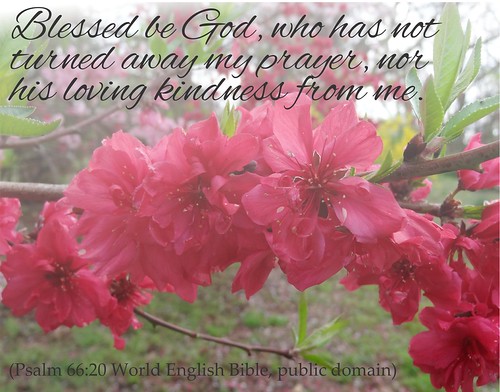
The above poster is an attempt to do justice to Psalm 66:20, which says "Blessed be God, who has not turned away my prayer, nor his loving kindness from me." (World English Bible, public domain.)
The photo is some member of the rose family, perhaps a crabapple. I'm not good at distinguishing between peaches, pears, apples, cherries, and the like.
Thanks for looking! Blessed be God.
Wednesday, March 25, 2015
Sunspots 514
Things I have recently spotted that may
be of interest to
 someone else:
Christianity (and Mathematics): He Lives has addressed the question, posed by some, about 1 Kings 7:23, which implies that the Israelites thought that the circumference of a circle was 3 times its diameter, not pi (3.14159...) times its diameter.
Computing: Gizmo's Freeware gives an annotated list of 18 free Android games that have been downloaded more than 100 million times each.
Education: Relevant reports on a study that says that US Millennials "aren't very skilled."
First Things has a short essay on why studying the humanities in college is important, and how university officials, who say that, aren't really being specific enough.
History: King Richard III of England is to be re-buried. He died in 1485. Read more at the History Blog.
Humor: "The 50 Funniest Puns in the History of Funny Puns." Sample: A plateau is the highest form of flattery. Thanks to a niece for drawing my attention to this web site.
Image source (public domain)
Christianity (and Mathematics): He Lives has addressed the question, posed by some, about 1 Kings 7:23, which implies that the Israelites thought that the circumference of a circle was 3 times its diameter, not pi (3.14159...) times its diameter.
Computing: Gizmo's Freeware gives an annotated list of 18 free Android games that have been downloaded more than 100 million times each.
Education: Relevant reports on a study that says that US Millennials "aren't very skilled."
First Things has a short essay on why studying the humanities in college is important, and how university officials, who say that, aren't really being specific enough.
History: King Richard III of England is to be re-buried. He died in 1485. Read more at the History Blog.
Humor: "The 50 Funniest Puns in the History of Funny Puns." Sample: A plateau is the highest form of flattery. Thanks to a niece for drawing my attention to this web site.
Image source (public domain)
Tuesday, March 24, 2015
A. W. Tozer on beauty
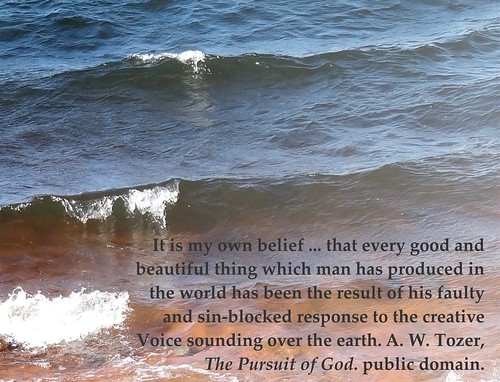
A. W. Tozer was a pastor and author. The quote above is taken from his The Pursuit of God, which is in the public domain. (The book is available free, here, in several digital formats, and also available from Amazon, for 99 cents.)
Tozer wrote, as follows:
It is my own belief ... that every good and beautiful thing which man has produced in the world has been the result of his faulty and sin-blocked response to the creative Voice sounding over the earth.
Thanks for reading, and looking. Read Tozer.
Monday, March 23, 2015
Cinderella
I don't think I saw Disney's animated version of Cinderella when it first came out. But I did see the comic book that accompanied it, and can still remember my fascination with the talking birds, mice, and Lucifer the cat, over six decades ago. I suppose that that Cinderella was re-released, and I did see it, perhaps with my wife and children, at a later date.
My wife and I saw the new version recently, starring Lily James, Cate Blanchett, Derek Jacobi, and others. We liked it a lot. The story was very similar to the one in the animated version, although Cinderella was more athletic -- she rode a horse, and did it well. Also, the birds didn't put her gown together in this version.
Cinderella's mother made the girl promise to do two things, namely be courageous, and be kind. Cinderella obeyed, even when her servitude to her stepmother and stepsisters made that very difficult.
In the end, of course, the prince fell in love with her, and she ran away, at the final stroke of midnight, as her magically provided horses, coach, footmen, and coachman morphed back into mice, a pumpkin, lizards, and a goose -- which scene is probably the most appealing to little kids. Nonetheless, eventually the prince identified her with a glass slipper, the only item of attire left from her fairy godmother's magical preparation for the ball, and which would fit no one else in the kingdom.
The sets, including the views of the harbor, the castle, the forest, and the surrounding mountains, were spectacular. The costumes were splendid. Lots of details clicked, such as the way the clock struck. There was a clear struggle between good and evil, and good prevailed. Cinderella's last statement to her stepmother, who showed no evidence of repentance, was "I forgive you."
A fine film. I recommend this article, from Speculative Faith, which combines a review with a reaction to some negative reactions on the part of others. Here's another article, by the same author as the first one, E. Stephen Burnett, also on Cinderella.
Thanks for reading. See Cinderella. There's probably not much hurry -- it's doing very well in theaters, so it will be around for a while.
My wife and I saw the new version recently, starring Lily James, Cate Blanchett, Derek Jacobi, and others. We liked it a lot. The story was very similar to the one in the animated version, although Cinderella was more athletic -- she rode a horse, and did it well. Also, the birds didn't put her gown together in this version.
Cinderella's mother made the girl promise to do two things, namely be courageous, and be kind. Cinderella obeyed, even when her servitude to her stepmother and stepsisters made that very difficult.
In the end, of course, the prince fell in love with her, and she ran away, at the final stroke of midnight, as her magically provided horses, coach, footmen, and coachman morphed back into mice, a pumpkin, lizards, and a goose -- which scene is probably the most appealing to little kids. Nonetheless, eventually the prince identified her with a glass slipper, the only item of attire left from her fairy godmother's magical preparation for the ball, and which would fit no one else in the kingdom.
The sets, including the views of the harbor, the castle, the forest, and the surrounding mountains, were spectacular. The costumes were splendid. Lots of details clicked, such as the way the clock struck. There was a clear struggle between good and evil, and good prevailed. Cinderella's last statement to her stepmother, who showed no evidence of repentance, was "I forgive you."
A fine film. I recommend this article, from Speculative Faith, which combines a review with a reaction to some negative reactions on the part of others. Here's another article, by the same author as the first one, E. Stephen Burnett, also on Cinderella.
Thanks for reading. See Cinderella. There's probably not much hurry -- it's doing very well in theaters, so it will be around for a while.
Sunday, March 22, 2015
Excerpts from Orthodoxy, by Gilbert K. Chesterton, 15
I could never mix in the common murmur of that rising
generation against monogamy, because no restriction on sex seemed so odd and unexpected as sex itself.
Keeping to one woman is a small price for so much as seeing one woman. To complain that I could only be married once was like complaining that I had only been born once. It was incommensurate with the terrible excitement of which one was talking. It showed, not an exaggerated sensibility to sex, but a curious insensibility to it. A man is a fool who complains that he cannot enter Eden by five gates at once.
Orthodoxy, first published in 1908, by G. K. Chesterton, is in the public domain, and available from Project Gutenberg. The previous post in this series is here. Thanks for reading! Read Chesterton.
Keeping to one woman is a small price for so much as seeing one woman. To complain that I could only be married once was like complaining that I had only been born once. It was incommensurate with the terrible excitement of which one was talking. It showed, not an exaggerated sensibility to sex, but a curious insensibility to it. A man is a fool who complains that he cannot enter Eden by five gates at once.
Orthodoxy, first published in 1908, by G. K. Chesterton, is in the public domain, and available from Project Gutenberg. The previous post in this series is here. Thanks for reading! Read Chesterton.
Subscribe to:
Posts (Atom)